AI Automation Services: A Strategic Guide for Enterprise Leaders
AI automation services help enterprises reduce manual work by designing, implementing, and managing AI-powered systems that automate business processes safely. For CTOs, IT Directors, and Operations leaders, the core question is no longer whether AI automation can improve efficiency, but where it can do so without weakening governance, security, data control, or operational oversight.
This guide covers how to evaluate AI automation services, select the right service model, apply governance frameworks, and move from pilot to production across mid-market and enterprise environments. It focuses on practical service selection and implementation strategy for organizations that need to streamline business processes while protecting regulated data, legacy systems, and critical business operations.
AI automation services use artificial intelligence to perform business tasks without human intervention, especially repetitive, data-heavy, and time-sensitive tasks. When implemented correctly, AI-driven automation reduces manual labor hours, lowers operational expenses, improves speed and accuracy, and frees the human workforce to focus on strategic projects rather than routine tasks.
In this guide, you will learn how to:
Evaluate consulting, implementation, managed, and hybrid AI automation service models.
Use governance frameworks to manage risk, compliance, and explainability.
Build an AI implementation roadmap that aligns technology, people, and processes.
Measure ROI through cycle time, error reduction, FTE capacity, and operational efficiency.
Compare service providers without creating vendor lock-in or ownership problems.
Enterprise adoption is accelerating. As of Q1 2026, 78% of Global 2000 companies have deployed at least one AI workload in production, and global enterprise spending on AI has reached approximately US$247 billion. The median enterprise reports a 2.4× ROI on AI investments, while top quartile firms see 5× or more. The benefits of AI are real, but they depend on selecting the right workflow automation strategy rather than adopting ai tools for novelty.
Understanding AI Automation Services
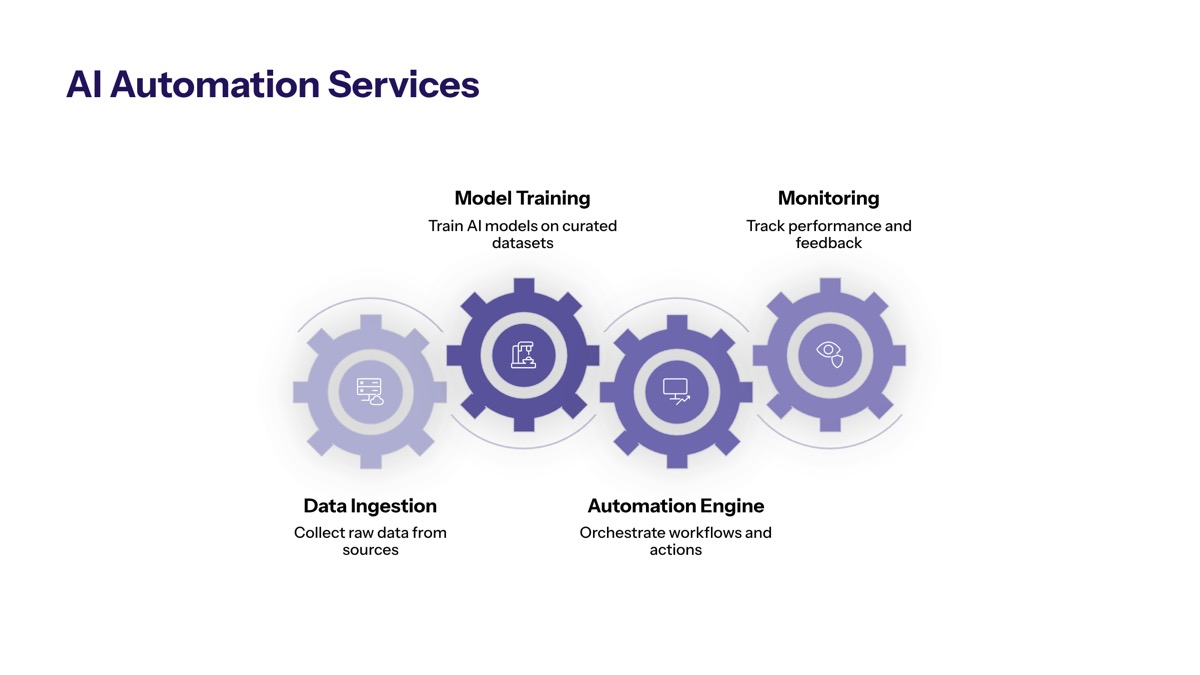
AI automation refers to the use of artificial intelligence, machine learning, natural language processing, generative ai, and automation technologies to execute or improve business processes with limited manual intervention. AI automation services are the professional services that assess, design, integrate, deploy, monitor, and optimize those ai systems across enterprise workflows.
Unlike traditional automation, which usually follows fixed rules for predefined tasks, ai powered automation can interpret unstructured data, learn from historical data, make predictions, and adapt to changing conditions. Traditional automation tools and robotic process automation can still be valuable, but intelligent automation extends process automation into complex workflows where decisions, exceptions, natural language, or data analysis are required.
For enterprises, the relevance is practical. AI-driven automation allows businesses to simplify processes and get more done by automatically executing a series of actions, freeing employees to focus on higher-value work. Organizations that adopt AI automation often see faster turnaround times, fewer errors, and more time for high-impact work, enhancing overall operational efficiency. AI automation helps organizations achieve greater speed, accuracy, and innovation by streamlining tasks and reducing manual effort, which is essential for operational efficiency.
AI workflow automation can also improve worker performance by nearly 40%, translating to significant productivity gains and cost savings for businesses. Companies can scale operations faster by using AI to handle sudden spikes in work volume without hiring new staff, which is especially valuable in customer support, document processing, sales operations, IT, finance, and supply chain management.
Service Categories and Capabilities
AI automation services usually fall into four categories: consulting services, implementation services, managed services, and hybrid solutions.
Consulting services help enterprise teams identify where ai automation work will produce measurable value. This includes assessing current workflows, reviewing data quality, identifying risk constraints, and defining success metrics before selecting ai automation tools. A thoughtful approach makes AI automation easier to implement because it focuses on solving real problems rather than adopting technology for its own sake.
Implementation services build and integrate ai powered systems into existing systems. This can include ai workflow automation tools, robotic process automation rpa, document processing, API integrations, natural language processing nlp pipelines, ai agents, predictive analytics, and business process management platforms. AI enhances workflow optimization by integrating seamlessly with existing software tools, but only when architecture, access controls, and data management are designed properly.
Managed services provide ongoing monitoring, support, retraining, optimization, and compliance management. This matters because ai models can drift, data sources can change, and automated workflows can fail if they are not observed. Enterprises often need service-level agreements for uptime, response times, incident management, model performance, audit logs, and governance reviews.
Hybrid solutions combine advisory, custom development, vendor platforms, and ongoing operations. This model is common when enterprises need the speed of commercial automation tools but also require customization, security, data residency, and integration with legacy systems. Industries utilize AI automation services to reduce operational costs, minimize human error, and scale routine tasks, but the right service category depends on compliance requirements, security posture, scalability needs, and ownership expectations.
Business-Aligned vs. Technology-First Approaches
A technology-first approach starts with a tool: an ai assistant, autonomous ai agents, generative ai, or a robotic process automation platform. This can create impressive demos, but it often produces islands of automation that do not connect to commercial KPIs or core business processes. Maintaining islands of automation presents challenges such as higher IT maintenance costs and the need for complex integrations, which can create costly inefficiencies and defeat the purpose of adopting automation technology.
A business-aligned approach starts with the workflow. It asks which manual tasks, repetitive tasks, data entry steps, customer service inquiries, approval processes, or complex tasks create measurable cost, delay, risk, or customer dissatisfaction. Then it defines objectives such as lower cost per transaction, fewer errors, faster cycle time, improved customer satisfaction, or significant cost savings before implementing ai automation.
This is where a structured methodology such as RAPID becomes useful. RAPID connects Requirements, Architecture, Pilot, Integration, and Delivery measurement, so implementing AI automation becomes both strategic and technical. Implementing AI automation successfully requires a structured AI implementation roadmap that aligns your technology, people, and processes.
The enterprises that succeed are not simply buying ai features or adding automation technologies with just a few clicks. They are aligning ai and automation with real constraints: data quality, existing software, security, regulatory obligations, employee workflows, and measurable outcomes. That foundation leads naturally into the specific service types enterprises should evaluate.
AI Automation Service Types and Applications
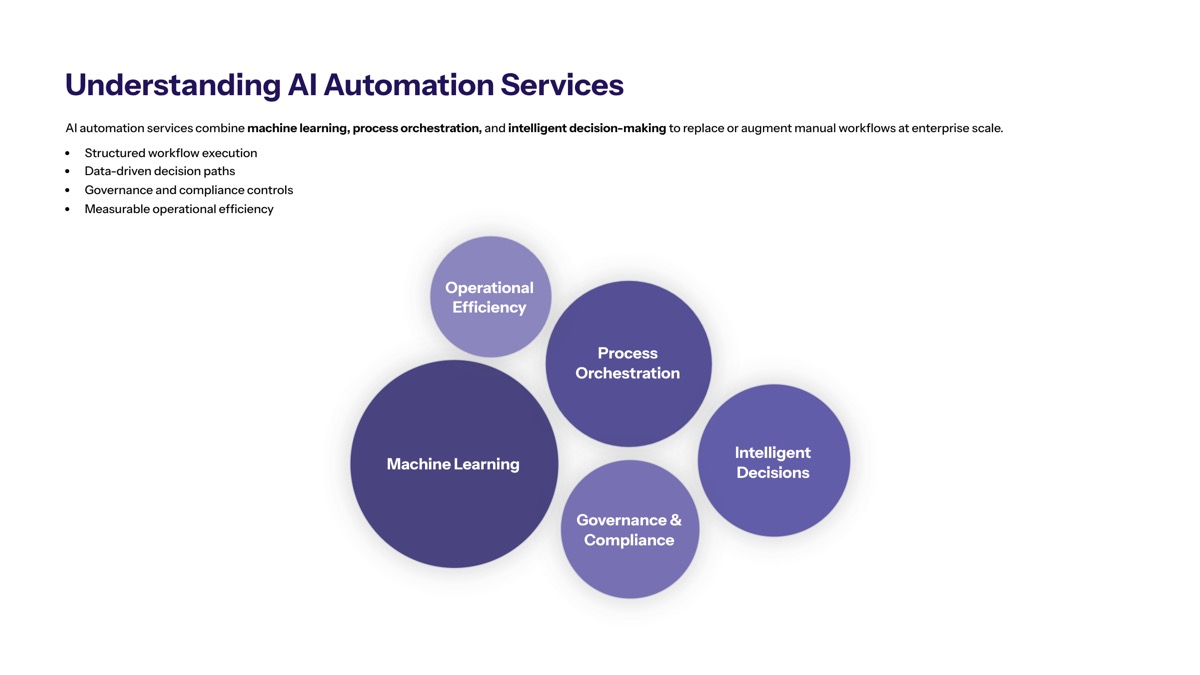
Once the business case is clear, enterprise leaders can map AI automation services to the work that should be automated. The most common service areas are document processing, workflow orchestration, customer experience automation, and internal operations across IT, finance, HR, compliance, marketing, sales operations, and supply chain management.
AI automation services transform operations by handling repetitive, data-heavy, and time-sensitive tasks across major global sectors. AI automation is transforming how work gets done across various industries by streamlining tasks, reducing manual effort, and increasing efficiency, particularly in sales, service, marketing, and IT.
Document Processing and Data Extraction Services
Document processing services use machine learning, optical character recognition, natural language processing, and ai models to classify documents, extract fields, summarize content, and route approvals. Common use cases include contract clause analysis, invoice processing, insurance claims, loan applications, KYC reviews, compliance documentation, regulatory filings, and automated data extraction.
AI technology supports automated data extraction, which is crucial for compliance and efficiency in regulated industries. Automated systems can rapidly process, verify, and approve standard applications in loan and insurance industries. In financial services, AI automation is being utilized to streamline document processing and enhance security by analyzing transaction patterns to identify anomalies in real time, thus improving customer service and compliance.
Cognitive automation involves analyzing unstructured data like emails, images, and video. This capability is important because many enterprise processes depend on unstructured data that traditional automation tools cannot handle well. AI systems that handle unstructured data need audit trails, access controls, redaction, encryption, and clear retention policies, especially under frameworks such as the General Data Protection Regulation.
In healthcare, AI automation can significantly reduce administrative overhead, allowing healthcare providers to spend more time with patients and improve the accuracy of disease detection and preventive measures. For regulated sectors, the strongest document processing services combine workflow efficiency with explainability, human review, and evidence capture.
Workflow Orchestration and Integration Services
Workflow orchestration services connect ai powered workflows across existing systems, SaaS platforms, ERP systems, CRMs, internal applications, APIs, and legacy systems. The purpose is to move beyond isolated task automation and create automated workflows that can route work, trigger approvals, update records, escalate exceptions, and synchronize data across departments.
This is where ai workflow automation becomes central to modern business operations. Orchestration platforms can combine robotic process automation, event-driven middleware, API gateways, ai agents, and monitoring tools to coordinate complex workflows. AI can extract actionable insights from massive datasets in real time, leading to better decision-making across finance, operations, customer service, and supply chain data.
Workflow automation is also valuable in asset-heavy and inventory-driven environments. AI-driven predictive maintenance utilizes IoT sensors to automatically schedule maintenance to prevent downtime. In manufacturing, AI automation can help control expenses by analyzing data from machinery to avoid costly repairs and using image recognition to detect defects in products, thereby ensuring safety and efficiency.
AI systems can track stock levels automatically and adapt to changing supply chain demands. Predictive AI can forecast inventory needs and sales trends by analyzing historical data. AI can dynamically adjust product prices based on competitor rates and demand trends. These examples show how ai solutions can move from back-office automation into revenue, logistics, pricing, and operational planning.
Customer Experience and Support Automation Services
Customer experience automation services use ai powered tools such as chatbots, virtual assistants, intelligent routing, voice automation, and ai agents to handle customer service inquiries and support workflows. AI automation allows for 24/7 availability for customer support and data processing, which helps organizations maintain service continuity during demand spikes.
AI automation enhances customer experiences by providing fast, personalized, and consistent interactions, meeting customer expectations effectively. AI automation enhances customer experiences by providing personalized service through tools like chatbots and virtual assistants, which can handle common inquiries and escalate issues to human agents when necessary.
AI-powered tools like chatbots and virtual assistants can handle common customer inquiries, guide users through complex tasks, and escalate issues to human agents when necessary, improving service quality over time. Predictive analytics in AI automation helps identify customer needs before they ask, enabling proactive support that builds trust and loyalty among customers.
Quality controls are essential. Customer-facing ai systems need tone monitoring, escalation rules, human-in-the-loop review, privacy safeguards, and ongoing analysis of customer satisfaction. In enterprise environments, ai powered workflow automation should not replace accountability; it should make service faster while preserving visibility and control.
The service categories can be summarized simply: document services handle information, orchestration services connect systems, customer automation handles interactions, and internal operations services improve routine work across departments. The next step is selecting a structured implementation strategy that prevents these services from becoming disconnected automation projects.
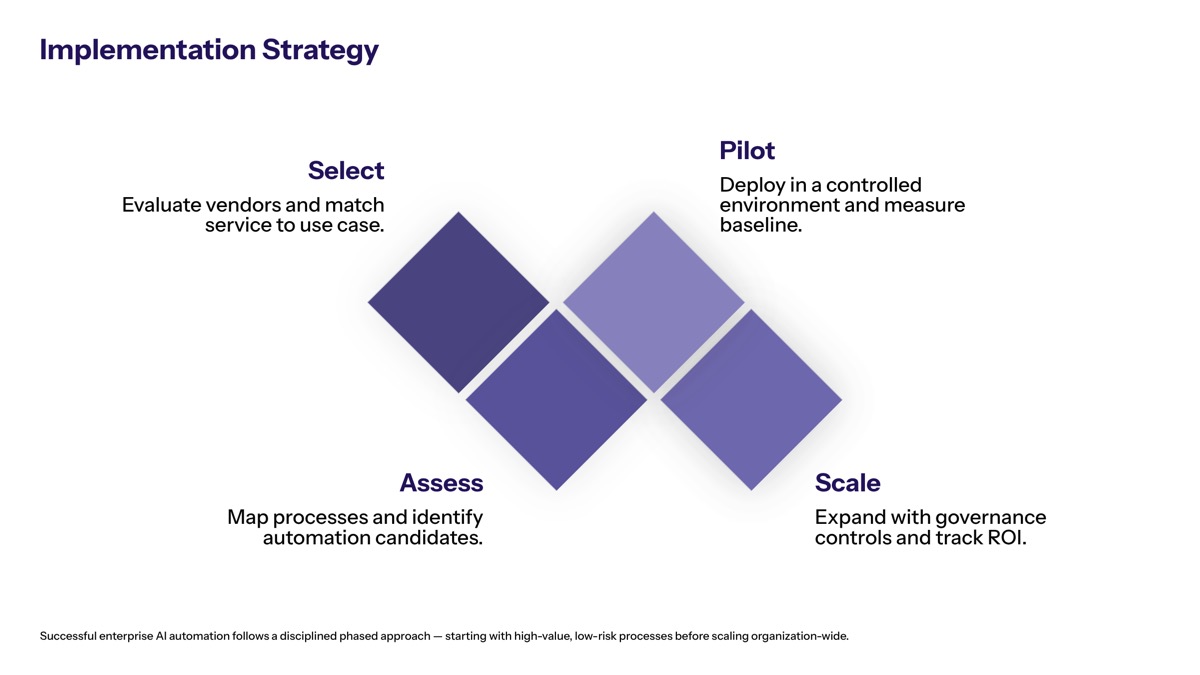
Implementation Strategy and Service Selection
Implementing AI automation is both a technical and strategic challenge, requiring organizations to adapt their processes and systems to integrate AI effectively. The work involves more than choosing automation tools. Enterprise teams must align business objectives, data readiness, security architecture, compliance obligations, workforce impact, and operating models.
Key best practices for implementing AI workflow automation include assessing current workflows, identifying areas for automation, and setting clear objectives before selecting tools. Organizations face practical challenges when getting started with AI automation, including the need for skilled resources to manage various automation tools and complex integrations to connect different technologies.
RAPID Framework for AI Automation Services
Use a structured implementation methodology when the workflow touches regulated data, multiple systems, critical operations, customer interactions, or employee roles. RAPID provides a practical roadmap for moving from business case to governed delivery.
Requirements assessment and constraint identification
Map the current workflow, including manual tasks, handoffs, data sources, exception paths, approval points, and system dependencies. Identify constraints such as data quality, security policy, General Data Protection Regulation requirements, HIPAA obligations, PCI-DSS controls, legacy systems, budget, and employee readiness. Define objectives such as cycle time reduction, error rate reduction, cost per transaction, customer satisfaction, throughput, or FTE capacity.Architecture planning for AI-first automation
Design how ai systems will connect with existing systems, data repositories, workflow engines, and monitoring platforms. Decide whether to use commercial ai automation tools, custom ai models, robotic process automation, agentic ai, or hybrid architecture. Plan for encryption, role-based access control, data residency, audit logging, model versioning, and separation between training and inference environments.Pilot implementation with governance controls
Start with a workflow that is valuable but limited enough to test safely. Build the pilot with clear access rules, human review points, fallback processes, performance thresholds, and compliance documentation. The pilot should validate whether ai powered automation improves workflow efficiency without increasing operational risk.Integration with existing systems and workflows
Move successful pilots into production by integrating APIs, UI automation, data pipelines, business process management systems, and reporting tools. This stage is where many pilots fail if the organization has not planned for complex integrations, ownership, support, and change management.Delivery measurement and optimization cycles
Monitor model accuracy, drift, exception rates, cost savings, employee adoption, customer outcomes, and compliance evidence. Continue improving prompts, models, rules, integrations, and automated processes. Retire automations that no longer produce value, and scale the ones that do.
This roadmap helps ensure AI automation improves business automation outcomes rather than creating disconnected technical experiments.
Service Provider Evaluation Matrix
Evaluation Criteria | Consulting Firms | Technology Vendors | Custom Development Partners |
|---|---|---|---|
Security & Compliance | Strong governance, policy, risk, and regulatory advisory experience; may depend on third-party platforms for technical enforcement. | Built-in security features, platform SLAs, and certifications; data residency, customization, and audit flexibility may be limited. | Highest control over architecture, data flows, access rules, audit logging, and regulated deployment models; requires careful vendor due diligence. |
Industry Experience | Useful for operating model design and best practices across sectors; depth varies by delivery team. | Some vendors specialize in healthcare, finance, logistics, customer support, or IT automation; templates may be rigid. | Strong fit for domain-specific workflows, complex tasks, legacy systems, and industry-specific compliance needs. |
Implementation Track Record | Good for strategy, roadmaps, and program governance; execution quality depends on implementation capability. | Faster deployment for standardized workflows; flexibility may decrease as processes become more complex. | Strong for tailored ai solutions and complex integrations; timelines and cost can be higher. |
Support Model | Often supports assessment, roadmap, training, and change management; long-term operations may transition internally. | Vendor support, platform upgrades, and managed infrastructure; enterprises must review lock-in and pricing exposure. | Can provide managed services, custom optimization, and responsive support; requires clear ownership and service-level agreements. |
For speed, technology vendors can be attractive. For high-control environments, custom development partners or hybrid models are often better. Consulting firms can help define the roadmap and governance model, but enterprise leaders should confirm who is accountable for production reliability, compliance evidence, and long-term optimization.
The right partner should help the enterprise enhance business processes, not simply deploy ai tools. That means proving implementation track record, integration capability, security maturity, and ownership terms before signing.
Common Challenges and Solutions
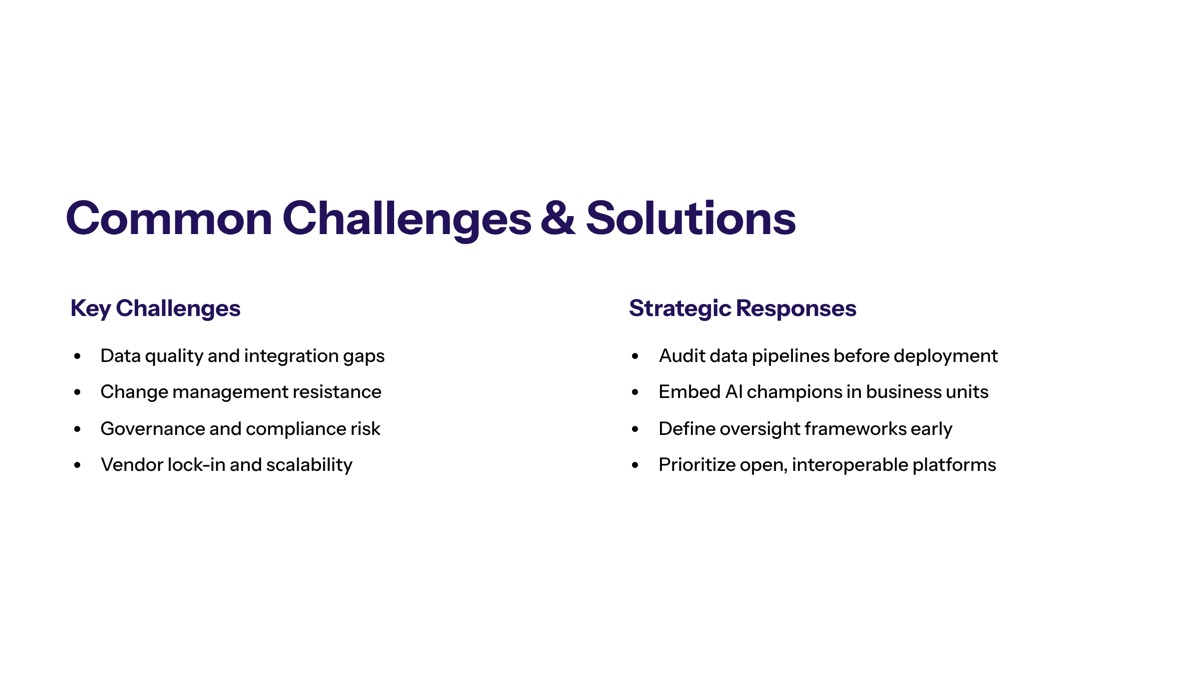
Enterprise AI automation service adoption fails most often when teams underestimate governance, data security, integration complexity, or workforce impact. Change management and employee concerns are significant challenges in AI automation implementation, as employees may worry about job security and changes to their workflows, leading to resistance against adopting AI.
The solution is to treat AI automation as an operating model change, not only a technology deployment.
Governance and Compliance Concerns
Governance issues appear when no one clearly owns the ai workflow, model behavior, escalation path, or compliance record. Enterprises should define ownership for the data, model, workflow, business outcome, and risk review before production deployment.
A practical governance model should include audit trails, role-based access controls, model versioning, dataset tracking, approval workflows, exception logs, and regulatory alignment. For regulated industries, governance should also include explainability standards, human review thresholds, retention rules, and evidence capture for internal audit teams.
Continuous governance is essential for autonomous ai agents and agentic ai because these systems may act across multiple applications. Frameworks such as AI Trust OS are emerging to support observability, auditability, and continuous control across autonomous AI systems.
Data Security and Privacy Protection
Data security risks include unclear data residency, weak encryption, uncontrolled access, model leakage, and insufficient transparency about how data is processed. These risks increase when ai powered systems interact with sensitive customer, employee, financial, or health information.
Enterprises should require encryption in transit and at rest, zero-trust access controls, tokenization or redaction of sensitive data, data residency options, private or hybrid deployment where needed, and transparent logging. Vendors should document what data is used for training, inference, monitoring, and support.
Data management must also address quality. Poor data quality can cause inaccurate recommendations, broken workflows, compliance exceptions, and low user trust. Before implementing ai automation, teams should profile data sources, define data owners, and establish quality thresholds for production use.
Vendor Lock-in and Ownership Issues
Vendor lock-in occurs when workflows, data, prompts, models, or integrations become dependent on proprietary APIs, closed formats, or usage pricing that the enterprise cannot control. This is especially risky when AI becomes embedded in critical business operations.
Enterprise contracts should define data portability, model ownership, code ownership, export rights, service continuity, termination support, and access to logs. Architectures should use interoperable components, abstraction layers, open standards where possible, and modular integration patterns.
Avoiding lock-in does not mean avoiding vendors. It means designing system independence from the beginning. Enterprises should know whether they can move their workflows, retrain models, export data, switch ai models, or replace a provider without rebuilding the entire automation environment.
Conclusion and Next Steps
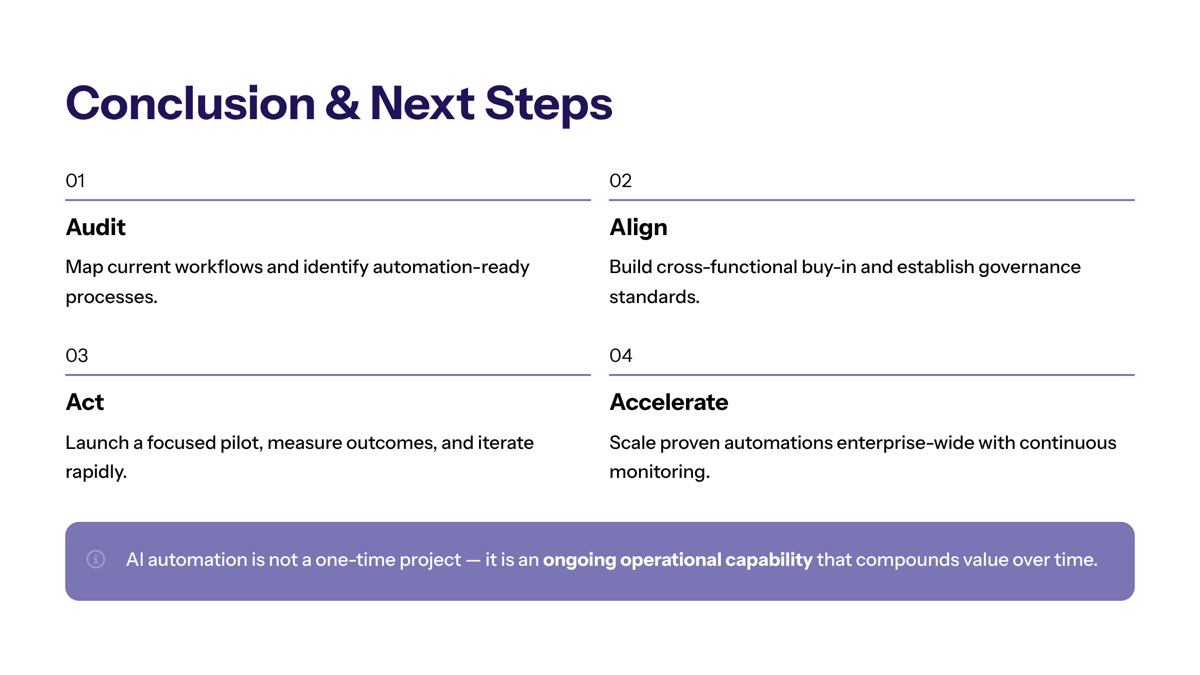
AI automation services can safely reduce manual work when they are tied to measurable business outcomes, governed by clear controls, and integrated into existing systems with ownership and security in mind. The strongest programs use AI to streamline business processes, improve operational efficiency, reduce errors, and support the human workforce rather than creating disconnected islands of automation.
To move forward:
Assess current workflows. Identify repetitive tasks, manual approvals, data entry, complex workflows, customer service inquiries, and operational bottlenecks where automation could produce measurable value.
Define success metrics. Set targets for turnaround time, error reduction, cost savings, throughput, customer satisfaction, compliance evidence, and employee capacity.
Apply a structured roadmap. Use RAPID or a similar framework to align requirements, architecture, pilot design, integration, and delivery measurement.
Evaluate service providers. Compare consulting firms, technology vendors, and custom development partners across security, compliance, industry experience, support model, and ownership terms.
Pilot with governance. Start small, validate outcomes, monitor risks, and scale only when automated workflows are reliable, explainable, and secure.
Related areas worth exploring include custom software development for AI-first operations, legacy system modernization, secure ai architecture consultation, and managed AI automation services for ongoing optimization.
Additional Resources
Cognativ RAPID framework assessment tools: Use these to structure requirements, architecture, pilot planning, integration readiness, and delivery measurement for AI automation services.
Industry-specific implementation guides: Healthcare, finance, logistics, manufacturing, customer service, sales operations, and IT teams should use sector-specific controls for data privacy, compliance, and workflow risk.
Vendor evaluation templates: Include security requirements, data residency, encryption, role-based access control, audit logging, data portability, model ownership, support SLAs, and exit terms.
Security requirements checklists: Review General Data Protection Regulation obligations, regulated data handling, access controls, model monitoring, and incident response procedures before implementing ai automation.
Pilot metrics dashboard: Track cycle time, error rate, cost per transaction, exception volume, customer satisfaction, employee adoption, model accuracy, and realized savings over time.