RAPID Transformation Turns Strategy Into Measurable Execution
Cognativ helps leaders move from ambiguity to accountable execution using RAPID, the outcomes-based transformation system created by Cognativ CEO Ali Davachi and introduced in the Forbes best-selling book RAPID Transformation.
Tell Us About Your Next Initiative
Need to build software, modernize a platform, or put AI to work? Share your business goals and the challenge your team needs to solve.
Include your priorities, current systems, and expected timeline so we can discuss the right next step.
A Transformation System Created for Real Execution Pressure
RAPID stands for Research, Analyze, Plan, Implement, and Decide. It is Cognativ's human-centered transformation methodology for leaders who need to reduce uncertainty, align teams, and create measurable progress without waiting months for perfect conditions.
Created by Cognativ CEO Ali Davachi, RAPID was built from delivery reality: complex stakeholders, unclear ownership, legacy constraints, competing priorities, and teams that need evidence-backed decisions while the business keeps moving.
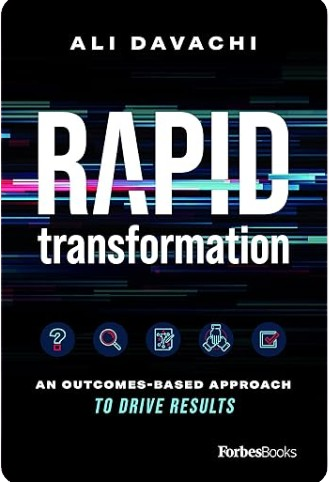
The framework is introduced in Davachi's Forbes Books title RAPID Transformation: An Outcomes-Based Approach to Drive Results, and Cognativ applies it as a working operating model across strategy, software, modernization, AI, and organizational transformation.
Forbes Books Foundation
RAPID Transformation by Ali Davachi is a Forbes best-selling book that explains the outcomes-based approach behind Cognativ's transformation system.
Where RAPID Solves Transformation Drag
Transformation work usually stalls for practical reasons: vague outcomes, slow decisions, overloaded teams, unclear ownership, weak data, or a roadmap that does not survive contact with delivery. RAPID is designed to expose those constraints early and turn them into accountable action.
Unclear Outcomes
RAPID forces the team to define the customer value, business outcome, and success signal before initiatives absorb budget and attention.
Misaligned Teams
RAPID brings leadership, operations, product, technology, and delivery owners into one decision model so work does not fragment across functions.
Slow Decisions
RAPID tracks who owns each decision, what evidence is needed, and which blockers are stopping progress from turning into shipped outcomes.
Roadmap Drift
RAPID keeps the roadmap tied to risk, effort, resistance, dependency, and measurable value so plans can adapt without losing strategic control.
When RAPID Is the Right Transformation Model
RAPID fits initiatives where strategy, technology, operations, and people have to move together. It is useful when the business needs more than project management, but does not need another static strategy deck.
Business Transformation
Use RAPID when the operating model, accountability structure, resource allocation, or decision rights need to change before growth can scale.
Digital Transformation
Use RAPID when software, data, cloud, automation, or AI investments need to connect to business outcomes and a measurable ROI model.
Change Management
Use RAPID when process improvement, stakeholder alignment, training, adoption, and communication planning are as important as the technology itself.
Execution Governance
Use RAPID when leadership needs project governance, decision cadence, risk tracking, and implementation visibility across multiple teams.
The Five Phases of RAPID Transformation
RAPID is not a linear workshop. It is a repeatable operating cycle that helps teams uncover truth, analyze tradeoffs, plan around risk, implement with visibility, and decide before momentum stalls.
Research
Uncover truth before teams commit to the wrong plan.
Research defines the real problem, not the loudest symptom. Cognativ reviews customer value, operational friction, stakeholder assumptions, cultural signals, data reality, and the constraints that shape execution.
- Customer value and business outcome inventory
- Stakeholder interviews and operating-context review
- Current-state process, data, and decision mapping
A practical view of what matters, what is blocked, and which evidence should shape the next decision.
Analyze
Weigh value, risk, resistance, and feasibility.
Analysis separates high-value work from attractive distractions. Cognativ ranks opportunities against business outcomes, delivery risk, data readiness, dependency load, organizational resistance, and expected return.
- Risk vs. reward scoring
- Resistance, redundancy, and capability gap mapping
- Value, dependency, and feasibility analysis
A ranked decision set that shows what to pursue, what to defer, and what risk must be managed first.
Plan
Build a roadmap that can survive execution.
Planning turns analysis into a sequenced roadmap with owners, milestones, constraints, change-management needs, and early proof points. The goal is movement with control, not a static deck.
- Outcome-aligned roadmap design
- Milestone and dependency planning
- Early-win sequencing and mitigation strategy
A decision-ready execution plan that tells teams what moves now, what waits, and why.
Implementation
Turn the plan into measurable movement.
Implementation connects strategy, engineering, operations, and leadership through delivery cadence. Cognativ helps teams keep execution visible, manage blockers, instrument outcomes, and adjust without losing accountability.
- Delivery governance and weekly risk review
- Embedded coaching and stakeholder alignment
- Outcome dashboards and release visibility
A managed execution rhythm with visible progress, owners, risks, and measurable next moves.
Decide
Keep momentum by forcing decision clarity.
Decide keeps the system from drifting. Each cycle identifies what must be approved, changed, stopped, escalated, or repeated so transformation stays tied to evidence and value.
- Decision inventory and owner mapping
- Go, no-go, change, and escalation frameworks
- Continuous improvement loop for the next cycle
A documented decision path that keeps accountability visible and prevents stalled work from hiding.
What RAPID Transformation Should Produce
A RAPID engagement is designed to leave leaders with sharper decisions, clearer ownership, and a practical path into implementation. The output is not just insight. It is a governed way to keep transformation moving.
Current-State Truth
Evidence on the workflows, systems, data, customer value, cultural signals, and decision gaps that shape transformation success.
Prioritized Initiatives
A ranked set of initiatives based on value, dependency, risk, resistance, effort, and ability to prove progress quickly.
Execution Roadmap
A sequenced roadmap that ties each workstream to outcomes, owners, milestones, risks, and the next decision required.
Decision Ownership
A decision inventory that identifies who owns each decision, what information is needed, and how blockers should escalate.
Outcome Metrics
A measurement model that tracks adoption, operational improvement, delivery movement, customer impact, and business value.
Continuous Improvement
A repeatable loop that lets teams revisit assumptions, adjust priorities, and keep transformation tied to evidence instead of static plans.
How Cognativ Delivers RAPID
Cognativ can use RAPID as a focused strategy engagement, a delivery governance layer, or a full transformation model that spans product, operations, software, data, and AI work.
The model adapts to the size of the problem, but the operating discipline stays consistent: research the reality, analyze the tradeoffs, plan around risk, implement with visibility, and decide fast enough to keep value moving.
The First 30 Days
The first month usually focuses on clarity: current-state discovery, stakeholder alignment, decision inventory, value ranking, roadmap pressure-testing, and the first set of moves that can prove progress.
That early structure helps leaders avoid overcommitting to the wrong work while giving teams enough direction to act.
Read the RAPID Foundation
RAPID Transformation by Ali Davachi
The RAPID methodology is backed by Ali Davachi's Forbes best-selling book, RAPID Transformation: An Outcomes-Based Approach to Drive Results.
The book explains why transformation fails when teams chase tools before outcomes, and why leaders need a decision system that connects strategy, data, people, technology, and measurable progress.
Use the book as a starting point, then use Cognativ's RAPID service to apply the model inside your real operating context.
Frequently Asked Questions About RAPID Transformation
Answers to common questions about RAPID, Ali Davachi's framework, the Forbes Books foundation, and how Cognativ applies RAPID to transformation work.
RAPID Transformation is Cognativ’s outcomes-based transformation system created by Ali Davachi. It connects Research, Analyze, Plan, Implement, and Decide into a repeatable operating model for turning ambiguity into measurable execution.
Traditional consulting often stops at recommendations. RAPID connects discovery, prioritization, roadmap design, delivery support, and decision governance so the strategy keeps moving into execution.
RAPID was created by Ali Davachi, Cognativ’s CEO and author of the Forbes Books title RAPID Transformation: An Outcomes-Based Approach to Drive Results.
Use RAPID when priorities are unclear, teams are stalled, transformation work is fragmented, delivery decisions are slow, or leaders need a practical way to connect strategy, technology, operations, and measurable outcomes.
No. Cognativ applies RAPID across software delivery, digital transformation, operating models, modernization work, and complex business initiatives where alignment and execution speed matter.
A RAPID engagement can produce research findings, value and risk analysis, a sequenced roadmap, delivery plans, decision inventories, governance cadence, implementation support, and a clearer path from strategy to measurable outcomes.
Use RAPID to Move From Strategy to Execution
Bring Cognativ into the work when the roadmap needs sharper decisions, stronger ownership, and measurable movement.