Why Cognativ: AI, Software, and Enterprise Outcomes
A strategic technology partner for AI, software development, ecommerce modernization, and enterprise transformation where execution, ownership, and measurable outcomes matter. Strategy, AI, software, governance, and delivery discipline connected inside one execution model.
Tell Us About Your Next Initiative
Need to build software, modernize a platform, or put AI to work? Share your business goals and the challenge your team needs to solve.
Include your priorities, current systems, and expected timeline so we can discuss the right next step.
Why Cognativ for AI, Software Development, and Enterprise Transformation
Why Cognativ: because enterprise teams need more than software development capacity; they need a strategic technology partner that can connect business strategy, technology strategy, AI systems, governance, delivery discipline, and measurable business outcomes. Cognativ helps US organizations modernize critical software, build private AI systems, improve operations, and move digital transformation from planning into controlled execution.
This article explains how Cognativ differs from traditional development vendors, staff augmentation firms, and generic AI consulting partners. It is written for leaders in healthcare, finance, ecommerce, logistics, education, telecom, media, and other complex environments where legacy systems, fragmented tools, ai cyber threats, compliance demands, unclear ownership, and operational friction slow growth.
The short answer: Cognativ is a consulting-first technology company that uses RAPID execution, SmartSaaS™ principles, custom software development, private AI, workflow optimization, data analytics, and enterprise-grade engineering to help organizations create durable systems and drive growth.
You will understand:
-
How Cognativ RAPID connects strategy, execution, and business value.
-
Why private AI systems matter for enterprise data, security, and governance.
-
How SmartSaaS™ reduces vendor lock in and improves long-term control.
-
Why Cognativ is an ecommerce modernization partner beyond storefront design.
-
How Cognativ proves value through case studies, performance gains, and measurable outcomes.
Understanding Complex Enterprise Decisions
Enterprise technology decisions are complex because the problem is rarely one tool, one project, or one team. Legacy systems often hinder growth and increase operational risk, making modernization essential for organizations aiming to remain competitive. Disconnected CRM, ERP, inventory, finance, data, and reporting systems can block real time visibility, reduce speed, and make leadership decisions harder than they should be.
Cognativ’s role is not to act as another vendor delivering isolated software tickets. Cognativ works as a strategic partner for organizations dealing with scaling limits, operational friction, AI adoption challenges, ecommerce complexity, compliance requirements, and execution risk. That distinction matters because transformation failures often happen when technology outpaces alignment, ownership, governance, and stakeholder readiness.
Effective legacy system modernization involves a structured approach that includes assessing current systems, identifying gaps, and planning for future needs. Modernizing legacy systems can significantly improve operational performance by reducing inefficiencies and enhancing data visibility. Cognativ brings that diligence into the process through consulting, engineering, data experts, AI expertise, security awareness, and controlled delivery.
Beyond Development Capacity
A consulting-first approach means Cognativ starts with the business problem before prescribing software, platforms, AI, automation, or integrations. This differs from staff augmentation, where a company may receive development resources without the strategy, architecture, governance, or clear ownership required to produce business outcomes.
Custom software development allows organizations to create tailored solutions that meet specific business needs and challenges, enhancing operational efficiency and effectiveness. The process of custom software development involves understanding the unique requirements of a business, designing a solution that fits those needs, and implementing it in a way that integrates seamlessly with existing systems.
That matters for enterprise-grade solutions because generic software may not fully address operational complexities or industry-specific requirements. Custom software solutions can help businesses reduce reliance on generic software, which may not fully address their operational complexities or industry-specific requirements.
Cognativ’s experience across Fortune 50/500 environments, regulated industries, ecommerce operations, and mission-critical platforms gives clients access to a team that understands both delivery and enterprise risk.
Explore Software Development ServicesBusiness-Aligned Technology Strategy
Cognativ connects business goals to technology execution by tying every project to outcomes such as revenue growth, lower operating cost, improved performance, better customer engagement, faster reporting, stronger business intelligence, and reduced risk. Technology strategy is treated as an extension of business strategy, not a separate technical exercise.
This is important because effective workflow optimization can lead to significant improvements in operational efficiency, allowing organizations to reduce costs and enhance productivity. Identifying and addressing root causes of inefficiencies in workflows is essential for organizations aiming to streamline operations and improve overall performance.
Implementing value-based planning helps organizations sequence work around business value, practical dependencies, and stakeholder readiness, which is crucial for successful workflow optimization. Cognativ uses this logic to create a plan that leaders, engineering teams, operations teams, and stakeholders can actually implement. That bridge from strategy to execution is where RAPID becomes central.
Explore Business Strategy ServicesRAPID Turns Strategy Into Execution
Many enterprise transformation efforts stall because teams have goals but no operating model for decision-making. Leaders may agree that modernization, AI, analytics, automation, ecommerce performance, or security matters, yet still struggle to prioritize work, resolve constraints, assign ownership, and maintain momentum.
Cognativ’s RAPID framework is designed to keep strategy, execution, and business value connected, addressing the common issue of transformation failures when technology outpaces alignment. RAPID gives organizations a practical process for moving from uncertainty to execution while preserving speed, governance, and accountability.
Explore Why RAPIDThe RAPID Framework
RAPID stands for Research, Analyze, Plan, Implement, and Decide, providing a structured approach for organizations to move from uncertainty to execution. It is not just a project management label. It is a decision and delivery model for complex business, data, software, AI, and operations challenges.
The RAPID framework helps teams understand real problems, analyze risks and opportunities, plan appropriate solutions, implement with discipline, and make informed decisions to maintain momentum. In practice:
-
Research maps workflows, systems, data, stakeholders, ownership, constraints, and business context.
-
Analyze identifies bottlenecks, risks, gaps, opportunities, dependencies, and value drivers.
-
Plan sequences solutions around business value, feasibility, readiness, and measurable KPIs.
-
Implement moves work forward through disciplined delivery, engineering, automation, and governance.
-
Decide uses evidence, feedback, reporting, and leadership alignment to keep progress moving.
The framework emphasizes constraint focus and weekly decision velocity. Instead of waiting months for perfect certainty, teams identify what is blocking progress, create a practical plan, implement with speed, and adjust based on data.
Execution Discipline
RAPID creates clear ownership by defining who is responsible for decisions, delivery, tradeoffs, governance, and outcomes. That clarity is especially important when software, AI, business intelligence, analytics, security, finance, operations, customers, and leadership teams all depend on the same systems.
Enterprise credibility comes from controlled delivery. Cognativ aligns engineering work with strategy, performance requirements, security standards, stakeholder readiness, and measurable value. Secure and compliant platforms are essential for regulated industries to meet compliance and security standards, so delivery discipline must include architecture, data control, auditability, access management, testing, and risk management.
This is also where Cognativ’s approach differs from technology vendors that focus only on output. Code delivery matters, but success depends on whether the project improves the business process, creates useful insights, reduces operational risk, and gives the organization more control over its future.
Evidence-Based Decision Making
Cognativ uses RAPID as a structured operating model for moving from strategy to execution. Evidence-based decision making means leaders do not rely only on opinions, generic benchmarks, or isolated technical preferences. They use data, analytics, business intelligence, customer behavior, system performance, operational reporting, and stakeholder feedback.
Digital transformation assists companies in modernizing their operations, including customer relationship management (CRM) and enterprise resource planning (ERP) systems. But modernization only creates value when decisions are grounded in real constraints and business outcomes. RAPID helps Cognativ clients decide what to build, buy, integrate, automate, replace, or defer.
That discipline becomes even more important when organizations introduce AI into real business systems.
AI That Works Inside Real Business Systems
Enterprise AI fails when it is treated as a novelty instead of an operating capability. Generative AI demos may look impressive, but enterprise teams need ai systems that respect data governance, security, compliance, workflow integration, business rules, and measurable operational value.
Cognativ focuses on developing secure AI systems that ensure sensitive enterprise data remains compliant with regulations. That focus is increasingly important as US lawmakers, the White House, regulators, clients, and boards place more scrutiny on AI behavior, data usage, security, and explainability.
Private AI Systems
Private AI systems are designed so an organization can maintain control over data, access, model behavior, governance, and intellectual property. This differs from generic AI experimentation, where teams may test public tools without a full plan for privacy, compliance, data leakage, reporting, or long-term integration.
Cognitive AI is a branch of artificial intelligence designed to mimic human thinking, reasoning, and context-awareness. Cognition systems rely on a specific triad of technology layers to execute human-like tasks: Natural Language Understanding (NLU), Deep Learning & Neural Networks, and Agentic Workflows.
Natural Language Understanding enables systems to comprehend nuances in language, rather than just matching keywords. Deep Learning & Neural Networks consist of multi-layered algorithms that process real-world data feeds simultaneously to find hidden connections. Agentic Workflows allow users to request high-level outcomes while the AI agent determines the necessary steps independently.
Workflow-Specific Automation
AI-driven automation can significantly enhance business processes by reducing repetitive tasks, allowing employees to focus on higher-value activities. AI-driven automation helps organizations streamline workflows and improve productivity by automating routine tasks and providing insights that inform strategic decisions.
Integrating AI into business operations can lead to improved decision-making and operational efficiency, as AI systems can analyze data faster and more accurately than humans. The value is not AI for its own sake; the value is better operations, faster decisions, reduced manual work, improved customer engagement, stronger forecasting, and more useful insights.
Examples vary by industry. In e-commerce and advertising, AI analyzes live browsing contexts to predict buying probabilities. Healthcare AI applications sift through complex patient records to flag high-risk diagnoses. In finance, AI is deployed for real-time risk assessment and market forecasting.
AI-First Architecture
AI-first architecture means systems are designed so AI can operate within the business context from the beginning. This includes data pipelines, security controls, model governance, retrieval layers, analytics, application logic, reporting, and workflow integration.
AI infrastructure involves designing and deploying GPU-dense computing clusters and energy-efficient systems for running massive enterprise AI models. For many organizations, this requires coordination across data science, engineering, security, operations, finance, and leadership teams.
Cognativ’s AI work connects machine learning, data driven solutions, business intelligence, automation, and custom software into platforms that can be governed and scaled. The next issue is ownership: if the business cannot control the software, data, integrations, and exit paths, even strong AI can become another dependency.
Software Built for Ownership and Control
Cognativ’s software philosophy is tied to ownership, control, adaptability, security, and long-term value. Enterprise teams need systems that can evolve with the business, support innovation, reduce operational drag, and avoid unnecessary vendor dependency.
SmartSaaS™ principles help frame this approach. They address a common market problem: organizations buy tools to move faster, then discover hidden costs, fragile integrations, limited portability, weak transparency, and vendor lock in.
SmartSaaS Certification
SmartSaaS™ is Cognativ’s standard for software that supports transparency, data control, portability, scalability, security, and business-side leverage. The goal is to help clients understand not only what software does, but how much control the organization has over pricing, data, integrations, workflows, upgrades, and exit paths.
This reduces dependency on any one vendor or closed platform. It also supports better governance because leaders can see how technology choices affect risk, cost, flexibility, and future growth.
For Cognativ clients, SmartSaaS™ means software should be understandable, adaptable, secure, and aligned with business value. It should not trap the company inside a system that cannot support the next phase of growth.
Explore SmartSaaS PrinciplesLong-Term Software Value
Building for ownership means treating software as a business asset, not just a subscription or short-term project. Cognativ focuses on custom software, integrations, modernization, and platforms that improve operations while preserving flexibility.
Upgrade stability matters. Enterprise systems often fail when changes to one tool break downstream processes, reporting, analytics, ecommerce workflows, finance operations, or customer-facing services. Cognativ’s engineering discipline emphasizes architecture, testing, maintainability, performance, and governance so systems can evolve without constant disruption.
This approach supports leadership teams that need to stay ahead without rebuilding from scratch every time the market changes. It also reflects decades of enterprise technology lessons: the cheapest short-term tool can become expensive when it limits control, scalability, or business outcomes.
Explore Custom Enterprise SoftwareTechnology Stack Control
Technology stack control is not about building everything internally. It is about making deliberate decisions about what to buy, build, integrate, own, automate, and retire. Cognativ helps organizations evaluate those choices based on business strategy, risk, data needs, security, performance, and operational complexity.
A strong stack may include custom software, SaaS platforms, private AI systems, analytics tools, ecommerce engines, APIs, data infrastructure, and workflow automation. The key is that the company understands the architecture and can make changes without losing momentum.
This is especially important in ecommerce, where storefront performance, merchandising workflows, inventory, fulfillment, search, customer experience, pricing, and promotions all need to work together.
Explore Technology Stack StrategyEcommerce Modernization With Operational Depth
Ecommerce modernization is not only about redesigning a storefront. For enterprise and mid-market commerce teams, the real challenge is often the operating system behind the store: catalog data, inventory visibility, supplier feeds, pricing logic, promotions, checkout performance, fulfillment, customer service, analytics, and brand expansion.
Cognativ approaches ecommerce as a full business system. That makes the company a strong ecommerce modernization partner for organizations that need measurable improvements in conversion, speed, scalability, and operational control.
TotalCommerce Stack Approach
The TotalCommerce Stack approach focuses on infrastructure, performance, integrations, merchandising workflows, conversion architecture, and scalable operations. It is designed for companies that need more than frontend changes and want a platform that can support growth across products, brands, channels, and customers.
Cognativ’s ecommerce modernization work has included unified systems for inventory, orders, promotions, content, and business team workflows. In one commerce transformation, reported outcomes included 300x conversion growth and 150% AOV improvement, with a TotalCommerce stack implementation designed to improve performance without relying only on additional ad spend.
The practical value is that non-technical teams can move faster. Merchandising, marketing, operations, and leadership can gain better control over launches, promotions, reporting, and customer experience instead of waiting on developers for every operational change.
Operational Integration
Operational integration brings inventory, fulfillment, customer experience, analytics, supplier feeds, order management, and business intelligence into a more unified system. This matters because ecommerce growth often creates complexity faster than teams can manage it manually.
Cognativ’s work with multi-brand commerce environments has supported faster brand launches, improved inventory accuracy, scalable merchandising workflows, and stronger platform control. The goal is not just more traffic; it is a better operating model that can convert demand into revenue with fewer failures and less overhead.
For clients, the measurable improvements can include revenue growth, better customer satisfaction, stronger NPS, reduced order failures, faster catalog updates, and improved operational performance.
Why Cognativ vs Traditional Vendors
Traditional vendors often solve the narrow problem they are hired to solve: write code, implement a platform, provide developers, or deliver a generic AI strategy. Cognativ is positioned differently. The company connects consulting, engineering, AI, data, governance, software development, ecommerce modernization, and RAPID execution into one controlled transformation model.
That difference matters when enterprise teams are choosing partners for systems that affect customers, operations, compliance, security, revenue, and long-term growth.
Comparison Framework
| Criterion | Cognativ | Traditional vendors |
|---|---|---|
| Approach | Strategic technology partner connecting business strategy, technology strategy, engineering, and measurable outcomes. | Transactional delivery focused on tickets, resources, or isolated implementation. |
| AI capabilities | Private AI systems, data control, governance, workflow automation, machine learning, data science, and secure enterprise integration. | Generic generative AI pilots, disconnected tools, or experiments without full governance. |
| Execution model | Cognativ RAPID: Research, Analyze, Plan, Implement, Decide, with constraint focus and weekly decision velocity. | Standard project management that may track activity without resolving ownership or bottlenecks. |
| Ownership | SmartSaaS™ principles: transparency, portability, security, scalability, data control, and reduced vendor lock in. | Closed systems, unclear exit paths, hidden dependencies, and limited business control. |
| Outcomes | Business outcomes such as growth, performance, operational efficiency, uptime, conversion, and reduced risk. | Code delivery, staffing volume, or platform installation without full value accountability. |
The synthesis is simple: Cognativ is built for organizations that need technology to perform as a business capability. If the goal is only short-term capacity, a generic vendor may be enough. If the goal is secure modernization, private AI, scalable ecommerce, workflow optimization, and durable software value, Cognativ offers a more complete model.
Enterprise Credibility
Cognativ’s credibility comes from experience with complex enterprise environments, Fortune 50/500 expectations, regulated industry requirements, and systems where failure has real business impact. That includes healthcare, finance, ecommerce, logistics, education, telecom, media, and other markets where security, governance, uptime, performance, and data control matter.
Security and compliance are not add-ons. They influence architecture, access control, data handling, AI governance, reporting, auditability, testing, and operational readiness. This is essential when clients face ai cyber threats, regulatory pressure, customer trust concerns, and leadership accountability.
Under leadership perspectives associated with Ali Davachi and the Cognativ team, the mission is to help organizations build smarter systems that create value, improve operations, and prepare for the future. The proof is visible in outcomes.
Proof Through Case Studies and Outcomes
Cognativ’s positioning is strongest when tied to measurable results. Enterprise buyers want evidence that a partner can improve performance, stabilize platforms, modernize operations, and deliver business outcomes rather than only produce software.
The case patterns show how RAPID execution, custom software development, private AI thinking, SmartSaaS™ principles, and data driven solutions can translate into better systems and stronger business performance.
Virtual CTO Platform Stabilization
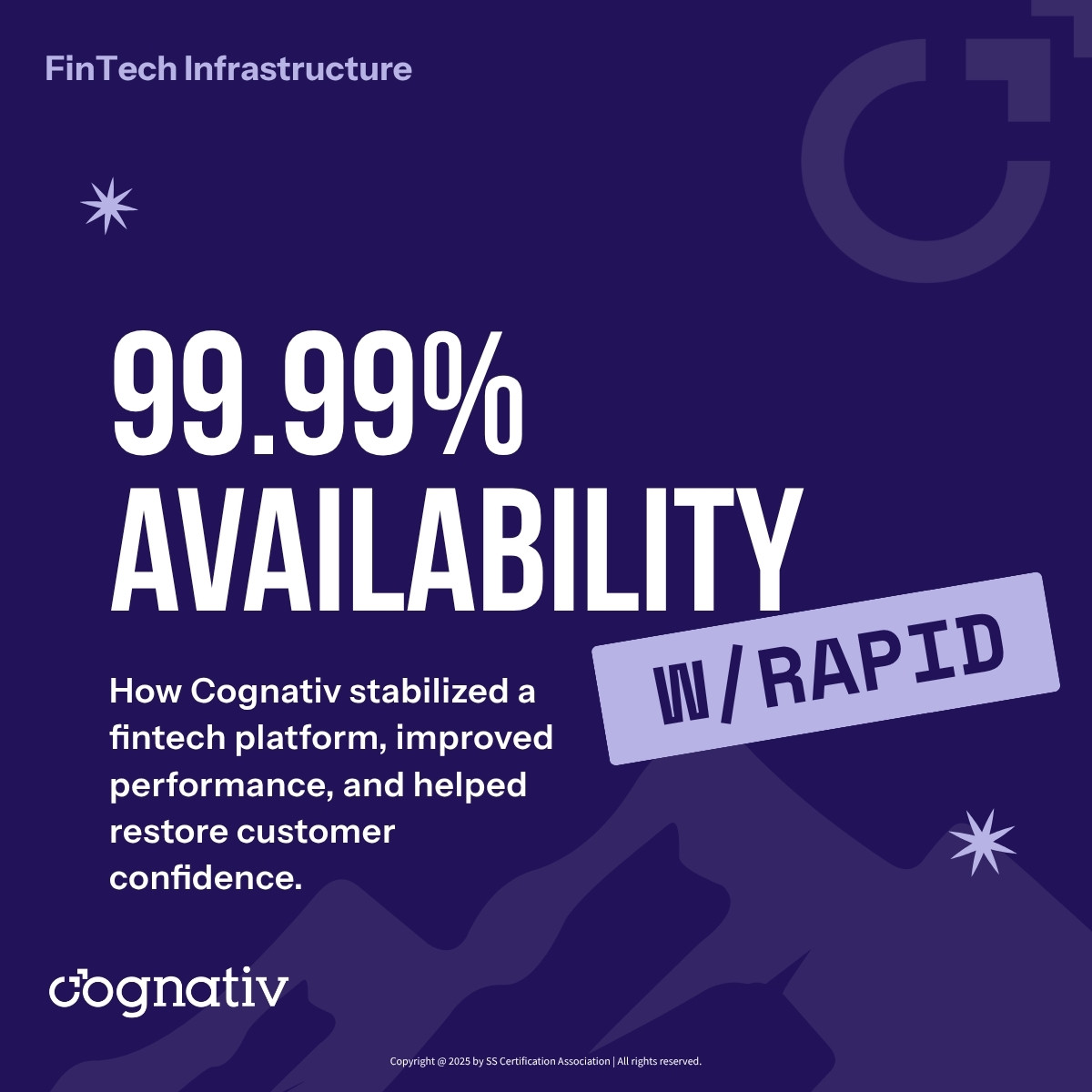
For a fintech platform, Cognativ’s Virtual CTO-style support helped stabilize mission-critical technology and achieve 99.99% availability. In finance, that level of reliability affects customer confidence, regulated growth, partner trust, risk management, and operational continuity.
This type of work combines technology leadership, engineering diligence, security awareness, data visibility, and controlled delivery. It is especially relevant for companies that have outgrown their current architecture but cannot afford disruption.
The result is more than uptime. It is a foundation for growth, compliance, customer engagement, and better leadership decision-making.
View Fintech Stability Case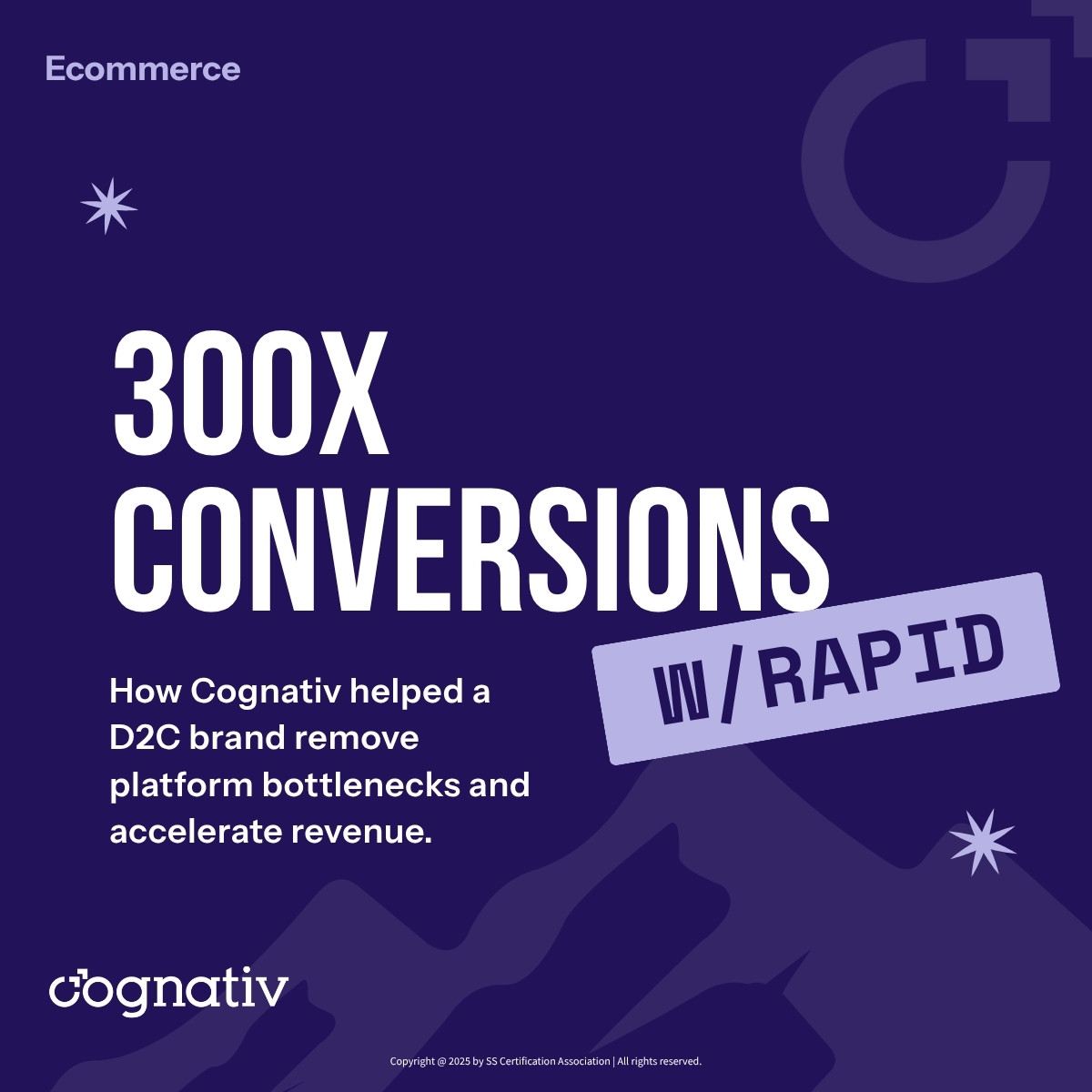
RAPID Commerce Transformation
In a RAPID commerce transformation, Cognativ helped modernize ecommerce operations with a TotalCommerce stack that unified systems, improved performance, and gave business teams more control. Reported outcomes included 300x conversion growth and 150% AOV improvement.
This transformation reflects the value of connecting ecommerce infrastructure, merchandising workflows, inventory, promotions, content, analytics, and customer experience. It also shows why Cognativ treats ecommerce modernization as an operations and platform challenge, not only a design project.
When systems are aligned, teams can move faster, reduce dependency on ad spend alone, improve reporting, launch campaigns with more confidence, and create a better customer journey.
View 300x Conversion Case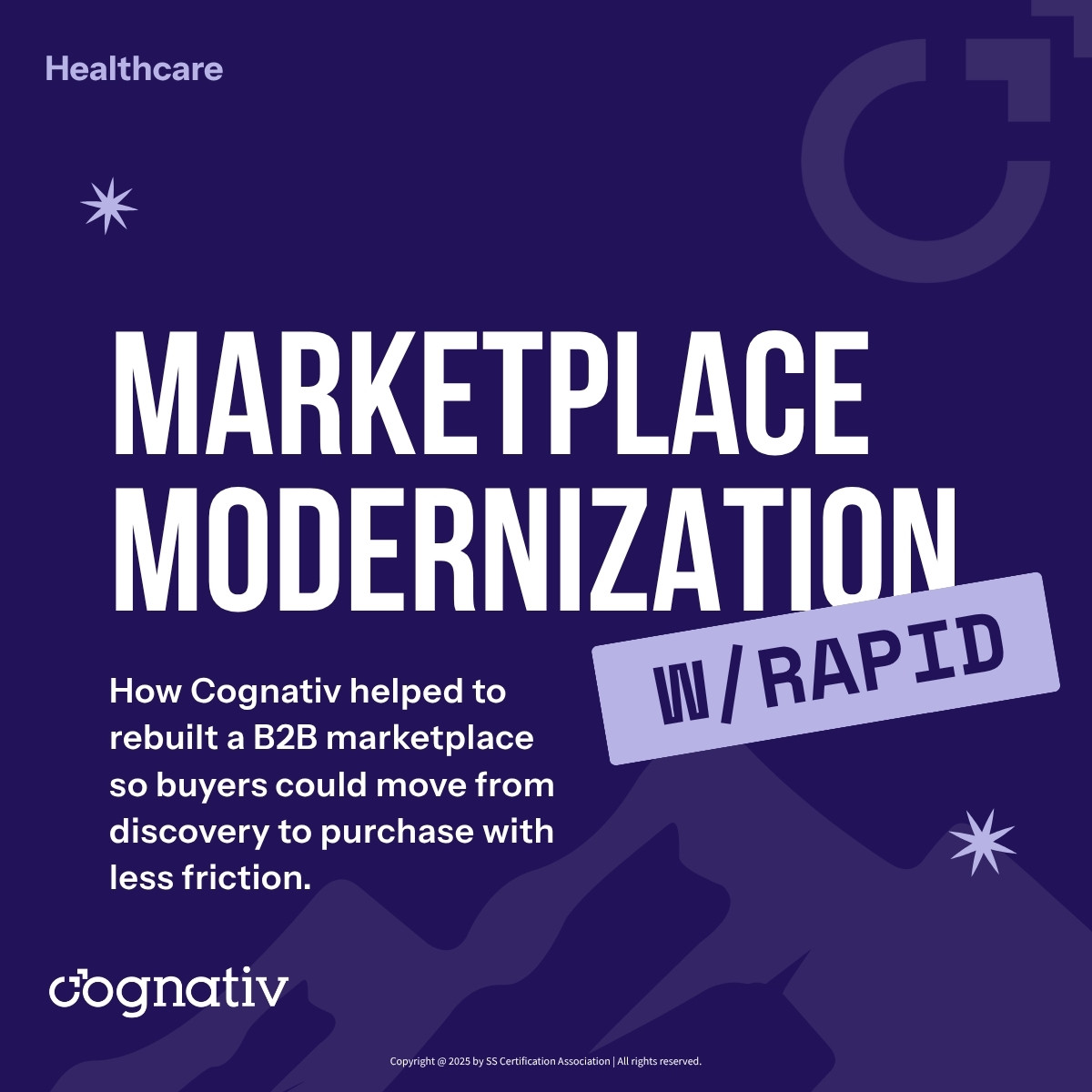
Enterprise AI and Modernization Results
Cognativ’s broader modernization outcomes include integration automation reducing order failures by 22% and B2B marketplace modernization improving search and bulk ordering. These are practical business improvements: fewer failures, better buying experiences, more efficient operations, and stronger customer satisfaction.
Other case signals include ecommerce revenue growth, reduced technical overhead, improved inventory accuracy, lower infrastructure and licensing burdens, stronger platform stability, and reduced downtime. These outcomes matter because leaders need proof that technology investments can produce value at scale.
For organizations evaluating why Cognativ, the conclusion is not that every project produces the same metric. The conclusion is that Cognativ uses structured strategy, RAPID delivery, engineering expertise, data, AI, and ownership principles to create conditions where measurable success is more likely.
View Marketplace Case
Integration Automation Cuts Order Failures
Cognativ implemented integration automation and real-time observability to reduce failed orders, improve customer communication, and stabilize fulfillment operations.
The work reduced order cancellations by 22%, lifted Net Promoter Score by 18 points, and cut manual order triage by 40%.
View Order Recovery CaseCognativ Enterprise AI and Software Modernization Next Steps
Cognativ is a strong fit for enterprise teams that need a strategic technology partner for AI, software development, ecommerce modernization, custom software, workflow optimization, data analytics, and digital transformation. The company’s differentiation comes from combining RAPID execution, private AI systems, SmartSaaS™ principles, consulting-first leadership, and enterprise engineering discipline.
Practical next steps:
-
Schedule a Cognativ assessment to review your software, AI, ecommerce, operations, and modernization challenges.
-
Discuss a modernization roadmap that evaluates legacy systems, data visibility, workflow gaps, security, and platform control.
-
Explore RAPID implementation to move from uncertainty to Research, Analyze, Plan, Implement, and Decide.
-
Evaluate SmartSaaS™ principles to reduce vendor dependency and improve transparency, portability, security, and long-term value.
-
Identify private AI opportunities where automation, machine learning, data science, and business intelligence can improve real operations.
Related topics worth exploring include RAPID transformation methodology, private AI systems, SmartSaaS™ certification, ecommerce modernization, and custom software development for enterprise environments.
Choosing Cognativ: FAQs
Choose Cognativ when your organization needs consulting, software, AI, governance, ecommerce modernization, and measurable business outcomes in one disciplined delivery model.
Cognativ is consulting-first, uses RAPID execution, builds for ownership through SmartSaaS™, and focuses on business value rather than only code output.
Cognativ uses RAPID to research the real problem, analyze risk and opportunity, plan around value, implement with discipline, and decide based on evidence.
Use these resources to evaluate Cognativ’s approach in more detail:
-
RAPID Transformation methodology - learn how Cognativ structures Research, Analyze, Plan, Implement, and Decide.
-
Cognativ case studies - review client success stories, ecommerce modernization results, and platform transformation examples.
-
SmartSaaS™ principles - understand transparency, data control, portability, adaptability, security, and reduced vendor dependency.
-
AI-first architecture services - explore private AI systems, governance, and enterprise AI integration.
-
Custom software development - review Cognativ software development capabilities for enterprise platforms.
Yes. Cognativ focuses on secure AI systems, data control, governance, workflow integration, and compliance for enterprise environments.
Cognativ improves ecommerce infrastructure, integrations, merchandising workflows, inventory visibility, conversion architecture, performance, and scalable operations.
SmartSaaS™ means software should provide transparency, data control, portability, security, adaptability, and reduced vendor lock in.
Build Smarter Enterprise Systems With Cognativ
If your organization is dealing with legacy systems, fragmented tools, unclear ownership, AI adoption risk, ecommerce complexity, compliance pressure, or slow decision-making, the next step is to define the constraint before choosing the solution.