AI-Driven Compliance in Real Estate: Automating Regulatory Management for Enterprise Operations
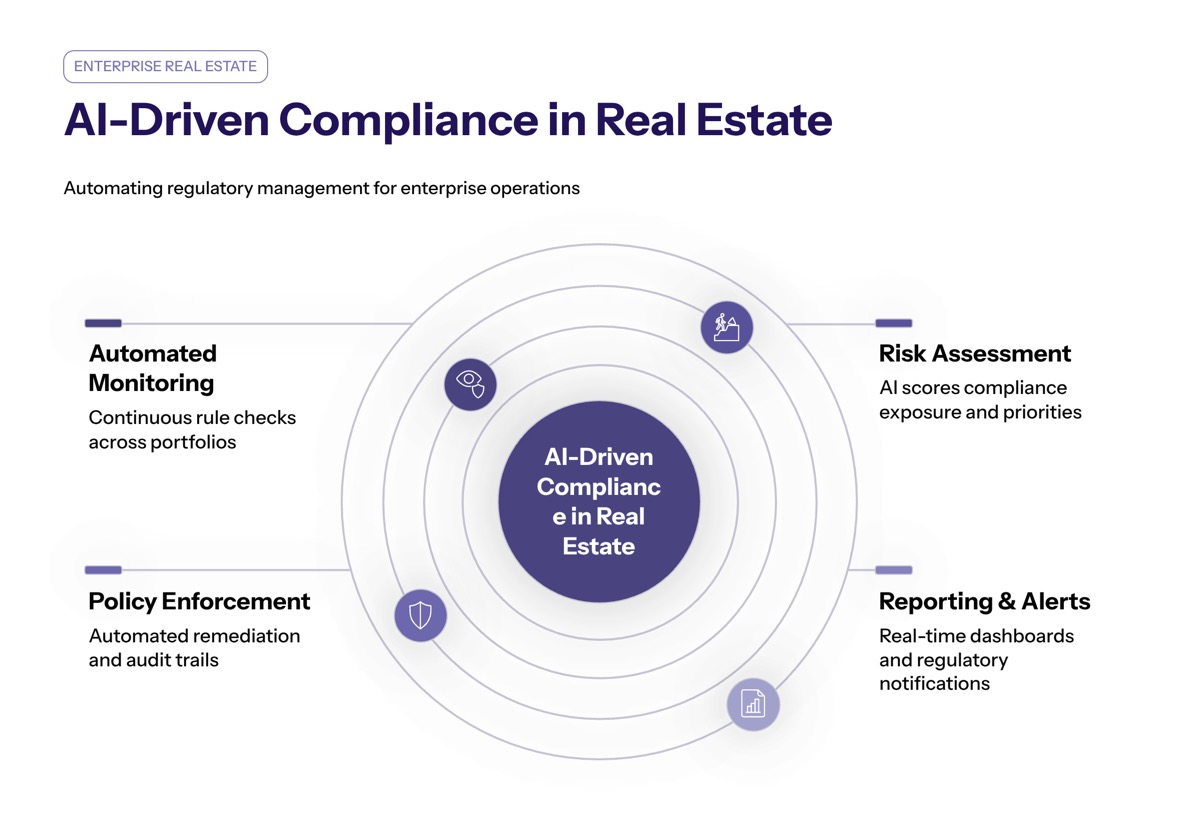
AI-driven compliance in real estate uses artificial intelligence to automate, optimize, and enhance adherence to regulatory requirements, internal policies, and industry standards. For real estate operators, that means faster document review, continuous monitoring of real estate regulations, stronger auditability, and better risk mitigation across properties, portfolios, transactions, and physical assets.
This article covers document automation, regulatory monitoring, audit readiness, fraud detection, fair housing controls, and enterprise software integration for real estate companies evaluating AI solutions. It is written for real estate operators, compliance managers, property managers, technology leaders, and decision-makers comparing software solutions, custom software, and enterprise software systems that can improve operational efficiency without creating new legal or data management risks.
The short answer: AI-driven compliance automates regulatory adherence through intelligent document processing, real-time monitoring, and predictive risk assessment. AI systems can scan transactions and leases 24/7 rather than relying on annual manual audits, allowing firms to ensure compliance more consistently and respond to regulatory changes faster.
Key outcomes include:
Reduced compliance costs through process automation, less manual effort, and fewer late-stage errors
Improved audit readiness through digital audit trails, version history, and tailored compliance reports
Automated documentation for leases, contracts, mandatory disclosures, inspection reports, and property records
Enhanced risk mitigation through fraud detection, anomaly detection, and Fair Housing Act safeguards
Complete visibility across portfolios through dashboards, ongoing monitoring, and real time oversight from one platform
For broader modernization planning, operators can also connect AI compliance initiatives to enterprise software strategy for the real estate industry.
Understanding AI-Driven Compliance Fundamentals
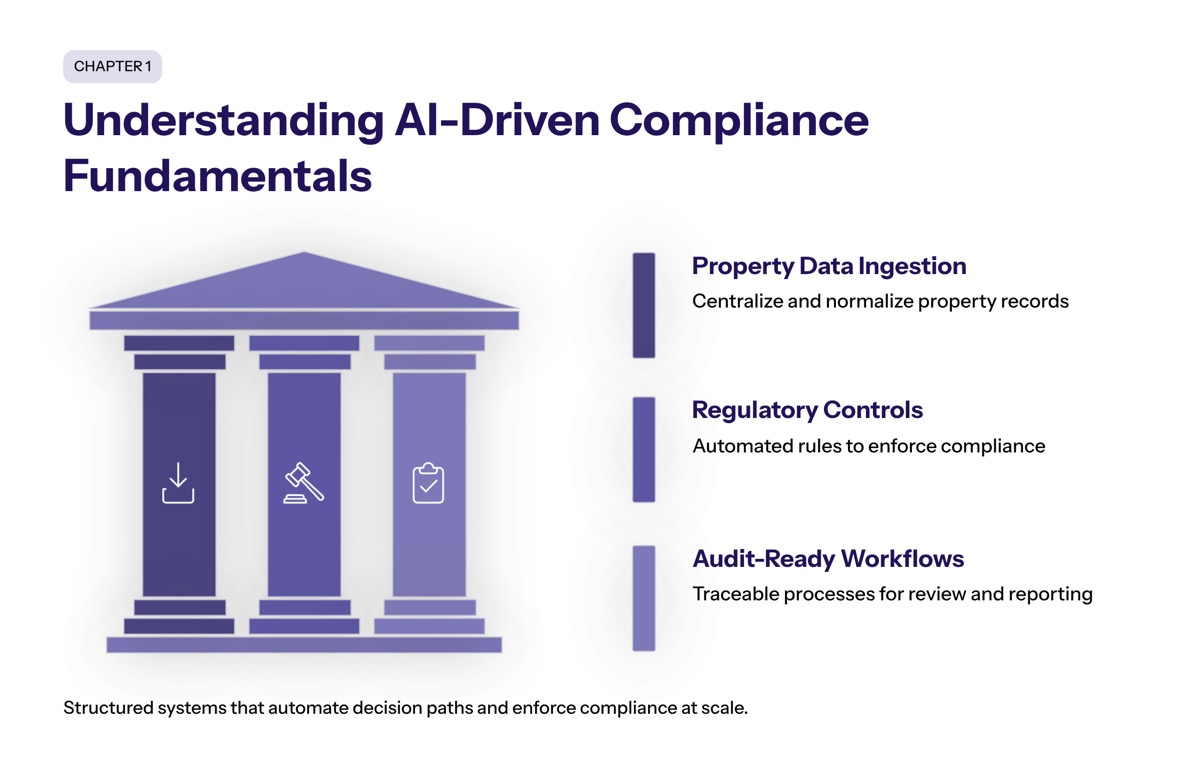
Modern real estate compliance is difficult to manage with traditional methods because operators must track federal, state, and local rules across leasing, tenant screening, zoning, disclosures, building safety, accessibility, insurance, finance, and property management. AI-driven compliance in real estate utilizes technologies to automate and enhance adherence to regulatory requirements, internal policies, and industry standards, enabling firms to operate efficiently within legal boundaries.
AI-driven compliance solutions deliver measurable improvements across accuracy, efficiency, risk management, and regulatory adherence, addressing the unique challenges faced by real estate firms operating in complex, multi-jurisdictional environments. Automating tedious document reviews and compliance reporting allows professionals to focus their energy on client relationships and strategic business growth instead of repetitive manual processes.
Core AI Technologies in Compliance
Machine learning, natural language processing, and document intelligence are the core technologies behind ai driven compliance. AI technologies like Natural Language Processing (NLP) and Machine Learning (ML) are utilized to automate compliance tasks such as document validation, risk scoring, and anomaly detection, significantly improving operational efficiency.
Natural Language Processing in AI helps machines read and interpret unstructured text, identifying missing clauses and prohibited language in compliance documents, which enhances the accuracy of compliance verification. In real estate compliance, NLP can review leases, disclosures, listing descriptions, inspection reports, and regulatory updates to identify key information such as parties, dates, obligations, rent terms, renewal windows, missing clauses, and prohibited language.
Machine learning models in AI can predict risks and classify behaviors, allowing compliance teams to prioritize which files require enhanced scrutiny, thus improving risk management processes. Machine learning models can also detect anomalies, emerging regulatory trends, and potential fraud early, allowing firms to act before issues escalate, thus reducing costly legal exposures and business interruptions.
Document intelligence combines OCR, layout recognition, clause extraction, and validation logic to process large volumes of contracts, scanned PDFs, application packets, and property records. Cloud-based AI systems instantly read agreements, leases, and disclosures to catch missing signatures, empty required fields, or outdated forms before a transaction closes.
Compliance Automation Components
Compliance automation usually includes three connected components: automated workflows, regulatory monitoring systems, and audit trail generation. Automated workflows route contracts, leases, tenant applications, mandatory disclosures, and inspection reports to the right reviewer, while regulatory monitoring tools scan multiple sources for rule changes and alert the business when action is needed.
Automation in compliance allows for continuous regulatory monitoring, where AI systems can automatically flag updates relevant to specific properties or portfolios, minimizing the lag between regulatory changes and compliance actions. AI systems enable continuous regulatory monitoring by automatically scanning for changes in federal, state, and local laws, which helps organizations maintain compliance without lagging behind regulatory updates.
AI enhances audit readiness by maintaining comprehensive digital audit trails and generating tailored compliance reports, which reduces manual preparation time and increases transparency during regulatory reviews. For enterprise software architecture, these audit trails should connect with document management, enterprise resource planning, property management, finance, legal, and reporting systems so teams can track progress, access evidence, and make informed decisions from one platform.
The next step is understanding how these components work in real world compliance operations.
AI Implementation in Real Estate Compliance Operations
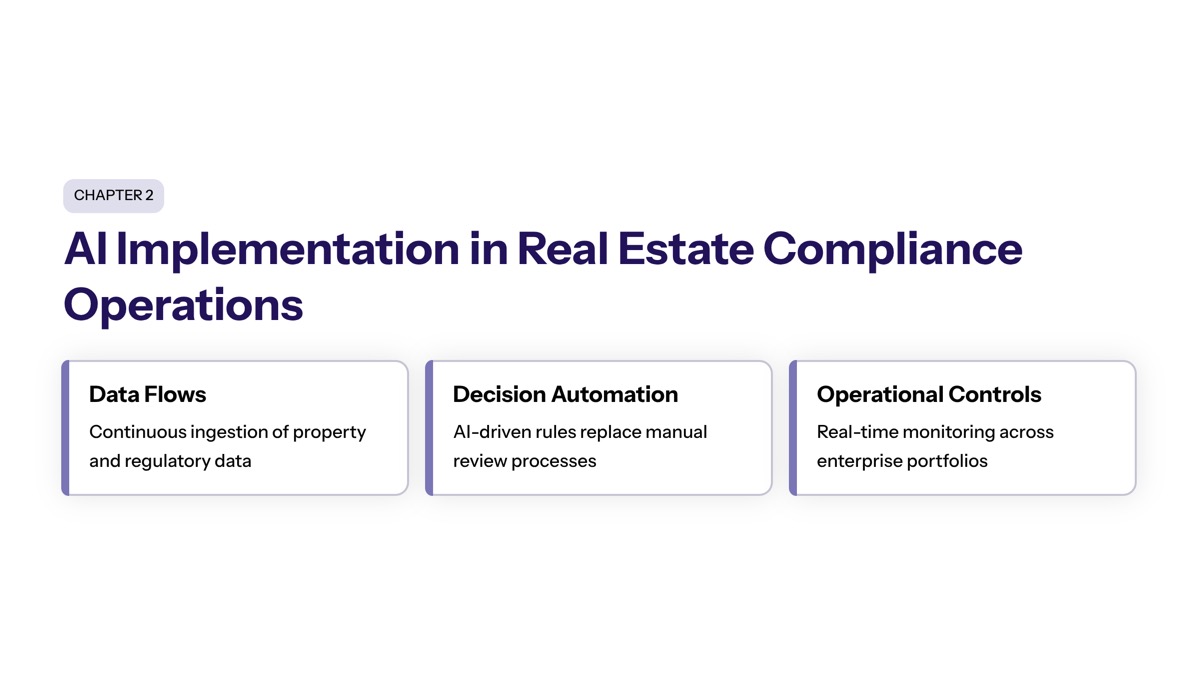
Once the fundamentals are in place, implementing AI becomes a matter of connecting the right use cases to business needs. Real estate companies often begin with document management because leases, disclosures, applications, and property records contain the data required for compliance, auditability, and operational decisions.
AI implementation then expands into regulatory monitoring, risk scoring, fraud detection, and integration with existing property management and transaction systems. The goal is not to replace legal or compliance judgment, but to let ai platforms do the heavy lifting across large volumes of data so professionals can review exceptions, resolve risk, and serve clients more efficiently.
Document Processing and Validation
AI algorithms validate contracts, leases, and disclosures against jurisdiction-specific rules, minimizing costly errors and overlooked compliance gaps that often occur with manual processes. AI enables rapid review of thousands of documents, lease agreements, and disclosures far faster than human teams, significantly accelerating compliance processes.
Document processing systems extract key compliance data from property documents, including tenant names, effective dates, rent escalations, renewal deadlines, deposits, signatures, checkbox responses, special clauses, and local disclosure requirements. This improves accuracy and creates a streamlined process for reviewing documents before execution, closing, renewal, or audit.
In real world examples, document automation has delivered large gains: Docugami reported about an 80% reduction in lease analysis time, Jash Data Science achieved more than 90% accuracy and roughly 70% manual review reduction for California Residential Purchase Agreement validation, and Datasmith AI reported 70% faster lease document processing while processing over 1,500 lease agreements monthly.
Regulatory Monitoring Systems
Real-time regulatory monitoring enables AI systems to continually scan for updates across state and local ordinances. AI continuously scans federal, state, and local law changes, automatically flagging updates relevant to specific properties or portfolios, which minimizes lag between regulatory updates and business compliance actions.
AI platforms automatically track federal, state, and local regulatory changes, instantly integrating updates into compliance protocols, ensuring ongoing adherence without lagging behind regulatory shifts. AI platforms automatically track federal, state, and local regulatory changes, instantly integrating updates into compliance protocols, ensuring real estate firms maintain ongoing adherence without lagging behind regulatory shifts.
These systems are especially useful when a portfolio spans cities or states with different lease disclosure rules, zoning requirements, building codes, accessibility standards, licensing obligations, and local ordinances. Compliance platforms utilize AI agents to match planned property developments or renovations against local zoning maps and national building codes, while AI tools cross-reference physical building data against accessibility requirements and local fire codes, auto-scheduling necessary maintenance or physical alterations.
Risk Assessment and Fraud Detection
Predictive analytics can score compliance risk, prioritize files, and identify exceptions that deserve human review. Anomaly detection algorithms in AI support anti-money laundering (AML) and fraud monitoring by flagging unusual patterns that deviate from established norms, enhancing the ability to identify compliance risks in real-time.
AI identifies forged documents, deepfakes, and suspicious financial activities, securing transactions and protecting agencies. AI automates the “Know Your Customer” process by verifying the source of funds and detecting fraudulent documents to ensure compliance with federal financial regulations.
Tenant screening is another high-impact area. AI technology in tenant screening can analyze vast amounts of data quickly, providing a comprehensive view of applicants’ financial stability, rental history, and potential risks, which enhances the efficiency of the screening process. Automated screeners flag non-compliant tenant applications instantly, and AI systems can help ensure fair housing compliance by removing subjective human judgment from tenant selection, focusing solely on measurable factors like credit scores and income ratios, thus minimizing the risk of discrimination.
However, AI adoption must be governed carefully. AI flags biased language in listings to prevent Fair Housing Act violations, but regular testing and refinement of AI algorithms are essential to mitigate bias, ensuring that the systems do not perpetuate historical prejudices in tenant screening processes.
Enterprise AI Compliance Architecture and Implementation
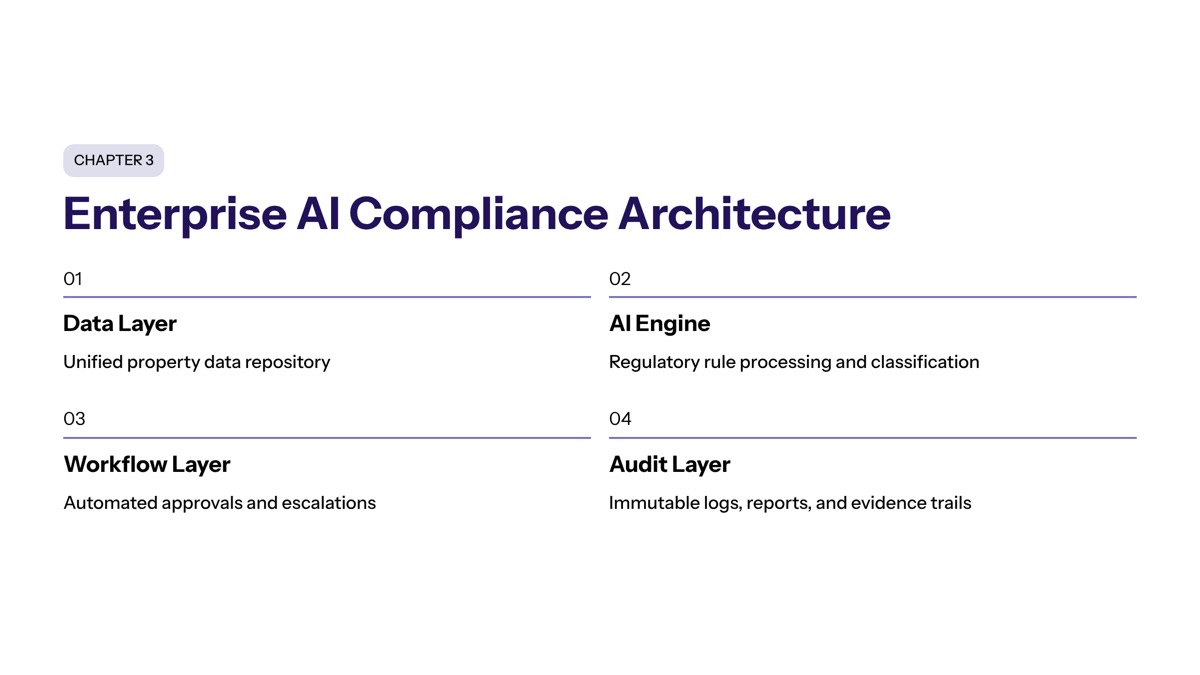
Enterprise AI compliance requires more than a standalone tool. Real estate operators need secure, scalable architecture that connects document management, property management, enterprise resource planning, financial reporting, inspection workflows, and regulatory data sources.
For many organizations, this becomes a custom software development and systems integration initiative. A custom software development company can help evaluate whether off-the-shelf ai solutions, custom software, or hybrid enterprise software solutions best fit the business, especially when legacy systems, complex data management, and strict regulatory requirements create integration constraints.
Implementation Process
Use a phased roadmap to reduce risk, avoid scope creep, and build measurable cost savings before scaling.
Compliance and systems assessment - 2 to 4 weeks
Map documents, workflows, systems, data sources, regulatory obligations, and current gaps. Deliverables should include a compliance process inventory, risk register, manual effort baseline, and priority use cases.Requirements definition and platform selection - 4 to 6 weeks
Define key features such as document validation, clause extraction, signature checks, regulatory monitoring, audit trails, dashboards, access controls, and reporting. Compare ai platforms against business needs, compliance requirements, and integration constraints.Data preparation and model configuration - 4 to 8 weeks
Gather leases, disclosures, inspection reports, property records, historical data, regulatory references, and transaction files. Prepare training or configuration datasets, define validation rules, and create testing protocols for bias, accuracy, and explainability.Pilot deployment - 4 to 6 weeks
Launch one workflow, region, property type, or portfolio segment. A pilot should include user training, dashboard setup, exception handling, audit log review, and early ROI measurement.Integration and scaling - 8 to 12 weeks
Connect the compliance platform to property management systems, enterprise software, finance tools, document repositories, and reporting environments through APIs or middleware. Data synchronization should support ongoing monitoring, complete visibility, and real time oversight.Governance and continuous improvement - ongoing
Establish ownership across compliance, legal, IT, property operations, and software development teams. Ongoing governance should include model monitoring, regulatory updates, access reviews, bias testing, audit reporting, and new features based on operational feedback.
Platform Comparison and Selection
AI compliance platforms should be evaluated according to their ability to reduce manual processes while preserving transparency, data security, and legal defensibility. The best platform is not simply the most advanced artificial intelligence system; it is the one that fits operational workflows and helps teams make smarter decisions.
Criterion | What to Assess | Why It Matters |
|---|---|---|
Compliance features | Lease validation, disclosure checks, fair housing controls, zoning support, audit trails, AML support, and automated reporting | Weak features leave manual work in place and increase risk |
Integration capabilities | APIs, data synchronization, enterprise resource planning connectivity, property management integration, document ingestion, and dashboard exports | Connected systems reduce duplicate entry and support one platform visibility |
Security standards | Encryption, role-based access, audit logs, data minimization, privacy controls, and vendor data handling policies | Real estate data includes tenant PII, financial data, contracts, and sensitive property records |
Scalability and usability | Portfolio volume, performance, user friendly workflows, reporting speed, support model, and multi-location deployment | Enterprise operations need software that scales across assets, teams, and jurisdictions |
Selection priorities should reflect both compliance and business outcomes. For example, a lender may prioritize covenant monitoring and financial risk scoring, while a residential operator may prioritize tenant screening, fair housing review, mandatory disclosures, and lease automation. Operators should work closely with technology partners to confirm integration feasibility, pricing, support, and governance before signing a long-term contract or requesting a free demo.
Common Implementation Challenges and Solutions
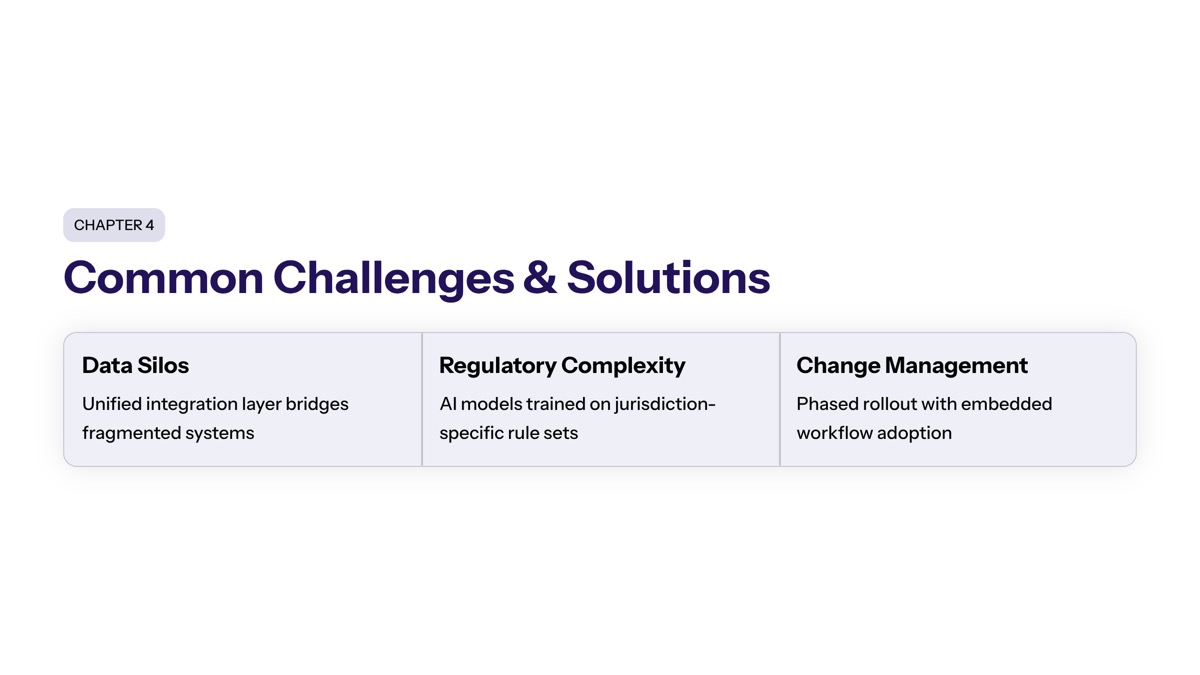
AI can improve real estate compliance, but implementation challenges are predictable. The most common obstacles involve data privacy, algorithmic bias, and legacy system integration.
Successful teams treat compliance automation as both a legal process and an enterprise software project. That means clear ownership, disciplined project management, secure data practices, and measurable success criteria.
Data Privacy and Security Requirements
AI compliance systems process sensitive property and tenant data, including names, addresses, income, credit information, financial statements, leases, inspection reports, and transaction records. The solution is to design privacy and security controls before data enters the AI workflow.
Real estate operators should use encryption at rest and in transit, role-based access, least-privilege permissions, data minimization, retention controls, and complete audit logs. Systems should be evaluated against GDPR where applicable, state privacy laws such as CCPA, federal credit and tenant screening obligations, and industry standards for secure software development.
A secure architecture should also define how AI models use data, whether customer data is used for training, how long records are retained, and how users can access, correct, or delete information. These controls help ensure compliance while reducing the risk of unauthorized access or misuse.
Algorithm Bias and Fair Housing Compliance
Fair housing compliance is one of the most important governance issues in real estate AI. AI systems can reduce subjective human judgment, but they can also reproduce discriminatory patterns if historical data, proxy variables, or opaque scoring models are not tested.
The practical solution is to require bias testing, explainability, and legal review before deployment. AI models should avoid protected class proxies where possible, measure disparate impact, document decision logic, and provide human review for adverse or high-risk decisions.
Regular testing and refinement of AI algorithms are essential to mitigate bias, ensuring that the systems do not perpetuate historical prejudices in tenant screening processes. Listings, recommendations, lead routing, tenant screening, and advertising tools should be tested against Fair Housing Act requirements, and ai driven workflows should maintain records that show how decisions were made.
Legacy System Integration
Many real estate organizations rely on fragmented property management, finance, leasing, document management, inspection, and reporting systems. Legacy integration becomes difficult when systems use inconsistent data formats, disconnected databases, or manual spreadsheet workflows.
The solution is to start with a data mapping phase, then use APIs, middleware, standard data schemas, and phased deployment. A pilot can connect the AI compliance tool to a small number of systems first, prove data quality, and then expand to broader enterprise software solutions.
Integration planning should also account for future use cases such as predictive maintenance, automated reporting systems, and AI-driven property analytics. When compliance data flows cleanly across systems, operators gain actionable insights, track progress, reduce manual effort, and stay ahead of regulatory and operational risk.
Conclusion and Next Steps
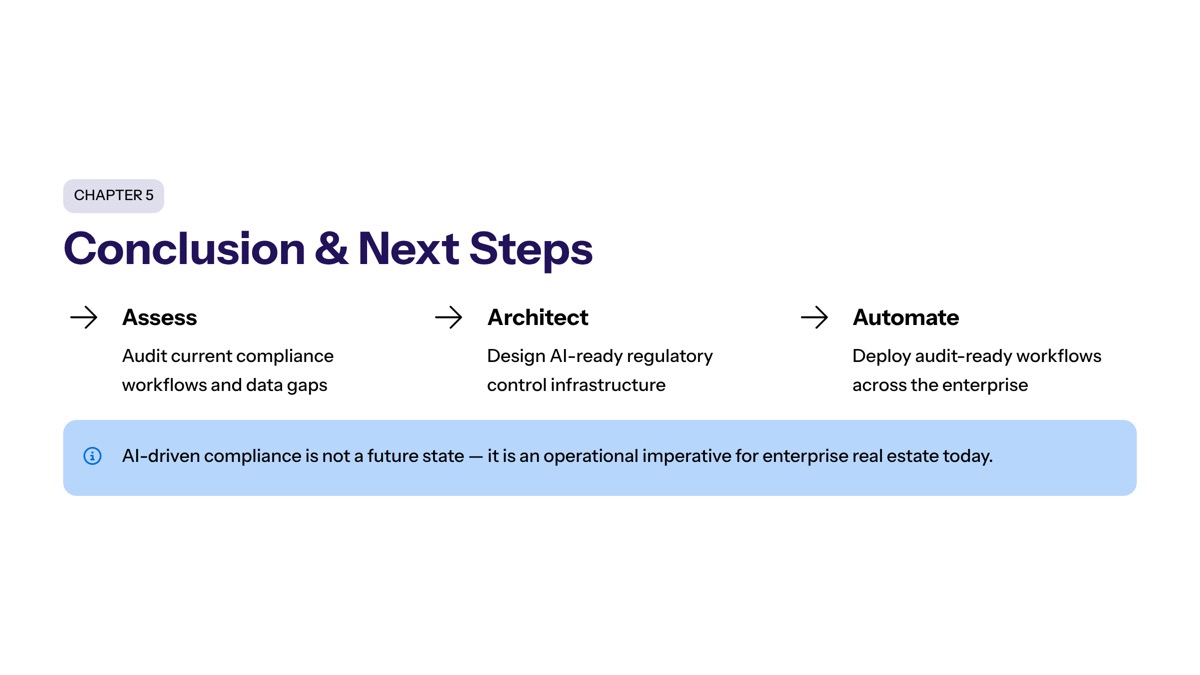
AI-driven compliance is becoming essential for scalable real estate operations because it gives teams faster document review, continuous regulatory monitoring, stronger auditability, and better risk detection. The highest-value implementations combine artificial intelligence with practical governance, secure enterprise software, and workflows designed around real estate compliance realities.
Recommended next steps:
Run a compliance assessment
Identify high-volume manual processes, recurring errors, missing audit trails, jurisdiction-specific obligations, and workflows with the highest cost or risk.Evaluate vendors and architecture options
Compare ai solutions, custom software, and enterprise software solutions against compliance features, integration requirements, security controls, scalability, and support.Plan a focused pilot program
Start with a defined workflow such as lease validation, disclosure review, tenant application screening, covenant monitoring, or regulatory alerts for one portfolio.Create an ROI measurement framework
Track manual effort reduction, error reduction, cycle time, audit preparation time, cost savings, risk mitigation, and user adoption.Connect compliance to broader modernization
Use AI compliance as a foundation for AI-driven property analytics, predictive maintenance, automated reporting systems, and improved property management operations.
For operators planning enterprise modernization, see how industry-specific software strategy supports the real estate industry.
Additional Resources
AI compliance risk assessment template
Use a structured checklist covering regulatory requirements, document workflows, privacy, access controls, model governance, bias testing, audit trails, and vendor accountability.Regulatory guidance to monitor
Track Fair Housing Act guidance, HUD updates on algorithmic decision-making, federal financial regulations, state privacy laws, tenant screening rules, zoning changes, accessibility requirements, and local fire codes.Implementation reference framework
Use a phased roadmap: assessment, requirements, data preparation, pilot, integration, scaling, and ongoing monitoring.Related technology topics
Explore enterprise software, custom software development, document management, predictive analytics, data management, and automated reporting as part of a broader real estate technology strategy.Useful external reading
Review public materials from HUD on fair housing, state real estate regulators, privacy authorities, and industry research on AI adoption in housing and property operations.