AI Implementation Services: A Guide for Enterprise Teams
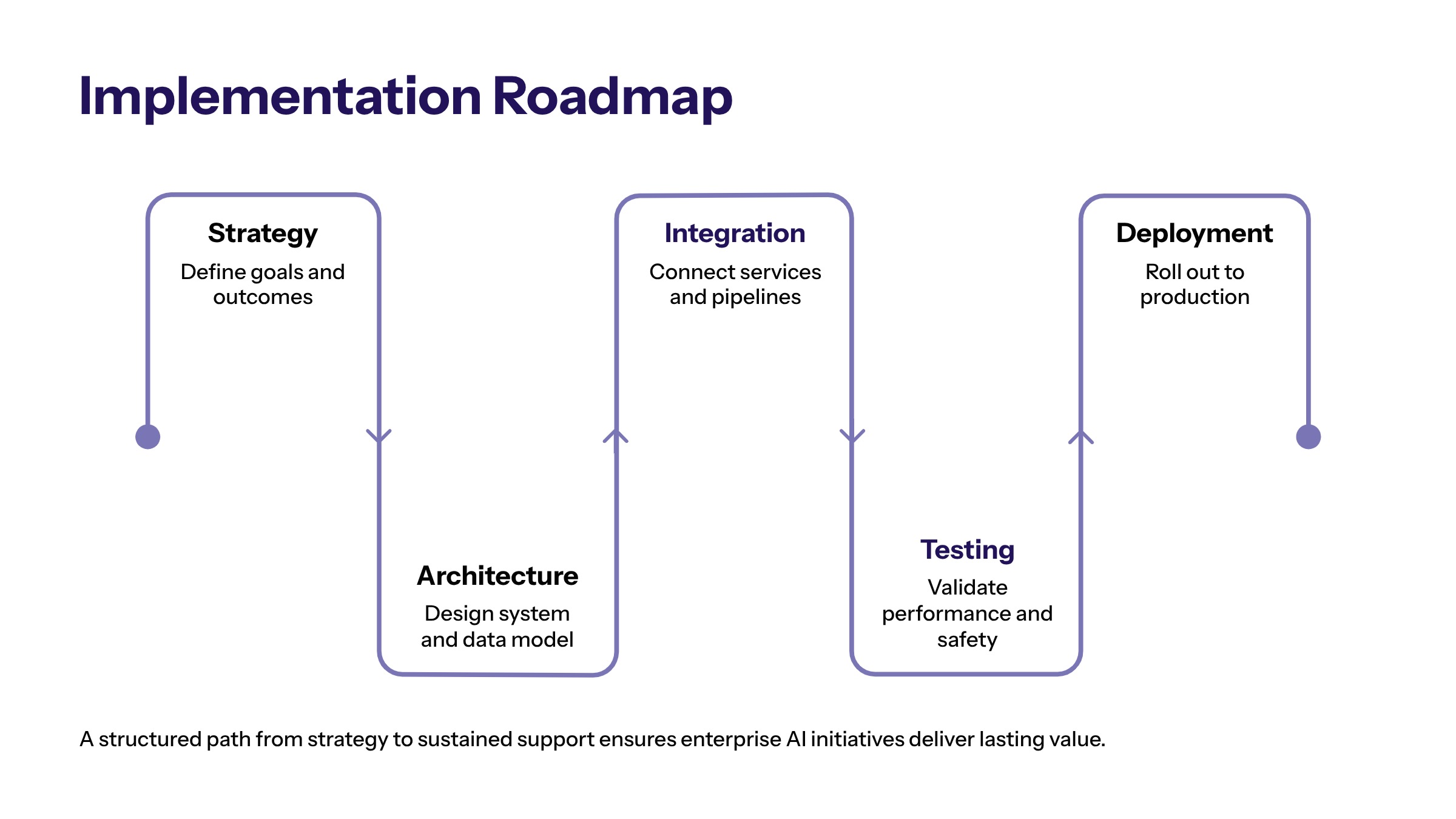
AI implementation services help organizations move AI from idea, pilot, or tool evaluation into governed production workflows. The work usually includes use-case assessment, data readiness, architecture, integration, testing, deployment, training, and ongoing support.
For enterprise teams, the hard part is rarely proving that AI can produce an impressive demo. The hard part is connecting AI to real workflows, secure data access, ownership, and measurable outcomes. That is where implementation discipline matters.
This guide explains what AI implementation services include, when they are useful, how service models differ, and what leaders should evaluate before choosing an implementation partner.
Enterprise AI implementation services should connect advisory work with production delivery. The right model may include AI implementation consulting services, architecture support, custom software, managed optimization, or a hybrid partner that can keep strategy and execution aligned.
What AI Implementation Services Include
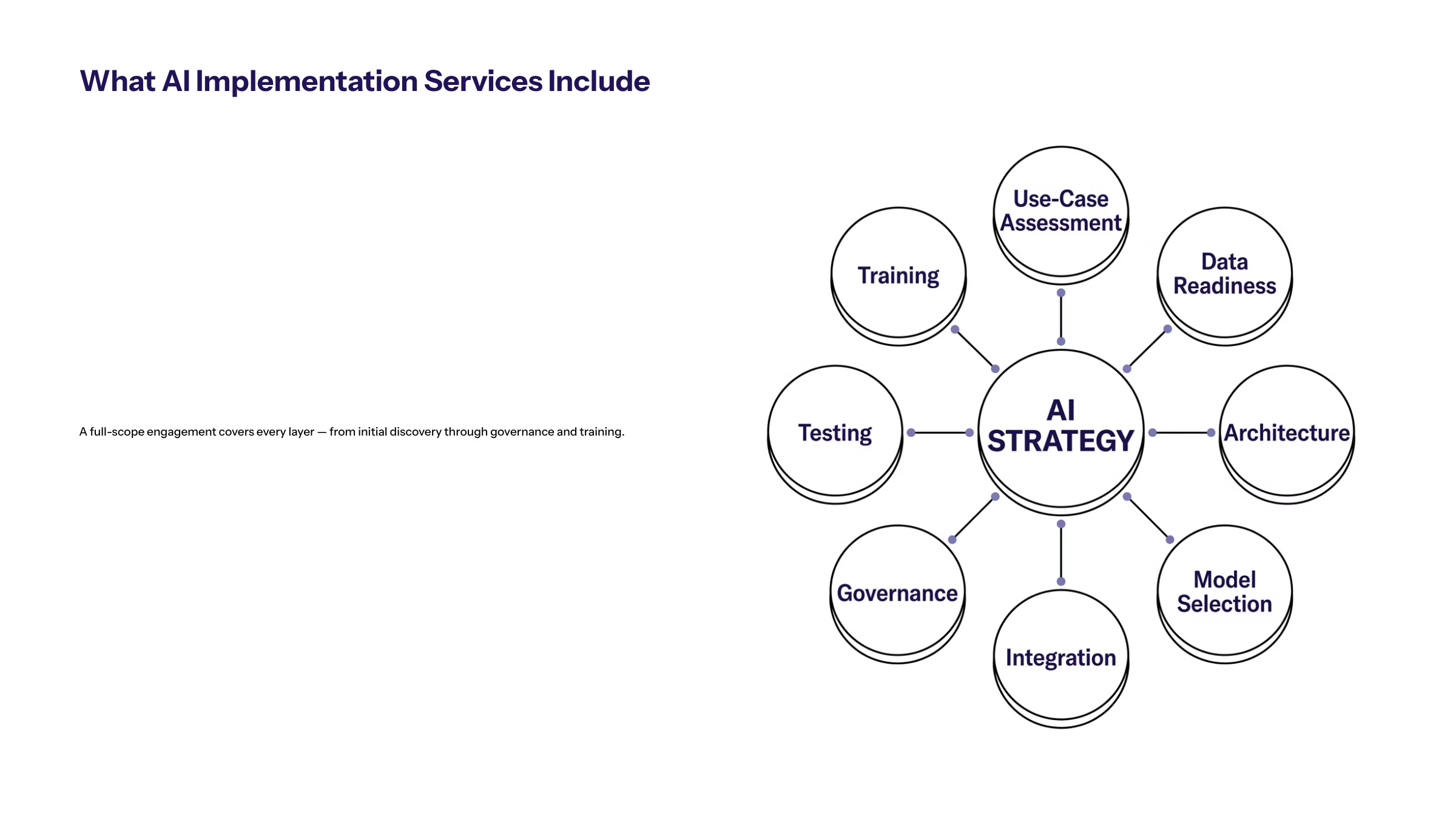
AI implementation services cover the practical work required to move from strategy to usable systems. A complete implementation effort may include workflow discovery, requirements definition, data preparation, architecture design, model selection, integration, testing, user adoption, and governance.
The exact scope depends on the business problem. A document automation project may require extraction, validation, review queues, and audit trails. An AI agent project may require tool access, permissions, workflow orchestration, and monitoring. A decision-support system may require retrieval, reporting, and human approval paths.
Implementation is not only technical delivery. It is the connection between business strategy, engineering decisions, operating model, and adoption.
When an Organization Needs AI Implementation Support
Organizations usually need implementation support when internal teams understand the business problem but need help designing the system around it. This is common when workflows cross departments, rely on legacy systems, involve regulated data, or require custom integration.
Implementation support is also useful when AI pilots stall. A pilot may show promise, but production requires security review, data access, performance monitoring, user training, and ownership. Without those elements, the pilot remains disconnected from the business.
Teams should also consider external support when AI adoption needs to align with business strategy. Use-case selection, prioritization, and sequencing often determine whether implementation creates measurable value.
AI Implementation Service Models
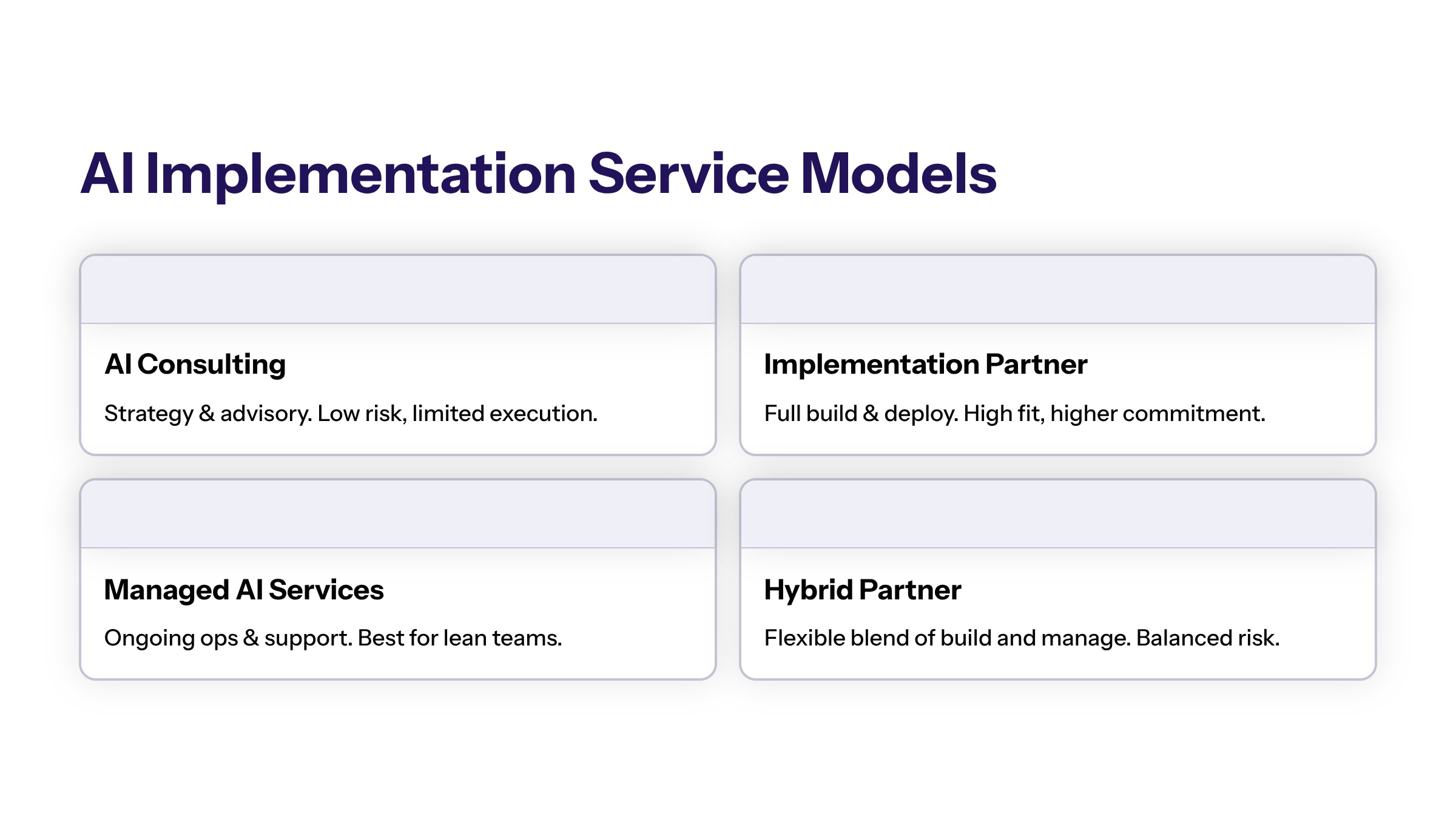
Different service models solve different problems. Some organizations need strategic advisory. Others need engineering capacity, managed support, or a hybrid partner that can take responsibility from planning through production.
AI strategy and implementation services are useful when leaders need to decide which use cases should move first, what controls are required, and how implementation should be sequenced. Managed AI implementation services providers are more relevant after launch, when monitoring, support, and optimization become ongoing responsibilities.
Service Model | Best Fit | Watch For |
|---|---|---|
AI consulting | Use-case discovery, roadmap, governance, business alignment. | May not include production engineering. |
Implementation partner | Architecture, integration, deployment, testing. | Needs strong security and ownership practices. |
Managed AI services | Monitoring, optimization, support after launch. | Contracts should clarify data, model, and workflow ownership. |
Hybrid partner | Strategy through production for complex environments. | Scope must stay tied to measurable outcomes. |
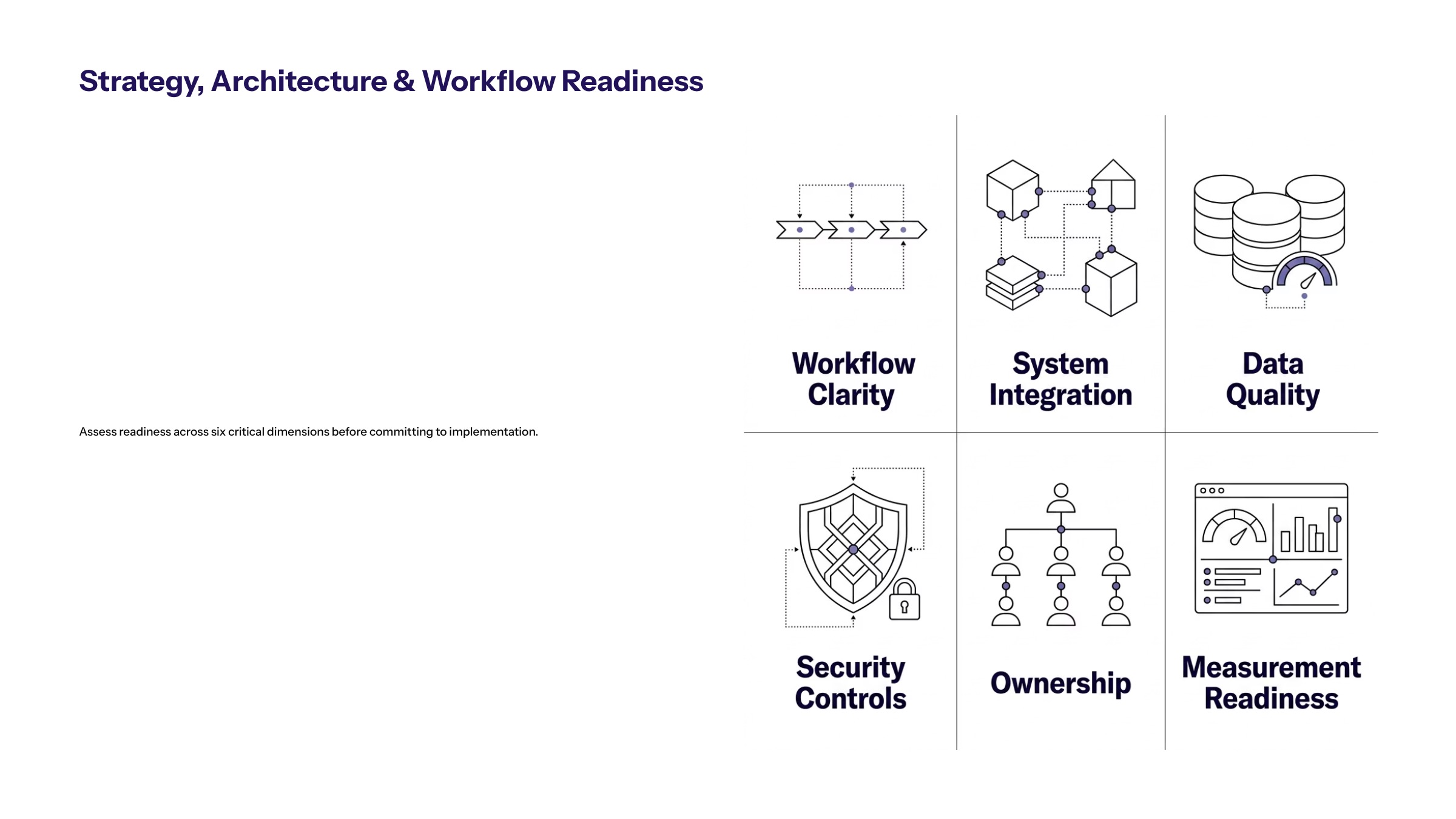
Strategy, Architecture, and Workflow Readiness
Before implementation starts, the organization should understand the workflow it wants to improve. That includes who owns the process, which systems are involved, what data is needed, which decisions are risky, and how success will be measured.
Technical architecture should follow that workflow. AI implementation may require data pipelines, APIs, retrieval systems, model services, workflow orchestration, audit logs, and reporting. For many organizations, this becomes part of a broader AI-first architecture effort.
Governance, Security, and Compliance Controls
AI implementation services should define governance early. Teams need to know who can access data, how outputs are reviewed, when humans approve actions, how decisions are logged, and how the system is monitored after launch.
Security controls should be designed around the data and workflow risk. Sensitive customer, financial, employee, or regulated data requires stronger access controls, auditability, and retention practices. Implementation should not treat governance as a final checklist after the system is built.
How to Evaluate AI Implementation Partners
A strong implementation partner should be able to explain how they move from business problem to production system. Evaluate the partner’s ability to map workflows, design secure architecture, integrate with existing systems, support users, and measure outcomes.
When comparing AI implementation services, buyers should avoid evaluating only model access or tool familiarity. The stronger question is whether the partner can connect enterprise AI implementation services to secure data practices, integration reality, user adoption, and measurable workflow improvement.
Questions to ask include:
How do you select and prioritize AI use cases?
How do you handle data access, privacy, and security controls?
Who owns the workflow after launch?
How do you measure whether implementation worked?
How do you support the system after deployment?
What a Complete AI Implementation Plan Should Define
A complete implementation plan should be specific enough that business, engineering, security, and operations teams understand what will change. It should not stop at a list of tools or a general roadmap. It should define the workflow, the data, the architecture, the controls, the rollout path, and the measurement model.
The workflow definition should describe the current state and the desired future state. That means documenting triggers, inputs, owners, decision points, system actions, approvals, exceptions, and handoffs. If the workflow is unclear, implementation will inherit the confusion. AI may make the workflow faster, but it will not automatically make it more accountable.
The data plan should identify which systems the AI solution needs to read from, which records it can update, and which data is too sensitive or unnecessary for the workflow. Data minimization is important because giving an AI system broad access can create risk without improving performance. The plan should also define data quality requirements, retention expectations, and whether any data can be used for model improvement.
The architecture plan should explain how AI will connect to existing systems. This may include APIs, middleware, retrieval layers, vector stores, workflow engines, permission services, monitoring tools, and reporting dashboards. Architecture is what turns an AI model into a business system. Without it, teams may have a useful prototype that cannot operate reliably in production.
The rollout plan should define pilot scope, user groups, training, support, approval gates, rollback procedures, and expansion criteria. A strong plan makes it clear when the organization should continue, pause, revise, or stop. That discipline helps avoid the common pattern where AI pilots remain active but unmeasured for months.
Common Implementation Mistakes to Avoid
A common implementation mistake is choosing the AI tool before defining the workflow. Tools matter, but the business problem determines what the tool needs to do. A document intelligence platform, AI agent, retrieval system, automation platform, or custom software solution may all be appropriate in different contexts. The right choice depends on the work being improved.
The second mistake is treating implementation as an IT-only project. AI implementation touches business process, data governance, training, adoption, compliance, and operating model design. If operations, legal, security, and business owners are not involved early, the system may be technically functional but difficult to trust or adopt.
The third mistake is underestimating integration. Many AI pilots work because they use exported data, manual uploads, or isolated test environments. Production requires stable access to the systems where work happens. That may include CRM, ERP, service desks, finance tools, document repositories, identity providers, and analytics platforms. Integration should be planned as a first-class workstream, not a late-stage connection task.
The fourth mistake is launching without support ownership. AI systems need monitoring, issue response, user feedback loops, and periodic review. If no team owns performance after deployment, the system can drift, users can lose trust, and the business may not capture value even when the technology works.
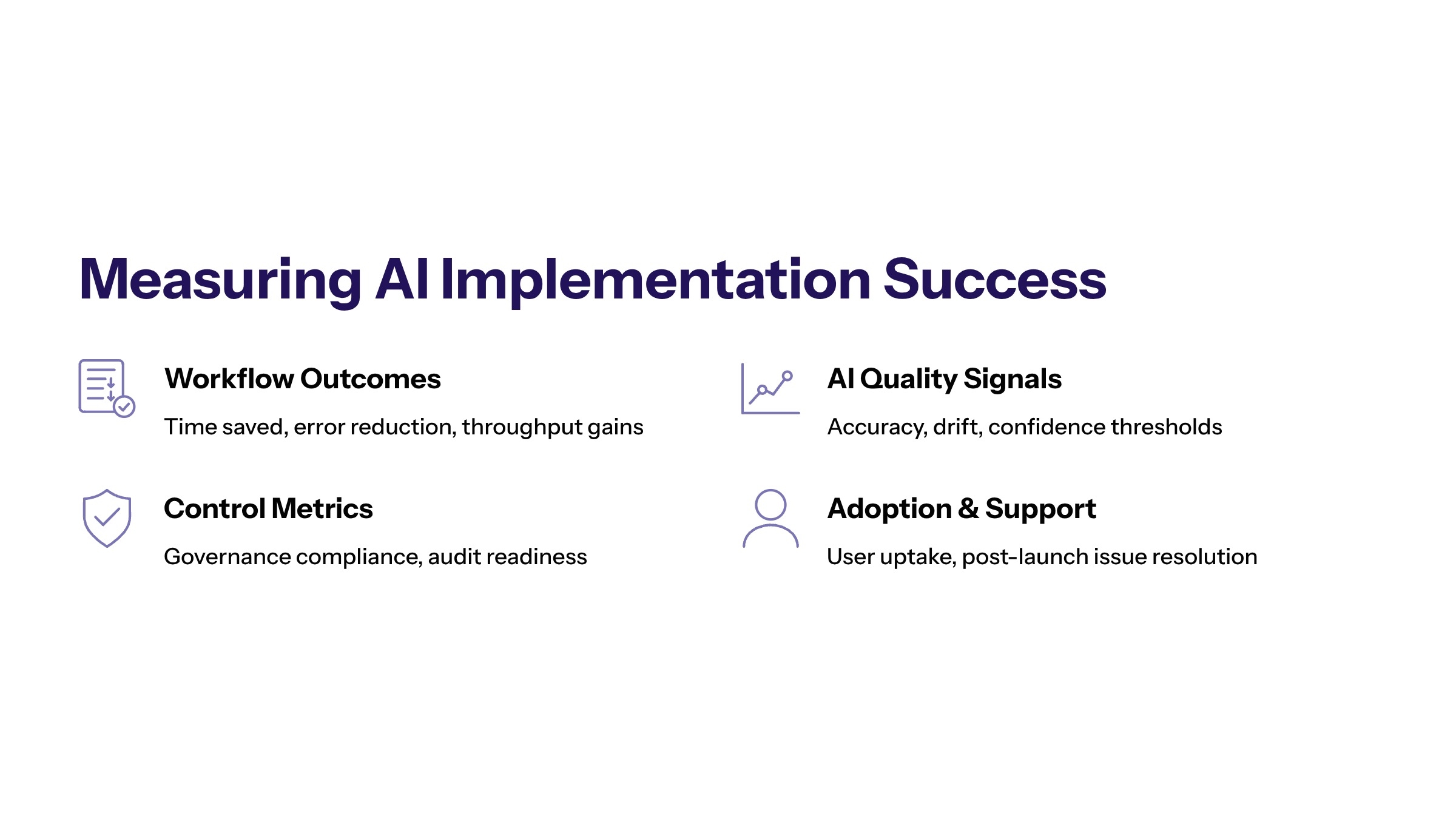
Measuring AI Implementation Success
Implementation success should be measured by business outcomes and operational reliability. Useful metrics include cycle time reduction, backlog reduction, error rate, manual effort, user adoption, exception volume, support tickets, compliance evidence, and stakeholder satisfaction. The metrics should be selected before implementation begins so the pilot can be evaluated honestly.
AI-specific metrics still matter. Teams should monitor accuracy, confidence, hallucination risk, retrieval quality, model drift, prompt failures, integration errors, and escalation rates. But those metrics should support the business case rather than replace it. A system can perform well technically and still fail if users do not adopt it or if the workflow does not improve.
Measurement should also include control metrics. For example, teams should know how often the system required human review, how many exceptions were escalated, how long unresolved cases stayed open, and whether audit logs were complete. These controls help leaders decide whether the system is ready for broader deployment.
For Cognativ-style delivery, the most important measurement question is whether the AI implementation created a durable capability. That means the organization understands how the system works, who owns it, how it is governed, how it creates value, and how it can evolve as the business changes.
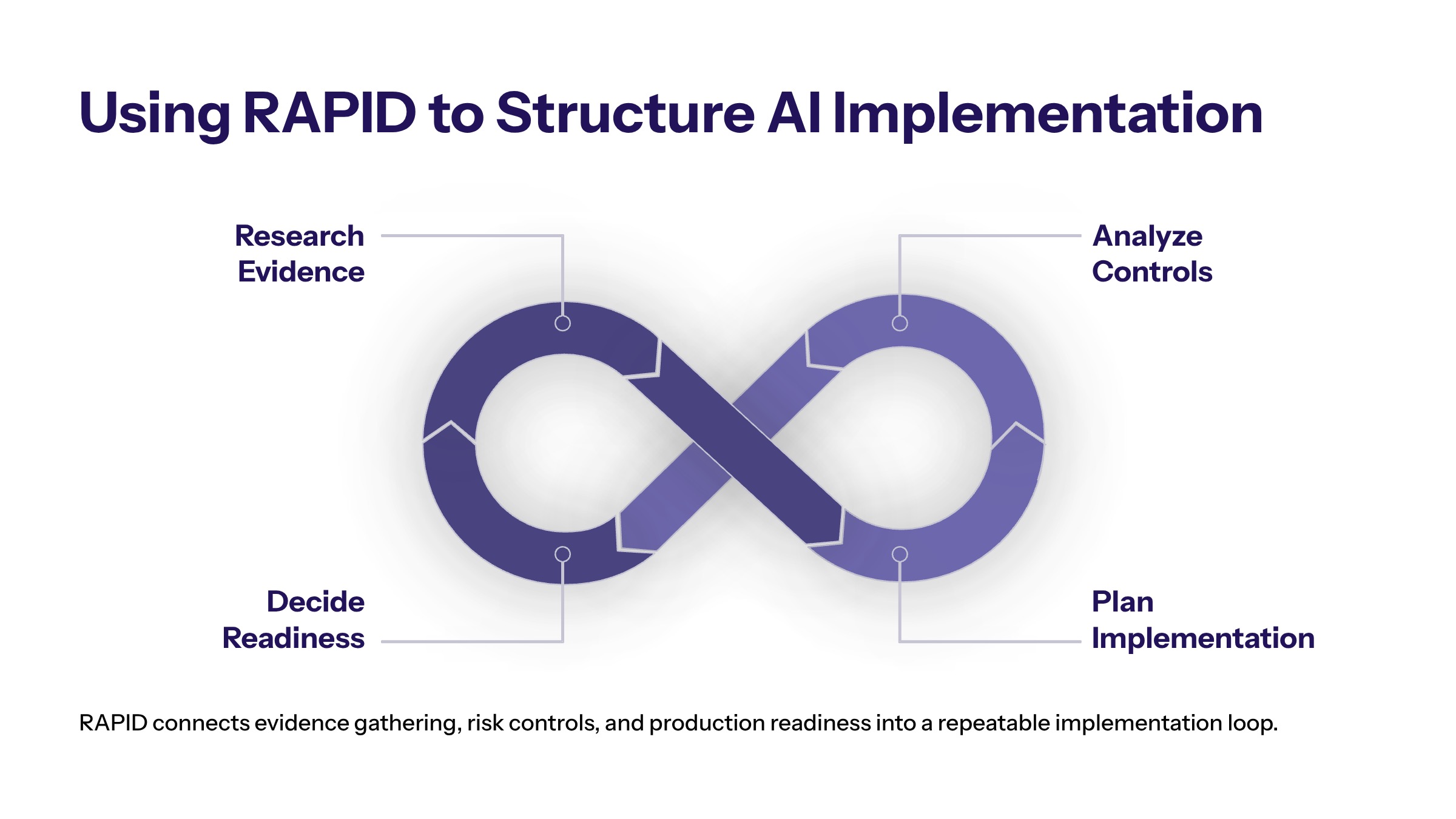
Using RAPID to Structure AI Implementation
AI implementation benefits from a repeatable execution framework because the work crosses strategy, software, data, security, operations, and adoption. A RAPID-style approach keeps the program anchored in evidence rather than tool excitement.
Research starts with the real business constraint. The team maps the workflow, stakeholders, systems, data, pain points, risks, and current performance. This stage should identify whether the problem is actually an AI problem or whether the organization first needs process cleanup, integration, data quality work, or ownership clarification.
Analyze turns discovery into implementation choices. The team evaluates use-case value, risk, data readiness, security needs, architecture options, vendor constraints, and user impact. This is where leaders decide whether the right path is a commercial platform, custom software, a hybrid build, or no implementation yet.
Plan defines the delivery model. It should include scope, milestones, roles, integrations, controls, test criteria, training, support, and measurement. Planning should also define what will not be included in the first release. Tight scope is often what makes AI implementation possible without creating unnecessary risk.
Implement builds the pilot or production release with controlled access, testing, logging, and review. Implementation should include users early enough to validate whether the system supports real work. It should also include security and operational readiness before launch, not after.
Decide uses evidence to determine the next move. If the system improves the workflow and controls hold, the organization can expand. If results are mixed, the team can revise. If the workflow does not justify the investment, stopping is a good decision. The point is to make AI implementation an evidence-based operating discipline.
Post-Launch Support and Optimization
AI implementation does not end at deployment. Post-launch support is where the system either becomes trusted or slowly loses value. Teams should monitor user adoption, workflow completion, output quality, exception queues, integration errors, and business outcomes. If users stop trusting the system, the metrics should make that visible quickly.
Optimization should be planned as a normal part of the lifecycle. Teams may need to improve retrieval content, adjust prompts, refine business rules, add integrations, update training, or tighten review thresholds. These changes should follow a controlled release process so improvements do not introduce new risk.
Support ownership should be explicit. Users need to know where to report issues. Technical teams need to know who responds to incidents. Business owners need to know how changes are prioritized. Without this operating model, even a strong implementation can become difficult to maintain.
Bottom Line for AI Implementation Buyers
The right implementation partner should help the organization make better decisions before writing production code. That means clarifying the workflow, identifying constraints, testing assumptions, and designing the operating model that will support the system after launch.
Enterprise AI implementation is successful when the business gains a working capability it can understand, govern, measure, and improve. A useful partner should not only deliver an AI feature. It should help the organization create a durable system with clear ownership, secure architecture, adoption support, and evidence that the work is producing value.
Implementation Roadmap and Next Steps
A practical AI implementation roadmap starts with a narrow, valuable workflow. Define the business outcome, map the current process, identify data and integration constraints, design controls, and then build a pilot that can be measured.
The roadmap should also define what evidence leadership needs before expanding. That may include adoption signals, workflow metrics, user feedback, security review, audit completeness, and operational support readiness. Expansion should be a decision based on proof, not a default assumption. This prevents pilots from becoming unmeasured commitments.
Once the pilot proves value, expand carefully. Production AI requires monitoring, support, change management, and continuous improvement. Cognativ’s implementation approach connects AI services, business strategy, architecture, and controlled delivery so AI projects can become durable business systems rather than isolated experiments. The end goal is controlled execution, not another disconnected pilot.
Frequently Asked Questions About AI Implementation Services: A Guide for Enterprise Teams
AI implementation services usually include use case selection, architecture, data readiness, integration planning, governance, pilot delivery, testing, adoption, and measurement. For related reading, see custom enterprise software.
Enterprises need AI implementation support when AI work must connect to real workflows, secure systems, business ownership, compliance controls, and measurable outcomes. For related reading, see custom software development.
AI implementation success should be measured through workflow outcomes such as cycle time, adoption, quality, auditability, risk reduction, and business value. For related reading, see AI agent frameworks.
An AI implementation plan should include the use case, data sources, integration path, controls, testing approach, owners, timeline, and success metrics. It should also define what is out of scope. For related reading, see AI agent orchestration.
Services teams reduce risk by starting with a bounded pilot, validating data access, testing edge cases, and setting clear approval gates. The goal is controlled adoption, not broad automation on day one. For related reading, see AI agent platforms.
After launch, the team should monitor performance, collect user feedback, review exceptions, update controls, and decide whether to scale, revise, or stop the workflow. Ownership must continue after deployment. For related reading, see AI agent tools.