AI Risk Management in Software Development: A Complete Guide for Enterprise Leaders
AI risk management in software development is the systematic process of identifying, assessing, controlling, and monitoring the security, operational, and compliance risks introduced by AI tools and AI systems across the software development lifecycle. For enterprise teams, the issue is no longer whether artificial intelligence can accelerate delivery; it is whether ai assisted development can produce secure code, protect sensitive data, and meet regulatory compliance expectations at enterprise scale.
This guide covers the practical risk areas software leaders need to govern: code generation risks, dependency vulnerabilities, data leakage, insecure prompts, AI agent permissions, review controls, and release governance. It is written for CTOs, software leaders, security architects, engineering managers, and development managers responsible for responsible ai adoption in enterprise environments where ai coding tools, large language models, and automated agents are becoming part of daily engineering workflows.
In short, AI risk management in software development involves implementing governance frameworks, security controls, and monitoring systems to prevent AI-generated vulnerabilities, data exposure, and compliance violations throughout the development lifecycle. Effective ai governance ensures that ai generated code, AI-driven automation, and AI agent behavior are evaluated with the same rigor as human written code, while also addressing AI-specific risks such as prompt injection, training data exposure, and excessive agent permissions.
By the end of this guide, you will understand how to:
Identify AI-specific security risks in code generation, prompts, dependencies, and AI agent workflows.
Implement a practical risk management and ai governance framework for enterprise software development.
Establish review controls, security feedback loops, and oversight mechanisms for AI-generated outputs.
Monitor AI system behavior across the ai lifecycle, from development to deployment.
Maintain compliance with data protection obligations, industry standards, and emerging ai regulations such as the eu ai act.
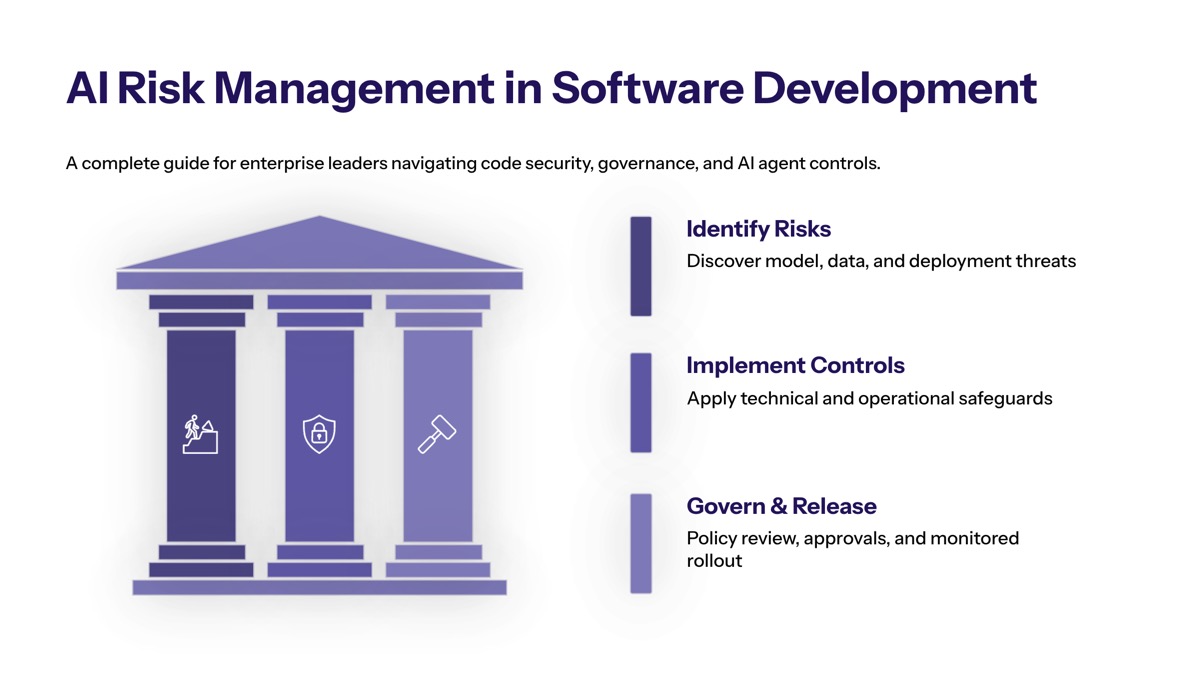
Understanding AI Risks in Software Development
AI risks in software development are the security, operational, and compliance threats introduced by ai coding assistants, automated development tools, generative ai models, and ai driven systems that participate in planning, coding, testing, reviewing, or deploying software. These risks appear when ai tools generate code, recommend dependencies, process sensitive data, create prompts, interact with internal systems, or act through an ai agent with permissions to read, write, execute, or deploy changes.
The relevance is immediate for enterprise software teams adopting AI tools to speed up delivery. AI coding can reduce repetitive development work and help engineering teams produce functional code faster, but ai generated code introduces risks that traditional security processes were not designed to catch on their own. Existing research has found that a meaningful share of generated code contains security flaws, including injection weaknesses, input validation problems, insecure dependency use, and cryptographic misuse. That does not mean ai coding tools should be banned; it means organizations need proper oversight, secure coding practices, and governance processes that reflect how AI changes the development workflow.
Code Generation and Quality Risks
Code generation risks occur when ai tools, coding assistants, or large language models produce insecure code, incomplete logic, weak validation, or patterns that appear correct but fail under real-world security context. AI models may produce code that compiles and passes simple tests while still containing security vulnerabilities such as SQL injection, cross-site scripting, insecure authentication logic, weak cryptography, or missing authorization checks.
These risks connect directly to software supply chain security and production system exposure. AI coding assistants may suggest open-source packages, copy outdated patterns from training data, or include dependencies with known vulnerabilities. If generated code is treated as inherently trustworthy because it came from a modern ai assistant, critical security issues can move into production faster than security teams can detect them. Secure code still requires human review, automated testing, SAST, SCA, and context aware remediation suggestions that account for the application’s architecture and business objectives.
Data and Privacy Exposure Risks
Data and privacy exposure risks arise when sensitive data is shared with AI services through prompts, logs, retrieval systems, fine-tuning pipelines, or unmanaged integrations. Developers may paste proprietary code, credentials, customer records, internal architecture diagrams, or regulated data into ai tools without realizing that the data could be stored, processed, logged, or used in ways that violate data protection obligations.
Prompt injection makes this risk more complex. Insecure prompts and untrusted external content can manipulate an AI system into revealing hidden instructions, leaking data from retrieval-augmented generation contexts, or performing unauthorized actions. If an organization uses internal documentation, ticket history, customer data, or source code to train ai models or ground AI responses, data quality, data integrity, access control, and prompt isolation become core parts of responsible ai governance. These risks also affect intellectual property protection because proprietary algorithms, trade secrets, or licensed code can leak through AI model interactions.
Operational and Governance Risks
Operational and governance risks emerge when AI adoption happens faster than governance practices. Shadow AI is a common example: teams begin using unapproved AI tools, browser extensions, coding assistants, or autonomous agents without a centralized inventory, security review, or clear ai governance policies. This creates unknown exposure across data security, code quality, software licensing, and release governance.
Governance risk also includes unclear accountability. If ai generated code causes a production failure or security breach, the organization must still know who accepted the code, which tool produced it, what prompt was used, which security controls ran, and who approved deployment. AI governance encompasses policies, oversight mechanisms, technical controls, audit trails, and shared understanding across engineering teams, security teams, business leaders, and compliance stakeholders. The next step is to translate these foundational risks into specific categories and business impact areas.

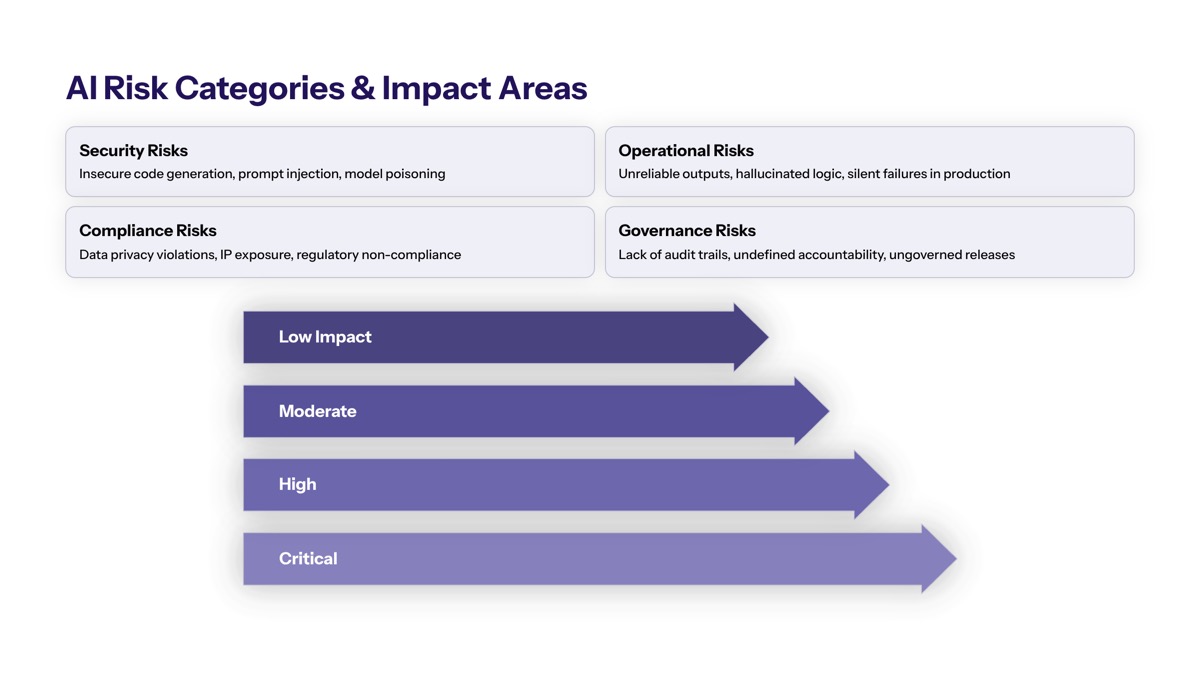
AI Risk Categories and Impact Areas
Once the foundational risks are understood, enterprise leaders need a practical way to categorize AI risk across code, data, agents, and release workflows. Risk categories help teams decide where lighter controls are acceptable and where stricter governance frameworks are required. A prototype UI component does not need the same oversight as an AI-assisted change to payment processing, healthcare logic, authentication, or production deployment automation.
The most material risk categories in AI-enabled software development are code security and vulnerability risks, data governance and privacy risks, and AI agent and permission risks. Each category affects business objectives differently: security vulnerabilities can create breach exposure, data leakage can trigger regulatory consequences, and uncontrolled agents can turn automation into an operational attack path.
Code Security and Vulnerability Risks
AI generated code can contain the same vulnerability classes found in human written code, but it may introduce them at higher speed and larger scale. Common examples include SQL injection, cross-site scripting, server-side request forgery, cryptographic failures, missing input validation, insecure deserialization, weak session handling, and authentication or authorization bypasses. These issues are especially dangerous when generated code looks syntactically correct and passes basic functional tests.
Dependency confusion and software supply chain attacks are another major impact area. AI tools may recommend packages from public repositories without verifying publisher reputation, maintenance history, license obligations, or known vulnerabilities. In a high-velocity ai development environment, a developer may accept a suggested package without checking whether it is malicious, abandoned, typosquatted, or incompatible with enterprise security policies.
Insecure API implementations also deserve focused attention. AI coding assistants may generate API handlers that expose tokens, skip rate limiting, mishandle secrets, or implement authorization checks incorrectly. For enterprise systems, API misuse can lead to privilege escalation, data exposure, and business logic abuse. Security controls should therefore evaluate not only whether code works, but whether it fits the application’s security context and secure coding practices.
Data Governance and Privacy Risks
Data governance and privacy risks appear when AI systems access, process, store, or generate outputs based on sensitive data. Prompts can contain customer information, credentials, proprietary source code, internal design documents, incident reports, or regulated records. If those prompts are sent to external services without approved controls, the organization may create confidentiality, data residency, retention, and consent problems.
Compliance exposure is significant. GDPR, HIPAA, CCPA, LGPD, financial services rules, and industry-specific regulations can restrict how personal or regulated data is processed by ai technologies. The eu ai act also increases the need for documentation, transparency, risk controls, and oversight for certain high-risk AI use cases. AI governance important work includes determining which data can be used in prompts, which data can be used to train ai models, how long AI providers retain data, and whether outputs can be audited.
Intellectual property leakage is a separate but related risk. Developers may expose proprietary code, product strategy, customer-specific configurations, or protected algorithms when using generative ai tools. AI models may also suggest code that resembles copyrighted or restrictively licensed training data. Responsible ai governance should include data classification, prompt rules, approved tool lists, contractual review, and auditability for AI model interactions.
AI Agent and Permission Risks
AI agent risks arise when automated systems are given permissions to take action rather than simply provide suggestions. An ai agent may read files, modify code, call internal APIs, create tickets, run commands, access repositories, update infrastructure, or trigger deployments. These capabilities can improve productivity, but excessive permissions can turn a prompt manipulation event into a system compromise.
Unauthorized system access and privilege escalation are central concerns. If an attacker can influence an agent through direct prompt injection, indirect prompt injection, poisoned documentation, malicious repository content, or compromised context, the agent may misuse its legitimate permissions. The risk is not only that the AI gives a bad answer; the risk is that the AI acts with trusted access.
AI agent governance therefore requires least privilege, identity and access management integration, sandboxing, approval workflows, audit logs, and real-time monitoring for high-risk actions. The goal is not to prevent all agentic AI, but to ensure AI-driven outcomes remain controlled, traceable, and aligned with business objectives. That leads directly to the need for a structured AI risk management framework.
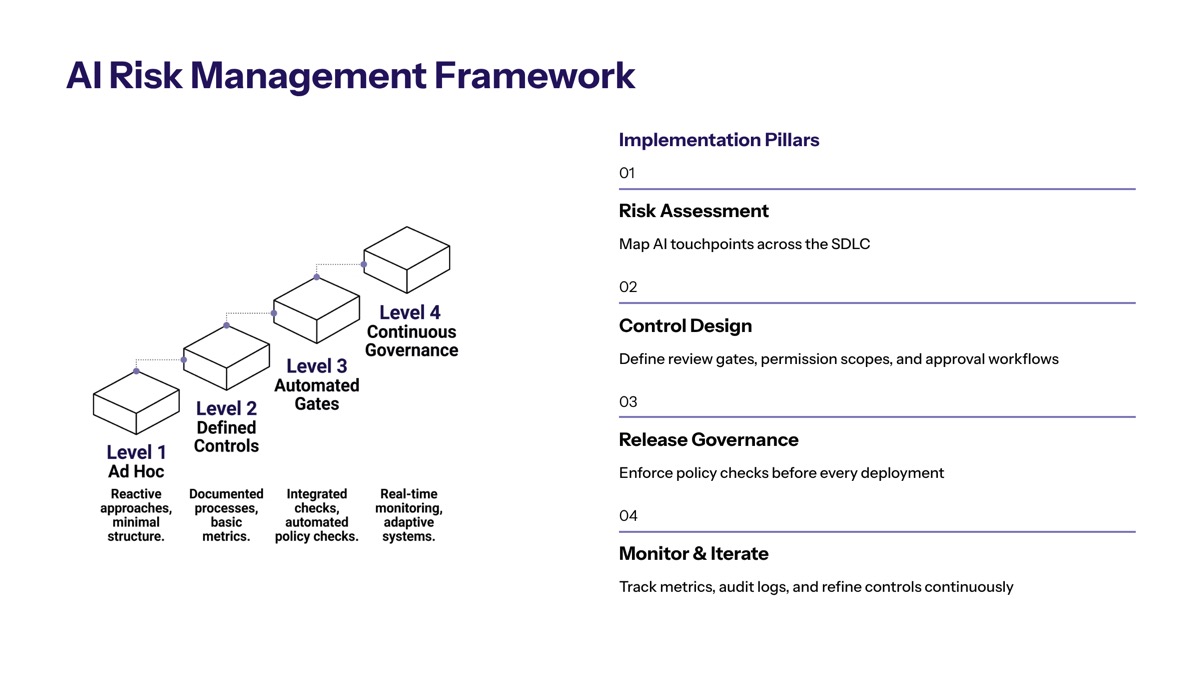
AI Risk Management Framework and Implementation
A practical AI risk management program turns risk awareness into repeatable governance processes. Instead of treating every AI use case the same, enterprise teams should classify AI systems by risk, apply appropriate controls, and monitor outcomes across the ai lifecycle. The strongest programs combine responsible ai principles, security engineering, compliance review, and delivery governance in a way that supports innovation without ignoring critical security issues.
A useful ai governance framework should answer five questions: which AI tools are in use, what data they access, what permissions they have, what risks they introduce, and what controls prove those risks are being managed. Frameworks such as the NIST AI Risk Management Framework organize this work around governance, mapping, measurement, and management. In software development, that translates into inventory, classification, secure development controls, monitoring, and incident response.
Risk Assessment and Classification Process
Organizations need structured risk assessment whenever AI tools are introduced into coding, testing, review, documentation, infrastructure, deployment, customer support, or any workflow involving sensitive data or production systems. This process should be simple enough for engineering teams to use, but strong enough for security teams, auditors, and business leaders to trust.
Inventory all AI tools and systems in development workflows. Document ai coding tools, ai coding assistants, chat interfaces, code review bots, test generation tools, AI agents, plugins, models, hosting arrangements, and integrations with repositories or CI/CD systems.
Classify AI systems by risk level based on data access and system permissions. Evaluate whether each AI system touches public data, internal data, customer data, regulated data, secrets, source code, infrastructure, or production environments.
Map AI tool dependencies and integration points with critical systems. Identify connections to source control, artifact repositories, package managers, build systems, issue trackers, cloud environments, APIs, and identity providers.
Assess potential impact of AI-related security incidents. Consider data breach exposure, service disruption, insecure code deployment, compliance penalties, intellectual property loss, customer impact, and incident response cost.
Document risk tolerance levels for different AI use cases. Define what is acceptable for low-risk documentation work, medium-risk internal tooling, and high-risk areas such as authentication, payments, healthcare workflows, regulated data processing, or autonomous deployment.
Risk classification should be reviewed regularly because AI initiatives evolve quickly. A tool that begins as a simple ai assistant for documentation can become a high-risk system if it later gains repository access, ticketing permissions, or production deployment capabilities.
Governance Controls Comparison
Governance controls should scale with risk. Low-risk AI use cases can often be managed with automated scanning, approved tools, and periodic review. Medium-risk use cases need tighter access controls and stronger human review. High-risk use cases require security expert involvement, real-time monitoring, release gates, and complete traceability.
Risk Level | Code Review Requirements | Data Access Controls | Monitoring Frequency |
|---|---|---|---|
Low Risk | Automated scanning only | Public data only | Weekly reports |
Medium Risk | Peer review + automated tools | Restricted data access | Daily monitoring |
High Risk | Security expert review required | No sensitive data access | Real-time monitoring |
This comparison is a starting point, not a complete control catalog. Effective ai governance may also include SAST, DAST, SCA, dependency allow-lists, secret scanning, sandboxed execution, prompt templates, model access rules, approval workflows, and release governance gates. For high-risk systems, generated code should be reviewed at least as rigorously as human written code, and AI agent actions should be logged with enough detail to support forensic analysis.
The right control level depends on the organization’s risk profile, regulatory obligations, software architecture, data sensitivity, and deployment model. Implementing ai governance does not mean applying maximum friction everywhere. It means matching controls to risk so that low-risk innovation can continue while high-risk systems receive the oversight they require. The remaining challenge is making these controls work in real enterprise environments.
Common Challenges and Solutions
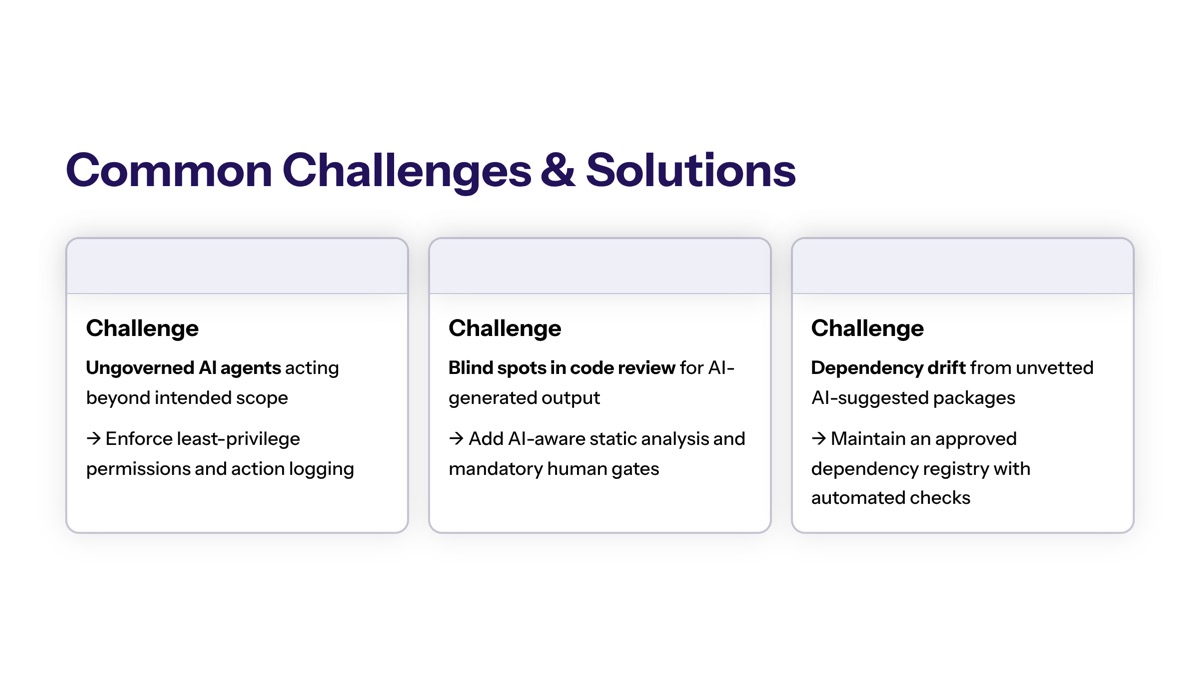
Enterprise teams often know they need AI risk management, but implementation is difficult because AI adoption is decentralized, fast-moving, and often driven by developer productivity pressure. The most common challenges are shadow AI, lack of AI security expertise, tension between speed and control, and growing compliance and audit requirements.
The solution is to make AI governance practices practical. Policies should be clear enough for developers to follow, technical controls should be embedded into existing workflows, and governance programs should create useful security feedback rather than only adding approval steps.
Shadow AI and Uncontrolled Tool Adoption
Shadow AI occurs when teams use unapproved AI tools, browser plugins, coding assistants, or autonomous agents without security review or centralized oversight. This creates unknown risks around sensitive data, generated code, tool permissions, and provider data handling practices.
The solution is to implement automated discovery tools and maintain an AI tool inventory across development teams. Organizations should use network monitoring, SaaS discovery, endpoint visibility, repository analysis, and developer surveys to identify which AI tools are in use. Then they should establish approved AI tool policies with clear usage guidelines, restricted data categories, permissions standards, and escalation paths for new AI use cases.
Lack of AI Security Expertise
Many engineering teams understand secure coding practices but have less experience with AI-specific threats such as prompt injection, system prompt extraction, model hallucination, data leakage through retrieval contexts, and AI agent role hijacking. Security teams may also be unfamiliar with how to audit generated code or evaluate whether AI outputs reflect the right security context.
The solution is specialized training combined with tooling. Developers should learn secure prompting techniques, AI threat modeling, dependency validation, and safe use of ai coding assistants. Security teams should integrate automated scanning tools that understand AI-generated code patterns and provide context aware remediation suggestions. For critical systems, human-in-the-loop review remains essential because automated tools can miss logic flaws, business rule violations, and architectural risks.
Balancing Innovation Speed with Risk Controls
AI adoption is often justified by speed: faster prototyping, faster refactoring, faster test generation, and faster delivery. The challenge is that insecure code can also move faster. If governance processes are too slow, teams bypass them; if controls are too weak, vulnerabilities and compliance issues reach production.
The solution is risk-based governance. Low-risk AI usage can rely on approved tools, automated scans, and lightweight review. Medium-risk work should require peer review, dependency checks, and security testing in CI/CD. High-risk AI development should require security expert review, restricted data access, real-time monitoring, and formal release approval. Automated remediation tools, policy-as-code, and security feedback inside developer workflows help reduce friction without ignoring AI risk.
Compliance and Audit Requirements
Compliance requirements are expanding as ai regulations mature and auditors expect traceability for AI-enabled development. Organizations need to show which AI tools were used, what data was accessed, which prompts or models influenced generated code, what reviews occurred, which security controls passed, and who approved release decisions.
The solution is comprehensive audit trails. Maintain records of AI tool usage, model configurations, data access, prompt policies, generated code origin, review decisions, security test results, agent actions, and deployment approvals. This supports regulatory compliance, data protection, incident response, and responsible ai governance. AI risk management is not a one-time implementation; it is an ongoing operating model that must evolve with the organization’s ai ecosystem.
Conclusion and Next Steps
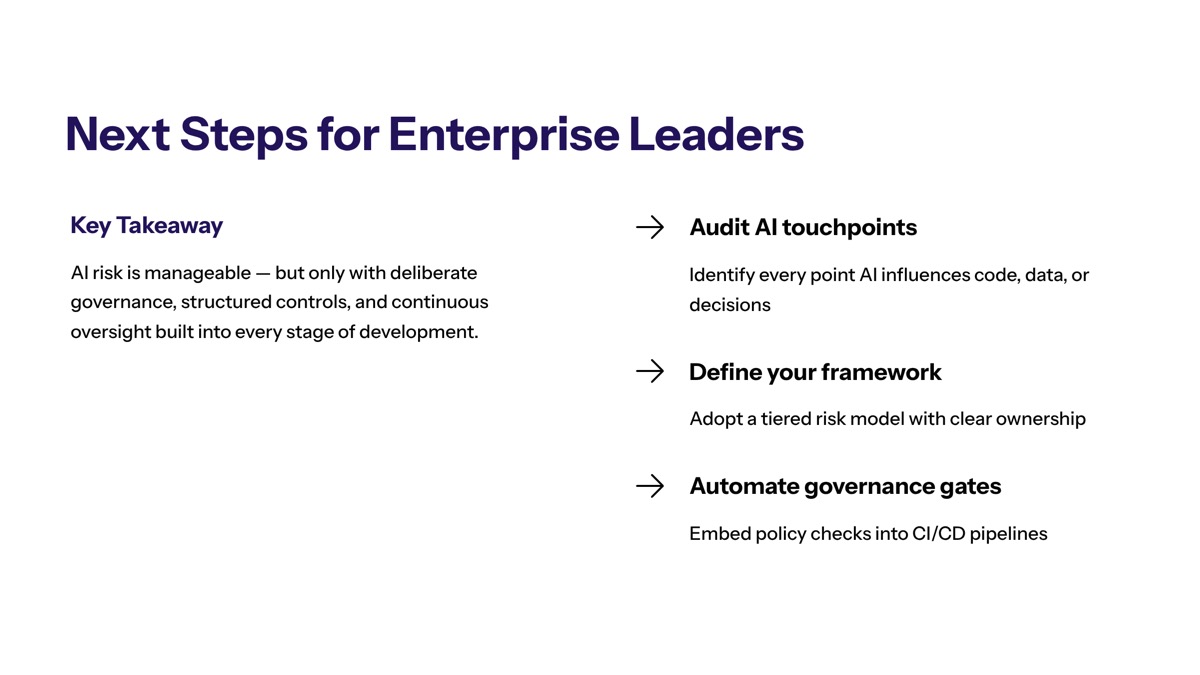
AI risk management in software development is essential for secure AI adoption without stifling innovation. AI tools can improve productivity, accelerate modernization, and support better engineering outcomes, but they also introduce security risks, data governance challenges, agent permission issues, and compliance obligations that require structured oversight.
Enterprise leaders should start with practical, high-impact actions:
Conduct an AI tool inventory and risk assessment. Identify all AI tools, AI systems, coding assistants, models, agents, integrations, data flows, and permissions in use across development teams.
Establish governance policies and security controls. Define approved tools, acceptable data use, review requirements, dependency rules, prompt standards, and release governance gates by risk level.
Implement monitoring and compliance systems. Track generated code, vulnerabilities, agent activity, sensitive data exposure, audit trails, and policy exceptions throughout the ai lifecycle.
Train development teams on AI security best practices. Build shared understanding across engineering teams, security teams, and business leaders so responsible ai becomes a collective responsibility.
Related areas worth exploring include AI governance frameworks, secure AI architecture design, AI-first development methodologies, and responsible ai governance programs. Each helps organizations move from ad hoc AI adoption to controlled, measurable, and compliant AI-enabled software delivery.
Additional Resources
NIST AI Risk Management Framework: A useful foundation for mapping, measuring, managing, and governing AI risk across enterprise systems.
EU AI Act and sector-specific regulations: Important for organizations building or using high-risk AI systems, especially in regulated industries.
AI security tooling: SAST, DAST, SCA, secret scanning, dependency monitoring, prompt monitoring, AI agent activity logging, and automated remediation platforms.
Internal governance materials: Approved AI tool lists, secure prompting standards, data classification policies, AI development playbooks, and release governance checklists.