AI Strategy and Implementation Services: Turning AI Plans Into Governed Delivery
AI strategy and implementation services help enterprises connect use-case selection, roadmap design, architecture, governance, integration, testing, and production delivery. The goal is to turn AI plans into governed systems and workflows that create measurable business value.
CEOs, CTOs, operations executives, transformation leaders, and enterprise teams can use this article to compare AI consulting, delivery planning, and implementation support. It explains what strategy-to-delivery services include, why AI strategy fails without delivery planning, how consulting differs from implementation, and how RAPID can structure strategy-to-execution work.
AI strategy is only useful when it defines what the business will do next. Implementation turns that direction into workflows, architecture, ownership, governance, integrations, and measurement. Without both sides, organizations risk building prototypes that never become operating capabilities.
The more useful evaluation starts with strategy fit: whether the implementation partner can connect business priorities, workflow design, data readiness, security controls, delivery planning, and measurable outcomes.
What AI Strategy-to-Implementation Services Include
AI strategy-to-implementation services usually start with business alignment. Teams identify business constraints, use cases, stakeholders, systems, data sources, risk boundaries, and success metrics. The strategy should clarify which AI opportunities are worth pursuing and why.
The implementation side turns that strategy into practical delivery. It defines architecture, integrations, data readiness, workflow design, governance, testing, user adoption, monitoring, and support. A plan without implementation detail may create alignment, but it will not change how work happens.
Strong services connect both. They do not begin with model selection alone. They begin with business value, then define the technical and operating model required to deliver it. That includes ownership, decision rights, evidence, and post-launch improvement.
Why AI Strategy Fails Without Implementation Planning
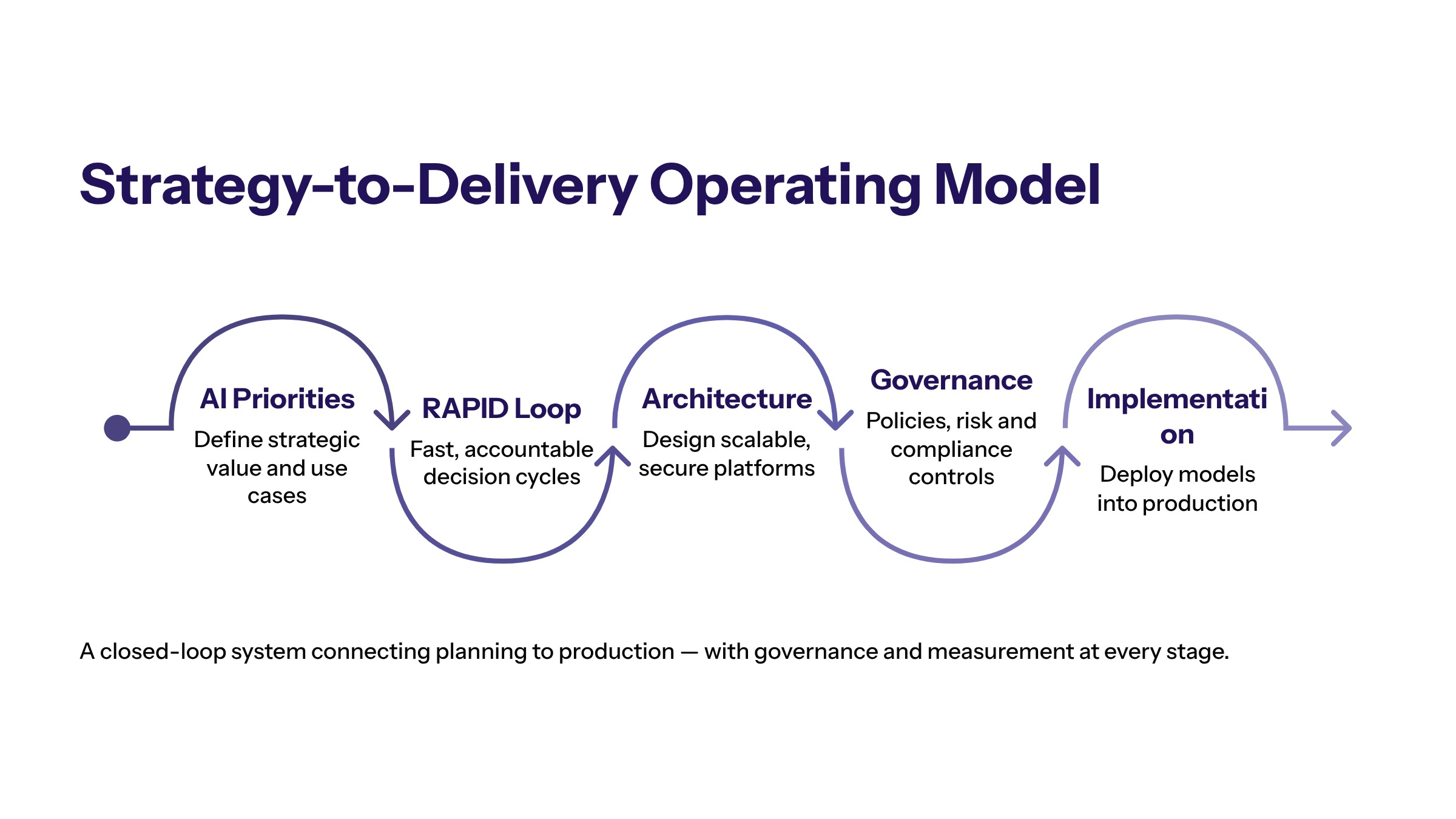
AI strategy often fails when it remains too abstract. A roadmap may list use cases, platforms, or innovation themes, but it may not define workflow fit, data readiness, system integration, security controls, or who owns the outcome. That gap can leave teams with good ideas and weak execution.
Implementation planning forces strategy to confront constraints. Does the data exist? Is it approved for use? Which systems need integration? Who reviews AI outputs? What happens when the model is uncertain? How will success be measured? Who supports the workflow after launch?
These questions are not technical details to postpone. They are what determine whether an AI strategy can become a real business capability. The earlier they are answered, the easier it is to prioritize work and avoid scattered pilots.
Strategy without implementation can also create stakeholder fatigue. Teams may attend workshops, approve ideas, and watch prototypes appear without seeing durable operational change. A delivery-oriented strategy should create a decision path from idea to pilot to production.
AI Consulting vs AI Implementation Services
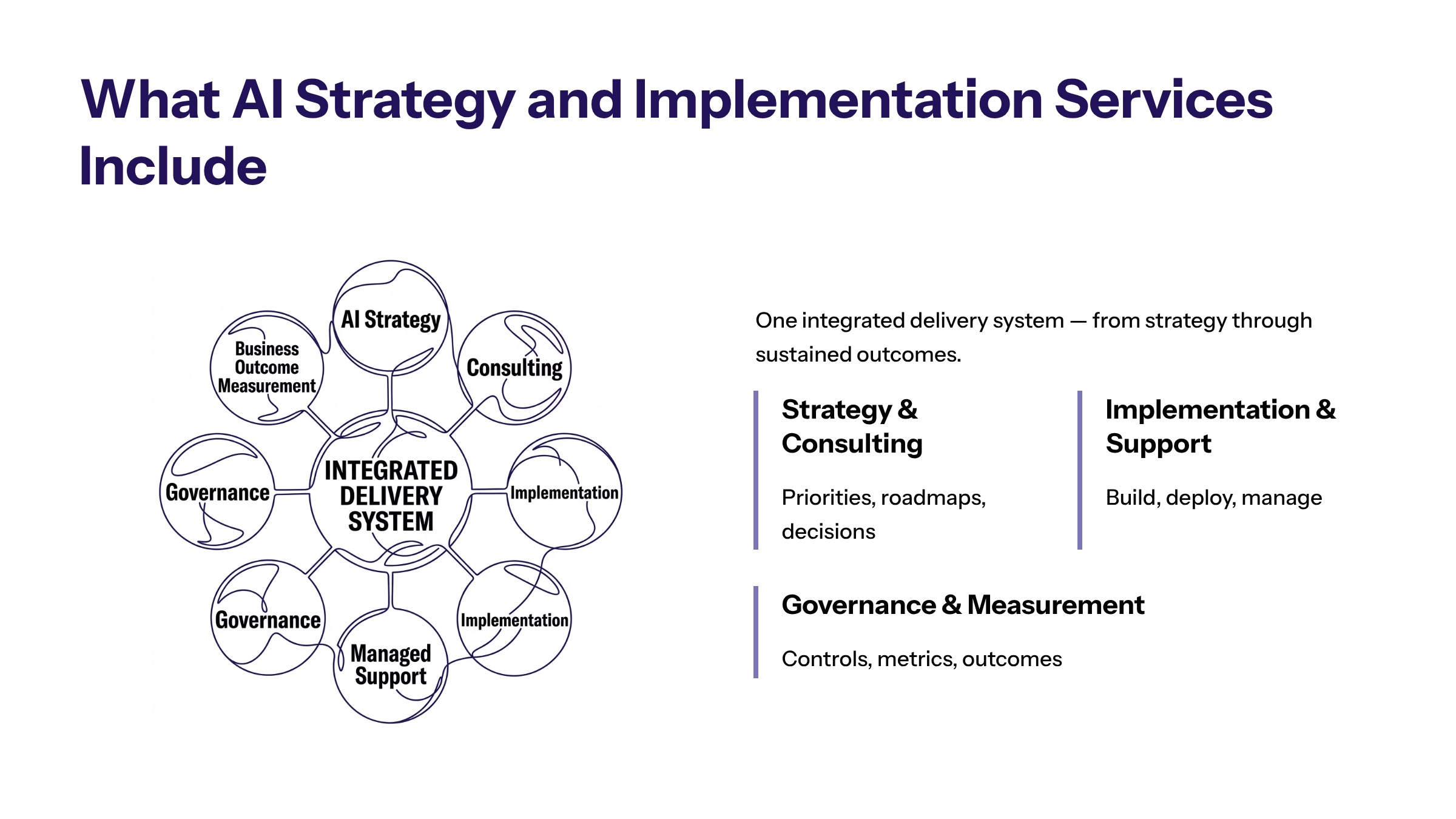
AI consulting and implementation services overlap, but they are not identical. Consulting may define opportunity, assess readiness, guide governance, and shape the roadmap. Implementation services build, integrate, test, launch, and support the AI workflow or system.
Service Area | Main Question | Deliverable | Risk if Missing |
|---|---|---|---|
AI strategy | What should the business pursue? | Use-case portfolio, roadmap, success criteria. | Disconnected pilots and unclear priorities. |
AI consulting | How should the organization approach the work? | Readiness assessment, governance model, planning support. | Weak alignment and hidden constraints. |
AI implementation | How will the system or workflow be delivered? | Architecture, integration, testing, deployment, support. | Strategy never becomes production capability. |
Managed support | How will the workflow improve after launch? | Monitoring, optimization, change control, user support. | Degraded workflows and unowned automation. |
The best AI consulting and implementation services connect these areas instead of treating them as separate handoffs. The strategy should inform architecture. Architecture should support governance. Implementation should produce evidence. Evidence should guide the next decision.
RAPID Framework for AI Strategy and Delivery
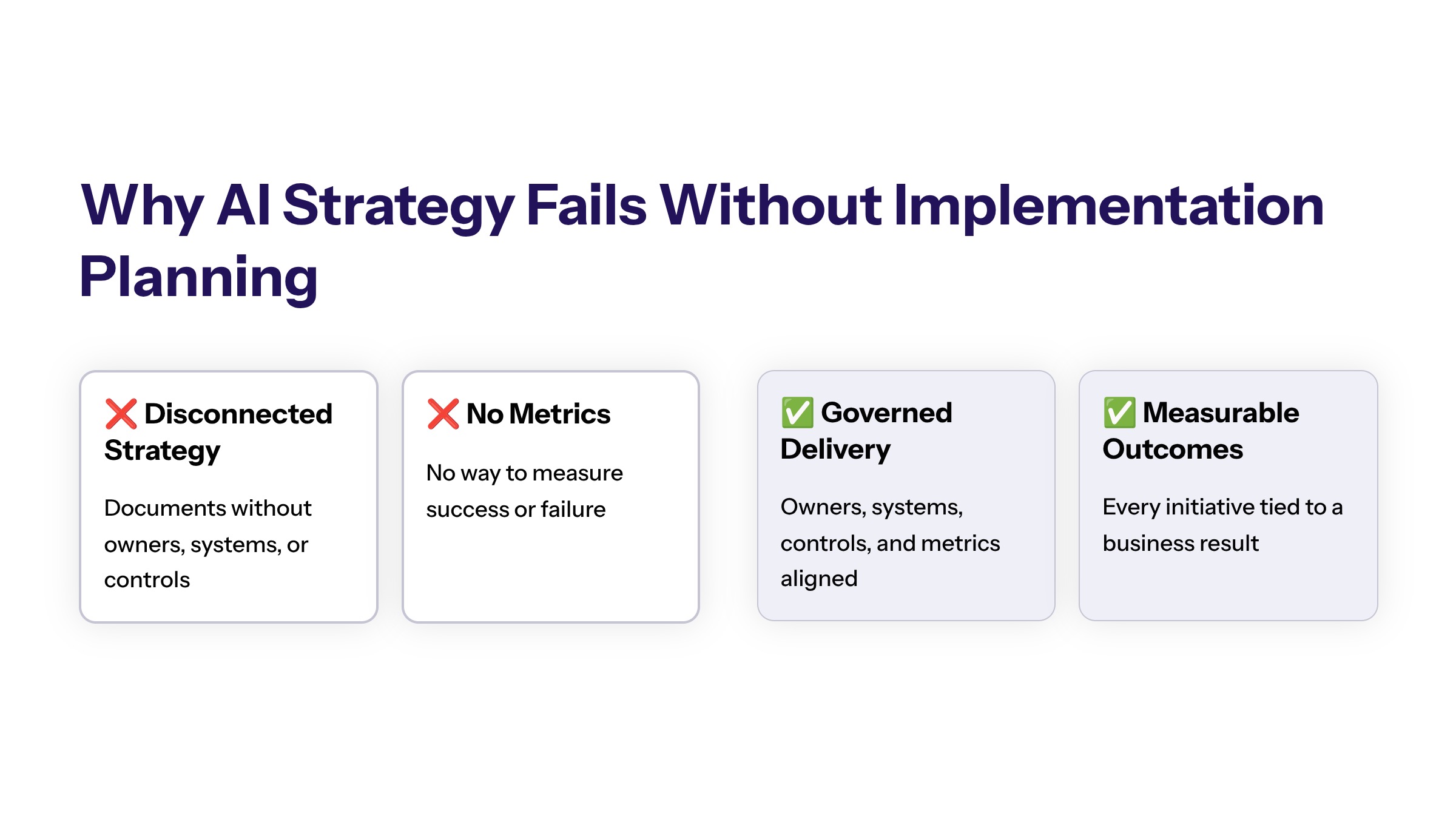
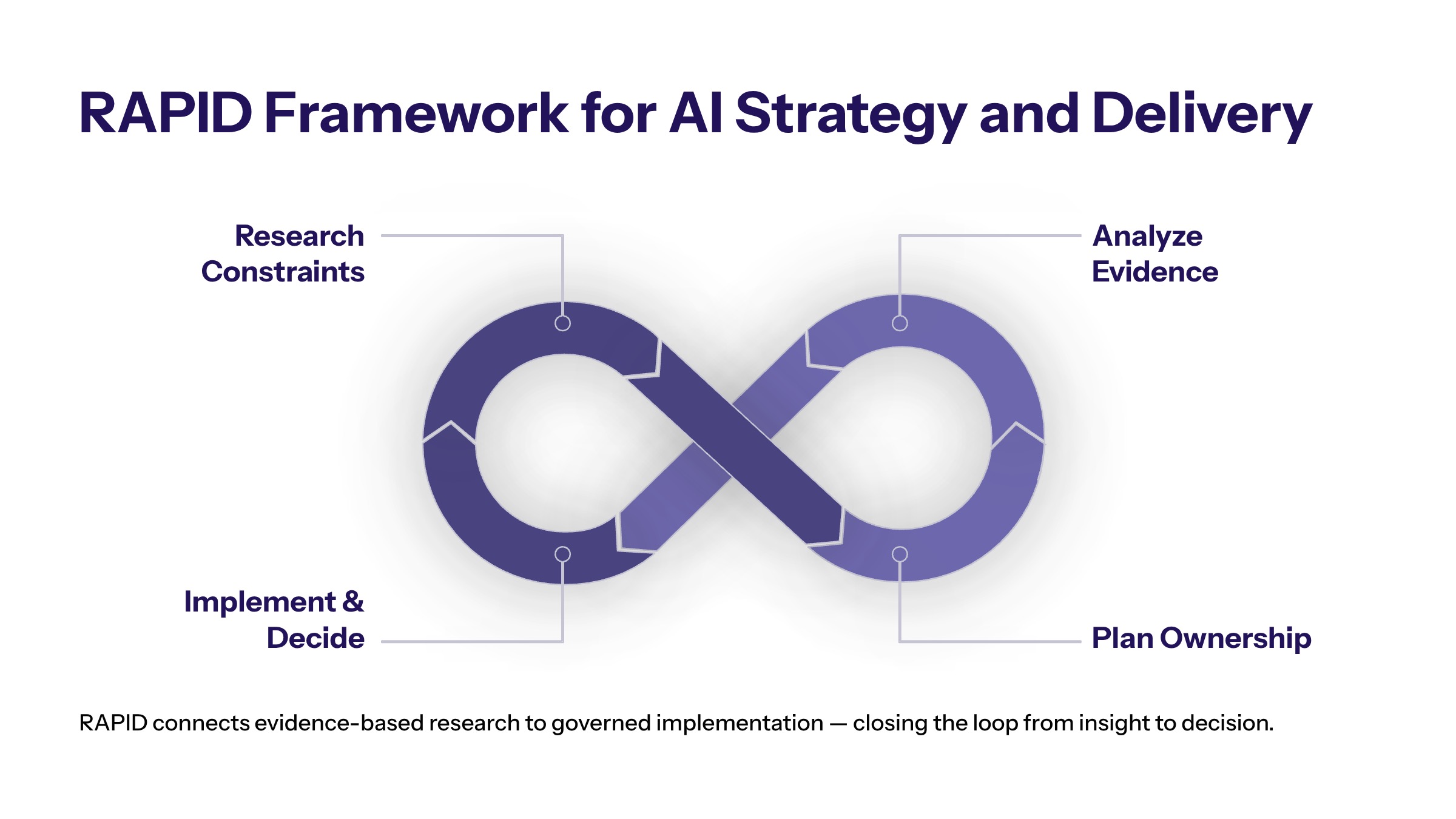
RAPID can structure AI strategy and implementation because it keeps research, analysis, planning, implementation, and decision-making connected. The value is not the label. The value is the operating rhythm that prevents AI work from drifting into disconnected experimentation.
Research maps business goals, workflows, systems, data sources, stakeholders, and constraints. Analyze identifies use-case fit, risk, readiness, and value. Plan sequences the work around priorities, dependencies, governance, and measurable outcomes. Implement builds and tests the workflow or system. Decide uses evidence to scale, revise, pause, or stop.
This framework is useful because AI initiatives often fail at decision points. Teams know AI matters, but they struggle to decide which use cases matter first, what should be built, what should be bought, and what risk controls are required. RAPID gives those decisions a practical structure.
For strategy-to-delivery work, RAPID should be used as delivery discipline, not decoration. It should shape the roadmap, meeting cadence, evidence requirements, and decision criteria.
Architecture, Governance, and Secure Deployment
AI implementation needs architecture. Models, prompts, and prototypes cannot operate safely without data access, identity, integrations, workflow state, logging, monitoring, and user interfaces. Architecture translates strategy into a system that people can use.
Governance defines ownership and control. It should clarify who owns the use case, who owns the data, who approves changes, who reviews exceptions, who monitors performance, and who decides whether to scale. Without governance, implementation can create new operational dependencies that no one owns.
Secure deployment requires access controls, audit trails, input handling, human review, data boundaries, and incident response. When AI affects customer workflows, revenue, finance, compliance-sensitive work, or employee records, the control model should be built into the implementation plan.
AI services should connect these elements instead of treating implementation as a one-time build. The system needs support after launch because data, users, business rules, and workflows change.
How to Prioritize AI Implementation Services for Businesses
AI implementation services for businesses should be prioritized by business value, workflow clarity, data readiness, integration feasibility, risk, and adoption. A use case may be strategically attractive but not ready for implementation if the data is poor or ownership is unclear.
A practical prioritization model should ask six questions. What business constraint does this solve? How often does the workflow occur? What data is required? Which systems need integration? What risks must be controlled? How will success be measured?
High-priority use cases often have visible friction, clear owners, measurable baselines, and bounded scope. Lower-priority use cases may be interesting but too broad, too risky, or too dependent on unresolved system changes.
Prioritization should also consider sequencing. A data readiness project may need to happen before an AI workflow. A governance model may need to exist before agents receive system access. A pilot may need to prove value before the organization invests in a broader platform.
How to Evaluate AI Implementation Services Companies
Teams evaluating AI implementation services companies should prioritize service fit. The right partner should understand business strategy, architecture, governance, secure development, integration, testing, adoption, and support.
Useful evaluation questions include: can the partner map workflows before recommending tools? Can they design secure architecture? Can they integrate with existing systems? Can they define governance and ownership? Can they support production after launch? Can they explain how success will be measured?
Buyers should also evaluate transparency and ownership. Who owns code, prompts, workflow configuration, documentation, and data mappings? Can the organization move to another provider or model later? Does the implementation create flexibility or dependency?
The best partner is not simply the one with the most AI language. It is the one that can help the organization make decisions, implement safely, and prove value through evidence.
AI Strategy Implementation Roadmap
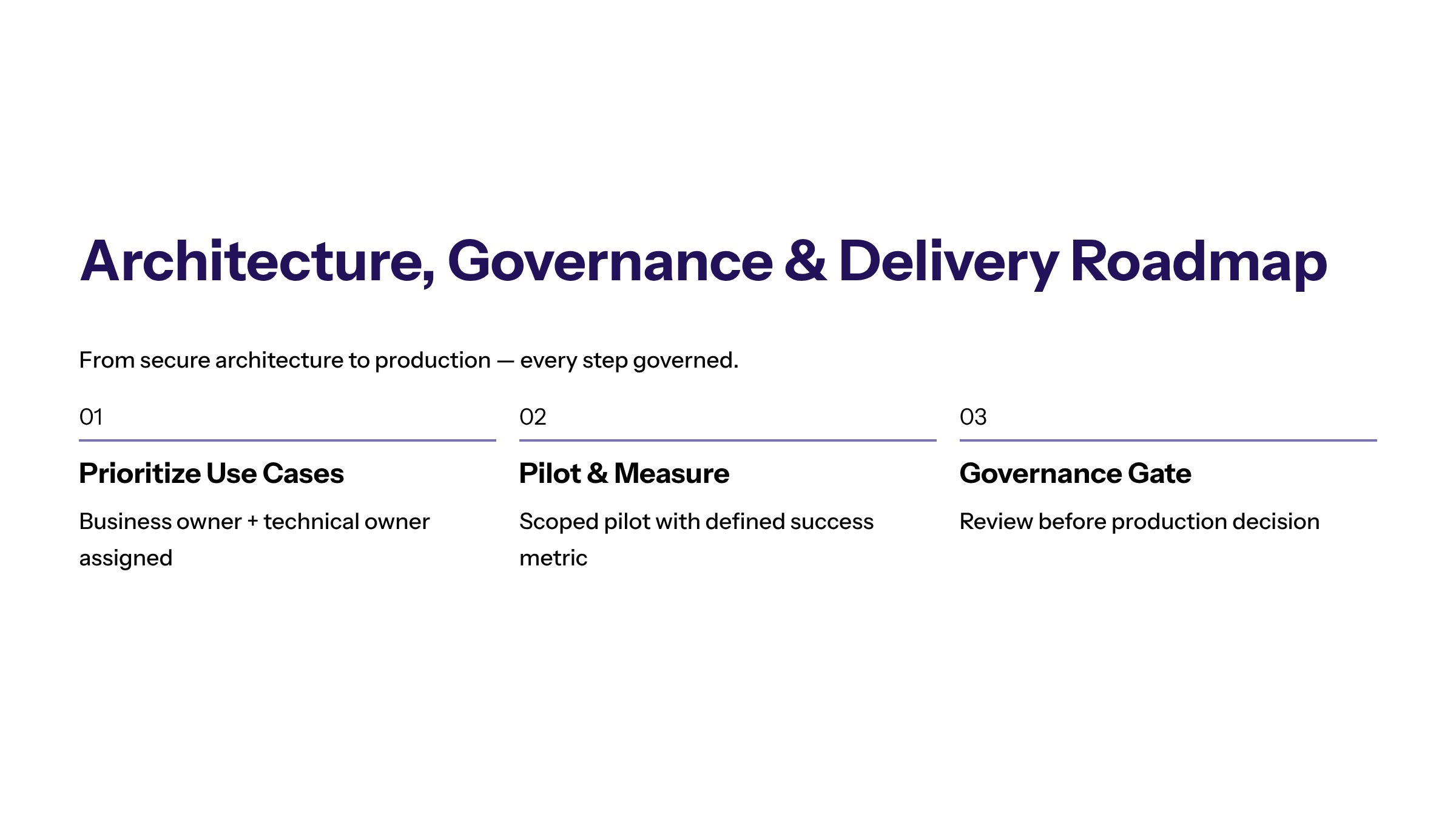
A practical AI strategy and implementation roadmap moves from discovery to production in controlled stages. It should create decisions at each stage instead of assuming every idea deserves full deployment.
Assess business constraints. Identify workflows, systems, data, stakeholders, and desired outcomes.
Prioritize use cases. Score opportunities by value, readiness, risk, and implementation feasibility.
Design architecture and governance. Define data access, integrations, review thresholds, logging, and ownership.
Build a focused pilot. Test one workflow with real users and controlled scope.
Measure evidence. Review workflow metrics, control metrics, user feedback, and operational impact.
Decide the next step. Scale, revise, pause, or stop based on evidence.
Common Strategy-to-Implementation Gaps
The first gap is unclear ownership. A strategy may identify promising use cases, but if no business owner is accountable for the workflow, implementation will struggle. Ownership should include business value, data access, adoption, and post-launch performance.
The second gap is weak data readiness. AI strategy often assumes the organization can access useful data, but implementation reveals disconnected systems, inconsistent records, or unclear data rights. Data readiness should be assessed before a use case is promised as production-ready.
The third gap is missing governance. AI implementation needs approval thresholds, audit evidence, access controls, human review, and change control. If governance is treated as a policy document instead of a workflow design requirement, implementation risk rises.
The fourth gap is poor measurement. Teams may celebrate launch without knowing whether the workflow improved. Strategy should define measurement before implementation begins, including baseline metrics and decision criteria for scale.
Operating Model After Implementation
Strategy and implementation programs should define what happens after launch. Production AI workflows need monitoring, support, user feedback, release control, and periodic review. Without an operating model, the system may drift from the original strategy.
The operating model should include a business owner, technical owner, data owner, and risk owner. These roles keep the workflow useful, secure, and aligned with business priorities. They also make it easier to decide whether to expand, revise, or retire an AI capability.
Post-launch review should compare expected outcomes with actual evidence. If the workflow improves visibility and reduces friction, the organization can consider adjacent use cases. If the workflow creates confusion or weak evidence, the right move is to revise before scaling.
Readiness Checklist for AI Strategy and Implementation
Before moving from strategy into implementation, teams should confirm that the use case has a business owner, a measurable outcome, an approved data path, an integration plan, a governance model, and a support owner. If the strategy does not answer those questions, implementation may begin with hidden risk.
The checklist should also define decision gates. What evidence is required to move from assessment to pilot? What evidence is required to move from pilot to production? What would cause the team to pause or stop? These gates keep AI implementation services focused on evidence rather than momentum.
A clear readiness model makes AI strategy more practical. It gives leaders a way to compare opportunities, sequence work, and avoid launching projects that are not ready for governed delivery.
Decision Gates Before Scaling AI Work
AI strategy should include decision gates because not every use case should move from idea to production. A gate after discovery confirms that the business problem is real. A gate after planning confirms that data, architecture, and governance are ready. A gate after the pilot confirms whether evidence supports scale.
These decision gates protect budget and focus. They help teams stop weak use cases early and invest more confidently in workflows that show value. They also make AI implementation services easier to manage because every stage has a clear decision, not just a next task.
How to Turn AI Strategy Into Delivery
AI strategy and implementation services should help organizations move from AI interest to governed delivery. Start with business constraints, prioritize use cases, design architecture and governance, and implement one workflow with measurable outcomes.
The strongest AI programs connect strategy to execution. They do not stop at ideas, and they do not rush into tools before the business knows what it needs AI to accomplish.
Frequently Asked Questions About AI Strategy and Implementation Services: Turning AI Plans Into Governed Delivery
AI strategy defines priorities, business goals, governance direction, and roadmap. AI implementation turns that direction into workflows, architecture, integrations, testing, deployment, and support. For related reading, see building AI agents.
It should start with a business problem. Model selection should follow workflow fit, data readiness, governance needs, and measurable outcomes. For related reading, see AI agent architecture.
RAPID creates a decision rhythm: research the context, analyze constraints, plan around value, implement with controls, and decide based on evidence. For related reading, see AI agent use cases.
AI strategy should come first because it defines the business goal, workflow fit, ownership model, governance needs, and measurement plan. Implementation is stronger when the team knows what problem it is solving. For related reading, see AI agent workflows.
AI strategy should answer who owns the workflow, what data can be used, what actions need approval, how evidence is captured, and how incidents are handled. These decisions shape the implementation. For related reading, see generative AI implementation.
Teams should prioritize workflows with clear value, accessible data, defined ownership, manageable risk, and measurable outcomes. High uncertainty workflows should wait until the operating model is clearer. For related reading, see AI-first architecture.