Approval Chains as a System Failure: Reducing Decision Latency
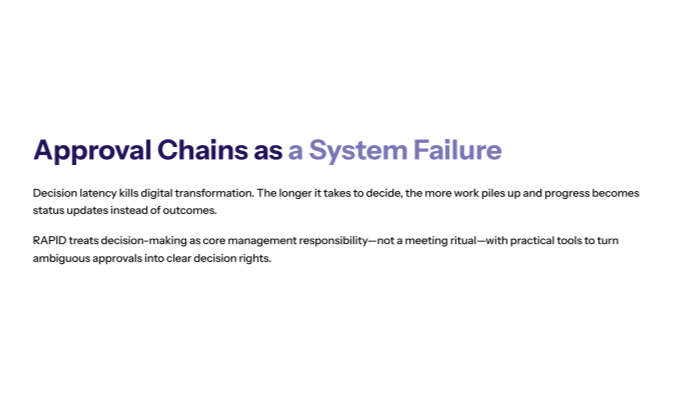
Approval chains don’t slow transformation because people are lazy. They slow transformation because the system is designed to delay decisions.
And in digital transformation, decision latency is a killer: the longer it takes to decide, the more work piles up, the more handoffs fracture, and the more “progress” becomes status updates instead of outcomes.
RAPID treats this problem directly. It frames decision-making as a core management responsibility (not a meeting ritual), and it gives you practical tools—especially the Decision Inventory—to turn ambiguous approvals into clear decision rights, owners, and priorities.
This post shows how to reduce decision latency by treating approval chains as a design flaw in your operating model—then fixing it with RAPID’s evidence-first approach.

Why approval chains exist and why they fail under transformation?
1.1 Approval chains are a symptom of unclear ownership
Most approval chains start with good intent: reduce risk, increase alignment, prevent mistakes. But they often evolve into a substitute for clarity.
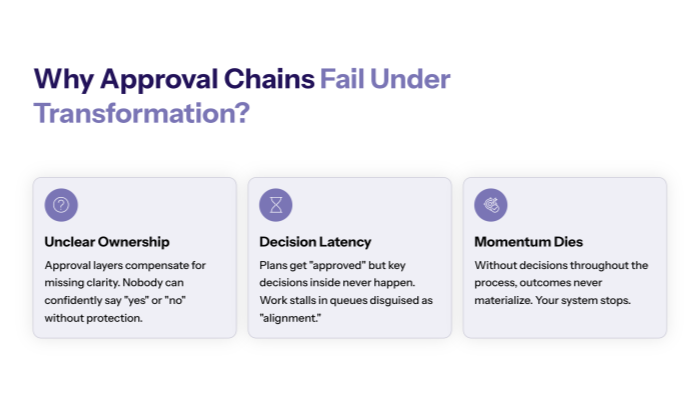
When outcomes aren’t ranked, decision rights aren’t explicit, and risks aren’t surfaced, organizations compensate by adding approval layers. Work doesn’t move because nobody can confidently say “yes” (or “no”) without protection.
RAPID’s toolkit makes the opposite move: identify the decisions that drive outcomes, assign owners, link decisions to customer value, and prioritize them—so approvals stop being “everyone’s job” and become an owned execution mechanism.
When that structure is missing, decision latency becomes the default safety mechanism.
1.2 Decision latency is where momentum dies
RAPID is explicit that decisions are not a final step—they happen throughout the process, and if even one critical decision never gets made, the outcome never happens.
That’s exactly how decision latency works in real transformation programs:
- the plan is “approved,” but key decisions inside the plan are not
- teams wait for clarifications
- risks escalate quietly
- work stalls in queues (often disguised as “alignment”)
RAPID’s view is blunt: decisions create momentum; without them, your system stops.
Diagnose decision latency with RAPID (don’t debate it—measure it)
2.1 Use the Decision Inventory to expose the real approval chain
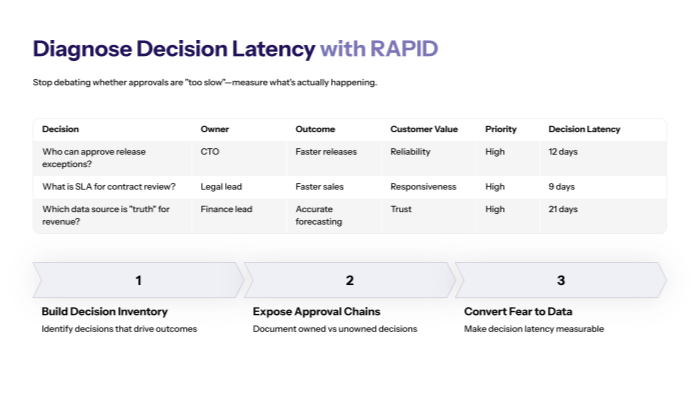
RAPID defines the Decision Inventory with a clear objective: making decisions is the hardest and most important management task, and the exercise starts by identifying the decisions that drive outcomes and success.
This is where you stop arguing about whether approvals are “too slow” and start documenting what’s actually happening.
Build a Decision Inventory specifically for decision latency using RAPID’s structure: decisions posed as questions, with owners, linked to outcomes and customer value, prioritized (and optionally dated).
Here’s a practical version you can drop into your week:
|
Decision (posed as a question) |
Who owns it? |
Outcome impacted |
Customer value impacted |
Priority |
Target decision date |
Current decision latency |
|---|---|---|---|---|---|---|
|
Who can approve release exceptions? |
CTO / Eng leader |
Faster releases |
Reliability |
High |
Weekly |
12 days |
|
What is the SLA for contract review? |
Legal lead |
Faster sales cycle |
Responsiveness |
High |
This week |
9 days |
|
Which data source is “truth” for revenue? |
Finance lead |
Accurate forecasting |
Trust |
High |
This week |
21 days |
The moment you build this, approval chains become visible as a sequence of owned or unowned decisions—and decision latency becomes measurable.
2.2 Pair it with Risks (Fears): approvals often exist to manage fear
RAPID includes a Risks (Fears) Inventory specifically to convert fear into data points and remove emotion.
This matters because high decision latency is often a fear-management strategy:
- fear of blame → “let’s get more sign-off”
- fear of compliance → “legal must approve everything”
- fear of being wrong → “wait for more data”
- fear of change → “pause until the steering committee meets”
When you translate those fears into explicit entries (probability + cost), you can decide what controls are actually necessary—and where approvals are just inherited anxiety.
The approval-chain failure modes that inflate decision latency
3.1 The “committee loop”: consensus replaces decision ownership
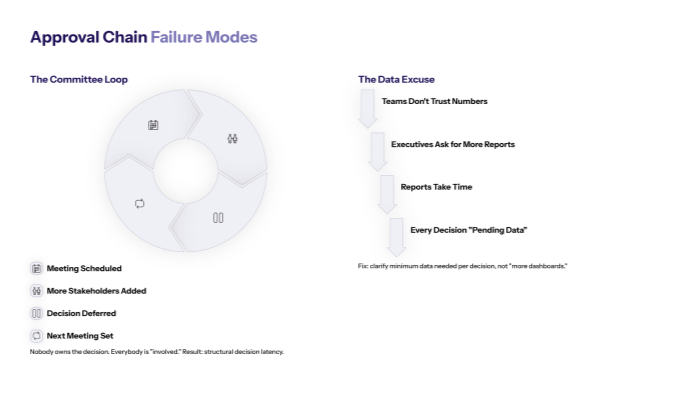
The committee loop looks like this:
- decision needed
- meeting scheduled
- more stakeholders added
- decision deferred (“need more input”)
- next meeting scheduled
Nobody “owns” the decision. Everybody is “involved.” The outcome is decision latency as a structural feature.
RAPID’s philosophy is the opposite: decisions drive outcomes, and decisions must be owned and prioritized—otherwise momentum collapses.
3.2 The “data excuse”: reporting delays become permission to wait
RAPID repeatedly highlights how lack of timely, accurate data creates major issues and undermines decision-making.
This is a classic decision latency amplifier:
- teams don’t trust the numbers
- executives ask for more reports
- reports take time to generate
- every decision becomes “pending data”
The fix is not “more dashboards.” The fix is clarifying the minimum data needed for each decision and making the reporting flow consistent enough that decision owners can decide. RAPID’s approach here is practical: if you can’t get timely, accurate data, issues become inevitable.
How to reduce decision latency? (design a decision system, not a meeting cadence)
4.1 Reduce decision latency with decision rights + SLAs + delegation
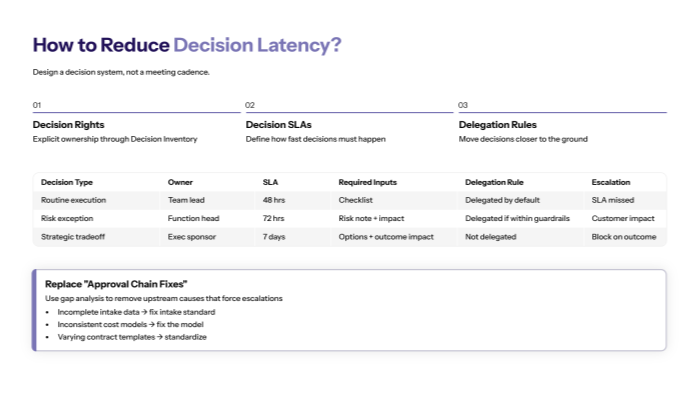
If you want to cut decision latency, you need three design elements:
1) Decision rights (who decides)
RAPID forces this through the Decision Inventory “Who?” column—explicit ownership.
2) Decision SLAs (how fast a decision must happen)
If no SLA exists, decision-making expands to fill the calendar.
3) Delegation rules (when decisions move closer to the ground)
RAPID calls out a critical leadership decision: management must decide to “no longer decide” implementation details—so the team closest to the work can make decisions and keep momentum.
That’s not a culture slogan. It’s an operating rule that directly reduces decision latency.
Here’s an example “decision design” table you can use:
|
Decision type |
Default owner |
SLA |
Required inputs |
Delegation rule |
Escalation trigger |
|---|---|---|---|---|---|
|
Routine execution |
Team lead |
48 hrs |
checklist |
delegated by default |
SLA missed |
|
Risk exception |
Function head |
72 hrs |
risk note + impact |
delegated if within guardrails |
customer impact risk |
|
Strategic tradeoff |
Exec sponsor |
7 days |
options + outcome impact |
not delegated |
block on ranked outcome |
4.2 Replace “approval chain fixes” with gap analysis + easy wins
Approval chains often sit on top of broken process interfaces and unclear product/tool behavior.
RAPID’s Analyze phase includes Process Gap Analysis and Product Gap Analysis to convert research into specific improvements aligned to customer value and outcomes.
Instead of saying “we need fewer approvals,” you can say:
- “This step exists because intake data is incomplete → fix intake standard.”
- “Finance reviews every request because cost models are inconsistent → fix the model.”
- “Legal reviews everything because contract templates vary → standardize templates.”
Then pick Easy Wins to build confidence and deliver tangible improvements quickly.
This matters because decision latency often drops fastest when you remove the upstream causes that force escalations—rather than trying to police people into deciding faster.
Sustain low decision latency (avoid KPI theater and keep the flywheel moving)
5.1 Measure decision latency honestly—or you’ll drift into vanity metrics
RAPID warns directly against vanity metrics: selectively chosen measurements that make leadership feel good about decisions that are actually failing.
If you don’t measure decision latency honestly, you’ll create “KPI theater”:
- lots of dashboards
- lots of meetings
- no faster execution
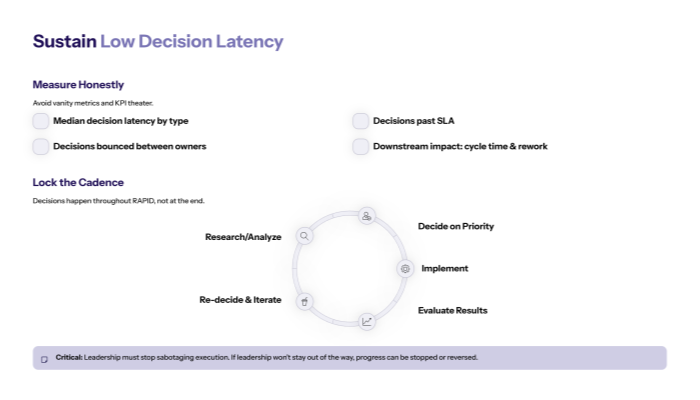
Keep measurement simple and operational:
- median decision latency by decision type
- number of decisions past SLA
- number of decisions bounced between owners
- downstream impact: cycle time and rework
And when measurement shows reality, RAPID’s Decide phase gives you only three choices: stay, change, or stop.
5.2 Lock the cadence: decisions happen throughout RAPID, not at the end
RAPID is explicit that Decide happens throughout all phases, feeding decisions back into the other phases and keeping momentum going.
That’s why the best operating rhythm is not “monthly steering committee approvals.” It’s a tight loop:
- Research/Analyze surfaces constraints
- decisions are made on priority blockers
- implementation happens
- results are evaluated
- you re-decide and iterate
RAPID describes this as a fluid progression and a flywheel that keeps improving itself through focused information, better iterations, and better planning/decision-making.
Also: leadership has to stop sabotaging execution. RAPID makes the risk explicit—if leadership won’t stay out of the way, progress can be stopped or even reversed.
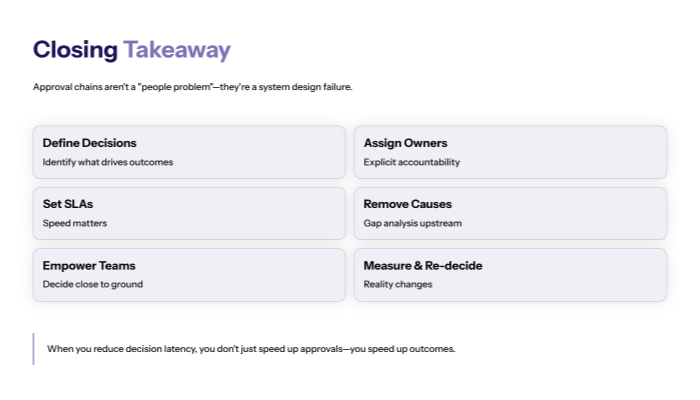
Closing takeaway
Approval chains aren’t a “people problem.” They’re a system design failure that shows up as decision latency.
If you want transformation to move, treat decision-making like a product:
- define the decisions
- assign owners
- set SLAs
- remove upstream causes with gap analysis
- empower teams to decide close to the ground
- measure honestly and re-decide as reality changes
When you reduce decision latency, you don’t just speed up approvals—you speed up outcomes.