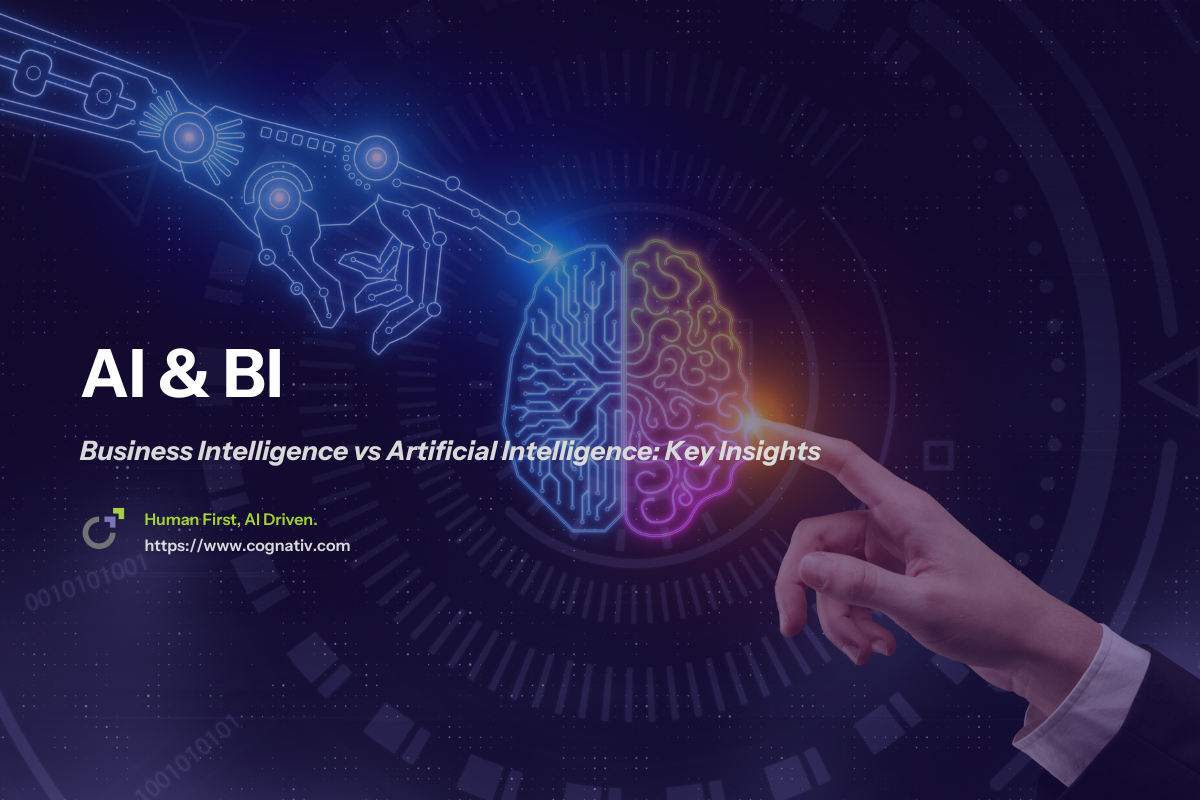
Business Intelligence vs Artificial Intelligence: Key Insights
In today’s data-rich business landscape, the distinction between Business Intelligence (BI) and Artificial Intelligence (AI) is more critical than ever for enterprise leaders. CIOs, CTOs, CISOs, CEOs, and CFOs face the challenge of integrating these technologies to optimize decision-making, operational efficiency, and competitive advantage.
This article explores the evolving roles of business intelligence vs artificial intelligence, highlighting their implications for enterprise adoption, cost management, compliance, risk mitigation, and strategic planning. It also examines how leading organizations and modern BI tools are harnessing AI algorithms and machine learning models to unlock deeper insights from business data and predict future outcomes.
Key Takeaways
-
Business intelligence primarily focuses on analyzing structured historical data to generate actionable insights and track key performance indicators (KPIs) for human decision making.
-
Key differences between business intelligence and artificial intelligence include BI’s emphasis on descriptive analytics and historical data, while AI focuses on predictive analytics, automation, and processing both structured and unstructured data.
-
Artificial intelligence leverages advanced algorithms and machine learning to process both structured and unstructured data, enabling predictive and prescriptive analytics that anticipate future trends.
-
The integration of AI and BI systems enhances operational efficiency, supports real-time data analysis, and automates report generation, transforming traditional BI into AI-powered BI platforms.
-
Enterprises must address challenges around data quality, governance, compliance, and interpretability to fully realize the benefits of AI-enhanced business intelligence.
-
Strategic adoption of AI and BI can drive competitive differentiation by enabling proactive decision making, improved customer behavior analysis, and optimized business processes.

Defining Business Intelligence and Artificial Intelligence in the Enterprise
Business intelligence refers to the frameworks, tools, and processes used to transform raw business data into meaningful insights. BI primarily focuses on analyzing historical data and past data to provide insights into previous performance and inform decision-making.
It traditionally relies on structured data stored in data warehouses, which serve as the primary source of structured historical data for BI. By analyzing historical data and past data, business analysts and business users can generate reports, visualize historical trends, and track key metrics. BI platforms like Microsoft Power BI, Tableau, and Qlik Sense have long served as the backbone for descriptive and diagnostic analytics, providing clarity on past performance and operational status.
Artificial intelligence, by contrast, encompasses computer systems designed to simulate human intelligence, typically requiring human intelligence to perform tasks such as learning, reasoning, and decision making.
AI uses machine learning algorithms, deep learning algorithms, and natural language processing to analyze vast volumes of structured and unstructured data. Deep learning algorithms enable AI systems to autonomously learn from data, recognize patterns, and make predictions.
Both BI and AI analyze data and involve analyzing data to generate insights, forecast trends, and automate decision-making processes. Data analytics serves as the overarching field that encompasses both BI and AI approaches, transforming raw data into actionable insights for modern organizations.
Business Intelligence’s Role in Analyzing Historical Trends
BI systems excel at organizing and analyzing structured historical data, enabling organizations to understand what happened and why. This retrospective focus supports business context by providing a foundation for human decision making through dashboards and BI reports, where data visualizations play a crucial role in helping teams interpret and communicate insights from past data. Tracking key performance indicators allows enterprises to monitor operational efficiency and identify areas for improvement.
Artificial Intelligence’s Predictive Capabilities and Automation
AI extends beyond retrospective analysis by applying advanced algorithms to anticipate future trends and provide prescriptive recommendations. AI-powered BI platforms integrate predictive analytics to forecast customer behavior, enable fraud detection by analyzing real-time transaction data, and optimize business processes in real time.
These systems also help businesses predict future trends, such as sales fluctuations or supply chain disruptions, allowing for proactive preparation. This forward-looking approach enables enterprises to move from reactive to proactive strategies.
Business Intelligence Tools
Business intelligence tools are essential software applications that empower organizations to analyze and present business data in ways that drive smarter, data-driven decision making. These BI tools are designed to transform raw data from various sources into actionable insights, enabling business users to make informed choices that align with strategic objectives.
Modern BI tools such as Microsoft Power BI, Tableau, and QlikView offer robust data visualization, reporting, and dashboarding capabilities. With these platforms, organizations can easily aggregate and analyze historical data, uncover patterns, and visualize key metrics through interactive dashboards. This not only streamlines the process of generating bi reports but also makes it easier for business users to interpret complex data and identify emerging trends.
By leveraging the power of business intelligence tools, enterprises can move beyond static spreadsheets and manual analysis. Instead, they gain the ability to create dynamic visualizations, track performance against key indicators, and forecast future business outcomes. For example, Microsoft Power BI allows users to connect to multiple data sources, transform raw data into meaningful visualizations, and share insights across teams—accelerating the pace of data driven decision making.
Ultimately, the adoption of advanced BI tools enables organizations to harness the full value of their business data, supporting continuous improvement and more agile, informed decision making at every level.
Implications for Enterprise Adoption and Strategy
The convergence of AI and BI presents both opportunities and challenges for enterprises. CIOs and CTOs must consider how to integrate AI algorithms into existing BI systems and BI tools, which are evolving to handle more complex data types and analytics. AI enhances BI by adding predictive analytics, automation, and advanced insights, transforming how organizations analyze data and make decisions, all while ensuring data integrity and compliance with regulations such as GDPR and HIPAA.
Cost and Infrastructure Considerations
Implementing AI-enhanced BI requires investment in scalable infrastructure capable of handling large volumes of real-time data. Cloud-based data warehousing platforms and AI frameworks like TensorFlow and PyTorch support this scalability but come with operational costs that must be balanced against expected business outcomes.
Compliance and Risk Management
AI’s reliance on large datasets raises concerns about data privacy, security, and ethical use. Enterprises must establish robust governance frameworks to manage data quality and ensure transparency in AI-driven decision making. Interpretability of AI models is crucial to maintain trust among business users and regulatory bodies.
Strategic Opportunities with AI-Powered BI
Integrating AI with traditional BI opens new avenues for deeper insights and competitive differentiation. This integration empowers organizations to make data-driven decisions by providing timely and relevant insights that inform strategic choices. For example, Salesforce Einstein uses AI to enhance customer relationship management by providing predictive lead scoring and automated recommendations.
Similarly, supply chain platforms leveraging AI and BI can dynamically adjust inventory levels based on predictive demand forecasting. Organizations looking to expand these capabilities can benefit from AI consulting strategies that enhance business impact and drive measurable success.
Challenges and Considerations in Integrating AI and BI
While the benefits are compelling, integrating AI into BI systems is not without hurdles. Data fragmentation, inconsistent data formats, and legacy systems can impede seamless integration. Additionally, the complexity of AI software development services requires specialized data science expertise to develop, deploy, and maintain.
Addressing Data Quality and Integration
Successful AI-powered BI depends on clean, unified data. Enterprises must invest in data cleansing, transformation, and integration processes to ensure that AI algorithms receive reliable inputs. This foundational work reduces the risk of inaccurate predictions and supports more effective business intelligence.
Bridging the Skills Gap
The demand for professionals skilled in both business intelligence and computer science is growing. Organizations need cross-functional teams comprising business analysts, data scientists, and AI engineers to maximize the value from AI and BI integration.
The Evolution of Business Intelligence with AI
The future of business intelligence is inseparable from advances in artificial intelligence. As AI capabilities mature, BI platforms will become more autonomous, offering real-time, personalized insights with minimal human intervention. Natural language processing will democratize data access, allowing business users to query data conversationally and receive instant, actionable insights.
Emerging trends such as edge computing and privacy-centric AI will further shape how enterprises deploy AI-powered BI, balancing performance with compliance and security needs. Organizations that strategically invest in AI and BI integration will be better positioned to anticipate market shifts, optimize operations, and drive innovation.
Conclusion
For enterprise leaders, understanding the distinctions and synergies between business intelligence vs artificial intelligence is vital for digital transformation success. While traditional BI provides essential insights into past performance through structured data analysis, AI introduces predictive power and automation that revolutionize decision-making.
Strategically integrating AI with BI systems enables enterprises to harness deeper insights, track key performance indicators more effectively, and predict future outcomes with greater accuracy. Addressing challenges around data quality, compliance, and skills will be critical to unlocking the full potential of AI-enhanced business intelligence.
Stay ahead of AI and tech strategy. Subscribe to What Goes On: Cognativ’s Weekly Tech Digest for deeper insights and executive analysis.