Change Management for Executives: Incentives, Adoption, and Enablement
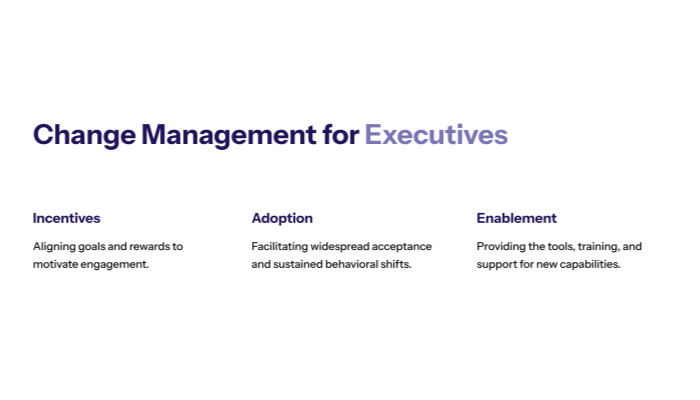
Change management fails when leadership treats it like a communications plan. In reality, it’s an operating system: incentives that shape behavior, adoption mechanisms that make the new way unavoidable, and enablement that builds capability fast enough to keep momentum.
RAPID Transformation frames this clearly: productive change requires courage, facts, and execution—not opinion, politics, or “hope.” RAPID is intentionally data-driven and designed to remove emotion from decision-making so teams can align around measurable outcomes and act. At the same time, RAPID doesn’t ignore the human side—it confronts fear, culture, and leadership behaviors that silently sabotage adoption.
Below is a practical executive playbook to make change stick—without turning your company into a compliance factory.

1) Executive Reality Check: Why Change Doesn’t “Land”?
1.1 Change fails when fear becomes your operating model
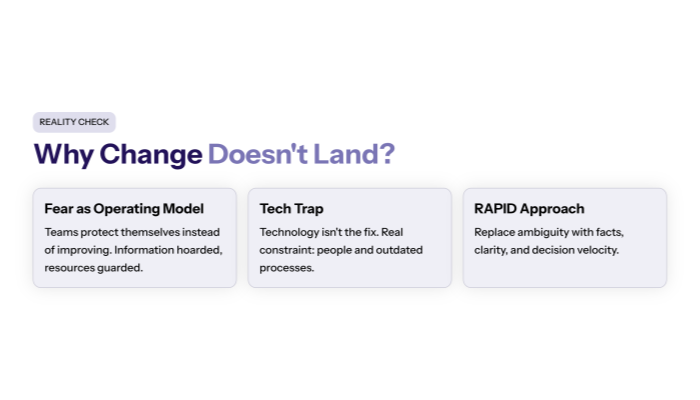
When fear permeates an organization, teams protect themselves instead of improving the system. They hoard information, guard resources, and optimize for personal safety—while leadership loses visibility into what’s actually happening. This is one reason transformations stall: the org goes inward, and the real work becomes invisible.
RAPID treats fear as a signal. The book’s “fear is fuel” idea is blunt: big change is intimidating, but fear can be used to focus attention on what can go wrong and mitigate it—raising the odds of success. Executives don’t eliminate fear by announcing a program; they eliminate fear by replacing ambiguity with facts, clarity, and decision velocity.
1.2 Change fails when leaders try to “tech” their way out
A common executive trap is assuming technology is the fix—when the real constraint is people and outmoded processes. The book highlights a recurring pattern: leaders avoid coaching, teaching, giving transparent feedback, and—when needed—making hard people decisions, even if it blocks strategy.
RAPID’s core stance is simple: strategy should dictate technology, not the other way around. If you don’t address incentives, adoption, and enablement, “new tools” become expensive theater.
2) Incentives: Make the New Way the Rational Choice
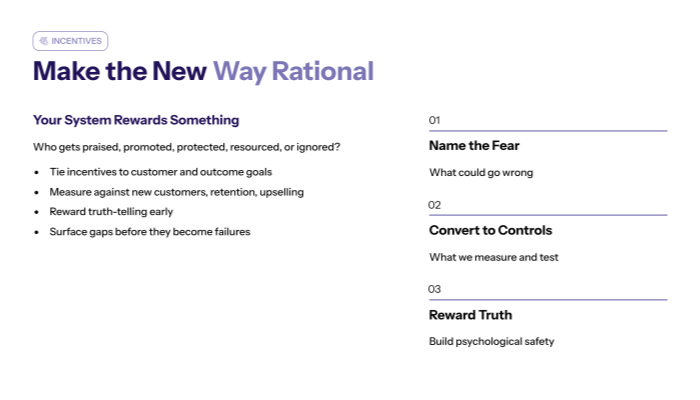
2.1 Incentives aren’t just compensation, your system rewards something
Even if you never touch comp plans, your organization is still rewarding behavior every day: who gets praised, promoted, protected, resourced, or ignored. RAPID calls out how leadership can drift into vanity metrics—numbers that look good but don’t predict outcomes—creating misalignment and denial.
To lead change, executives must answer one question: What behavior does our current system make rational?
If the rational behavior is “don’t take risks,” “don’t escalate,” or “don’t challenge the org chart,” adoption will stall.
A practical RAPID-aligned approach is to tie incentives to customer and outcome goals. The RAPID tools section explicitly emphasizes measuring people against customer goals (new customers, retention, upselling, etc.) and training teams once direction is decided. That’s the blueprint: incentives must reinforce outcomes, not activity.
2.2 Use “fear as fuel” without weaponizing it
Executives often create accidental fear by making change feel like judgment: “Who broke this?” RAPID’s stance: decisions should be about data, and the framework exists to diagnose, plan, and execute without getting stuck in emotion and blame.
So the executive move is:
- Name the fear (what could go wrong).
- Convert it into controls (what we measure, test, and mitigate).
- Reward truth-telling early (surface gaps before they become failures).
This builds psychological safety without lowering standards—and it dramatically improves adoption quality.
3) Adoption: Turn “Agreement” Into Behavior Change
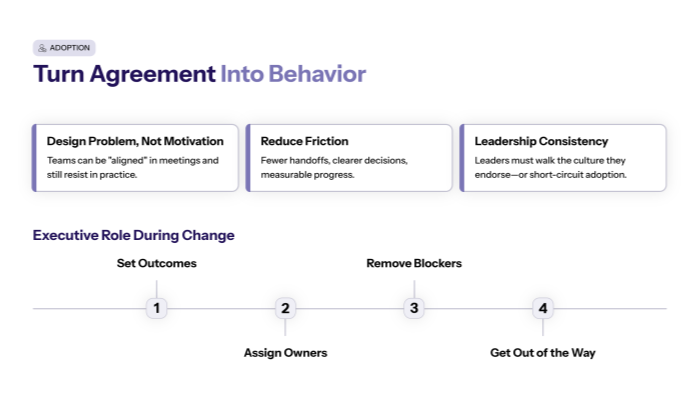
3.1 Adoption is a design problem, not a motivation problem
Teams can be “aligned” in meetings and still resist in practice. RAPID even includes a people-type lens (e.g., the “Eeyore” archetype who agrees in the room and undermines afterward). Executives shouldn’t moralize this; they should design for it.
Adoption happens when the new way:
- reduces friction (fewer handoffs, clearer decisions),
- is measurable (teams can see progress),
- and is reinforced (leaders act consistently with the intended culture).
RAPID explicitly warns that if leadership endorses a culture but doesn’t walk it, they short-circuit themselves and the organization. It also emphasizes empowerment—people can’t reach potential unless empowered and engaged.
3.2 Executives must stop “helping” in ways that break adoption
One of the most underrated adoption killers: senior leadership interfering with execution. RAPID calls it out directly—if a CEO won’t stay out of the way and respect the people doing the work, progress can stall or even go backwards.
Your job as an executive during change is not to be the hero. It’s to:
- set outcomes,
- assign owners,
- fund the work,
- remove blockers,
- and decide quickly.
Then, get out of the way—and support the team.
4) Enablement: Build Capability Faster Than the Change Curve
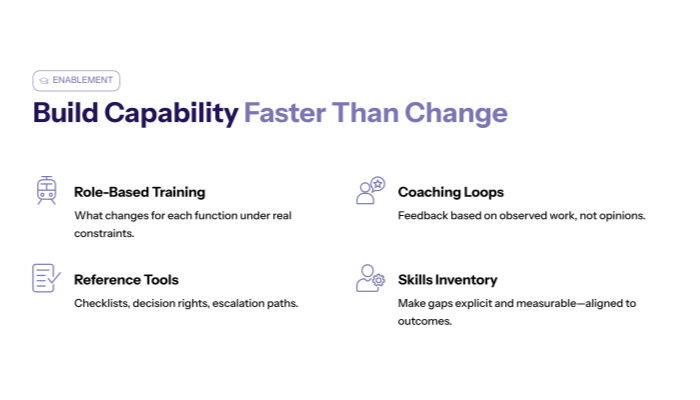
4.1 Enablement is training + tools + coaching (not “a rollout deck”)
Enablement means people can execute the new behaviors under real constraints. RAPID’s tools lean into structured training and measurement once direction is decided. And the foreword/early sections reinforce that leaders often avoid coaching and teaching because it’s uncomfortable—yet it’s foundational to change.
A RAPID-aligned enablement plan typically includes:
- role-based training (what changes for each function),
- coaching loops (feedback based on observed work, not opinions),
- simple reference tools (checklists, decision rights, escalation paths),
- and skills inventorying so gaps are explicit.
4.2 Use a “skills inventory” to prevent invisible failure
Transformations often fail because the organization assumes capability exists. RAPID provides a Skills Inventory tool explicitly tied to outcomes and customer value—skills should be specific and aligned to goals.
If you skip this, enablement becomes vibes-based:
- you “expect adoption,”
- but people don’t know how,
- or don’t have time,
- or don’t have permission.
A skills inventory turns enablement into a measurable system: what’s missing, where, and what you’ll do about it.
5) The Executive Checklist: Incentives + Adoption + Enablement in One System
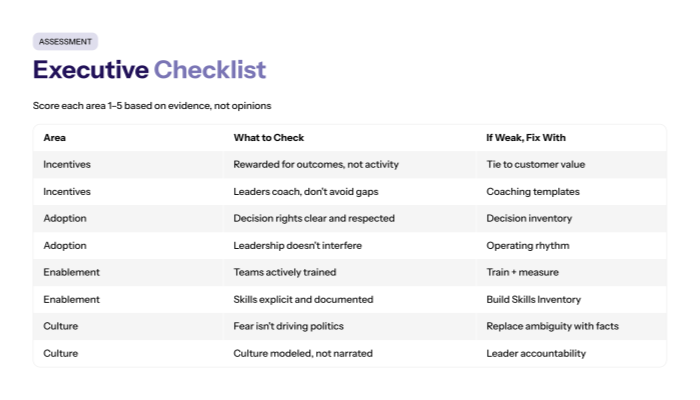
5.1 A practical current-state checklist (use it in Week 1)
Use this table as a fast executive assessment. Score each line 1–5 (strongly disagree → strongly agree) and document evidence, not opinions—consistent with RAPID’s data-first approach.
|
Area |
What to Check |
Evidence to Look For |
If Weak, Fix With |
|---|---|---|---|
|
Incentives |
People are rewarded for outcome progress, not activity |
Promotion stories, recognition patterns, metrics used in reviews |
Tie rewards to outcomes + customer value |
|
Incentives |
Leaders confront performance gaps with coaching, not avoidance |
Coaching cadence, feedback artifacts, role clarity |
Coaching templates + explicit expectations |
|
Adoption |
Decision rights are clear and respected |
Fewer escalations, faster decisions, less rework |
Document decision inventory + escalation rules |
|
Adoption |
Leadership does not interfere with execution |
Stable ownership, fewer “drive-by” priorities |
Exec operating rhythm + “hands-off” enforcement |
|
Enablement |
Teams are actively trained after direction is set |
Training completion + observable behavior change |
Train + measure + iterate |
|
Enablement |
Skills required for outcomes are explicit |
Skills inventory exists and is used |
Build Skills Inventory aligned to outcomes |
|
Culture |
Fear isn’t driving politics and silence |
Bad news travels fast; issues are surfaced early |
Treat fear as fuel; replace ambiguity with facts |
|
Culture |
Culture is modeled, not narrated |
Leader behavior matches stated values |
“Walk the walk” accountability |
5.2 A 30-day executive operating rhythm (simple, repeatable)
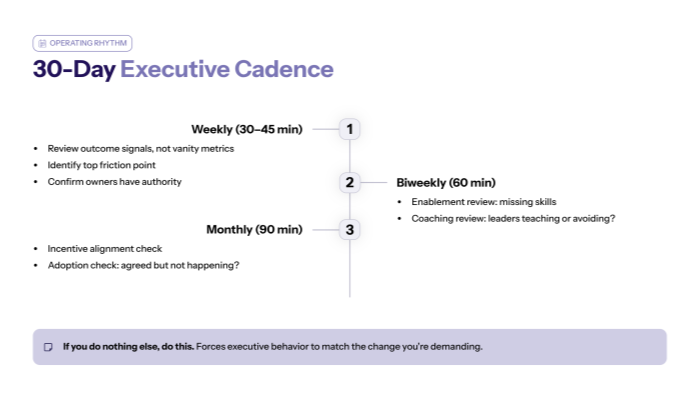
RAPID is designed as an execution-oriented process that stays in motion—observe, learn, course-correct. A lightweight rhythm keeps incentives, adoption, and enablement connected:
Weekly (30–45 min):
- Review outcome signals (not vanity metrics).
- Identify the top friction point and decide the next constraint to remove.
- Confirm owners have authority (and leadership is not interfering).
Biweekly (60 min):
- Enablement review: what skills are missing, where, and what’s being done.
- Coaching review: are leaders teaching and giving transparent feedback—or avoiding it?
Monthly (90 min):
- Incentive alignment check: are we rewarding the behaviors we want?
- Adoption check: what’s “agreed” but not happening—and why?
If you do nothing else, do this. It forces executive behavior to match the change you’re demanding.