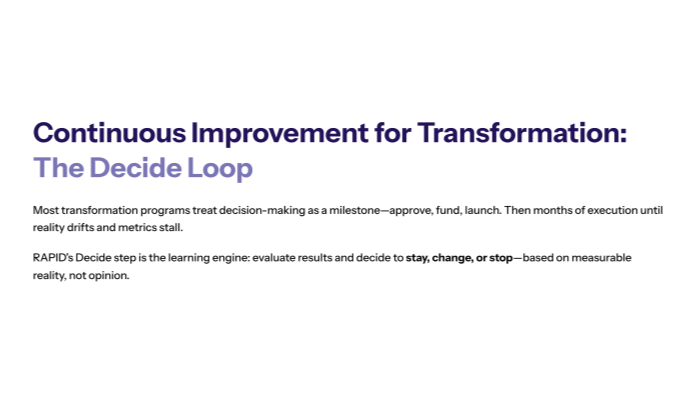
Continuous Improvement for Transformation: The Decide Loop
Most transformation programs treat “decision-making” as a milestone:
- approve the plan
- fund the roadmap
- launch the program
Then they spend months executing—until reality drifts, metrics stall, and the organization quietly starts protecting the narrative.
RAPID is built to prevent that failure mode. The Decide step is the learning engine: after implementation, you evaluate results and decide to stay, change, or stop—based on measurable reality, not opinion.
This post shows how to use the Decide loop to create continuous improvement during transformation—without turning your teams into spreadsheet reporters.

Why transformations stall without a Decide loop?
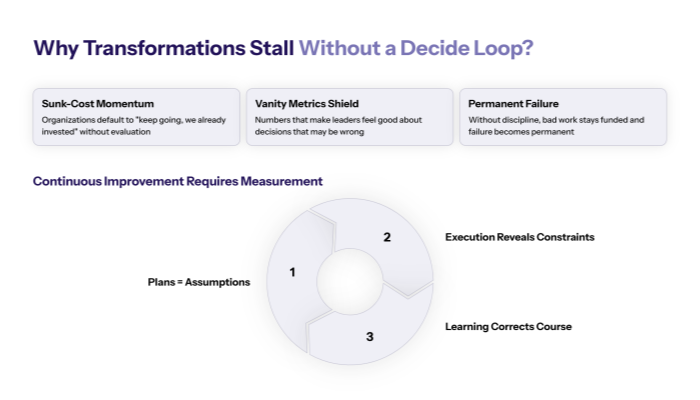
1.1 Without Decide, transformation becomes sunk-cost momentum
When you don’t have a disciplined Decide loop, organizations default to:
- “keep going, we already invested”
- “the results will show up later”
- “we just need more adoption”
- “we need more governance”
That’s how failure becomes permanent.
RAPID is explicit about the danger of vanity metrics: numbers that make leaders feel good about decisions that may be wrong. Without Decide, vanity metrics become the shield that keeps bad work funded.
1.2 Continuous improvement requires measurable evaluation, not optimism
RAPID makes a hard point: if success can’t be measured in tangible ways, you can’t evaluate initiatives.
The Decide loop exists because:
- plans are assumptions
- execution reveals constraints you didn’t see
- the “X factor” can derail even good plans
- learning must happen fast enough to correct course
Continuous improvement is not a culture statement. It’s a decision cadence tied to measurement.
What the Decide loop is? (RAPID definition, operationalized)
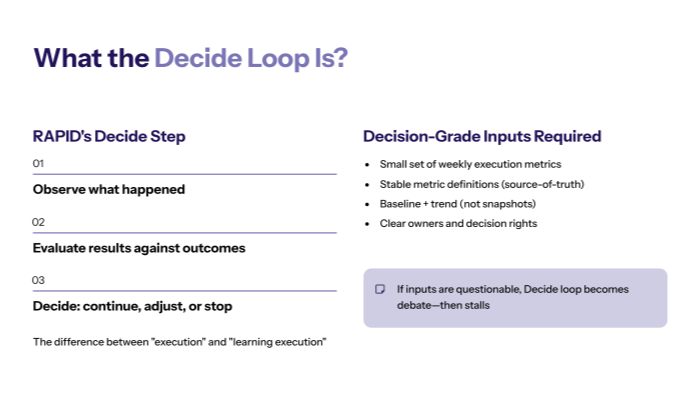
2.1 Decide = evaluate impact, then stay / change / stop
RAPID’s Decide step is straightforward:
- observe what happened
- evaluate results against measurable outcomes
- decide whether to continue, adjust, or stop
This is the difference between “execution” and “learning execution.”
If your organization can’t stop work that isn’t moving outcomes, transformation will accumulate noise until the real work becomes impossible.
2.2 Decide only works if the inputs are decision-grade
RAPID emphasizes that accurate, timely information must be shared with decision makers; otherwise major issues are inevitable.
So the Decide loop requires:
- a small set of weekly execution metrics
- stable metric definitions (source-of-truth)
- baseline + trend (not snapshots)
- clear owners and decision rights
If your inputs are questionable, your Decide loop becomes debate—then stalls.
The Decide loop in practice (weekly and monthly cadences)
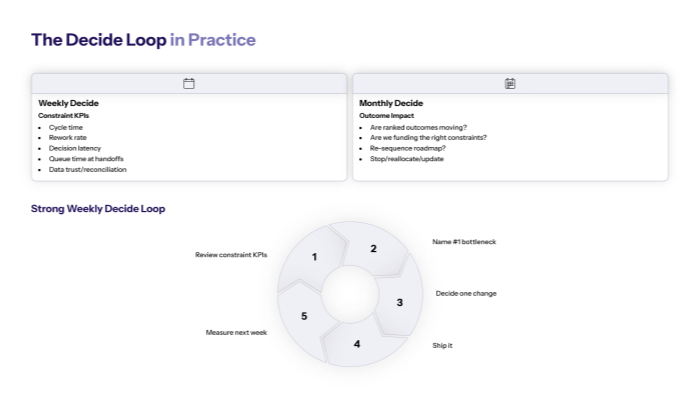
3.1 Weekly Decide: constraint KPIs and the bottleneck call
Weekly Decide is about leading indicators—constraint metrics that move early:
- cycle time
- rework rate
- decision latency
- queue time at handoffs
- data trust/reconciliation (where relevant)
RAPID’s system is built around surfacing what’s beneath the surface (the iceberg problem) and removing constraints in sequence.
A strong weekly Decide loop:
- review constraint KPIs
- name the #1 bottleneck
- decide one change that removes it
- ship it
- measure again next week
This creates continuous improvement without bureaucracy.
3.2 Monthly Decide: outcome impact and portfolio correction
Monthly Decide is where you check:
- are ranked outcomes moving?
- are we funding the right constraints?
- do we need to re-sequence the roadmap?
This is where “stay/change/stop” can apply to initiatives:
- stop what isn’t moving outcomes
- reallocate resources to what is
- update owners and decision rights if governance is the bottleneck
RAPID’s flywheel exists for this: better information → better analysis → better planning → better decisions.
How to make Decide objective? (avoid politics and ego)
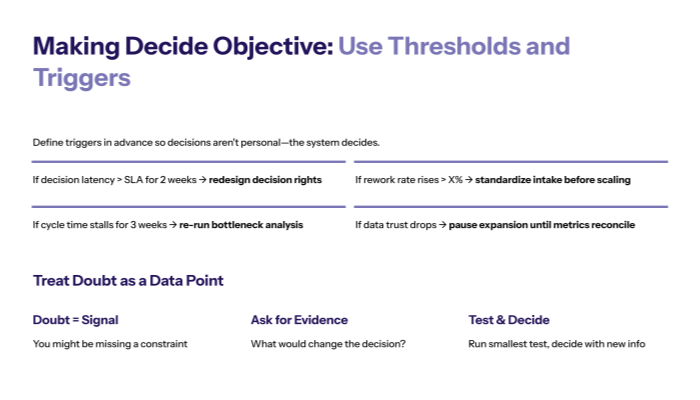
4.1 Use thresholds and triggers (so decisions aren’t personal)
Decide becomes political when it’s subjective. So define triggers in advance.
Examples:
- If decision latency > SLA for 2 weeks → redesign decision rights
- If rework rate rises > X% → standardize intake and acceptance criteria before scaling
- If cycle time stalls for 3 weeks → re-run bottleneck analysis
- If data trust drops → pause expansion until metrics reconcile
This is how you reduce emotion: the system decides.
RAPID emphasizes that the framework helps remove emotion and fear from decision-making by relying on data-driven reality.
4.2 Treat doubt as a data point (not as resistance)
RAPID treats doubt as useful: “doubt is nothing but a data point.”
In a Decide loop:
- doubt is a signal you might be missing a constraint
- resistance is sometimes workflow friction
- pushback may indicate unclear incentives or decision rights
So the executive move is:
- ask what evidence would change the decision
- run the smallest test that can produce that evidence
- decide again with new information
That’s continuous improvement in real time.
Decide is also how you scale (without regressions)
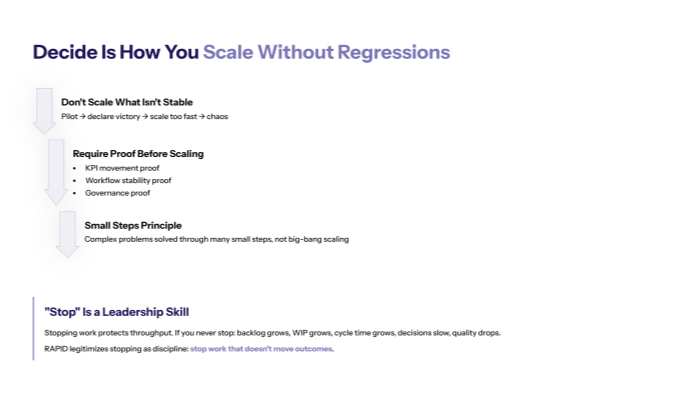
5.1 Don’t scale what isn’t stable
One of the most common transformation mistakes:
- pilot something
- declare victory
- scale it too fast
- regress into chaos because exceptions weren’t designed
The Decide loop prevents this by forcing:
- KPI movement proof (not feelings)
- workflow stability proof (low rework, stable cycle time)
- governance proof (decisions made within SLAs)
RAPID’s small-steps principle applies here: complex problems are solved through many small steps, not big-bang scaling.
5.2 “Stop” is a leadership skill (and a transformation superpower)
Stopping work is how you protect throughput.
If you never stop:
- the backlog grows
- WIP grows
- cycle time grows
- decisions slow
- quality drops
RAPID’s Decide step legitimizes stopping as a discipline: stop work that doesn’t move outcomes, change what’s misaligned, stay only when evidence supports it.
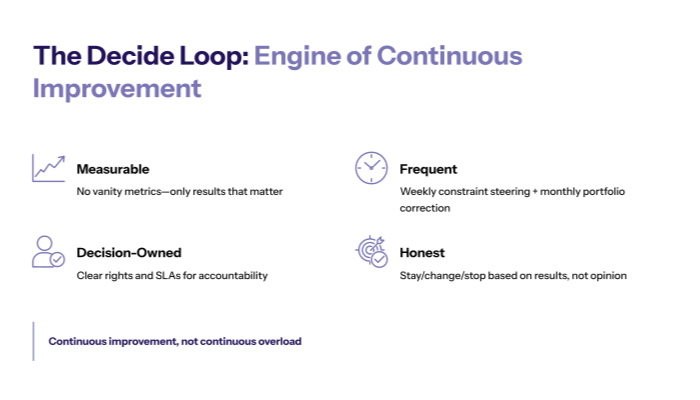
This is how transformation becomes continuous improvement, not continuous overload.
Closing takeaway
The Decide loop is the engine of continuous improvement in transformation.
It works because it is:
- measurable (no vanity metrics)
- frequent (weekly constraint steering + monthly portfolio correction)
- decision-owned (clear rights and SLAs)
- honest (stay/change/stop based on results)