Conversational AI for Customer Support: Strategy, AI Agents, Tools, and Implementation
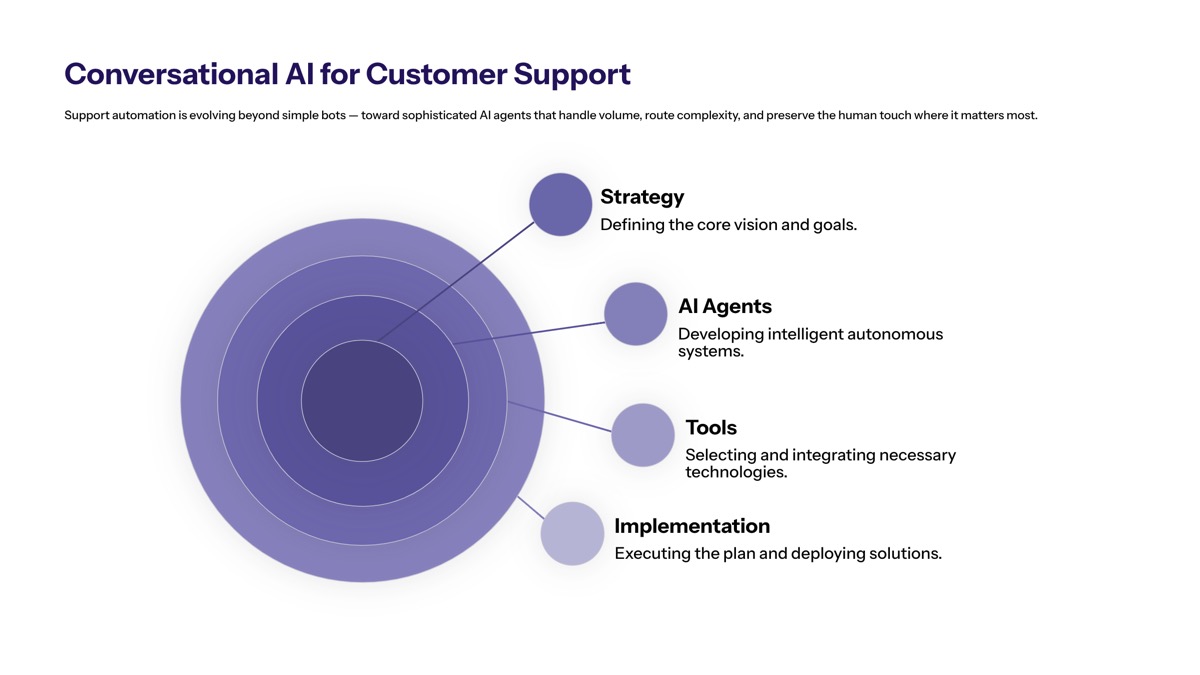
Support automation is moving beyond simple bots that answer basic questions. The market for AI in customer service is evolving towards sophisticated AI agents beyond basic chatbots.
For companies with high-volume service requests, conversational AI can provide fast answers, route complex queries, support live teams, and improve customer satisfaction across voice, chat, and self-service channels.
The goal is not to remove the human touch. The better goal is to use support automation where it helps, then preserve human agents for emotional, sensitive, or judgment-heavy cases.
What Is Conversational AI for Customer Support?
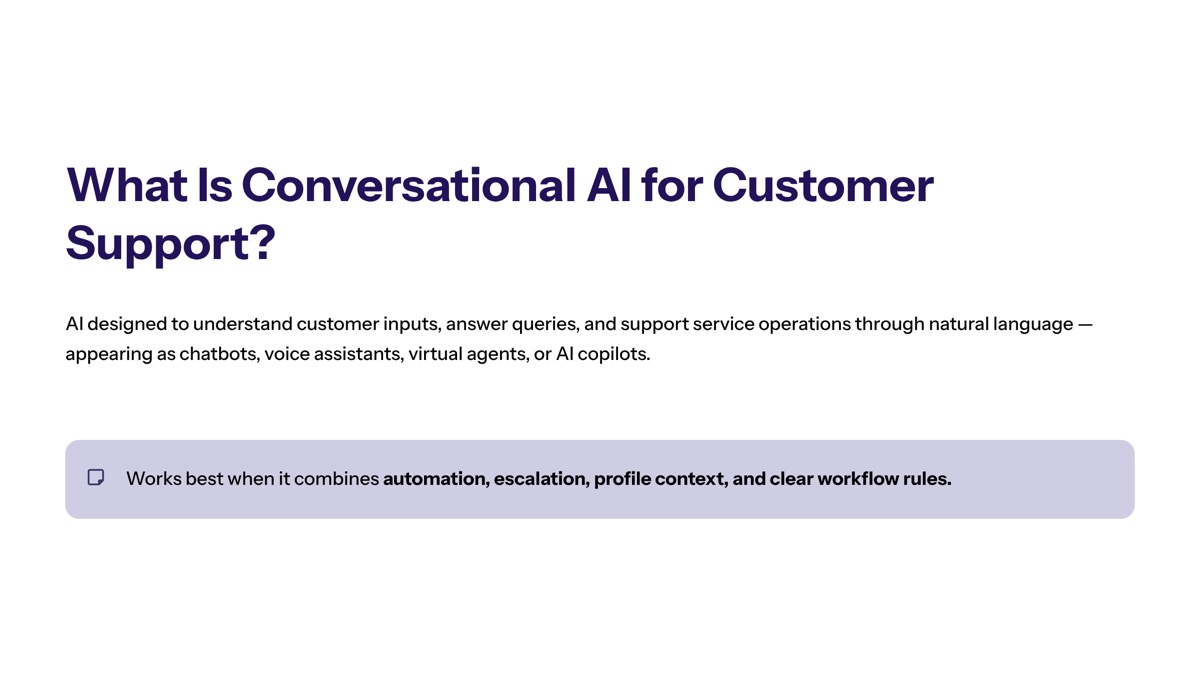
Conversational AI for customer support is conversational artificial intelligence designed to understand customer inputs, answer customer queries, and support customer service operations through natural language conversations.
Conversational AI for customer can appear as a conversational AI chatbot, voice assistants, virtual assistants, AI assistants, AI powered chatbots, or AI agents embedded into a support platform.
Customer service conversational AI works best when it combines automation, escalation, profile context, and clear workflow rules.
How Conversational AI Works
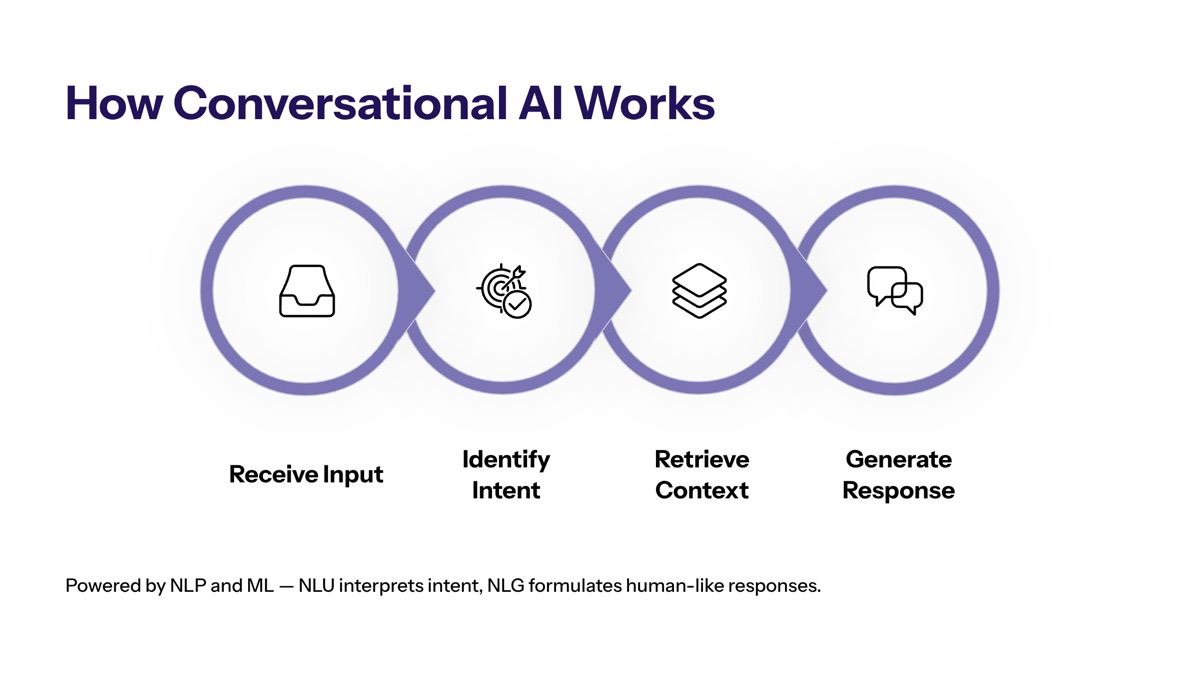
Conversational AI works by receiving user input, identifying intent, retrieving context, and generating a response or action. Conversational AI works across a conversational interface, service calls, chat, account workflows, and proactive messages.
Conversational AI is powered by natural language processing (NLP) and machine learning (ML) technologies, which enable it to understand and respond to human language effectively.
Natural language processing (NLP) consists of two main components: natural language understanding (NLU), which interprets user intent, and natural language generation (NLG), which formulates responses in a human-like manner.
Conversational AI Technology
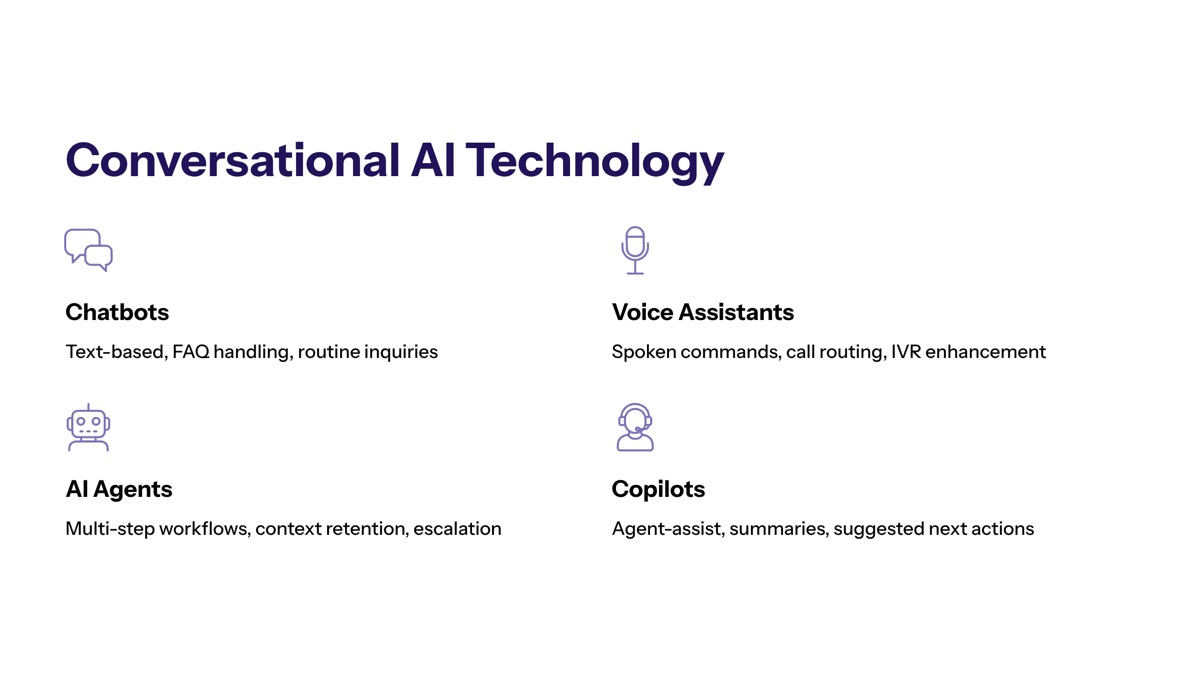
Conversational AI technology comes in several forms, including chatbots, voice assistants, virtual agents, and AI assistants (or copilots), each designed to facilitate seamless, human-like customer interactions across various channels.
Conversational AI technology uses language processing, natural language understanding, natural language generation, learning models, generative AI, large language models, and business integrations.
These AI technologies help systems translate human conversations, understand human language, and respond in a way that feels closer to human conversation than a static rules tree.
Conversational AI depends on artificial intelligence that can interpret intent, use context, and decide whether a response should be automated or escalated.
Core AI Technologies Behind Support Automation
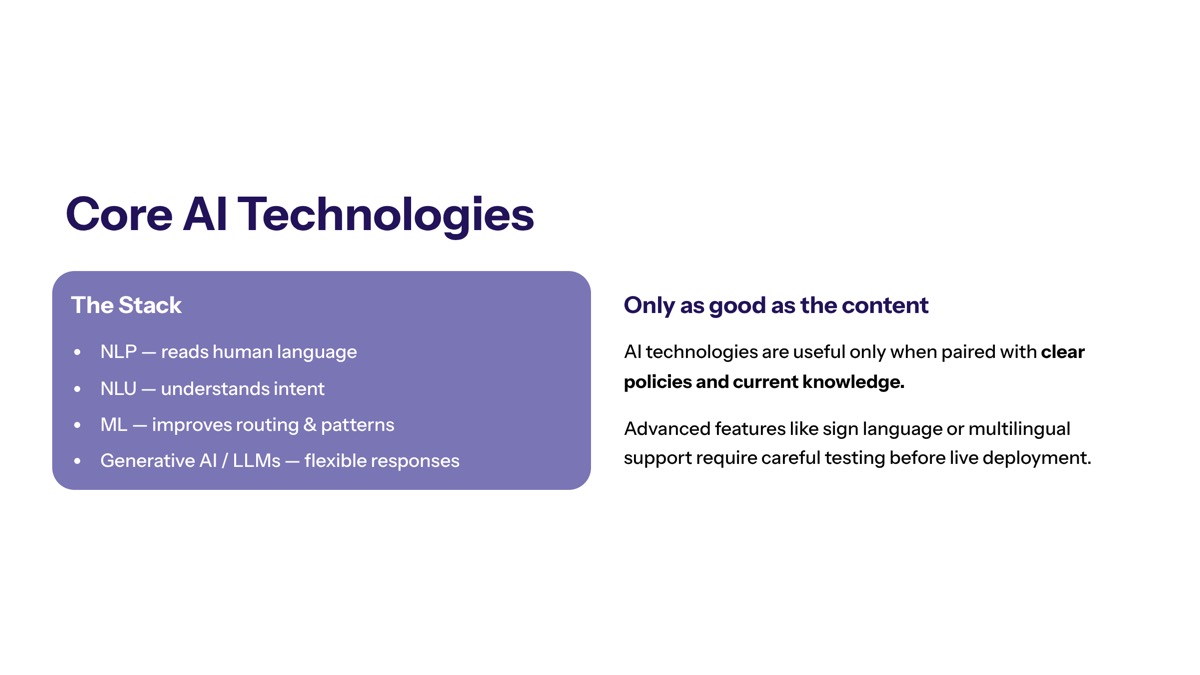
Artificial intelligence gives the support layer the ability to classify requests, search approved knowledge, and recommend actions. Natural language processing helps the system read human language, while natural language understanding helps it understand customer intent rather than only matching words.
Machine learning algorithms improve routing, answer selection, and pattern detection as the system reviews more service data. These AI technologies are useful only when they are paired with clear policies and current content.
Advanced AI technologies can also support accessibility. Some systems may capture sign language or support multiple languages, but those features require careful testing before they are used in real service interactions.
Conversational AI Tools and Software
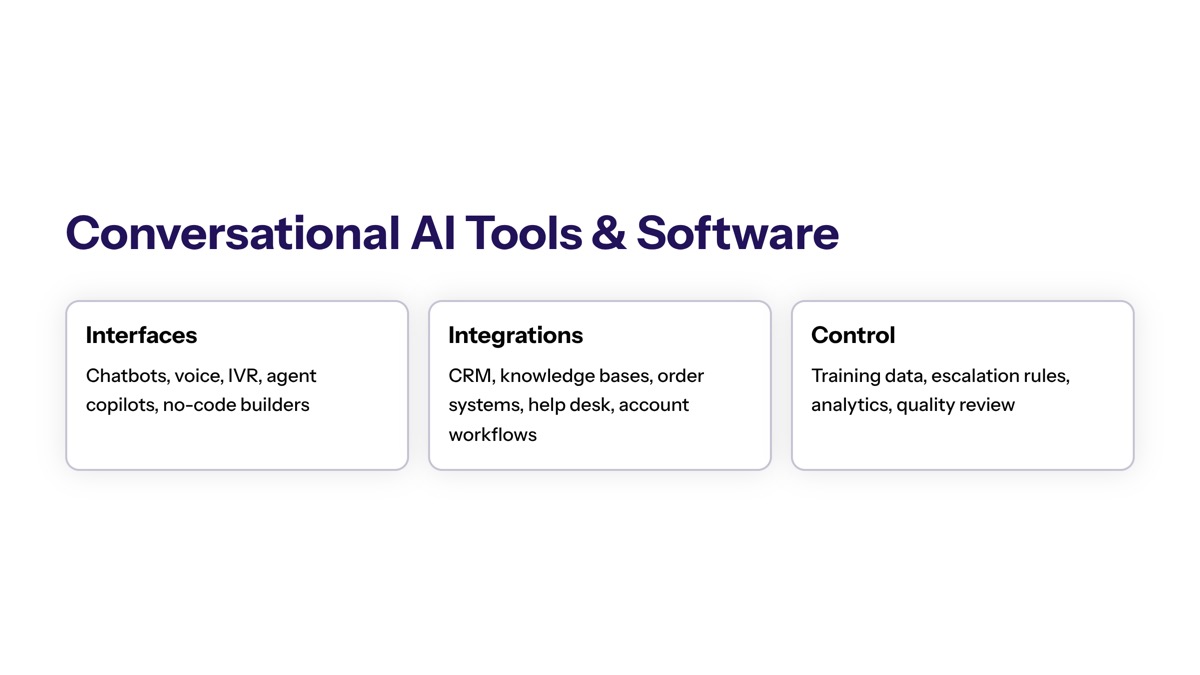
Conversational AI tools include chatbots, voice interfaces, agent copilots, IVR enhancements, assistant copilots, and no code software for teams that need faster deployment.
Conversational AI software should connect to CRM systems, knowledge bases, order systems, help desk tools, account workflows, and other business systems.
The best support tools give service leaders control over training data, escalation, analytics, and quality review.
Customer Service Team Readiness
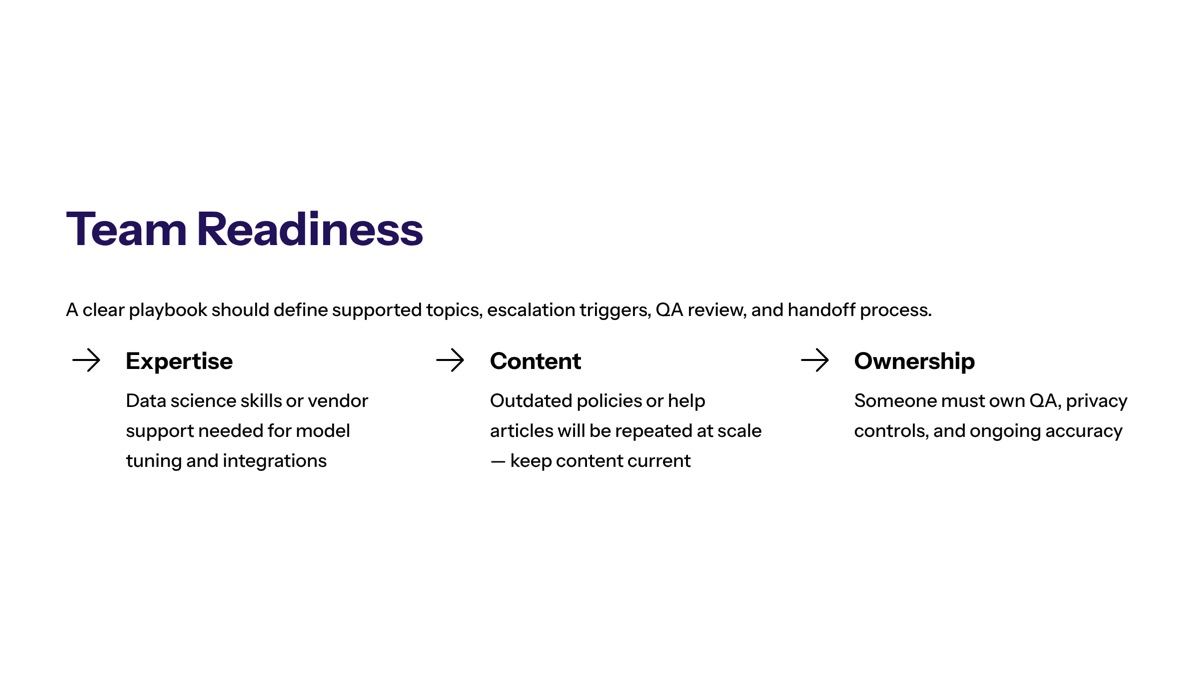
Support leaders need to know where conversational AI for customer support helps and where it stops. A clear playbook should explain supported topics, escalation triggers, QA review, and the handoff process.
The team also needs data science expertise or vendor support when the system depends on model tuning, analytics, or custom integrations. Without that expertise, training conversational AI in-house can become slower and more expensive than expected.
Readiness also includes content. If policies, help articles, product information, or account workflows are outdated, conversational AI models will repeat those problems at scale.
AI Agents Beyond Basic Chatbots
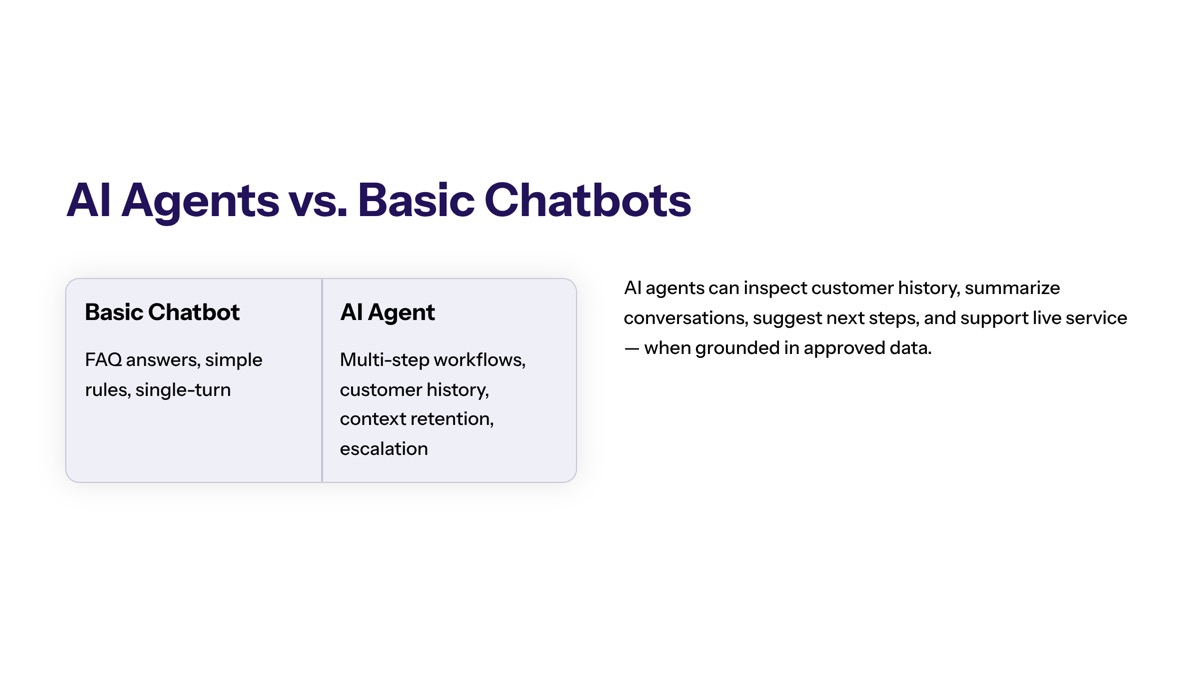
AI agents are more sophisticated than basic chatbots, capable of managing complex queries and providing detailed support while ensuring a smooth customer experience by escalating issues to human agents when necessary.
AI agents can inspect customer history, summarize customer conversations, suggest next steps, and support live service work.
Unlike basic chatbots, AI agents can manage multi-step workflows when the conversational AI models are grounded in approved data and the system can maintain context.
AI Powered Chatbots
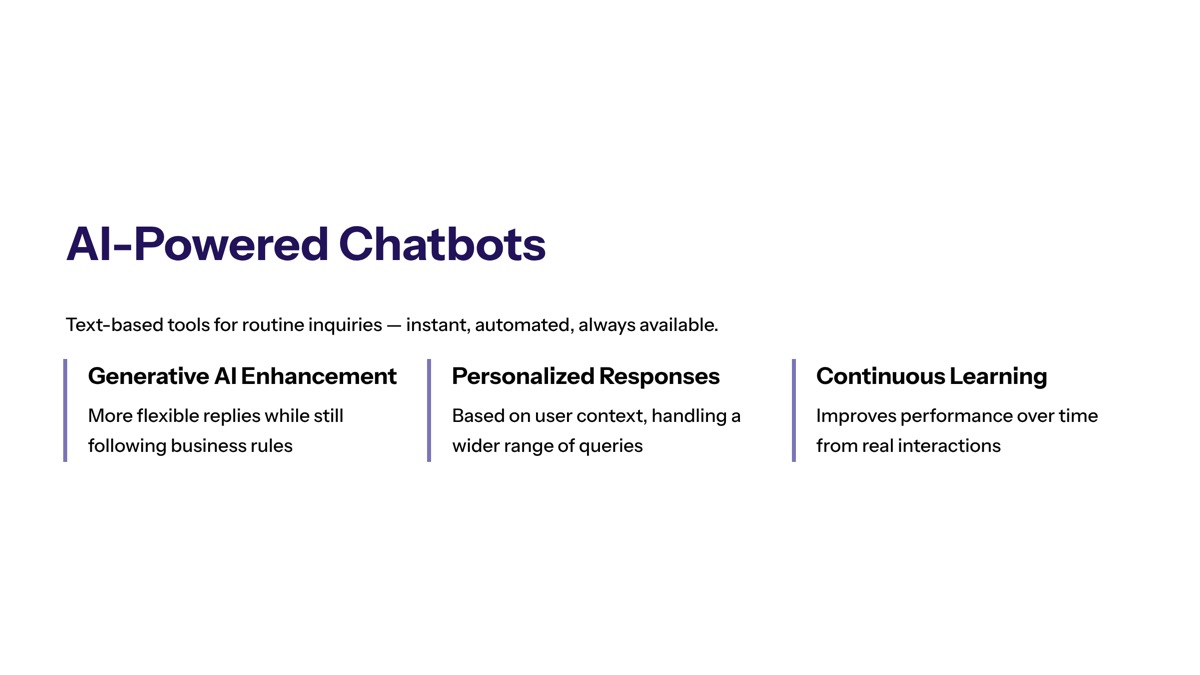
Chatbots are text-based conversational AI tools that can answer frequently asked questions and provide instant, automated support, ideal for handling routine customer inquiries.
Modern conversational AI chatbots can use generative AI to produce more flexible replies while still following business rules.
Generative AI enhances chatbots by enabling them to provide personalized responses based on user context, handle a wider range of queries, and continuously learn from interactions to improve performance over time.
Voice Assistants and Customer Calls
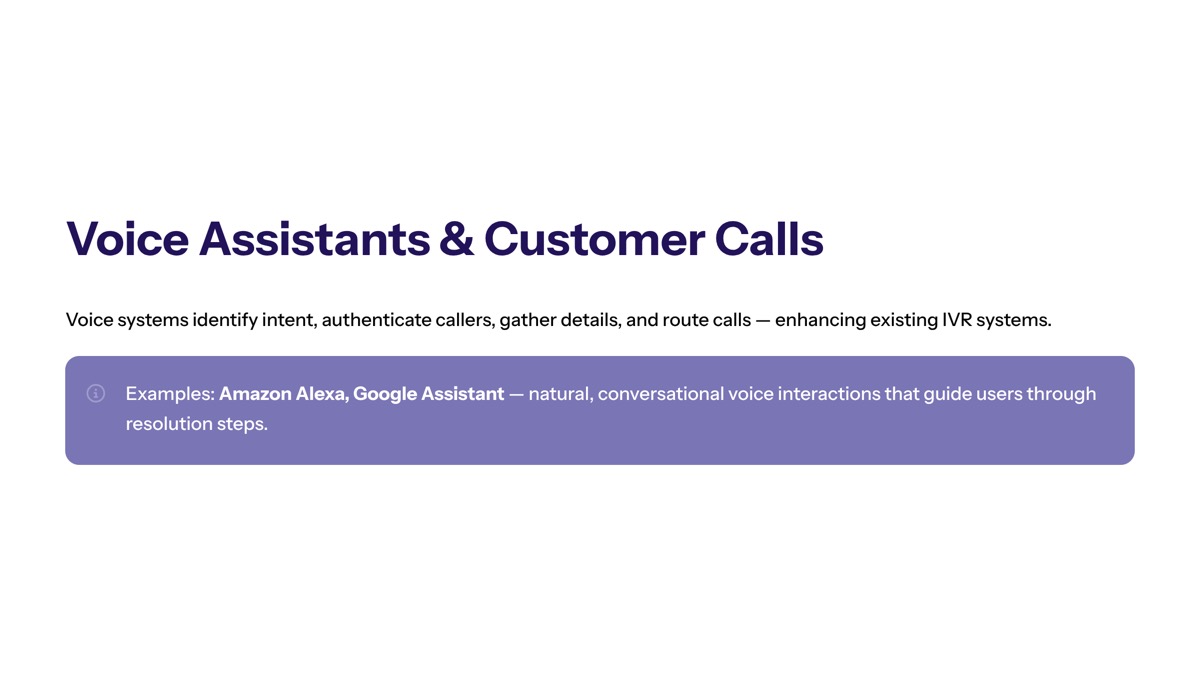
Voice assistants, such as Amazon Alexa and Google Assistant, utilize advanced voice recognition to interpret spoken commands and perform tasks, enabling customers to resolve issues through natural, conversational voice interactions.
In support environments, voice systems can identify customer intents, authenticate callers, gather details, and route calls to the right team.
Conversational AI can enhance existing interactive voice response (IVR) systems by identifying customer intents and guiding users through resolution steps, thus improving the overall customer support experience.
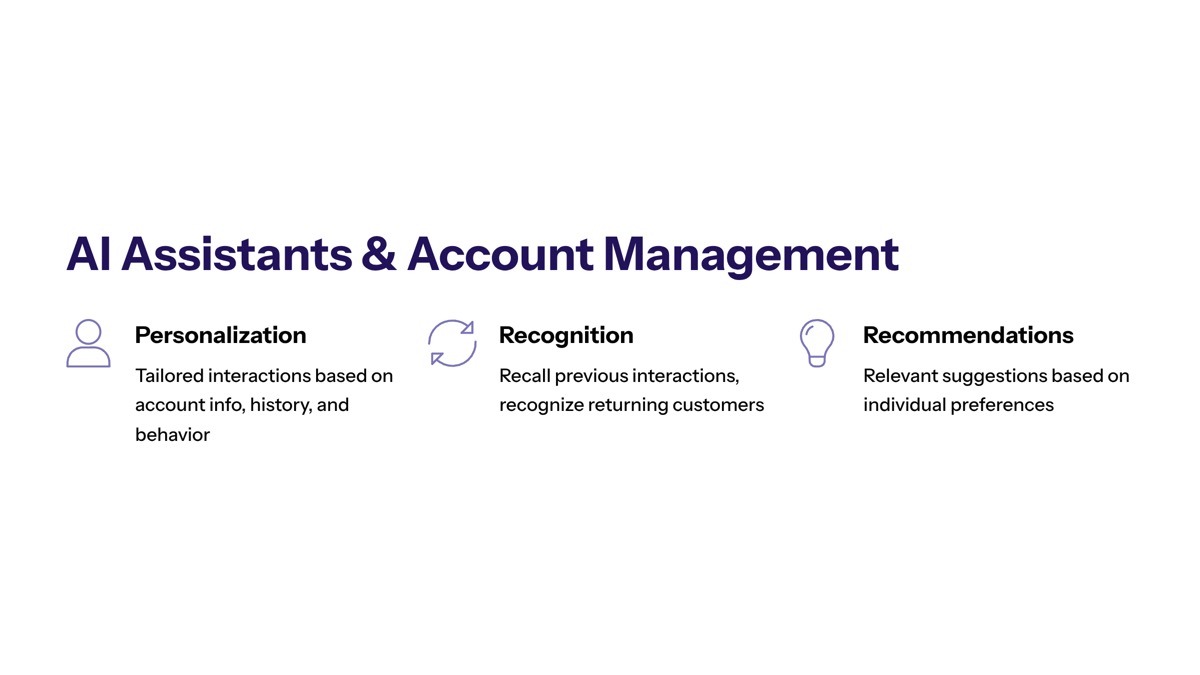
AI Assistants and Account Management
Assistant copilots can help with account management by retrieving details, explaining status, collecting missing fields, and routing requests when needed.
Conversational AI can tailor interactions based on each customer’s account information, actions, behavior, and more, enhancing the personalization of customer experiences. Conversational AI can provide personalized interactions and solutions based on customer history and preferences, making customers feel valued and enhancing their overall experience.
By integrating customer data into conversational AI platforms, businesses can recognize returning customers, recall previous interactions, and offer recommendations that are relevant to each individual.
Conversational AI Strategy
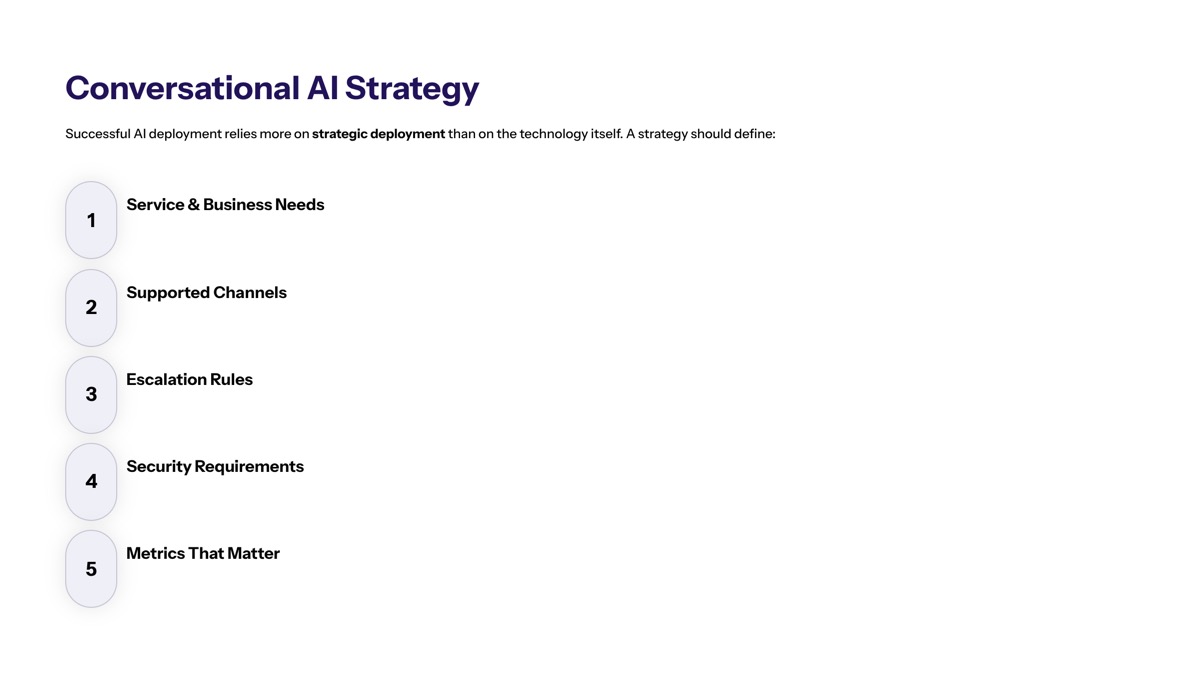
Successful AI deployment in customer service relies more on strategic deployment compared to the technology itself.
A conversational AI strategy should define customer service needs, business needs, supported channels, escalation rules, security requirements, and the metrics that matter.
Successful implementation of conversational AI requires a detailed assessment of existing infrastructure to ensure that the chosen tools can integrate seamlessly with current systems and software.
Implement Conversational AI Safely
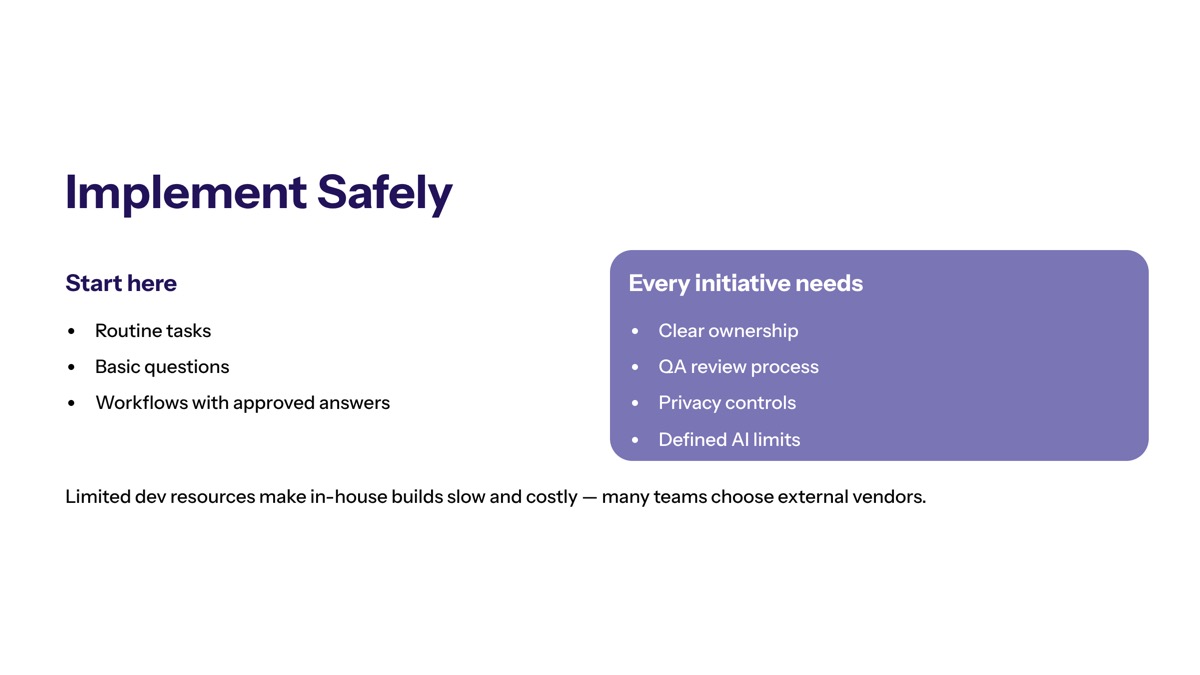
To implement conversational AI safely, teams should start with routine tasks, basic questions, common customer inquiries, and workflows that already have approved answers.
Limited developer resources can make building and training conversational AI in-house challenging and expensive, leading many organizations to seek external vendors for implementation.
A conversational AI initiative should include ownership, QA review, privacy controls, real service examples for testing, and clear limits on what the AI tool can do.
Integration With Existing Systems
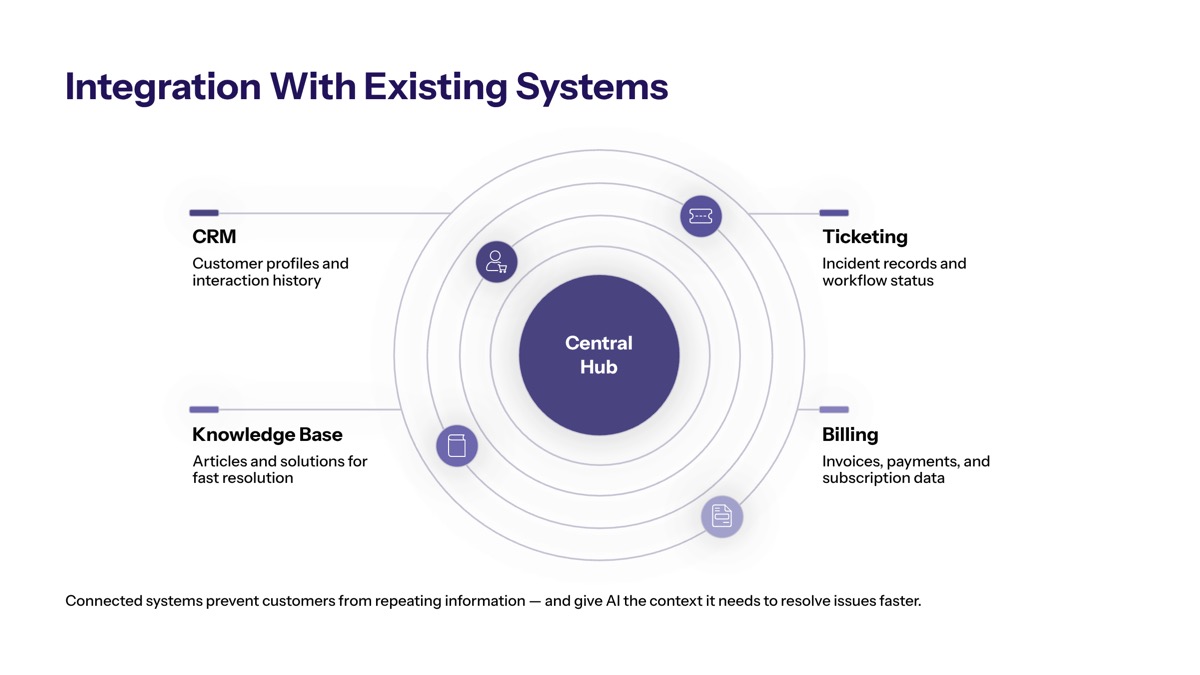
Integrating conversational AI with existing customer relationship management (CRM) systems and other business tools allows the AI to absorb customer data and improve its responses without extensive training or configuration.
Conversational AI platforms should integrate with ticketing systems, CRM tools, product data, billing, account workflows, and knowledge sources.
By connecting conversational AI solutions to service systems, support teams can avoid forcing customers to repeat information.
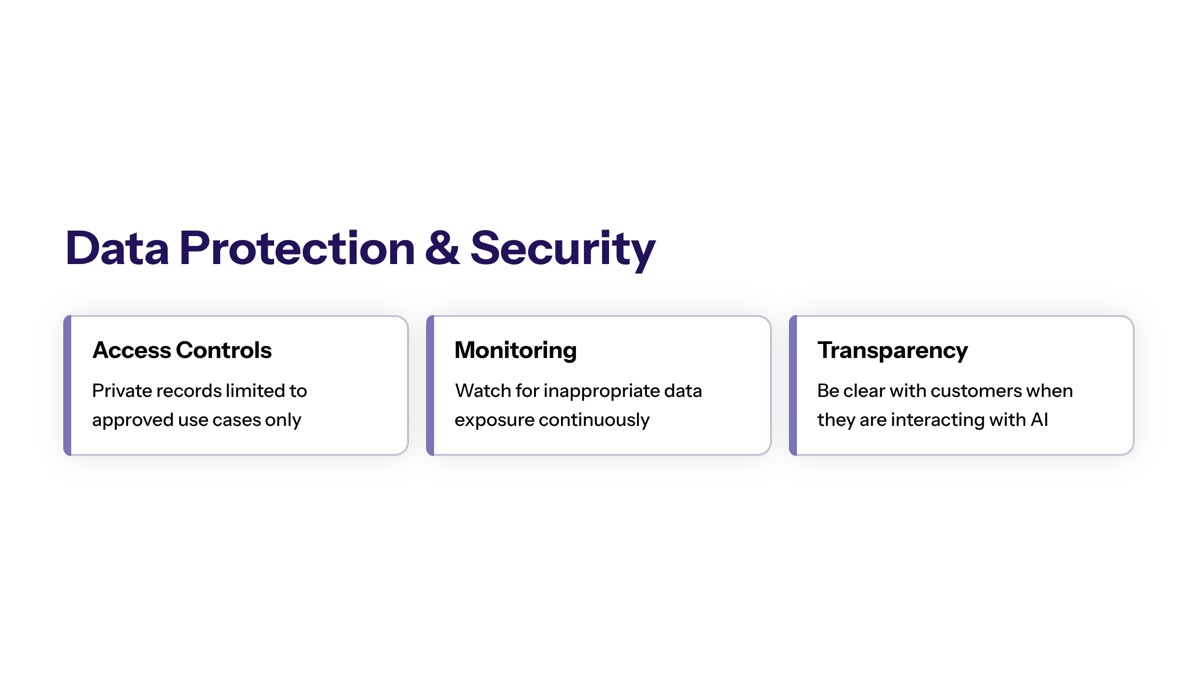
Data Protection and Security
AI systems require strict security measures to protect sensitive customer data during their deployment in customer service.
Private records should be limited to approved use cases, protected through access controls, and monitored for inappropriate exposure.
Organizations should be transparent with customers about interactions with AI to build trust and manage expectations.
AI Accuracy and Review
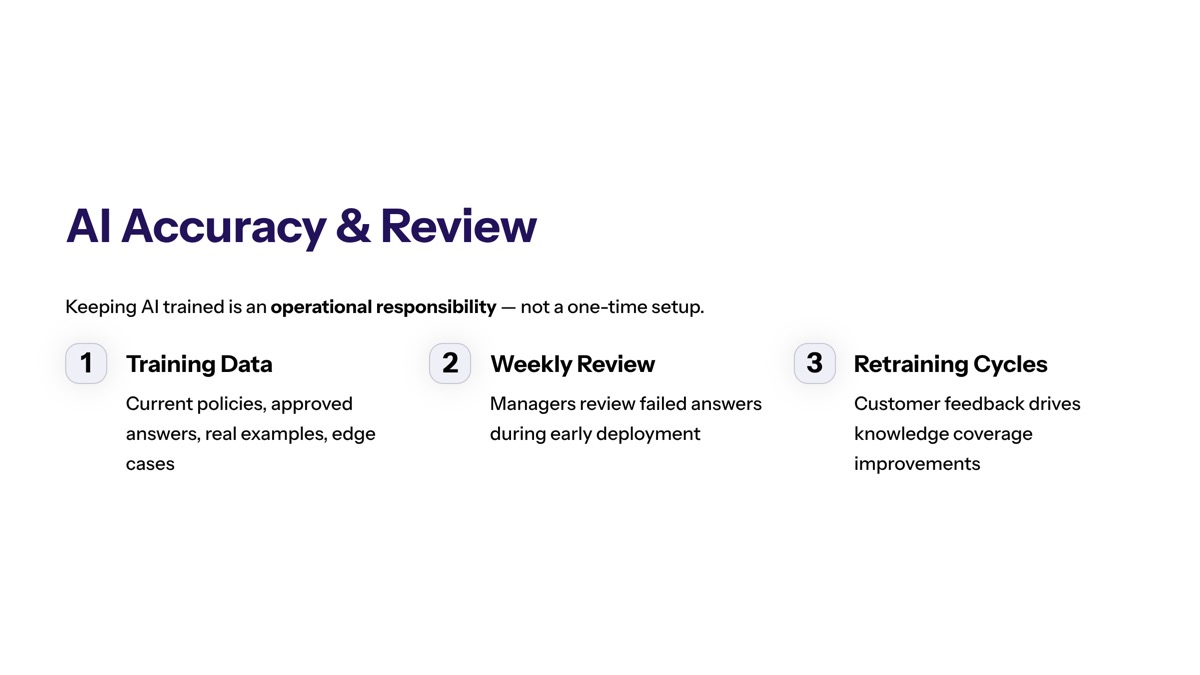
Keeping the AI trained is an operational responsibility. Training data should include current policies, approved answers, real service examples, edge cases, and examples of requests that should escalate.
If the system is not updated, it may give stale answers or miss customer intent. This is why customer feedback, quality review, and retraining cycles matter after launch.
Support managers should review failed answers weekly during early deployment. That helps tune the conversational AI chatbot, improve knowledge coverage, and reduce avoidable escalations.
Customer Experience and Customer Satisfaction
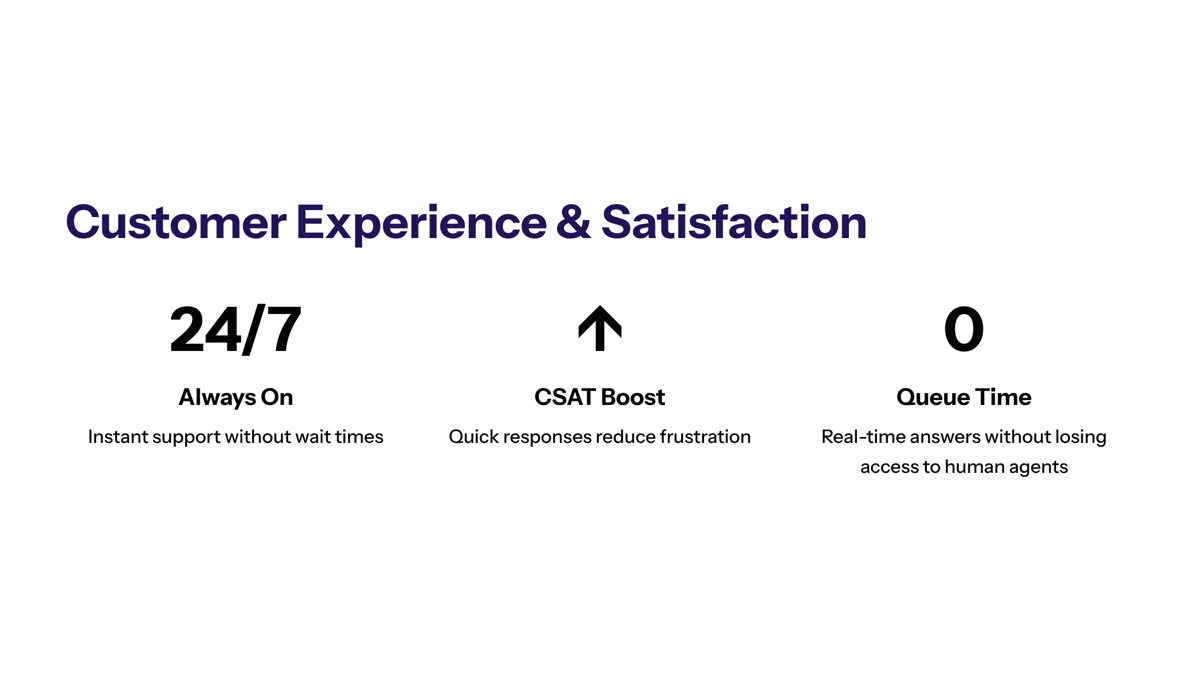
Conversational AI improves customer service by providing instant, round-the-clock support, which helps boost customer satisfaction as users receive quick responses and resolutions.
Conversational AI can significantly boost customer satisfaction and engagement by offering 24/7 support for quick answers and problem-solving, which reduces frustration from wait times.
Customer experience improves when customers can get real time support without losing access to the support team.
Human Agents and Handoffs
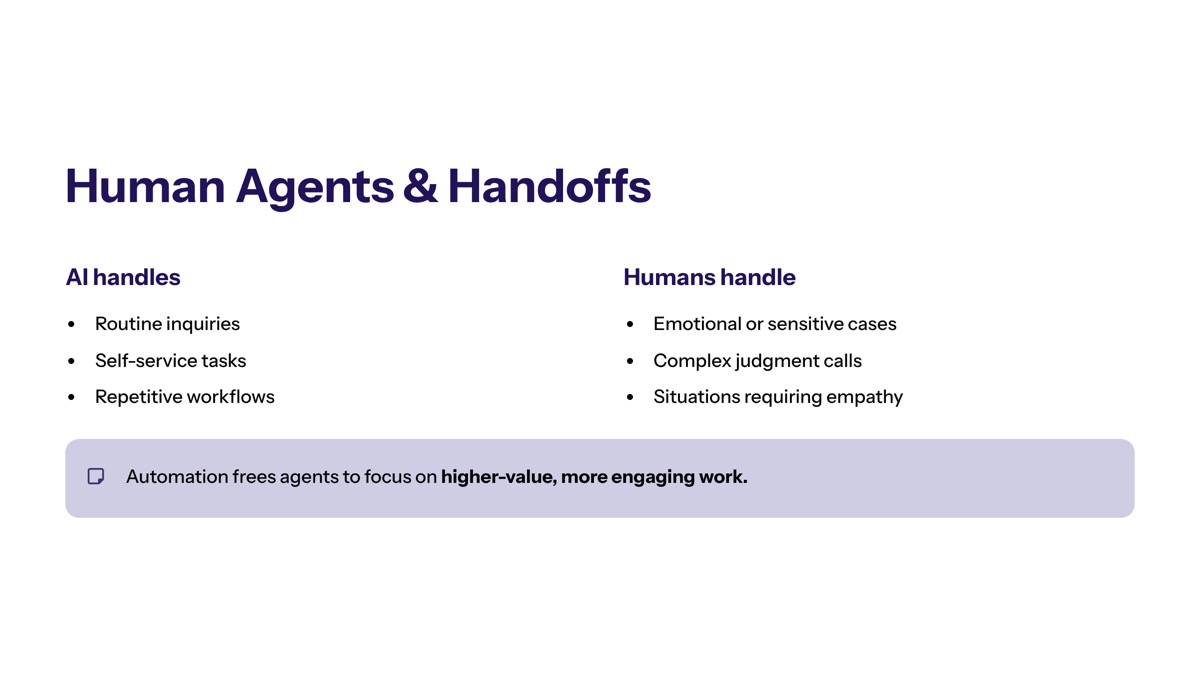
By automating routine inquiries and tasks, conversational AI frees up live agents to handle more complex issues, optimizing workflow within contact centers and improving service quality.
By automating routine tasks and providing self-service support through conversational AI, businesses empower support teams to focus on resolving more complex and engaging issues.
Human agents are still essential when AI struggles with highly emotional or sensitive cases that require human empathy and emotional intelligence.
Complex Queries and Context
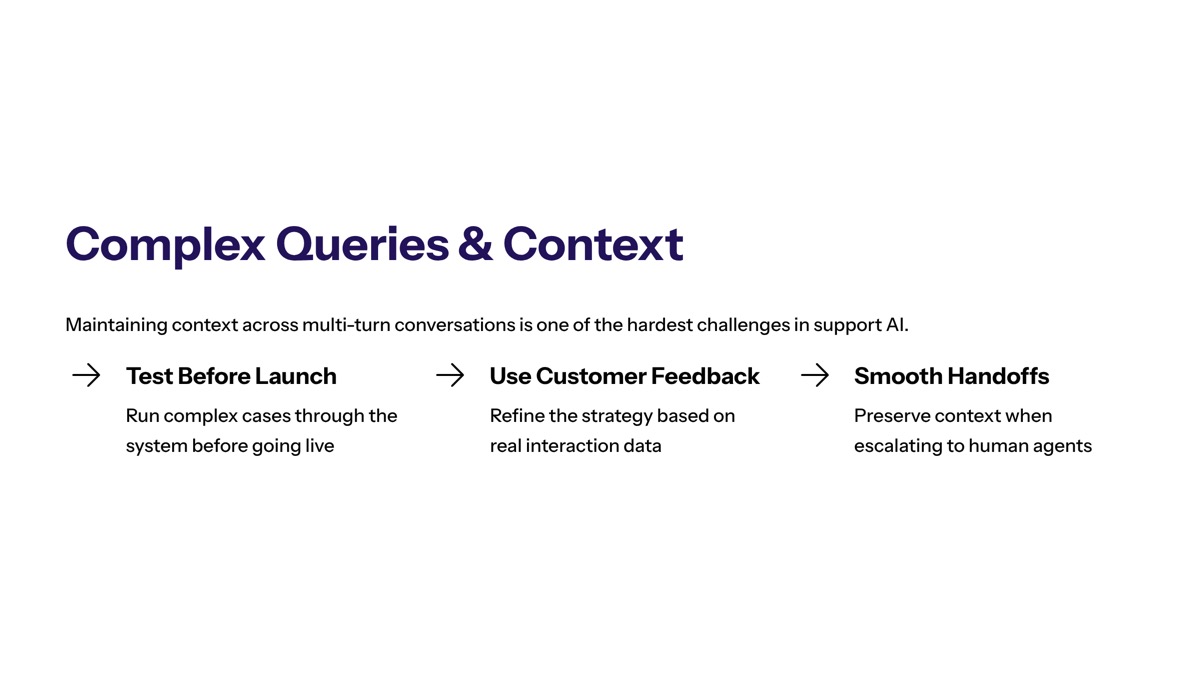
Common challenges with conversational AI for customer service include handling complex queries, maintaining context, ensuring smooth human handoffs, protecting data privacy, and keeping the AI trained for accuracy.
Conversational AI systems can struggle with maintaining context throughout multi-turn conversations, which is crucial for effective customer support and can lead to customer frustration.
Support teams should test complex cases before launch and use customer feedback to refine the conversational AI strategy.
Model Learning and Training Data
Machine learning (ML) algorithms are used in conversational AI to continuously improve the accuracy of responses by learning from vast datasets of customer interactions over time.
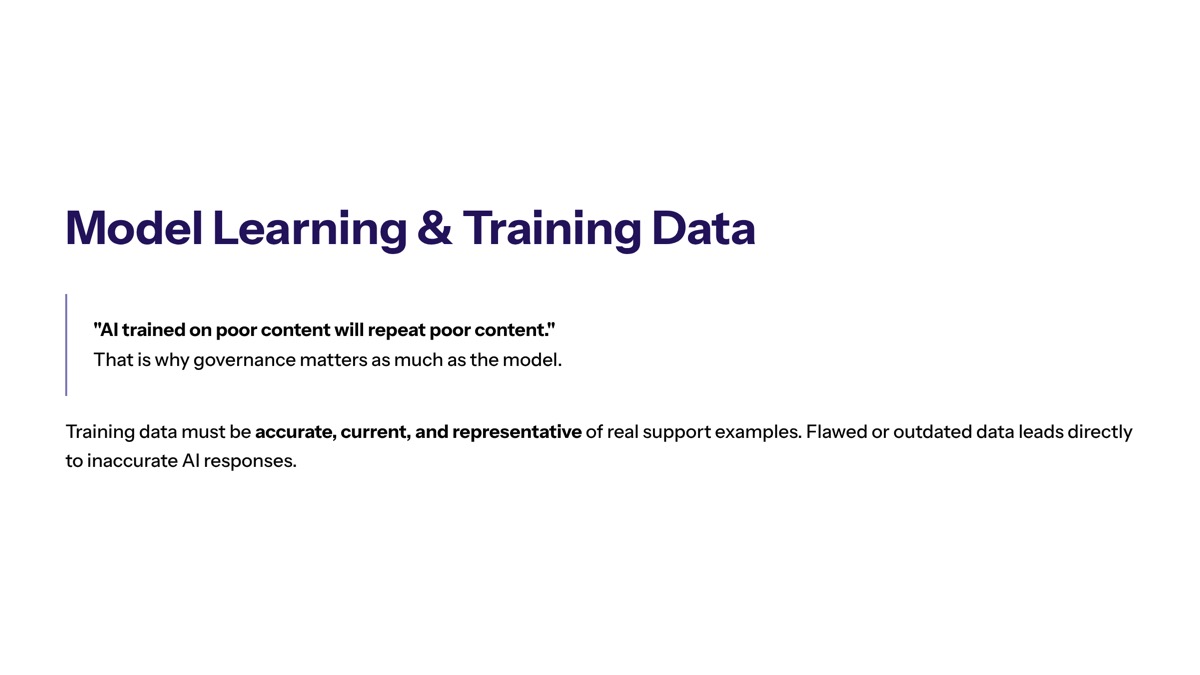
Training data should be accurate, current, and representative of real support examples. Flawed or outdated data leads to inaccurate AI responses in customer service applications.
AI trained on poor content will repeat poor content. That is why governance matters as much as the model.
Generative AI in Customer Support
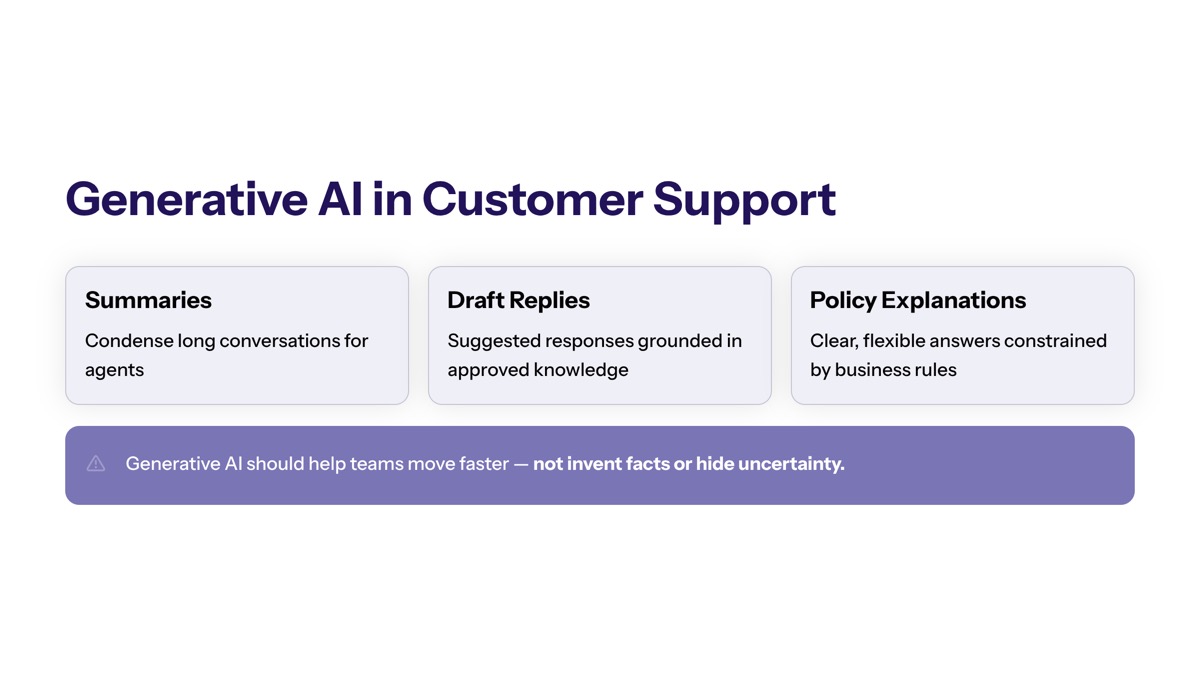
Generative AI can help produce summaries, draft replies, explain policies, and support agents with suggested next actions.
Large language models can improve answer flexibility, but generative AI should be grounded in approved knowledge and constrained by business rules.
Generative AI is strongest when it helps support teams move faster without inventing facts or hiding uncertainty.
Personalized Support
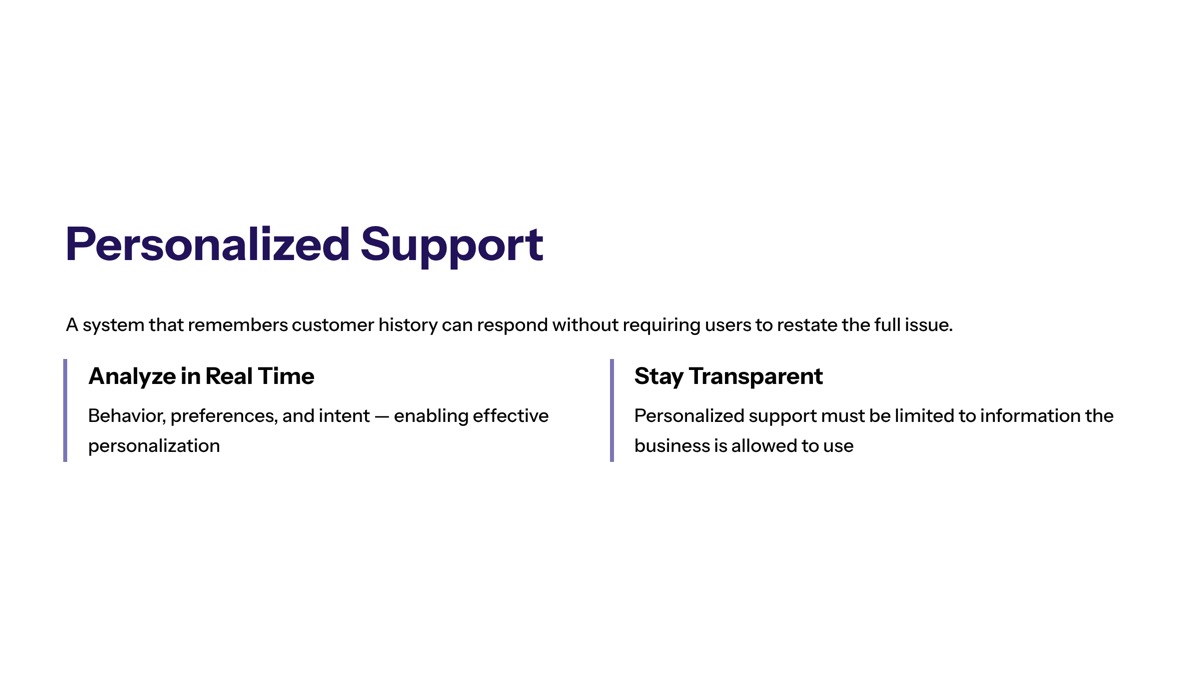
Advanced natural language processing and machine learning technologies enable conversational AI to analyze customer behavior, preferences, and intent in real time, allowing for more effective personalization.
Personalized interactions make support feel less generic. A system that remembers customer history can provide personalized responses without requiring the user to restate the full issue.
Personalized support should be transparent, useful, and limited to information the business is allowed to use.
Proactive Support
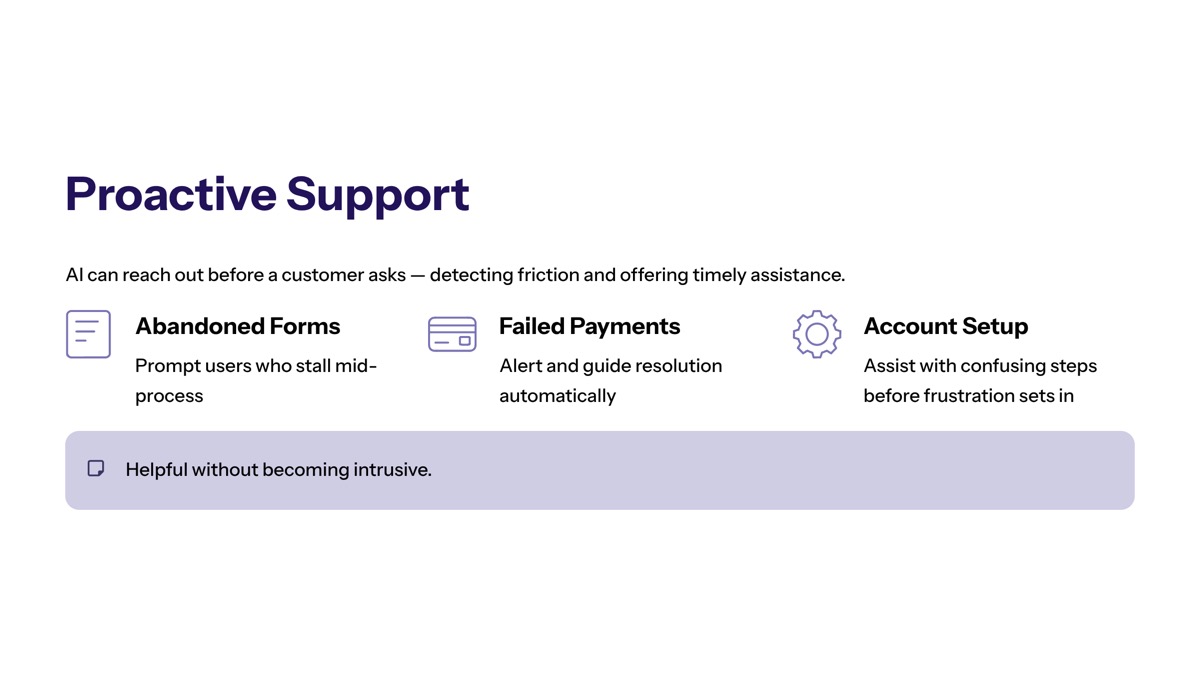
AI systems can reach out proactively with updates, alerts, or assistance when users seem stuck on a webpage.
Proactive support can help with abandoned forms, failed payments, confusing checkout steps, or account setup issues.
The best timely assistance is helpful without becoming intrusive.
Multilingual Support
AI provides multilingual support, offering real-time translation across various languages.
Multiple languages matter for companies with global customers, distributed teams, or regional service operations.
Multilingual conversational AI capabilities can reduce wait times when live agents are not available in every language.
Operational Efficiency and Contact Centers
Conversational AI technology can streamline customer service workflows, allowing human agents to concentrate on more complex tasks, thereby improving overall operational efficiency.
By 2026, technologies like AI in customer service are predicted to save contact centers approximately $80 billion in labor costs.
Support AI can improve customer service operations when it reduces repetitive work without lowering service quality.

Customer Engagement and Proactive Resolution
Customer engagement improves when a support experience feels timely, relevant, and easy to continue.
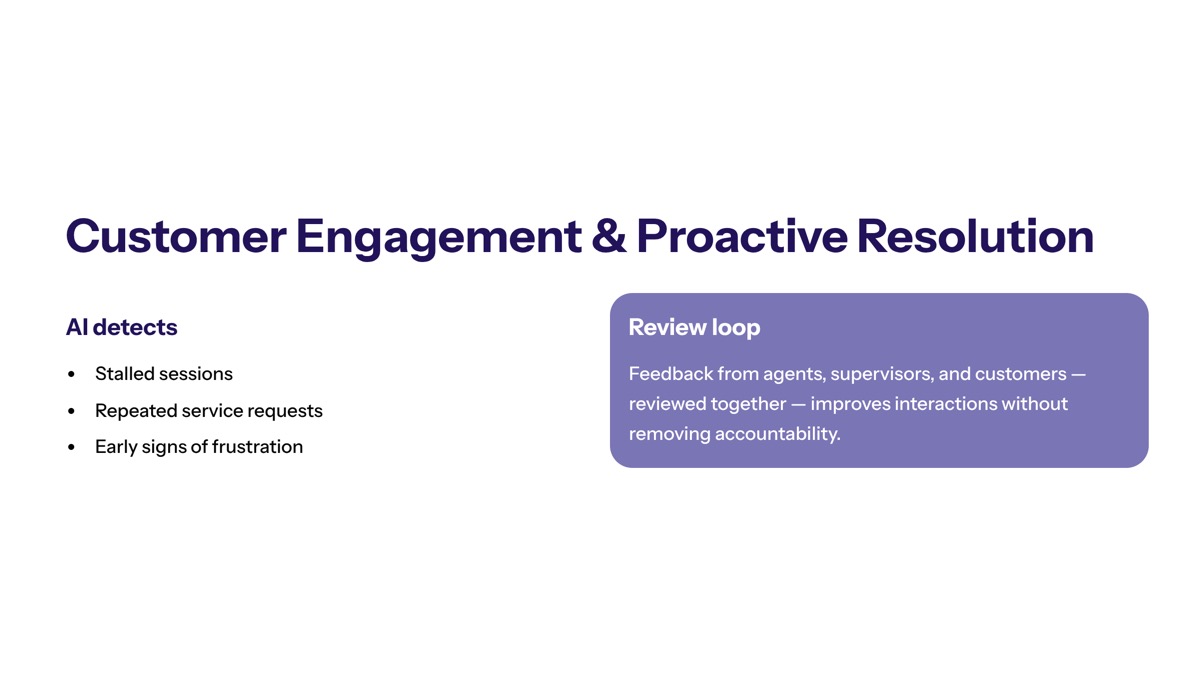
AI tools can help detect stalled sessions, repeated service requests, and customer frustration before the issue becomes a complaint.
The best support AI gives customers a fast path forward and gives the service team better context.
The customer service team should also review real customer interactions before expanding automation. That review shows which customer requests are clear, which ones need human conversation, and where virtual assistants should ask a clarifying question instead of guessing.
AI for customer service improves faster when feedback from agents, supervisors, and customers is reviewed together. That review improves customer interactions without removing accountability.
Customer Queries and Request Routing
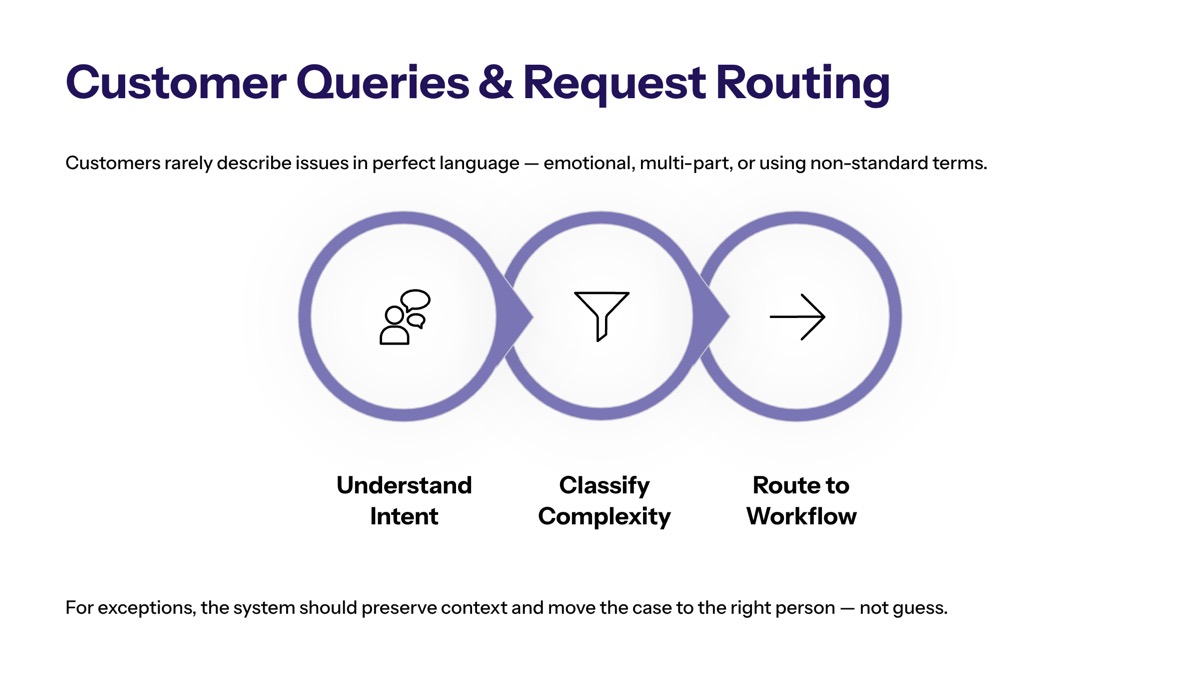
Customer queries rarely arrive in perfect language. Customers may describe a billing issue emotionally, ask several questions at once, or use terms that do not match the support team's categories.
Support automation should understand customer intent, separate simple requests from complex queries, and route each issue to the right workflow. This is where a conversational interface can reduce friction without pretending every case is simple.
For common requests, automation can provide fast resolution. For exceptions, the system should preserve context and move the case to the right person.
Conversational AI Solutions for Different Teams
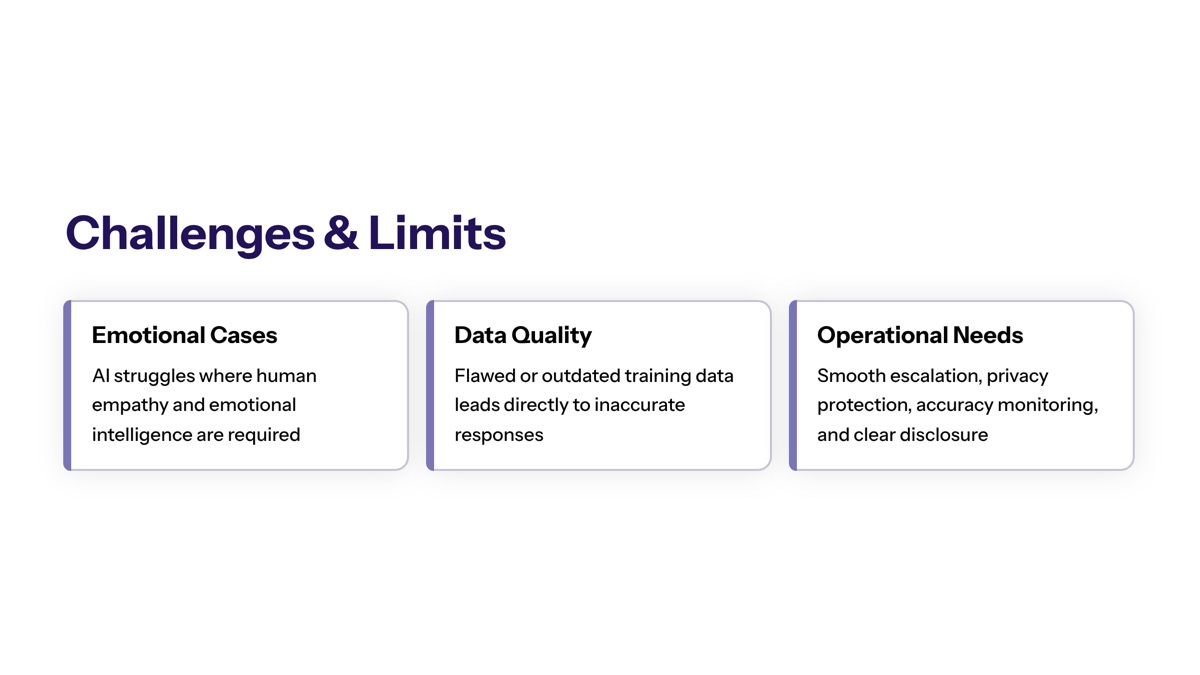
Conversational AI solutions can support customer service, sales support, onboarding, technical support, billing, account workflows, and internal help desks.
For customer service conversational AI, the priority should be resolution quality, handoff quality, and safe use of profile data.
The right AI solution depends on business needs, support volume, data readiness, and whether service leaders can maintain it.
Choosing an AI for Customer Service Vendor
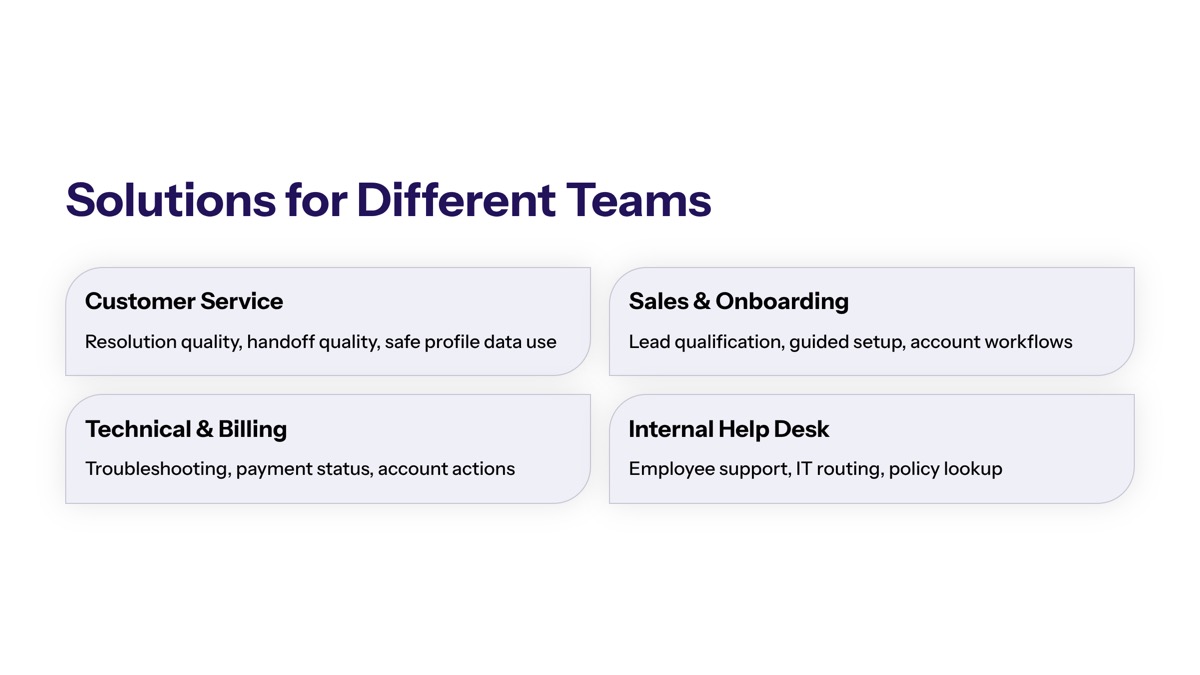
Choosing AI for customer service is partly a build-versus-buy decision. Some teams have enough engineering capacity, support operations maturity, and data science expertise to configure deeper workflows internally. Others need a vendor that can provide implementation help, model tuning, integrations, and support after launch.
The vendor should prove that its conversational AI chatbot can work with real workflows, not only demo scripts. Ask how it handles messy customer queries, where it stores profile data, how it connects to CRM records, and how support managers can review failed answers.
Teams should also test whether the product can support multiple languages, account-specific answers, and human handoffs. A platform that looks strong in one language or channel may fail when the customer base is broader.
Where AI for Customer Support Fits
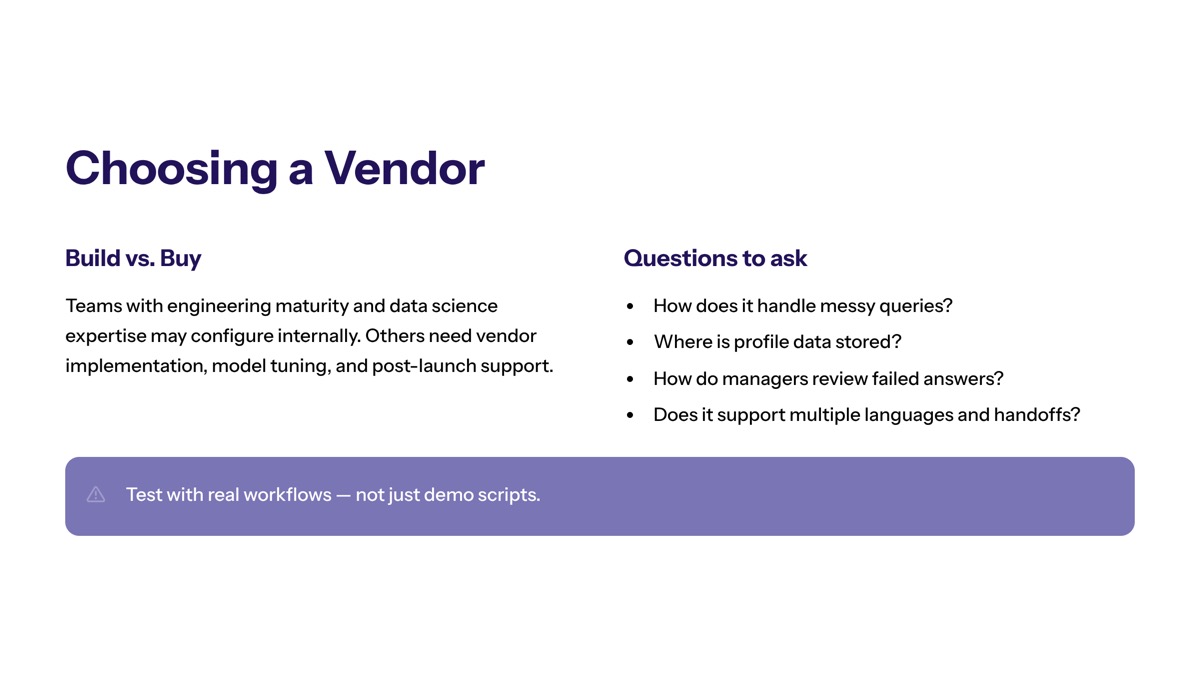
Support AI works best as a service layer between customers, knowledge, workflows, and human agents. It should help the customer service team move faster while keeping escalation available.
Good fits include password resets, order questions, billing status, appointment changes, account workflows, troubleshooting, and timely assistance. Riskier fits include legal disputes, medical issues, angry customers, and anything that requires emotional intelligence.
Support leaders should decide which use cases are safe for automation, which need approval, and which must stay with people. That boundary is what keeps service AI useful instead of risky.
Challenges and Limits
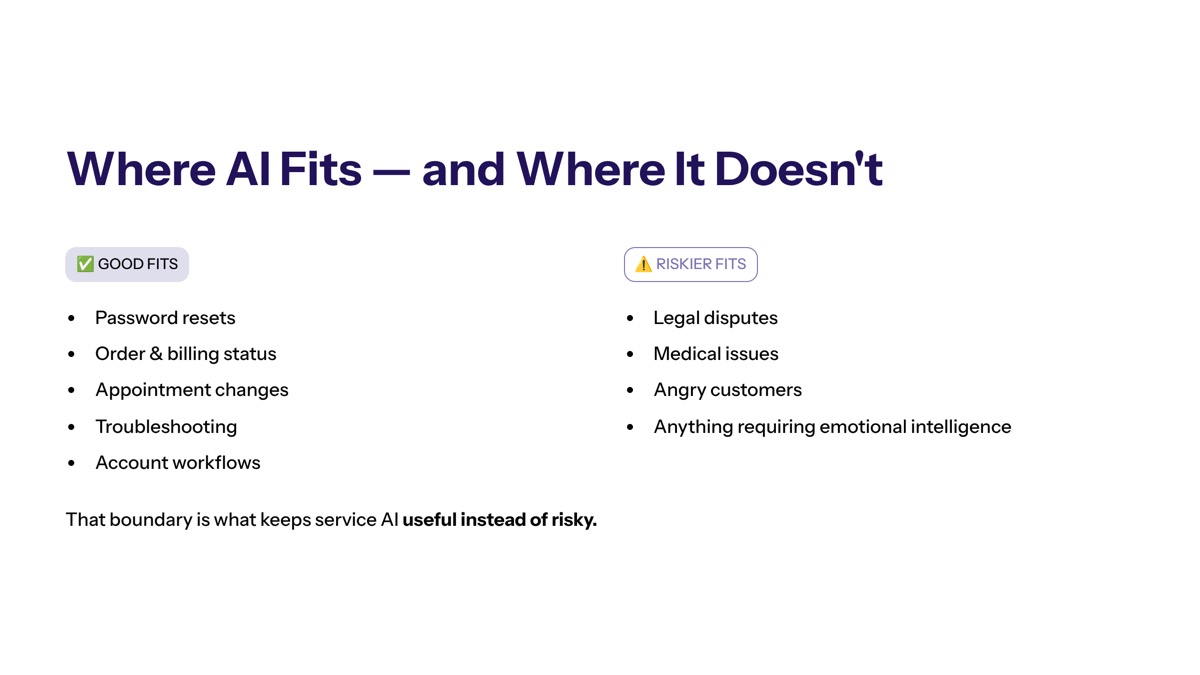
AI struggles with highly emotional or sensitive cases that require human empathy and emotional intelligence.
Flawed or outdated data leads to inaccurate AI responses in customer service applications.
Customer support automation also needs smooth escalation, privacy protection, accuracy monitoring, and clear customer disclosure.
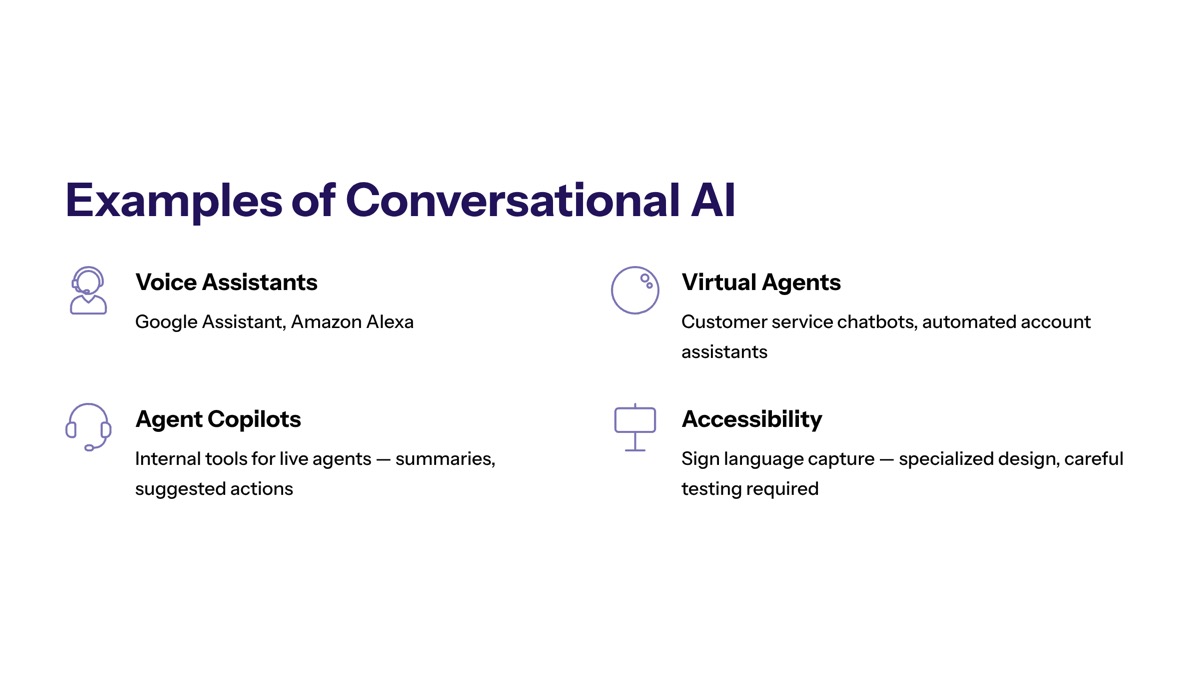
Examples of Conversational AI
Examples include Google Assistant, Amazon Alexa, modern conversational AI chatbots, customer service virtual agents, internal agent copilots, and automated account assistants.
Some tools can answer frequently asked questions. Others can handle account actions, provide timely assistance, or help with controlling home automation devices.
Advanced AI technologies can also capture sign language in accessibility contexts, though that requires specialized design and careful testing.
Final Takeaway
Conversational AI for customer support can improve customer satisfaction, customer engagement, and customer experience when it is deployed with the right strategy.
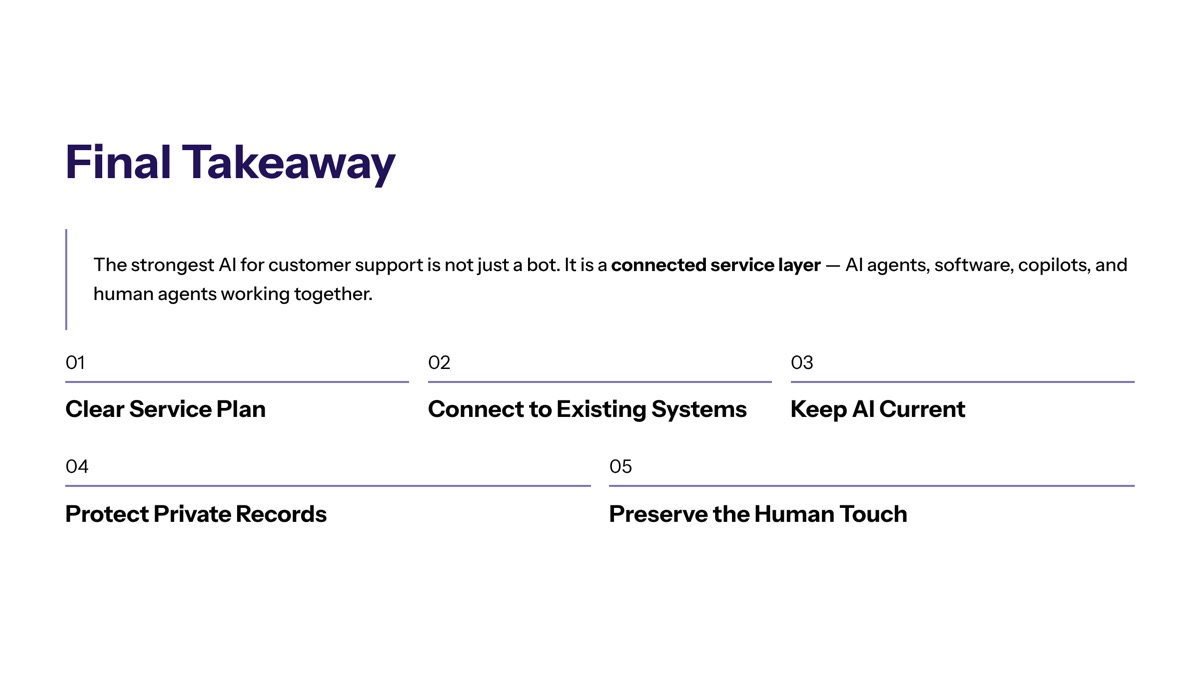
The strongest AI for customer support is not just a bot. It is a connected service layer that uses conversational AI software, AI agents, assistant tooling, and human agents together.
Start with a clear service plan, connect the tools to existing systems, keep the AI current, protect private records, and preserve the human touch where it matters.