Conversational AI for Ecommerce: Conversational Commerce, Personalization, and Scalable Support
Conversational AI for ecommerce is becoming a practical growth and service layer for retailers, marketplaces, subscription brands, and B2B commerce teams. It helps customers search, compare, ask questions, receive recommendations, track orders, and complete transactions through natural language conversations instead of forcing every buyer through static menus and disconnected support flows.
The opportunity is not simply adding another chatbot to a storefront. The stronger opportunity is designing conversational commerce around the buying path, shopper needs, customer records, and the existing tech stack that already runs catalog, inventory, checkout, fulfillment, and support.
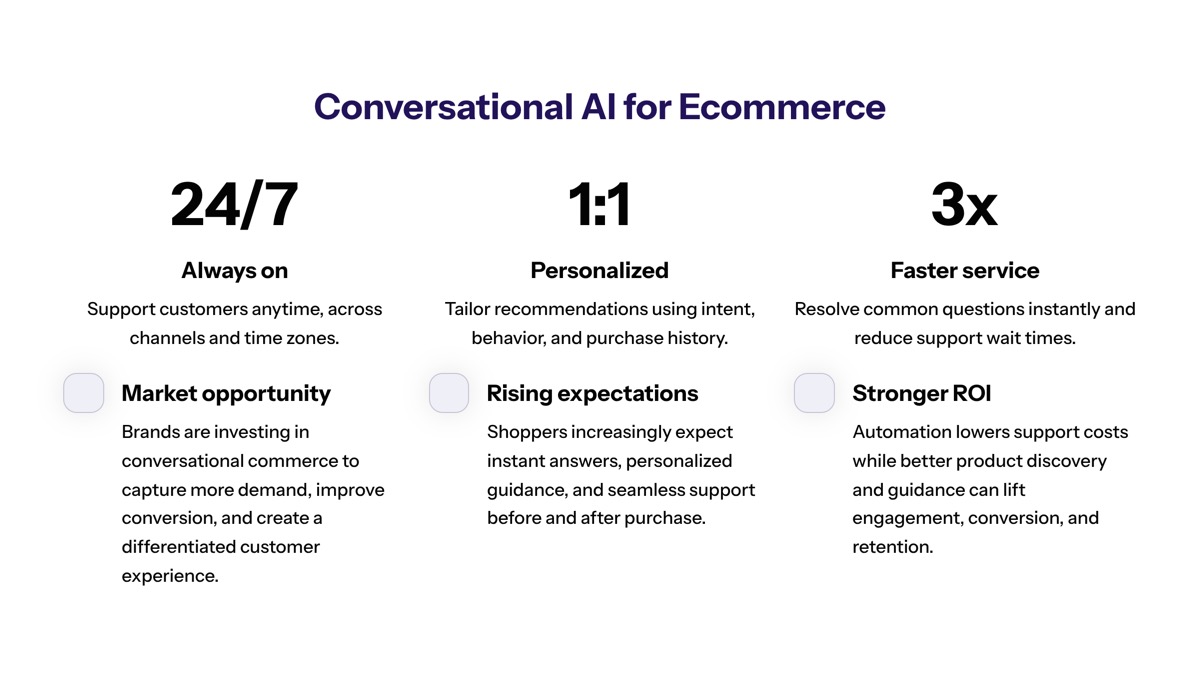
When conversational AI is implemented well, it improves customer experience, strengthens customer engagement, reduces routine questions, and helps brands serve shoppers across channels without losing tone or operational control.
What Is Conversational AI for Ecommerce?
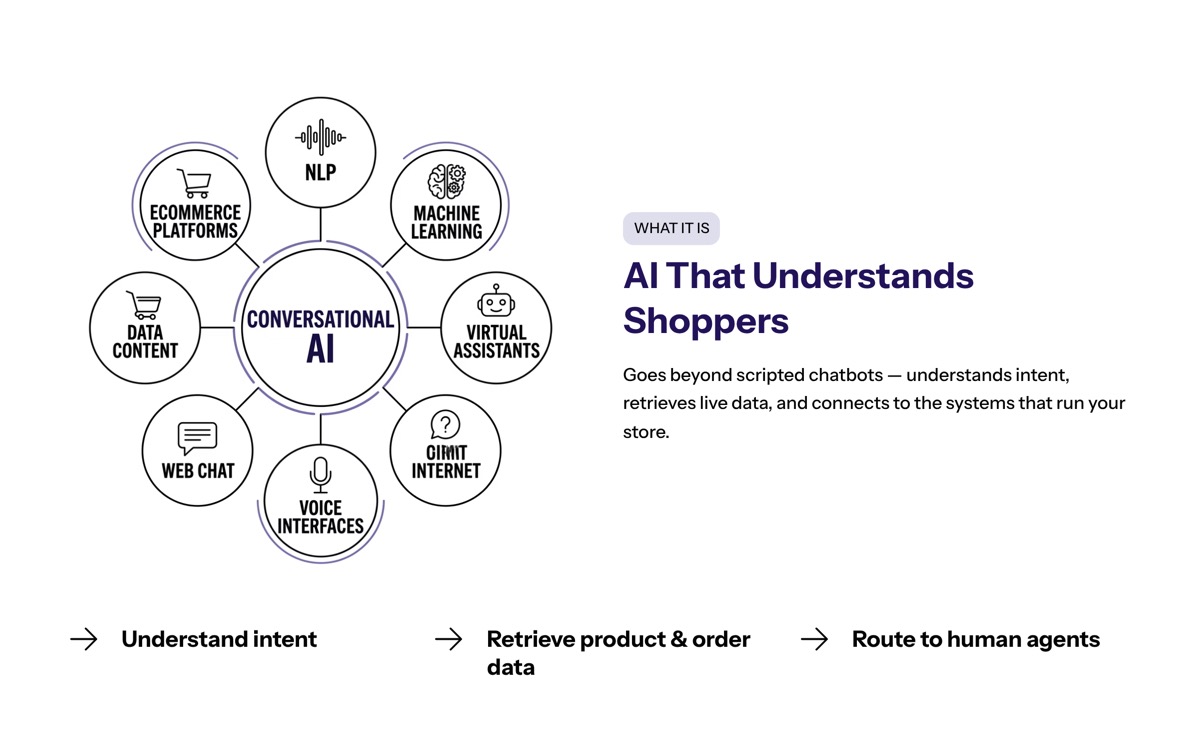
Conversational AI for ecommerce uses artificial intelligence, machine learning, natural language processing, and natural language understanding to support customer conversations across a storefront, messaging platforms, web chat, voice assistants, and ecommerce platforms.
Conversational AI can understand user intent, provide instant answers, suggest relevant products, retrieve delivery details, and route complex customer queries to human agents. It can power virtual assistants, AI powered chatbots, an AI agent inside a support platform, or voice interfaces that help customers shop hands-free.
Conversational AI for ecommerce is most useful when it moves beyond generic scripts. The system should understand human language, respond with relevant responses, and connect to the systems that hold product, inventory, purchase history, pricing, promotion, and shopper records.
What Is Conversational Commerce?
Conversational commerce is the use of chat, messaging channels, voice assistants, and AI powered experiences to help customers shop through a conversation. Conversational commerce allows customers to discover products, ask questions, receive recommendations, and complete transactions through natural language conversations.
In conversational commerce, the customer can move from discovery to checkout without switching between search bars, FAQ pages, and support tickets. A shopper might ask for a running shoe under a certain price, compare sizes, check stock, and buy inside the same flow.
Conversational commerce is not only customer service automation. It is a commerce experience that blends support, merchandising, guided selling, shopper context, and checkout assistance.

How Does Conversational Commerce Work?
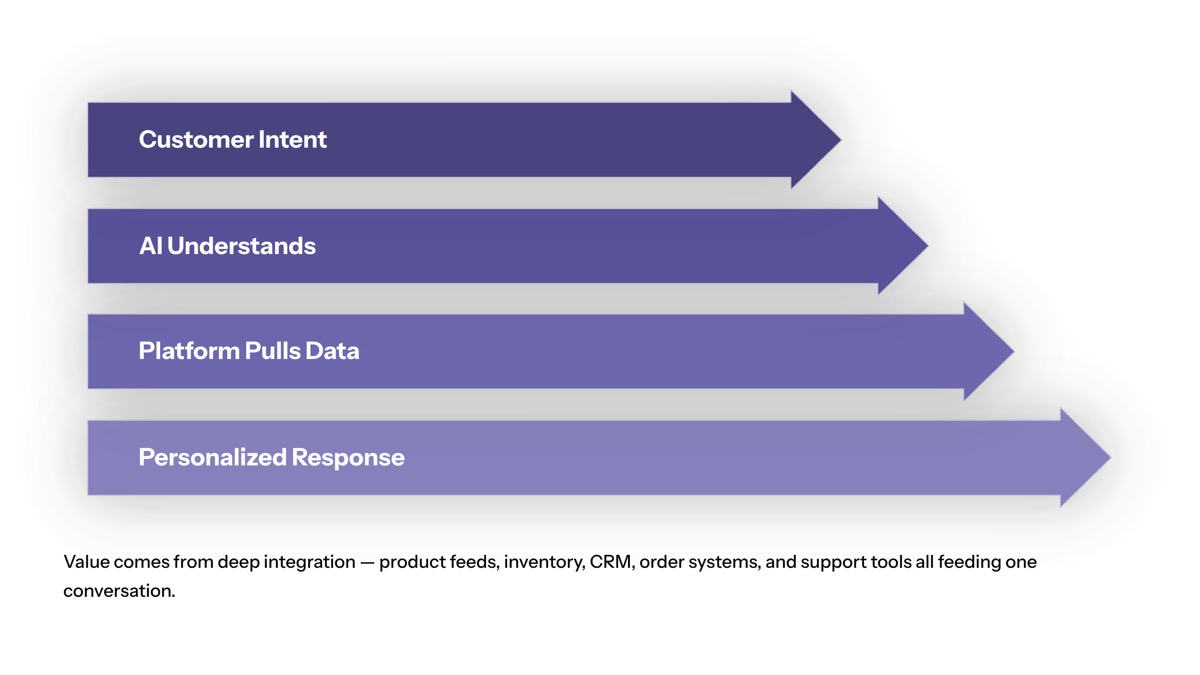
Conversational commerce work starts when a customer asks a question or shows intent through behavior. The system uses natural language processing nlp, machine learning, and customer context to decide whether the shopper needs product information, support, a recommendation, or human help.
The conversational commerce platform then pulls information from ecommerce platforms, product feeds, inventory systems, CRM tools, order systems, and service tools. If the customer asks about a jacket, the AI agent can check stock availability, compare sizes, and provide personalized responses based on purchase history.
Conversational commerce tools should not operate as isolated widgets. The value comes from integration with ecommerce systems and the ability to improve customer interactions across the whole buying journey.
Why Customer Expectations Changed
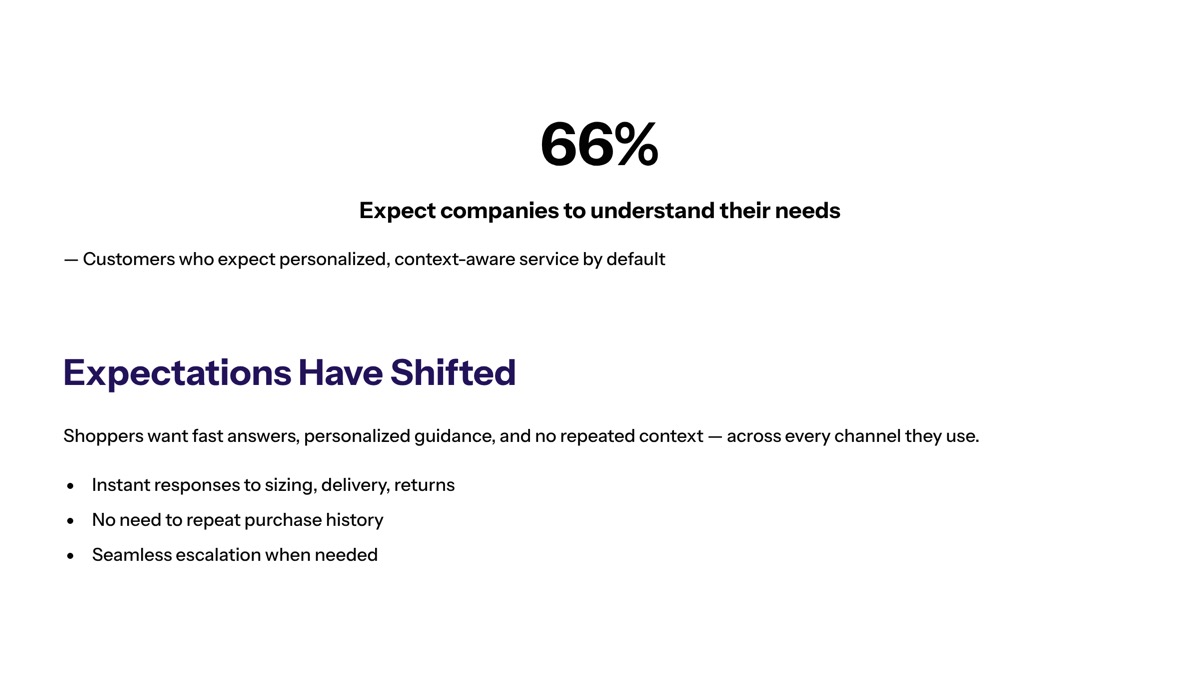
Customer expectations have shifted because shoppers are used to fast answers, personalized recommendations, and service across multiple channels. Understanding customer expectations and pain points is fundamental to creating effective conversational AI architecture, as 66% of customers expect companies to understand their needs and expectations.
That expectation changes how commerce teams should design support and selling flows. Customers do not want to repeat context, search through irrelevant products, or wait for simple answers about sizing, delivery, returns, or shipment status.
Conversational AI for ecommerce can help meet those expectations by combining instant responses with contextual product guidance and escalation when the issue requires human agents.
Customer Engagement Across the Customer Journey
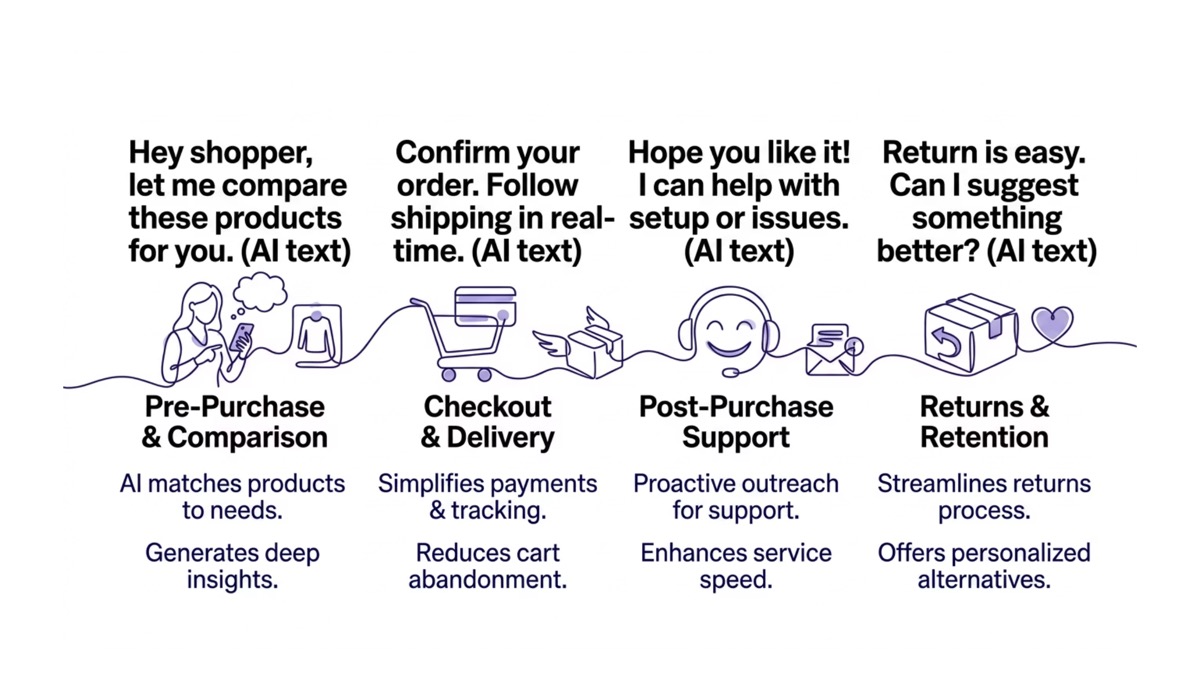
Conversational AI can significantly enhance customer engagement by providing real-time support and personalized recommendations, which improves overall shopping experiences and increases customer satisfaction.
Across the shopping path, conversational commerce can help engage customers before purchase, during product comparison, at checkout, after delivery, and during returns. These interactions generate valuable insights that can improve merchandising, support, and retention.
Data-driven insights from customer interactions provide valuable information on preferences and behavior. That makes shopper feedback and customer conversations useful inputs for strategy, not only support records.
Customer Experience and Customer Satisfaction
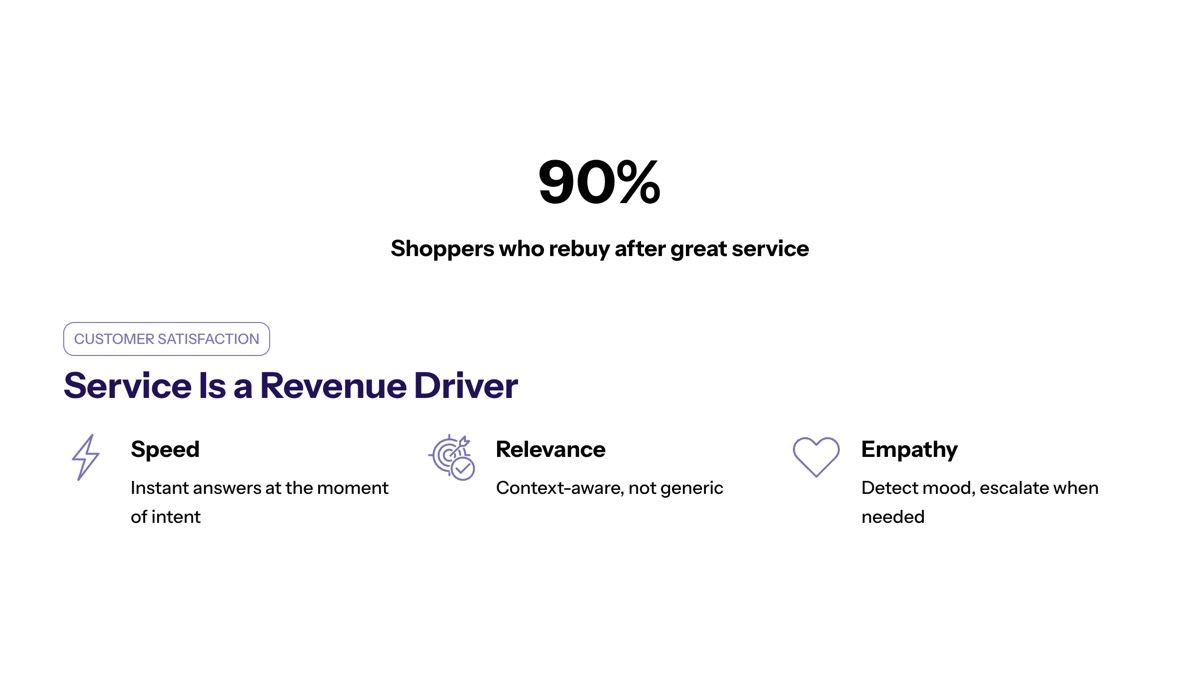
Customer experience improves when shoppers get useful help at the moment of intent. Roughly 90% of shoppers say that good customer service is a direct reason that makes them buy again, highlighting the importance of personalized interactions in conversational commerce.
Roughly 90% of shoppers say that good customer service is a direct reason that makes them buy again, highlighting the importance of effective customer engagement strategies.
Customer satisfaction depends on speed, relevance, and trust. Conversational AI for ecommerce should provide instant answers where possible, acknowledge customer emotions, detect customer mood, and escalate when a conversation needs human judgment.
AI Powered Product Discovery
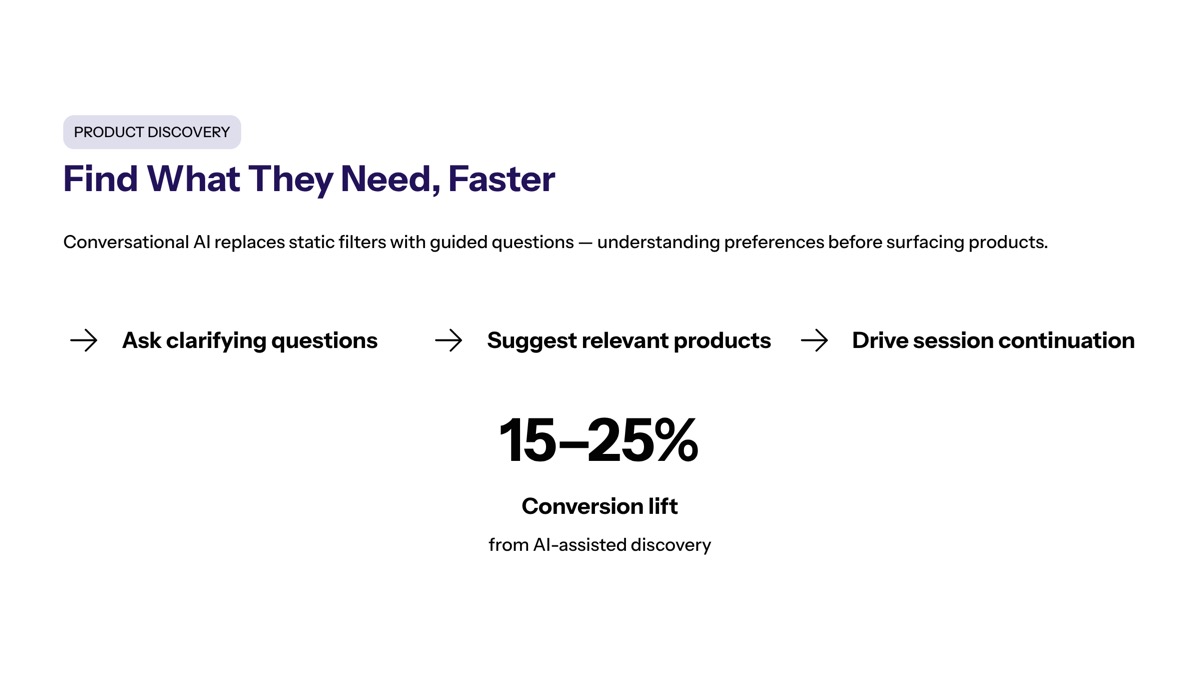
AI powered product discovery helps shoppers find what they need without filtering through large catalogs alone. AI-assisted discovery can lead to conversion lifts of 15% to 25% by helping customers find what they need faster.
Instead of showing every product that matches a keyword, conversational commerce can ask clarifying questions, understand customer preferences, and suggest relevant products. This creates personalized shopping experiences that feel closer to guided selling than static search.
Discovery is a strong use case because it supports both customer experience and revenue. When customers find relevant products faster, they are more likely to continue the session and buy.
Personalized Customer Experiences
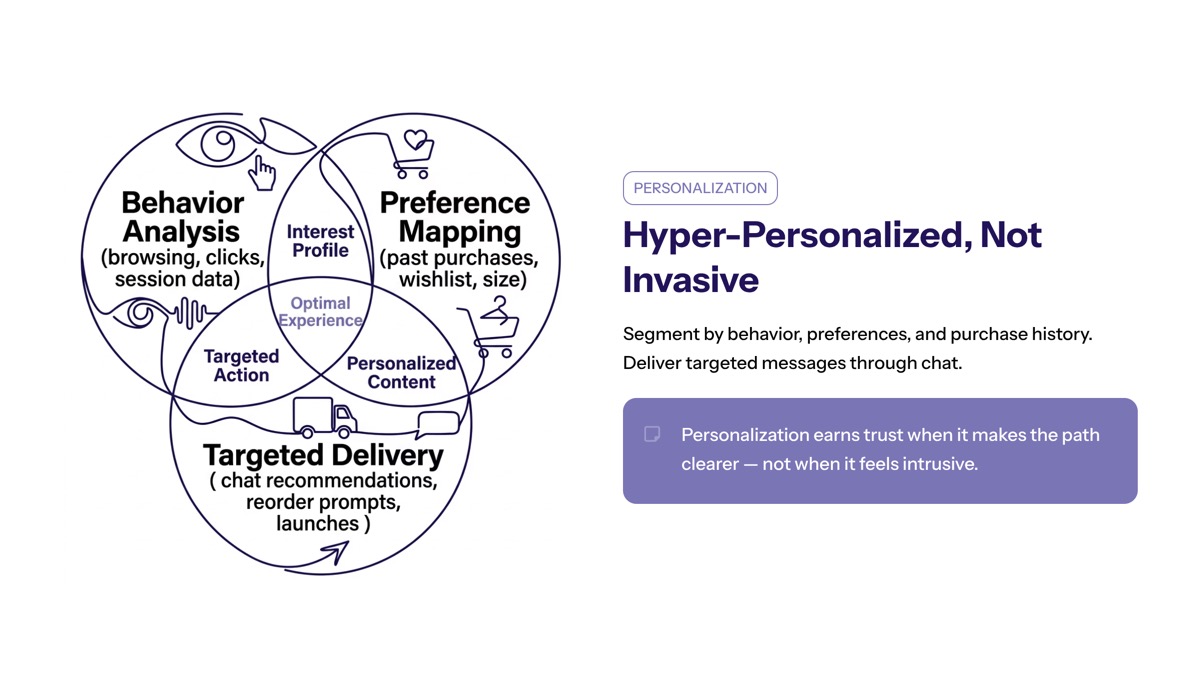
Conversational commerce enables businesses to create hyperpersonalized experiences that target individual customer preferences and guide them to relevant product recommendations.
AI collects and analyzes customer behavior and preferences, enabling brands to refine their marketing strategies. AI-driven personalized marketing allows ecommerce businesses to segment customers according to behavior, preferences, and purchase history, delivering targeted marketing messages through chat platforms.
Personalized customer experiences should still respect consent, privacy, and brand voice. Personalization becomes useful when it makes the shopping path clearer, not when it feels invasive.
Customer Data, Privacy, and Trust
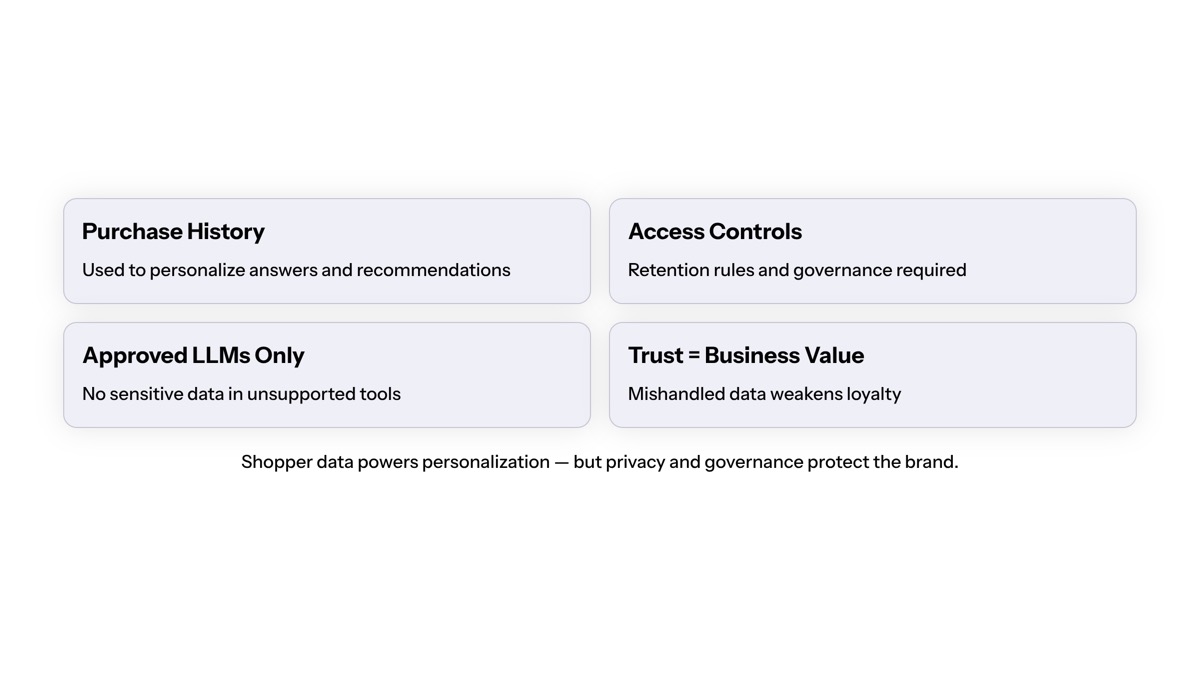
Shopper data is the foundation of effective conversational commerce, but it also creates risk. The AI agent may use purchase history, browsing behavior, customer preferences, loyalty status, location, and order records to personalize answers.
That information should be protected with access controls, retention rules, and clear governance. Brands should avoid feeding sensitive customer data into unsupported tools or unapproved large language models.
Trust is part of business value. A conversational commerce platform that mishandles profile data can hurt loyalty even if it appears to improve short-term conversion.
Conversational Commerce Platform Requirements
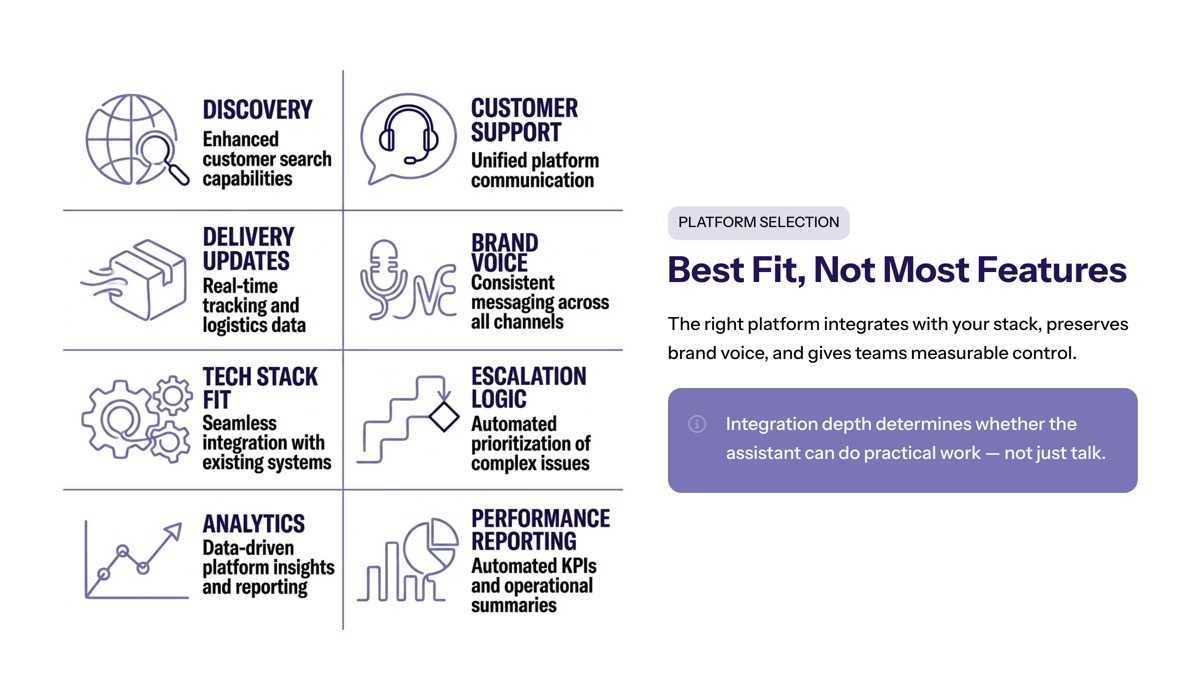
The best conversational commerce platform is not simply the one with the most features. It is the one that fits the existing tech stack, integrates with ecommerce platforms, supports brand voice, and gives teams measurable control.
Integrating conversational AI with existing ecommerce systems is essential for effective implementation, allowing AI assistants to perform practical tasks such as retrieving product information and checking stock availability.
A conversational commerce platform should support discovery, customer support, delivery updates, customer feedback, analytics, escalation, and clear performance reporting.
Conversational AI Tools and Ecommerce Systems
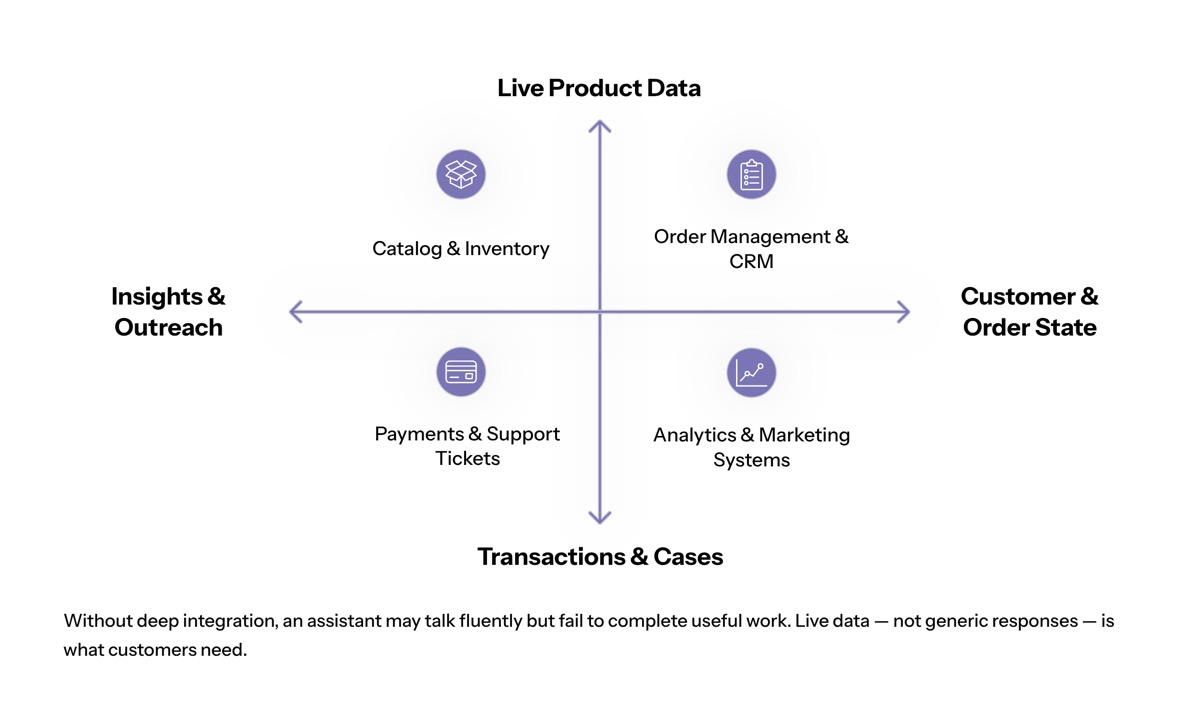
Conversational AI tools should connect with catalog data, order management, CRM records, payment workflows, support tickets, and marketing systems. Without that integration, an assistant may talk fluently but fail to complete useful work.
For ecommerce platforms, integration determines whether conversational commerce can answer practical questions. A customer asking if a product is in stock needs an answer from live inventory, not a generic response.
Ecommerce solutions also need testing for load, privacy, and reliability. A polished demo does not prove the tool can handle seasonal spikes, promotions, or high-volume customer inquiries.
Facebook Messenger, Messaging Apps, and Messaging Platforms
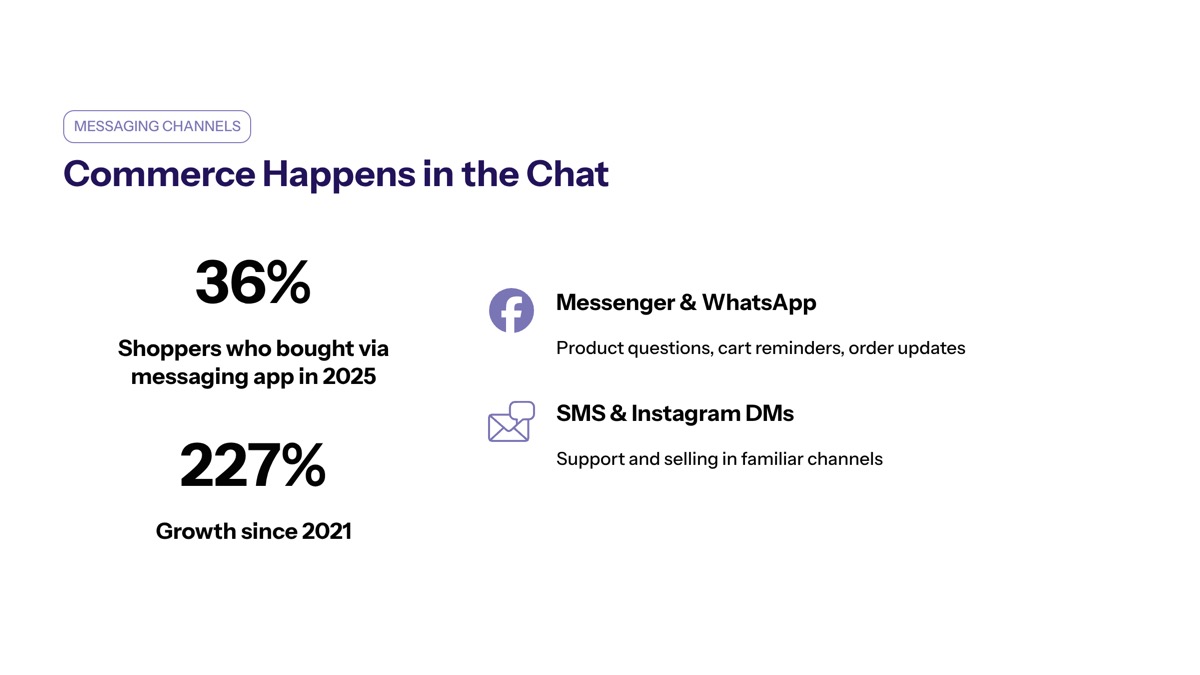
Conversational commerce often happens outside the ecommerce site itself. Facebook Messenger, WhatsApp, Instagram DMs, SMS, web chat, and other messaging platforms can become shopping channels when they connect to the commerce stack.
In 2023, 36% of shoppers made a purchase through a messaging app, an increase of 227% since 2021. That trend matters because customers already use messaging apps for daily communication.
Facebook Messenger and other messaging platforms can support product questions, abandoned cart reminders, order updates, and support. The key is consistent context across messaging channels and the storefront.
Voice Assistants and Conversational Shopping
Voice assistants can support hands-free product search, reorder flows, delivery updates, and quick service questions. For some shoppers, voice assistants are useful when browsing is inconvenient or when replenishment is predictable.
Conversational AI for ecommerce should treat voice assistants as one part of the overall shopping path. The same customer may begin with voice, continue in a messaging app, and complete the purchase in the online store.
Voice assistants also need extra care around confirmation. When customers buy through voice, the system should repeat important details, verify intent, and avoid accidental purchases.

Order Tracking and Post-Purchase Support
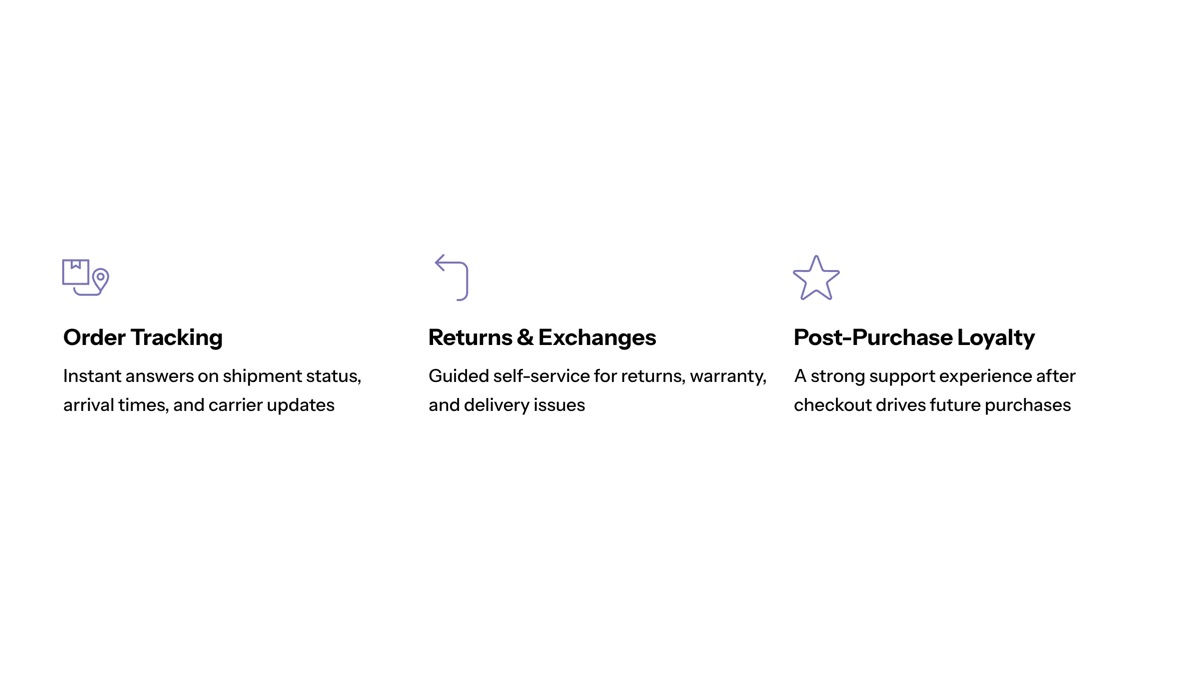
Delivery status is one of the clearest support use cases for conversational AI for ecommerce. Customers ask where an order is, whether it shipped, when it will arrive, and how to change delivery details.
Conversational AI can answer order tracking questions quickly when it is connected to fulfillment and carrier data. It can also support customers with returns, exchanges, warranty questions, and delivery issues.
Post-purchase support shapes customer loyalty. A poor support experience after checkout can weaken future purchases even when the product itself is strong.
Routine Customer Inquiries and Human Agents
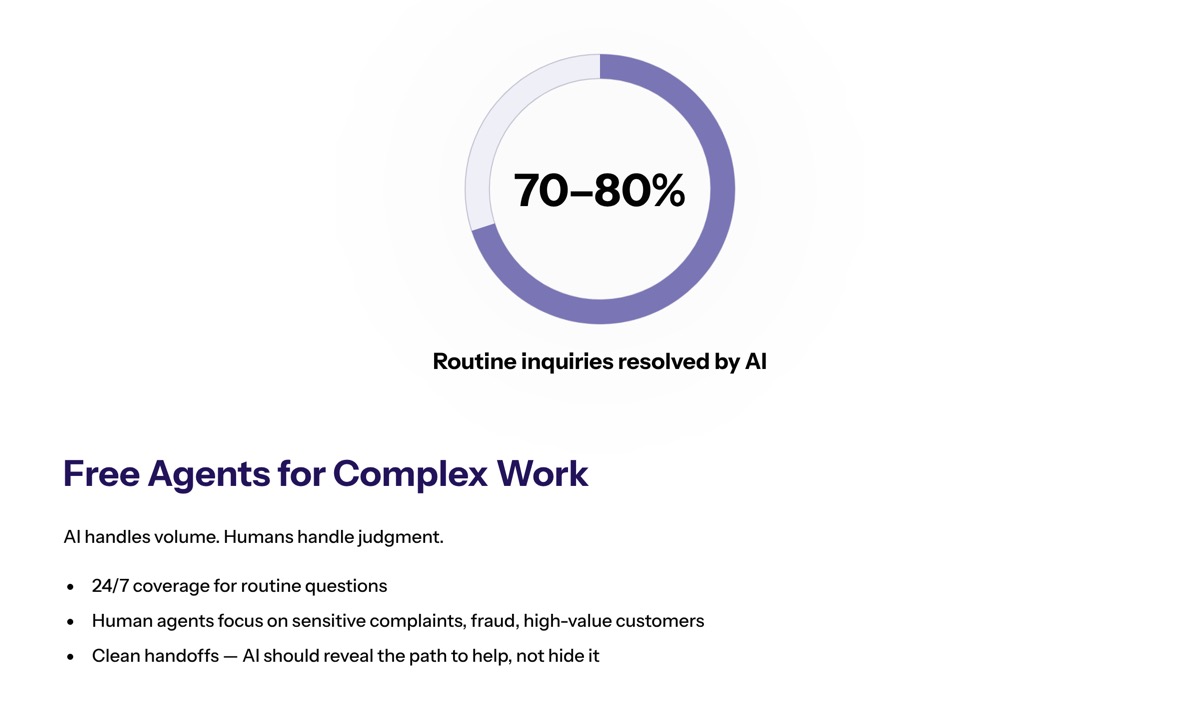
Conversational AI can autonomously resolve 70–80% of routine customer inquiries, significantly reducing the workload for human support agents and allowing them to focus on complex cases that require contextual judgment or specialized expertise.
AI-driven automation in ecommerce can enhance operational efficiency by automating repetitive tasks, allowing businesses to provide 24/7 support and freeing up human agents to handle more complex inquiries.
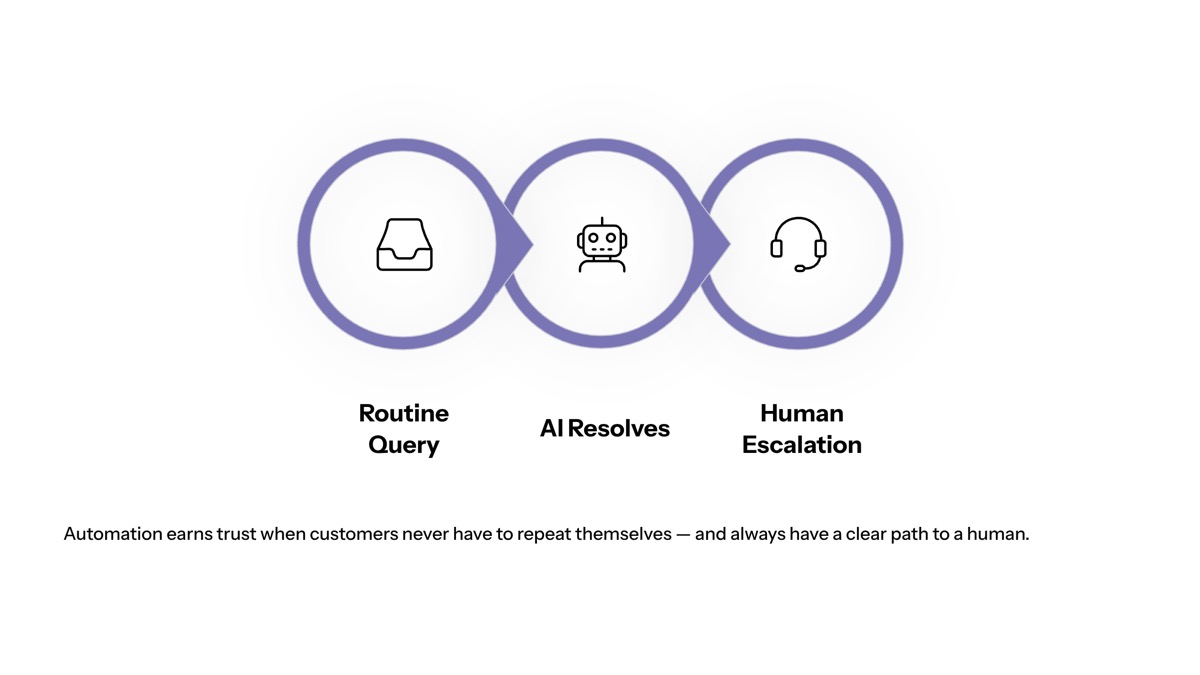
Human agents remain important for sensitive complaints, edge cases, fraud concerns, unusual returns, high-value customers, and customer emotions that require empathy. The AI agent should make handoffs cleaner, not hide the path to help.
Repetitive Customer Queries and Customer Support
Customer support teams spend significant time answering routine questions about shipping, returns, sizing, warranties, product availability, and promotions. Customer service automation can reduce that load when the assistant has approved answers and current data.
AI powered chatbots are useful when they resolve common questions without making customers repeat information. They become frustrating when they loop, misunderstand intent, or block human help.
Supporting customers well means knowing when automation should stop. The conversational AI solution should escalate quickly when it cannot provide relevant responses.
Abandoned Carts and Checkout Recovery
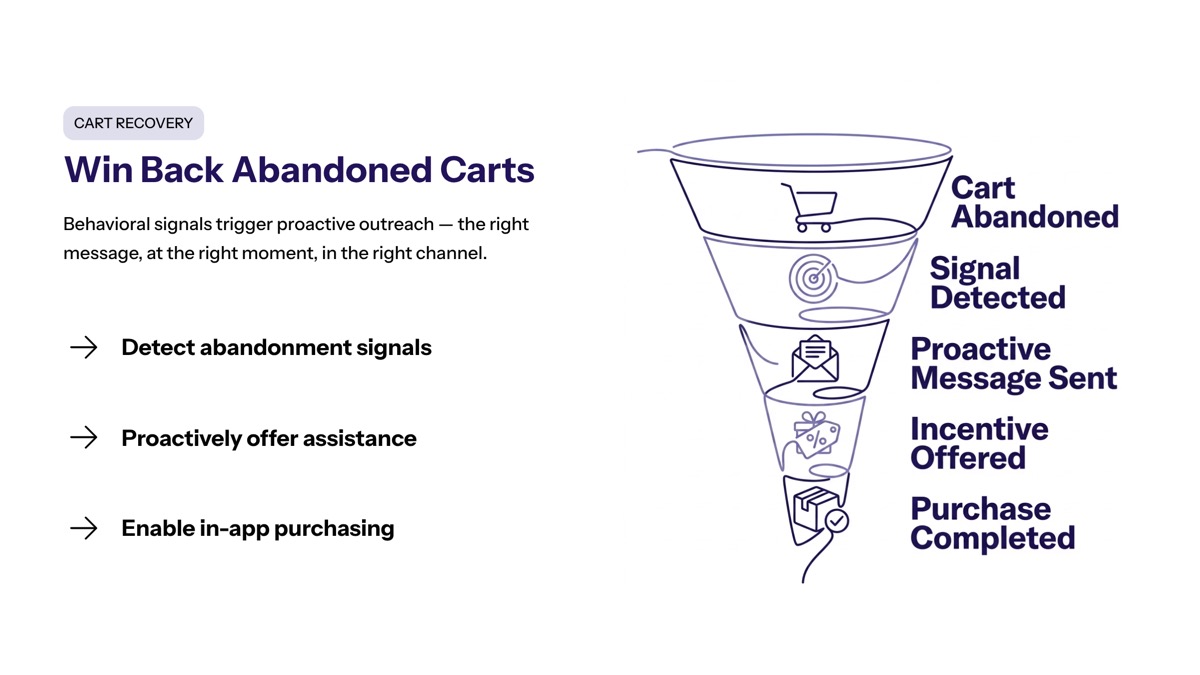
Conversational commerce employs various strategies to combat the issue of abandoned carts, which pose a significant challenge for online retailers.
Proactive messaging, rapid initial response times, and in-app purchasing options within messaging platforms can significantly increase the likelihood of customers completing their transactions.
Conversational systems can detect behavioral signals associated with abandonment and proactively offer assistance or incentives designed to help customers complete their purchase.
Complete Transactions in the Conversation
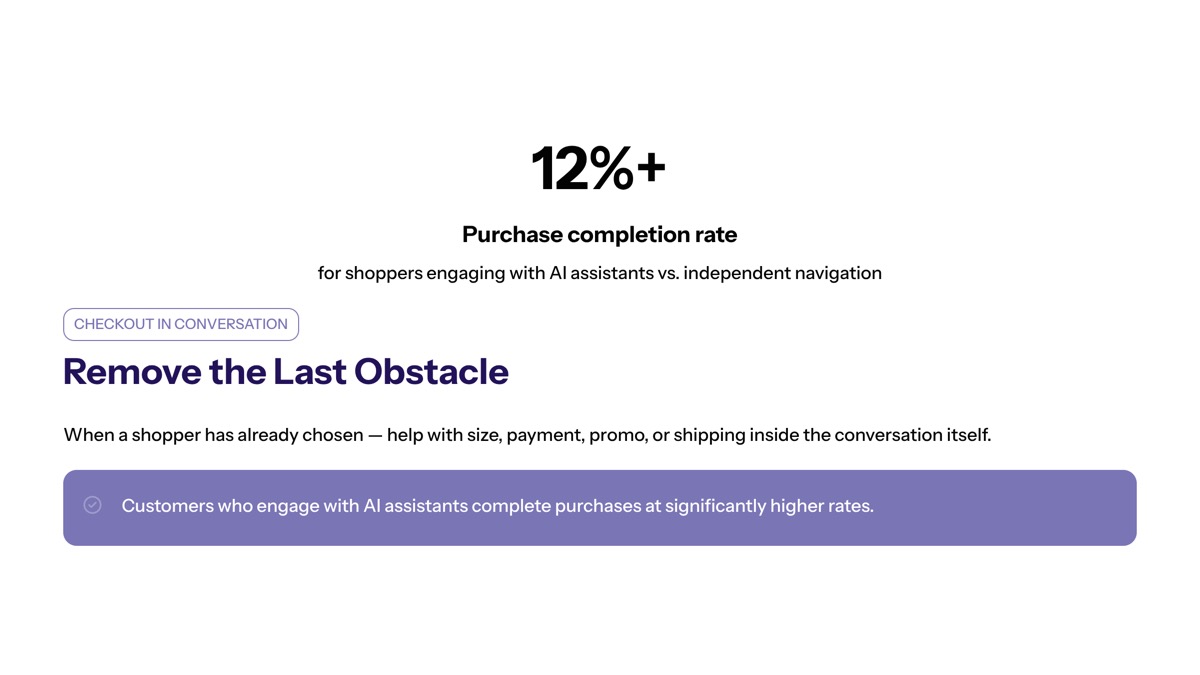
Conversational commerce can help customers purchase without leaving the conversation. This is useful when a shopper has already selected a product and only needs help with size, payment, shipping, or promotion details.
Retailers implementing conversational interfaces typically report that customers who engage with AI assistants complete purchases at significantly higher rates than those navigating independently, with some implementations showing purchase completion rates exceeding 12%.
Retailers implementing conversational interfaces often report that customers who engage with AI assistants complete purchases at significantly higher rates than those navigating independently, with some implementations exceeding 12% purchase completion rates.
Scalability, Traffic Spikes, and Operational Efficiency
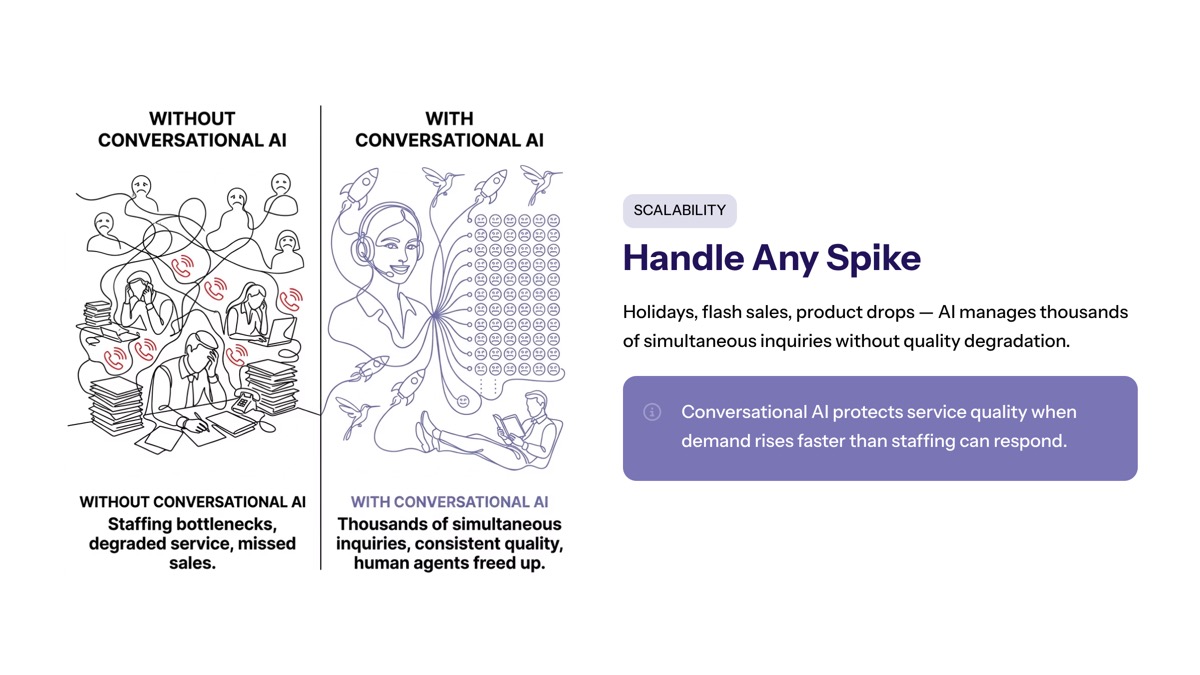
Scalability refers to AI's ability to handle sudden spikes in traffic without a decrease in response quality or speed.
AI can manage thousands of inquiries simultaneously, optimizing operational scalability and allowing human agents to focus on complex cases.
This matters during holidays, product drops, flash sales, and service incidents. Conversational AI for ecommerce can protect service quality when support demand rises faster than staffing.
Fraud Detection and Secure Customer Interactions
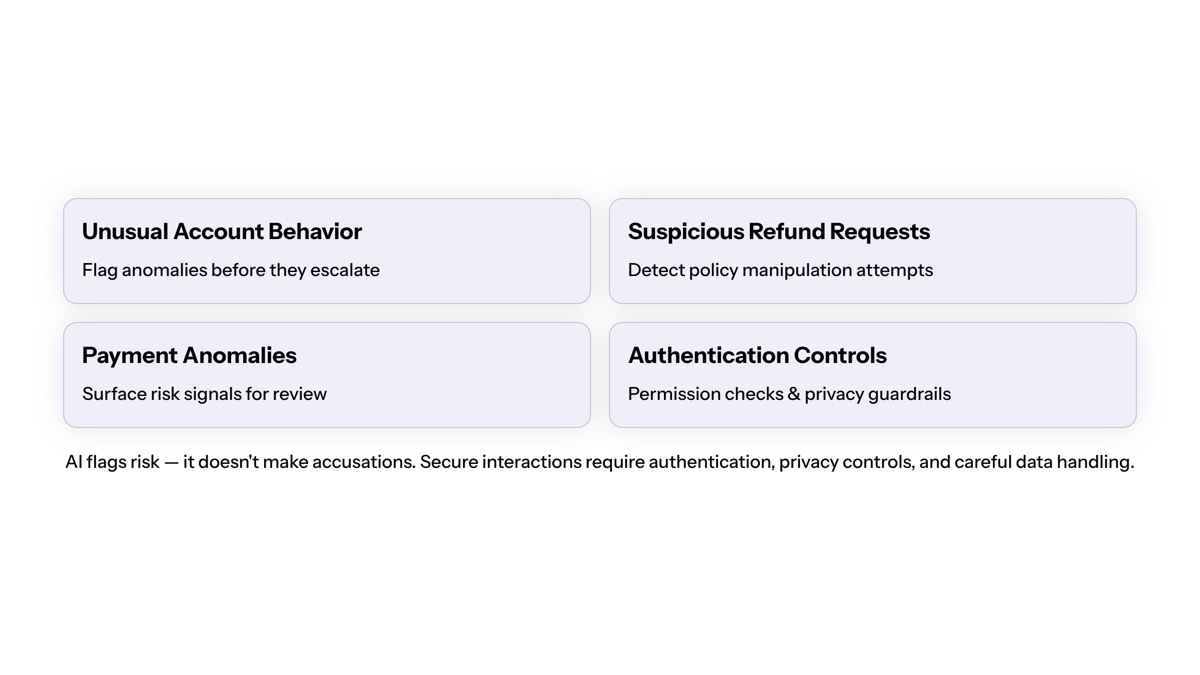
AI can detect suspicious communication patterns and flag malicious activity for fraud detection.
Fraud detection in conversational commerce may involve unusual account behavior, suspicious refund requests, payment anomalies, or attempts to manipulate support policies. The assistant should flag risk, not make unsupported accusations.
Secure customer interactions require authentication, permission checks, privacy controls, and careful handling of customer data.
SMART Objectives for Implementation
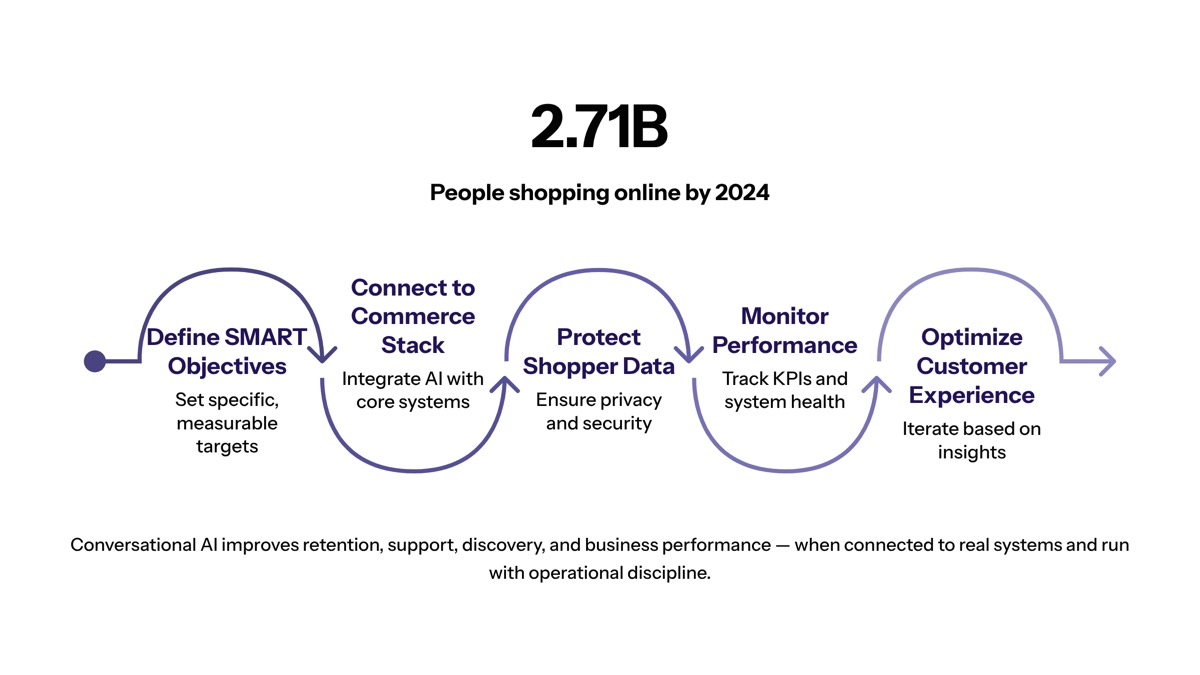
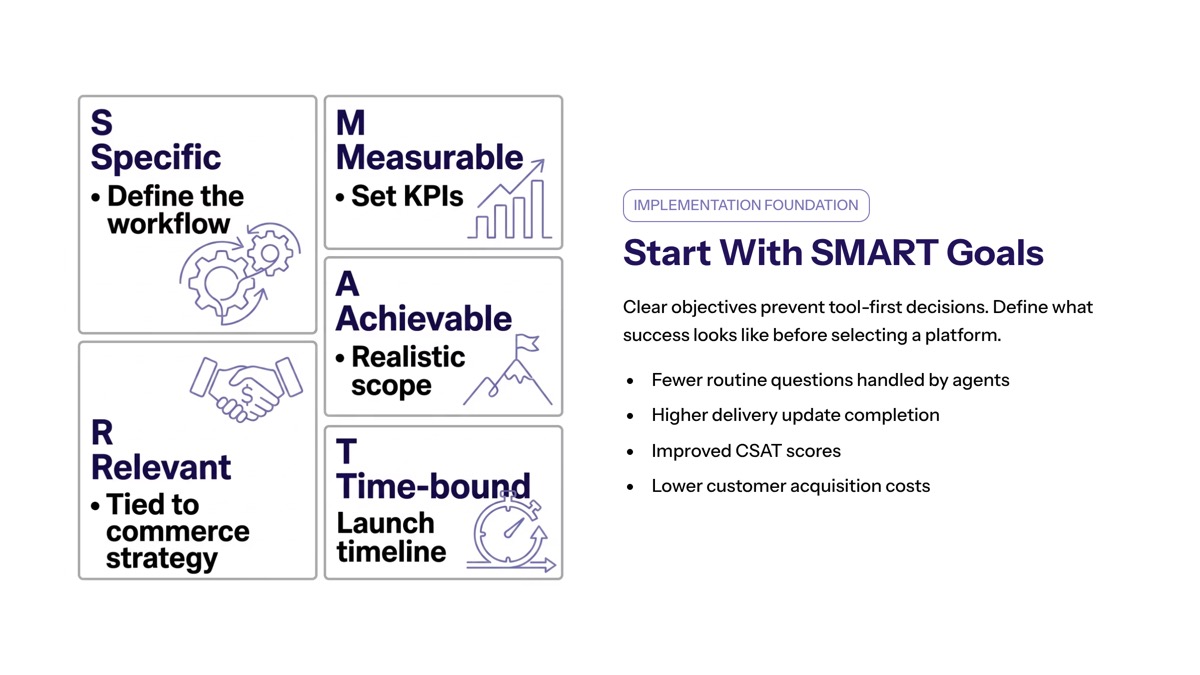
Establishing clear objectives that follow the SMART criteria (Specific, Measurable, Achievable, Relevant, Time-bound) is crucial for guiding the development of conversational AI solutions in ecommerce.
SMART objectives help teams decide what the project should achieve. A team might target fewer routine questions, better delivery update completion, higher customer satisfaction scores, improved conversion, or lower customer acquisition costs.
Clear objectives also prevent tool-first decisions. Conversational AI for ecommerce should support a commerce strategy, not become a disconnected experiment.
Implementing Conversational AI in Ecommerce
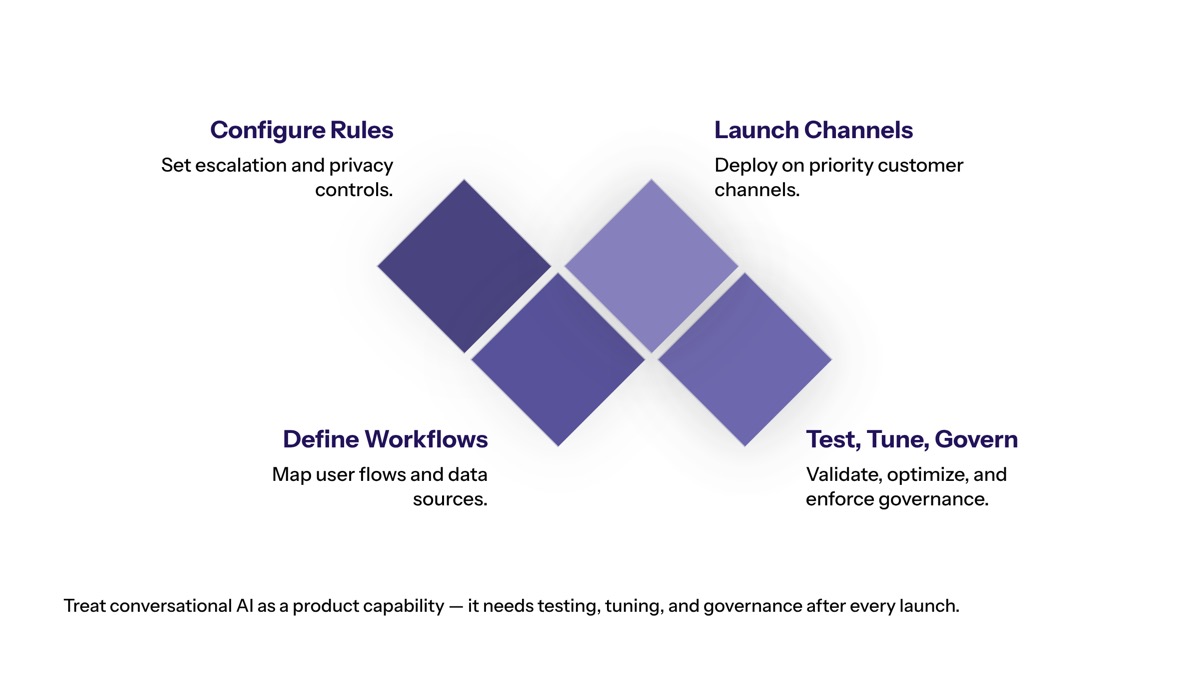
Implementing conversational AI should start with one or two workflows that have clear user intent and measurable outcomes. Product guidance, delivery status, abandoned cart recovery, and support are common starting points.
The implementation should define approved data sources, escalation rules, tone, privacy controls, analytics, and ownership. Ecommerce businesses should also decide which channels matter first: site chat, social DMs, SMS, voice interfaces, or other messaging platforms.
Conversational AI implementation should be treated as a product capability. It needs testing, tuning, and governance after launch.
Monitoring, Metrics, and Customer Feedback
Continuous monitoring and optimization of conversational AI systems are necessary to improve performance, with metrics such as customer satisfaction scores and conversation completion rates being key indicators of success.
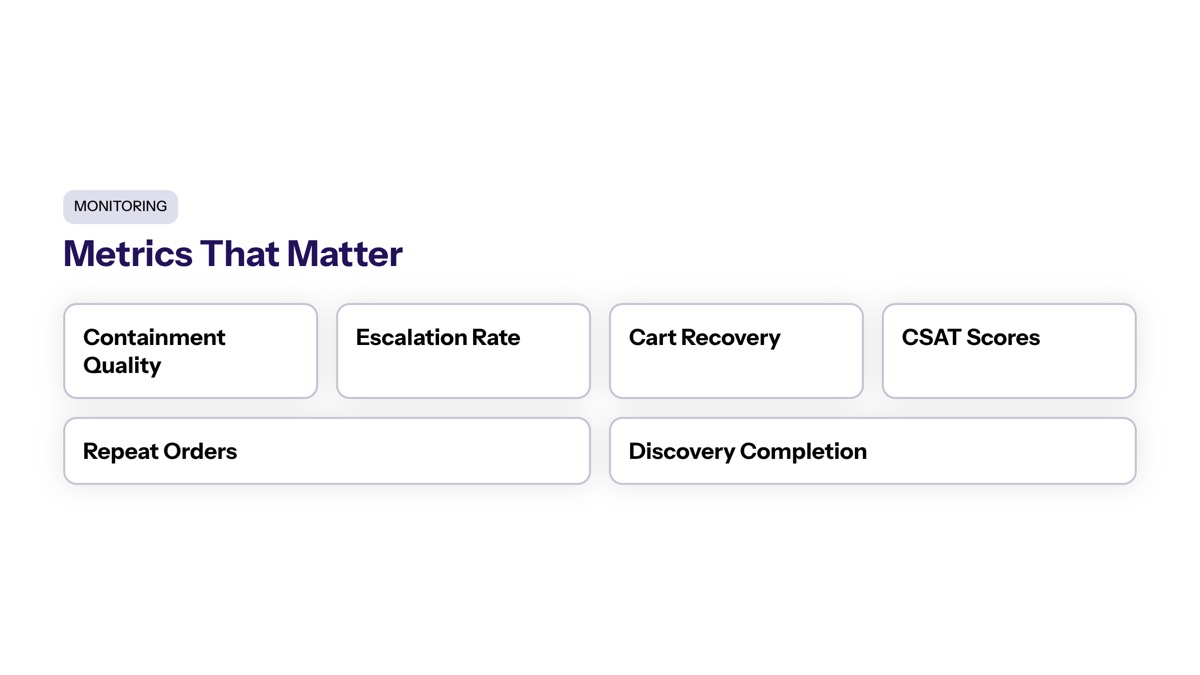
Customer feedback helps teams understand whether the assistant is improving customer experience or creating friction. Useful metrics include containment quality, escalation rate, guided discovery completion, checkout recovery, delivery update completion, customer satisfaction scores, and repeat orders.
Valuable insights from shopper conversations should feed product content, merchandising, support scripts, and marketing. This creates a loop where conversational commerce improves the store experience over time.
Personalized Marketing Through Chat Platforms
AI-driven personalized marketing allows ecommerce businesses to segment customers according to behavior, preferences, and purchase history, delivering targeted marketing messages through chat platforms.
Conversational commerce can support personalized customer interactions after the first sale. It can recommend replenishment, announce relevant launches, recover abandoned carts, and encourage repeat business when the timing and context are right.
Personalized marketing should be useful, not intrusive. The best customer conversations feel like help, not pressure.

Customer Loyalty and Repeat Purchases
Conversational commerce fosters authentic and personalized customer interactions, treating each customer as a valued sponsor rather than a one-time transaction, which can lead to improved loyalty and a stronger bottom line.
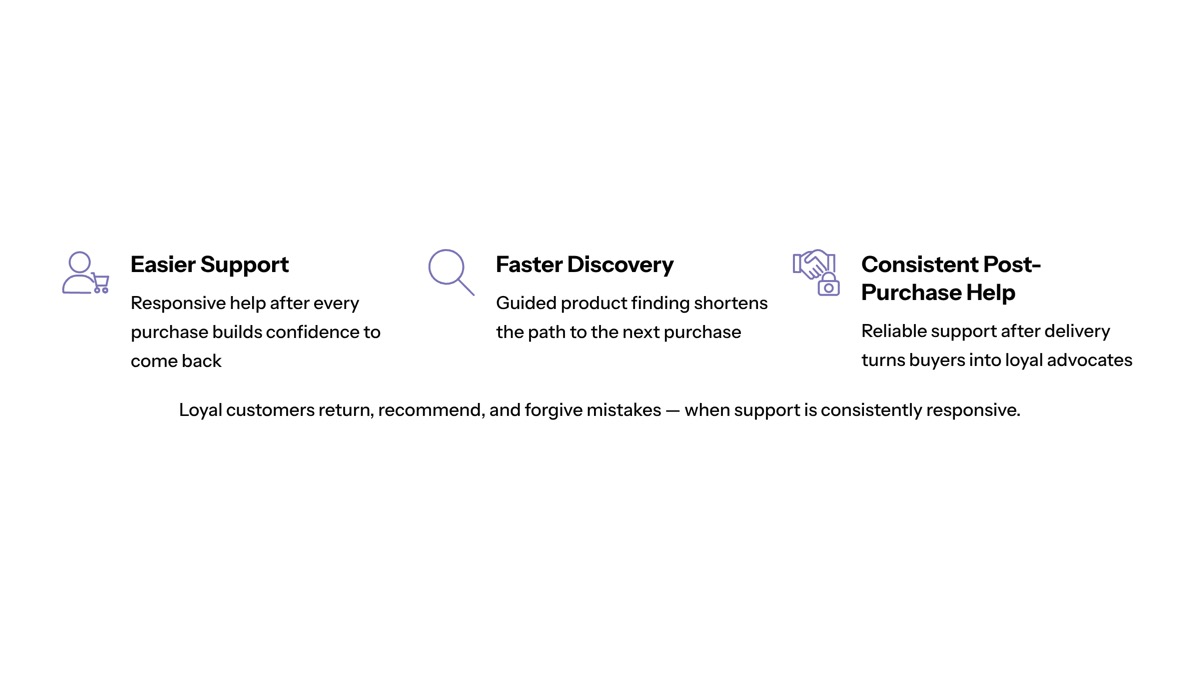
Loyal customers are more likely to return, recommend the brand, and forgive occasional mistakes when support is responsive.
Conversational AI for ecommerce encourages repeat business by making support easier, discovery faster, and post-purchase help more consistent.
Can AI Create an Ecommerce Website?
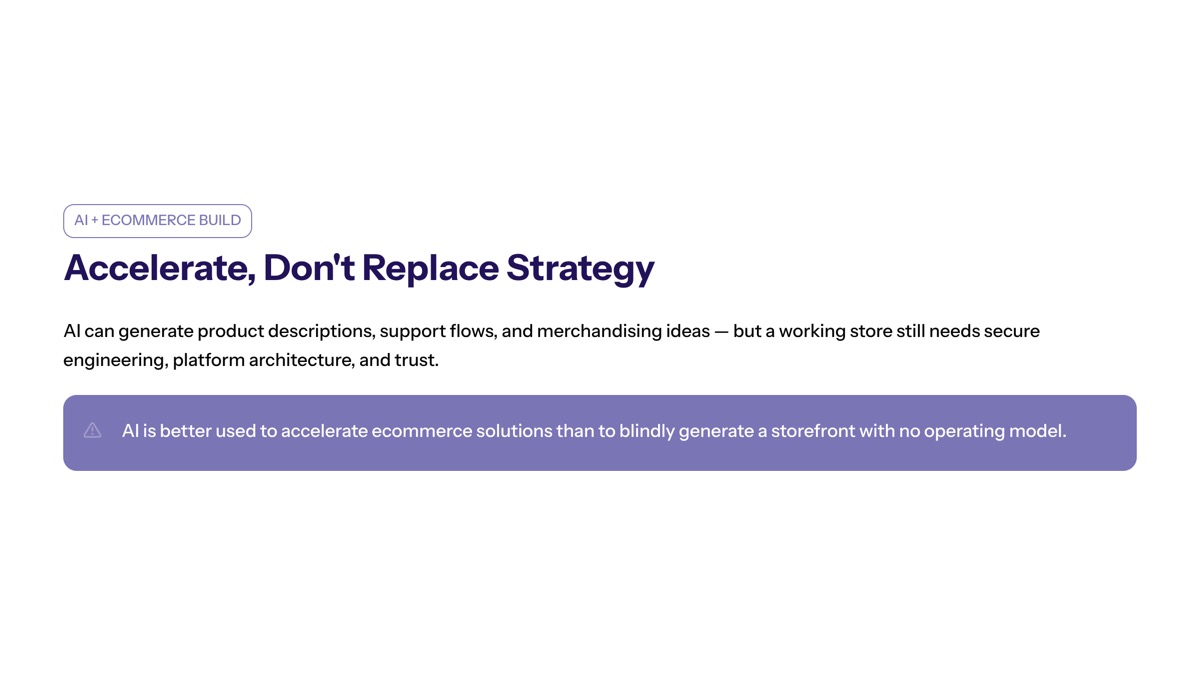
AI can help create an e commerce website by generating product descriptions, page layouts, support flows, merchandising ideas, and testing plans. It can also help teams analyze customer behavior and improve business performance.
AI should not replace e commerce strategy, secure engineering, accessibility review, payment security, or platform architecture. A working store still needs reliable ecommerce platforms, clean integrations, analytics, performance, and trust.
For most brands, AI is better used to accelerate ecommerce solutions than to blindly generate an e commerce storefront with no operating model.
What Is the Best AI for Ecommerce?
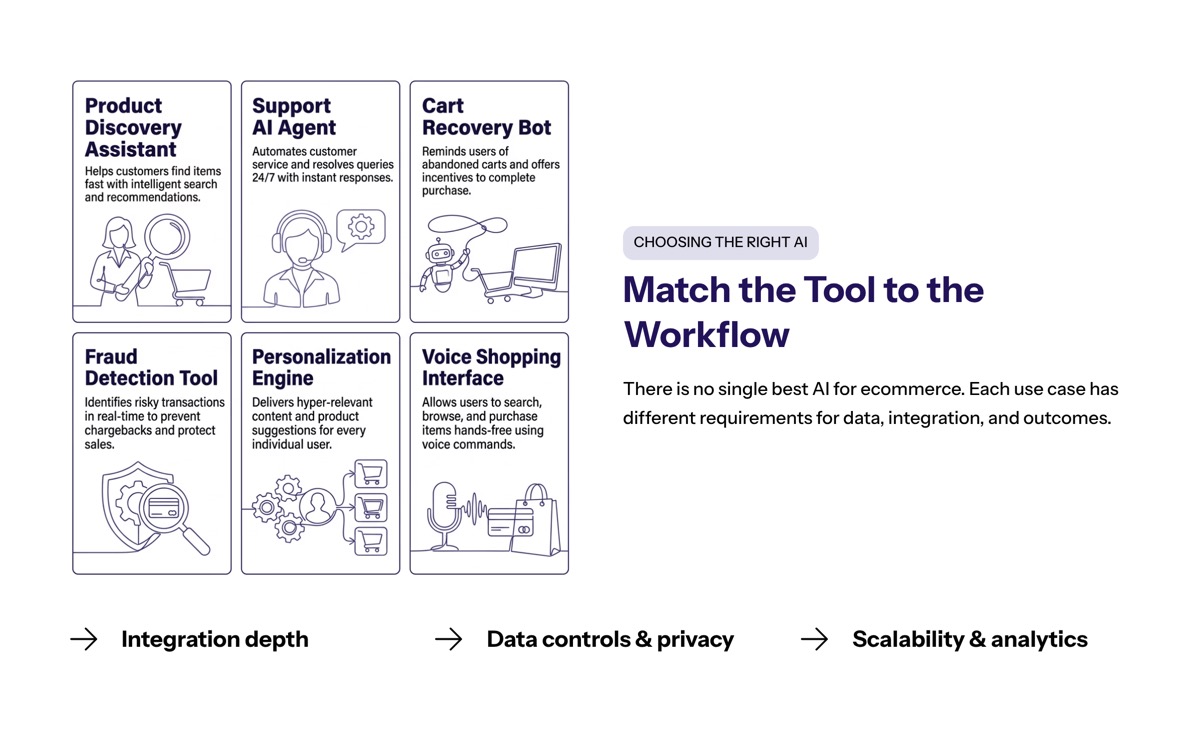
The best AI for ecommerce depends on the workflow. A product discovery assistant, support AI agent, abandoned cart assistant, fraud detection tool, and personalization engine solve different problems.
For conversational commerce, the best platform is the one that connects to inventory, orders, and support systems while maintaining brand voice and measurable outcomes.
Teams should evaluate fit against business value, integration depth, data controls, scalability, analytics, and support for priority channels.
What Is the Best Conversational AI Platform?
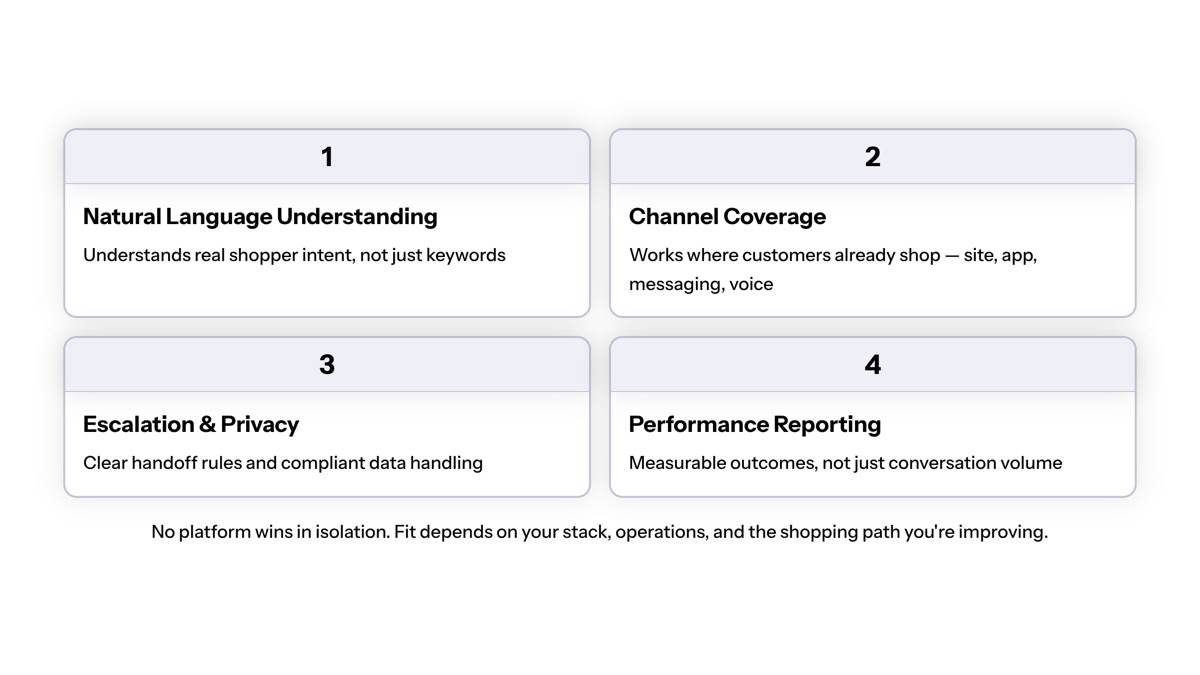
The best conversational AI platform is the one that can support real shopper interactions in the channels where customers already shop. It should connect to the online store, ecommerce platforms, messaging apps, support tools, and analytics.
Conversational commerce tools should provide natural language understanding, conversation design controls, escalation, privacy settings, and performance reporting. They should also allow teams to improve interactions based on customer feedback.
No platform is best in isolation. The right choice depends on the existing tech stack, ecommerce operations, and the shopping path the business wants to improve.
Rollout Priorities for Commerce Teams
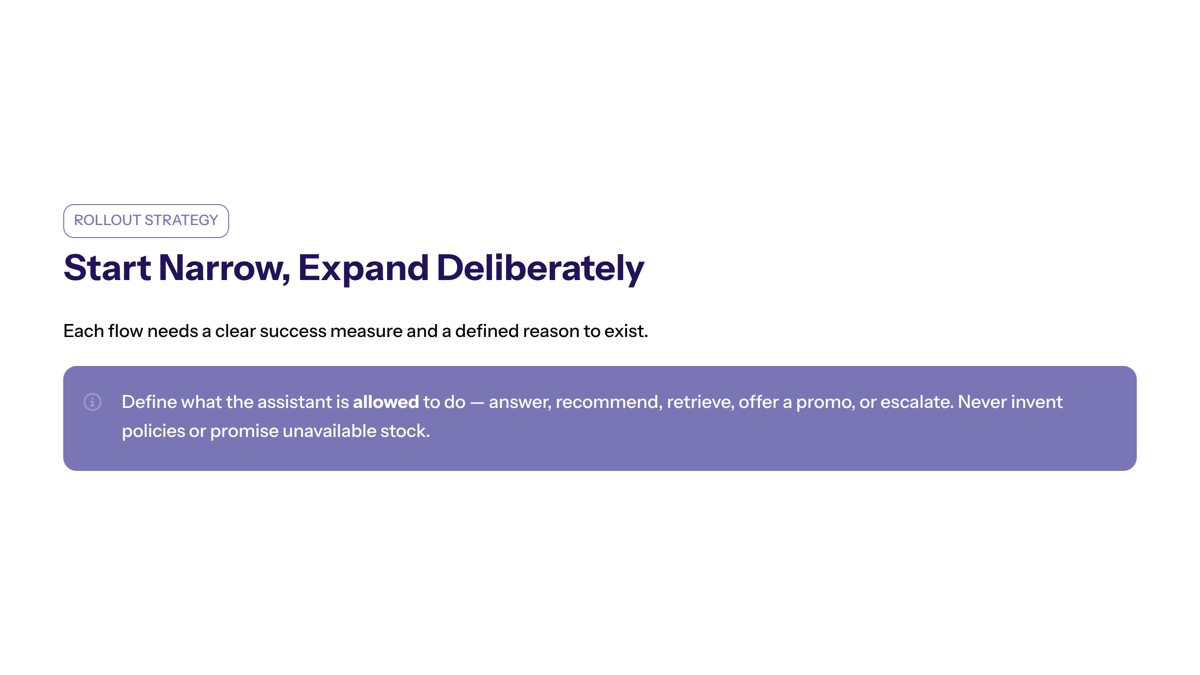
The safest rollout usually starts with a narrow service or selling moment. A team might begin with delivery questions, guided product comparison, cart recovery, or sizing help. Each flow should have a clear success measure and a clear reason to exist.
The team should also decide what the assistant is allowed to do. It may answer a product question, recommend an item, retrieve status, offer a promotion, or send the buyer to a person. It should not invent policies, promise unavailable stock, or make unsupported claims about delivery timing.
Training also matters for internal teams. Support, merchandising, marketing, and operations need to understand what the assistant can do, where it may fail, and how to review transcripts. That review process turns launch data into practical improvements instead of leaving teams guessing.
Measurement and Customer Retention
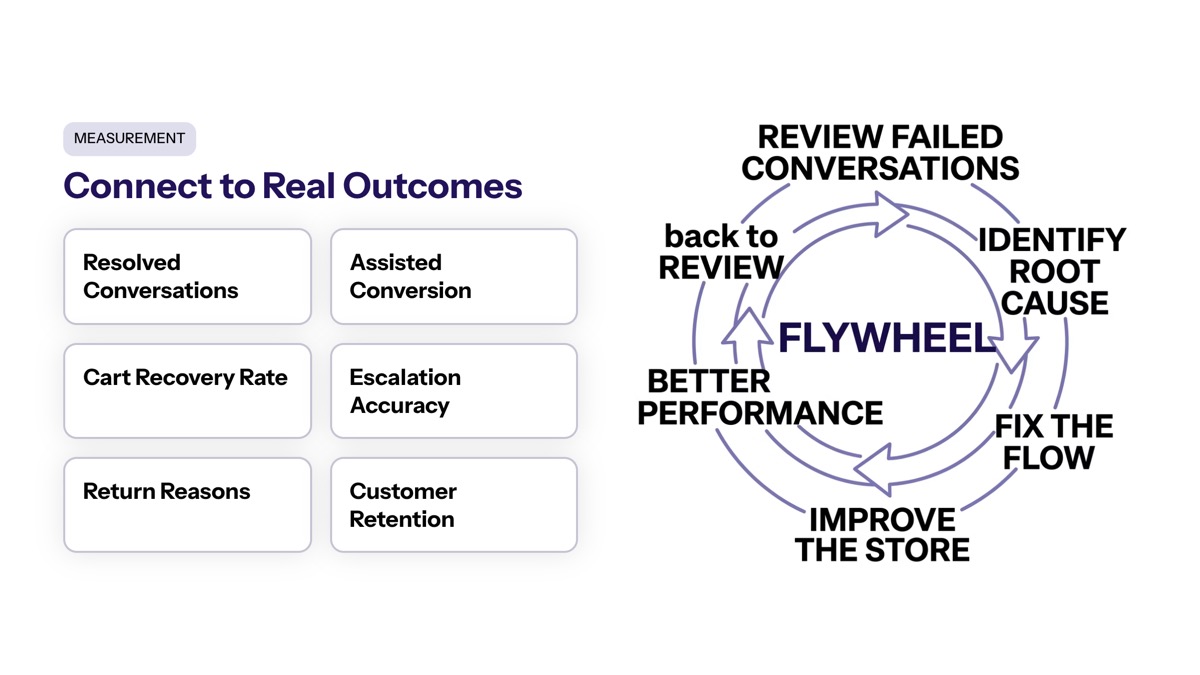
Measurement should connect the assistant to real business outcomes. Useful signals include resolved conversations, assisted conversion, cart recovery, service deflection quality, escalation accuracy, return reasons, and customer retention.
The most useful reports separate easy wins from risky cases. If the assistant resolves delivery questions but fails on sizing, that is a design signal. If it helps buyers compare products but creates confusion during checkout, the flow needs sharper rules.
Teams should also review failed conversations. Missed intent, vague product content, stale inventory, unclear policies, and slow handoffs are often the real issues. Fixing those issues improves the assistant and the store behind it.
That review cadence should be weekly during launch and slower after the system stabilizes. Early attention prevents small answer gaps from becoming larger trust, sales, or service problems. Review should stay practical.
Customer Journey Design Principles
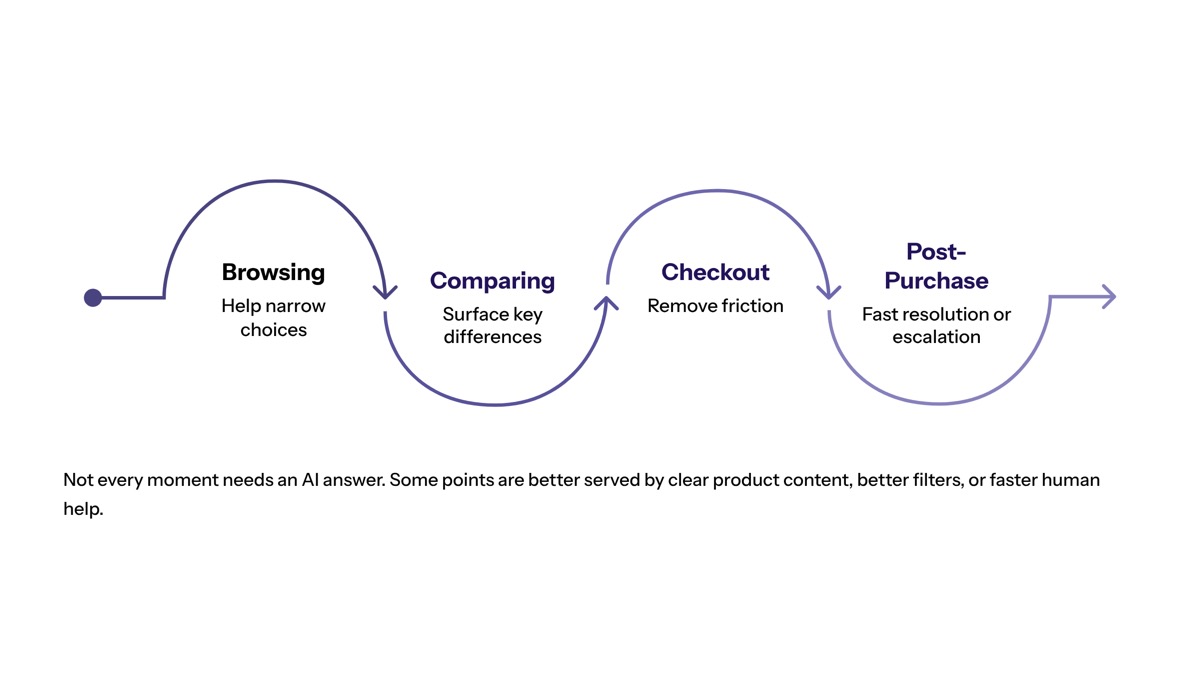
The customer journey should guide the rollout, not the technology menu. A useful assistant should know whether the shopper is browsing, comparing, checking availability, recovering a cart, tracking a delivery, or asking for help after purchase.
That context changes the tone, timing, and next step. A buyer comparing two products may need concise product differences. A returning customer with a failed delivery needs direct support. A shopper who paused during checkout may need reassurance, not a generic discount.
Conversational commerce can support each stage of the customer journey when the business maps the desired outcome first. For discovery, the goal may be helping shoppers narrow choices. For checkout, the goal may be removing friction. For support, the goal may be fast resolution or clean escalation.
This design work also helps teams avoid over-automation. Not every moment needs an AI answer. Some points in the shopping path are better served by clear product content, better filters, or faster human help.
AI Architecture and Business Strategy
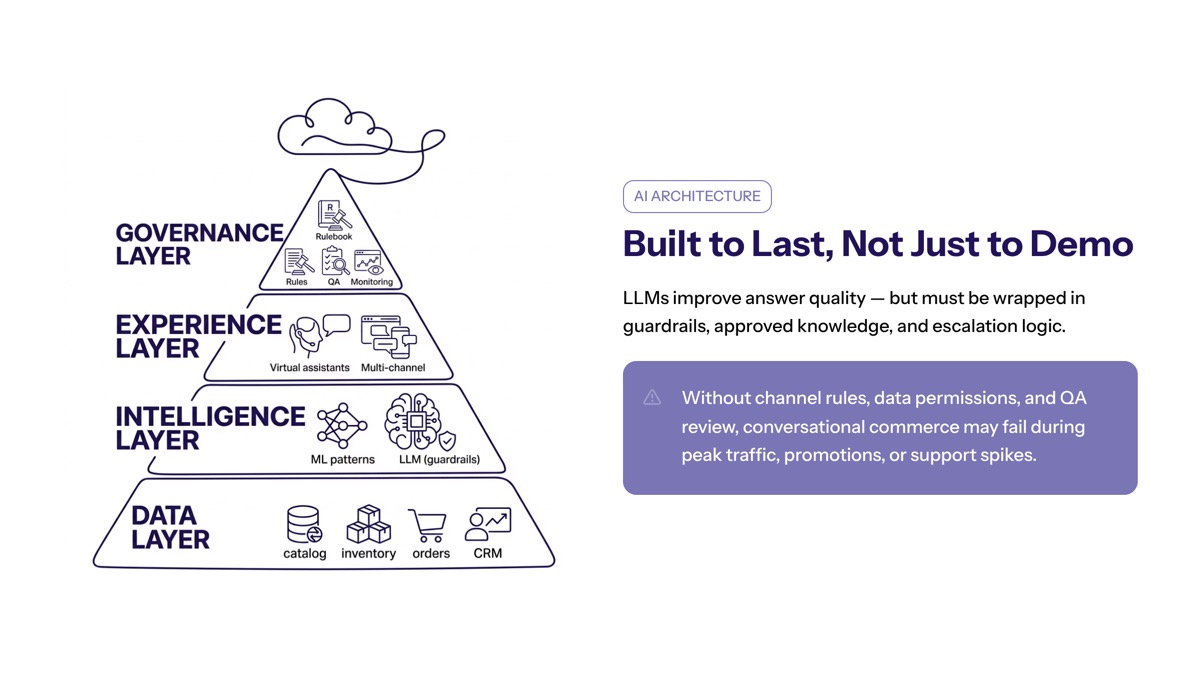
Conversational AI for ecommerce should sit inside a broader commercial plan. The architecture needs to connect customer-facing experiences with catalog data, inventory, order management, payment workflows, analytics, and support operations.
Machine learning can help detect patterns in browsing, cart behavior, product questions, and service requests. Large language models can improve answer quality and flexibility, but they should be wrapped in guardrails, approved knowledge, and escalation logic.
Virtual assistants should also work across multiple channels without losing context. If a shopper begins in a social chat and later returns through the site, the experience should not restart from zero.
This is where implementation discipline matters. The assistant needs channel rules, data permissions, response boundaries, QA review, and performance monitoring. Without those pieces, conversational commerce may look impressive in a demo but fail during peak traffic, promotions, or support spikes.
Final Takeaway
By 2026, an estimated 2.71 billion people were expected to shop online. As ecommerce grows, customers will keep expecting faster help, better product discovery, and more personalized shopping experiences.
Conversational AI for ecommerce can improve retention, support, discovery, and overall business performance when it is connected to real ecommerce systems.
The practical path is clear: define SMART objectives, understand shopper needs, connect the conversational commerce platform to the commerce stack, protect data, monitor performance, and keep optimizing around customer experience.