Custom AI Agents for Business: When to Build and How to Govern Them
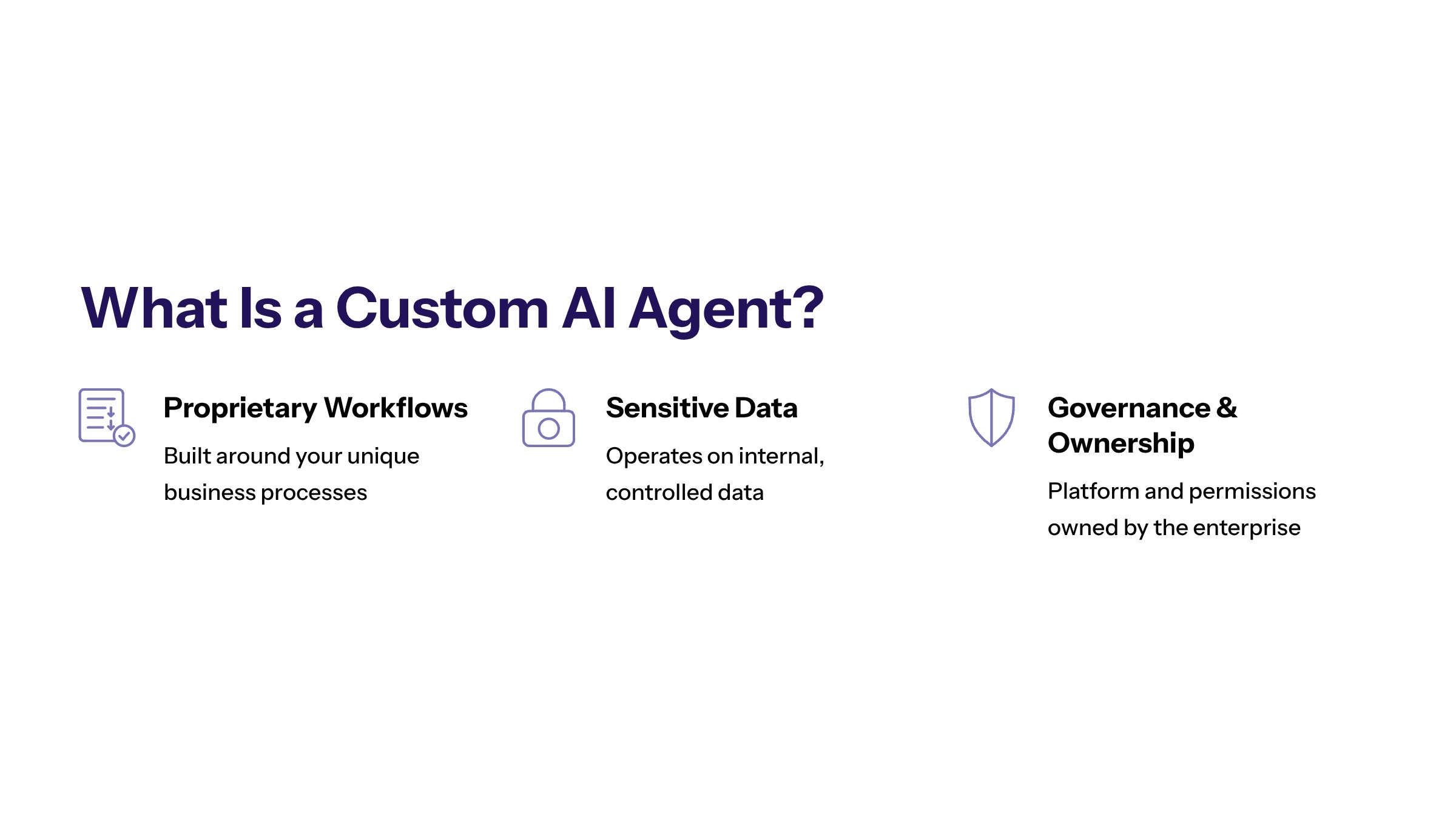
Custom AI agents for business are AI systems designed around a company’s specific workflows, data, permissions, and integration requirements. They are useful when generic AI tools cannot support the way work actually moves through the organization.
A custom agent may classify requests, retrieve customer or operational context, draft outputs, trigger system actions, route approvals, or escalate exceptions. The value depends on workflow fit. If the agent cannot access the right systems or operate inside the right controls, it will remain a disconnected assistant.
This guide explains when custom AI agents make sense, what they require, and how to build them without losing control over data, security, or ownership.
Leaders evaluating custom AI agents for business should start with the workflow constraint, not the model. The practical question is how to build AI agents for business that can operate with the right context, permissions, safeguards, and measurable outcomes.
What Custom AI Agents for Business Are
A custom AI agent is built for a defined business purpose. Unlike a general AI assistant, it is shaped around specific tasks, systems, rules, and outcomes. It may use a language model, retrieval system, workflow engine, APIs, and business logic to complete or support work.
Custom agents can be part of broader AI software development. They often require custom interfaces, integrations, permission models, monitoring, and deployment practices. The agent is only one part of the system.
How companies build custom AI agents for business depends on what the agent is allowed to do. A recommendation-only agent needs different controls than an agent that updates records, routes approvals, or triggers a customer-facing action.
When Custom Agents Are Better Than Off-the-Shelf Tools
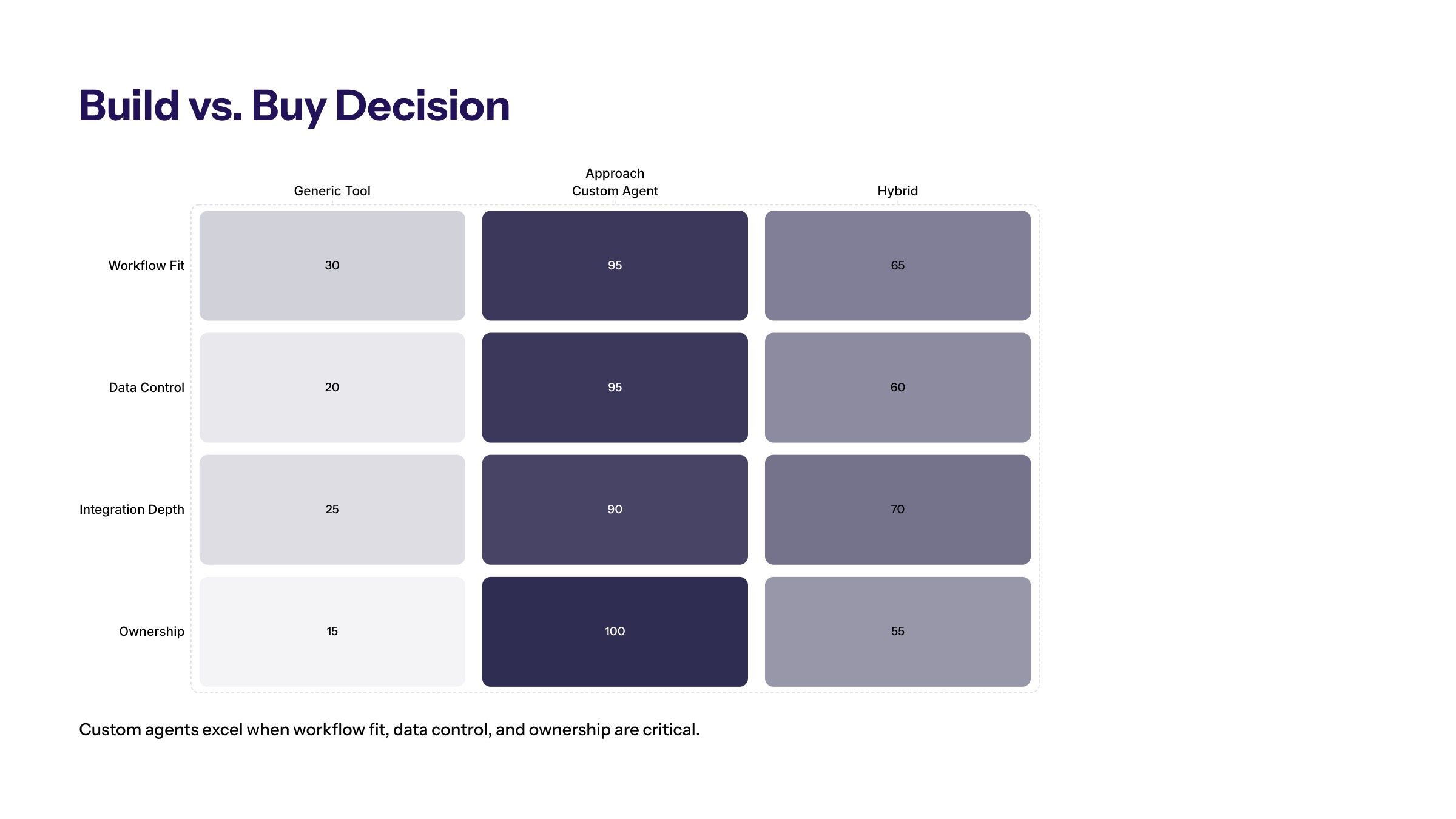
Off-the-shelf tools are useful when the workflow is common, low-risk, and well supported by an existing product. Custom agents become more relevant when workflows are proprietary, data access is sensitive, integrations are complex, or the business needs control over how decisions are made.
Option | Best Fit | Tradeoff |
|---|---|---|
Off-the-shelf tool | Common workflows and faster setup. | Less control over data, behavior, and integration depth. |
Custom AI agent | Unique workflows, sensitive data, complex systems. | Requires stronger planning, engineering, and governance. |
Hybrid approach | Commercial platform plus custom workflow layer. | Requires clear ownership and integration boundaries. |
The decision is not about custom being inherently better. It is about whether the business needs workflow fit, data control, adaptability, and integration depth that generic tools cannot provide.
What Custom AI Agents Need to Access and Control
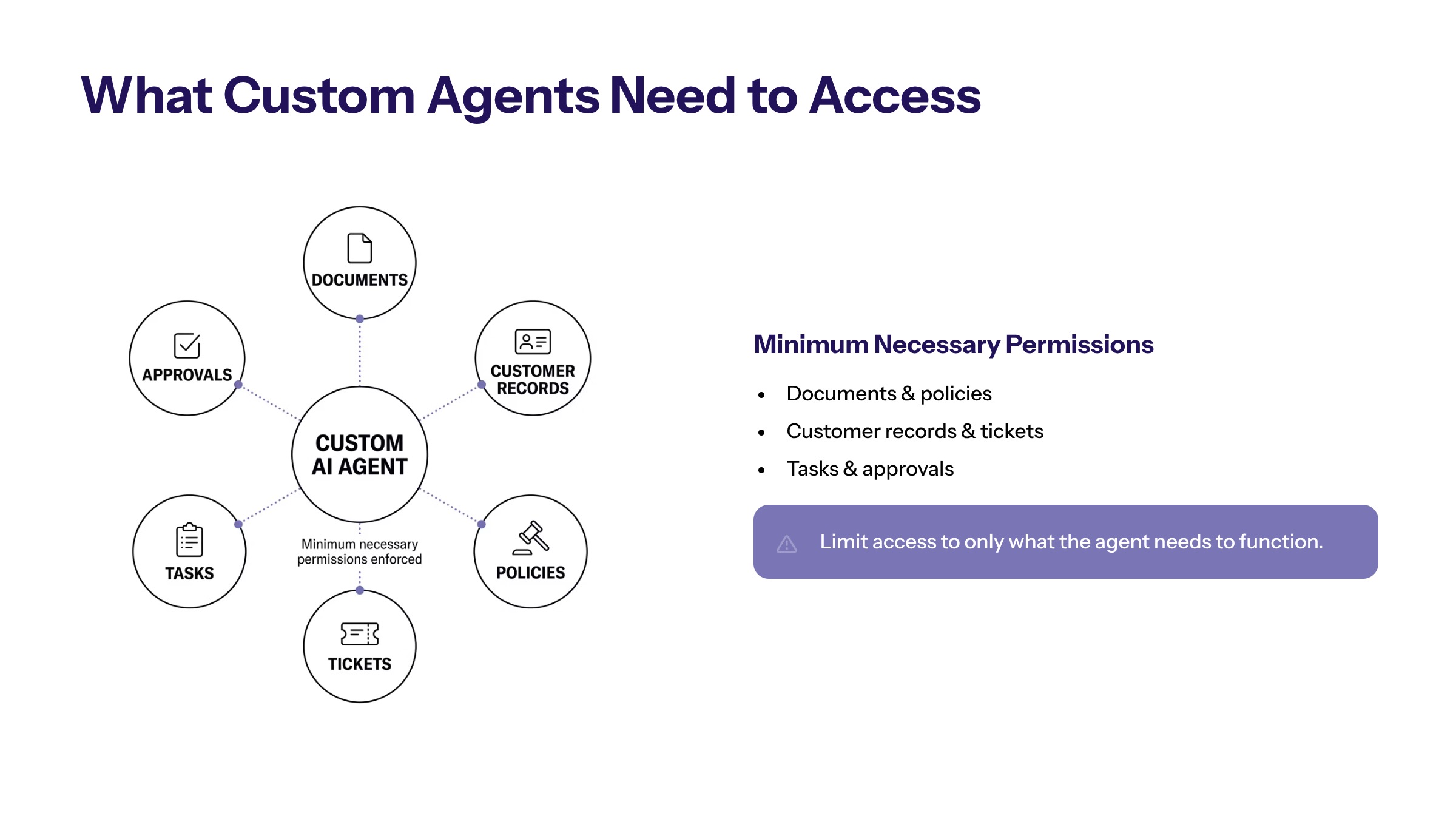
Custom agents need carefully defined access. They may need to read documents, query customer records, retrieve policies, update tickets, create tasks, or generate summaries. Each permission should be tied to the workflow goal.
Broad access creates risk. A well-designed agent should have the minimum access required to perform its role. Sensitive workflows should include approval thresholds, logging, and review. This is especially important when agents work with customer data, financial records, employee information, or operational commitments.
Architecture and Integration Requirements
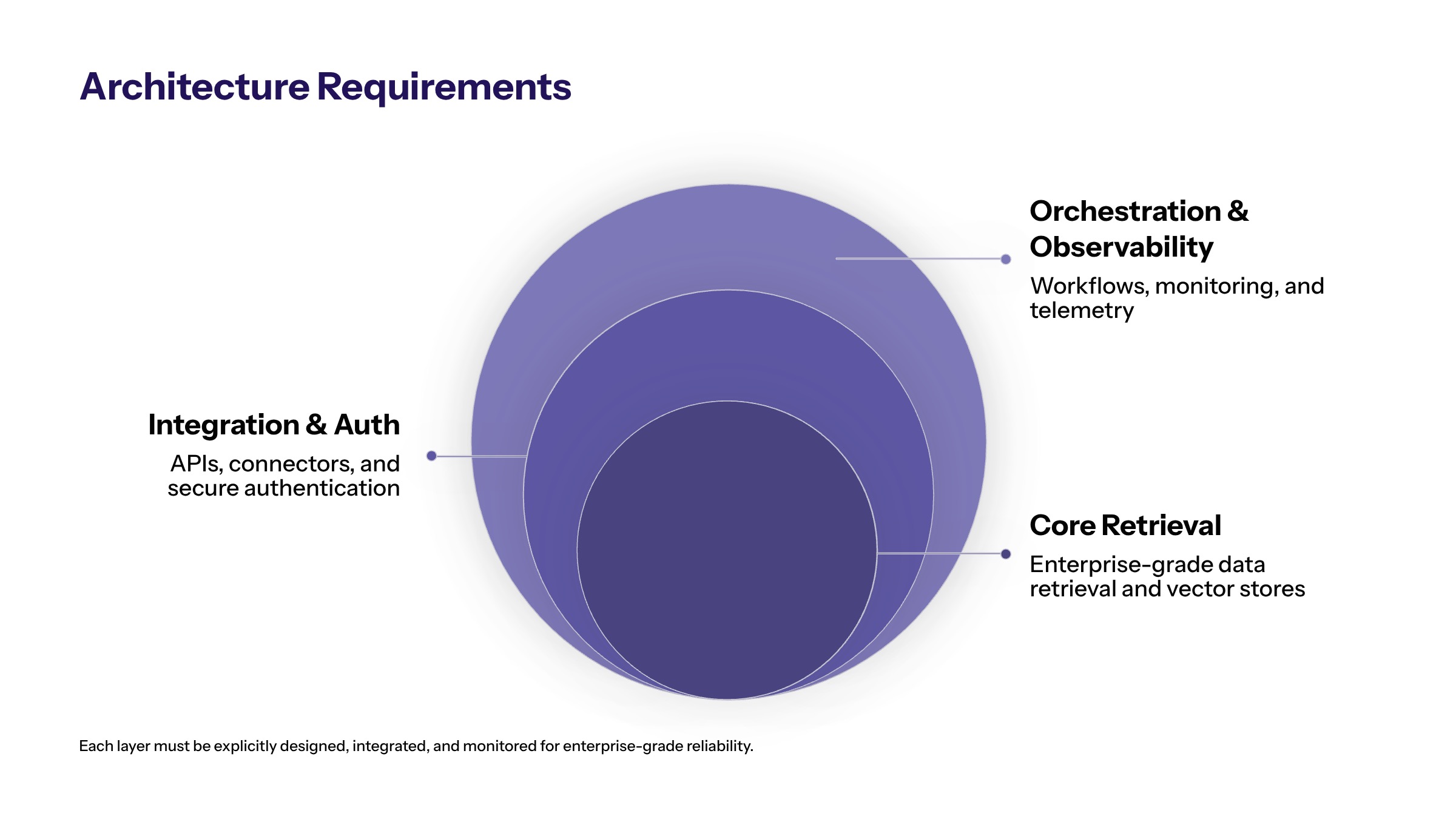
Custom AI agents depend on the surrounding software architecture. The agent may need a retrieval layer, API connections, authentication, workflow orchestration, observability, and a user interface. The business also needs a way to test and update agent behavior without disrupting operations.
For many teams, custom agents are part of a broader custom software strategy. The goal is not to build everything from scratch. The goal is to decide what should be owned, integrated, automated, or governed differently because the workflow matters to the business.
Governance, Security, and Ownership
Custom AI agents require clear ownership. Someone must own the workflow, data access, approval rules, monitoring, incident response, and business outcome. Without ownership, agent behavior can drift away from business intent.
Security controls should be built into the design. That includes role-based access, audit logs, data boundaries, input validation, monitoring, and rollback paths. Teams should treat agent development as a secure development effort, not only an AI experimentation project.
Development Roadmap
A custom AI agent should start with the workflow, not the model. The roadmap should define the business problem, target users, required systems, data sources, approval logic, risk boundaries, and success metrics.
Teams that want to build AI agents for business should treat the roadmap as both a software plan and an operating model plan. That keeps the agent tied to governance, support, ownership, and measurable workflow value.
Identify the workflow constraint. Choose a repeated problem with measurable business impact.
Define the agent role. Decide what the agent can read, recommend, change, and escalate.
Design the architecture. Map data, integrations, permissions, monitoring, and user experience.
Build a controlled pilot. Test with real examples, edge cases, and human review.
Operationalize support. Monitor performance, update logic, and review outcomes.
Build vs Buy Decision Criteria
The build-versus-buy decision should be based on workflow importance, data sensitivity, integration depth, governance needs, and long-term control. A generic tool may be enough when the workflow is common, the data is low-risk, and the organization can accept the vendor’s workflow model. A custom agent becomes more compelling when the workflow is central to operations or when the business needs stronger control over behavior and data.
Workflow importance is the first criterion. If the process affects revenue, customer experience, compliance, service quality, or operational reliability, the organization should be cautious about forcing it into a generic tool. Custom development may be justified when the workflow is a competitive capability or when errors create meaningful risk.
Data sensitivity is the second criterion. Some agents need access to customer records, financial information, contracts, employee data, operational plans, or regulated documents. In those cases, the organization needs to know where data flows, how it is stored, who can access it, and whether it can be used by a vendor for training or support. Custom or hybrid architecture can give the business more control over those decisions.
Integration depth is the third criterion. If the agent needs to work across CRM, ERP, service desks, finance systems, analytics tools, document repositories, and internal applications, the implementation may need custom orchestration. A tool that works well in isolation may struggle when the real value depends on coordinated action across systems.
Long-term control is the fourth criterion. Teams should ask whether they can modify the workflow, export data, change models, update prompts, move infrastructure, and replace components without rebuilding everything. This is where ownership and platform control become part of the business case, not only the technical design.
Designing Custom Agent Capabilities
Custom agent capabilities should be designed in layers. The first layer is knowledge access: what the agent can read and retrieve. The second layer is reasoning and recommendation: how the agent interprets the situation and suggests next steps. The third layer is workflow action: what the agent can create, update, route, or trigger. The fourth layer is evidence: what the system records for review and improvement.
Knowledge access should be curated. Agents need relevant context, not unlimited context. A sales agent may need account history, product rules, and pricing guidance. A service agent may need customer status, support policies, and ticket history. A compliance agent may need document clauses, audit rules, and workflow evidence. Each use case should define the minimum context required.
Recommendation behavior should be transparent enough for users to trust. The agent should show what it considered, where its answer came from, and when it is uncertain. Users should be able to correct outputs and provide feedback. That feedback can improve prompts, retrieval, business rules, and training material.
Workflow actions should be introduced gradually. A custom agent may start by drafting recommendations and later gain permission to create tasks, update fields, or route approvals. Higher-impact actions should require explicit approval, clear logs, and rollback options. The goal is not to make the agent powerful on day one. The goal is to make it useful, controlled, and improvable.
Testing and Quality Assurance for Custom Agents
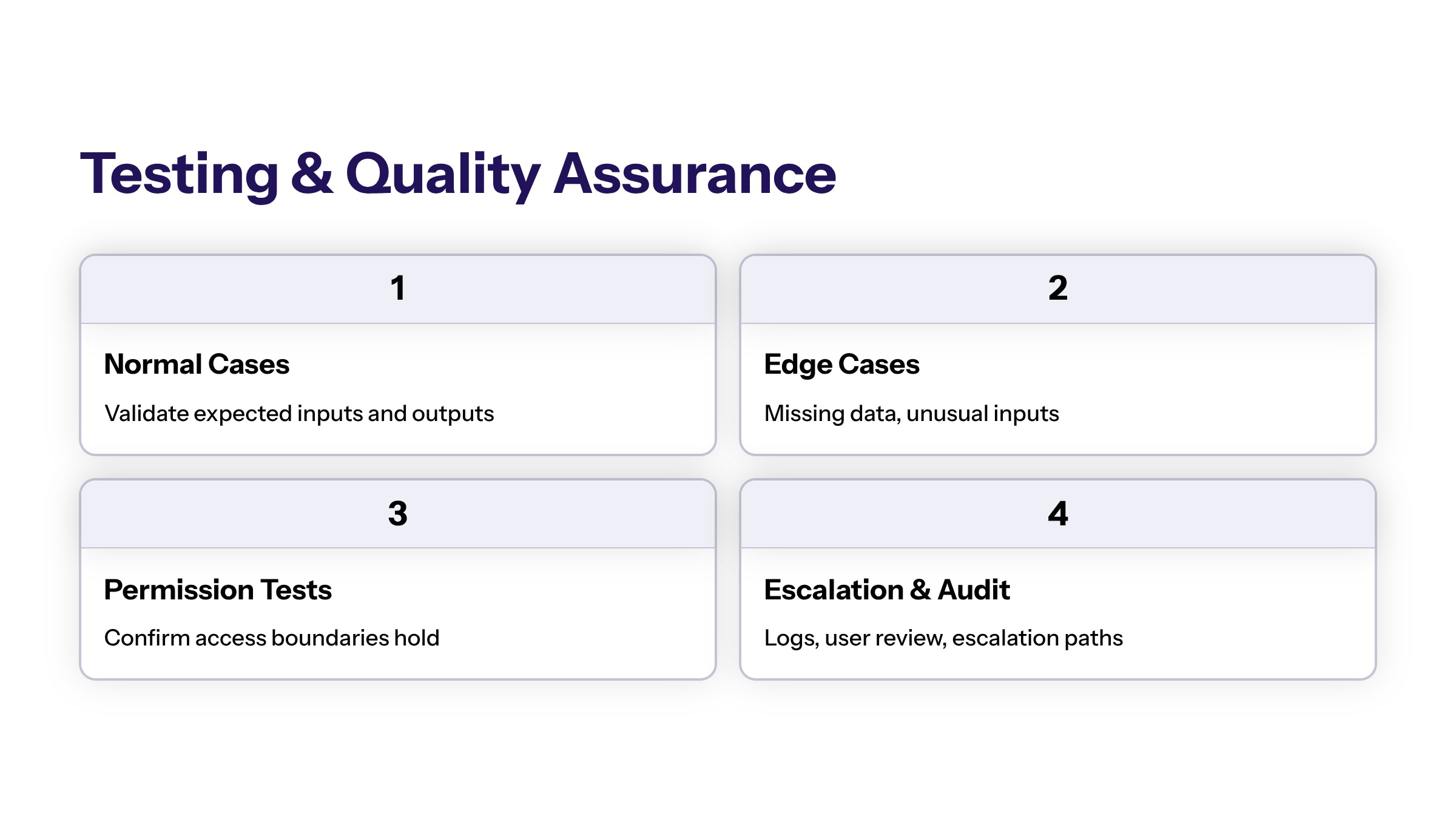
Custom AI agents need a QA process that tests more than language quality. Teams should test task completion, retrieval accuracy, permission boundaries, tool calls, exception handling, escalation behavior, and audit logging. The agent should be evaluated against real workflow examples, not only ideal prompts.
Test sets should include normal cases, edge cases, missing data, conflicting data, high-risk requests, unsupported requests, and attempts to exceed permissions. If the agent is supposed to refuse certain actions, those refusal paths should be tested as carefully as successful actions. Failure behavior is part of the product.
Quality assurance should also include user review. The people who perform the workflow today can often identify subtle problems that technical tests miss. They know which inputs are ambiguous, which exceptions are common, which policies are misunderstood, and which outputs would create rework. Their feedback should shape the agent before production.
After launch, QA becomes monitoring. Teams should track accuracy, correction rates, escalations, workflow completion, user adoption, action failures, and business outcomes. Custom agents should improve as the organization learns, but that improvement requires evidence, ownership, and a controlled release process.
Maintaining Ownership After Launch
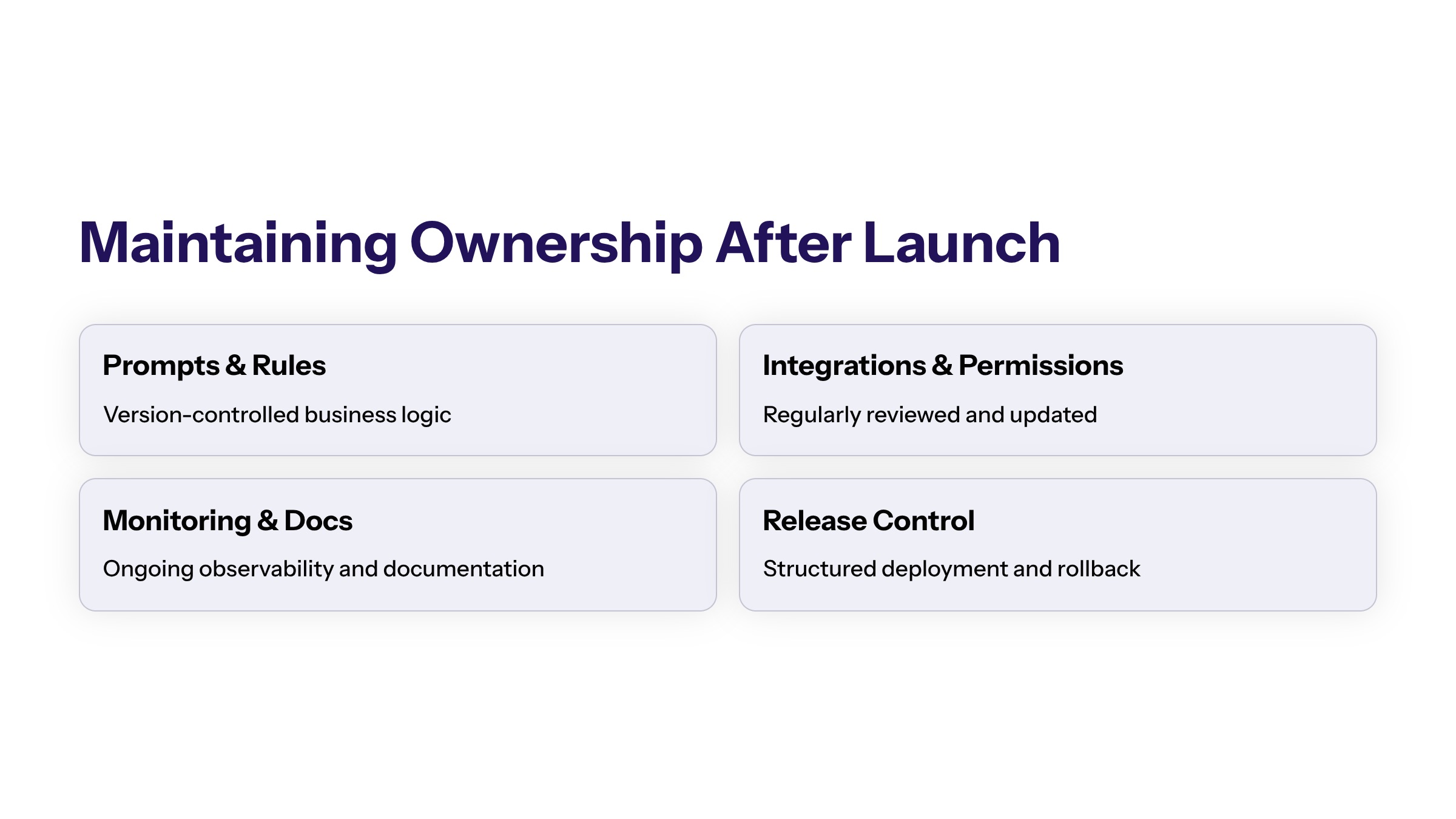
Custom agents create long-term value only when ownership continues after deployment. The business should know who maintains prompts, business rules, integrations, permissions, test cases, documentation, and user training. If those responsibilities are unclear, the agent can become fragile as systems, policies, and workflows change.
Ownership also includes change control. When a model changes, a data source changes, a workflow changes, or a new integration is added, the agent should be tested before the change affects production users. This is especially important when agents support customer-facing or compliance-sensitive work.
Platform control matters because custom agents often become part of how the business operates. Teams should avoid architectures where prompts, data, logs, workflow definitions, and integration logic are trapped in a system they cannot inspect or migrate. A custom agent should increase the organization’s control over critical workflows, not replace one dependency with another.
For Cognativ-style implementation, the goal is not custom software for its own sake. The goal is software that gives the business better ownership, better visibility, better governance, and better outcomes from workflows that matter.
Cost, Maintenance, and Lifecycle Planning
Custom AI agents should be planned as lifecycle assets, not one-time builds. The initial cost may include discovery, architecture, data preparation, integration, interface design, testing, security review, deployment, and training. The ongoing cost may include monitoring, support, model updates, prompt maintenance, data-source changes, and workflow improvements.
Maintenance planning is important because agents depend on systems that change. A CRM field may be renamed, a policy may be updated, an API may change, a model may behave differently, or a department may revise its process. If the agent is not maintained, small changes can create inaccurate outputs or broken workflows.
Lifecycle planning should include ownership for each part of the system. Technical teams may own infrastructure, integrations, observability, and releases. Business teams may own workflow rules, success metrics, and user feedback. Security teams may own access review, audit requirements, and incident response. When those responsibilities are clear, the agent can evolve without becoming unmanaged.
Cost planning should also consider the value of control. A custom agent may require more upfront work than a generic tool, but it can reduce long-term friction when the workflow is important, the integrations are specific, or the business needs portability. The strongest business case compares total operational value, not only the first implementation price.
Bottom Line for Custom AI Agent Strategy
Custom AI agents make sense when the business needs more than a generic assistant. They are strongest when the workflow is important, the data is specific, the integrations are meaningful, and the organization needs control over behavior, evidence, and long-term adaptability.
The decision should be grounded in ownership. If a workflow is central to how the business serves customers, manages risk, or coordinates operations, the organization should understand exactly how the agent works and how it can be changed. Custom development is justified when that control creates business value that a generic tool cannot provide.
How to Evaluate Readiness
Before building a custom AI agent, ask whether the business can define the workflow clearly, provide reliable data, assign ownership, and measure success. If those conditions are missing, the first step is readiness work.
Readiness should also include support capacity. A custom agent will need feedback review, issue response, release management, access review, and periodic testing as systems and workflows change. If the organization cannot support those responsibilities, the agent should remain limited until the operating model is stronger.
Custom AI agents for business are most valuable when they give the organization better control over workflows that matter. The right implementation should improve how work moves, how decisions are supported, and how the business maintains ownership over its systems. This is the heart of any AI agents for business integration guide: connect capability to workflow control before scaling autonomy.
Frequently Asked Questions About Custom AI Agents for Business: When to Build and How to Govern Them
Custom AI agents for business are agents designed around proprietary workflows, systems, data access, permissions, governance rules, and operating requirements. For related reading, see building AI agents.
A business should consider a custom AI agent when off the shelf tools cannot match workflow fit, data control, integration depth, or governance needs. For related reading, see AI agent architecture.
Custom AI agents should be governed with clear ownership, test cases, permission limits, audit logs, release control, monitoring, and human escalation paths. For related reading, see AI agent use cases.
A custom agent is worth building when the workflow depends on proprietary data, unique business rules, deep integrations, or control needs that generic tools cannot meet. The value case should be measurable. For related reading, see AI agent workflows.
Custom agents should connect through approved APIs, identity controls, retrieval layers, workflow orchestration, and audit logging. Access should be limited to the workflow role. For related reading, see generative AI implementation.
Teams maintain custom agents by reviewing prompts, permissions, integrations, test cases, logs, and business rules as the workflow changes. Maintenance should have a named owner and cadence. For related reading, see AI-first architecture.