Custom Enterprise Software Development: A Strategic Guide for Business Leaders
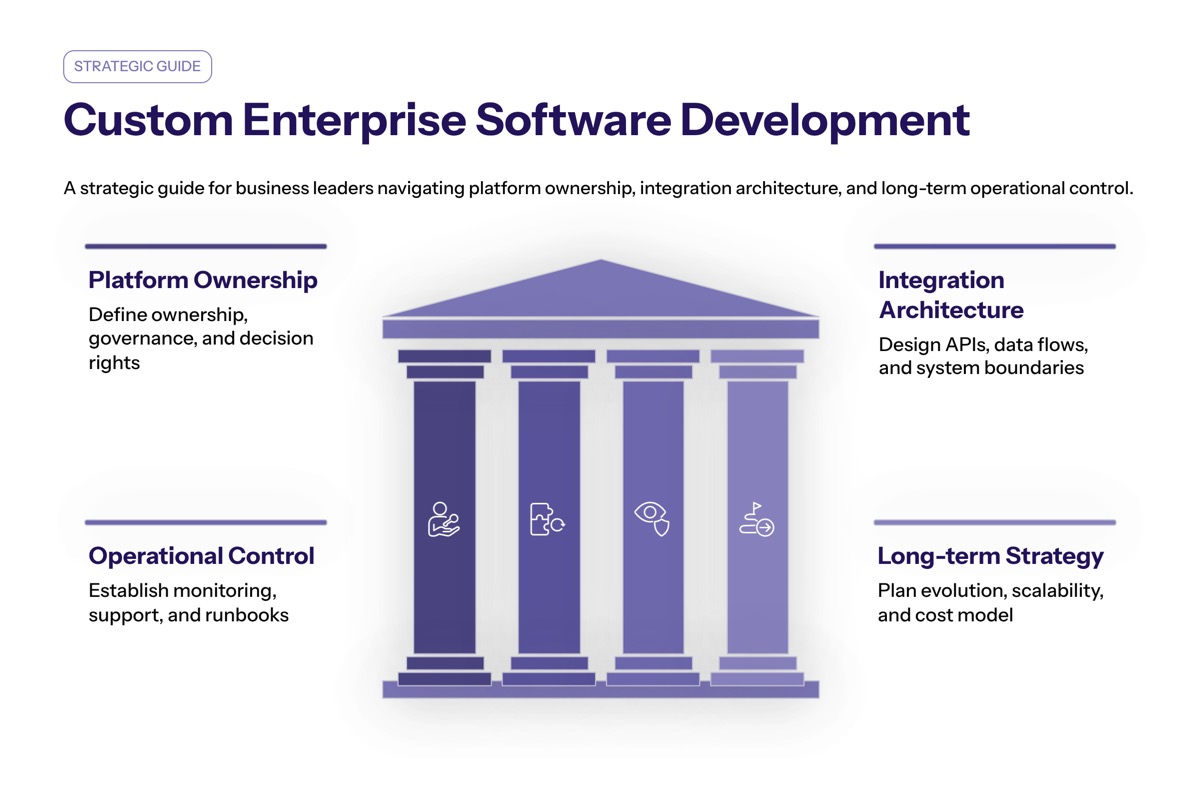
Custom enterprise software development helps organizations build tailored platforms that match their workflows, compliance obligations, data structures, and growth plans instead of forcing complex operations into generic software. For businesses managing regulated data, fragmented tools, legacy systems, or highly specific business processes, custom enterprise software can become the foundation for better control, faster execution, and measurable business outcomes.
This guide covers custom platforms, platform ownership models, enterprise integration strategy, governance frameworks, security requirements, and long-term value. It is written for technology leaders, CTOs, CIOs, operations executives, and business decision-makers evaluating custom software development versus off the shelf software, SaaS products, or hybrid models.
The direct answer: custom enterprise software development creates tailored platforms that reduce operational friction, improve data visibility, and deliver ROI through software architecture aligned with business objectives. When implemented well, custom software solutions streamline operations, integrate with existing systems, automate processes, strengthen data security, and support business growth over time.
Key outcomes you will gain from this guide:
Understand where custom software offers strategic advantages over standard enterprise software.
Compare custom platform ownership, SaaS, off-the-shelf products, and hybrid models.
Plan secure integration with legacy systems, cloud based platforms, and third party systems.
Establish governance, quality assurance, and compliance frameworks for enterprise grade solutions.
Measure long-term value through operational efficiency, cost efficiency, scalability, and competitive advantage.
Understanding Custom Enterprise Software Development
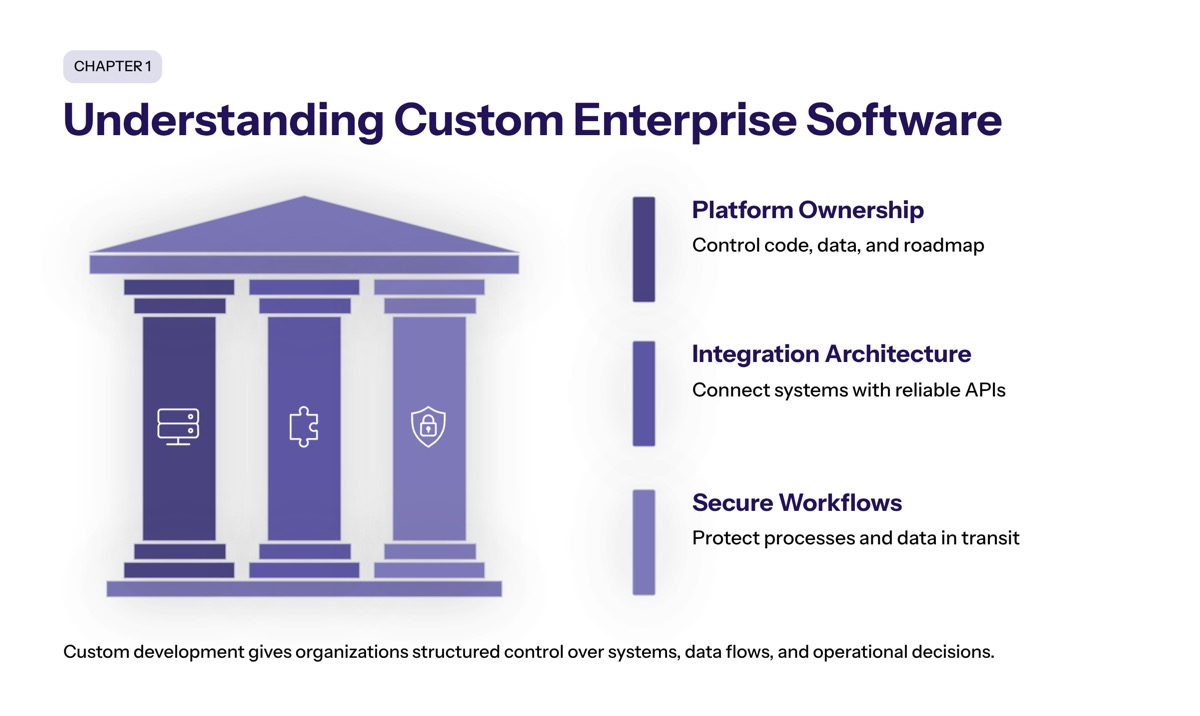
Custom enterprise software development is the process of designing, building, implementing, and maintaining software solutions for complex organizational needs. Unlike generic tools, custom enterprise software is specifically designed to fit unique business processes and requirements, ensuring a tailored solution that works seamlessly for organizations.
The custom enterprise software development process typically includes stages such as requirements gathering, design and architecture, development, testing and quality assurance, deployment, and post-launch maintenance. In practice, that means a development team works from real business operations, maps the project scope, defines the technology stack, designs the software architecture, and delivers scalable solutions that support current and future business goals.
Custom development differs from off the shelf software in three important ways. First, workflow alignment is deeper because features are designed around actual business processes instead of generic assumptions. Second, integration capability is stronger because custom software can connect to existing systems, legacy systems, data management platforms, cloud solutions, and third party systems. Third, scalability is planned into the architecture, allowing businesses to adapt to new demands without disruption.
Investing in custom software often leads to improved operational efficiency, smoother integration with existing systems, and a strong return on investment (ROI). For enterprise leaders, the key question is not only whether software can perform a task, but whether the software can support complex business operations, evolving market demands, and measurable business outcomes.
Core Components of Custom Enterprise Platforms
The core components of custom enterprise platforms include business-specific functionality, custom data models, role-based user interfaces, integration layers, security controls, and governance capabilities. These components turn enterprise software development from a technical project into a business platform strategy.
Business-specific functionality is where custom enterprise software creates immediate value. Custom ERP systems centralize and manage core business processes such as finance, human resources, and supply chain, tailored to fit a business’s unique workflows and requirements. Custom CRM systems are designed to manage customer interactions and optimize sales processes, specifically tailored to a company’s unique customer service requirements. Custom finance and accounting software is built to manage complex financial workflows, including budgeting, payroll, and compliance, tailored to a company’s specific financial processes.
Custom platforms can also serve industry-specific needs. Custom e-commerce solutions are designed to meet the specific needs of online businesses, offering features that go beyond standard platforms to enhance customer engagement and streamline transactions. Custom healthcare software manages electronic health records, appointments, and billing, ensuring compliance with healthcare regulations while centralizing patient data.
Data models and user interfaces are equally important. A custom enterprise platform can structure customer data, transaction records, operational events, and business intelligence around how the organization actually works. It can also provide interfaces tailored to roles, permissions, workflows, and service delivery needs, making it easier for employees to complete tasks and for leaders to analyze customer data, monitor performance, and make faster decisions.
These custom components enhance operational efficiency because they remove unnecessary steps, reduce manual work, and support core business processes directly. Implementing custom software solutions allows businesses to streamline their workflows, leading to improved productivity and faster decision-making processes.
AI-First Architecture in Custom Development
AI-first architecture means designing custom enterprise platforms so automation, machine learning, predictive analytics, and intelligent workflow optimization are built into the foundation rather than added later. This does not mean replacing expert judgment; it means using cutting edge technologies to support better decisions, automate routine actions, and surface insights from enterprise data.
In custom software development, AI-driven capabilities can support business intelligence, anomaly detection, document processing, supply chain management, customer relationship management, and predictive analytics. For example, a custom enterprise platform can analyze customer data to identify sales risks, route service requests based on priority, or automate processes that previously required manual review.
The relationship to core platform components is direct. AI depends on strong data management, clean integration, clear business rules, and secure software architecture. If existing systems are fragmented or customer data is trapped in silos, AI features are less reliable. Custom software allows the enterprise software development partner to design the data flows, governance model, and automation logic around real business needs.
For regulated environments such as healthcare and finance, AI capabilities must enhance expert workflows while preserving accountability. Custom development allows business rules, human review points, audit trails, role-based access, and compliance controls to be embedded directly into the platform. This connection between tailored solutions, data security, and intelligent automation leads naturally to a larger strategic question: who should own the platform and its future roadmap?
Custom Platform Ownership vs. Alternative Models
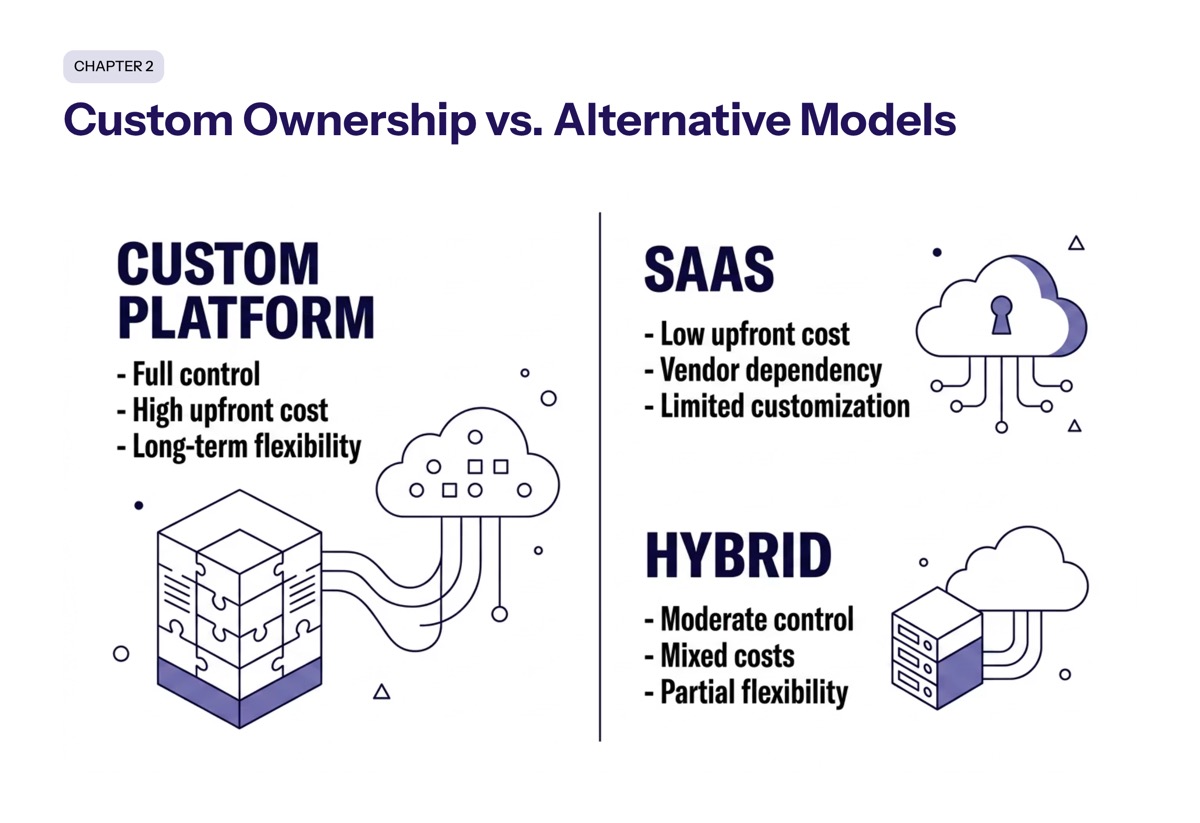
Once leaders understand what custom enterprise software can include, the next decision is ownership. Organizations can build a custom platform, buy SaaS or off-the-shelf tools, or combine both through a hybrid integration strategy. Each model affects control, cost, data governance, scalability, and long-term business agility.
Custom platform ownership gives an organization direct influence over functionality, security, integrations, user experience, and future development. SaaS and standard products can be faster to adopt, but they often constrain business processes, create licensing dependencies, and limit how deeply software integration can support unique operational requirements.
Custom-Built Platform Ownership
Custom-built platform ownership gives the organization control over functionality, data governance, security implementation, and the future development roadmap. Instead of waiting for a vendor to prioritize a feature, the business can direct software development toward the capabilities that matter most.
The benefits are strongest where workflows, compliance requirements, or competitive differentiation are specific to the organization. Custom software solutions provide scalability, allowing businesses to adapt to new demands without causing disruptions, unlike off-the-shelf solutions which may not be as flexible. Custom enterprise software is designed to scale with a business, ensuring that as operational demands increase, the software can adapt without compromising performance or efficiency.
Ownership also improves the ability to automate processes. Custom enterprise software can significantly enhance operational efficiency by automating routine tasks, which reduces manual errors and frees up employee time for more strategic activities. For leaders managing complex business challenges, this can translate into lower operational costs, better service delivery, and more consistent execution.
The commercial case is not only about features. Custom software offers the potential for long-term cost efficiency by eliminating recurring licensing fees. However, leaders still need to evaluate total cost of ownership, because the total cost of ownership (TCO) includes considerations for long-term maintenance, support, and updates for custom software.
SaaS and Off-the-Shelf Limitations
SaaS and off-the-shelf software can be useful for standardized functions, but limitations emerge when organizations need deep customization, strict compliance, or seamless integration with legacy systems. Vendor dependencies can affect feature availability, pricing, upgrade timing, data portability, and security posture.
Feature gaps are common when standard software products do not match unique business processes. Teams may compensate with spreadsheets, manual workarounds, disconnected databases, or duplicate data entry. Over time, those workarounds create operational challenges, reduce data quality, and make business intelligence less reliable.
Integration constraints are another major issue. APIs may not expose the right data, customization tools may be limited, and third party systems may not support the flow of information required across the enterprise. Integrating custom enterprise software with existing systems is crucial to prevent data silos and ensure a seamless flow of information across an organization’s technology ecosystem.
Cost implications also extend beyond subscription fees. SaaS licensing, per-user charges, paid add-ons, limited customization, integration services, and migration costs can increase over time. For organizations with unique workflows, the cheapest starting point is not always the most cost-effective long-term solution.
Hybrid Approaches and Strategic Considerations
A hybrid approach uses standard tools where they are sufficient and custom solutions where they create strategic value. For example, a business may keep commodity SaaS for payroll or email while building custom enterprise software for supply chain management, customer relationship management, finance workflows, data analytics, or industry-specific operations.
Selective customization can work well when leaders define which capabilities are differentiating and which are administrative. Platform extensions, integration layers, cloud computing, cloud solutions, and custom APIs can connect existing systems while giving the business a more unified operating model.
Key considerations include:
Total cost of ownership: Include software development, integration, support services, maintenance and support services, updates, infrastructure, and internal staffing.
Risk factors: Evaluate security exposure, regulatory requirements, implementation complexity, vendor lock-in, and operational disruption.
Strategic alignment: Prioritize custom development where business objectives, core business processes, customer data, and competitive advantage depend on better software.
Organizational readiness: Assess technical expertise, project management capacity, development process maturity, and executive sponsorship.
The right model depends on business needs, not technology preference. Once leaders decide where ownership matters, the next practical challenge is integrating the chosen platform into the enterprise environment without disrupting business operations.
Enterprise Integration Strategy and Implementation
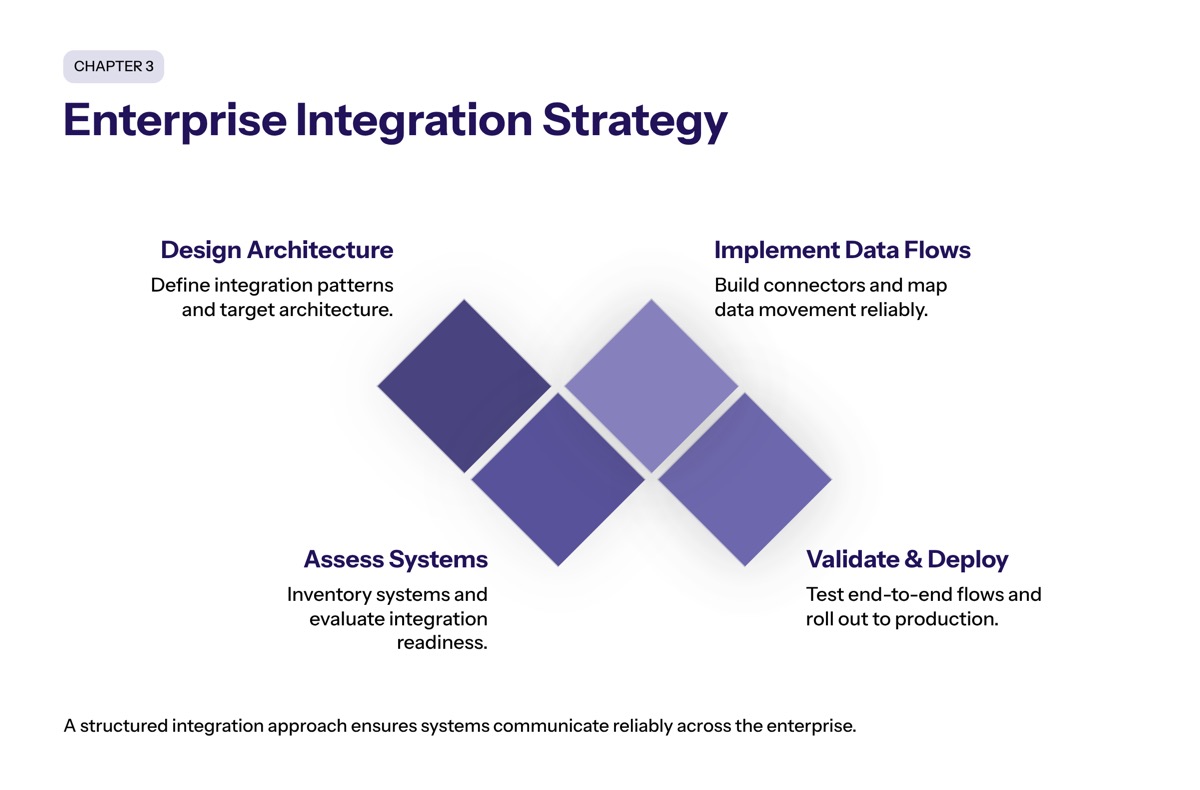
Enterprise integration turns custom software from an isolated application into a connected business platform. A strong integration strategy defines how custom enterprise software will exchange data with existing systems, legacy systems, cloud based platforms, third party systems, analytics tools, and operational workflows.
Successful system integration requires a clear understanding of the existing infrastructure and the specific needs of the business to ensure that the new software aligns with operational workflows and enhances overall efficiency. Without that clarity, even reliable software solutions can create new silos, duplicate data, or introduce security risks.
RAPID Framework for Implementation Planning
A structured methodology reduces delivery risk and keeps enterprise software development aligned with business goals. Cognativ-style RAPID planning can be useful for leaders evaluating enterprise software development services, custom software development services, or an enterprise software development company.
Research the current environment. Map existing systems, legacy systems, data sources, integrations, business processes, user roles, security requirements, and operational challenges.
Assess business value and risk. Identify where custom software can streamline operations, reduce operational costs, improve data management, strengthen compliance, or enhance customer interactions.
Prioritize capabilities. Define the project scope around high-value workflows first, such as automation, reporting, compliance, supply chain management, customer service, or finance operations.
Implement in phases. Use agile methodology, modular software architecture, and incremental releases so the development team can validate assumptions and adjust throughout the development process.
Deliver and measure outcomes. Track measurable business outcomes such as productivity, error reduction, faster decision-making, system adoption, and improved operational efficiency.
Effective custom software development requires a collaborative approach, where the development partner works closely with the client to make incremental changes throughout the process, ensuring the solution meets business needs. That collaboration is what turns software development services into a long-term enterprise software development partner relationship.
Integration Architecture Comparison
Different integration architectures solve different problems. The right choice depends on complexity, security, scalability, maintenance requirements, timeline, and the condition of existing systems.
Criterion | API-Based Integration | Middleware Solutions | Cloud-Native Architectures | Legacy System Modernization |
|---|---|---|---|---|
Complexity | Moderate; effective when systems expose reliable APIs | Moderate to high; useful for coordinating multiple systems | High; requires DevOps maturity and modern engineering practices | High; depends on legacy code, data quality, and business continuity needs |
Security | Strong if API gateways, authentication, encryption, and monitoring are implemented | Strong if centralized controls are well governed | Strong when cloud security, identity, and observability are built in | Variable; older systems may require compensating controls |
Scalability | Good for modular services and partner integrations | Good for orchestration, but middleware can become a bottleneck | Excellent for scalable solutions, cloud computing, machine learning, and high-volume workloads | Improves over time as systems are replatformed, wrapped, or replaced |
Maintenance Requirements | Requires version control, documentation, and API lifecycle management | Requires specialized administration and monitoring | Requires ongoing cloud operations, automation, and platform engineering | Requires migration planning, testing, and support for transitional states |
Implementation Timeline | Often faster for targeted integration | Medium; depends on number of connected systems | Longer upfront, stronger long-term flexibility | Phased; may involve API wrapping, data migration, and gradual replacement |
Challenges in system integration often arise from incompatible technologies, inconsistent data formats, and security concerns, which can complicate the process of connecting custom software with legacy systems. API-based integration may be best for quick connectivity, middleware may support complex orchestration, cloud-native architecture may deliver scalable enterprise solutions, and legacy modernization may be necessary when old systems limit business growth.
The decision should follow business objectives. Leaders should choose the architecture that supports seamless integration, protects data security, enables ongoing support, and keeps the software up to date. Integration choices also set the foundation for governance, security, and compliance requirements.
Governance, Security, and Compliance Frameworks
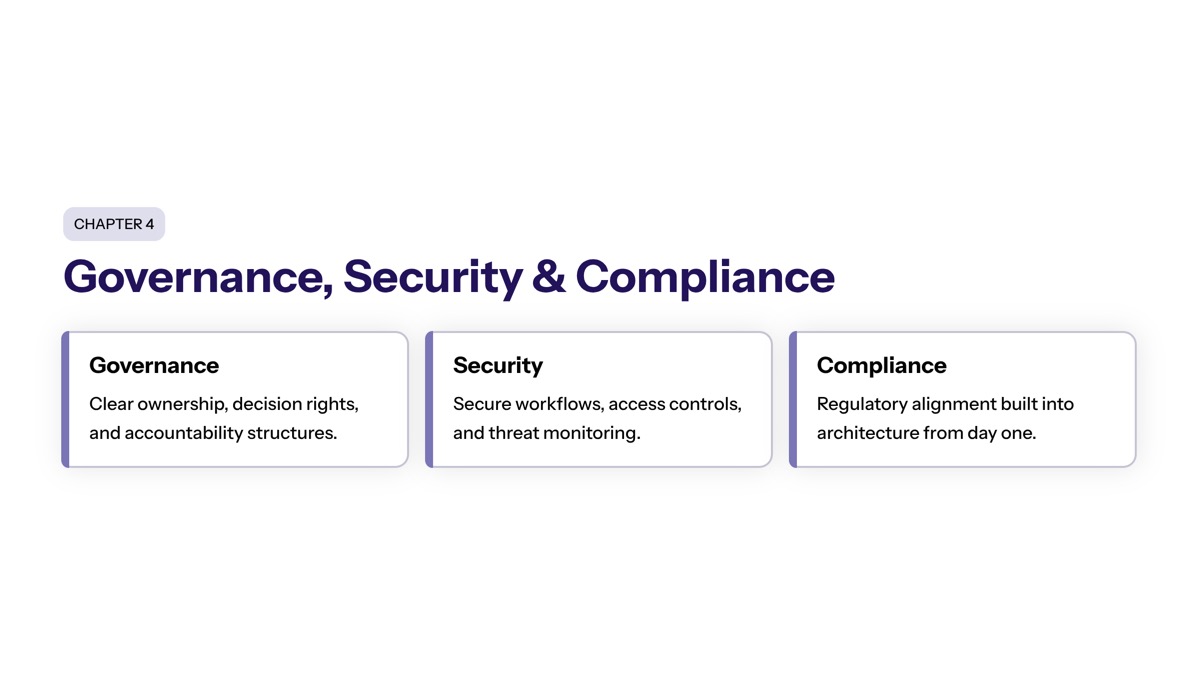
Governance determines whether custom enterprise software remains secure, compliant, maintainable, and aligned with business operations after launch. For regulated industries and enterprise-scale implementations, governance cannot be added at the end of the development process. It must be designed into the platform from the start.
Custom software development involves adherence to security and compliance standards like GDPR and HIPAA. Custom enterprise software development must ensure compliance with industry regulations, particularly in sectors like healthcare and finance, where strict standards are enforced.
Data Governance and Security Implementation
Data governance defines who can access data, how data is classified, where data is stored, how activity is monitored, and how compliance evidence is maintained. In custom enterprise software, governance should support business operations while protecting sensitive information.
Security features in custom software include role-based access control, user activity monitoring, and data encryption to protect sensitive information. These controls help organizations protect customer data, financial records, patient information, internal documents, and operational data.
Custom software allows for flexibility in architecture, enhancing security protocols and compliance directly within the framework. This is a major advantage over tools that offer only surface-level configuration. A custom enterprise platform can include role-specific workflows, approval chains, audit trails, encrypted data flows, secure authentication, logging, data retention rules, and policy-based access.
A practical governance framework should define:
Data ownership and stewardship responsibilities.
Access permissions by role, attribute, department, and workflow.
Encryption standards for data at rest and in transit.
Audit logging, monitoring, and incident response procedures.
Compliance reporting requirements for regulated business processes.
Compliance Automation and Risk Management
Compliance automation reduces manual reporting effort and makes risk easier to detect. Custom enterprise software can enforce policy at the workflow level, generate audit evidence, monitor exceptions, and flag activities that require review.
For healthcare, custom healthcare software manages electronic health records, appointments, and billing, ensuring compliance with healthcare regulations while centralizing patient data. For finance, custom finance and accounting software is built to manage complex financial workflows, including budgeting, payroll, and compliance, tailored to a company’s specific financial processes. In both sectors, secure data management and documented controls are essential.
Automated compliance capabilities may include policy enforcement, risk scoring, permission reviews, exception alerts, data retention schedules, and compliance dashboards. These features help leaders respond to audits, reduce manual work, and improve accountability.
Security validation is part of risk management. Conducting thorough security testing, including penetration tests and source code audits, is essential to identify vulnerabilities in custom software before deployment. Automated testing includes security vulnerability scans and performance load testing to ensure the software is robust.
Change Management and Quality Assurance
Enterprise software must evolve without creating instability. Change management defines how new features, integrations, security updates, and configuration changes are reviewed, tested, approved, deployed, and monitored.
Quality assurance in custom software development involves various levels of testing, including functional, performance, compatibility, and security testing, to ensure the software meets established requirements and quality standards. This is especially important when custom software connects to legacy systems, cloud based platforms, third party systems, and mission-critical workflows.
A strong QA and deployment methodology includes:
Requirements traceability from business needs to delivered features.
Functional testing for workflow accuracy.
Performance testing for scalability and reliability.
Compatibility testing across devices, browsers, integrations, and environments.
Security testing for vulnerabilities, access controls, and data protection.
Staging environments, rollback plans, and release governance.
Change management also includes training, documentation, stakeholder communication, and maintenance and support services. These practices keep enterprise software reliable after deployment and prepare the organization to capture long-term value from ownership.
Long-Term Value and Strategic Ownership
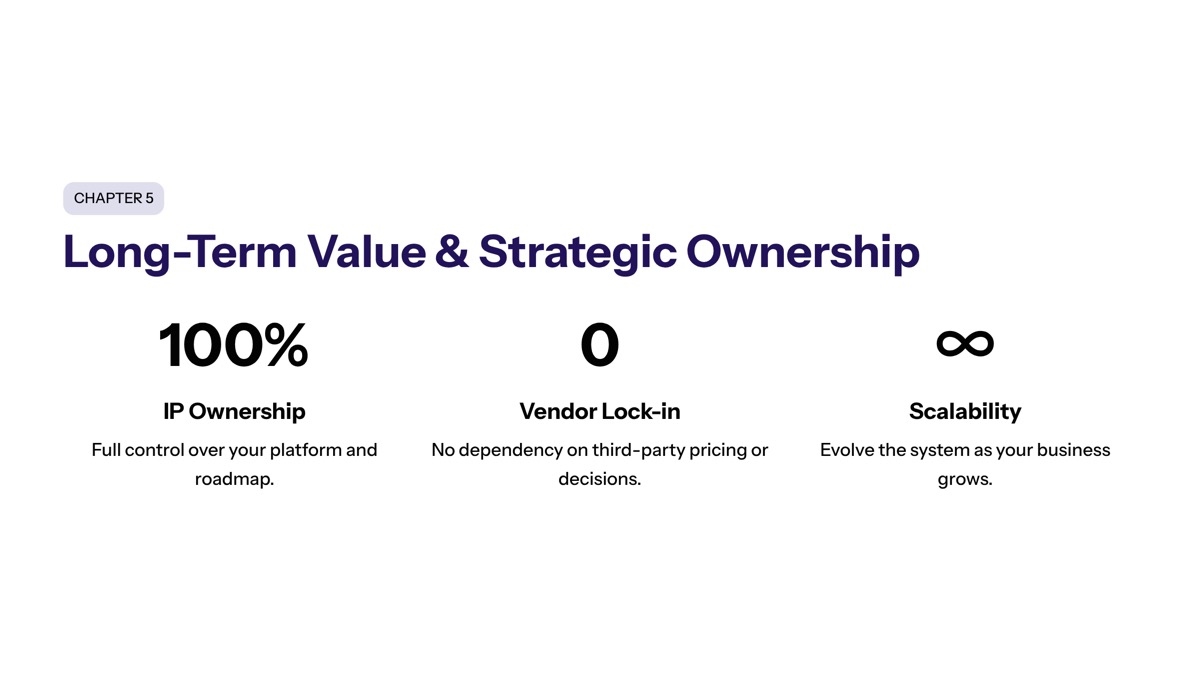
The value of custom enterprise software is measured over years, not only at launch. Leaders should evaluate ROI, platform evolution, operational efficiency, risk reduction, and strategic control. A well-designed platform can improve service delivery, support business growth, reduce tool sprawl, and help the organization respond to evolving market demands.
Strategic ownership also affects innovation capacity. When an organization controls its technology stack, it can build innovative solutions around business needs rather than waiting for vendor roadmaps.
Measuring Business Value and ROI
Measuring ROI requires a baseline. Before implementation, leaders should document current process times, manual effort, error rates, software costs, licensing fees, support workload, reporting delays, compliance effort, and data quality issues.
Operational efficiency metrics may include fewer workflow steps, faster approvals, reduced manual entry, lower error rates, faster reporting, and improved employee productivity. Implementing custom software solutions allows businesses to streamline their workflows, leading to improved productivity and faster decision-making processes.
Cost reduction may come from eliminating redundant tools, reducing manual labor, improving system reliability, lowering integration overhead, and removing recurring licensing fees where custom ownership replaces vendor subscriptions. The total cost of ownership (TCO) includes considerations for long-term maintenance, support, and updates for custom software, so ROI calculations should include both upfront build costs and ongoing support.
Custom enterprise software can also improve data visibility. When customer data, operational data, financial data, and supply chain data are connected, leaders can use business intelligence, data analytics, and predictive analytics to make better decisions. Reduced tool sprawl, fewer data silos, and automated workflows are often the clearest indicators that custom development is producing measurable business outcomes.
Platform Evolution and Modernization
Custom platforms are designed to adapt as business requirements, technology, and market conditions change. A modular platform can add new workflows, integrate new systems, incorporate mobile app development, support cloud solutions, or introduce machine learning capabilities without rebuilding the entire environment.
This flexibility matters because business operations rarely remain static. Companies may expand into new markets, acquire other businesses, change compliance requirements, launch new products, or increase transaction volume. Custom enterprise software is designed to scale with a business, ensuring that as operational demands increase, the software can adapt without compromising performance or efficiency.
Vendor-dependent solutions can limit evolution when roadmap timing, pricing, API access, or feature availability does not match business goals. By contrast, custom software development services can keep the platform aligned with changing business objectives through ongoing support, modernization, refactoring, integration services, and maintenance.
Platform evolution requires discipline. Leaders must keep software up to date, monitor technical debt, invest in quality assurance, and review architecture decisions regularly. The goal is not just to build software once, but to maintain a reliable platform that continues to deliver scalable enterprise solutions.
Competitive Advantage Through Technology Ownership
Technology ownership creates competitive advantage when the platform supports capabilities competitors cannot easily copy. This may include proprietary workflow automation, better customer interactions, faster fulfillment, stronger compliance reporting, advanced analytics, or specialized service delivery models.
Custom enterprise software gives leaders control over data assets, operational capabilities, security rules, integration priorities, and the development roadmap. That control supports faster market responsiveness and more precise innovation. When business users identify a new need, the organization can prioritize it directly with its software developers instead of waiting for a vendor release.
Ownership also protects institutional knowledge. The rules that define core business processes, customer service requirements, supply chain logic, financial controls, and compliance workflows can be embedded into the platform. Over time, the custom enterprise platform becomes more than software; it becomes an operating asset.
This is where the right software development partner matters. An experienced enterprise software development partner provides technical expertise, project management, enterprise application development, integration services, security planning, and support services that help the platform continue delivering value.
Common Implementation Challenges and Solutions
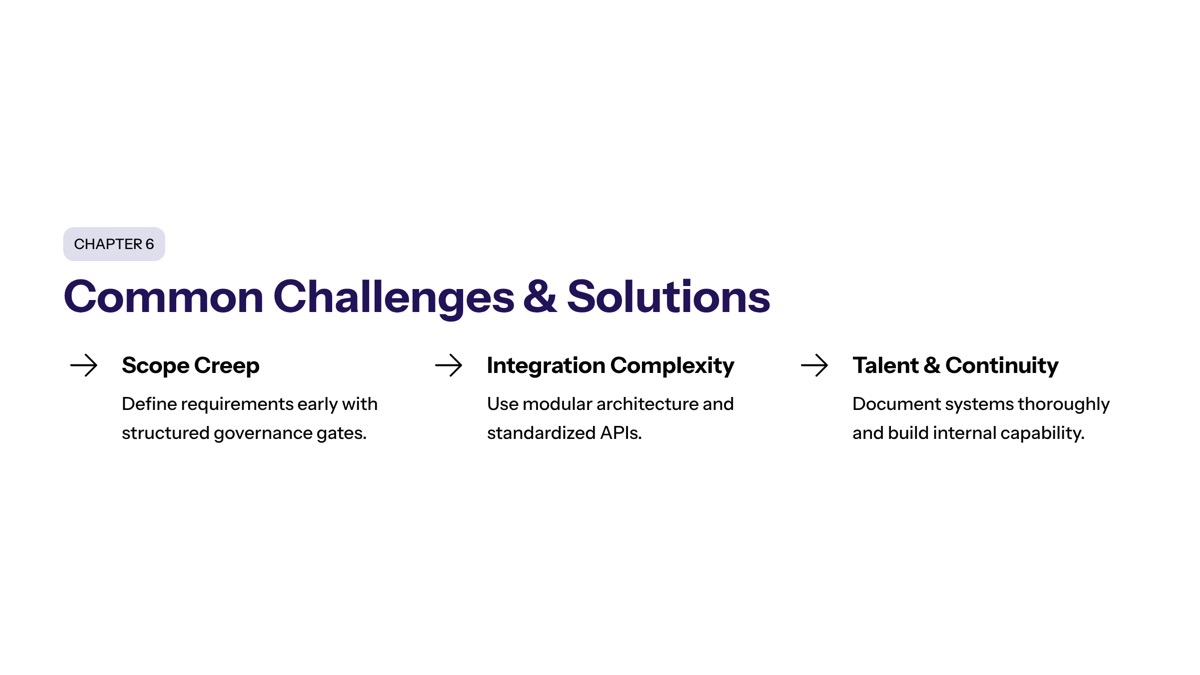
Custom enterprise software development can solve complex business challenges, but it also introduces delivery risks. Common obstacles include legacy integration complexity, unclear requirements, resource constraints, timeline pressure, stakeholder misalignment, security concerns, and change resistance.
The solution is not to avoid custom software. The solution is to manage the entire development process with disciplined discovery, realistic planning, iterative delivery, governance, and continuous business involvement.
Legacy System Integration Complexity
Legacy systems often contain critical data and business logic, but they may use outdated technologies, inconsistent data formats, brittle interfaces, or undocumented workflows. These factors make integration harder and can increase security and continuity risks.
A practical solution is phased modernization. Start by mapping existing systems, identifying data dependencies, and defining which workflows require real-time integration versus batch synchronization. Then use API development, adapters, middleware, or data layers to connect systems gradually.
Data migration should be planned carefully. Teams need data cleansing, field mapping, validation rules, reconciliation checks, and fallback procedures. This reduces operational disruption while allowing the custom enterprise platform to improve data management and create seamless integration across the technology ecosystem.
Resource Allocation and Timeline Management
Custom software requires software developers, architects, DevOps engineers, security specialists, QA professionals, business analysts, and product owners. Underestimating the required technical expertise or project management effort can lead to missed deadlines and scope creep.
The practical approach is to define project scope clearly, prioritize high-value capabilities, and deliver in phases. Agile methodology works best when paired with executive governance, clear decision rights, and measurable milestones. This allows the development team to adjust as learning occurs without losing alignment with business objectives.
Leaders should also plan for support after launch. Maintenance and support services, monitoring, issue resolution, security updates, user feedback, and roadmap planning are part of successful enterprise software development-not optional extras.
Stakeholder Alignment and Change Management
Custom enterprise software affects multiple groups: executives, IT, operations, finance, legal, compliance, customer service, sales, and end users. If these stakeholders define success differently, rework and adoption problems are likely.
The solution is structured collaboration from the beginning. Leaders should define business needs, success metrics, workflow requirements, compliance constraints, and user expectations before development begins. Regular workshops, demos, user feedback cycles, and steering committee reviews keep the solution aligned.
Change management should include training, documentation, adoption support, and communication about why the platform is changing. Effective custom software development requires a collaborative approach, where the development partner works closely with the client to make incremental changes throughout the process, ensuring the solution meets business needs.
With alignment, governance, and phased delivery in place, custom enterprise software becomes a controlled strategic investment rather than a risky technology experiment.
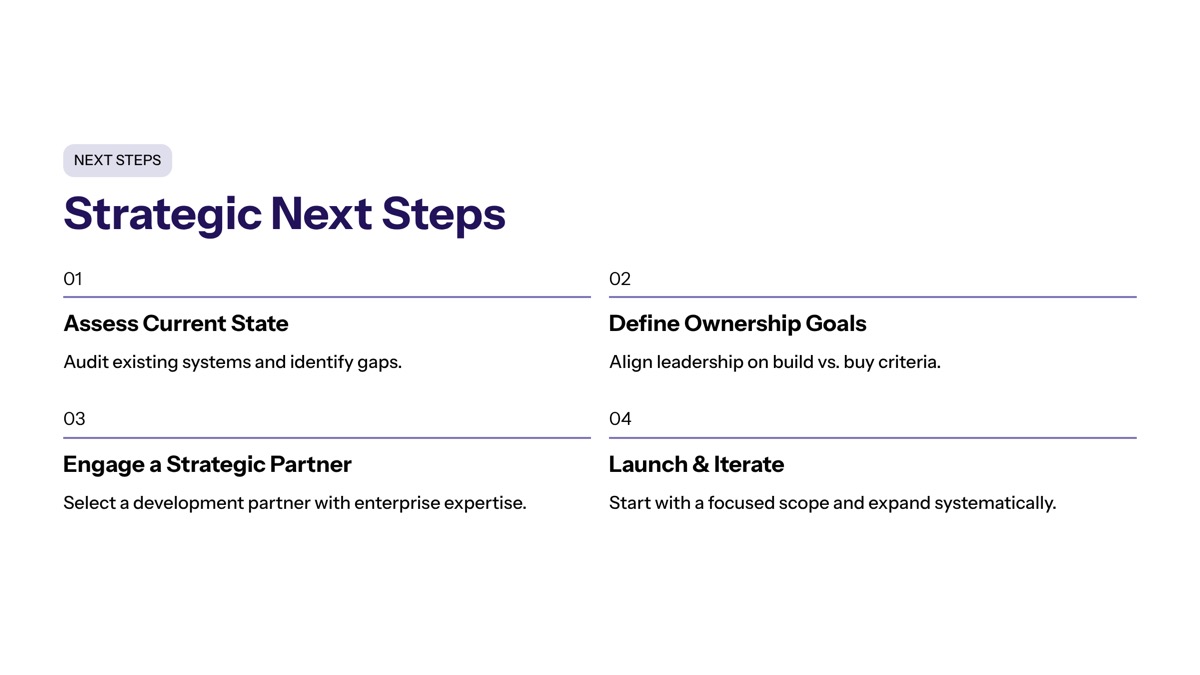
Conclusion and Strategic Next Steps
Custom enterprise software development is a strategic investment for organizations that need workflow-specific automation, secure data management, scalable architecture, and competitive differentiation. When compared with off-the-shelf tools, custom enterprise software gives leaders greater control over business processes, integrations, compliance, data security, and long-term platform evolution.
The next steps are practical:
Conduct a technology assessment. Map existing systems, legacy systems, integrations, data flows, security gaps, and operational challenges.
Evaluate current system constraints. Identify where off the shelf software creates manual work, data silos, licensing pressure, or workflow misalignment.
Define business requirements. Prioritize business goals, compliance needs, user roles, reporting needs, and measurable business outcomes.
Compare ownership models. Evaluate custom software, SaaS, hybrid approaches, and total cost of ownership over the full platform lifecycle.
Plan the implementation roadmap. Choose an enterprise software development partner with technical expertise in software architecture, quality assurance, integration services, cloud computing, and ongoing support.
Related areas worth exploring include AI integration strategies, cloud modernization approaches, mobile app development for enterprise workflows, and industry-specific compliance requirements such as GDPR, HIPAA, finance controls, and healthcare data governance. For leaders managing complex business operations, the right custom enterprise platform can become the operating foundation for long-term growth, resilience, and innovation.