How Data Center Growth May Push US Grid Costs Onto Consumers
Data center growth is forcing utilities across the United States to invest approximately $1.4 trillion in grid upgrades through 2030, and these capital expenditures will likely appear on consumer electricity bills. The rapid expansion of AI data center facilities and hyperscale computing operations has fundamentally disrupted traditional utility load planning, creating infrastructure demands that existing transmission lines, substations, and power generation assets cannot accommodate without significant modernization.
This analysis covers the specific mechanisms through which data center electricity demand drives utility investment, the regulatory processes that determine how costs flow to residential customers, and the regional variations that make some communities more vulnerable to electricity price increases than others. Business leaders, facility managers, and decision-makers evaluating infrastructure costs and digital transformation budgets will find actionable intelligence for assessing location-specific risks and planning for rising energy costs.
Data center electricity demand growth of 20-30% annually in concentrated markets is forcing utilities to upgrade aging infrastructure at an accelerated pace. A Carnegie Mellon University study estimates that data center expansion could lead to an average 8% increase in consumer electric bills nationally by 2030, with significantly higher impacts in dense data center markets like Northern Virginia and Texas. Since the AI boom, average U.S. electricity prices have increased from around 13 cents to 19 cents per kilowatt-hour (kWh), reflecting the surge in electricity demand from AI and cloud computing data centers that is driving higher monthly utility bills for consumers.
By the end of this article, you will understand:
The infrastructure investment triggers that connect data center development to grid upgrade requirements
How utility rate recovery processes translate capital expenditures into residential customer electricity bills
Regional variations in consumer electricity cost impact across major data center markets
Mitigation strategies that local governments and regulators are implementing
Business planning implications for facility location and power cost projections
The broader economic and environmental impacts of data center industry growth
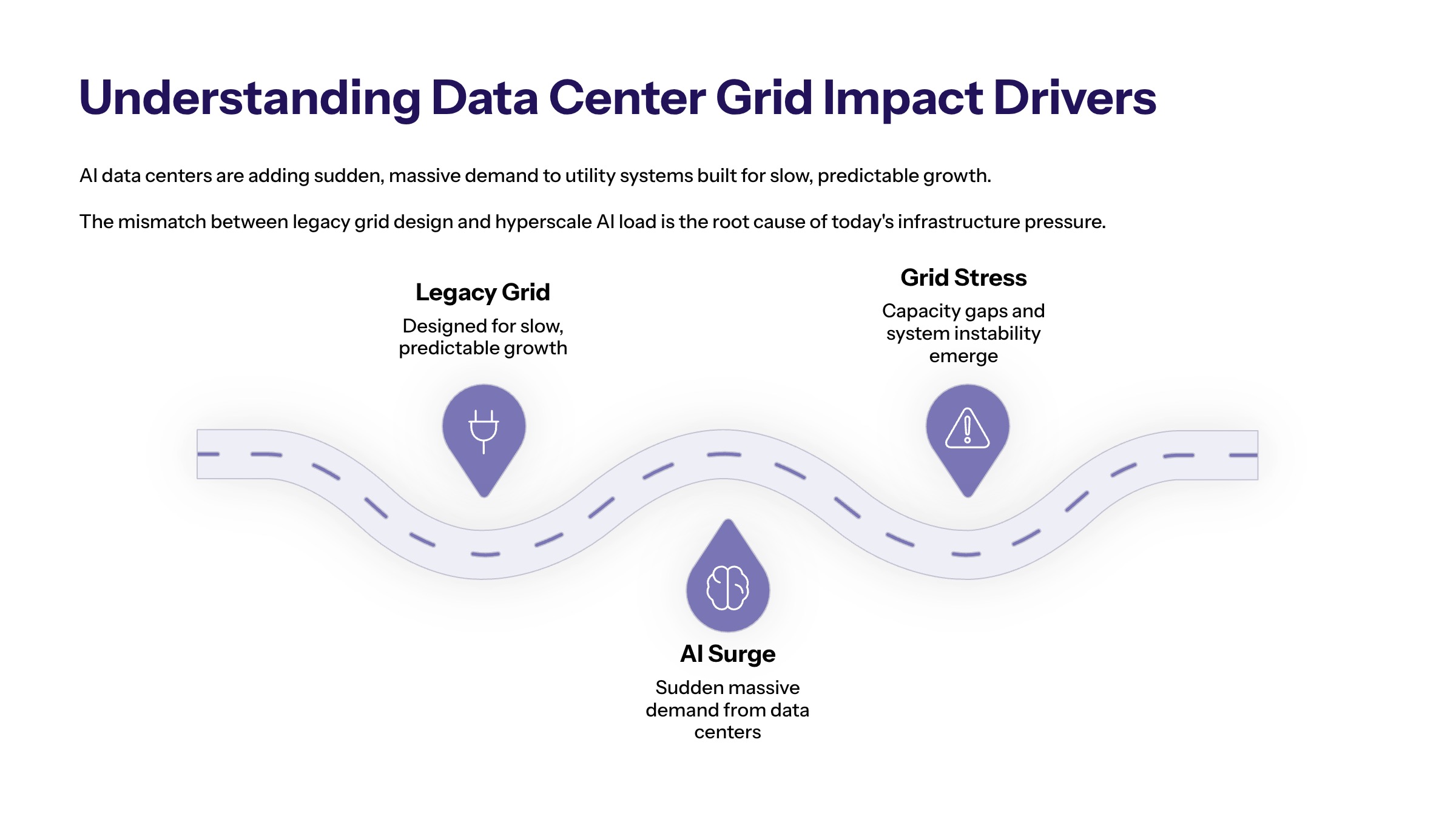
Understanding Data Center Grid Impact Drivers
Traditional utility load planning assumes annual electricity demand growth of 1-2%, a rate that allows gradual infrastructure expansion aligned with standard capital investment cycles. Data center demand fundamentally breaks this model—new data centers can add load growth equivalent to decades of residential development within months of becoming operational. A single data center campus can consume as much electricity as 100,000 homes, necessitating the construction of expensive high-voltage transmission lines and substations that utilities had not anticipated in their capital planning.
Grid operators now face a planning crisis: the infrastructure required to serve data center interconnection requests often exceeds available electric grid capacity in target regions, and the timeline for data center deployment outpaces the multi-year construction schedules for transmission infrastructure.
AI Data Center and Hyperscale Facility Power Requirements
AI data center facilities require substantially more power density than traditional computing operations. While conventional data centers might require 5-10 megawatts per building, AI-focused facilities can demand 50-100 megawatts or more to power GPU clusters and cooling equipment necessary for machine learning workloads.
Data centers could consume nearly 9% of all electricity demand in the U.S. by 2035, up from approximately 4% in 2023. Some projections indicate data centers could represent up to 12% of all U.S. electricity consumption by 2028. This concentration of power demand creates localized strain on distribution networks that were designed for diffuse residential and commercial loads, not continuous high-density industrial consumption.
The energy consumption of data centers is expected to double or triple by 2028, contributing to increased wholesale electricity costs across regional markets where these facilities cluster.
Regional Electric Grid Capacity Constraints
Geographic concentration amplifies infrastructure strain. Northern Virginia’s Data Center Alley hosts the highest concentration of data center infrastructure in the world, with data centers accounted for approximately 25% of Virginia’s total electricity consumption—a figure projected to rise to 39-57% by 2030. Texas, California, and emerging markets in Georgia and Arizona face similar clustering dynamics.
Aging infrastructure compounds these capacity constraints. Many transmission lines and substations serving high-growth regions were constructed decades ago for load profiles that bear no resemblance to current data center demand. The Electric Reliability Council of Texas (ERCOT) now projects peak electricity demand of 145 GW by 2031, driven substantially by data center interconnection requests that have flooded the queue.
Utility Investment Triggers
Regulatory requirements compel utilities to maintain electric grid reliability and meet demand within their service territories. When load growth approaches or exceeds available grid capacity, power companies must invest in new generation, transmission, and distribution infrastructure—or face reliability violations from the Federal Energy Regulatory Commission and state regulators.
Data center developers often secure land and permits faster than utilities can build supporting infrastructure, creating a mismatch between commercial deployment schedules and physical grid capacity. This dynamic shifts negotiating leverage toward data center companies while forcing utilities into accelerated capital expenditure programs that ultimately flow through to ratepayers.
These infrastructure demands translate directly into specific investment requirements that utilities must fund and recover through rates.
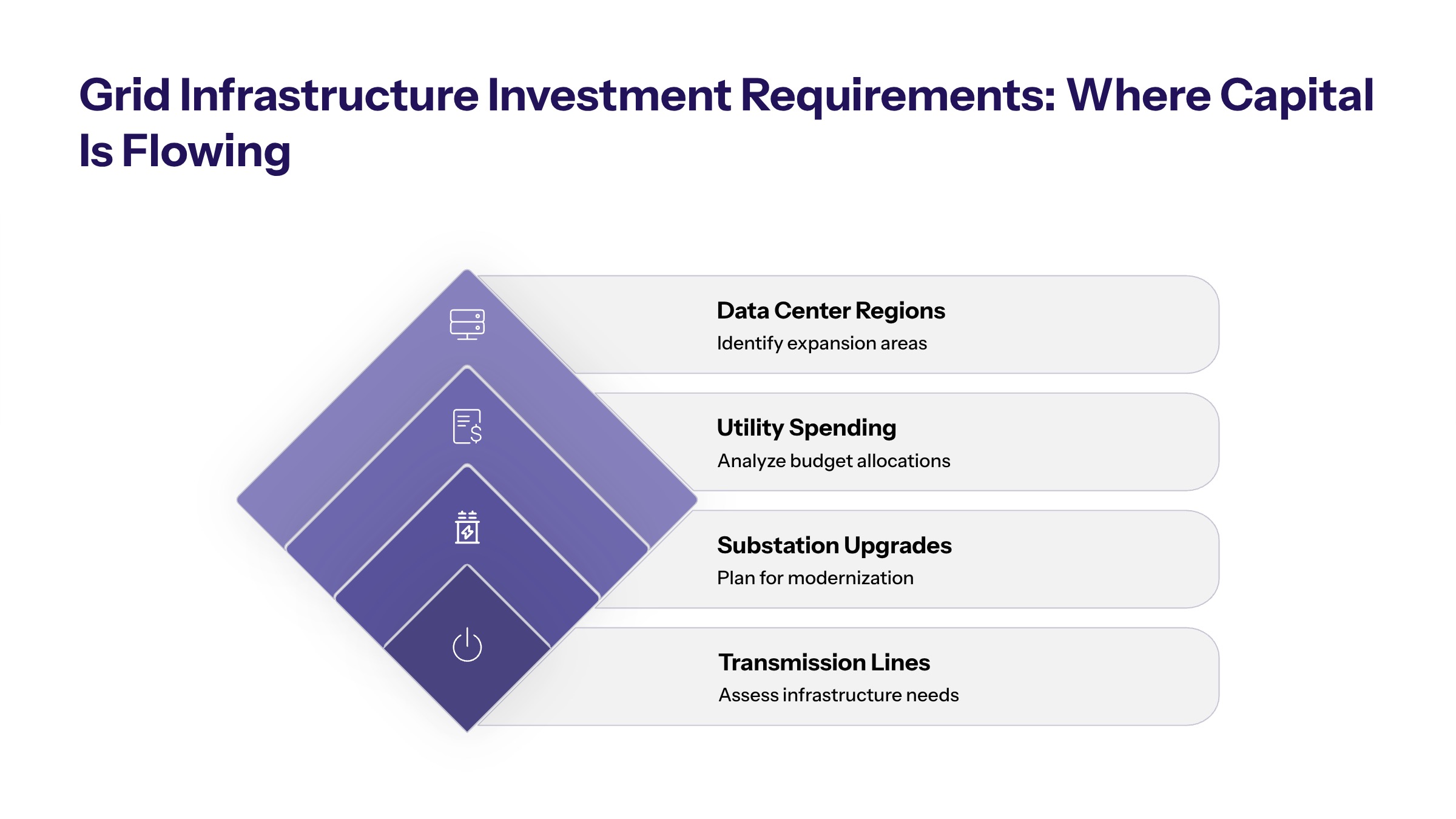
Grid Infrastructure Investment Requirements
Utilities are projected to spend $1.4 trillion over five years to upgrade transmission lines and substations due to growing data center demand, according to analysis from nonprofit PowerLines. This spending represents a substantial increase from previous capital planning cycles and will require rate recovery from customers across utility service territories.
Transmission and Distribution Upgrades
Substation capacity expansion represents the most immediate infrastructure bottleneck. Data center loads require dedicated high-voltage feeds, transformer capacity, and switchgear that may not exist near preferred development sites. Utilities must construct new substations or significantly expand existing facilities to accommodate data center interconnection requests.
High-voltage transmission line construction connects remote power generation sources to data center load centers. Maryland customers face an estimated $2.0 billion in transmission capital costs from PJM Interconnection planning, largely driven by grid upgrades to accommodate demand from data center development—including facilities serving out-of-state customers.
Distribution network reinforcement handles the “last mile” delivery of power to data center facilities. Feeders, transformers, and protective equipment throughout the distribution system often require upgrades when high-load customers concentrate in previously low-demand areas.
Generation Capacity Expansion
Increased electricity demand requires increased power generation. Utilities are adding natural gas generation capacity and renewable energy facilities to meet growing data center electricity demand. In San Antonio, CPS Energy revised its peak electricity demand growth forecast from approximately 115 MW annually to 260 MW per year specifically due to the data center boom.
Grid storage requirements grow alongside renewable energy integration, as battery storage systems help balance intermittent solar and wind generation with continuous data center power usage. Backup power infrastructure—both utility-scale and behind-the-meter diesel generators at data center facilities—adds redundancy that supports 99.999% uptime requirements but also contributes to greenhouse gas emissions and air quality concerns.
Water Usage and Environmental Considerations
Data centers require significant amounts of water for cooling, with mid-sized facilities using up to 300,000 gallons per day and large facilities consuming as much as 5 million gallons daily. This substantial water demand can strain local water supplies, especially in water-stressed areas such as parts of Arizona, Texas, and the Colorado River Basin. The competition for water resources raises concerns about sustainable water management and the long-term viability of data center siting in vulnerable regions.
Air Quality and Health Impacts
The construction and operation of data centers can lead to increased air pollution and health risks for nearby communities, particularly when facilities rely on gas-fired generation and diesel backup generators. These sources emit harmful pollutants linked to respiratory diseases and other health problems. Diesel generators, used for emergency backup, emit nitrogen oxides and particulate matter at levels significantly higher than natural gas plants, contributing to local air quality degradation. These environmental impacts are often concentrated in communities already facing environmental burdens.
Environmental Justice and Community Burdens
Data centers are often located in areas with existing environmental challenges, with nearly half of U.S. data centers situated in census tracts that have above-median environmental burdens, including air pollution, limited park access, and water quality issues. This siting pattern risks exacerbating inequities in affected communities, particularly those with higher poverty rates and social vulnerability. Addressing these disparities requires intentional policies and community engagement to ensure equitable outcomes in data center market development.
Economic Impact and Market Development
The total government revenues associated with the data center sector increased from $66 billion in 2017 to more than $162 billion in 2023, highlighting the economic impact of data center expansion on local and state economies. While data centers generate hundreds of temporary construction jobs and a limited number of permanent positions, the broader economic development benefits include increased tax revenues and business activity. However, these gains must be weighed against the costs of infrastructure investments and potential environmental impacts.
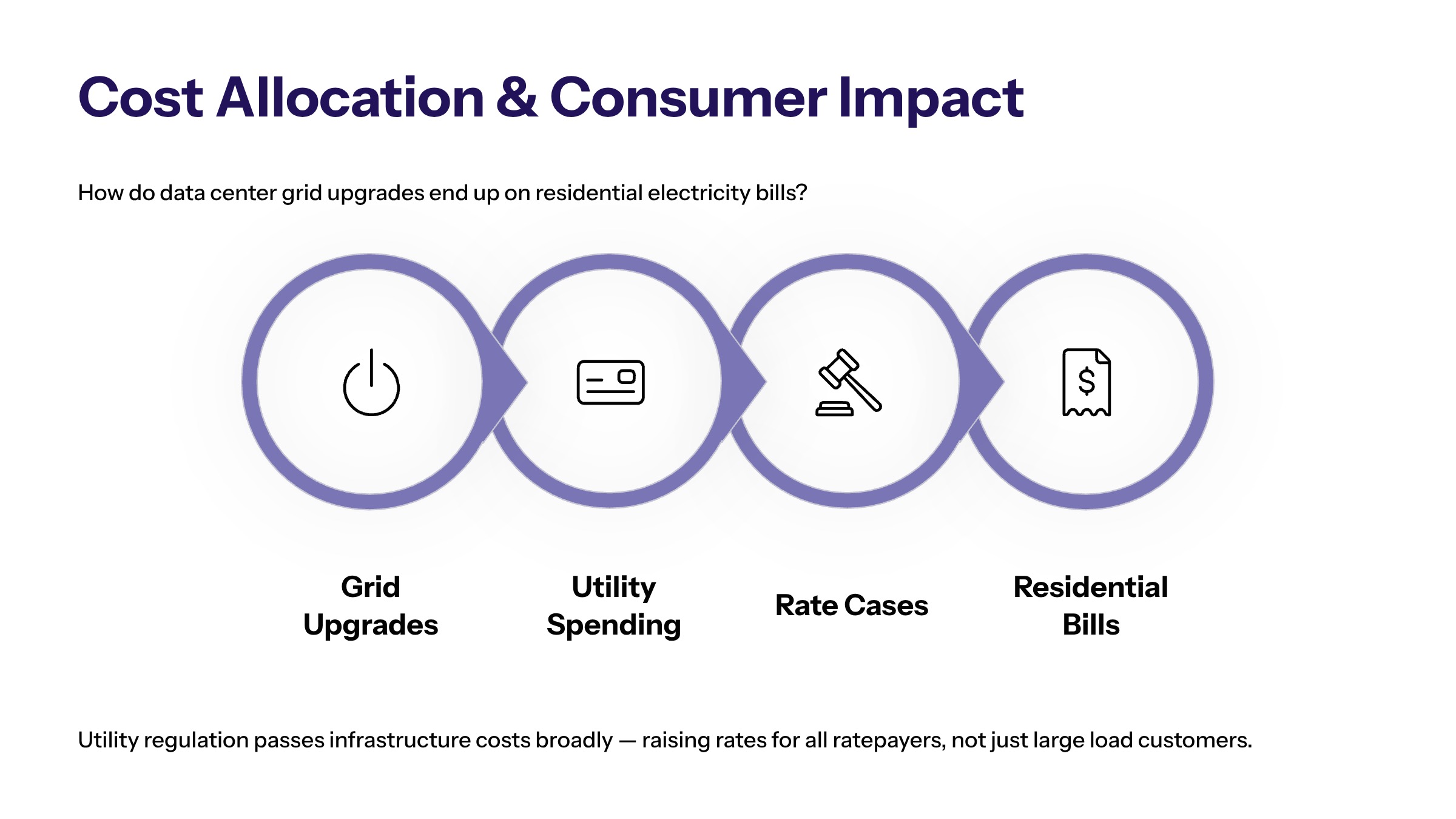
Cost Allocation Methods and Consumer Impact on Electricity Bills
Infrastructure investments flow to consumer electricity bills through regulatory processes that vary by state and utility type. Understanding these cost recovery mechanisms reveals why data center growth translates into higher electricity costs for residential customers who may never directly use cloud computing services.
Utility Rate Recovery Processes
Regulated utilities invest capital in generation, transmission, and distribution assets, then file rate cases with state public utility commissions to recover those costs through customer rates. The process involves:
Utility files application demonstrating infrastructure need and cost prudency
Consumer advocacy groups and intervenors challenge cost allocation and rate design
Commission staff evaluates engineering and financial justifications
Commissioners issue orders setting allowed rates and recovery timelines
Rates take effect, typically 12-18 months after initial filing
This timeline creates lag between when utilities incur capital expenditures and when customers see bill impacts. Rate cases proceeding now will result in electricity bill changes appearing in 2026-2028, meaning the consumer cost burden from current data center growth has not yet fully materialized.
State policy modifications are allowing U.S. utilities to charge residential consumers upfront fees for infrastructure intended for data centers before the projects become operational, accelerating cost recovery timelines in some jurisdictions.
Cost Allocation Comparison
Allocation Method | Cost Distribution | Data Center Share | Consumer Impact |
|---|---|---|---|
Socialized Regional | All ratepayers across region | Proportional to usage | Higher residential burden |
Local System Impact | Customers in affected zone | Higher direct allocation | Concentrated local impact |
Dedicated Rate Class | Large users pay premium rates | Direct cost responsibility | Lower residential impact |
Developer Contribution | Upfront infrastructure payments | Direct funding requirement | Reduced rate base growth |
Virginia’s State Corporation Commission approved a new rate class for AI data center-scale facilities starting January 2027: these large users must pay at least 85% of contracted transmission and distribution demand costs and 60% of generation demand. This represents an emerging model for shifting cost burden away from residential customers.
Regional Electricity Price Increases and Impact Variations
Wholesale electricity costs have increased by as much as 267% in areas near data centers over the past five years, according to Bloomberg News analysis of Grid Status data. Consumers living near these facilities report substantial single-year electricity bill increases.
In 2025, electricity costs for consumers in areas with significant data center activity are projected to rise by more than $9.3 billion due to increased demand on the electric grid from these facilities. Since the AI data center boom began, average U.S. electricity prices have increased from around 13 cents to 19 cents per kilowatt-hour.
In the PJM Interconnection grid covering 13 states, future capacity prices soared ninefold, resulting in higher costs for households throughout the mid-Atlantic region. A Virginia legislative analysis estimated that typical households could pay an extra $14-$37 per month by 2040 purely from infrastructure and capacity costs attributable to data center demand.
Higher electricity costs create a 0.2% drag on consumer spending growth, disproportionately affecting lower-income households who spend a larger percentage of income on energy bills.
These cost allocation dynamics create challenges that regulators, utilities, and local communities are actively working to address.
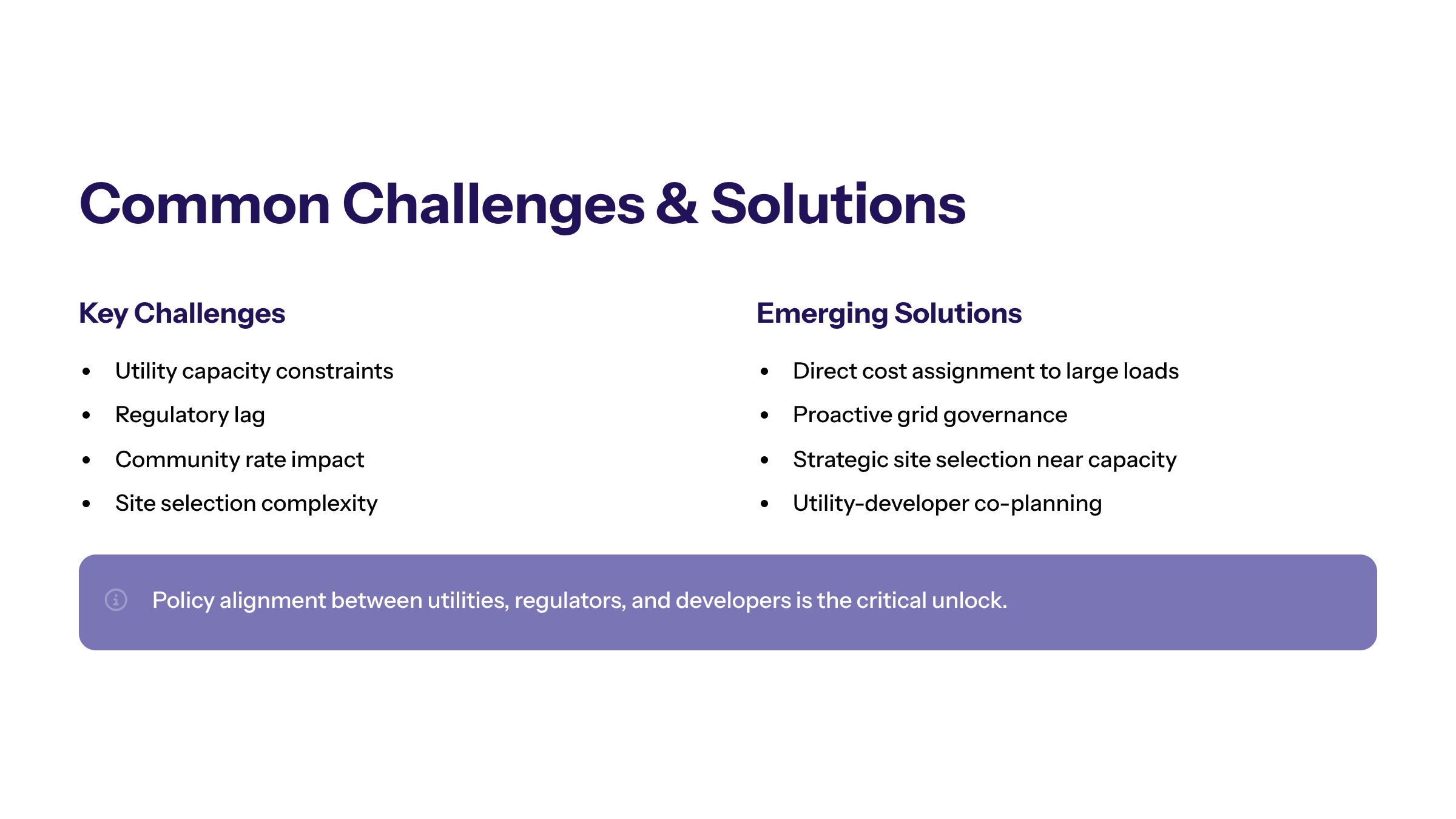
Common Challenges and Solutions
Business decision-makers and facility planners face an evolving regulatory landscape as communities respond to data center development impacts. Understanding emerging governance practices helps anticipate policy changes that could affect site selection and operating economics.
Regulatory Cost Recovery Delays
The multi-year timeline between utility investment and rate recovery creates uncertainty for infrastructure planning and customer cost projections. Some jurisdictions are implementing streamlined approval processes for critical infrastructure investments, including pre-approved cost recovery mechanisms for qualified data center grid upgrades.
Texas enacted Senate Bill 6 in June 2025, which includes reforms for planning, interconnection, cost-sharing, transparency, and emergency operations to strengthen the state’s electric grid in response to rapid data center development. This legislation establishes clearer frameworks for allocating costs between data center developers and existing ratepayers.
Consumer Electricity Bill Impact Management
Data centers are increasingly being required to pay for the infrastructure they use, which can shift costs onto other ratepayers, raising concerns about fairness and the economic burden on local communities. Emerging solutions include graduated rate implementation to spread costs over longer timeframes and revenue sharing agreements between data center operators and host communities.
In Virginia, lawmakers have debated scaling back data center tax exemptions and proposed bills to link eligibility to tax incentives with improved energy efficiency or clean energy performance, though these proposals have stalled. The total government revenues associated with the data center sector increased from $66 billion in 2017 to more than $162 billion in 2023, providing negotiating leverage for communities seeking better terms.
Grid Planning Coordination
Enhanced utility-developer collaboration improves demand forecasting accuracy. Regional transmission planning that incorporates realistic data center growth scenarios helps optimize infrastructure investments and avoid both overbuild and capacity shortfalls.
As data centers proliferate, local officials are beginning to develop stronger tools to support negotiations with developers, including temporary moratoria to reassess siting criteria and community safeguards. Local governments in some regions are exploring policies to treat data centers as a distinct land use, applying additional reviews to large-scale projects to mitigate their impacts on local residents.
Emerging governance practices are being implemented to manage the trade-offs of data center growth, including energy demand management, water demand protection, and air quality considerations. Data centers require significant amounts of water for cooling, with mid-sized facilities using up to 300,000 gallons per day and large facilities consuming as much as 5 million gallons daily, which can strain local water supplies.
Conclusion and Next Steps
Data center growth will likely result in consumer electricity cost increases across most U.S. markets, with regional variations and timing dependent on regulatory approaches and infrastructure investment schedules. National electricity generation costs may increase 8% by 2030 from data center demand alone, while concentrated markets like Northern Virginia, Texas, and areas served by PJM Interconnection face substantially higher impacts.
The construction of data centers generates hundreds of temporary jobs, but the number of permanent positions is limited, with even the largest facilities employing fewer than 150 permanent workers, raising questions about the long-term economic benefits for local communities that absorb infrastructure costs.
Data centers are often located in areas with existing environmental burdens, with nearly half of U.S. data centers situated in census tracts that have above-median environmental challenges. The construction and operation of data centers can lead to increased air pollution and health risks for nearby communities, particularly when facilities rely on gas-fired generation and diesel backup generators, which impact local air quality.
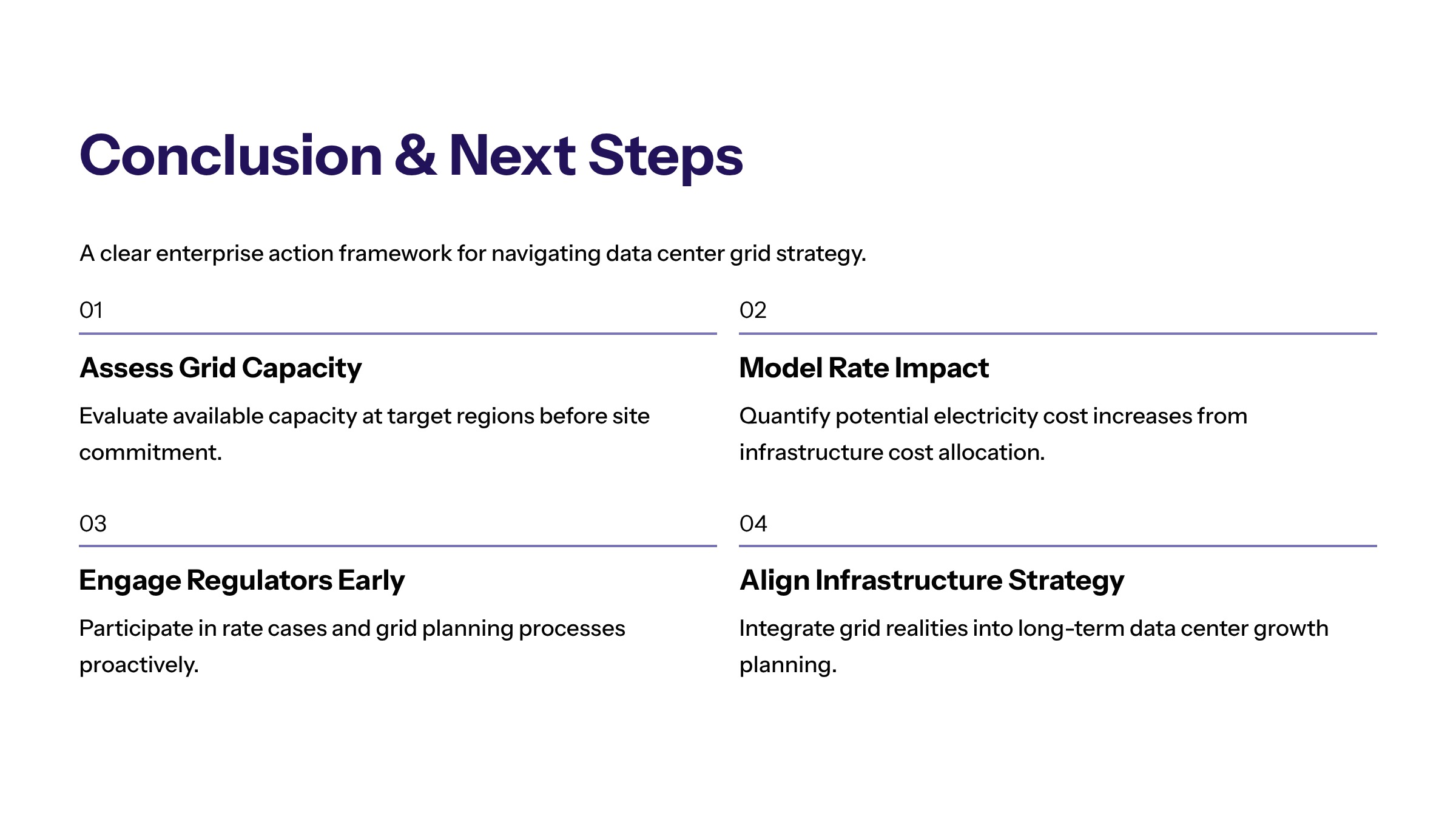
Immediate actionable steps for business leaders:
Evaluate location-specific rate projections and pending utility filings in target markets
Assess facility power requirements against available electric grid capacity and interconnection timelines
Plan for infrastructure cost escalation in operating budgets and lease negotiations
Monitor regulatory proceedings for rate class changes affecting large electricity users
Incorporate demand response and energy efficiency measures to reduce peak demand exposure
Related topics worth exploring include renewable energy procurement strategies for data center operations, demand response program economics, and distributed generation options that reduce grid dependency while hedging against transmission cost escalation.
Additional Resources
State public utility commission dockets for pending data center rate proceedings
PJM, ERCOT, and regional transmission organization demand forecasts and interconnection queue reports
Lawrence Berkeley National Laboratory data center energy efficiency research
Energy Information Administration electricity price tracking and projections
Federal Energy Regulatory Commission transmission cost allocation proceedings