Digital Transformation Assessment: A Practical Current-State Checklist
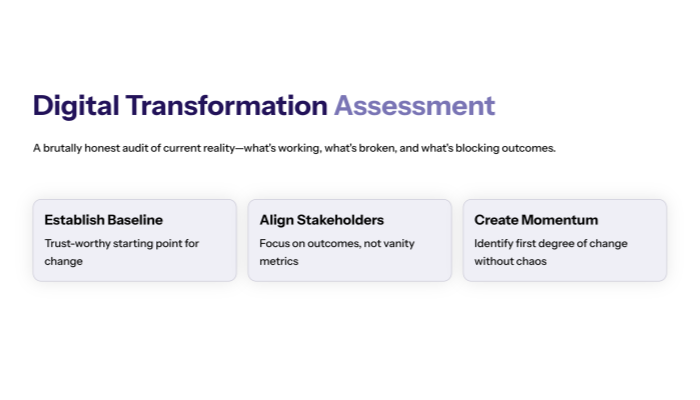
A digital transformation assessment is not a maturity score you show the board. It’s a brutally honest audit of current reality—what’s working, what’s broken, what’s invisible, and what’s blocking outcomes. Ali Davachi frames this as the starting point for RAPID: before you “solve,” you have to deliver truth hot and hard and get clear-eyed about the situation.
Use this digital transformation assessment to establish a baseline you can trust, align stakeholders around outcomes (not vanity metrics), and identify the first “one degree of change” that creates momentum without triggering chaos.

Outcomes & Alignment (Clarity Before Change)
1.1 Define the outcome (not the tool)
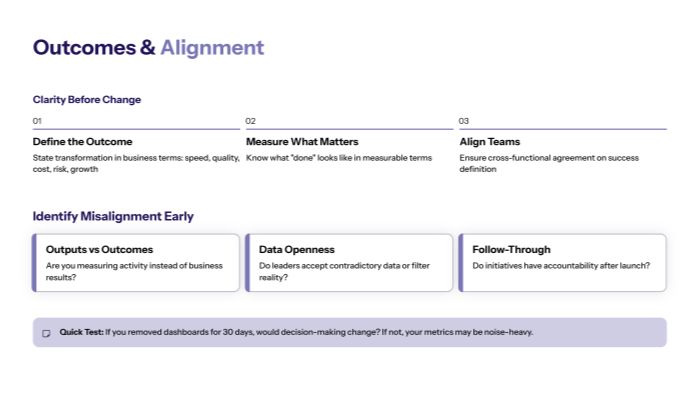
Every effective digital transformation assessment begins with an outcome statement. RAPID is explicit that outcomes are the current that powers everything—and that teams often drift into activity without aligning daily work to desired outcomes.
Checklist
- Do we have one transformation outcome stated in business terms (speed, quality, cost, risk, growth)?
- Do we know what “done” looks like in measurable terms (not “implement platform X”)?
- Do teams agree on the same definition of success across functions?
- Evidence to collect
- The single-sentence outcome statement + 3 KPIs
- The top 3 workflows that most influence the outcome
A list of current initiatives mapped to those workflows (or proof they aren’t mapped)
1.2 Identify misalignment and vanity metrics
RAPID warns against vanity metrics—numbers that “look good” but don’t describe performance in a way that improves future strategy. A strong digital transformation assessment calls this out early because vanity metrics create false confidence.
Checklist
- Are we measuring outputs (activity) instead of outcomes (customer and business results)?
- Are leaders open to contradictory data, or do we “only see what we want to see”?
- Do teams have follow-up after decisions, or do initiatives “launch” and disappear?
Quick test
If you removed your dashboards for 30 days, would your ability to make decisions materially change? If not, your measurement system may be noise-heavy and insight-light.
Customer Reality & Market Signal (Research That Matters)
2.1 Customer Relationship Quality (CRQ) mini-audit
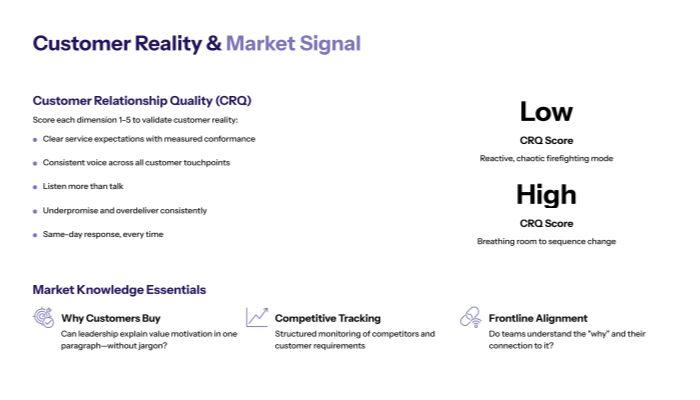
A credible digital transformation assessment must validate customer reality. The RAPID tools include a customer relationship quality assessment that focuses on service expectations, consistency of messaging (“same voice”), listening behavior, and responsiveness.
CRQ checklist (score 1–5 each)
- We set clear service expectations and measure conformance.
- When we speak to customers, we speak with the same voice.
- We listen more than we talk.
- We underpromise and overdeliver.
- We respond the same day, consistently.
Interpretation
Low CRQ usually means transformation work will be reactive and chaotic (firefighting replaces planning). High CRQ gives you breathing room to sequence change.
2.2 Market knowledge and “why customers buy”
In the book, Davachi notes he often doesn’t ask leaders “what are your goals?” directly—he asks why customers do business with them and what value motivates customers to pay. This belongs inside your digital transformation assessment because it defines what must be protected (“do no harm”) while you change systems.
Checklist
- Can leadership explain why customers buy in one paragraph—without jargon?
- Do you track competitors and customer requirements in a structured way?
- Do frontline teams know the “why” and how their work connects to it?
Evidence to collect
- Win/loss themes
- Top 10 customer complaints categorized (recurring vs one-off)
- Renewal/churn drivers (or support ticket patterns if no churn model exists)
People, Culture, and Process (Where Transformation Actually Breaks)
3.1 People and self-awareness: “who’s who” and commitment
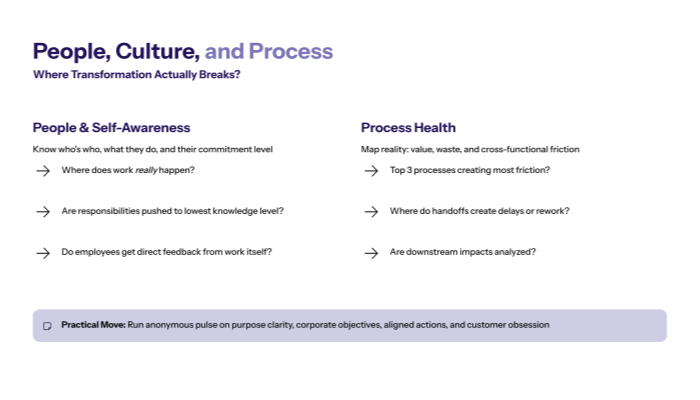
RAPID emphasizes that for the human aspect, “nothing is irrelevant.” You need to know who’s who, what they do, how they do it, and how committed they are—because culture can kill companies or save them.
Checklist
- Do we know where work really happens (not just reporting lines)?
- Are responsibilities pushed to the lowest level where knowledge exists, or is everything controlled “up”?
- Do employees get direct feedback from the work itself (clear “did I do a good job?” signals)?
Practical move
Run an anonymous “thumbs up / thumbs down” pulse on: purpose clarity, corporate objectives, aligned actions, and customer obsession (RAPID’s self-awareness tools).
3.2 Process health: value, waste, and cross-functional friction
A digital transformation assessment must map process reality. Davachi’s process planning guidance starts with a simple question: is every existing process still required and delivering value? Then: where would a new process improve flow?
Checklist
- Can you name the top 3 processes that create the most friction across departments?
- Where do handoffs create delays (queues), rework, or “shadow workflows” outside systems?
- If you modify one department’s process, do you analyze downstream impacts (flywheel principle)?
Fast artifact
Create a one-page value-stream map for one critical workflow (quote-to-cash, incident-to-resolution, onboarding-to-activation). The goal is not beauty—it’s visibility.
Technology, Data, and Financial Reality (Stop Optimizing Blind)
4.1 Technology assessment: keep it simple, prioritize nonfunctional risk
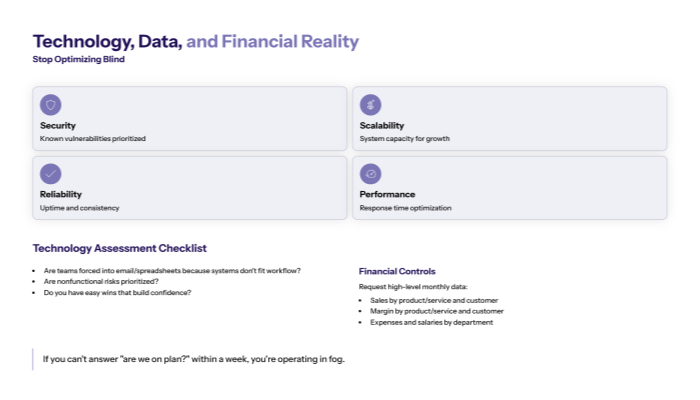
RAPID is clear: if tech is involved, keep it simple—technology should support the business, not wag the dog. When assessing a tech product (or internal systems), Davachi also looks at nonfunctional areas like security, scalability, reliability, and performance to find low-hanging fruit that quickly increases customer value.
Checklist
- Are teams forced into email/spreadsheets because systems don’t fit the workflow?
- Do you have known risks in security, scalability, reliability, or performance—and are they prioritized?
- Do you have “easy wins” that increase customer value quickly and build confidence?
4.2 Data and financial controls: can leaders get timely, trustworthy numbers?
Transformation fails when decisions are made without timely, accurate, consistent data—especially financial data that reflects whether value is being created or destroyed. A rigorous digital transformation assessment asks finance for directional inputs early, not perfect models.
Evidence request (RAPID-aligned)
- From finance, request high-level monthly data:
- Sales by product/service; sales by customer (if possible)
- Margin by product/service; margin by customer (if possible)
- Expenses and salaries by department
- Any internal ops/financial KPIs currently tracked
- Financial controls snapshot
RAPID’s tools include a practical “how do we track and control financial goals?” ladder—from checkbook to budgets reviewed monthly/quarterly.
If you can’t reliably answer “are we on plan?” within a week, you’re operating in fog.
Readiness Scorecard + What to Do Next (Turn Assessment Into Motion)
5.1 The digital transformation assessment scorecard (use this table)
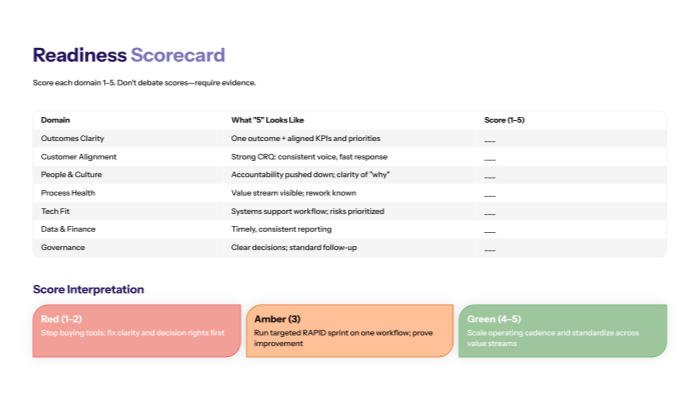
Score each domain 1–5. Don’t debate scores—require evidence.
|
Domain |
What “5” Looks Like |
Evidence |
Score (1–5) |
|---|---|---|---|
|
Outcomes clarity |
One outcome + aligned KPIs and priorities |
Outcome statement + KPI list |
|
|
Customer alignment |
Strong CRQ: consistent voice, fast response, measurable expectations |
CRQ pulse + churn/complaint themes |
|
|
People & culture |
Accountability pushed down; clarity of “why”; low fear |
Pulse + interview notes |
|
|
Process health |
Value stream visible; rework known; cross-team impact considered |
Map + top friction list |
|
|
Tech fit |
Systems support workflow; nonfunctional risks prioritized |
Risk list + easy wins |
|
|
Data & finance |
Timely, consistent financial + ops reporting |
Finance extracts + KPI glossary |
|
|
Governance |
Decisions are clear; follow-up is standard |
Decision inventory + cadence |
This digital transformation assessment scorecard is your baseline. Re-run it every 30–45 days to make progress visible.
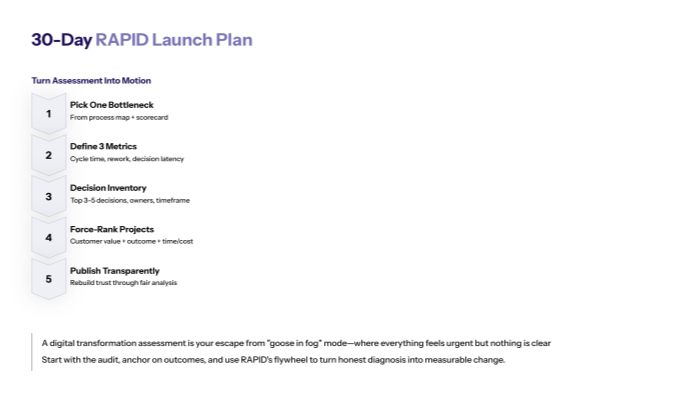
5.2 Convert findings into a 30-day RAPID launch plan
RAPID is a flywheel: Research and Analyze feed Plan, Implement, Decide—and the loop improves with each iteration. The mistake is treating the assessment as a report instead of the start of execution.
30-day plan template
- Pick one bottleneck (from the process map + scorecard)
- Define 3 metrics that matter (cycle time, rework, decision latency) as your operational truth
- Create a decision inventory: top 3–5 decisions required; who makes them; timeframe
- Inventory projects and easy wins and force-rank them (customer value + outcome + time/cost)
- Publish findings transparently to rebuild trust—Davachi notes transparency helps teams relax when they see a fair analysis and nothing filtered.
Red/Amber/Green interpretation
- Red (1–2): stop buying tools; fix clarity and decision rights first
- Amber (3): run a targeted RAPID sprint on one workflow; prove improvement
- Green (4–5): scale the operating cadence and standardize across value streams
Closing thought
A digital transformation assessment is your escape from “goose in fog” mode—the state where everything feels urgent but nothing is clear. Start with the audit, anchor on outcomes, and use RAPID’s flywheel to turn honest diagnosis into measurable change.