Digital Transformation Roadmap: Outcomes First, Tools Second
A digital transformation roadmap is often treated like a portfolio of projects: migrate this system, launch that platform, implement that tool, standardize those workflows.
But roadmaps built that way usually fail for one reason: they optimize activity, not outcomes.
RAPID’s core argument is that transformation succeeds when you build an outcomes-driven system: you research what’s real, analyze what matters, plan around constraints, implement with discipline, and decide based on measurable results. A roadmap in RAPID is not a list of initiatives—it’s a sequence of outcomes, owners, and KPIs that your organization can actually execute.
This post shows how to build a digital transformation roadmap the RAPID way: outcomes first, tools second—so you stop shipping initiatives and start shipping results.

Why most digital transformation roadmaps fail?
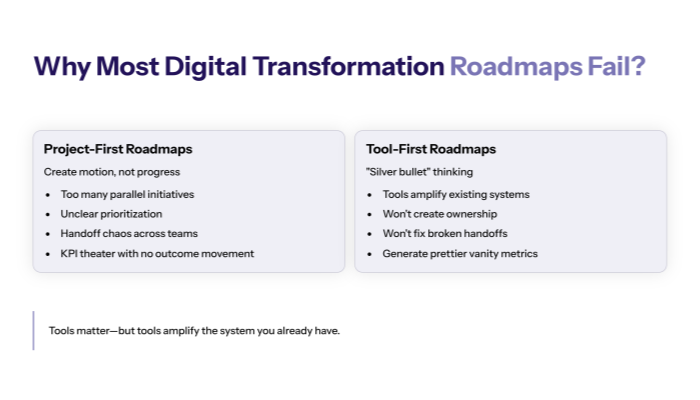
1.1 Project-first roadmaps create motion, not progress
A project-first roadmap looks “organized,” but it hides the real constraint: your operating model.
When a roadmap is a list of projects, it often produces:
- too many parallel initiatives
- unclear prioritization (“everything is important”)
- handoff chaos across teams
- approval chain delays
- KPI theater (“on track” reporting with no outcome movement)
RAPID’s method exists because big, complex problems aren’t solved by one giant initiative—they’re solved by many small steps executed in the right sequence.
A digital transformation roadmap built as a project plan typically ignores bottlenecks and assumes capacity is infinite. It isn’t.
1.2 Tool-first roadmaps are “silver bullet” thinking
RAPID explicitly warns against the “silver bullet platform” mentality: buying or implementing a new system and expecting it to fix structural issues without addressing people, process, and product realities.
Tools matter—but tools amplify the system you already have.
- If decisions are unowned, tools won’t create ownership.
- If handoffs are broken, tools won’t magically fix interfaces.
- If metrics are vanity-driven, tools will generate prettier vanity metrics.
That’s why the RAPID approach to a digital transformation roadmap starts with outcomes, constraints, and decision rights—not vendor selection.
RAPID Plan: What “roadmap” actually means?
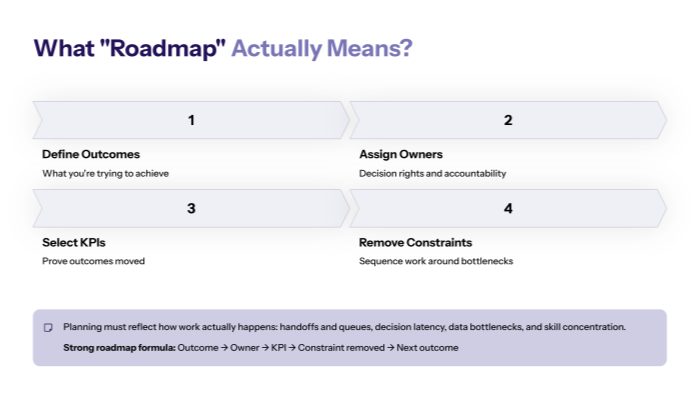
2.1 Plan is where constraints become a sequence of outcomes
RAPID is designed as flywheels: Research/Analyze generates truth and constraints, then Plan/Implement/Decide converts that into execution and measurable progress.
In that system, Plan is not “make a Gantt chart.”
Plan is:
- define the outcomes you’re trying to achieve
- assign owners and decision rights
- select KPIs that prove outcomes moved
- sequence work around the bottleneck
- choose tools only where they remove a proven constraint
A strong digital transformation roadmap is essentially:
Outcome → Owner → KPI → Constraint removed → Next outcome
2.2 Planning must reflect how work actually happens (not the org chart)
RAPID emphasizes that many problems live beneath the surface (the iceberg rule) and that analysis often reveals missing understanding that forces you back into research.
That’s critical for roadmap planning: if the roadmap is built on assumptions instead of reality, it becomes optimistic fiction.
So the roadmap should be grounded in:
- how work flows across teams (handoffs and queues)
- where decisions stall (decision latency)
- which metrics are trusted (data bottleneck)
- where skill is concentrated (people risk)
Then planning becomes constraint removal in the right order—rather than a project list.
How to build an outcomes-first digital transformation roadmap?
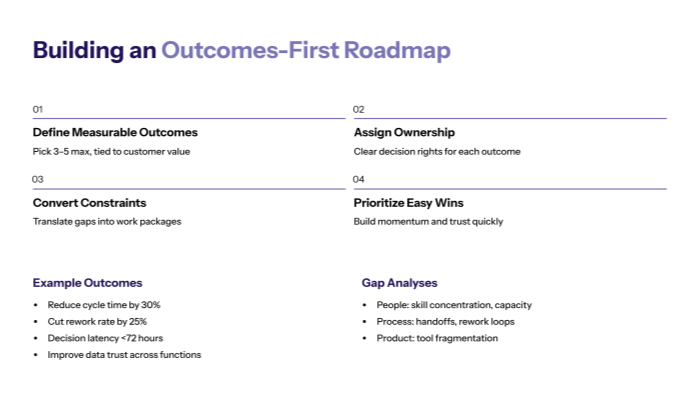
3.1 Define measurable outcomes tied to customer value
RAPID repeatedly anchors execution to customer value and measurable outcomes—because that’s how you remove doubt and fear and avoid vanity narratives.
A practical outcomes-first approach:
Step 1: Pick a narrow set of outcomes (3–5 max)
Examples:
- Reduce end-to-end cycle time by 30%
- Cut rework rate by 25%
- Reduce decision latency for key approvals to <72 hours
- Improve data trust (reconciliation rate) across functions
Step 2: Tie each outcome to customer value
Even if the “customer” is internal, treat the consumer of the outcome as the customer.
RAPID uses this framing explicitly in its inventory tools: processes and products must map to outcomes and customer value, and internal stakeholders are treated like internal customers of reliable information.
Step 3: Assign an owner and decision rights
If nobody owns the outcome, the roadmap becomes a suggestion.
RAPID treats decision-making as central: decisions are required throughout, and if critical decisions never get made, outcomes never happen.
This is where a digital transformation roadmap becomes operational instead of aspirational.
3.2 Convert constraints into roadmap “work packages” (not projects)
Once outcomes are defined, you translate the constraints (from Analyze) into work packages that remove the constraint.
RAPID’s gap analyses are the bridge here:
- People Gap Analysis (skill concentration, capacity gaps)
- Process Gap Analysis (handoffs, rework loops, interface standards)
- Product Gap Analysis (tool fragmentation, missing capabilities)
This is how you keep a digital transformation roadmap clean:
- you don’t “do projects”
- you remove constraints that block outcomes
And you prioritize Easy Wins early to build momentum and trust quickly.
KPIs that prove the roadmap is working
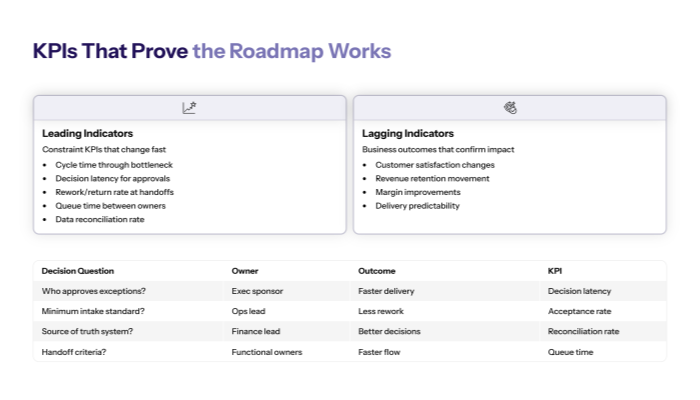
4.1 Kill KPI theater: choose constraint KPIs (leading) + business outcomes (lagging)
RAPID explicitly warns against vanity metrics—selective measurement designed to protect a narrative rather than evaluate reality. And it stresses that if you can’t measure success in tangible ways, you can’t evaluate initiatives, which means you keep funding failure.
So your digital transformation roadmap needs two KPI layers:
Leading indicators (constraint KPIs)
These change fast and tell you if the operating model is improving:
- cycle time through the bottleneck
- decision latency for priority approvals
- rework/return rate at handoffs
- queue time between owners
- data reconciliation/trust rate
Lagging indicators (business outcomes)
These confirm impact:
- customer satisfaction / churn changes
- revenue retention / conversion rate movement
- margin / cost-to-serve improvements
- delivery predictability (on-time outcomes)
The key is that leading indicators should map directly to the constraints you’re removing—so the roadmap is measurable week to week.
4.2 Use Decision Inventory to link KPIs to owned decisions
RAPID’s Decision Inventory frames decisions as questions, assigns owners, links them to outcomes and customer value, and prioritizes them.
That structure is a roadmap superpower: it stops KPI drift.
Example Decision-to-KPI mapping for a digital transformation roadmap:
|
Decision question |
Owner |
Outcome |
KPI (leading) |
|---|---|---|---|
|
Who can approve exceptions within guardrails? |
Exec sponsor |
Faster delivery |
decision latency |
|
What is the minimum intake standard for requests? |
Ops lead |
Less rework |
first-pass acceptance rate |
|
Which system is “source of truth” for weekly reporting? |
Finance lead |
Better decisions |
reconciliation rate + report freshness |
|
What handoff acceptance criteria must be enforced? |
Functional owners |
Faster flow |
queue time at handoff |
If you can’t attach a KPI to a decision, you’re not ready to ship the change.
Tools second: when technology belongs in the roadmap
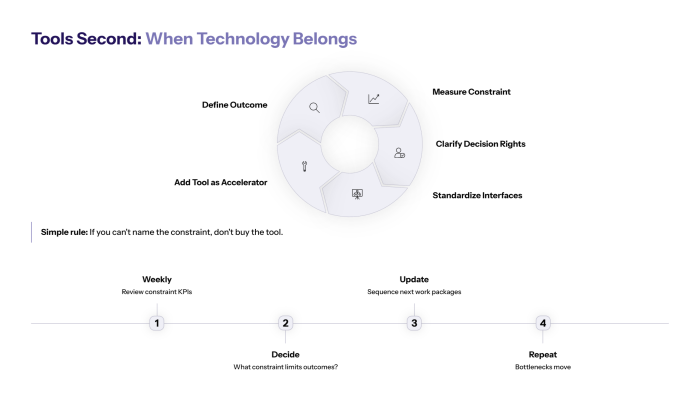
5.1 Add tools only where they remove a proven constraint
A simple rule for a digital transformation roadmap:
If you can’t name the constraint, don’t buy the tool.
RAPID is explicit that technology shouldn’t dictate strategy, and if tech is involved, you should keep it simple.
So tools show up in the roadmap only after:
- the outcome is defined
- the constraint is measured
- the decision rights are clear
- the process interfaces are standardized (where needed)
Then tools become accelerators, not crutches.
5.2 Keep the roadmap alive: measure → decide → adapt
A roadmap is only valuable if it evolves with reality.
RAPID’s Decide logic pushes for honest evaluation: measure results and decide to stay, change, or stop based on what actually happened.
That makes the digital transformation roadmap a living operating system:
- weekly: review constraint KPIs
- decide: what constraint is now limiting outcomes?
- update: sequence the next set of work packages
- repeat: because bottlenecks move
This is also how you prevent leadership from accidentally stopping progress: RAPID warns that if leadership won’t stay out of the way after backing the strategy, they can halt or reverse progress.
Closing takeaway
A digital transformation roadmap should not be a catalog of projects and tools.
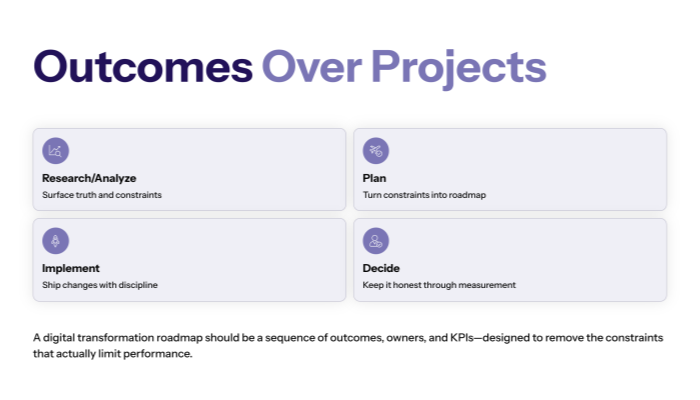
It should be a sequence of outcomes, owners, and KPIs—designed to remove the constraints that actually limit performance.
RAPID provides the system: Research/Analyze surfaces truth, Plan turns constraints into a roadmap, Implement ships changes, and Decide keeps it honest through measurement.