Digital Transformation Strategy Starts With Ownership (Not Software)
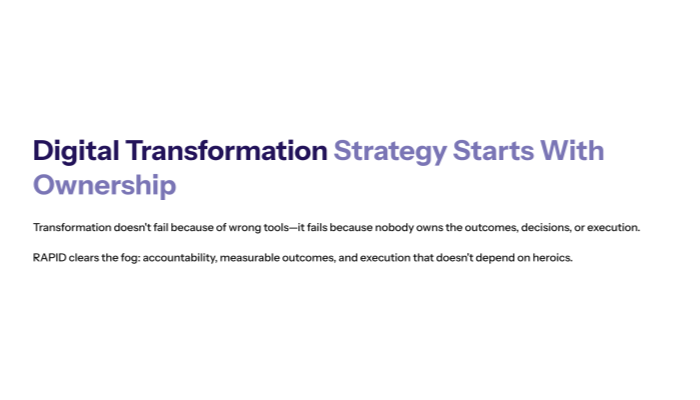
A digital transformation strategy doesn’t fail because the tool was “wrong.” It fails because nobody owns the outcomes, nobody owns the decisions, and the operating model can’t execute without escalation.
RAPID is designed to “clear up the fog,” drive accountability, and align actions around measurable outcomes—not vanity narratives. And when technology is involved, RAPID is blunt: keep it simple—IT should support business strategy, not dictate it.
This guide shows how to build a digital transformation strategy that starts with ownership: clear outcomes, clear decision rights, and an execution cadence that doesn’t depend on heroics.

Why Tools Don’t Fix Broken Operating Models?
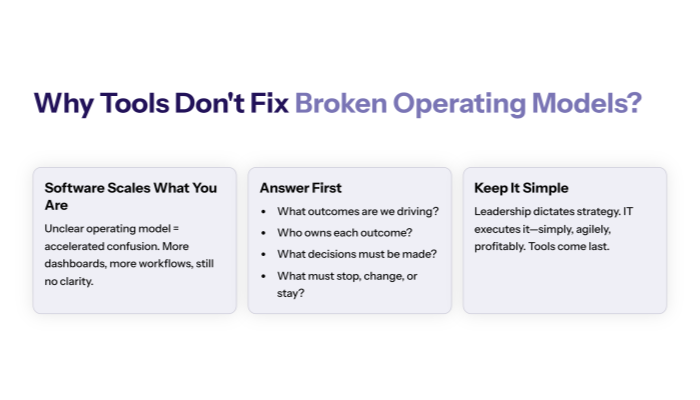
1.1 Software scales what you already are
If the operating model is unclear, software accelerates confusion: more dashboards, more statuses, more workflows—still no clarity. RAPID’s first job is to break teams out of their “bubble,” force honest assessment, and anchor everything to measurable outcomes rather than vanity metrics.
A practical digital transformation strategy starts by answering:
- What outcomes are we driving?
- Who owns each outcome?
- What decisions must be made to reach it?
- What must stop, change, or stay once implementation begins?
Without those answers, software becomes a distraction.
1.2 “Keep it simple” is a strategy, not a slogan
RAPID warns against the “tail wagging the dog” dynamic—where the company exists to support technology instead of the reverse. Leadership should dictate strategy; IT should execute it simply, agilely, and profitably.
So before selecting platforms, your digital transformation strategy should define:
- The operating constraints (risk, compliance, capacity)
- The minimum viable data needed to run the system
- The ownership model (who decides, who executes, who is accountable)
Tools come last because tools don’t create ownership—people and governance do.
Ownership Is the Real Starting Line of Strategy
2.1 Accountability is the outcome of clarity
RAPID explicitly frames “drive accountability” as part of the reset a struggling company needs. But accountability isn’t something you demand—it’s something you enable by making the system clear enough that people can own it.
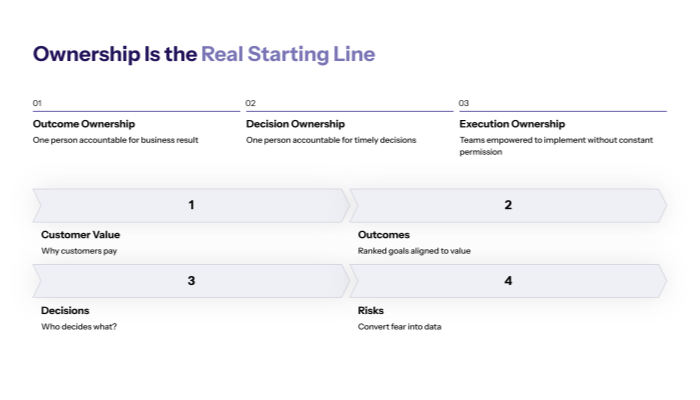
In any digital transformation strategy, ownership means:
- Outcome ownership: one person is accountable for the business result
- Decision ownership: one person is accountable for the decision being made on time
- Execution ownership: teams are empowered to implement without constant permission
RAPID’s emphasis on clear-eyed outcomes is central here: “desired outcomes are the current that powers everything.” If outcomes are unclear, ownership becomes political instead of operational.
2.2 The fastest ownership audit: “Who owns what?”
Use RAPID’s tool structure to surface ownership gaps. The appendix lists the inventories that matter early: Customer Value, Outcomes, Decision Inventory, Risks (Fears), Process Inventory, Product Inventory, and Financial Research.
A quick ownership audit for your digital transformation strategy:
- Customer Value Inventory — why customers pay (what must be protected)
- Outcomes — ranked goals aligned to customer value
- Decision Inventory — decisions that drive outcomes (who decides?)
- Risks/Fears Inventory — convert fear into data and remove emotion
If you can’t name owners for each of these artifacts, your strategy is not executable yet.
Decision Rights Turn Strategy Into Motion
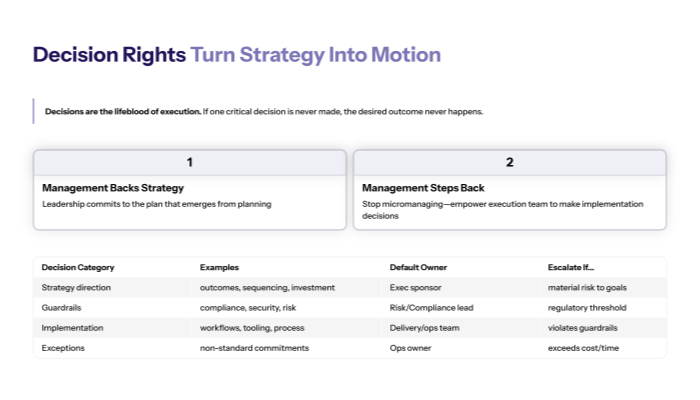
3.1 Decisions are the “lifeblood” of execution
RAPID calls out a truth most companies avoid: the Decide phase happens throughout the process, because decisions create momentum. If one critical decision is never made, the desired outcome never happens.
This matters because a digital transformation strategy is basically a decision system:
- What gets prioritized?
- What risks are accepted?
- What gets standardized?
- What stops?
If the organization can’t decide quickly and clearly, strategy turns into status meetings.
3.2 The two management decisions that make or break transformation
RAPID highlights two key decisions:
- Management decides to back the strategy that emerges from planning.
- Management decides to no longer decide—i.e., stop micromanaging implementation and empower the execution team to make implementation decisions close to the ground.
This is the heart of ownership. If leadership won’t delegate implementation decisions, decision latency explodes and the CEO can sabotage progress—even unintentionally. RAPID’s language is direct: after strategy/capital/hiring, leadership should “get out of the way” and support the team’s work.
A strong digital transformation strategy formalizes these decisions as operating rules, not personality-based exceptions.
Decision Rights Snapshot (drop-in template)
|
Decision category |
Typical examples |
Default owner |
Escalate only if… |
|---|---|---|---|
|
Strategy direction |
outcomes, sequencing, investment |
Exec sponsor |
material risk to business goals |
|
Guardrails |
compliance, security, risk tolerance |
Risk/Compliance lead |
regulatory or safety threshold |
|
Implementation |
workflows, tooling config, process changes |
Delivery/ops team |
violates guardrails |
|
Exceptions |
non-standard customer commitments |
Ops owner |
exceeds cost/time threshold |
Build the Ownership System (Not a Slide Deck)
4.1 Use RAPID inventories to assign owners, not just capture data
RAPID’s inventories are designed to produce actionable data tied to customer value and outcomes—not documentation theater.
Here’s how to turn them into an ownership system inside your digital transformation strategy:
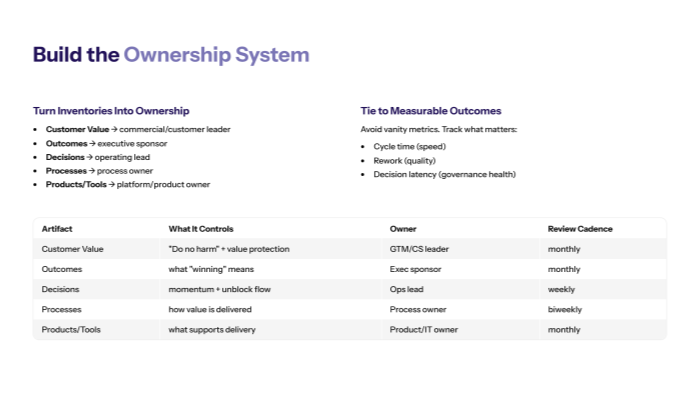
- Customer Value → owner: commercial/customer leader
- Outcomes → owner: executive sponsor (single accountable owner per outcome)
- Decision Inventory → owner: operating lead (ensures decisions are made)
- Process Inventory → owner: process owner (cross-functional, not “one department”)
- Product Inventory → owner: platform/product owner (internal or external)
Ownership Map (simple and effective)
|
Artifact |
What it controls |
Owner |
Review cadence |
|---|---|---|---|
|
Customer Value |
“Do no harm” + value protection |
GTM/CS leader |
monthly |
|
Outcomes |
what “winning” means |
Exec sponsor |
monthly |
|
Decisions |
momentum + unblock flow |
Ops lead |
weekly |
|
Processes |
how value is delivered |
Process owner |
biweekly |
|
Products/Tools |
what supports delivery |
Product/IT owner |
monthly |
This makes your digital transformation strategy something people can run—not something they “read.”
4.2 Tie ownership to measurable outcomes (avoid vanity drift)
RAPID explicitly warns about vanity metrics—facts chosen to protect a narrative when reality changes. Your ownership model must therefore include:
- outcome metrics (what changes in the business)
- operating metrics (what changes in execution)
At minimum:
- cycle time (speed)
- rework (quality)
- decision latency (governance health)
When these improve, ownership is functioning. When they worsen, your digital transformation strategy is signaling: decisions aren’t being made, guardrails aren’t clear, or work is not aligned to outcomes.
The 30-Day Ownership-First Transformation Plan
5.1 Week-by-week: establish baseline, then empower execution
RAPID is designed as two flywheels: Research/Analyze, then Plan/Implement/Decide—constantly iterating based on feedback. Your digital transformation strategy should mirror that cadence:
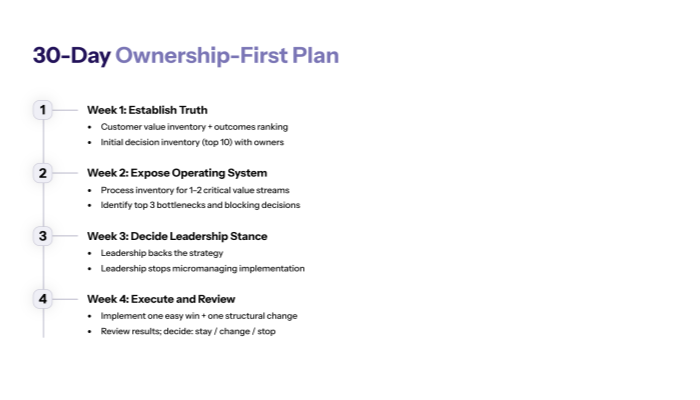
Week 1: Establish truth (audit)
- Customer value inventory + outcomes ranking
- Initial decision inventory (top 10) with owners
Week 2: Expose the operating system
- Process inventory for 1–2 critical value streams
- Identify top 3 bottlenecks and top 3 decisions blocking flow
Week 3: Decide leadership stance
- Decision #1: leadership backs the strategy
- Decision #2: leadership stops micromanaging implementation (“no longer decide”)
Week 4: Execute and review
- Implement one “easy win” and one structural change (decision SLA, intake standard, removal of redundant approval)
- Review results; decide: stay / change / stop
This is how a digital transformation strategy becomes an operating rhythm, not a one-time initiative.
5.2 The ownership checklist (executive-ready)
Use this to validate your digital transformation strategy is ownership-first:
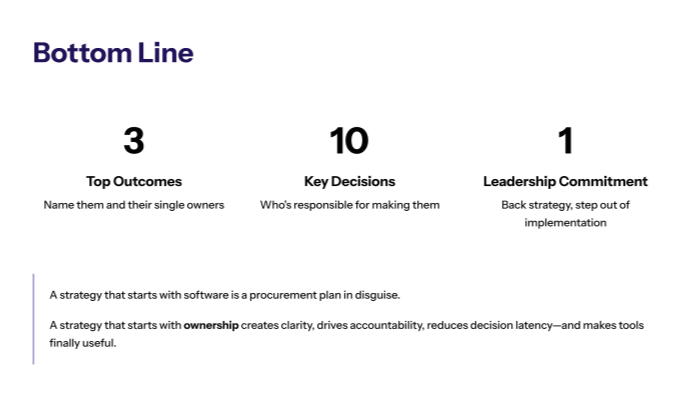
- We can name the top 3 outcomes and the single owner for each.
- We can name the top 10 decisions and who is responsible for making them.
- Leadership has committed to backing strategy and stepping out of implementation decisions.
- Processes and products/tools are mapped to customer value and outcomes.
- We review execution with feedback and adapt (RAPID is fluid, iterative, flywheel-driven).
Bottom line
A digital transformation strategy that starts with software is usually a procurement plan wearing a strategy costume.
A digital transformation strategy that starts with ownership creates clarity, drives accountability, reduces decision latency, and makes tools finally useful—because now they serve an operating model that can actually execute.