Ecommerce Software Development Services: Complete Guide for Custom Commerce Platforms
Ecommerce software development services are specialized engineering services that design, build, integrate, modernize, and maintain tailored commerce platforms for an ecommerce business. Unlike a generic ecommerce website builder, theme-based WordPress site, or template storefront, these services create a custom ecommerce solution around specific business processes, customer data, operational constraints, compliance needs, and growth goals.
The scope includes custom platform development, custom ecommerce website development, enterprise system integrations, legacy modernization, data migration, performance optimization, security hardening, and ongoing engineering support. This guide is written for enterprise teams, CTOs, platform owners, retail business leaders, and mid-market organizations evaluating custom ecommerce software development, digital commerce platforms, or an ecommerce software development company for long-term engineering partnership.
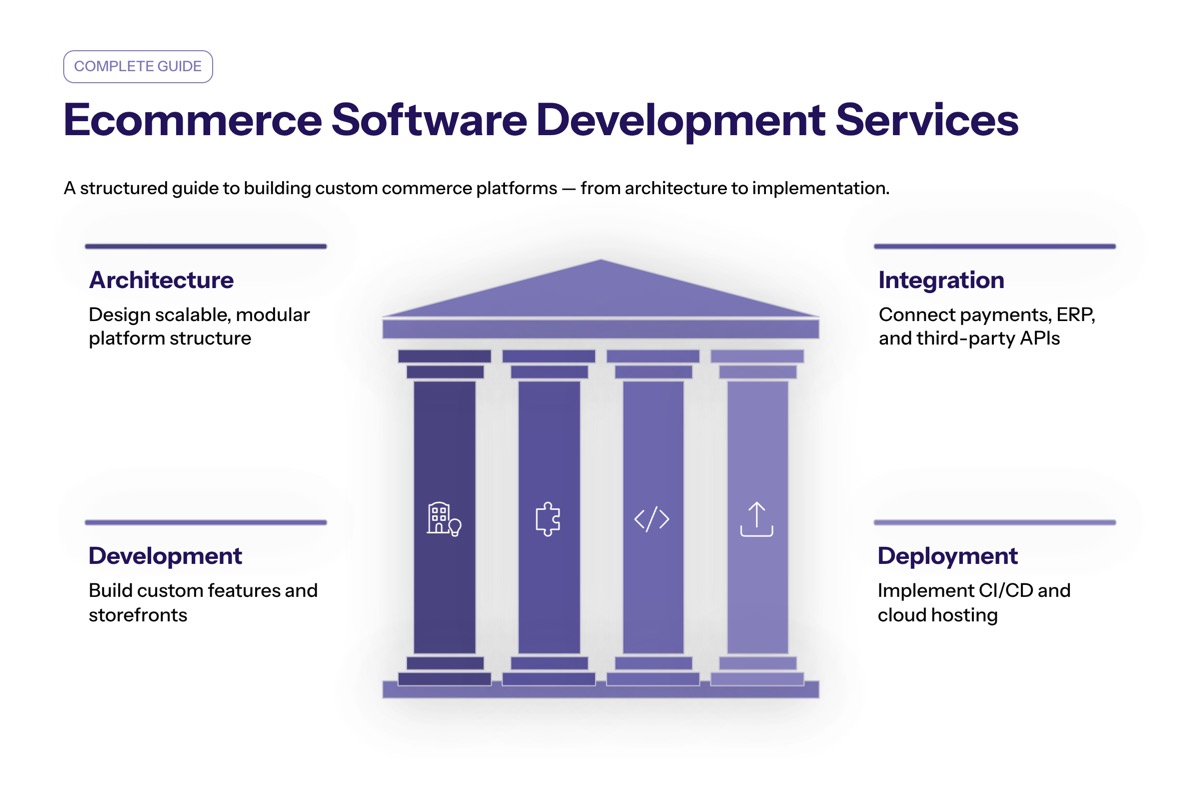
Professional ecommerce software development services design, build, and maintain tailored ecommerce platforms with custom workflows, secure integrations, scalable architecture, and governance controls. The goal is not just to launch an ecommerce site; it is to create a full ecommerce solution that supports customer experience, order processing, inventory management, payment systems, marketing teams, and back-office operations at scale.
Key outcomes include:
Reduced operational friction through automation and connected business systems
Measurable ROI from custom automation, improved conversion rates, and better inventory levels
Secure, compliance-ready ecommerce software with data security, PCI-DSS controls, SSL encryption, and auditability
Scalable, business-aligned architecture that handles increased traffic, seasonal spikes, mobile devices, and product catalog growth
Integrated workflow optimization across ERP, CRM, PIM, logistics software, accounting software, payment gateways, analytics tools, and third party integrations
Large enterprises accounted for about 58.4% of ecommerce development services revenue in 2025, and enterprise-scale builds often cost from $500,000 to several million USD excluding maintenance and support. Midmarket ecommerce platform builds often range from $50,000 to $250,000, while the broader U.S. custom software development market was valued at USD 9.08 billion in 2023 and is projected to grow at approximately 18.5% CAGR from 2024 to 2030.
Understanding Ecommerce Software Development Services
Ecommerce software development services combine business requirements analysis, software development, architecture planning, custom ecommerce development, system integration, testing, deployment, and ongoing platform optimization. The work starts with business needs and business goals, then translates those needs into an ecommerce platform that can support real operating conditions rather than forcing teams into preset basic features.
This matters most for organizations with complex operating environments: legacy systems, multiple sales channels, B2B workflows, regional compliance rules, high SKU volume, specialized payment options, custom pricing, approval workflows, or fragmented customer records. Conducting thorough market research helps define the target audience and identify competitors before starting development in eCommerce, because the right platform architecture depends on the business model, customer segments, sales trends, and operational reality.
Custom functionality in eCommerce platforms must be tailored to specific business logic and operational needs rather than relying on generic templates. Custom eCommerce development allows businesses to create unique platforms tailored to their specific needs, which can include features like personalized user experiences and specific integrations with existing business systems.
Custom Platform Development
Custom platform development means building tailored ecommerce platforms from business-specific requirements instead of adapting an online store to the constraints of a preset ecommerce website builder or even the best ecommerce website builder for simpler use cases. A custom ecommerce platform may include unique product configuration, contract pricing, multi-brand storefronts, customer-specific catalogs, custom dashboards, subscription logic, marketplace connectivity, complex tax rules, advanced search engine optimization, or differentiated content management systems.
Custom eCommerce solutions allow for unique branding and tailored features that align closely with specific business needs, while off-the-shelf platforms often come with predefined functionalities that may not fully meet unique requirements. For companies with a unique brand identity, custom ecommerce websites can support differentiated ecommerce experience across desktop, mobile devices, social media platforms, and regional storefronts while still preserving centralized governance.
Custom development connects directly to the main purpose of ecommerce software development: workflow-specific automation and reduced tool sprawl. Instead of manually reconciling sales data between an ecommerce store, inventory management systems, accounting software, and crm solutions, the development team can design custom solutions that automate handoffs and improve operational efficiency.
Scalable eCommerce software must handle increased traffic and product expansion without needing a complete rebuild. The architecture of eCommerce software should handle seasonal spikes in traffic and scale with product catalog growth. Custom eCommerce platforms can be designed to scale according to business growth, allowing for the addition of new features and integrations as needed, whereas off-the-shelf solutions may limit scalability due to their fixed nature.
Enterprise Integration Services
Enterprise integration services connect an ecommerce platform with existing business systems such as ERP, CRM, PIM, warehouse management, logistics software, payment providers, accounting software, analytics tools, and inventory management systems. End-to-end integration between your ecommerce platform and business systems enhances data visibility and operational efficiency, allowing for a seamless flow of information across various departments.
Integrating ecommerce platforms with Customer Relationship Management (CRM) systems provides a holistic view of customer data, which can optimize inventory levels and inform marketing strategies. The integration of ecommerce systems with Enterprise Resource Planning (ERP) solutions automates data sharing, minimizes management efforts, and streamlines order processing across multiple sales channels.
Logistics software integration with ecommerce platforms allows businesses to manage shipping and fulfillment from a single location, improving inventory tracking and customer order visibility. Product Information Management (PIM) systems are crucial for businesses with a high volume of SKUs, as they centralize product data and ensure consistency across all sales channels.
These integrations turn custom ecommerce software development into a business visibility layer. They allow sales, operations, finance, support, and marketing teams to work from synchronized data rather than disconnected spreadsheets or manual exports. The development partner for eCommerce should have experience integrating with APIs for ERPs, CRMs, and inventory software, because seamless third party integrations are often the difference between a storefront and an operating platform.
The next step is understanding which service categories matter most for implementation planning: AI-first automation, legacy modernization, and industry-specific development.
Core Ecommerce Software Development Service Categories
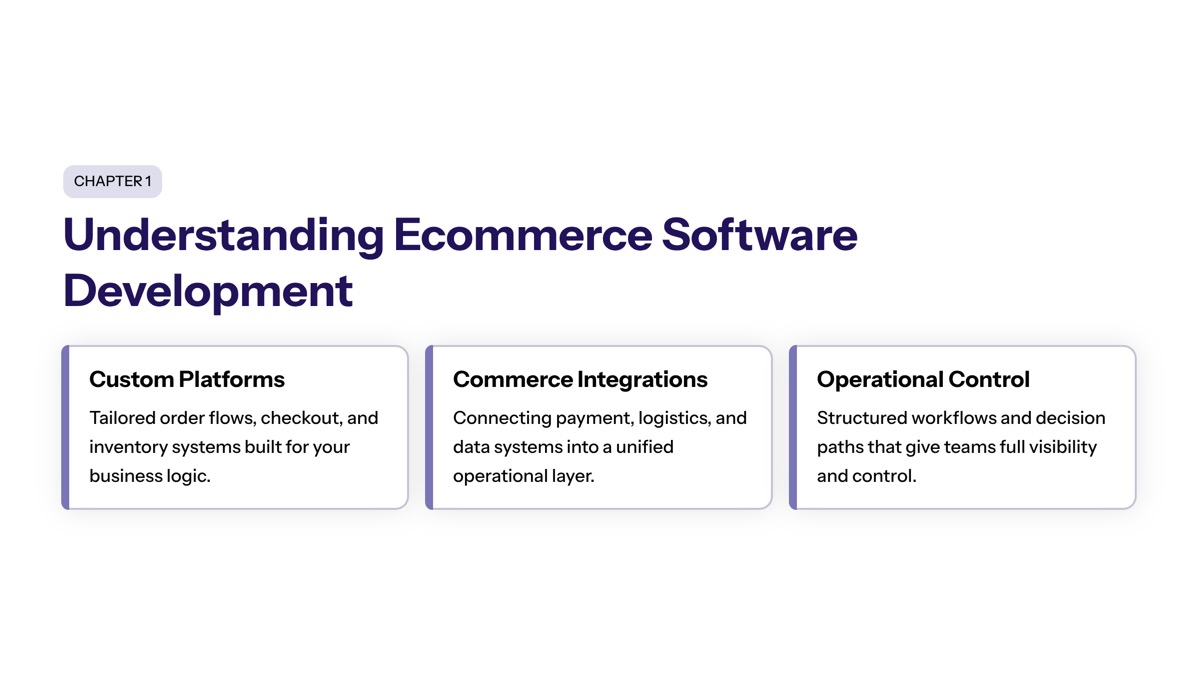
Once the platform concept and integration layer are clear, ecommerce development work typically falls into specific service categories. Each category addresses a different business need: increasing sales, reducing manual work, improving customer satisfaction, protecting customer data, modernizing legacy architecture, or building industry-specific compliance controls.
AI-First Architecture and Automation Services
AI-first ecommerce software development services build intelligence into the ecommerce solution instead of adding generic AI features after launch. These services can include AI-driven product recommendations, automated inventory management, predictive analytics, intelligent customer segmentation, virtual assistants, product descriptions generated at scale, content localization, pricing optimization, and in depth data analysis of user behavior.
AI and machine learning can streamline eCommerce operations by enabling predictive analytics, personalized recommendations, and workflow automation, which collectively enhance operational efficiency and customer satisfaction. Leading retail giants, including Walmart, eBay, Amazon, and Target, have adopted generative AI to improve product search, power shopping AI agents, and generate product information at scale, showcasing the transformative impact of AI on eCommerce operations.
For example, a conversational AI shopping assistant integrated with Shopify, real-time inventory, and payments delivered a 28% boost in conversion, a 35% reduction in cart abandonment within 90 days, more than 50,000 monthly conversations, and average order value growth from $128 to about $180. CN2U.AI used Google Cloud Vertex AI for cross-border ecommerce discovery and recommendations, reducing search query latency by more than 50%, improving recommendation accuracy by more than 10%, and increasing CTR by 15%.
Over 73% of customers consider experience as a crucial factor in their purchasing decisions, highlighting the importance of advanced technologies in enhancing customer experience in eCommerce. Hyper-personalization, driven by data and analytics, is essential for high customer satisfaction, with over 70% of customers expecting personalized shopping experiences. By 2030, the global immersive tech market, which includes AR and VR, is projected to grow from $40.64 billion in 2024 to $177.5 billion by 2031, indicating a significant opportunity for eCommerce to enhance customer engagement through immersive experiences.
Legacy System Modernization Services
Legacy system modernization services assess and improve existing ecommerce websites, monolithic commerce systems, custom legacy applications, and disconnected back-office tools without creating operational risk or data loss. Many organizations want to sell online across more channels, introduce AI, improve mobile performance, or add payment options, but their existing ecommerce software cannot support those goals without brittle workarounds.
Modernization strategies include replatforming, refactoring, rebuilding from scratch, and gradually replacing legacy functions with API-first services. Replatforming may move a company from an older bespoke platform to Adobe Commerce, SAP Commerce, BigCommerce, Shopify enterprise, Broadleaf Commerce, or a custom ecommerce architecture. Refactoring preserves useful business logic while improving code quality, security, scalability, and integration flexibility.
Modernization must maintain business continuity. Practical methods include migration scripts, data freeze windows, dual-running systems, dark launches, feature flags, backward-compatible APIs, and phased replacement through the strangler pattern. The development process for custom eCommerce solutions typically involves several stages, including identifying business requirements, designing user interfaces, implementing functionality, testing for quality, and executing deployment.
The initial investment for custom eCommerce development is typically higher than that of off-the-shelf solutions, but custom solutions can lead to lower long-term costs due to reduced licensing fees and better alignment with business processes. While custom eCommerce solutions offer greater flexibility and control over features and integrations, they also require ongoing maintenance and a dedicated development team, which can be a challenge for some businesses.
Industry-Specific Development Services
Industry-specific development services adapt custom ecommerce development to compliance, workflow, data, and integration needs in specialized markets. Healthcare ecommerce platforms may require HIPAA-compliant architecture, secure patient data handling, encryption at rest and in transit, granular role-based access control, full audit trails, breach response planning, and vendor governance.
Financial services, banking, and fintech commerce platforms require enhanced data security, audit trails, fraud controls, secure payment workflows, and regulatory compliance features. Payment systems in eCommerce must meet strict PCI-DSS compliance standards for safety. Robust security and compliance in eCommerce ensures adherence to industry standards like PCI-DSS and protects customer data.
B2B manufacturing and logistics platforms often need complex pricing, customer tiers, volume discounts, quote workflows, purchase orders, approval workflows, multi-step fulfillment, returns logic, warehouse integration, supply chain visibility, and ERP/WMS/PIM connectivity. Cross-border and multi-market retail may require language localization, currency rules, VAT and tax handling, data residency controls, marketplace connections, and custom dashboards for regional performance.
The global immersive technology market, which includes AR and VR, is projected to grow from $40.64 billion in 2024 to $177.5 billion by 2031, indicating a significant opportunity for enhancing customer engagement in eCommerce. For regulated and complex industries, the key point is simple: industry-specific requirements often make generic templates, social media templates, and basic storefront tools insufficient. Custom ecommerce solutions can enhance operational efficiency by integrating with existing business systems such as CRM, ERP, and logistics software, allowing for seamless data flow and improved customer experiences.
These service categories lead directly into implementation methodology, because the right development process depends on risk, compliance, integration depth, and time-to-value.
Implementation Approaches and Technical Architecture
Choosing ecommerce software development services involves more than selecting a platform name. Choosing the right eCommerce software development services involves focusing on security, scalability, and strategic planning. Teams must decide how much to build, what to buy, which systems to integrate, how to protect customer data, and how to deliver business value without delaying launch indefinitely.
RAPID Framework Implementation Process
A structured framework reduces delivery risk when teams are dealing with complex integrations, custom ecommerce websites, regulated data, seasonal demand, or legacy constraints. The RAPID implementation process organizes ecommerce development into measurable steps that connect business goals with technical delivery.
Requirements assessment and business constraint identification
Identify workflow bottlenecks, target customer segments, competitors, market positioning, seasonal load expectations, product catalog complexity, compliance constraints, data migration needs, and integration dependencies. This stage defines core features, key features, business rules, and measurable ROI targets before the development team writes production code.Architecture planning with security and scalability considerations
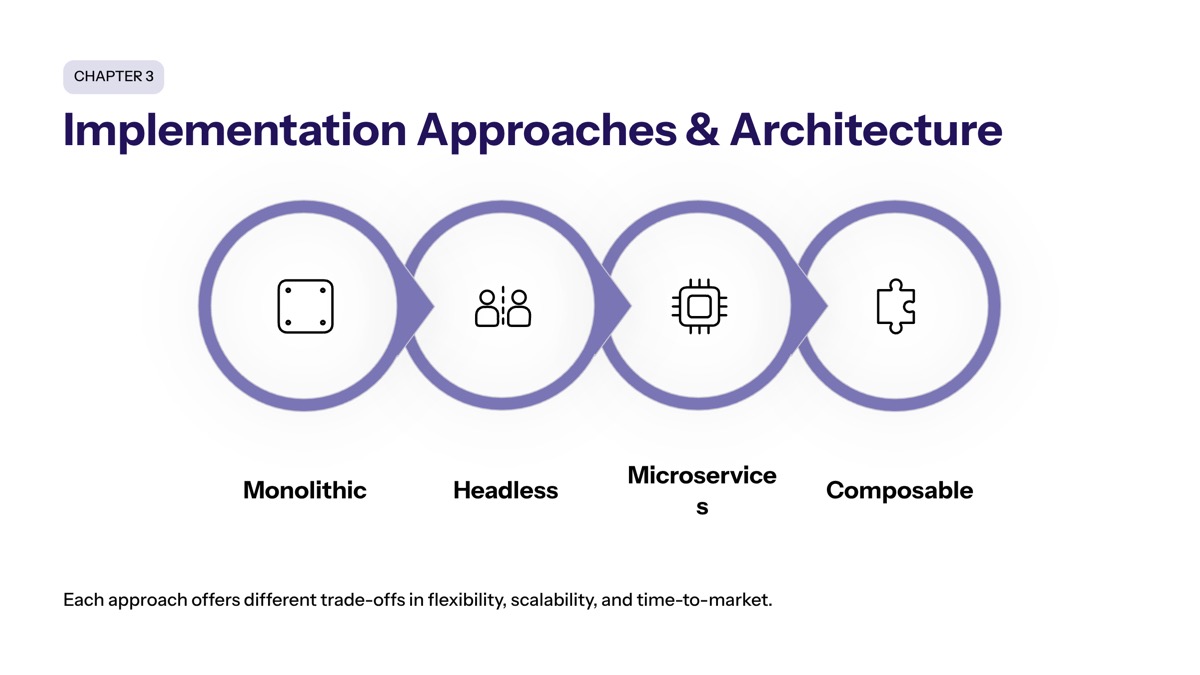
Decide whether the ecommerce platform should be custom, headless, composable, monolithic, hybrid, or based on major platforms such as Adobe Commerce or SAP Commerce. Plan API-first architecture, database design, customer records, payment gateways, payment systems, analytics tools, search engine optimization requirements, cloud infrastructure, observability, and scalability for traffic spikes.Phased development with measurable milestone delivery
Deliver high-value capabilities first, such as catalog, search, checkout, order processing, inventory management, and customer account workflows. Phased delivery helps teams validate conversion rates, cart abandonment, average order value, sales data, sales trends, and customer experience before expanding into AI, marketplaces, or advanced integrations.Integration testing and business workflow validation
Test ERP, CRM, PIM, logistics software, payment providers, accounting software, content management systems, and third party integrations across real business processes. Validation should cover promotions, tax, returns, fulfillment, customer service visibility, inventory levels, authorization rules, and end-to-end operational efficiency.Deployment with governance controls and performance monitoring
Launch with feature flags, rollback plans, logging, tracing, alerting, code reviews, change control, and security monitoring. Developers must implement multi-layer security including SSL encryption to safeguard eCommerce transactions. Security features like encryption, secure logins, and two-factor authentication are essential to protect data and build customer trust in eCommerce platforms. Robust SSL certificates and encryption protocols are critical for protecting user data in eCommerce.
Platform Architecture Comparison
Architecture Type | Customization Level | Integration Flexibility | Long-term TCO |
|---|---|---|---|
Custom Development | Unlimited workflow alignment for a custom ecommerce platform, custom domain strategy, unique brand identity, tailored UX, and specialized business logic | Full API and system control across ERP, CRM, PIM, payment gateways, inventory management systems, logistics software, and analytics tools | Lower ongoing fees and fewer transaction fees, but higher upfront investment, hosting, support, maintenance, and dedicated team requirements |
SaaS Platforms | Template-based modifications, social media templates, basic features, and vendor-defined limits that may work well for small businesses or simpler online business models | Pre-built connector limitations; third party integrations may be fast but constrained by platform boundaries | Monthly costs, transaction fees, app fees, and predictable support, but possible lock-in and limited control |
Hybrid Solutions | Selective custom modules around a SaaS, open-source, or enterprise commerce core for differentiated workflows | Mixed integration approaches using vendor APIs, custom services, middleware, and data synchronization layers | Balanced cost structure with some platform fees, some custom development, and moderate maintenance overhead |
Custom development fits organizations with strict compliance requirements, high integration complexity, differentiated customer experience, or unique operational workflows. SaaS platforms fit teams that need speed, standard ecommerce experience, predictable monthly costs, and enough built-in functionality to sell online quickly. Hybrid solutions fit teams that want to use proven platform capabilities while still building custom modules around competitive differentiators.
This architecture decision also affects common implementation challenges: speed, compliance, legacy integration, and total cost of ownership.
Common Implementation Challenges and Solutions
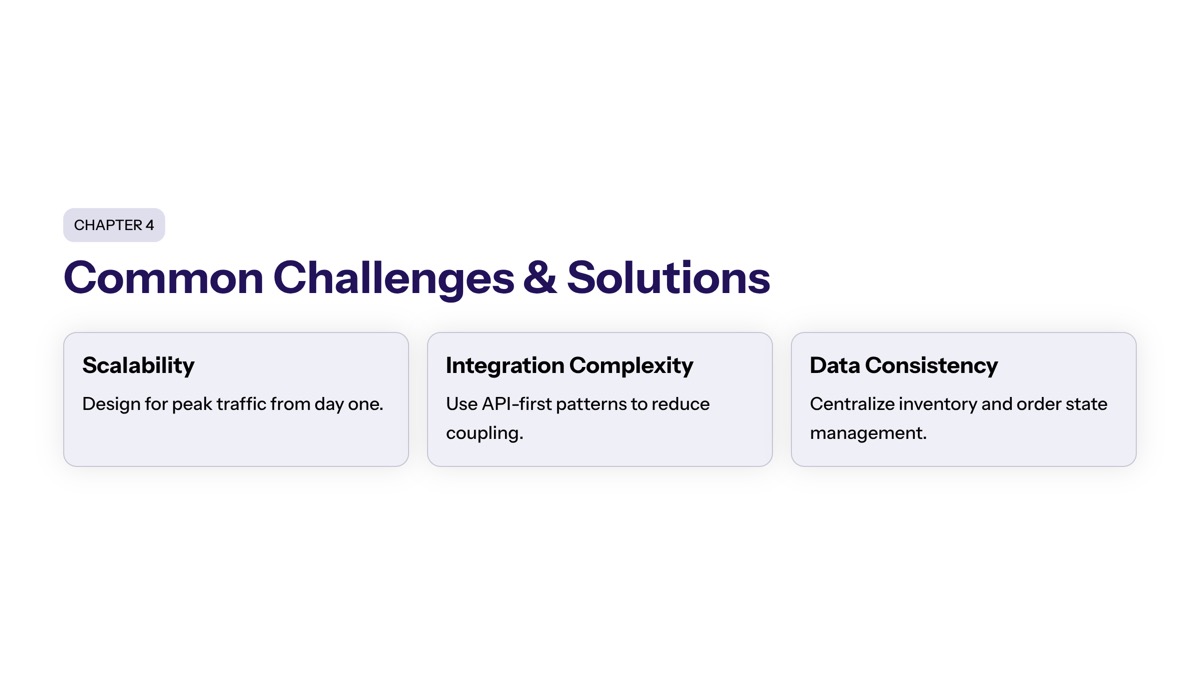
Teams evaluating ecommerce software development services often face the same core risks: building too much too slowly, underestimating integration complexity, overlooking security, or miscalculating long-term operating cost. The right development services should address these risks during planning rather than after launch.
Balancing Customization with Time-to-Market
Custom ecommerce software can deliver better alignment, but excessive scope can delay launch and reduce ROI. The solution is a phased delivery approach that focuses on high-ROI features first, such as product catalog, checkout, payment options, inventory visibility, order processing, and the workflows that most directly increase sales or reduce manual work.
Modular architecture supports future expansion without blocking the first release. Teams can launch a core ecommerce store, validate customer behavior, then add personalization, virtual assistants, advanced search, loyalty features, marketplace integrations, or immersive experiences based on measured user behavior and business value.
Ensuring Security and Compliance in Custom Platforms
Security must be designed into the platform from the start, not bolted on before release. Payment systems in eCommerce must meet strict PCI-DSS compliance standards for safety, and platforms that process sensitive healthcare, financial, or personal information require additional controls for auditability, privacy, data retention, and breach response.
The solution is a security-first architecture with secure SDLC practices, regular compliance audits, encryption, secure logins, two-factor authentication, robust SSL certificates, access controls, logging, vulnerability scanning, penetration testing, and industry-specific governance controls. Robust security and compliance in eCommerce ensures adherence to industry standards like PCI-DSS and protects customer data.
Managing Integration Complexity with Legacy Systems
Legacy systems often contain critical business logic but lack modern APIs, consistent documentation, or clean data structures. This creates risk during data migration, order processing, inventory synchronization, and customer records consolidation.
The solution is API-first architecture with gradual legacy system replacement and data migration strategies that maintain business continuity. Teams can wrap legacy functions in APIs, build middleware, use event-driven synchronization, validate mappings through test migrations, and replace modules one at a time rather than forcing a risky big-bang cutover.
Controlling Total Cost of Ownership
Total cost of ownership includes upfront investment, hosting, licensing, monthly costs, transaction fees, support, monitoring, upgrades, security patches, integrations, and the engineering capacity required for ongoing maintenance. Custom solutions may cost more at the start, but they can lower long-term cost when they reduce platform fees, eliminate manual work, improve operational efficiency, and align better with business processes.
The solution is to model business value before build decisions are finalized. Teams should compare expected revenue lift, cost savings, conversion rates, customer loyalty, support workload, infrastructure cost, and integration maintenance across custom, SaaS, and hybrid options. Automating maintenance tasks, documenting architecture, and building scalable systems reduces long-term operational cost.
Strategic planning and partner selection matter because ecommerce software is not just a launch project; it becomes operating infrastructure for the business.
Conclusion and Next Steps
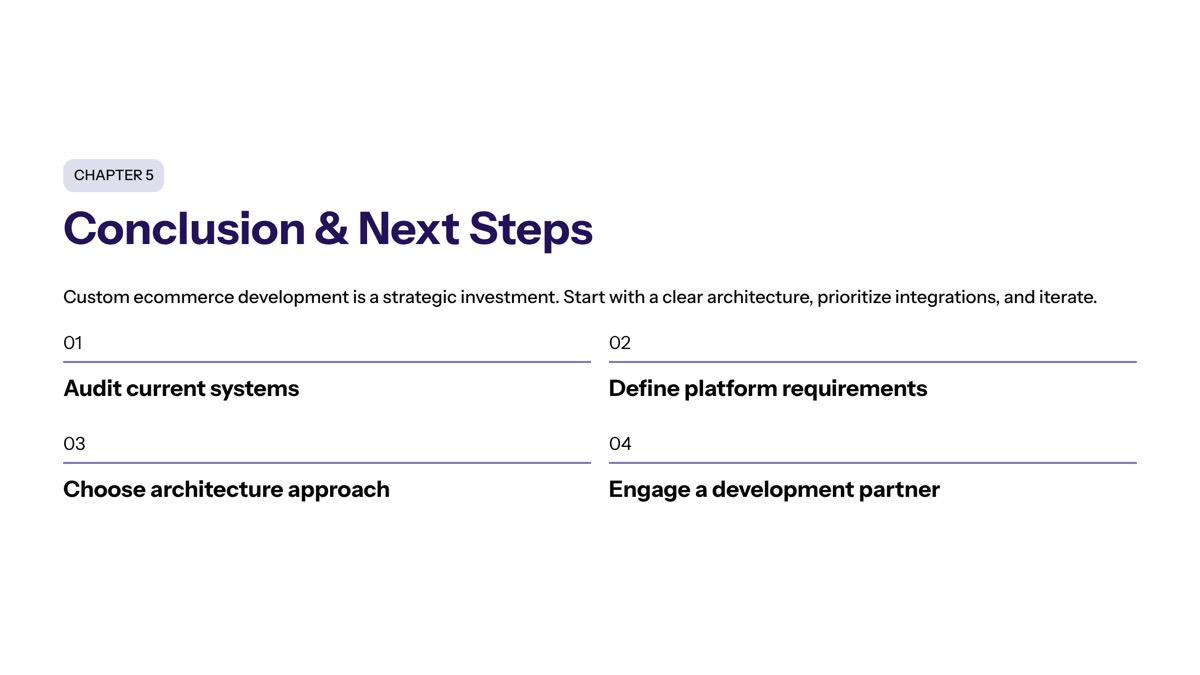
Ecommerce software development services help organizations move beyond generic storefront design and build custom commerce platforms that support business-aligned workflows, secure integrations, operational efficiency, customer satisfaction, and scalable growth. For enterprise and mid-market teams, the value of custom ecommerce software development is strongest when the platform must connect complex systems, enforce compliance, personalize customer experiences, and support long-term digital commerce strategy.
Next steps:
Assess current system constraints and business requirements
Document pain points across your ecommerce site, ERP, CRM, PIM, logistics software, payment systems, inventory management, customer records, marketing tools, and reporting workflows.Evaluate potential development partners with industry expertise
Look for an ecommerce software development company with experience in APIs, security, scalability, data migration, enterprise integrations, custom ecommerce websites, and industry-specific compliance.Plan a phased implementation approach with measurable ROI targets
Prioritize core features, integration milestones, customer experience improvements, operational efficiency gains, conversion rates, and long-term TCO before expanding into AI, immersive experiences, or advanced automation.
Related topics worth exploring include AI-first architecture planning, legacy system assessment, secure modernization roadmaps, composable commerce, headless ecommerce, and compliance-driven platform design for enterprise teams.
Additional Resources
Explore Cognativ’s ecommerce industry expertise for guidance on custom commerce software, digital commerce platforms, and engineering support.
Review Cognativ’s RAPID framework implementation guides for structured planning, phased delivery, integration validation, and governance.
Reference compliance requirements for healthcare, financial services, and B2B ecommerce, including HIPAA, PCI-DSS, data security, audit trails, secure payment systems, and customer data protection.
Use ROI and TCO calculators to compare custom development, SaaS platforms, and hybrid ecommerce solutions across upfront investment, monthly costs, transaction fees, maintenance, conversion impact, and operational efficiency.