Education Software Development Services: A Complete Guide for Educational Leaders
Education software development services help educational institutions build custom digital platforms that match how they teach, manage students, protect data, and scale programs. For schools, universities, training providers, and corporate learning teams, these services are most valuable when standard tools cannot support required workflows, integrations, compliance rules, or personalized learning experiences.
This guide focuses on custom LMS development, student information systems, learning portals, assessment platforms, and secure student-data systems. It does not compare generic off-the-shelf tools in depth; instead, it explains when custom software development is the better route for institutions that need tailored solutions, seamless integration with existing systems, and long-term platform ownership.
Education leaders, IT directors, administrators, CIOs, deans, and digital transformation teams can use this article to evaluate educational software development services, define technical priorities, and choose the right development partner. Education software development services create custom digital platforms that align with institutional workflows, compliance requirements, and student data security standards.
You will learn how to:
Identify where custom education software development creates value over licensed platforms.
Evaluate learning management systems, student information systems, portals, and secure data platforms.
Plan for AI, analytics, accessibility, mobile access, and interoperability.
Reduce implementation risks around migration, adoption, FERPA, COPPA, GDPR, and security.
Build a modernization roadmap for scalable digital learning platforms.
For a broader view of digital transformation in education, explore our education industry page.
Understanding Education Software Development Services
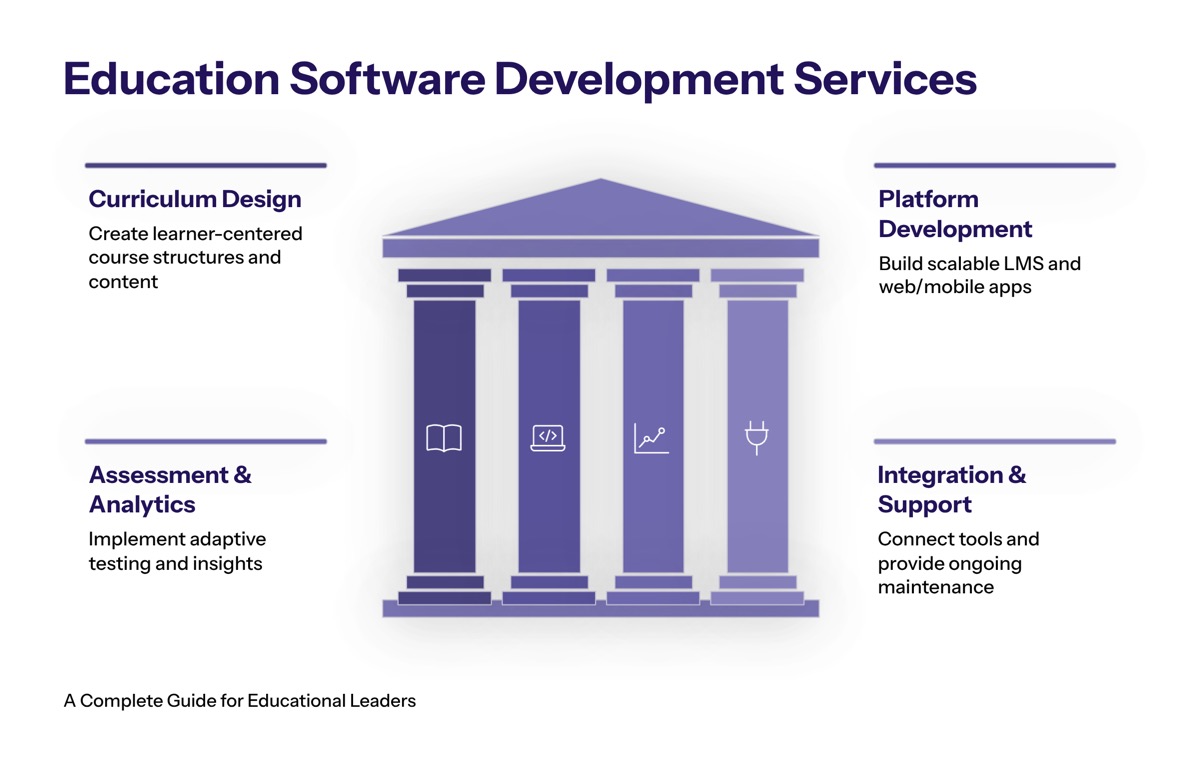
Educational software development is the design, engineering, deployment, and maintenance of software built for learning and administration. Unlike generic education software that is purchased and configured, custom education software development creates platforms around a specific institution’s pedagogy, governance model, student population, reporting needs, and integration environment.
Educational software can be customized for different levels of education and various target audiences, allowing for tailored features and learning paths that better assist users. The key to successful custom education software development is understanding the unique needs of the target audience, which can include K-12 students, higher education institutions, corporate training centers, and more.
Education software development services are designed to create customized solutions that improve learning experiences, streamline administration, and support lifelong learning. In practice, this can include custom software solutions for online learning, virtual classrooms, advanced analytics, mobile applications, secure records, collaborative learning experiences, and personalized learning paths.
Custom education software development services enable institutions to create personalized, efficient, and scalable learning ecosystems by combining technologies like AI, AR/VR, and cloud-based systems. The best software development services focus on scalability, interoperability, data security, and immersive user experiences from the beginning of the development process.
Core Service Categories
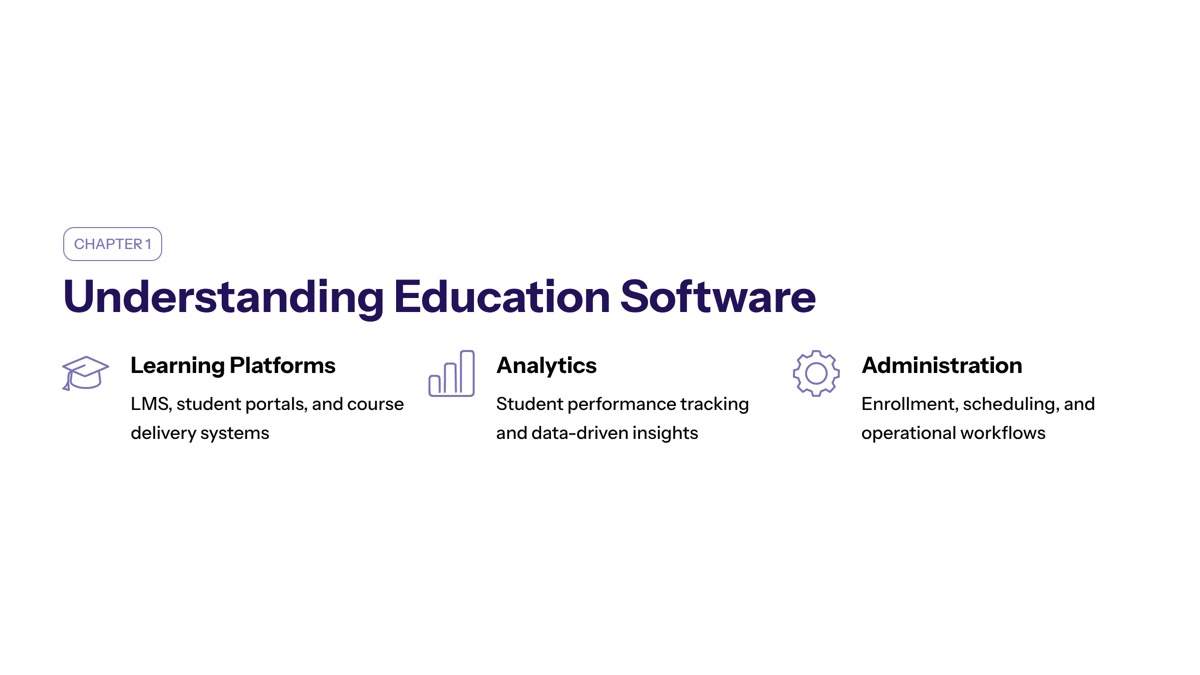
The main categories of educational software solutions usually include learning management systems, student information systems, school management systems, learning portals, virtual classrooms, assessment systems, and analytics dashboards.
Learning Management Systems (LMS) host courses, track student progress, and assign grades. Custom LMS development can support curriculum mapping, course authoring, cohort management, assessment workflows, knowledge retention, multimedia content, SCORM, xAPI, LTI integrations, and personalized learning paths. Modern education software must include interactive learning modules, personalized learning paths, collaboration tools, and analytics to enhance engagement and effectiveness.
Student Information Systems manage the academic and administrative student lifecycle. School Management Systems (SMS) handle admissions, attendance, scheduling, and student records, while student information systems often extend into demographics, grades, transcripts, class schedules, reporting, and long-term academic history. These management systems are central to institutional operations, so data governance, role-based access, and interoperability are critical.
Learning portals provide one access point for students, faculty, parents, administrators, and support staff. A portal may include dashboards, messages, assignments, content libraries, billing links, progress reports, and personalized access controls. The integration of collaboration tools in education software promotes peer-to-peer learning and student-teacher interaction, especially when combined with discussion spaces, shared projects, real-time feedback, and interactive learning tools.
Assessment and certification platforms support secure testing, grading, credential issuance, and verification. Automated assessment tools give students immediate feedback on their performance, allowing for instant corrections. These platforms may include timed exams, question randomization, plagiarism detection, proctoring, audit trails, micro-credentials, and certificate validation.
Virtual Classroom Software provides video conferencing, digital whiteboards, and real-time chat for online education. For institutions expanding digital learning, virtual classrooms can connect live instruction, recordings, assignments, discussions, and assessments into one education platform.
Custom vs. Off-the-Shelf Solutions
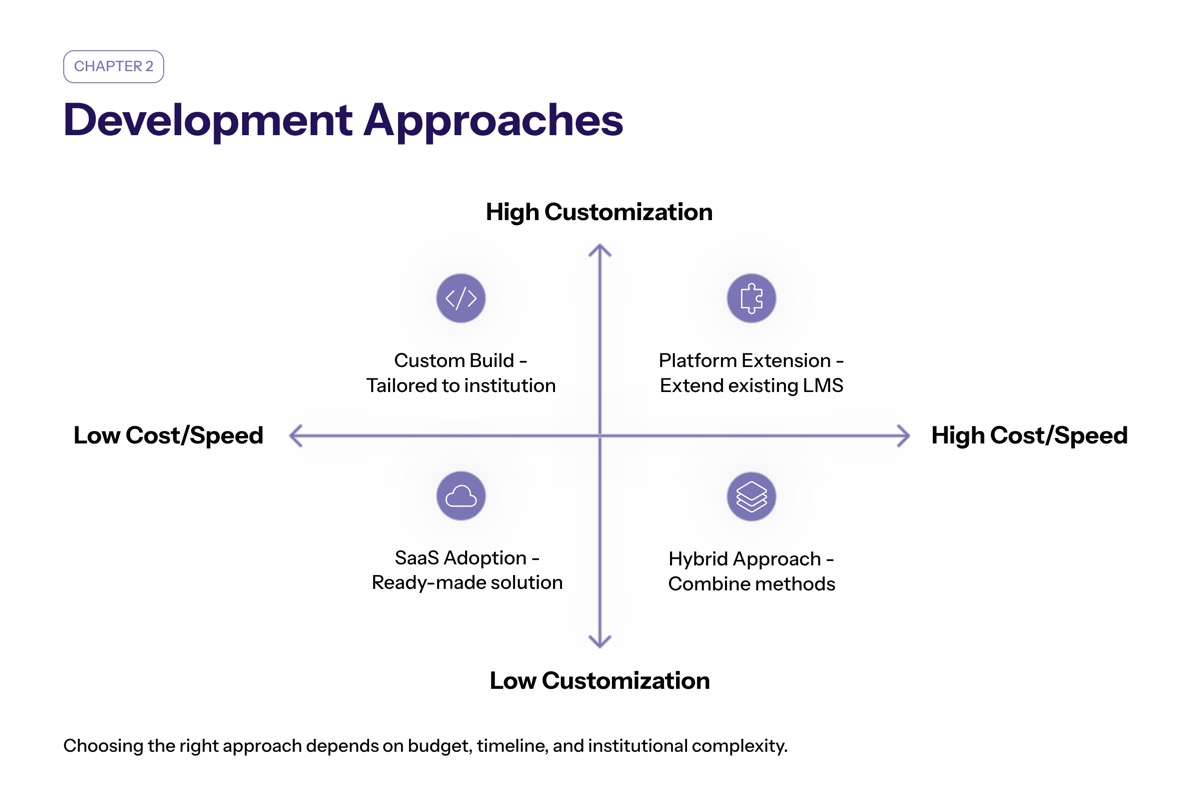
Custom development provides measurable ROI when licensed tools create workflow compromises, high per-user costs, limited data ownership, weak integrations, or barriers to innovation. For example, a university with multi-campus accreditation rules, a school network with parent-facing workflows, or a corporate learning team with specialized training programs may need custom software rather than a standard platform.
Integration is often the deciding factor. Integration with existing systems is a significant challenge in educational software development, as institutions often rely on multiple systems such as CRMs and ERPs, necessitating seamless interoperability to avoid data silos. A custom software development company can build APIs, data pipelines, SSO, role permissions, and reporting layers that connect LMS, SIS, finance, HR, admissions, identity management, and third party tools.
Long-term ownership also matters. Custom software gives educational organizations more control over source code, data models, user experience, branding, analytics, and future product direction. This is important as the education technology market is expected to continue growing, with increasing reliance on educational software by both students and staff.
The decision is not simply “custom or standard.” Many institutions choose a hybrid path: customizing Moodle, Open edX, or another platform core, then extending it with custom elearning solutions, mobile app development, AI capabilities, or secure dashboards. The next step is understanding which educational software development approaches best support institutional goals.
Educational Software Development Approaches
Once the core platform category is clear, education leaders need to define the development approach. Effective edtech software development connects pedagogy, student support, administration, compliance, data architecture, and user experience into one practical roadmap.
A strong education software development company should not start with features alone. The company should evaluate the learning process, data security expectations, accessibility requirements, device usage, integration needs, and measurable educational outcomes.
AI-First Architecture for Learning Platforms
AI-first architecture means artificial intelligence and machine learning are planned into the platform design, not added later as isolated features. Institutions can leverage AI capabilities to improve workflows when integrated correctly into education software.
Artificial intelligence is enhancing personalized learning by enabling systems to analyze student performance in real time and adjust content delivery accordingly. In adaptive learning systems, the platform can recommend resources, change difficulty levels, identify knowledge gaps, and support personalized learning paths based on performance, engagement, and learning styles.
Automated assessment and feedback tools can reduce grading workload and improve the speed of intervention. Automated assessment tools give students immediate feedback on their performance, allowing for instant corrections, while educators can use analytics to review class-wide trends and adjust instruction.
Intelligent content recommendation helps align curriculum, student progress, and next-best learning activities. A modern education software system may recommend remedial lessons, enrichment materials, peer groups, practice exams, or multimedia resources. Gamification and multimedia content increase student engagement by keeping them interested longer, especially when badges, progress markers, simulations, and interactive learning platforms are tied to learning objectives rather than used as decoration.
Immersive technologies such as augmented reality (AR) and virtual reality (VR) are transforming traditional lessons into interactive experiences, allowing students to engage with complex concepts in a more hands-on manner. These advanced technologies are especially useful in science labs, medical training, engineering, vocational education, and safety simulations.
Secure Student Data Management
Secure student data management is one of the most important parts of educational software development services. Developers must guarantee strict compliance with data privacy regulations such as FERPA, COPPA, and GDPR. Strict adherence to regulatory standards protects sensitive student and institutional information in education software development.
FERPA compliance architecture should include role-based access controls, audit trails, consent workflows, data retention rules, and clear permission boundaries for students, parents, instructors, advisors, and administrators. COPPA matters when software serves children under 13, while GDPR affects institutions handling personal data from users in the European Union.
Data encryption and secure authentication should be built into student information systems, learning portals, assessment tools, and mobile applications. Core controls include encryption in transit and at rest, SSO, SAML, OAuth, multi-factor authentication, secure session management, monitoring, and logging.
Privacy-first design is especially important for minor student data and academic records. The platform should limit data collection, define retention periods, support deletion or redaction where legally appropriate, and maintain audit documentation. Security decisions must be part of digital product strategy development, not a final review before launch.
Workflow-Specific Platform Design
Workflow-specific platform design means the software reflects how the institution actually operates. Custom development can model enrollment, admissions, grading, attendance, scheduling, credentialing, faculty approvals, accommodations, reporting, and accreditation processes.
This is where custom education software becomes more valuable than generic educational platforms. A school district may need parent permissions, district-level dashboards, attendance automation, and classroom-level reporting. A university may need course equivalency logic, advising workflows, credit rules, and integrations with legacy databases. A corporate training provider may need compliance training programs, certificates, employee learning paths, and enterprise solutions for multiple departments.
Integration with academic and administrative systems is essential. An education software development company should design APIs and data flows that connect existing systems such as SIS, CRM, ERP, finance, HR, identity providers, content repositories, and assessment engines. Seamless integration prevents duplicated data entry and improves reporting accuracy.
The condensed principle is simple: technology should follow educational goals. Custom software development services should improve administrative efficiency, strengthen teaching and learning, protect sensitive data, support accessibility, and provide analytics that help leaders make better decisions. That alignment shapes the implementation strategy.
Implementation Strategy and Technical Requirements
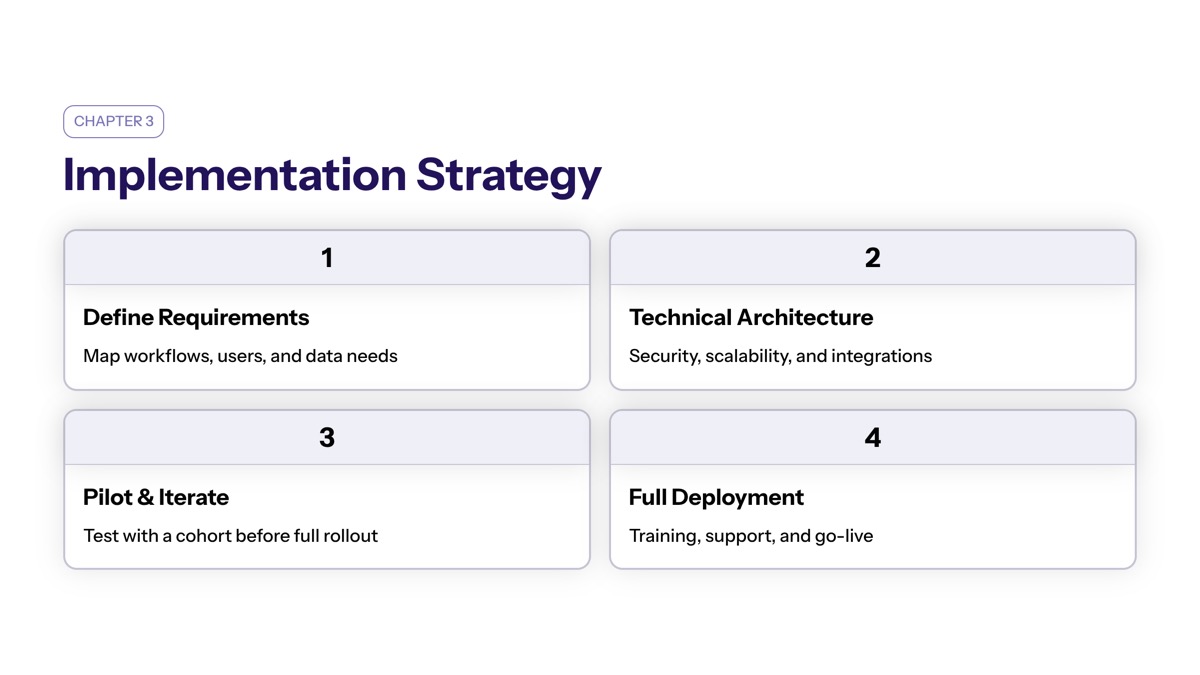
Moving from planning to execution requires governance, stakeholder involvement, technical architecture, and a phased rollout. Even a strong idea can fail if the development process ignores faculty needs, student accessibility, data migration, or compliance validation.
A reliable educational software development company should provide both engineering depth and education-domain experience. Look for a development partner with a proven track record in edtech solutions, mobile and web development, cloud solutions, app development, web development, website development, data security, and integration with third party tools.
Development Process and Governance
A structured implementation approach helps prevent scope creep and ensures the final platform supports real educational workflows.
Requirements gathering with academic and administrative stakeholders
Start with interviews, workflow mapping, data audits, curriculum requirements, compliance needs, and role definitions. Include students, faculty, administrators, IT, legal, accessibility specialists, and support teams.Pilot testing with controlled user groups before full deployment
A pilot validates usability, performance, integrations, reporting, security, and instructional fit. It also reveals whether virtual classrooms, LMS workflows, dashboards, and mobile app features work under real conditions.Staff training and change management for new platform adoption
Faculty onboarding should include role-based training, quick-start guides, instructional design support, and helpdesk coverage. Student orientation programs should explain login, platform access, digital literacy expectations, mobile app usage, assessments, and collaboration tools.Performance monitoring and iterative improvement cycles
After launch, monitor uptime, engagement, completion, student progress, support tickets, assessment results, and system performance. Advanced analytics can reveal adoption gaps, workflow delays, and opportunities to improve educational outcomes.
The adoption of education software development services can lead to greater efficiency for institutions by automating routine processes like attendance tracking and report generation. Analytics in education software provides actionable insights into student performance, attendance, and engagement, enabling educators to make data-driven decisions to improve learning outcomes. Dashboards in educational software allow teachers and administrators to visualize data trends, helping them identify struggling students early and adjust teaching strategies accordingly.
Technology Stack Considerations
The technology stack should be chosen around institutional control, growth, security, interoperability, accessibility, and the experience of students and staff.
Criterion | Common Approach | Education-Specific Consideration |
|---|---|---|
Deployment | Cloud infrastructure, on-premises hosting, or hybrid architecture | Cloud-based education platforms allow global accessibility for students to learn from any location at any time, while on-premises may be required for stricter institutional control or data policies. |
Device access | Responsive web, native mobile app, or cross-platform mobile applications | Cross-Platform Accessibility ensures the software works across all devices including desktops, tablets, and smartphones. |
Integration | REST APIs, GraphQL, webhooks, SSO, LTI, OneRoster, SCORM, xAPI | API integration capabilities are essential for connecting with existing systems and avoiding data silos. |
Scalability | Cloud solutions, containers, load balancing, CDN, modular services | Scalability planning should support growing enrollment, expanding programs, heavier media use, and future digital platforms. |
Accessibility | WCAG-aligned design, keyboard navigation, captions, screen reader support | Ensuring accessibility in educational software is crucial, as it must support diverse users while maintaining performance as demand grows, often requiring compliance with standards like WCAG. |
Mobile-first design is no longer optional. Students and faculty expect access across laptops, tablets, and smartphones. For some institutions, mobile app development services should also include offline learning, push notifications, downloaded content, and later synchronization.
The integration of analytics in educational platforms supports personalized learning paths by analyzing individual student data and recommending tailored resources and assessments. When a company leverages advanced technologies responsibly, analytics, AI, AR/VR, and automation can support better instruction without weakening privacy or accessibility.
Education leaders should evaluate technical decisions by asking whether the architecture supports compliance, adoption, growth, integrations, and measurable outcomes. The next challenge is managing the risks that commonly appear during implementation.
Common Implementation Challenges and Solutions
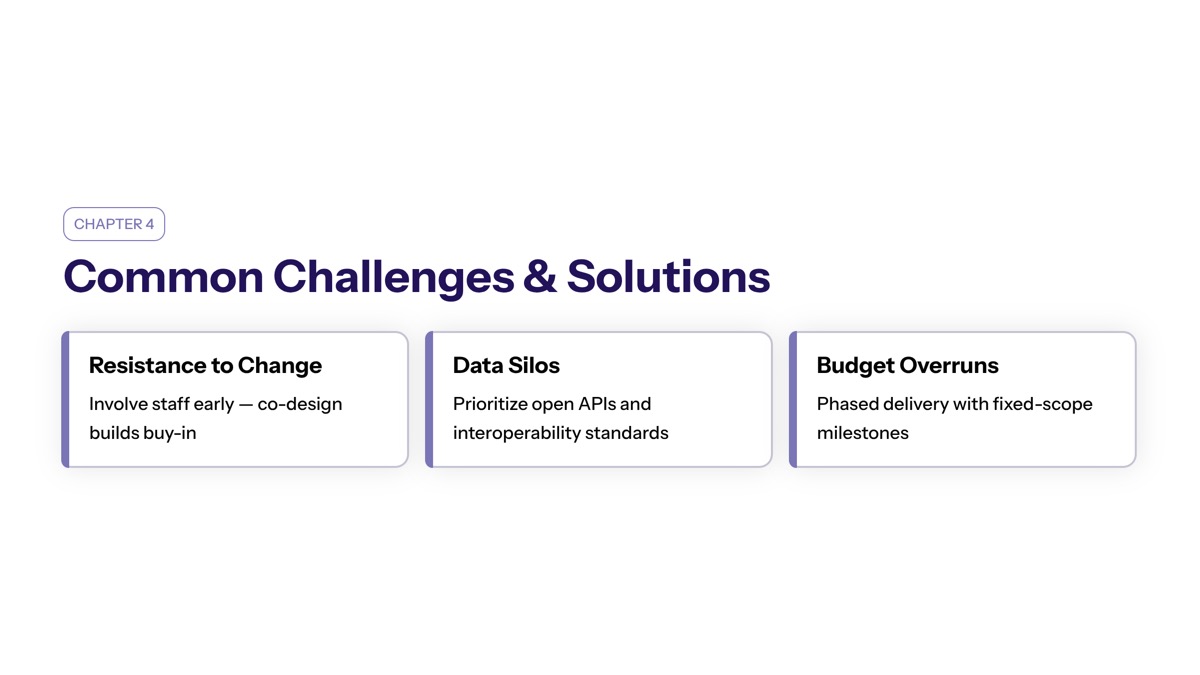
Educational software development faces multiple challenges, including alignment with pedagogy, user engagement, accessibility and inclusivity, integration with existing systems, regulatory compliance, and security. These risks are manageable when they are addressed early in planning rather than after launch.
Data Migration and System Integration
Data migration is difficult because academic records, transcripts, attendance, grades, course history, user accounts, and content may live in multiple legacy systems. Poor mapping can create errors, duplicate records, reporting gaps, or downtime during critical academic periods.
Use a phased migration plan with backups, validation rules, test imports, rollback procedures, and parallel runs where needed. API development should connect new platforms with existing SIS, finance systems, CRMs, ERPs, identity providers, and content systems. Seamless integration reduces manual work and protects data quality.
User Adoption and Training
A platform can be technically strong and still fail if faculty and students do not use it. Common adoption barriers include confusing UX, limited training, resistance to new workflows, weak instructional fit, and lack of support during the transition.
Faculty onboarding strategies should cover LMS workflows, grading, assessment tools, analytics dashboards, accessibility features, and virtual classroom tools. Student orientation programs should support platform access, digital literacy, mobile use, collaboration features, and online learning expectations. User feedback loops, pilot groups, helpdesk support, and incremental rollout schedules improve adoption.
Compliance and Security Requirements
Compliance and security requirements must be validated throughout development. FERPA compliance validation should include proper access controls, audit documentation, data minimization, consent handling, and permission reviews. COPPA and GDPR requirements should be reviewed when platforms serve minors or international users.
Security testing and vulnerability assessment are necessary for student data protection. This includes penetration testing, code reviews, encryption checks, authentication testing, logging validation, infrastructure hardening, and incident response planning. A responsible edtech software development company should treat data security as a product requirement, not only an IT checklist.
Conclusion and Next Steps
Education software development services help institutions build platforms that fit their educational model, administrative workflows, compliance obligations, and long-term growth plans. Custom development is especially valuable when educational institutions need secure student data systems, personalized learning experiences, advanced analytics, mobile access, and integration with existing systems.
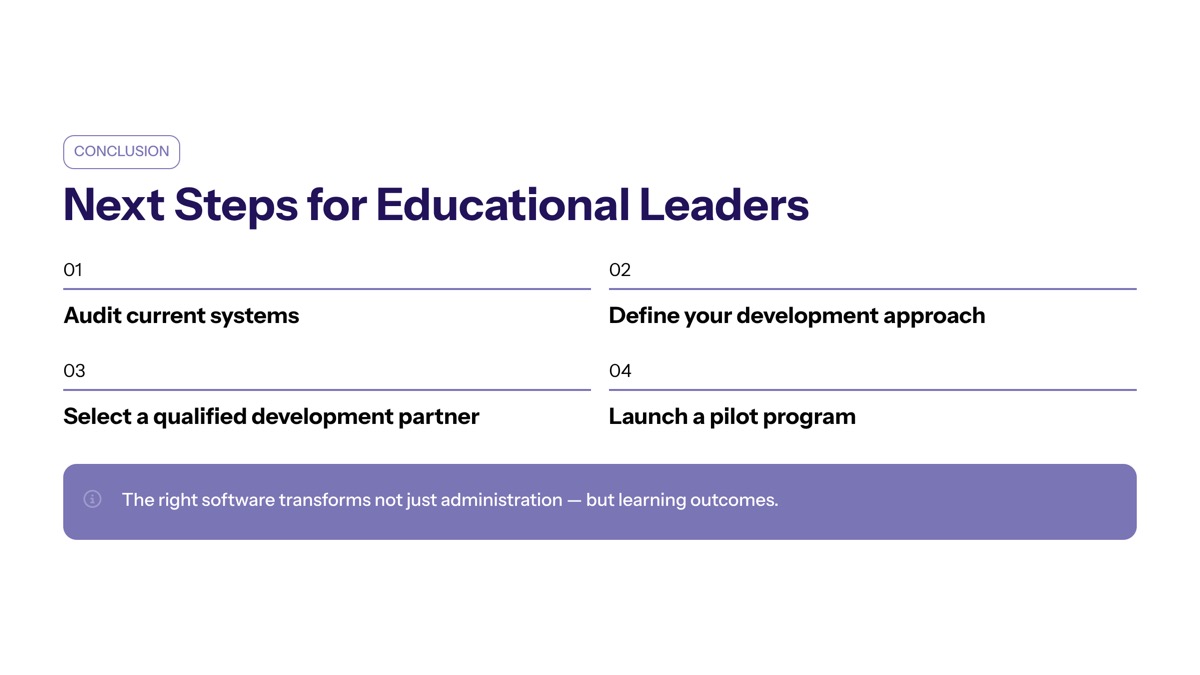
Immediate next steps:
Conduct a technology needs assessment
Audit current LMS, SIS, SMS, portals, CRMs, ERPs, assessment tools, data flows, and reporting gaps.Define the target outcomes
Clarify whether the priority is student engagement, administrative efficiency, knowledge retention, compliance, online learning expansion, or better educational outcomes.Evaluate integration and compliance requirements
Map required APIs, data standards, FERPA, COPPA, GDPR, WCAG, security controls, and governance responsibilities.Select the right development partner
Look for education software developers with experience in custom elearning software development, student information systems, cloud platforms, mobile app development, analytics, and secure architecture.Plan a secure modernization roadmap
Start with discovery, move through pilot development, validate with real users, then scale through iterative releases.
Related topics worth exploring include AI integration strategies, long-term platform governance, data ownership, maintenance models, accessibility planning, and consolidation of digital learning platforms. For broader strategic context, visit our education industry page.
Additional Resources
FERPA, COPPA, and GDPR compliance checklists for educational software selection, data governance, access control, consent, and audit documentation.
Custom vs. off-the-shelf evaluation frameworks to compare ownership, scalability, licensing costs, integrations, user experience, and long-term ROI.
Educational data security best practices covering encryption, identity management, monitoring, vulnerability testing, incident response, and secure student records.
Accessibility and WCAG planning guides for inclusive educational platforms that support diverse learners across devices.
Technology modernization roadmaps for institutions planning LMS, SIS, portals, virtual classrooms, mobile applications, analytics, and cloud-based education platforms.