Energy Sector Software Development: A Complete Guide for Utilities and Energy Leaders
Energy sector software development creates custom platforms that help utilities and energy companies integrate distributed energy resources, automate compliance reporting, and gain real time monitoring across generation, transmission, distribution, storage, and customer systems. For modern utilities, energy software is no longer a back-office upgrade; it is a core operating layer for grid reliability, renewable energy integration, regulatory compliance, and operational efficiency.
This guide covers custom energy platforms, operational visibility tools, compliance automation, grid modernization software, asset management systems, energy trading platforms, and customer billing solutions. It does not focus on generic office software or basic IT applications unless those systems connect directly to energy operations, energy data, or regulated business operations. The article is written for energy executives, utility CIOs, operations leaders, and digital transformation teams evaluating whether to build custom software, modernize legacy systems, or choose an external energy software development company.
The direct answer is simple: energy sector software development builds secure, scalable solutions that connect energy systems, automate processes, support regulatory reporting, and provide actionable insights across energy infrastructure. The best platforms are designed around the physical realities of the grid, strict legal requirements of the energy industry, and the need to process massive, real-time data streams with minimal latency.
By the end, you will understand:
Which types of energy industry software matter most for utilities and energy companies
How custom energy software development differs from commercial software packages
What architecture choices affect security, reliability, and scalability
How compliance automation supports NERC CIP, NIS2, IEEE, ESG, CO₂, and GHG reporting
How to evaluate ROI through operational costs, reliability, energy efficiency, and risk reduction
For a broader view of digital platforms across the sector, see our energy industry software development overview.
Understanding Energy Sector Software Development
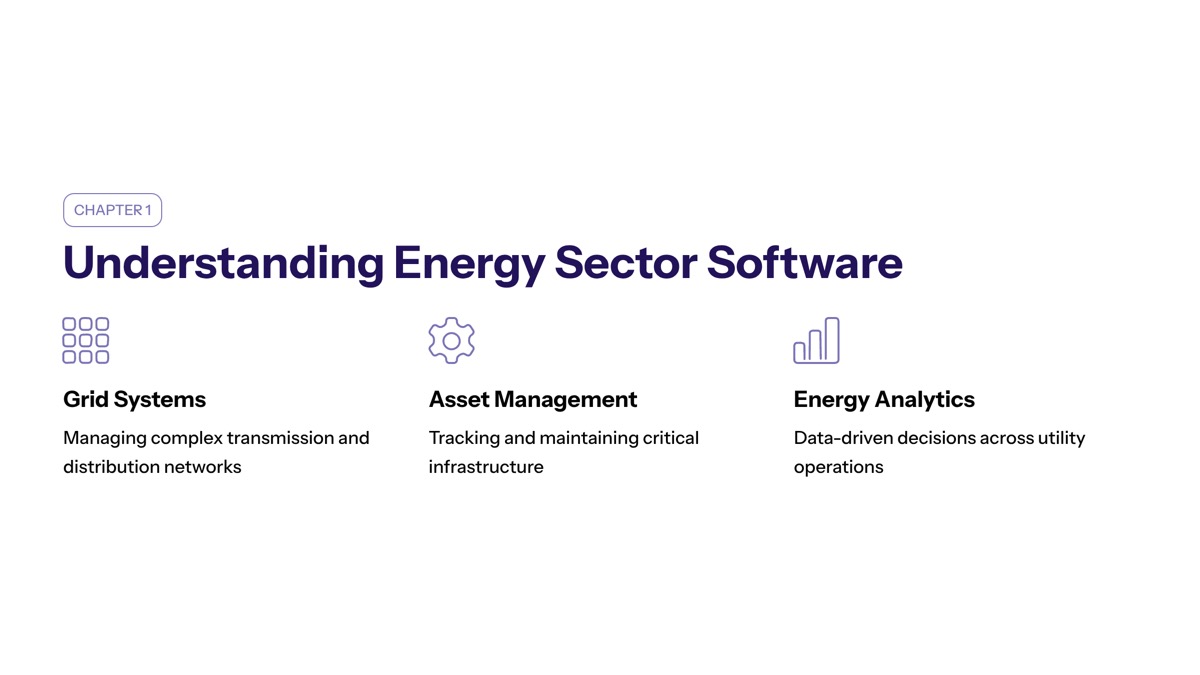
Energy sector software development is the design, engineering, integration, and modernization of software systems used to manage energy production, grid operations, transmission, distribution, storage, trading, compliance, customer engagement, and energy management. Unlike ordinary enterprise software development, energy software must interact with operational technology, embedded systems, SCADA environments, smart meters, IoT devices, renewable energy sources, and legacy systems that influence real-world infrastructure.
The difference matters because energy systems require extreme reliability and security, as failure can disrupt critical public services. Developers must account for the physical realities of the grid and the strict legal requirements of the energy industry. Software in the energy sector must handle massive, real-time data ingestion and comply with strict cybersecurity regulations, because even small delays or security gaps can affect grid stability, public safety, and regulatory exposure.
Generic business applications usually optimize workflows such as finance, HR, or sales. Energy industry software must support deterministic operations, audit trails, secure remote access, carbon reporting, environmental reporting, demand response, outage visibility, and communication with field assets. Software development for the energy sector must bridge the gap between volatile renewable energy sources and rigid legacy infrastructure.
Custom Energy Platforms vs. Off-the-Shelf Solutions
Custom energy platforms are built around the operating model of a specific utility, grid operator, generation company, co-op, retailer, or renewable energy business. A custom energy software solution can reflect local tariff structures, regulatory requirements, asset types, geographic risks, field workflows, energy resources, and existing infrastructure. This is why custom software development is often preferred when energy companies need seamless integration with SCADA, OT networks, ERP and CRM integration, specialized reporting, or unique demand response programs.
Off-the-shelf management software can work well for standardized billing, customer engagement, or reporting needs. However, packaged tools may force compromises when they cannot support legacy systems, real-time control, renewable energy integration, or specific compliance evidence requirements. Custom energy management platforms are especially valuable when a utility must modernize legacy systems while maintaining operational continuity.
Custom energy software development also supports long-term scalability. As decentralized energy grows, platforms must scale from managing a few dozen sensors to millions of devices. A custom platform can be designed for that expansion from the start, using APIs, event-driven architecture, edge processing, and distributed cloud infrastructure for processing data closer to the source to decrease latency and prevent data bottlenecks.
Operational Visibility and Data Integration
Operational visibility is the ability to see what is happening across energy assets, grid infrastructure, customer systems, and market operations in near real time. In practice, this means connecting SCADA, IoT sensors, smart meters, solar farms, wind turbines, substations, battery storage, distributed energy resources, and field devices into digital platforms that support monitoring, alerts, data analysis, and decision-making.
Integrating IoT technologies into energy management systems allows for real-time monitoring and data collection, which enhances operational efficiency and decision-making. IoT integration in energy systems enables the collection of data from various sensors, which can be analyzed to optimize energy consumption and reduce waste. The use of IoT devices in energy management facilitates predictive maintenance by providing data that can identify potential issues before they lead to equipment failures.
Energy systems must process massive data streams from smart meters, solar farms, and wind turbines with minimal latency to maintain grid stability. Energy management software can track usage in real-time and identify inefficiencies, helping organizations reduce energy consumption without compromising comfort or output. Energy analytics platforms transform complex data into understandable reports, enabling better decision-making across departments and aligning strategies with operational goals.
Compliance Automation and Regulatory Frameworks
Compliance automation embeds regulatory requirements directly into workflows, reports, access controls, audit trails, and evidence collection. Energy software must adhere to rigorous cybersecurity standards like NERC CIP in North America and the NIS2 Directive in Europe to ensure the security of energy infrastructure. In 2026, energy industry software must meet rigorous cybersecurity standards such as NERC CIP in North America and the NIS2 Directive in Europe to protect critical infrastructure.
Compliance with the Institute of Electrical and Electronics Engineers (IEEE) standards, such as IEEE 1547-2018, is crucial for safely connecting software to the grid in the energy sector. New software must also support specific protocols like IEC 61850 for substation automation. Software must adhere to rigorous standards like NERC CIP in North America or NIS2 in Europe, while energy software solutions must support compliance with environmental regulations, including CO₂, ESG, and GHG reporting standards, to help organizations meet sustainability goals.
ISO 27001 certification is essential for energy software companies to demonstrate their commitment to information security management and regulatory compliance. Security in the energy sector is a matter of national infrastructure safety, requiring compliance with standards like ISO 27001 and SOC2 Type II to ensure data protection and management. These requirements shape the application areas that follow: grid modernization, asset performance management, market operations, and customer-facing energy management.
Key Energy Software Applications and Use Cases
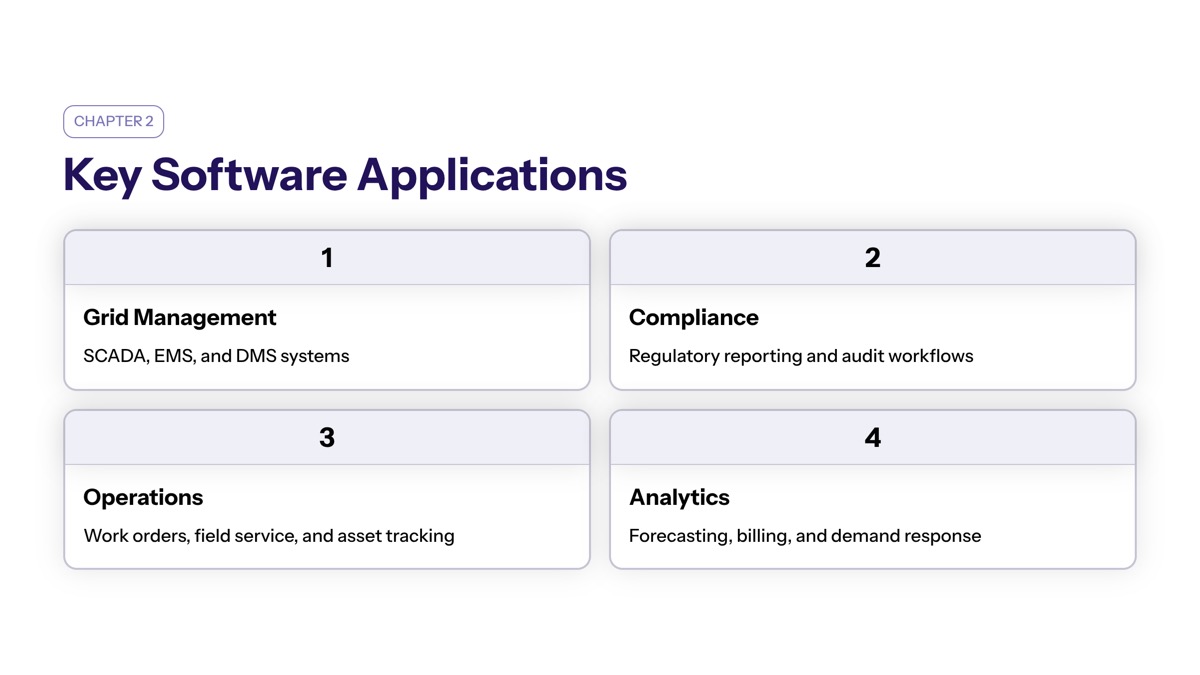
Once the foundation is clear, energy leaders can evaluate energy software development services by use case. The most valuable platforms improve energy operations, connect energy data, automate compliance, optimize resource utilization, reduce energy waste, and create actionable insights from complex operational and financial information.
Energy software now spans smart grid platforms, renewable energy software solutions, energy trading platforms, customer portals, carbon reporting tools, predictive maintenance tools, and custom energy management systems. The best digital solutions combine system integration, advanced analytics, machine learning, and secure architecture rather than treating each application as an isolated project.
Grid Modernization and Smart Grid Platforms
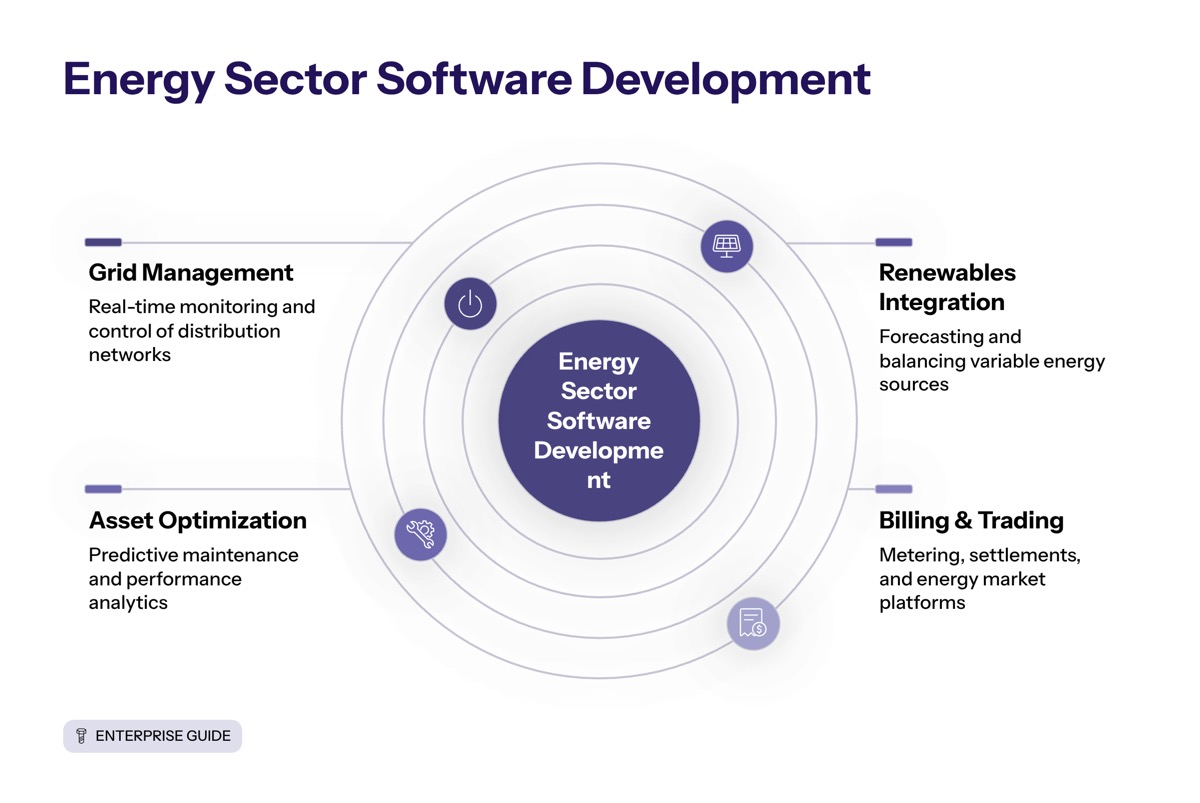
Grid modernization software helps utilities move from one-way power delivery to dynamic, two-way energy flow. Advanced distribution management systems support outage detection, voltage optimization, fault location, isolation, service restoration, energy storage coordination, and distributed energy resources management. These platforms must adaptively balance transmission, distribution, and storage to prevent grid instability due to the unpredictability of renewable energy sources.
Smart grid platforms also support renewable energy integration. Solar energy software, wind monitoring tools, battery management platforms, and green energy software must coordinate intermittent production with real-time demand, peak demand events, and grid constraints. Software for renewable energy market participation may also connect generation forecasts, pricing, storage dispatch, and demand response automation.
Advanced technologies such as AI, IoT, edge computing, and big data analytics are increasingly used to optimize energy usage and improve energy efficiency. At the grid edge, distributed devices generate energy data continuously. A scalable energy software solution must collect that data, validate it, route it securely, and present operators with operational visibility rather than noise.
Asset Performance Management
Asset performance management software helps energy companies improve reliability, reduce unplanned downtime, and extend the life of expensive infrastructure. Typical assets include turbines, transformers, substations, solar inverters, wind turbines, breakers, storage systems, and transmission equipment. Predictive maintenance uses sensor readings, operational logs, thermal data, vibration data, oil analysis, and historical failure records to identify risk before equipment fails.
Modern energy software solutions utilize AI to analyze sensor data, enabling predictive maintenance that identifies potential equipment failures before they occur. Predictive maintenance software within energy management systems can detect potential issues early, allowing for timely repairs and minimizing equipment downtime. AI-driven predictive maintenance can reduce operational downtime in the energy sector by 30–40% and extend the lifespan of expensive assets by up to a decade.
Condition monitoring also supports capital planning. Specialized tools in energy software integrate field data, financial metrics, and operational logs into a centralized dashboard for better strategic planning. This helps operations, finance, and engineering teams compare repair, replacement, and refurbishment options using shared evidence instead of fragmented spreadsheets.
Energy Trading and Market Operations
Energy trading platforms support pricing, bidding, hedging, scheduling, risk management, portfolio optimization, and market compliance. These systems ingest market prices, weather forecasts, fuel costs, renewable energy production forecasts, demand signals, and transmission constraints. For retailers, generators, and aggregators, energy trading software connects financial decisions to physical energy resources.
Real-time pricing platforms and automated trading systems must be fast, auditable, and resilient. Advanced analytics in energy software minimize waste and maximize profitability by streamlining logistics and balancing supply with real-time demand. Machine learning can improve price forecasting, load forecasting, energy consumption modeling, and renewable generation forecasts.
Compliance remains central. Market operations software must preserve transaction history, approval workflows, exposure calculations, and reports for market operators and regulators. When combined with energy management systems, trading platforms can help avoid overcommitment, reduce imbalance penalties, and optimize resource utilization across generation, storage, and demand response assets.
Customer Engagement and Billing Platforms
Customer engagement and billing platforms connect meter data, customer portals, tariff engines, outage notifications, self-service workflows, and demand response program management. Smart meter data management enables utilities to show customers energy usage, energy consumption patterns, peak demand exposure, and options to reduce energy waste. These digital platforms also support dynamic pricing, time-of-use rates, net metering, and renewable energy incentives.
Energy management software can facilitate the automation of meter readings and billing processes, improving accuracy and customer satisfaction while ensuring compliance with regulations. Custom energy management software solutions can enhance operational efficiency by integrating with existing systems, providing tailored features that meet specific business needs. This is especially important when billing platforms must connect to CIS, ERP and CRM integration, meter data management, EDI, customer portals, and regulatory reports.
The U.S. electricity sector CIS/Billing/EDI software market is valued at roughly $1.3B in total addressable market, with strong demand for SaaS challengers and modernization. However, utilities still need careful technology selection because billing, customer communications, outage management, and demand response often depend on secure integration with operational systems. That makes implementation strategy the next critical decision.
Implementation Strategy and Technology Selection
Moving from planning to execution requires more than choosing features. Energy sector software development must align business objectives, compliance obligations, OT constraints, data architecture, cybersecurity, project management, and long-term support. The right approach depends on whether the organization needs a full custom platform, a commercial product, a system integration program, or a hybrid model.
A reliable software partner should help energy leaders define business outcomes before selecting technology. Those outcomes may include lower operational costs, improved energy efficiency, better regulatory compliance, faster outage response, fewer manual workflows, improved customer satisfaction, or stronger visibility across energy assets.
Technology Architecture Decisions
Cloud-native and hybrid deployment models are both common in energy software development. Customer portals, analytics, billing, reporting, and non-control workloads often fit cloud development well. OT, SCADA, nuclear, substation, and safety-sensitive environments may require on-premises or edge deployment because latency, regulation, and safety requirements can limit public cloud use.
Microservices architecture supports scalable solutions by allowing teams to deploy, update, and scale individual services independently. This is useful for energy management, carbon reporting, asset management, forecasting, and customer engagement platforms. However, microservices require strong observability, secure APIs, disciplined DevOps, and rigorous testing because distributed systems can introduce consistency and monitoring challenges.
API-first design is essential for system integration. The energy transition involves diverse, decentralized resources often running on varying proprietary protocols, requiring seamless communication between systems. New software must support specific protocols like IEC 61850 for substation automation, and many platforms must also communicate with DNP3, MQTT, Modbus, OPC UA, and vendor-specific protocols.
Edge computing is increasingly important for real-time control and monitoring. Energy systems must process massive data streams from smart meters, solar farms, and wind turbines with minimal latency to maintain grid stability. Utilizing distributed cloud infrastructure for processing data closer to the source helps decrease latency and prevent data bottlenecks, while local processing can keep critical workflows running during network interruptions.
Security architecture must be designed from the start. Energy grids are high-value targets and must implement zero-trust architectures, multi-factor authentication, and military-grade encryption. Modern energy software development services now include “Zero Trust” architectures and AI-driven threat detection to isolate compromised systems before breaches escalate.
Developers also need to consider sustainability inside the software itself. Developers focus on energy-efficient software, writing algorithms that minimize CPU cycles to reduce the carbon footprint of data centers. For energy companies pursuing ESG goals, the efficiency of the software stack can become part of the broader sustainability strategy.
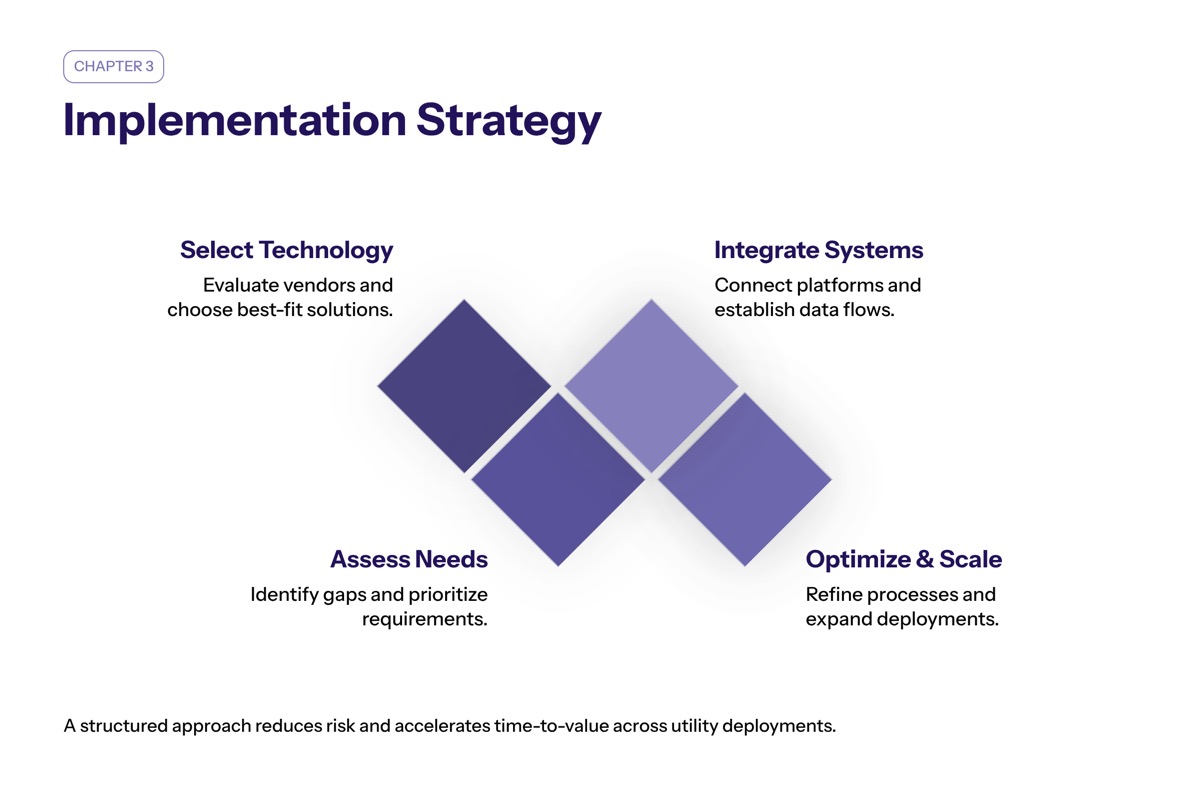
Vendor Evaluation Framework
Vendor selection should start with the operating risk of the system being built. A public customer portal, a compliance dashboard, a grid-edge control application, and a renewable energy forecasting engine have very different requirements. Leaders should evaluate whether they need an energy software development company, a traditional software development company with energy expertise, a commercial energy software vendor, or a system integrator.
The strongest partners combine domain experience, custom software engineering, regulatory knowledge, cybersecurity maturity, and transparent communication. Dedicated development teams should understand how to modernize legacy systems, support compliance evidence, integrate OT and IT systems, and design robust software solutions for high-availability environments.
Selection criteria should include:
Energy industry experience - proven work with utilities, generation, renewable energy, energy trading, grid modernization, or energy management.
Compliance expertise - knowledge of NERC CIP, NIS2, IEEE 1547-2018, IEC 61850, ISO 27001, SOC2 Type II, ESG, CO₂, and GHG reporting.
Architecture maturity - experience with cloud, hybrid, edge, microservices, APIs, embedded systems, IoT, and data pipelines.
Implementation discipline - phased rollout methods, testing, project management, risk controls, and operational continuity.
Long-term support - security patching, upgrades, performance monitoring, documentation, and roadmap alignment.
A leading energy software company should not simply promise features. A reliable technology partner should show how the platform will reduce risk, improve operational efficiency, support regulatory compliance, and scale with future energy resources.
Vendor Selection Comparison
Criterion | Custom Development Partners | Energy Software Vendors | System Integrators |
|---|---|---|---|
Energy Industry Experience | Strong when the partner has built custom energy software, renewable energy software, grid platforms, or energy management systems for similar organizations. | Often strong within a specific product category such as billing, asset management, compliance, or trading. | Strong when the integrator has deep utility, OT, SCADA, and enterprise architecture experience. |
Compliance Expertise | Best suited when regulatory workflows must be designed into the platform from the beginning, including NERC CIP, NIS2, IEEE 1547-2018, ISO 27001, SOC2 Type II, and carbon reporting. | Useful when the product already includes standard compliance templates, reports, and audit trails. | Valuable for connecting compliance tools to existing enterprise systems and legacy systems. |
Technical Architecture | Flexible for API-first design, microservices, embedded systems, AI, machine learning, edge computing, and cloud development. | Architecture depends on the vendor roadmap and product limitations. | Strong for middleware, data migration, infrastructure design, and multi-vendor system integration. |
Implementation Speed | Moderate to fast when scope is focused and delivered through phased custom software development. | Often fastest for standardized workflows that fit the product out of the box. | Depends on legacy complexity, number of connected systems, and field deployment requirements. |
Long-term Support | Strong when the software partner provides dedicated development teams, transparent communication, documentation, and managed support. | Strong when the vendor has a stable product roadmap, support model, and upgrade path. | Strong for ongoing integration support, environment management, and enterprise rollout coordination. |
Custom development partners are usually the best fit when the utility needs a differentiated platform, deep OT integration, advanced analytics, or tailored compliance workflows. Energy software vendors are often effective when business operations match a mature product category. System integrators are valuable when the main challenge is connecting many platforms, modernizing legacy infrastructure, or coordinating enterprise-wide deployment.
Many energy leaders choose a hybrid model: commercial software for standardized workflows, custom software for strategic differentiation, and system integration services for connectivity. This approach can reduce delivery risk while preserving flexibility where the utility needs it most.
Common Implementation Challenges and Solutions
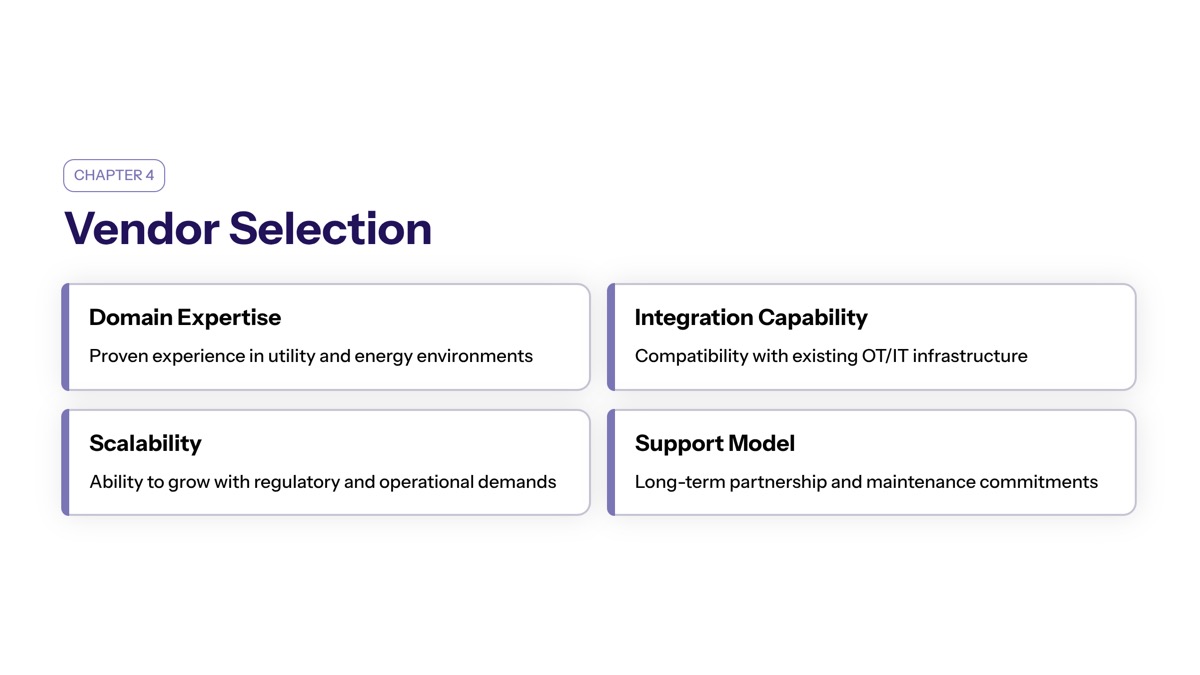
Energy software projects are complex because they operate at the intersection of physical infrastructure, cybersecurity, regulatory compliance, legacy technology, and changing market expectations. The most common failures are not caused by coding alone. They come from underestimating legacy integration, security requirements, scale, field workflows, and user adoption.
A practical implementation plan should reduce operational disruption, keep critical systems stable, and deliver value in phases. The goal is not only to deploy digital solutions but to improve energy operations in measurable ways.
Legacy System Integration Complexity
Many utilities still depend on decades-old SCADA systems, RTUs, PLCs, serial links, proprietary protocols, and custom databases. Legacy system modernization is essential for energy organizations to improve operational efficiency and reduce costs, as outdated systems can hinder growth and increase operational risks. At the same time, replacing every system at once is usually too risky.
The solution is phased modernization. Modern API development, middleware, protocol gateways, and data abstraction layers can connect old and new systems without interrupting critical operations. Modernizing legacy systems allows energy companies to integrate new technologies, enhance data analytics capabilities, and improve compliance with evolving industry regulations.
Custom software solutions for legacy system modernization can lead to significant long-term cost savings by ensuring seamless integration with existing infrastructure and improving overall system performance. A phased approach may start with read-only dashboards, then add workflow automation, then controlled write-back functions once reliability, security, and operator trust are proven.
Regulatory Compliance and Security Requirements
Regulatory compliance and cybersecurity must be built into the platform rather than added after deployment. Energy software must adhere to rigorous cybersecurity standards like NERC CIP in North America and the NIS2 Directive in Europe to ensure the security of energy infrastructure. Software must adhere to rigorous standards like NERC CIP in North America or NIS2 in Europe, while compliance with IEEE 1547-2018 is crucial for safely connecting software to the grid in the energy sector.
The solution is a security-by-design architecture with role-based access control, least privilege, multi-factor authentication, zero-trust network access, encryption, audit trails, change management, vendor access governance, and automated evidence collection. Energy grids are high-value targets and must implement zero-trust architectures, multi-factor authentication, and military-grade encryption.
Energy software companies should also demonstrate mature information security practices. ISO 27001 certification is essential for energy software companies to demonstrate their commitment to information security management and regulatory compliance. Security in the energy sector is a matter of national infrastructure safety, requiring compliance with standards like ISO 27001 and SOC2 Type II to ensure data protection and management.
Compliance automation can deliver measurable improvements. For example, an investor-owned utility used remote access governance to support NERC CIP-003-9 requirements across 800+ low-impact BES sites, reduced vendor access time from more than 4 hours to 8 minutes, achieved zero audit findings, and completed rollout in roughly 16 weeks with a two-person team. Basin Electric Power Cooperative also used compliance automation to move beyond spreadsheets and cut about 25% of the time previously spent tracking compliance tasks.
Scalability and Performance Under Load
Energy platforms must handle large volumes of data from meters, sensors, DERs, substations, customer systems, trading systems, and renewable energy assets. As decentralized energy grows, platforms must scale from managing a few dozen sensors to millions of devices. If data pipelines, APIs, storage, and processing layers are not designed for scale, operators may face delayed alerts, incomplete dashboards, and poor decision-making.
The solution combines distributed data processing, auto-scaling infrastructure, edge computing, event-driven architecture, and performance monitoring. Energy systems must process massive data streams from smart meters, solar farms, and wind turbines with minimal latency to maintain grid stability. Distributed cloud infrastructure can process data closer to the source, reduce latency, and prevent bottlenecks.
Scalability also includes business scalability. Software maximizes operational efficiency by automating complex workflows and optimizing resource allocation in the energy sector. AI technologies in energy management systems help automate processes, optimize energy consumption, and enhance operational efficiency by providing actionable insights from data analytics.
Change Management and User Adoption
Even technically strong software can fail if operators, field crews, compliance teams, and customer service teams do not trust or use it. Energy software affects established workflows, safety practices, reporting duties, and operational decision-making. User adoption is especially sensitive in OT environments where staff must be confident that software will not compromise safety or reliability.
The solution is user-centered design, early stakeholder involvement, role-specific training, and phased rollout. Field technicians need mobile workflows that work in constrained environments. Operators need clear dashboards, alarm prioritization, and reliable performance. Compliance teams need automated evidence, document control, and deadline reminders. Executives need strategic dashboards that connect field data, financial metrics, carbon reporting, and operational goals.
Project management should include communication plans, success metrics, training materials, support channels, and feedback loops. Transparent communication from the software development company or software partner helps teams understand what is changing, why it matters, and how the new platform improves energy operations.
Conclusion and Next Steps
Energy sector software development is a strategic enabler for operational efficiency, regulatory compliance, grid resilience, renewable energy integration, and better decision-making. The strongest platforms combine custom software development, secure architecture, real-time energy data, predictive analytics, compliance automation, and seamless integration with legacy systems and modern energy resources.
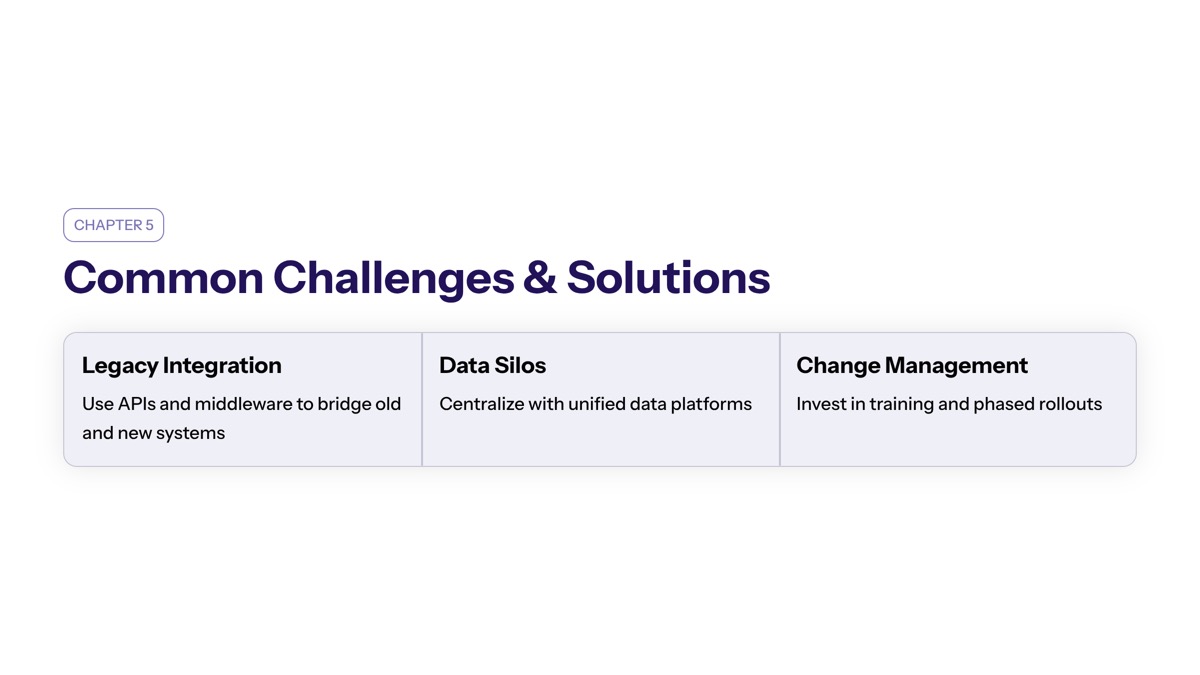
For utilities and energy leaders evaluating custom platforms, tracking tools, compliance automation, or operational visibility software, the next steps are:
Assess current system gaps - identify where legacy systems, manual processes, missing data, or compliance workloads are increasing risk.
Define business objectives - clarify whether the priority is grid modernization, asset management, billing accuracy, carbon reporting, energy efficiency, or customer engagement.
Conduct a technology audit - review SCADA, OT, IT, cloud, edge, cybersecurity, data quality, and integration requirements.
Evaluate internal capabilities - determine whether internal teams can build and maintain the platform or whether external energy software development services are needed.
Develop an implementation roadmap - prioritize pilot applications, integration milestones, compliance controls, and ROI metrics.
Select the right development partner - choose a reliable technology partner with energy industry experience, secure engineering practices, and transparent communication.
Pilot critical applications - start with high-value use cases such as predictive maintenance, compliance automation, real time monitoring, or customer billing modernization.
Related areas to explore include AI-first architecture for predictive analytics, cloud modernization strategies, renewable energy software solutions, and broader energy industry digital transformation frameworks. For sector-specific guidance, visit the energy industry software development page.
Frequently Asked Questions
What is the typical timeline for energy sector software development projects?
A focused energy software project can take 3 to 6 months for an initial pilot, while enterprise-scale platforms may take 12 to 24 months or longer. Timelines depend on legacy system complexity, regulatory requirements, data quality, OT integration, cybersecurity review, and field rollout needs.
A practical approach is to start with a limited, measurable use case such as compliance evidence automation, predictive maintenance dashboards, or smart meter analytics. After the pilot proves value, the platform can expand into broader energy management, asset management, billing, or grid modernization workflows.
How do custom energy platforms integrate with existing SCADA and OT systems?
Custom energy platforms usually integrate with SCADA and OT systems through secure APIs, middleware, protocol gateways, historian connections, edge devices, and controlled data pipelines. New software must support specific protocols like IEC 61850 for substation automation, and many environments also require DNP3, Modbus, MQTT, OPC UA, or vendor-specific connectors.
The safest approach is phased integration. Many utilities begin with read-only operational visibility, then add alerts, workflow automation, and controlled command capabilities only after testing, cybersecurity validation, and operator approval.
What compliance standards must energy software meet?
Energy software must commonly support NERC CIP in North America, the NIS2 Directive in Europe, IEEE 1547-2018 for grid interconnection, IEC 61850 for substation automation, ISO 27001 for information security management, and SOC2 Type II for data protection and operational controls. Energy software solutions must also support environmental regulations, including CO₂, ESG, and GHG reporting standards.
Specific requirements vary by geography, asset type, market role, and whether the software touches critical infrastructure. A utility-grade platform should provide audit trails, role-based access, automated evidence collection, secure remote access, and change management controls.
How can utilities measure ROI from custom software investments?
Utilities can measure ROI through reduced operational costs, lower downtime, fewer compliance findings, improved reliability, better asset utilization, reduced energy waste, faster reporting, and improved customer satisfaction. Predictive maintenance is often one of the clearest ROI areas because AI-driven predictive maintenance can reduce operational downtime in the energy sector by 30–40% and extend the lifespan of expensive assets by up to a decade.
Other useful metrics include SAIDI, SAIFI, billing error rates, self-service adoption, audit preparation hours, demand response performance, forecast accuracy, energy loss reduction, and maintenance cost avoidance.
What security considerations are unique to energy sector software?
Energy sector software is unique because cyber incidents can affect physical infrastructure and public services. Energy grids are high-value targets and must implement zero-trust architectures, multi-factor authentication, and military-grade encryption. Modern energy software development services now include Zero Trust architectures and AI-driven threat detection to isolate compromised systems before breaches escalate.
Security controls should cover IT, OT, vendor access, identity management, network segmentation, encrypted communication, incident response, and audit evidence. In critical environments, cybersecurity is not only an IT issue; it is a grid reliability and national infrastructure safety requirement.
When should utilities choose custom development over commercial energy software packages?
Utilities should choose custom development when operational workflows, compliance requirements, legacy systems, DER complexity, or strategic differentiation cannot be served well by a standard product. Custom energy software is especially valuable for renewable energy integration, custom energy management, advanced analytics, OT integration, and unique regulatory reporting.
Commercial energy software packages are often a better fit for standardized workflows such as basic billing, customer portals, or common compliance templates. Many utilities use a blended strategy: packaged software where standardization is sufficient, custom software where flexibility creates value, and system integration where connectivity is the main challenge.