Enterprise AI Modernization Is Forcing Companies to Fix Technical Debt First
Enterprise AI modernization requires fixing technical debt first because AI systems cannot scale safely on unstable infrastructure, fragmented data, weak security controls, and outdated delivery pipelines. The current collision is straightforward: companies want artificial intelligence, machine learning, enterprise automation, and AI enabled workflows in production, but years of deferred patching, maintenance, integration work, and infrastructure simplification are now blocking measurable progress.
This article explains what that collision means for CIOs, CTOs, enterprise architects, data leaders, compliance officers, and executives shaping enterprise strategy. It focuses on the practical business impact of technical debt, not abstract engineering theory: how legacy systems, outdated infrastructure, data silos, and poor governance frameworks slow AI adoption, increase compliance risks, and drain IT budgets that should be funding digital transformation.
The direct answer is this: companies cannot safely scale AI initiatives on infrastructure laden with unresolved technical debt. Enterprise AI modernization requires fixing technical debt first, or at least addressing technical debt in parallel with AI modernization through disciplined technical debt management, application modernization, and continuous optimization.
Readers will gain four key insights:
Why AI modernization exposes hidden weaknesses in core systems, cloud infrastructure, and enterprise architecture.
How technical debt blocks clean data access, AI governance, security, and operational efficiency.
How to prioritize technical debt remediation by business value, technical risk, and AI readiness.
How to use a structured RAPID-style approach to reduce technical debt while still delivering AI capabilities.
Understanding the Collision Between AI Modernization and Technical Debt
Technical debt is the accumulated cost of shortcuts, aging infrastructure, deferred maintenance, brittle integrations, undocumented dependencies, weak testing, and fragmented systems. In an enterprise context, tech debt is not limited to software development choices. It also includes outdated systems, monolithic application architecture, manual delivery pipelines, inconsistent data governance, poor observability, and security practices that no longer match current business requirements.
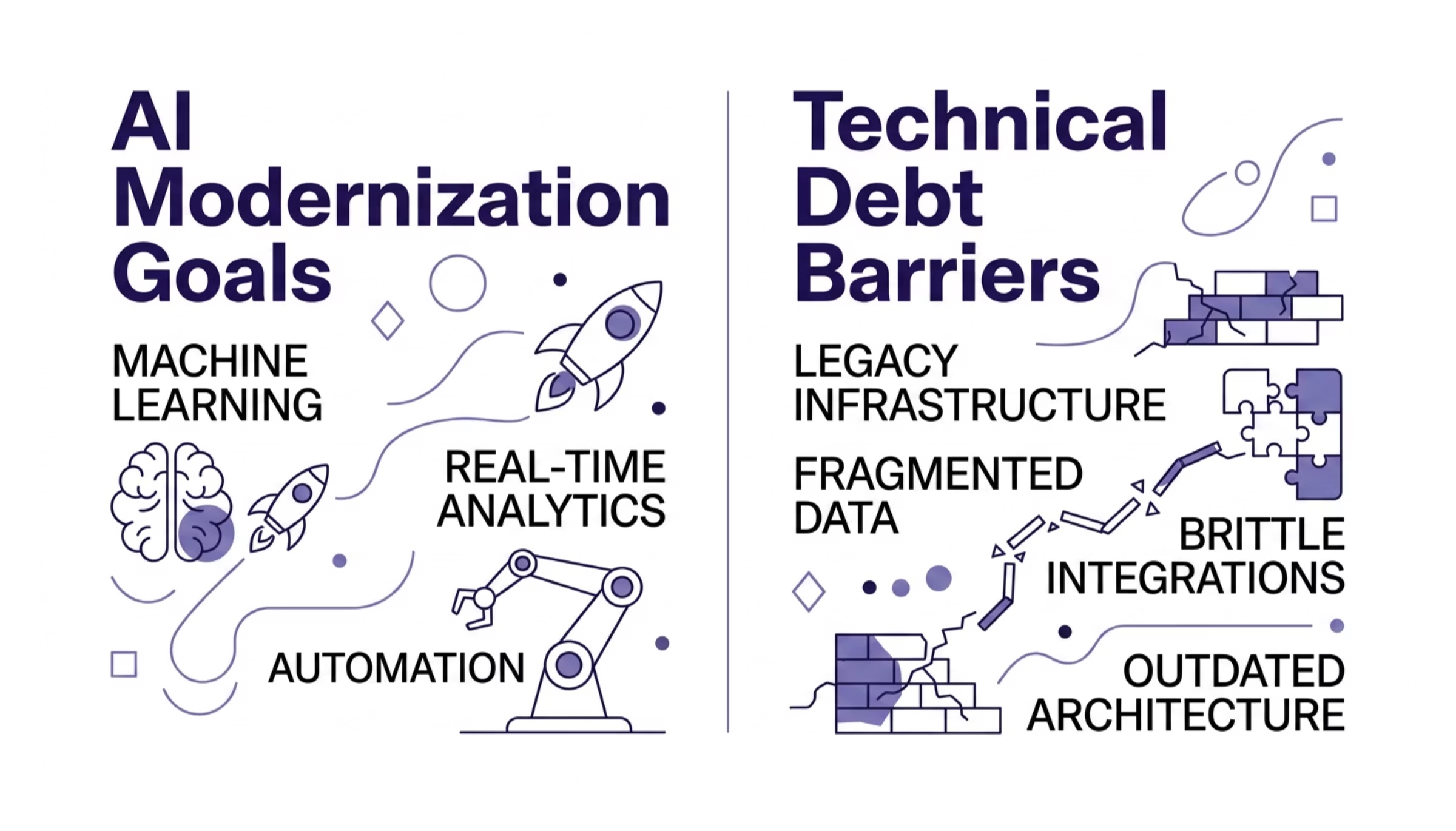
Enterprise AI modernization amplifies these problems instead of hiding them. AI deployments require high-quality, agile infrastructure to avoid bottlenecks in scalability, accuracy, and security caused by legacy technical debt. Fragmented, legacy systems and monoliths complicate integration with modern cloud and AI endpoints, making it difficult to connect models, data products, APIs, and operational workflows across the enterprise tech stack.
The financial stakes are now strategic. Technical debt costs businesses in the United States alone $2.41 trillion per year in lost productivity, inefficiencies, and unseized opportunities, making it a strategic risk that impacts competitiveness, especially in the age of AI.
Technical debt costs businesses in the United States approximately $2.41 trillion per year in lost productivity, inefficiencies, and unseized opportunities. Deloitte’s 2026 Global Technology Leadership Study found that technical debt accounts for 21% to 40% of an organization’s IT spending, which means managing technical debt is now a board-level business strategy issue, not only an IT modernization concern.
In the AI era, all technical debt is becoming AI technical debt, as outdated infrastructure and applications slow down companies’ ability to deploy AI solutions that could reshape their competitive landscape.
Why AI Exposes Hidden Infrastructure Weaknesses
AI requires stable data pipelines, consistent workflows, secure access controls, reliable infrastructure, and well-governed enterprise architecture. Legacy systems often operate with fragile integrations, inconsistent schemas, limited automation, and unclear ownership. Those weaknesses may be tolerable for batch reports or isolated business applications, but they become operational risks when AI systems depend on them for real-time decisions, predictions, recommendations, or autonomous actions.
AI systems require clean, integrated data and agile infrastructure to function effectively; technical debt manifested as data silos and outdated systems can significantly hinder AI adoption and innovation. If customer, product, claims, finance, or supply chain data is trapped in disconnected systems, an AI model may produce incomplete, biased, delayed, or misleading outputs. Rushed development results in fragmented data silos, leading to inconsistent naming conventions and messy legacy databases.
Modern deep learning and machine learning workloads make this even harder. Deploying modern deep learning models necessitates flexible and scalable infrastructure, a challenge posed by rigid legacy systems. Organizations also struggle to monitor how changing environmental data impacts model behavior over time without continuous monitoring tools, which creates model drift, accuracy decay, and quality assurance gaps.
The Modernization Pressure Collision
The collision is created by two opposing forces. On one side, business leaders want AI solutions now because competitors, investors, customers, and internal teams expect AI capabilities to improve operational efficiency, cost optimization, and data driven decision making. On the other side, enterprise technology teams know that unresolved tech debt makes production AI unsafe, unreliable, and difficult to govern.
Most enterprises lack centralized AI governance, leading to patchwork solutions and integration challenges when multiple business units deploy AI independently. This creates shadow AI, duplicated tooling, unmanaged code generation, inconsistent controls, and new AI technical debt layered on top of existing operational drag.
Rushed AI implementation may appear to accelerate modernization, but it often slows innovation later. AI pipelines that interface with aging infrastructure amplify vulnerabilities and compliance exposures, especially in regulated environments.
Without centralized technical debt management, security hygiene, cloud migration discipline, and governance frameworks, companies may gain quick prototypes but lose long term scalability, business resilience, and competitive advantage.
How Technical Debt Blocks AI Modernization Success
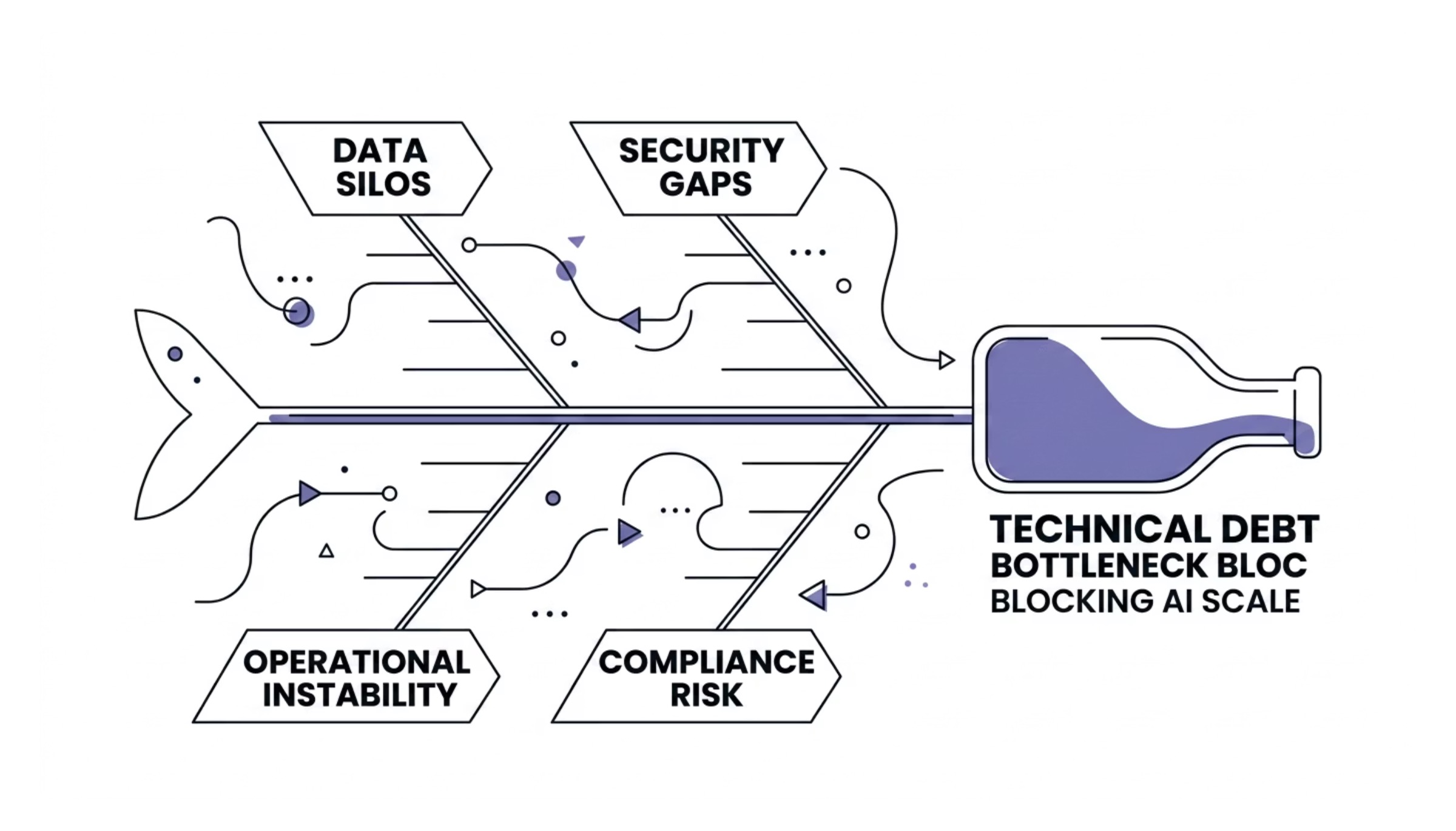
Technical debt blocks enterprise AI modernization in three primary ways: it prevents access to trusted data, increases security and compliance risks, and undermines operational stability. These are not isolated engineering concerns. They affect the company’s ability to deliver measurable business outcomes from artificial intelligence investments.
Data Infrastructure and Integration Challenges
AI depends on clean, connected, timely, and explainable data. Legacy system integration failures prevent AI from accessing clean, reliable data because many core systems were never designed for modern APIs, cloud infrastructure, streaming events, or AI endpoints.
Siloed data architectures then block enterprise-wide AI deployment because each business unit may define customers, transactions, assets, or risks differently.
Data governance becomes especially important when AI systems move from experimentation to production.
Without consistent lineage, access control, metadata, and data quality rules, AI adoption becomes limited to small pilots rather than scalable enterprise automation. A model trained on inconsistent data may appear useful in a proof of concept but fail when exposed to real business requirements.
Application modernization and cloud journey planning help resolve these constraints. Instead of replacing legacy systems all at once, many enterprises can wrap core systems with secure APIs, modernize integration layers, optimize cloud platforms, and build governed data products that support AI enablement across the organization.
Security and Compliance Risks
Technical debt creates security debt. Unpatched operating systems, outdated encryption, weak identity and access management, missing audit trails, and inconsistent monitoring all become more dangerous when AI systems process sensitive information or automate decisions.
AI pipelines that interface with aging infrastructure amplify vulnerabilities and compliance exposures, especially in regulated environments. This matters in healthcare, financial services, insurance, telecommunications, and public sector settings where explainability, privacy, model governance, and traceable data lineage are mandatory. Compliance risks can stop AI deployments even when the model itself performs well.
Security modernization must therefore be part of enterprise AI modernization. Patching, access controls, encryption, zero-trust patterns, secure DevOps, automated code scanning, third-party risk management, and continuous compliance validation are not optional technical chores. They are prerequisites for trustworthy AI systems and sustainable value.
Operational Stability and Performance Issues
AI systems place new demands on infrastructure reliability, compute capacity, storage performance, observability, and delivery pipelines. Legacy applications often have low automation and weak regression testing, increasing the risk of systemic failure. When AI services are connected to brittle systems, small defects can cascade across business processes.
Operational instability also affects costs. Technical debt consumes budget through operational overhead, manual workarounds, rework, incident response, and maintenance of redundant systems. Gartner projected that enterprises would direct 40% of IT budgets toward technical debt by 2025, highlighting the financial impact of legacy systems on modernization efforts.
That budget pressure limits innovation capacity. If IT budgets are spent keeping outdated infrastructure alive, fewer resources remain for AI infrastructure, platform engineering, cloud migration, data governance, and quality assurance. The result is a cycle where tech debt slows AI modernization, and rushed AI modernization creates even more tech debt.
Strategic Framework for Managing AI Modernization and Technical Debt
Enterprises do not need to eliminate technical debt before pursuing AI. In most cases, trying to eliminate technical debt completely before building AI capabilities would delay business value for too long.
The better approach is parallel modernization: identify the debt that directly blocks AI readiness, address it through structured technical debt remediation, and deliver targeted AI pilots with governance built in.
Companies that are well-positioned for change typically have a reinvention-ready digital core, which includes modernized cloud infrastructure, integrated data systems, and AI-enabled platforms that are modular and flexible.
A reinvention-ready digital core allows organizations to upgrade components without disrupting the entire system, ensuring agility and adaptability in the face of emerging technologies.
High-performing companies allocate approximately 15% of their IT budgets to technical debt remediation, which is essential for maintaining a robust digital core that supports ongoing innovation.
Organizations that are well-positioned for change typically set aside around 15% of their IT budgets for technical debt remediation, indicating a proactive approach to managing modernization efforts.
High-performing companies allocate about 15% of their IT budgets to technical debt remediation, ensuring that legacy systems do not accumulate into insurmountable liabilities.
Continuous application modernization is the ongoing, structured improvement of enterprise software systems, aimed at reducing technical debt and aligning applications with evolving cloud, AI, and business requirements.
Continuous application modernization reduces technical debt by making it visible, scoring it by business impact, and resolving it through repeatable improvement cycles, rather than waiting for major transformation programs.
Organizations that adopt continuous application modernization can improve their operational efficiency, reduce maintenance costs, and enhance their ability to innovate by systematically addressing technical debt.
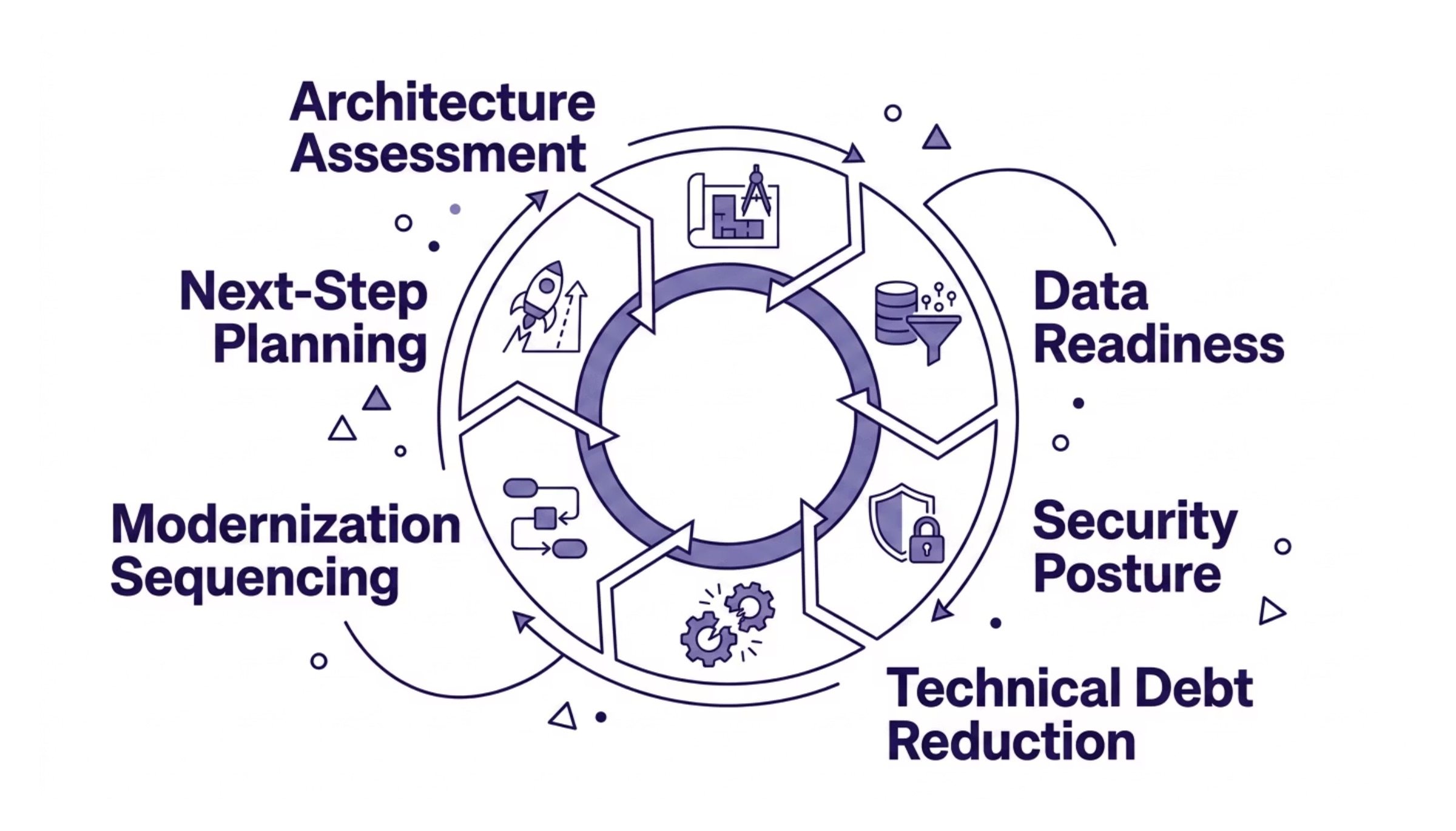
The RAPID Assessment and Prioritization Method
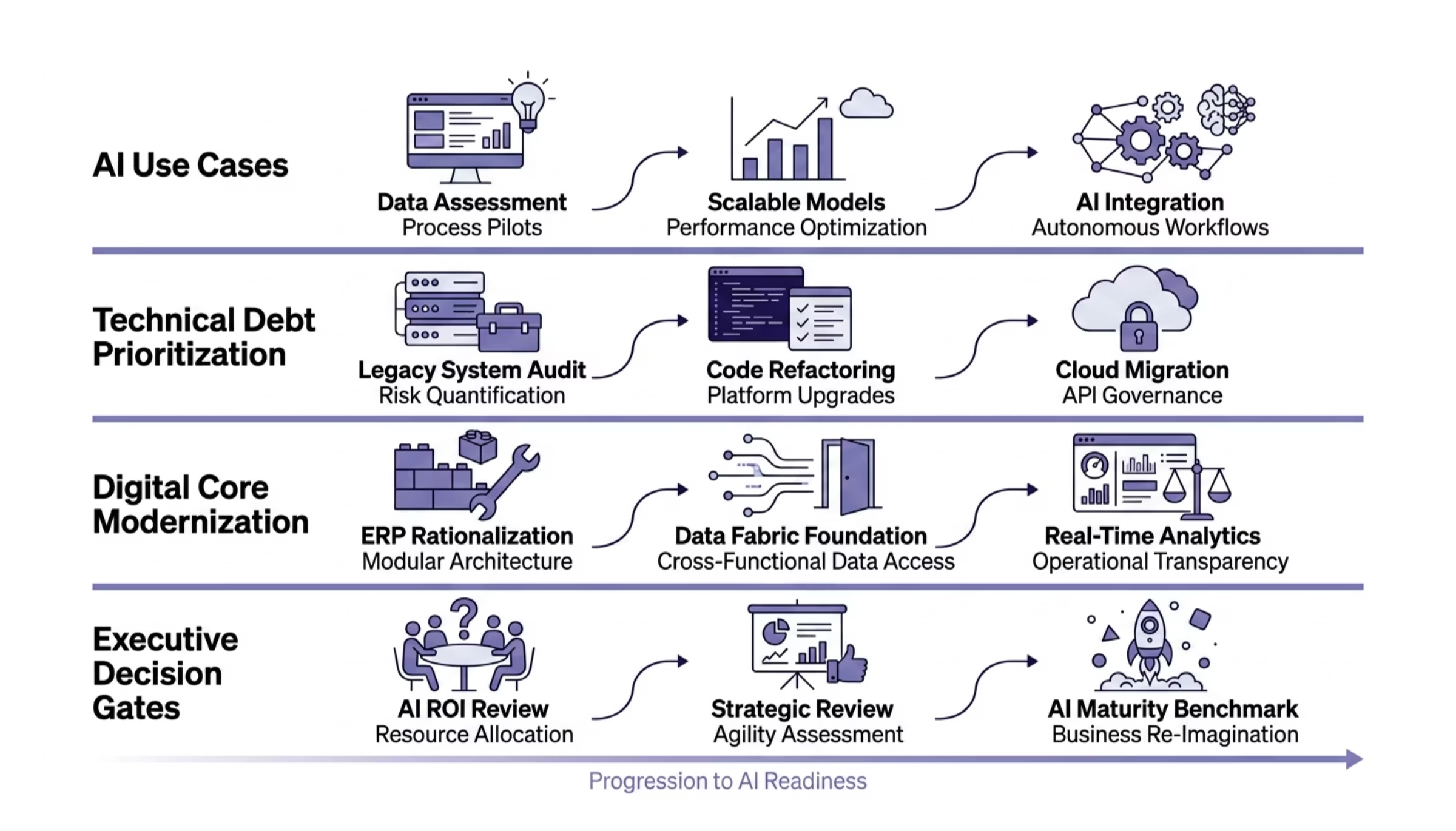
A RAPID assessment helps leaders connect enterprise AI modernization to technical debt reduction without turning modernization efforts into an open-ended infrastructure program. It is most useful when business units are already pushing AI use cases, but IT leaders see unresolved risks across applications, data, infrastructure, integrations, and security.
Recognize business pressure and technical debt impact on AI readiness. Identify which AI initiatives are most important to business goals, then map the legacy systems, data silos, cloud infrastructure gaps, and governance frameworks that could block them.
Assess current infrastructure stability, security posture, and integration capabilities. Review core systems, delivery pipelines, data management, testing, observability, access controls, and compliance risks. A structured modernization approach can address technical debt across multiple dimensions, including application architecture, integrations, testing, infrastructure, and data management, leading to systematic improvements.
Prioritize modernization initiatives by business value and technical risk. Not all tech debt is equal. Focus first on debt that creates operational risks, blocks AI adoption, undermines security, or prevents measurable business outcomes.
Implement foundational improvements alongside targeted AI pilot projects. Effective modernization frameworks emphasize the importance of continuous improvement and iterative approaches, allowing organizations to tackle technical debt incrementally while investing in new technologies.
Deploy measured improvements with governance and security built-in. Use data governance, quality assurance, monitoring, model oversight, and continuous modernization practices to prevent new AI technical debt from accumulating.
This approach allows leaders to manage tech debt while still proving value. It also aligns technology strategy with business strategy, turning modernization roadmaps into a practical path toward sustainable AI capabilities.
Modernization Approach Comparison
Approach | Technical Debt Strategy | AI Readiness Timeline | Business Risk Level |
|---|---|---|---|
Sequential (Fix Then Build) | Address all debt first | 18-36 months | Low technical, high competitive |
Parallel Modernization | Target critical debt blocking AI | 6-12 months | Moderate, managed |
Rush AI Implementation | Ignore existing debt | 3-6 months | High technical and operational |
Sequential modernization reduces technical risk, but it may slow business agility and delay competitive advantage. Rush AI implementation can create the appearance of speed, but it increases operational risks, compliance risks, and integration failures. Parallel modernization is usually the strongest enterprise strategy because it ties technical debt remediation to AI enablement and business value.
The right choice depends on risk tolerance, regulatory exposure, current AI readiness, cloud journey maturity, and available IT budgets. Leaders should use internal metrics, Deloitte benchmarks, IDC research, and IDC research shows-style market analysis to compare their environment against industry patterns, but the decision should ultimately be based on the organization’s own business requirements and modernization constraints.
Common Challenges and Practical Solutions
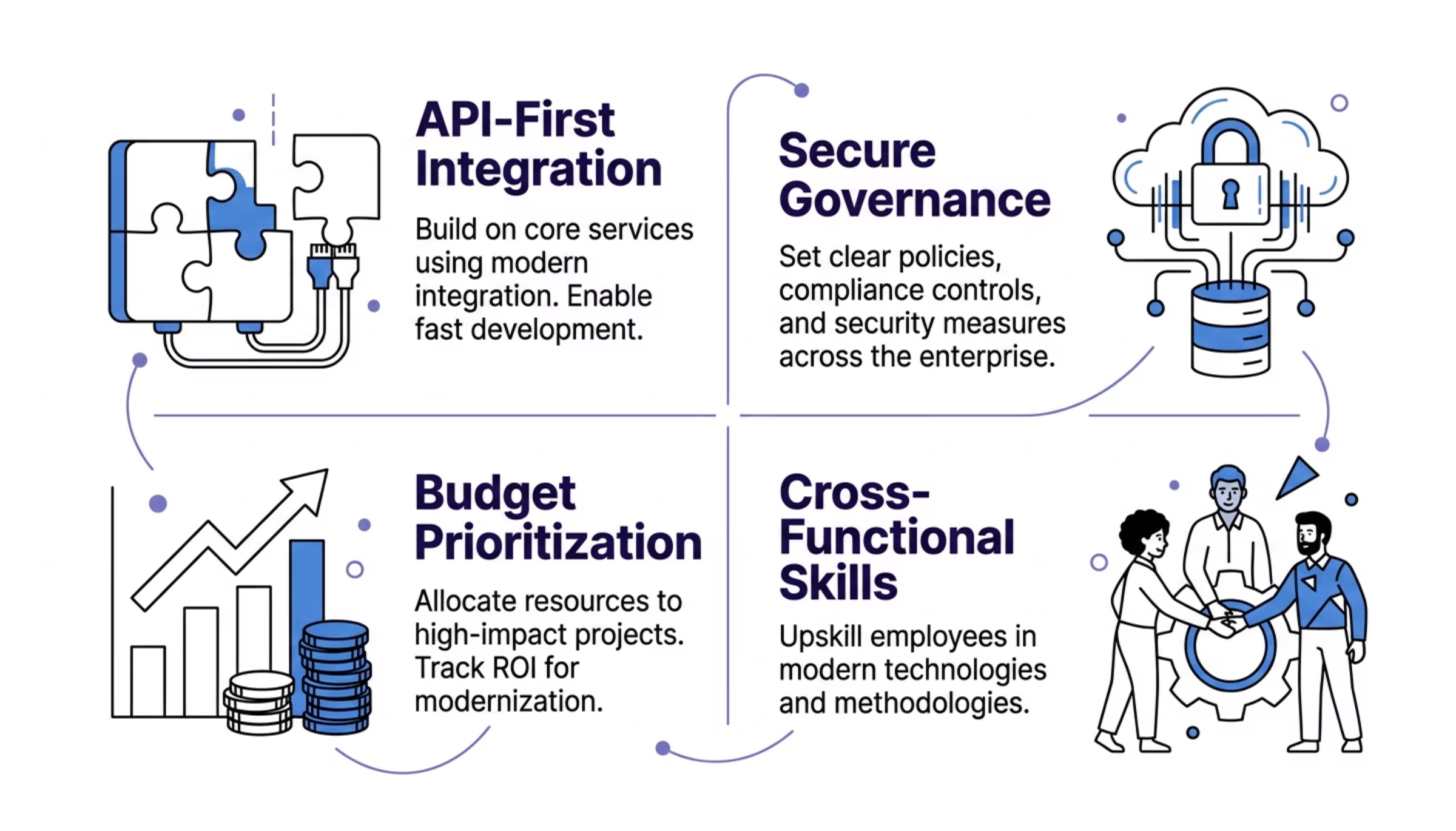
The most common collision points are predictable: legacy systems block data access, security debt creates AI governance exposure, budget constraints force false trade offs, and teams lack the combined skills needed for both legacy maintenance and AI implementation.
Managing technical debt well means resolving these issues through incremental modernization, not waiting for a single large transformation program.
Legacy System Integration Blocking AI Data Access
The practical solution is API-first modernization. Instead of replacing legacy systems immediately, enterprises can create secure interface layers, modern integration patterns, and governed data access paths that allow AI systems to use trusted information without destabilizing core systems.
This supports application modernization while preserving business continuity. Over time, organizations can decide where replacing legacy systems is necessary and where wrapping, refactoring, replatforming, or optimizing cloud infrastructure delivers enough business value.
Security Debt Creating AI Governance Risks
Security debt must be treated as a foundation for AI governance. Start with patching, identity and access controls, logging, encryption, vulnerability management, monitoring, and auditability. Then connect those controls to AI-specific governance frameworks for model approval, data lineage, explainability, privacy, and drift monitoring.
This reduces compliance risks while improving business resilience. It also prevents AI pipelines from becoming another unmanaged layer in an already complex tech stack.
Budget Constraints Forcing Either-Or Decisions
Many enterprises frame the issue as a choice between technical debt reduction and AI innovation. That framing is usually wrong. The better approach is to fund modernization investments that both reduce technical debt and enable AI capabilities.
For example, improving data governance, modernizing integrations, strengthening testing, and optimizing cloud infrastructure can reduce maintenance costs while accelerating AI adoption. This creates cost optimization and measurable progress rather than a competition between run-the-business and transform-the-business spending.
Skills Gaps in Both Legacy Maintenance and AI Implementation
AI modernization requires teams that understand both old and new technologies. Many organizations have specialists in legacy systems, cloud migration, software development, platform engineering, data governance, or machine learning, but not enough people who can connect these disciplines into a coherent enterprise architecture.
Partnering with experienced modernization teams can help. The right partner should understand technical debt management, AI infrastructure, secure delivery pipelines, compliance requirements, business strategy, and long term scalability.
Organizations that proactively manage technical debt are better equipped to adapt to disruption, integrate AI solutions faster, and pivot more effectively when markets shift.
Conclusion and Next Steps
Enterprise AI modernization is not only an AI challenge. It is a technical debt management challenge, an enterprise architecture challenge, a security challenge, and a business strategy challenge. Companies cannot scale production AI safely on top of unstable infrastructure, disconnected data, weak governance, and outdated systems.
The strongest path is not to pause AI until every legacy issue is fixed. It is to address technical debt strategically and continuously, focusing first on the debt that blocks AI readiness, creates operational drag, increases compliance risks, or limits business value. Managing technical debt is directly linked to business resilience, adaptability, and growth in the AI era, as it impacts the ability to deploy AI solutions effectively.
Immediate next steps:
Assess current technical debt impact on AI readiness. Map the applications, integrations, data silos, infrastructure gaps, and security weaknesses that affect priority AI use cases.
Prioritize infrastructure improvements that enable both stability and AI capabilities. Focus technical debt remediation on areas with clear business impact and measurable business outcomes.
Adopt continuous application modernization. Use repeatable cycles to reduce technical debt, improve operational efficiency, and remain agile as business requirements change.
Build governance frameworks that prevent new AI technical debt. Centralize AI governance, monitor models and data pipelines, enforce quality assurance, and control code generation practices.
Align modernization roadmaps with enterprise strategy. Tie AI modernization, cloud migration, cost optimization, and technical debt reduction to shared business goals.
Related areas to explore next include AI-first architecture design, secure modernization for regulated industries, platform engineering for AI infrastructure, and measuring ROI from parallel modernization initiatives. The companies that manage this collision well will not just deploy AI faster; they will build the digital core needed for continuous modernization and sustainable value.