Enterprise Software Development Services: Complete Guide for Business Leaders
Enterprise software development services encompass custom software engineering, system integration, and digital transformation consulting designed to modernize complex business operations and improve organizational efficiency. For organizations evaluating platform modernization, AI enablement, or complex system integration, these services help turn fragmented technology into secure, scalable enterprise systems.
This guide covers core service categories, implementation methodologies, technology considerations, and vendor selection criteria. It focuses on enterprise software development for mid-market and enterprise companies, not generic software development, basic SaaS subscriptions, or simple mobile app development projects. The intended readers are CIOs planning digital transformation, CTOs assessing a technology stack, enterprise architects responsible for integrating complex systems, and business leaders evaluating custom enterprise software investments.
Enterprise software development services help organizations build secure, scalable platforms that integrate seamlessly with existing systems, automate complex workflows, and deliver measurable business outcomes through strategic technology implementation. A qualified enterprise software development partner provides the technical expertise, deep industry knowledge, and project management discipline needed to connect technology decisions with business objectives.
For a broader service overview, see our guide to enterprise software development.
Readers will learn:
What enterprise software development services include and when they are needed
How custom enterprise software development differs from off-the-shelf software
Which service categories support digital transformation, data integration, and operational efficiency
How implementation frameworks like RAPID reduce delivery risk
How to evaluate an enterprise software development company based on experience, security, scalability, and long-term value
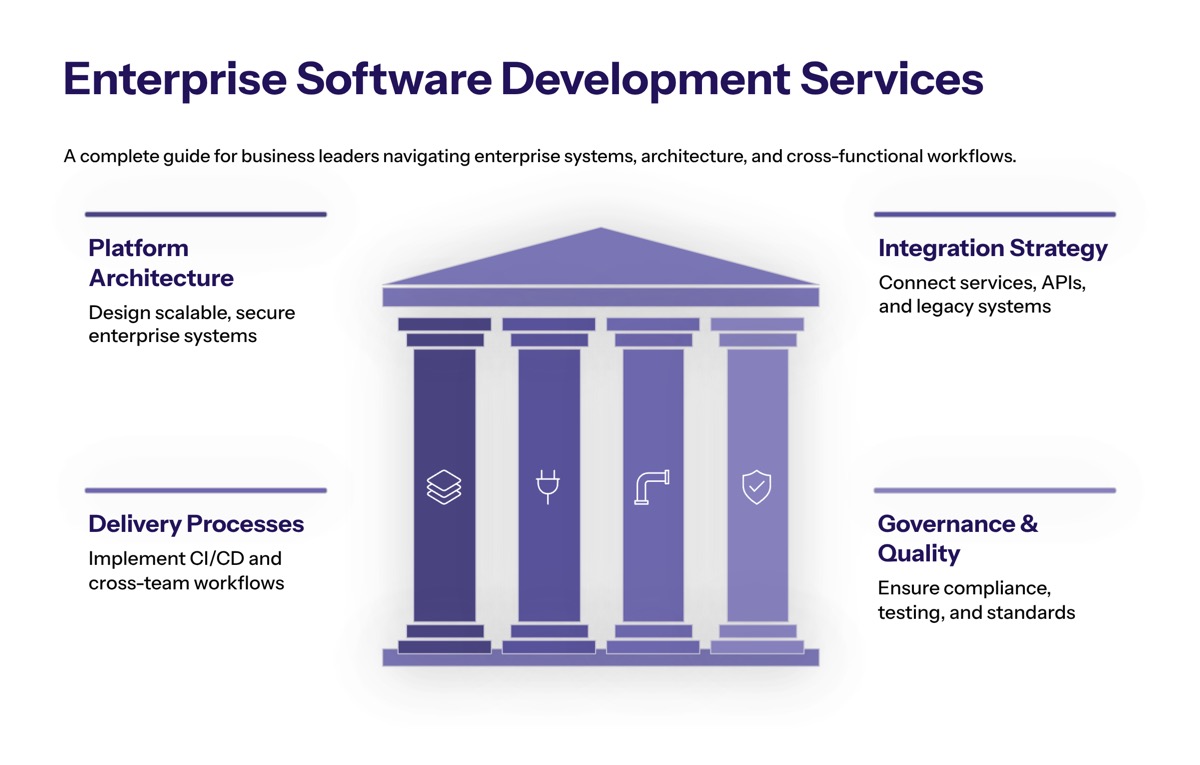
Understanding Enterprise Software Development Services
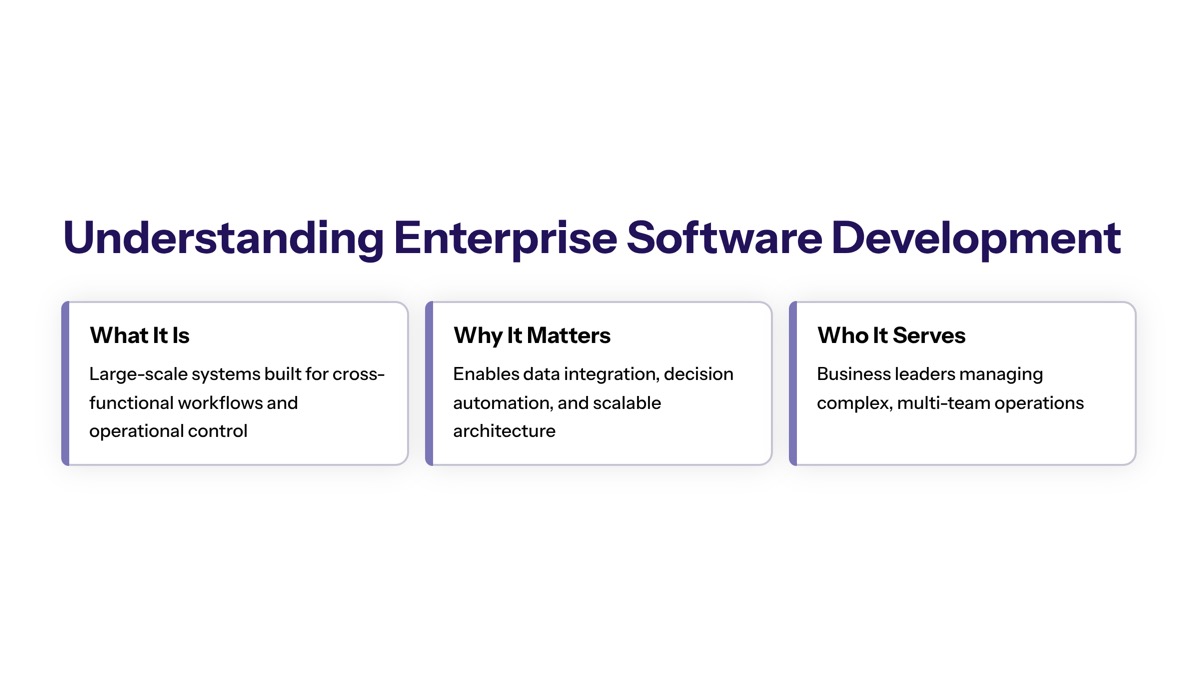
Enterprise software development services are specialized consulting and engineering services focused on designing, building, deploying, and maintaining large-scale software systems tailored to meet the complex operational needs of enterprises. These services include custom enterprise software development, enterprise application software modernization, system integration, cloud migration, data analytics, and secure platform development.
Unlike small business applications, enterprise software must support multiple departments, high transaction volumes, complex permissions, compliance obligations, and long-term maintainability. Enterprise software development companies provide a broad range of services aimed at optimizing business processes, enhancing user experiences, and ensuring scalability across business operations.
Enterprise software is especially relevant when organizations face regulatory compliance demands, data security requirements, workflow complexity, legacy system constraints, or fragmented software ecosystems. Enterprises are prime targets for cyberattacks and face strict regulatory laws such as GDPR or HIPAA, which makes security and compliance non-negotiable for enterprise software projects.
Enterprise systems often centralize data and provide real-time dashboards and analytics, helping executives make faster decisions. Implementing enterprise software enhances data visibility and control, allowing organizations to make informed decisions based on real-time data analytics and reporting. Enterprise software solutions also improve collaboration across departments by integrating various business functions, which helps eliminate data silos and enhances communication.
Custom Enterprise Software Development
Custom enterprise software development means building tailored software platforms around specific business processes, operational requirements, data models, and industry workflows. These custom enterprise software solutions are designed for organizations whose needs cannot be met by standard tools or basic SaaS products.
Off-the-shelf software often fails to meet the demands of enterprise growth, while custom solutions are engineered to handle increases in users, data volume, and transactions. This matters in healthcare, finance, manufacturing, logistics, and other regulated or operationally complex industries where enterprise applications must support core business functions such as enterprise resource planning, customer relationship management, supply chain management, business intelligence, and compliance reporting.
For example:
ERP: Enterprise Resource Planning manages core business processes like finance, HR, and manufacturing.
CRM: Customer Relationship Management tracks interactions with clients.
BI: Business Intelligence systems analyze datasets to guide decision-making.
SCM: Supply Chain Management optimizes goods flow.
HRM: Human Resource Management handles payroll, recruitment, and employee performance tracking.
Custom enterprise software can include advanced features such as predictive analytics, role-based dashboards, collaboration tools, digital asset management, advanced analytics tools, and automated approval workflows. Implementing robust reporting and analytics capabilities in enterprise software allows business owners to track performance in real-time, facilitating informed decision-making.
Custom enterprise software requires continuous upkeep and should be viewed as a long-term investment rather than a one-time cost. That long-term view affects architecture, quality assurance, security controls, project scope, and post-launch support planning.
Legacy System Modernization
Legacy system modernization means upgrading outdated technology stacks while preserving critical data, business logic, and operational continuity. Many enterprise companies still rely on legacy systems built on monolithic architectures, mainframes, outdated databases, or older programming languages. These systems may still run essential business operations, but they often limit scalability, usability, data integration, and cost efficiency.
Modernizing legacy systems can significantly reduce maintenance costs and improve overall performance by addressing usability and scalability issues. Legacy system modernization often involves a range of strategies, including code refactoring, functionality upgrades, and UX/UI design updates to enhance user experience.
Organizations that modernize their legacy systems can achieve better integration with new technologies, enabling improved data flow and operational efficiency across their tech ecosystem. This is especially important when enterprises need cloud solutions, artificial intelligence, real-time data analytics, or API-based integration with existing applications.
Legacy modernization also supports business continuity. Rather than replacing everything at once, many enterprise software projects use phased modernization, API encapsulation, data migration, refactoring, or selective replacement. These approaches allow organizations to maintain operational stability while gaining modern capabilities like AI integration, cloud scalability, improved usability, and stronger security.
These foundational services form the building blocks for comprehensive enterprise transformation strategies.
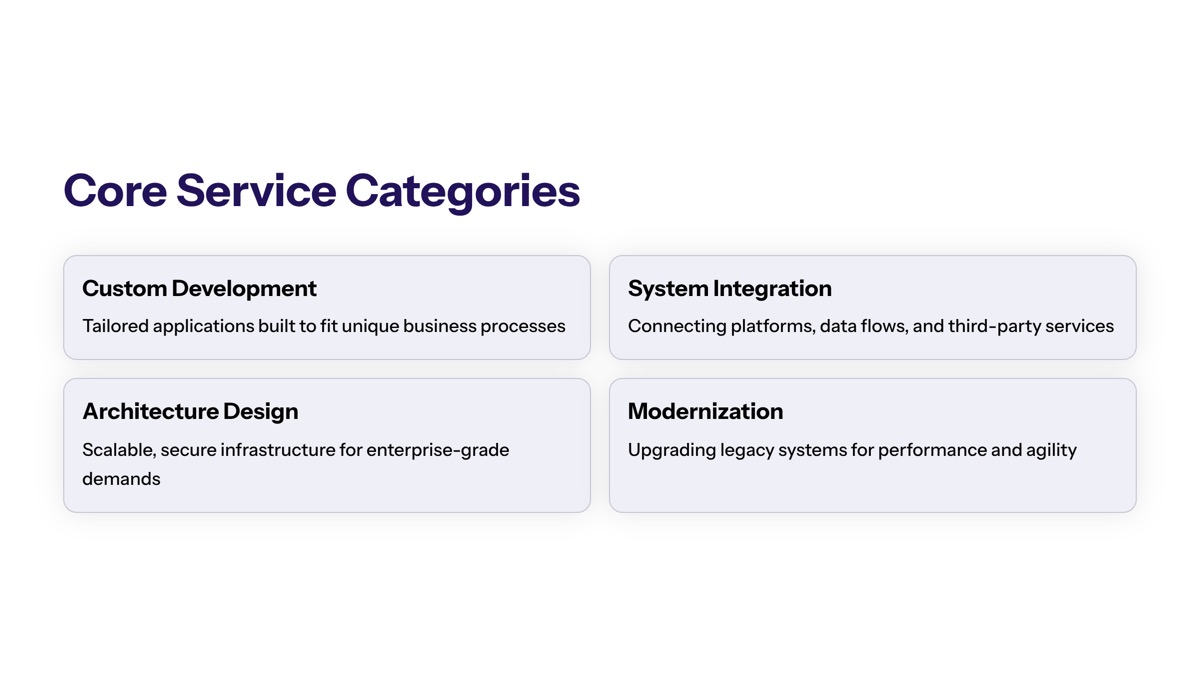
Core Enterprise Software Development Service Categories
Building on the foundational understanding, enterprise software development services typically fall into distinct categories that address specific business and technical challenges. Common services offered by enterprise software development agencies include custom software development, system integration, cloud migration, and application modernization.
Enterprise software development consulting services also provide strategic guidance to organizations looking to optimize their digital infrastructure or launch new software initiatives. The right service mix depends on business needs, project scope, regulatory exposure, existing systems, and the organization’s long-term IT strategy.
AI-First Architecture and Automation
AI-first architecture means designing enterprise software with artificial intelligence capabilities built into the foundation rather than added later as isolated features. This can include workflow automation, predictive analytics, intelligent decision support, anomaly detection, advanced analytics tools, and AI-assisted customer or operational insights.
The focus should be practical business value rather than AI implementation for its own sake. In healthcare, AI-first enterprise software may help analyze patient data, support diagnostics, and automate secure records workflows. In financial services, AI can improve risk assessment, fraud detection, credit decisioning, and compliance monitoring. In supply chain systems, AI can support demand forecasting, route optimization, inventory planning, and real-time exception management.
Integrating AI with cloud technologies enables organizations to leverage scalable computing resources, enhancing the performance and efficiency of AI applications. Cloud platforms provide the necessary infrastructure for deploying AI models, allowing businesses to process large datasets and perform complex computations without significant upfront investment in hardware. The combination of AI and cloud computing facilitates real-time data analysis and decision-making, which is crucial for enterprises aiming to improve operational efficiency and responsiveness to market changes.
AI-first enterprise development also requires governance. Models, data pipelines, access controls, auditability, and human oversight must be aligned with the enterprise architecture. Without that discipline, AI features can become fragmented, hard to audit, and disconnected from measurable business outcomes.
System Integration and Data Platform Development
System integration services ensure that various enterprise platforms, such as ERP and CRM systems, communicate seamlessly and operate as a cohesive ecosystem. This often includes connecting enterprise resource planning platforms, customer relationship management systems, BI tools, supply chain management platforms, HRM systems, project management software, collaboration tools, and specialized industry applications.
The objective is to eliminate data silos and improve cross-functional visibility. When data integration is handled correctly, executives and operational teams gain actionable insights from consistent, governed, and timely data. Enterprise systems centralize data and provide real-time dashboards and analytics, helping executives make faster decisions across finance, operations, sales, compliance, and customer service.
Enterprise software should be designed to integrate seamlessly with existing applications and utilize industry standards for data exchange protocols and security to enhance interoperability. This often involves APIs, middleware, event streaming, cloud services, data lakes, data warehouses, master data management, and governance controls.
System integration also connects directly to cloud migration and multi-platform data governance. Major cloud providers offer scalable cloud solutions and cloud computing services that support real-time analytics, high-availability architectures, and secure data processing. However, integration design must account for data residency, compliance, access control, latency, and the long-term software ecosystem.
Secure Platform Development and Compliance
Secure platform development means building enterprise software with security-first design principles from the start. This includes identity and access management, encryption, audit trails, vulnerability scanning, secure APIs, logging, least-privilege access, secure software development lifecycle practices, and compliance-ready documentation.
Security and compliance are non-negotiable for enterprise software projects, especially in regulated industries, making it essential to choose an agency that incorporates rigorous security protocols and compliance certifications into their solutions. Relevant requirements may include HIPAA for healthcare, SOC 2 for service organizations, PCI for payments, SOX for public company financial controls, and GDPR for privacy obligations.
Data security is not only a technical requirement. It is also a business risk issue. Security threats are a major concern for enterprise software, necessitating robust measures to protect against malicious actors who could disrupt operations or steal sensitive information.
Usability also belongs in secure platform design. Usability is a key factor in enterprise software development; if users struggle with the interface, they are less likely to utilize the software effectively, which can hinder productivity. Poor usability can also create security workarounds, incomplete data entry, and operational inefficiencies.
These service categories require structured implementation approaches to ensure successful delivery and measurable business outcomes.
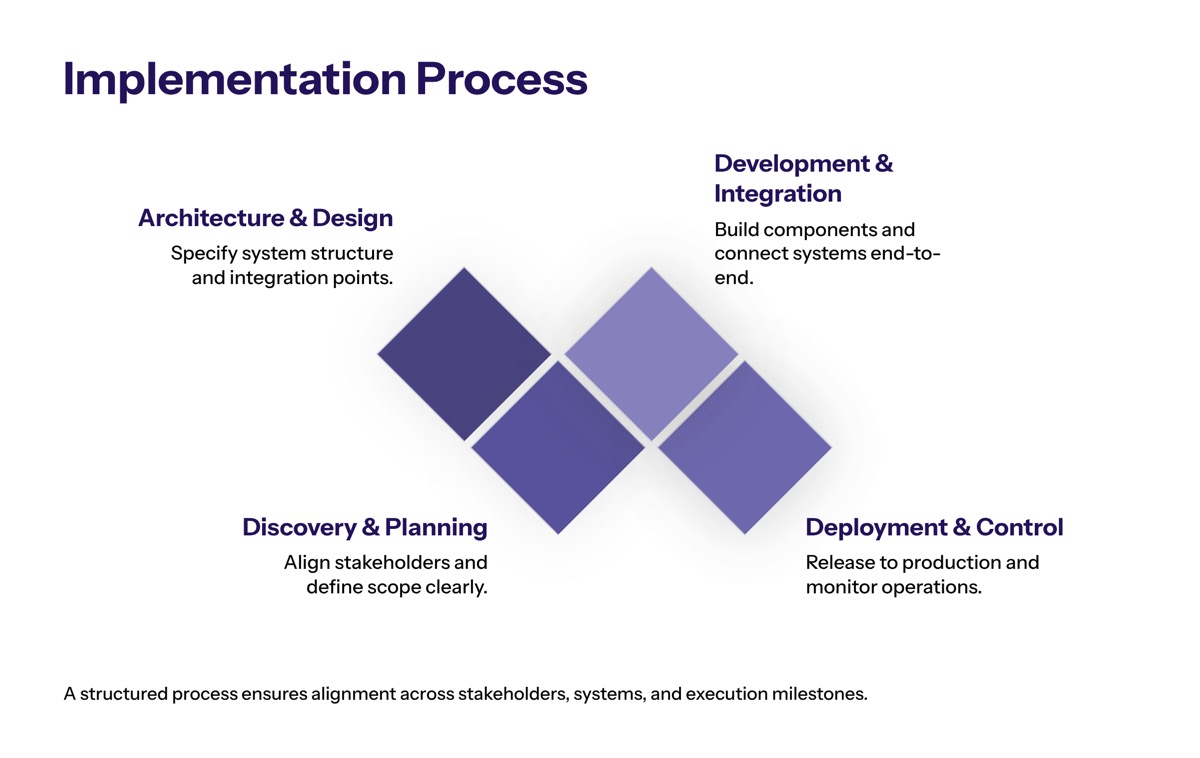
Enterprise Software Development Implementation Process
Successful enterprise software development follows proven methodologies that balance technical requirements with business objectives, user adoption, security, scalability, and risk management. Because enterprise software projects affect core business functions, implementation must be planned around both technology and organizational change.
Designing enterprise software with scalability in mind is crucial to ensure that the software can handle increased user loads and additional features without performance degradation. Scalability is also a significant challenge for enterprise software, as organizations must address potential surges in usage or changing utilization patterns over time.
RAPID Framework Implementation
Cognativ’s RAPID framework provides a structured approach for moving from business pressure to controlled implementation. It helps enterprise teams define the problem, reduce uncertainty, manage project scope, and move through the software development lifecycle with clear accountability.
Requirements gathering and business process analysis - RESEARCH
The process starts by mapping business processes, current workflows, user roles, dependencies, data flows, integration points, compliance obligations, and operational pain points. This step identifies where enterprise software solutions can streamline operations, reduce manual work, and enhance operational efficiency.Architecture design with security and scalability considerations - ANALIZE
Architecture decisions define the technology stack, integration model, cloud solutions, hosting approach, data security controls, and scalability path. Evaluation of a provider should include their expertise with modern frameworks and programming languages relevant to the long-term IT strategy.Phased development with iterative testing and stakeholder feedback - PLAN
Enterprise software development benefits from iterative delivery because complex projects change as stakeholders validate assumptions. Understanding the development methodologies employed by an agency is key to ensuring efficient project management, as these methodologies influence how the agency adapts to changes and ensures timely delivery.Integration testing with existing systems and data migration - IMPLEMENT
Integration testing verifies that enterprise applications work with legacy systems, ERP software, CRM platforms, business intelligence tools, and other existing systems. Data migration must preserve accuracy, lineage, access permissions, reporting logic, and business continuity.Deployment with performance monitoring and user training - DECIDE
Deployment includes production rollout, monitoring, quality assurance, user enablement, and support planning. Effective communication and collaboration between client teams and the enterprise software development agency are fundamental to project success, requiring regular status updates and transparent reporting.
Service Provider Evaluation Criteria
Selecting an enterprise software development company requires more than comparing hourly rates. Companies must align long-term business goals with a provider’s technical expertise and security standards when selecting enterprise software development services.
When selecting an enterprise software development agency, it is crucial to assess their experience within your specific industry, as this ensures they understand unique regulatory requirements and operational workflows. A proven track record and relevant case studies can provide insight into an agency’s ability to deliver successful outcomes, showcasing their problem-solving approach and quality standards.
Criterion | Enterprise-Grade Provider | Basic Development Shop |
|---|---|---|
Industry Experience | Deep industry expertise in regulated sectors and complex business operations | Generic application development with limited domain context |
Security Practices | Compliance certifications, audit trails, data security controls, secure SDLC, and privacy-aware architecture | Standard security measures applied late in the project |
Integration Capabilities | Legacy system expertise, API development, data integration, cloud migration, and experience integrating complex systems | Limited integration experience beyond simple third-party connectors |
Technical Expertise | Modern frameworks, programming languages, cloud services, AI, data analytics, and scalable solutions aligned to long-term IT strategy | Narrow technology stack or short-term delivery focus |
Delivery Discipline | Structured project management, quality assurance, phased delivery, transparent reporting, and change control | Informal process with higher risk of missed timelines or scope drift |
Post-Launch Support | Ongoing modernization, performance optimization, user support, monitoring, and roadmap planning | Basic maintenance only |
The right enterprise software development partner should bring specialized expertise, technical excellence, strategic guidance, and a delivery model that matches the organization’s compliance requirements, business objectives, and future growth plans.
Even with structured approaches, enterprise software projects face predictable obstacles that require proactive management.
Common Challenges and Solutions
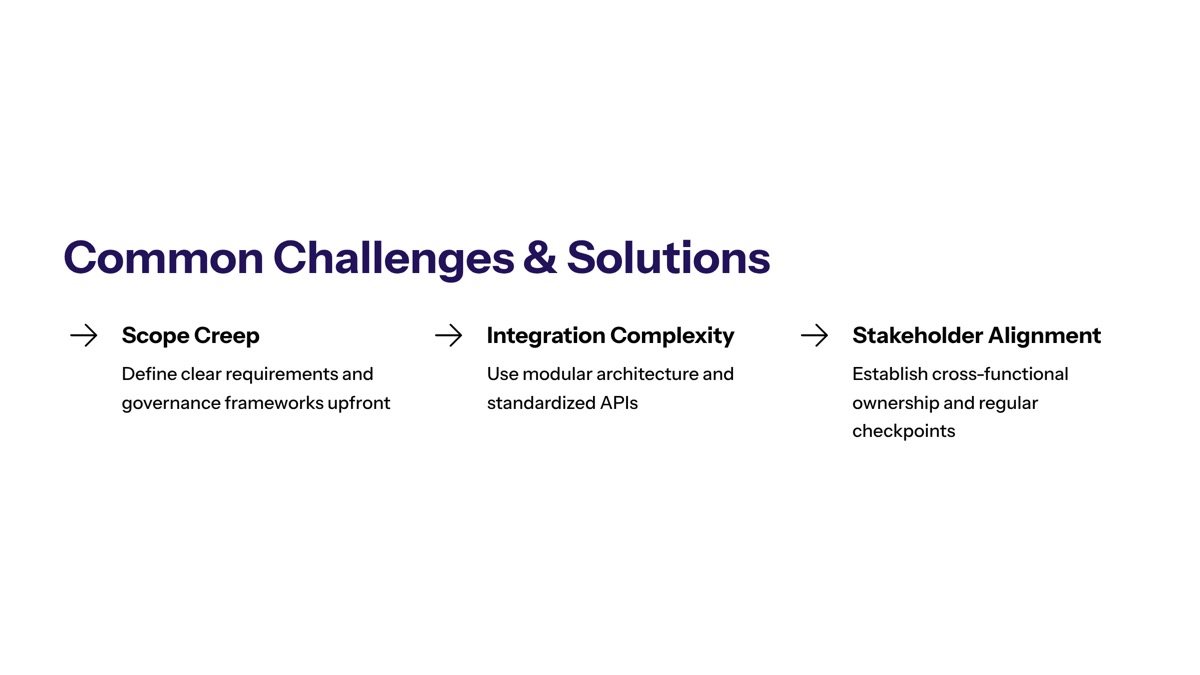
Enterprise software development involves complex technical and organizational challenges that can derail projects without proper planning and expertise. Common challenges in enterprise software include compatibility issues, scalability, security threats, insufficient user training, and data integration difficulties.
Enterprise applications often face compatibility issues due to complex and ever-changing feature sets, requiring ongoing management to ensure systems interact properly. These risks increase when multiple departments, legacy systems, cloud services, data platforms, and third-party tools must operate as one software ecosystem.
Legacy System Integration Complexity
Legacy system integration is difficult because older platforms may have undocumented business logic, proprietary interfaces, outdated databases, or limited API support. Compatibility issues can slow delivery when modern enterprise applications must exchange data with systems that were never designed for interoperability.
The solution is to conduct a comprehensive system architecture assessment before development begins, design a phased integration approach with fallback procedures, and maintain parallel systems during transition periods. This reduces operational risk while preserving critical business operations.
A strong integration plan should include data mapping, API strategy, middleware evaluation, quality assurance, data migration validation, security testing, and rollback planning. For modernization work, code refactoring, functionality upgrades, and UX/UI design updates can improve performance while protecting business continuity.
Scope Creep and Timeline Management
Scope creep occurs when enterprise software projects expand without proper prioritization, cost review, or change control. This is common in complex projects because stakeholders often discover new requirements during design, development, and testing.
The solution is to implement structured change management processes, use iterative development cycles with regular stakeholder reviews, and maintain clear documentation of requirements and approved modifications. Clear project management practices help teams distinguish between essential requirements, future enhancements, and unnecessary complexity.
Enterprise software applications can significantly reduce operational costs by automating routine tasks and streamlining workflows, leading to increased efficiency and productivity. However, those benefits are easier to achieve when project scope is tied to measurable business outcomes such as cost efficiency, faster cycle times, reduced incident rates, improved compliance readiness, or increased user adoption.
User Adoption and Change Management
User adoption is often the difference between technically successful software and business success. Insufficient user training can hinder the maximal functionality of enterprise applications, leading to underutilization and inefficiencies within organizations.
The solution is to involve end users in the design process, provide comprehensive training programs, and plan phased rollouts with support resources and feedback mechanisms. Usability testing, role-based training, documentation, internal champions, and support channels help users adopt new enterprise solutions with less disruption.
Change management should also address reporting, analytics, and decision-making habits. Implementing enterprise software enhances data visibility and control, but teams need training on how to use dashboards, advanced analytics tools, and business intelligence reports to turn data into actionable insights.
Understanding these challenges helps organizations make informed decisions about enterprise software development partnerships.
Conclusion and Next Steps
Enterprise software development services encompass custom platform development, legacy modernization, system integration, AI-first architecture, and secure platform engineering designed to improve operational efficiency and competitive advantage through scalable technology solutions. For enterprise companies, the goal is not simply to build software; it is to improve business operations, streamline operations, reduce risk, eliminate data silos, and support long-term growth.
The right enterprise software development solutions align business objectives with technical architecture, data security, usability, scalability, and measurable business outcomes. A capable enterprise software development company should bring deep industry expertise, modern software engineering practices, strong communication, and a proven track record across complex enterprise software projects.
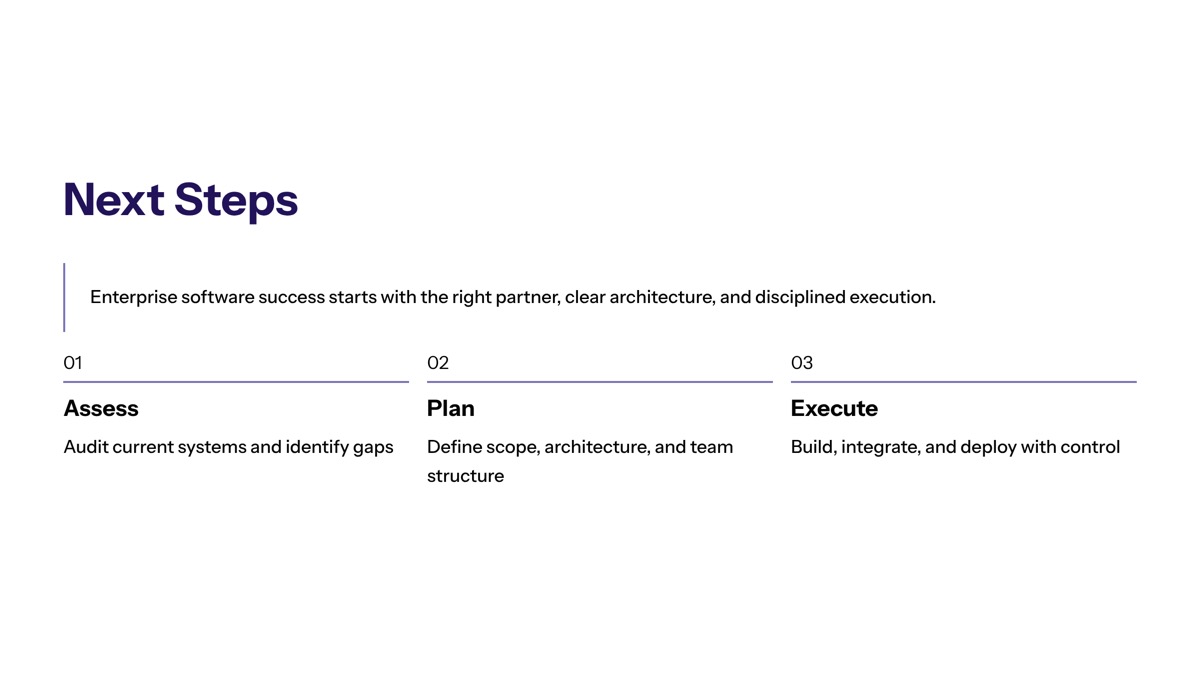
Immediate next steps:
Assess current system constraints and business process inefficiencies
Identify legacy systems, manual workflows, integration gaps, data silos, security risks, and usability issues.Define measurable outcomes and ROI expectations for software investment
Connect project goals to operational efficiency, cost efficiency, data visibility, user productivity, compliance readiness, and revenue impact.Evaluate potential development partners based on industry experience and technical capabilities
Review case studies, technical expertise, frameworks, programming languages, compliance standards, project management practices, and post-launch support models.Plan a pilot project or proof-of-concept to validate the approach before full-scale implementation
Choose a use case with meaningful business value and manageable risk, such as data integration, workflow automation, reporting modernization, or legacy application modernization.
Related topics to explore include AI integration strategies for enterprise systems, cloud migration planning for legacy platforms, compliance requirements for regulated industries, and enterprise architecture design for scalable solutions.
Frequently Asked Questions
What’s the difference between enterprise software development and regular application development?
Enterprise software development focuses on large-scale enterprise applications that support complex business operations, security requirements, integrations, compliance obligations, and long-term scalability. Regular application development is often narrower in scope and may not require the same level of architecture, data governance, integration, quality assurance, or operational resilience.
How long does typical enterprise software development take from planning to deployment?
Timelines depend on project scope, integrations, data migration, compliance requirements, and legacy system complexity. Smaller pilots may take a few months, while full enterprise software projects involving platform modernization or multiple enterprise systems can take a year or more. Phased delivery helps organizations realize value earlier while reducing implementation risk.
What are the key security considerations for enterprise software in regulated industries?
Key considerations include identity and access management, encryption, audit trails, secure APIs, vulnerability management, incident response, logging, privacy controls, and compliance with standards such as HIPAA, GDPR, SOC 2, and PCI. Security and compliance should be designed into the platform from the beginning, not added at the end.
How do you measure ROI from enterprise software development investments?
ROI can be measured through reduced maintenance costs, lower infrastructure spend, improved productivity, faster cycle times, fewer manual tasks, better compliance readiness, improved reporting, and new revenue opportunities. Enterprise software applications can significantly reduce operational costs by automating routine tasks and streamlining workflows, leading to increased efficiency and productivity.
What role does AI play in modern enterprise software development services?
AI supports predictive analytics, workflow automation, decision support, test automation, code assistance, anomaly detection, and advanced data analytics. When combined with cloud computing, AI can process large datasets, support real-time decision-making, and improve responsiveness to market changes. AI should be governed carefully and aligned with the broader enterprise architecture.
How do you handle data migration from legacy systems during modernization projects?
Data migration requires discovery, cleansing, mapping, validation, access control review, and parallel testing. Teams must preserve critical business logic, historical records, reporting definitions, and compliance requirements. In complex environments, migration is often phased to reduce risk and maintain continuity.
What are the ongoing maintenance and support requirements for enterprise software?
Custom enterprise software requires continuous upkeep and should be viewed as a long-term investment rather than a one-time cost. Ongoing support may include performance monitoring, security updates, feature enhancements, integration maintenance, cloud optimization, compliance reviews, user support, and technical debt management.
How do you ensure enterprise software scales with business growth and changing requirements?
Scalability starts with architecture. Enterprise software should be designed with modular services, performance testing, cloud capacity planning, database optimization, API governance, and flexible integration patterns. Designing enterprise software with scalability in mind is crucial to ensure that the software can handle increased user loads and additional features without performance degradation.