Enterprise Software Integration Strategy: A Complete Guide for Mid-Market and Enterprise Organizations
Enterprise software integration strategy is the plan that helps fragmented CRM, ERP, ecommerce, finance, data, and reporting systems work together as a coordinated business environment. For enterprise teams, the goal is not simply to make systems connect; the goal is to enable reliable data flow, seamless communication, and workflow automation across the business processes that drive revenue, operations, compliance, and customer experience.
This guide focuses on strategic planning and decision-making for enterprise integration initiatives, not middleware selection or low-level technical implementation. It is written for IT leaders, enterprise architects, data leaders, and business executives responsible for digital transformation, system integration, software integration strategy, and modernization programs across multiple systems, internal systems, cloud based applications, and legacy systems.
Enterprise software integration strategy is a structured approach to connecting disparate business systems that aligns integration priorities with business objectives, ensures scalable architecture, and delivers measurable ROI through coordinated data flow and workflow automation. A successful enterprise integration strategy should begin with a clear understanding of business goals and objectives, ensuring that the integration aligns with the overall business strategy.
By the end of this guide, you will have a practical view of how to:
Build a strategic framework for enterprise integration planning.
Assess current systems, data sources, integration gaps, and operational risk.
Develop a phased implementation roadmap for software integration services and modernization.
Establish governance controls, data ownership, security measures, and operating discipline.
Measure ROI through cost savings, operational efficiency, data consistency, and better business outcomes.
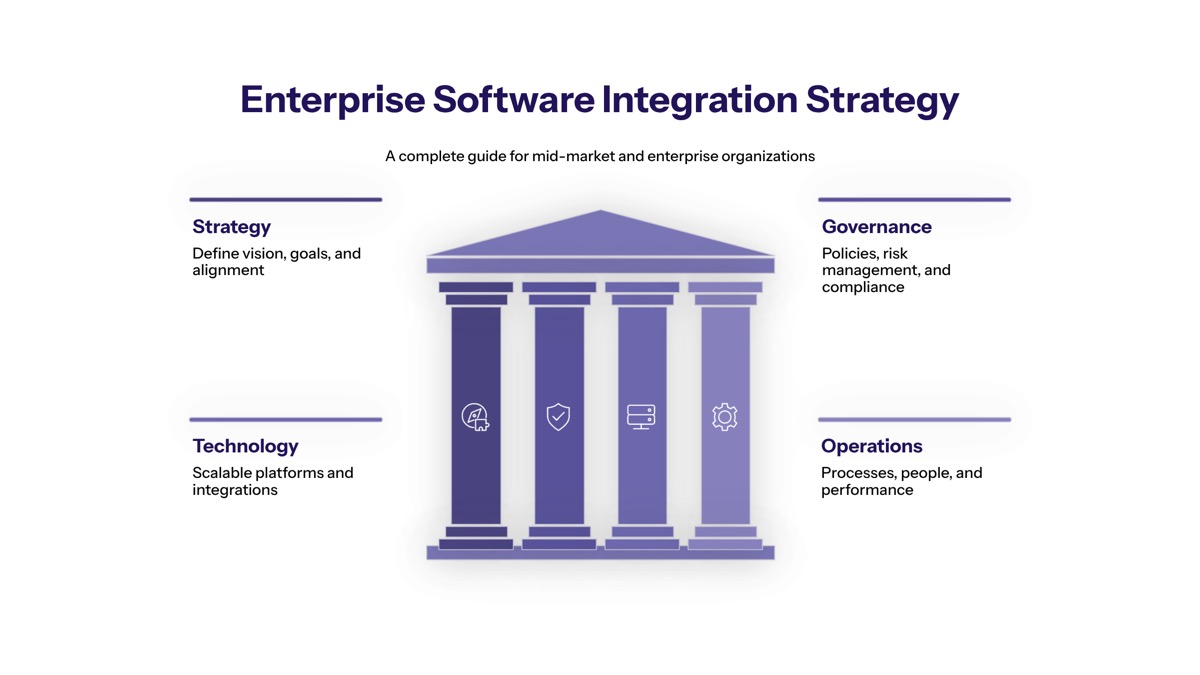
Understanding Enterprise Software Integration Strategy
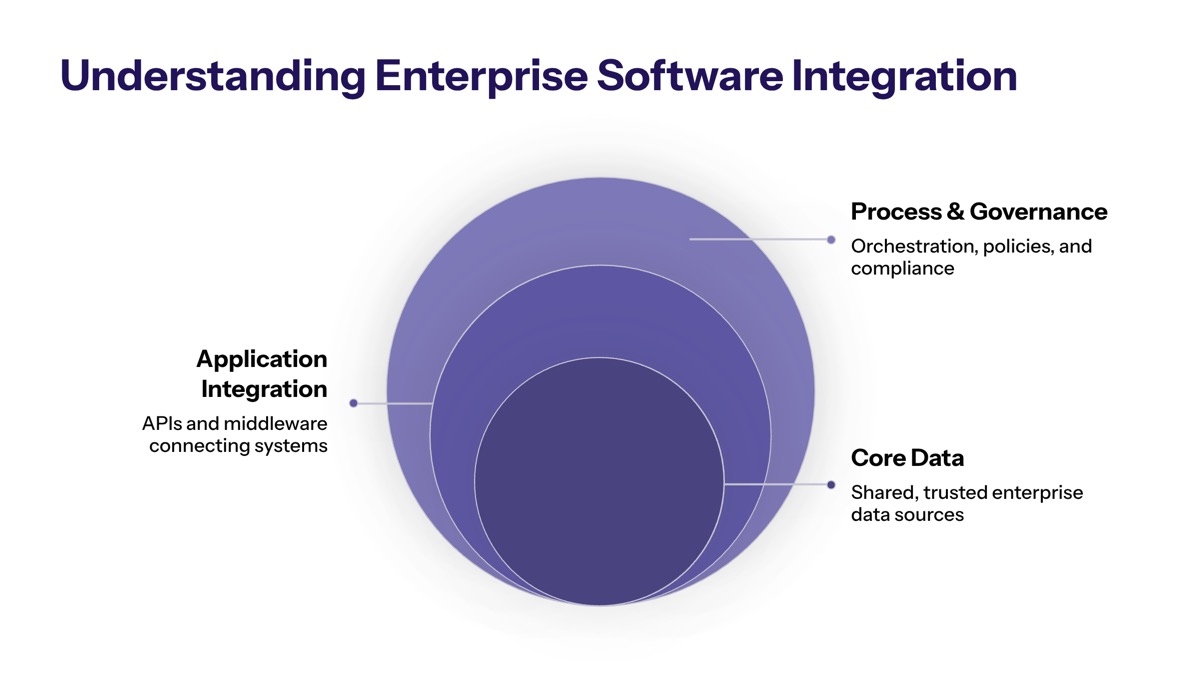
Enterprise integration refers to the technologies, platforms, and practices used to coordinate interactions between systems across an organization’s IT landscape, enabling applications to exchange information and ensuring consistent operations. In strategic terms, enterprise software integration strategy connects technology choices to business outcomes: faster order fulfillment, fewer manual handoffs, more consistent data, stronger reporting, and greater agility as business needs change.
A software integration strategy is different from a tactical integration project. A tactical project might connect one ecommerce platform to one ERP system. A strategy defines how all systems involved should exchange data, how integrations should be governed, how APIs and data formats should be standardized, and how the organization will manage integrations over time.
Organizations that treat enterprise integration as a long-term capability achieve more consistent and sustainable results than those that approach it as a series of one-off projects. Without a coordinated integration approach, organizations face challenges such as delayed information, inconsistent data, manual handoffs, and limited visibility across operations, which can slow execution and increase operational risk.
Strategic Business Alignment
Strategic business alignment means integration priorities are selected because they support measurable organizational goals, not because a specific tool or connector is available. Integration requires strategic alignment, clean data, and strong user adoption, because even well-designed integration software will fail if business teams do not trust the information or adapt their workflows.
For example, integrating CRM, finance, and ERP systems can reduce manual data entry, improve invoice accuracy, and give leadership timely access to unified data. Enterprise integration can significantly improve productivity by streamlining critical business processes, reducing manual data entry, and enhancing transparency across systems.
The strongest integration priorities usually sit where operational friction is visible: order fulfillment, invoicing, supply chain coordination, employee onboarding, customer support, and financial reconciliation. By coordinating how data and events move between systems, integration supports automation scenarios such as order fulfillment, invoicing, supply chain coordination, and employee onboarding.
Effective decision-making depends on timely access to unified data, and enterprise integration helps improve analytics and decision-making by enabling more timely data exchange, reducing fragmentation, and maintaining shared business context across applications. A successful integration strategy prevents data silos and reduces manual work while scaling with business growth.
Integration Architecture Planning
Integration architecture planning defines how different systems, cloud services, software applications, and data sources will exchange data in a secure, reusable, and scalable way. This includes application programming interfaces, event-driven messaging, data warehouse connections, cloud integration, on premises systems, data management practices, and the underlying infrastructure used to support enterprise integration services.
A mature enterprise integration approach emphasizes standardization and reuse, establishing shared patterns such as APIs and event-driven messaging to reduce duplication and support governance. APIs must be designed for reusability across multiple use cases, ensuring security and access control protocols are in place.
Architecture planning also has to account for scalability, data security, regulatory obligations, performance, and future system additions. Robust security in integration includes strong encryption, identity management, and role-based access controls. Master Data Management establishes a single source of truth for critical entity data, while data governance involves establishing clear rules for data ownership, formatting, and validation across applications.
An enterprise integration platform (EIP) is a software system that enables different applications, systems, and data sources to communicate and exchange information with each other in a seamless and integrated manner. Common types of enterprise integration platforms include integration Platform as a Service (iPaaS), Enterprise Service Bus (ESB), and API management solutions, each serving different integration needs and environments.
Enterprise integration platforms help organizations streamline their business processes, improve efficiency, and reduce errors by providing a central hub for managing the flow of data between disparate systems. The point is not to buy an integration platform first; the point is to define the business architecture, governance model, and integration process that determine which integration solution fits.
With the foundation defined, the next step is assessing the current environment: what systems exist, how they share data today, where data exchange breaks down, and which workflows create the greatest business impact.
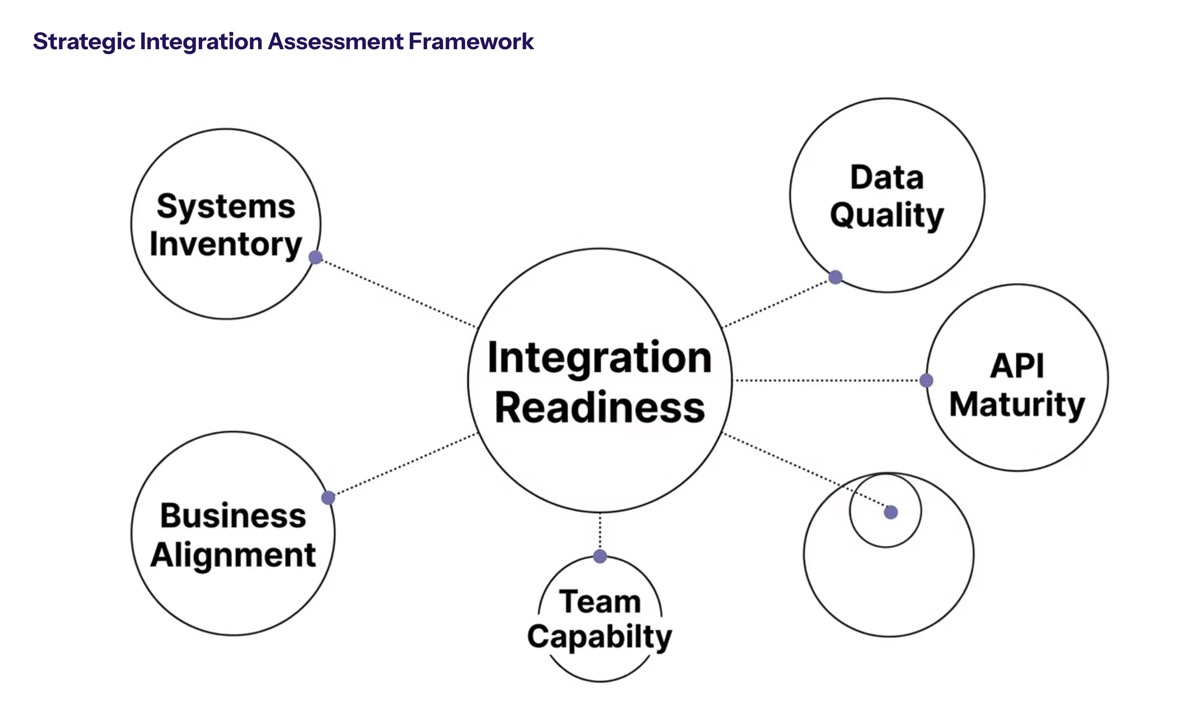
Strategic Integration Assessment Framework
A strong enterprise integration strategy depends on an honest assessment of current systems, business operations, technical constraints, and readiness for change. Integrating enterprise software requires a balance of technical alignment, data management, and cultural adaptation, because systems connect through architecture while people change how work is executed.
This assessment should identify the systems involved, the data formats in use, the business processes that cross applications, and the points where disconnected systems create operational delays. It should also identify where integration complexity is caused by custom code, legacy system integration, inconsistent ownership, or multiple teams solving similar problems independently.
Current State System Analysis
Current state analysis starts by mapping all major enterprise systems: CRM, ERP, ecommerce, finance, support, data warehouse, reporting, supply chain, HR, and department-specific software applications. For each system, document what data it owns, what data it consumes, how systems connect, and whether data sharing happens through APIs, file transfers, custom code, spreadsheets, or manual updates.
This analysis should expose data flow gaps, workflow bottlenecks, and places where users have to re-enter information because different systems cannot exchange data reliably. Without a coordinated integration approach, organizations may face issues such as delayed information, inconsistent data, and increased operational risk, which can hinder their ability to respond to changes effectively.
Legacy systems deserve special attention. Legacy systems can hinder business growth by limiting agility and the ability to adopt new technologies, which is essential for modern enterprises to remain competitive. Modernizing legacy systems through integration can significantly improve data exchange capabilities, enhance customer relationships, and reduce errors through automated workflows.
Business Impact Prioritization
Not every integration gap should become an immediate project. Business impact prioritization ranks opportunities by operational friction, data quality issues, process delays, revenue leakage, compliance exposure, and customer experience impact.
The highest-value opportunities often involve critical workflows that move across multiple systems, such as quote-to-cash, order-to-fulfillment, returns, procurement, financial close, and customer onboarding. One of the main challenges of enterprise integration is the complexity involved in connecting various systems, which requires alignment between IT and business goals to avoid operational headaches.
Quantification matters. Teams should estimate manual hours, cost per error, cycle time delays, missed service commitments, and reporting lag. Improper integrations can lead to significant financial losses, with estimates suggesting that inefficient integration processes can cost enterprises up to $500,000 in lost revenue annually due to missed customer SLAs and operational inefficiencies.
Bad data can paralyze an integrated environment, emphasizing the importance of data quality. A workflow that moves faster but spreads inaccurate customer, product, inventory, or financial information will increase risk rather than reduce it.
Technical Readiness Evaluation
Technical readiness evaluation reviews whether the organization can support the proposed software integration process. This includes API availability, application programming interfaces quality, authentication methods, logging, data formats, latency requirements, cloud platforms, on premises systems, regulatory constraints, and engineering capacity.
Teams should assess whether source systems are stable, whether documentation exists, and whether existing integrations are tightly coupled. Decoupling allows enterprises to build solutions that enable swapping out or upgrading systems without breaking dependent processes. This is especially important when business growth, acquisitions, cloud migration, or AI-enabled workflows may require future system changes.
Automated error handling should be implemented for integration processes to catch, log, and categorize exceptions effectively. Integration is an ongoing process that requires continuous monitoring and optimization of data flows and system performance.
The readiness assessment should feed directly into the implementation plan: which systems need abstraction, which data needs cleansing, which APIs should be reusable, which integrations require governance, and which modernization steps should be phased to reduce risk.
Strategic Implementation Planning and Execution
Once assessment is complete, execution should follow a structured roadmap rather than a collection of isolated software integration solutions. The roadmap should balance quick wins with long-term architecture, align multiple teams around shared priorities, and create a path from fragmented operations toward integrated systems that support automation, analytics, and AI.
Enterprise integration plays a foundational role in modernization initiatives, enabling reliable data movement and coordination across applications, which is essential for automation, analytics, and AI-enabled scenarios. Automation initiatives depend on the ability of systems to work together reliably, and integration provides the technical foundation that allows enterprise process automation to span applications, teams, and organizational boundaries.
Integration Roadmap Development Process
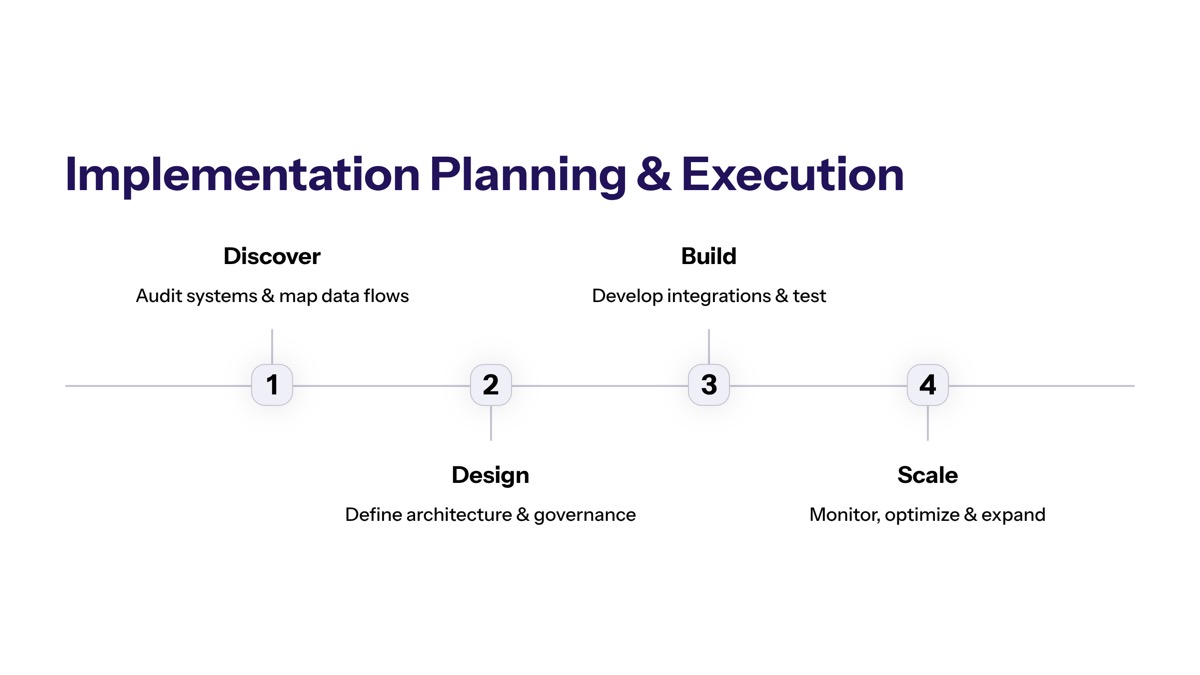
Roadmap development is essential when enterprise teams need to coordinate business priorities, cloud integration, legacy modernization, data management, and governance across multiple systems. The roadmap should make clear what happens first, why it matters, how success will be measured, and how the organization will manage integrations after launch.
Phase 1: Quick wins identification for immediate business value
Start with one or two high-friction workflows where improved data exchange can produce visible results. Examples include CRM-to-finance invoice reconciliation, ecommerce-to-ERP order synchronization, or customer support visibility into order status. Quick wins build trust, reduce manual data entry, and prove that enterprise integration can improve business operations.Phase 2: Core system integration for operational efficiency
Connect central transactional systems such as ERP, CRM, finance, inventory, WMS, customer master data, and reporting platforms. This phase should prioritize consistent data, reusable APIs, MDM, and shared data definitions so that the organization is not simply connecting systems but building a unified system of reliable operational context.Phase 3: Advanced automation and AI-driven workflows
After foundational data flow is reliable, organizations can expand into predictive analytics, event-driven automation, AI support workflows, automated fulfillment triggers, and real-time reporting. These scenarios depend on clean data, seamless data exchange, and strong governance controls across disparate applications.Phase 4: Continuous optimization and new system onboarding
Integration does not end at go-live. Monitoring and continuously improving integrations is essential; organizations should use analytics to track performance and identify issues early, allowing for timely adjustments to integration strategies. Monitoring and continuously improving integrations through performance tracking and analytics helps organizations identify issues early and refine their integration approaches as business and technology needs change.
Integration Approach Comparison
Enterprise leaders should evaluate integration approaches based on business needs, integration complexity, underlying infrastructure, security requirements, timeline, internal capacity, and growth plans. The best option is rarely universal; it depends on the number of systems involved, the need for real-time data exchange, legacy constraints, cloud based services, and external partners.
Approach | Best For | Complexity | Long-term Value |
|---|---|---|---|
Point-to-Point | Simple, temporary connections | Low initially | Limited scalability |
API-First Architecture | Scalable, modern systems | Medium | High flexibility |
Enterprise Service Bus | Complex, legacy environments | High | Comprehensive but rigid |
Hybrid Cloud Integration | Mixed on-premise/cloud | Medium-High | Future-ready |
Point to point integration can be useful for urgent, narrow use cases, but it often creates brittle dependencies when used as the default enterprise pattern. Best practices in enterprise integration include designing for reuse and scalability, avoiding tightly coupled point-to-point integrations, and establishing clear standards and guidelines for APIs and data formats.
API-first architecture is often a better long-term model for organizations that expect new applications, business growth, partner integrations, and changing workflows. API management supports security, access control, versioning, reuse, and observability.
An enterprise service bus can help coordinate complex environments, especially where many legacy systems and internal systems need centralized infrastructure. However, an enterprise service bus can become rigid if governance, ownership, and modernization planning are weak.
Hybrid cloud integration supports organizations that need cloud services, cloud based applications, on premises systems, and partner platforms to share data securely. This approach is often appropriate during phased modernization, which involves decoupling legacy systems and gradually migrating workloads to the cloud, and is a recommended strategy to minimize risk during the modernization process.
The best integration approach should reflect business outcomes, not technology preference. Choose the model that enables seamless data exchange, protects data security, supports future change, and gives business teams reliable information without creating unnecessary maintenance burden.
Common Strategic Challenges and Solutions
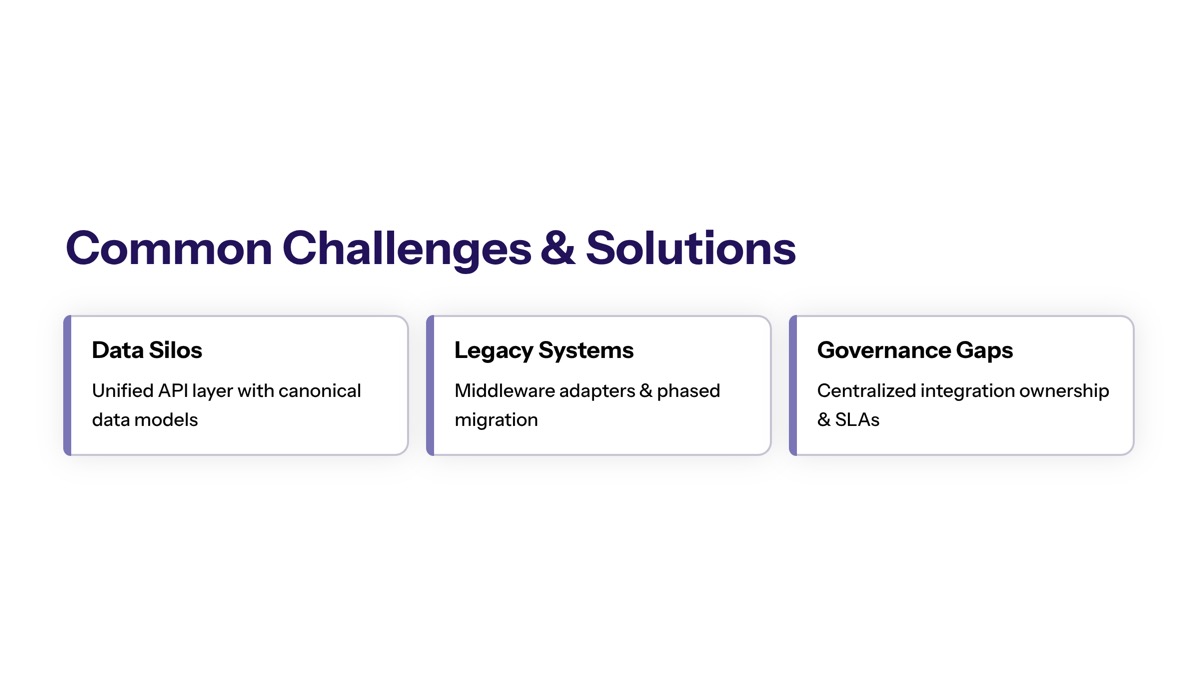
Enterprise integration strategy usually fails for predictable reasons: legacy constraints, unclear ownership, fragmented data definitions, weak governance, poor adoption, and undermeasured value. These challenges can be solved, but only if enterprise integration is treated as a business capability rather than a short-term integration process.
A coordinated strategy should make the organization better at deciding which systems connect, how they exchange data, how integration quality is monitored, and how software integration company partners or internal teams follow shared standards.
Legacy System Dependencies and Technical Debt
Legacy system integration is one of the most common barriers to modernization. Older platforms may lack modern APIs, use inconsistent data formats, depend on undocumented custom code, or require manual workarounds that are risky to change.
The solution is a phased modernization approach using API abstraction layers and gradual data migration to maintain operational continuity while enabling new integrations. Instead of replacing every legacy system at once, organizations can decouple critical functions, wrap legacy capabilities behind reusable services, improve data exchange, and migrate workloads to cloud platforms over time.
This approach reduces disruption while creating a path toward enhanced efficiency, better customer relationships, fewer errors, and stronger analytics. It also allows the business to replace or upgrade systems later without breaking dependent processes.
Cross-Department Coordination and Governance
Enterprise integration touches IT, data teams, operations, finance, sales, supply chain, compliance, and executive leadership. When each department buys tools, builds pipelines, or defines data independently, data silos return quickly and integrated systems become difficult to trust.
The solution is to establish an integration center of excellence with representatives from IT, operations, finance, and business units to ensure alignment and consistent decision-making. Establishing an Integration Center of Excellence (ICoE) can help organizations manage enterprise integration consistently at scale by providing guidance, standards, and shared services.
The ICoE should define API standards, data ownership, validation rules, access controls, onboarding process requirements, documentation practices, versioning policies, and monitoring expectations. This governance model helps multiple teams share data safely while keeping the integration strategy aligned with business needs.
ROI Measurement and Business Case Development
Enterprise integration investments need a business case that goes beyond technical completion. Leaders should define baseline metrics for manual processes, data accuracy, and cycle times before integration, then track improvements in operational efficiency, error reduction, and decision-making speed.
Useful metrics include manual hours eliminated, reduced reconciliation effort, order processing time, invoice accuracy, SLA performance, integration downtime, exception rates, reporting latency, customer satisfaction, and cost savings. Effective enterprise integration enhances decision-making by providing timely access to unified data, which reduces fragmentation and allows organizations to base decisions on a clearer understanding of operational conditions.
ROI measurement should also include risk reduction and future-readiness. A strong integration solution lowers operational risk, improves transparency, supports automation, and makes it easier to onboard new systems, cloud based services, or acquired business units without rebuilding the entire software integration process.
Conclusion and Next Steps
Enterprise software integration strategy is essential for connecting fragmented business systems and achieving operational excellence. When CRM, ERP, ecommerce, finance, data, and reporting platforms remain disconnected, organizations face manual data entry, delayed information, inconsistent data, operational risk, and limited visibility across business operations.
A strong enterprise integration strategy aligns business goals, architecture, data governance, security, implementation planning, and ROI measurement. It helps modern enterprises move from disconnected systems to integrated systems that support streamlined workflows, better analytics, process integration, automation, and AI-ready operations.
Practical next steps:
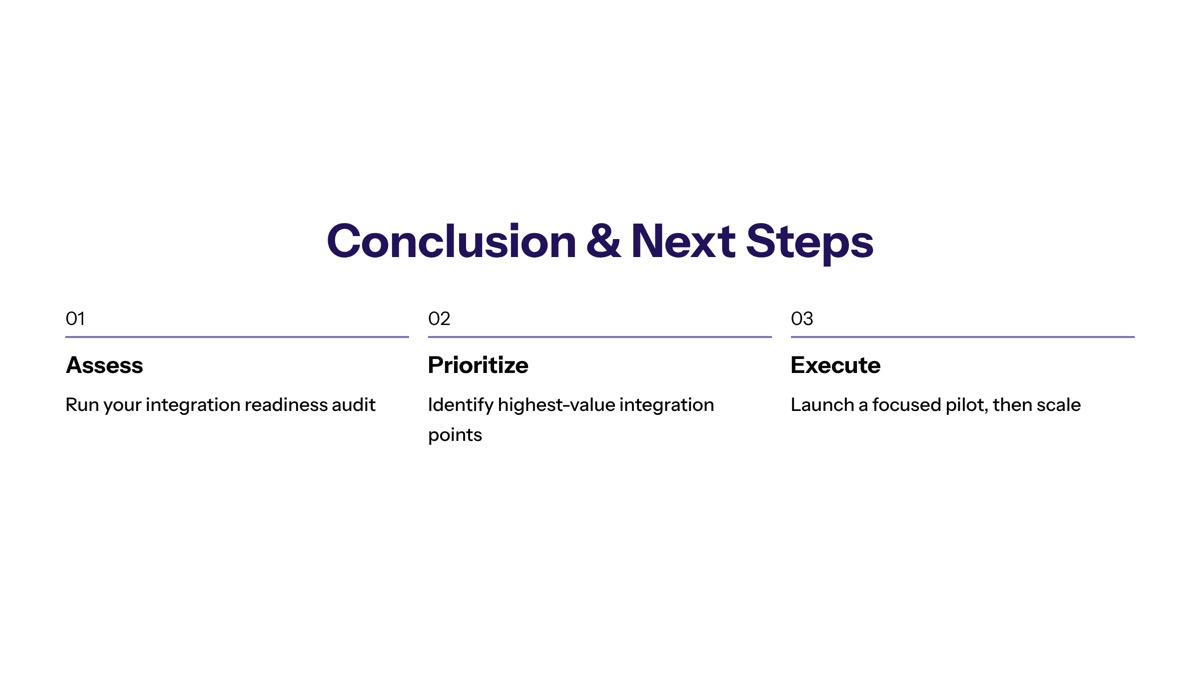
Conduct a current state assessment of systems, data sources, integrations, owners, data formats, and workflow bottlenecks.
Identify high-impact integration opportunities where data flow improvements can reduce cost, errors, delays, or compliance exposure.
Develop a phased implementation roadmap that balances quick wins, core system integration, advanced automation, and continuous optimization.
Establish a governance framework through an ICoE or equivalent operating model for standards, ownership, data security, and reusable integration patterns.
Measure ROI continuously using baseline metrics, performance analytics, exception tracking, and business outcome reporting.
Related strategic considerations include AI automation opportunities, cloud migration planning, legacy modernization, API management, data security, and compliance requirements. These initiatives depend on the same foundation: reliable enterprise integration that enables seamless data exchange across the systems that run the business.
Additional Resources
Use these resources as starting points for internal planning and executive alignment.
Integration assessment checklist for enterprise systems
Inventory CRM, ERP, ecommerce, finance, data warehouse, reporting, HR, supply chain, and customer-facing systems.
Document owners, data sources, data formats, integration points, manual handoffs, and reporting dependencies.
Identify data silos, duplicated records, missing fields, latency issues, and workflow bottlenecks.
Review API availability, authentication, logging, error handling, data security, and compliance requirements.
ROI calculation framework for integration projects
Establish baselines for manual hours, cycle times, error rates, SLA misses, reconciliation effort, and reporting delays.
Estimate financial impact from cost savings, reduced errors, faster invoicing, improved customer service, and enhanced efficiency.
Track post-integration improvements in operational efficiency, data consistency, decision-making speed, and business outcomes.
Include non-financial value such as transparency, risk reduction, user adoption, and modernization readiness.
Sample governance charter template for integration center of excellence
Define ICoE purpose, decision rights, participating teams, and executive sponsorship.
Establish standards for APIs, event-driven messaging, data validation, data ownership, access controls, and documentation.
Define how teams request new integrations, manage changes, monitor performance, and escalate incidents.
Require continuous improvement reviews so integration strategies evolve as business and technology needs change.