Fintech AI Development Services: Complete Guide for Financial Institutions
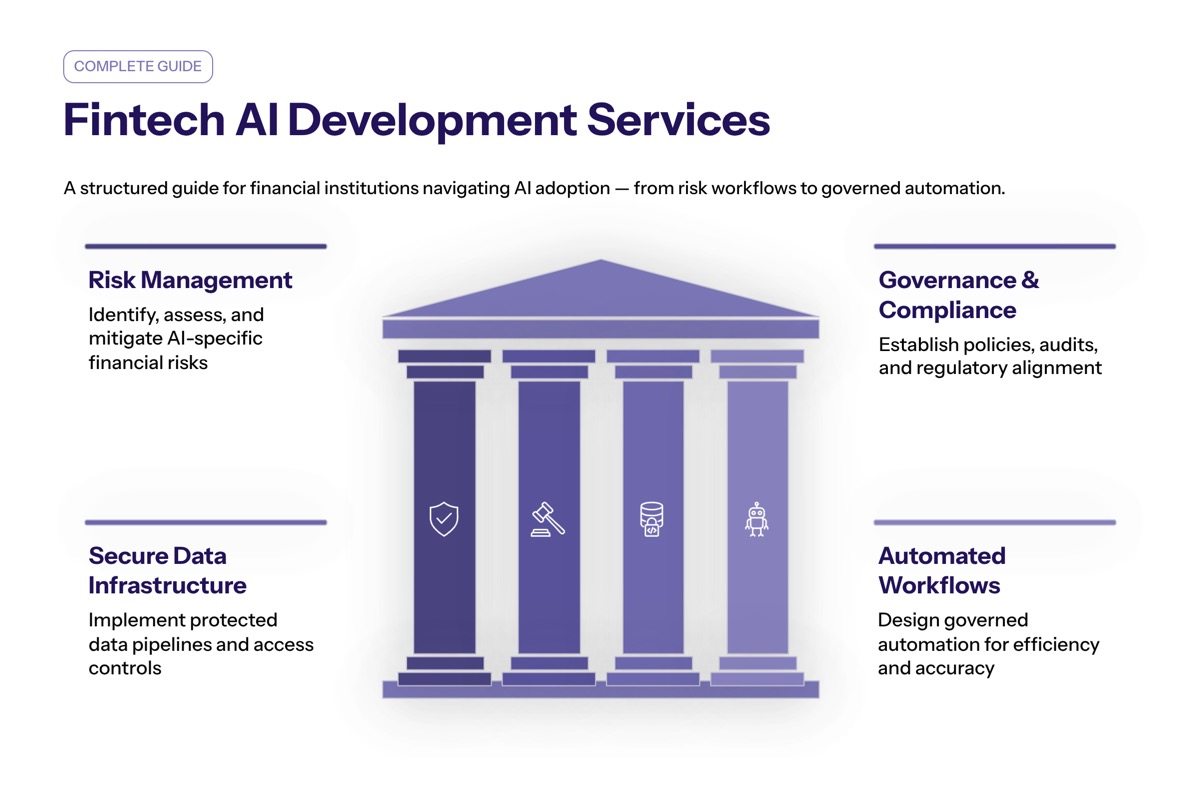
Fintech AI development services create secure, compliant AI solutions that automate financial workflows, improve fraud detection, strengthen risk management, and personalize customer experiences for banks, credit unions, fintech companies, and other financial institutions. These services focus on creating, integrating, and maintaining artificial intelligence software tailored for the financial sector, where data security, regulatory compliance, auditability, and low-latency decision-making are essential.
This guide covers AI-driven fraud detection, automated compliance, intelligent payment processing, customer personalization, and implementation strategy for fintech leaders, banking executives, CIOs, compliance teams, and technology decision-makers. It is written for organizations evaluating AI implementation as part of digital transformation, custom financial software development, banking software development, or broader financial services software development initiatives.
In practical terms, fintech AI development services help financial institutions automate financial processes, analyze financial data, detect suspicious activity, streamline back office operations, and improve customer satisfaction while meeting standards such as GDPR, PCI DSS, SOX, AML, KYC, and regional banking requirements.
You will learn how to evaluate:
AI implementation strategies for financial software systems and digital banking workflows
Security and compliance requirements for handling sensitive data and financial transactions
Use cases such as fraud detection, risk assessment, payment processing systems, and conversational AI
ROI signals such as operational efficiency, reduced manual workloads, and faster customer service
Vendor selection criteria for choosing a financial software development company or banking software development company
For a broader view of AI, automation, and custom software solutions across the finance industry, see the fintech industry page.
Understanding Fintech AI Development Services
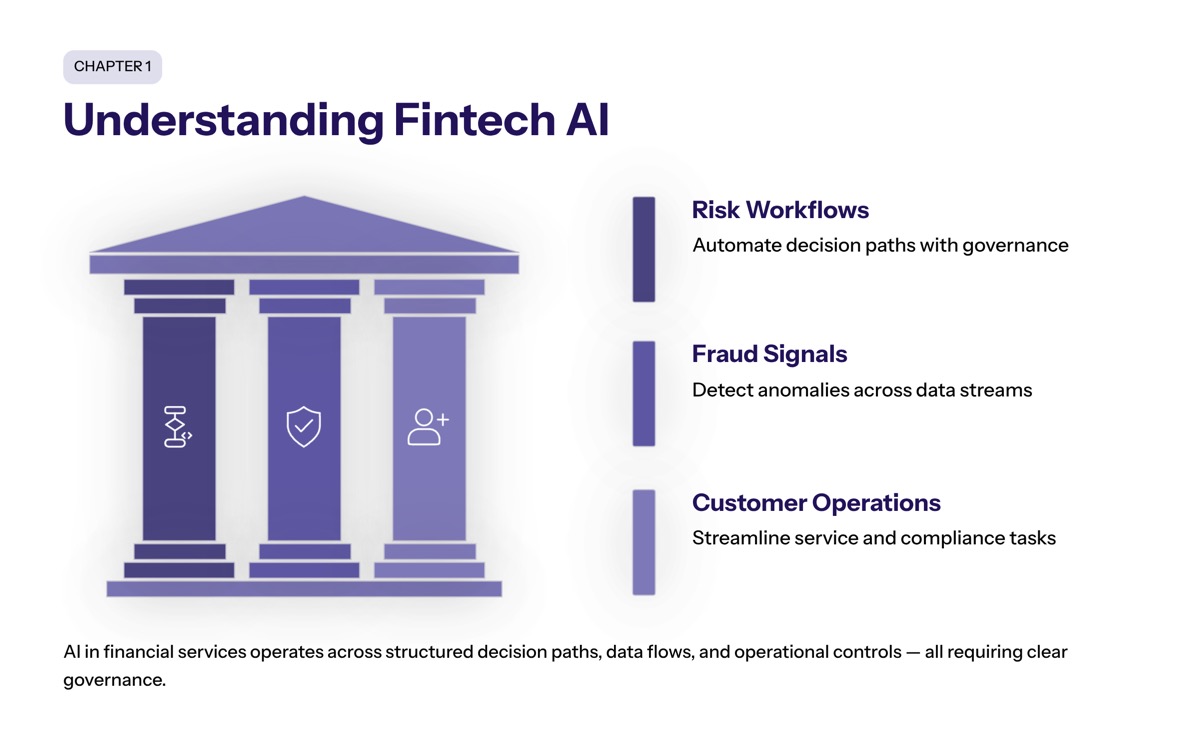
Fintech AI development is the creation of machine learning and artificial intelligence solutions specifically designed for financial services operations, financial data, and regulatory environments. Unlike generic AI software development, fintech AI must support secure data handling, explainable decisions, real-time financial transactions, compliance monitoring, and integration with existing systems such as a core banking system, payment gateways, loan platforms, and digital banking software.
Custom software development in the financial sector allows organizations to create tailored solutions that meet specific operational needs, enhancing efficiency and competitiveness. This is why many financial organizations choose custom financial software development instead of generic platforms: banking operations, lending workflows, regulatory reporting, investment management solutions, and online banking often require specialized logic, strong controls, and third party integrations.
Modern banking services face pressure from digital-first competitors, rising customer expectations, increasing fraud sophistication, and more demanding regulators. Customers now expect personalized banking experiences that cater to their individual needs and preferences, leading to a demand for hyper-personalization in banking software solutions. At the same time, financial institutions need robust software solutions that can automate routine workflows, reduce operational complexity, and provide ongoing support as regulations and market trends change.
AI-First Architecture for Financial Services
An AI-first approach in fintech means designing financial software solutions where AI capabilities are built into the architecture from the start rather than retrofitted later. This approach affects data pipelines, event streaming, decision engines, governance workflows, model monitoring, API design, and the software development lifecycle.
The core components typically include machine learning models, natural language processing, predictive analytics, real-time decision engines, and advanced data analytics platforms. Machine learning models in fintech process vast amounts of data to evaluate creditworthiness accurately, identify fraudulent activity, and optimize financial operations. Predictive analytics in fintech involves forecasting market trends and customer behavior using historical data, while generative AI models and predictive analytics are increasingly integrated into financial systems to detect fraud, automate decisions, and personalize user experiences, significantly improving service delivery.
AI systems in fintech automate operations, analyze large datasets, and improve customer experience. AI-powered analytics platforms unify customer, financial, and operational data into a single source of truth, enabling organizations to make informed decisions based on real-time insights. This improves operational efficiency, speeds up transaction processing, strengthens risk assessment, and gives leaders better visibility into customer engagement, customer acquisition, and retention.
AI-first architecture is also relevant to specialized use cases such as algorithmic trading, where automated mathematical models execute high-speed trades. Current AI models in fintech must adapt to operational needs such as algorithmic trading and fraud detection, differing from general AI development because financial services require accuracy, explainability, latency control, and regulatory traceability.
Compliance-Aware AI Implementation
Compliance-aware AI means artificial intelligence systems are designed with regulatory requirements embedded in architecture, data flows, model logic, testing, monitoring, and reporting. Developers of fintech AI models must ensure compliance with global and local data protection standards, and AI development for fintech must prioritize regulatory compliance with standards like GDPR and PCI-DSS.
Financial software development must prioritize compliance with regulations such as GDPR, PCI DSS, and KYC to ensure data protection and legal adherence. In fintech AI, this also includes SOX, AML rules, regional banking standards, model risk governance, data retention requirements, audit logs, and customer consent controls. Regulatory compliance in fintech entails continuous monitoring to adapt to changing financial laws and reporting standards.
Robust frameworks for fintech AI must include encrypted data handling and detailed audit logs. Security testing should be embedded in each stage of financial software development to align with industry standards and protect sensitive data. AI systems must provide transparent reasoning to satisfy auditing requirements and avoid algorithmic biases, especially in credit scoring, fraud review, loan approvals, and investment recommendations.
These foundations-AI-first architecture and compliance-aware design-make practical fintech AI applications possible. Once financial institutions have secure infrastructure, governed models, and reliable integrations, they can deploy AI across fraud detection, payment optimization, customer service, account management, and back office operations.
Core Fintech AI Development Services
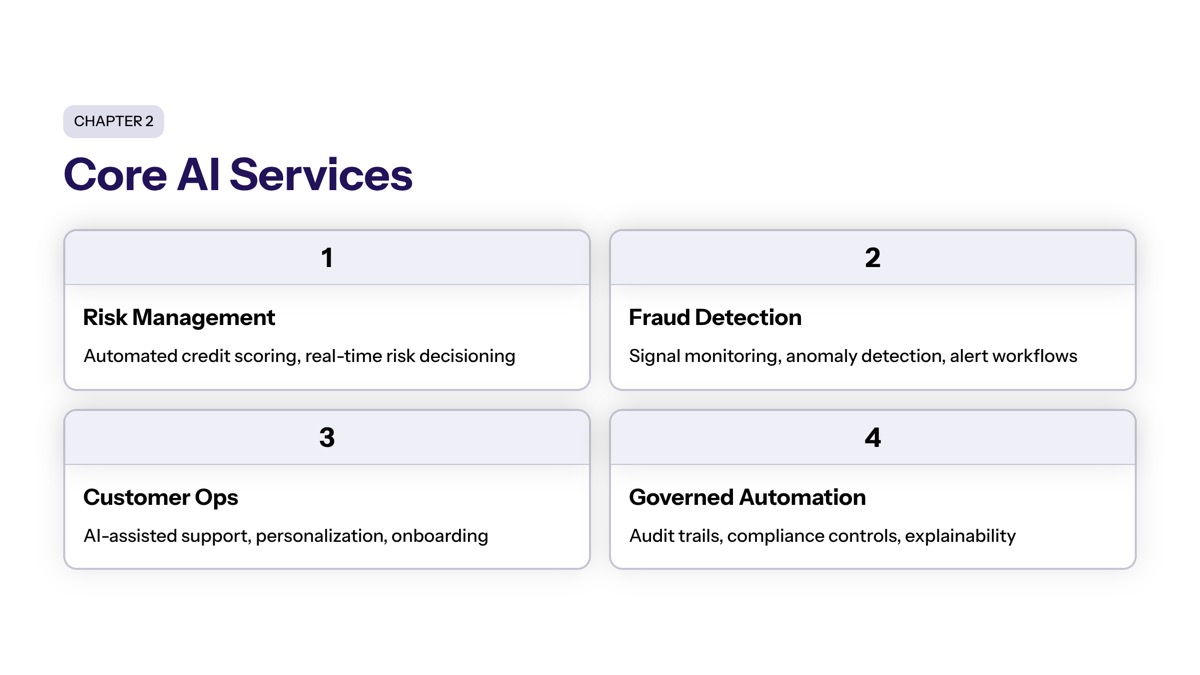
Core fintech AI development services turn AI-first architecture and compliance-aware systems into production financial software. These services may be delivered as custom banking software development, financial software development, banking software development services, or broader software development financial services initiatives.
The main goal is to streamline operations without compromising compliance, security, or customer trust. For banks, credit unions, and financial services companies, this often means modernizing existing systems, building custom banking solutions, integrating AI into core banking platforms, and improving digital banking solutions such as mobile banking apps, online banking portals, and real-time account dashboards.
Automated Risk Assessment and Fraud Detection
Fraud detection in fintech identifies suspicious transaction patterns using machine learning models. Machine learning in fintech enhances security by identifying fraudulent activities faster than humans, especially when models analyze transaction velocity, device behavior, IP reputation, location, historical patterns, and anomalies across financial transactions.
Real-time transaction monitoring uses machine learning algorithms to identify suspicious patterns and anomalies as payments, transfers, withdrawals, and card transactions occur. Anti-Money Laundering (AML) and fraud detection software are crucial for identifying suspicious financial activities, using advanced algorithms to monitor transactions in real-time. In production, these systems often combine supervised models, anomaly detection, behavioral analytics, and rules for regulatory thresholds.
Risk assessment in fintech evaluates creditworthiness and investment risks in real-time. Credit scoring automation uses AI models that analyze traditional credit history and alternative data sources such as transaction behavior, income patterns, cash flow, utility payments, or mobile data where regulations allow. This supports faster underwriting, more consistent decisions, and broader access to credit when models are built and audited responsibly.
Behavioral analytics strengthens user authentication and account security by observing how users type, navigate, transact, and interact with digital banking channels. These signals help detect account takeover, synthetic identity fraud, session hijacking, and suspicious deviations from normal behavior. For financial institutions, this improves risk management while reducing unnecessary friction for legitimate customers.
Intelligent Payment Processing and Workflow Optimization
Intelligent payment processing applies AI to routing, settlement, reconciliation, compliance checks, and operational workflows. Payment processing systems facilitate secure digital payments, including credit card transactions and peer-to-peer transfers, ensuring fast and convenient money movement for users.
AI-powered payment routing can select optimal rails based on cost, speed, currency, risk, settlement time, and payment type. This helps financial services companies reduce fees, improve transaction success rates, and streamline processes across domestic payments, cross-border payments, card payments, ACH, open banking, and embedded finance workflows.
Automated reconciliation systems match transactions across multiple platforms, currencies, bank accounts, ledgers, and payment processors. Process automation in fintech handles repetitive tasks like data entry and compliance checks. Automating routine workflows in fintech significantly reduces operational and labor costs, especially in back office operations where manual reviews, exception handling, and spreadsheet-based reconciliation remain common.
Smart contract integration can support programmable payments, conditional settlement, escrow workflows, and automated compliance logic. While adoption depends on regulatory context and business model, the same AI-first principles apply: secure architecture, explainable workflows, auditability, and seamless API integration with banking software, partner systems, and payment gateways.
AI-Driven Customer Experience and Personalization
AI-driven customer experience focuses on faster support, more relevant recommendations, and personalized financial guidance. Conversational AI in fintech enables advanced chatbots for 24/7 customer service and financial advice. AI-driven virtual assistants in fintech can manage accounts and guide users through applications without human intervention, improving service availability and reducing pressure on contact centers.
AI can analyze user spending to recommend personalized financial products and savings plans. This includes credit cards, loans, savings accounts, investment management solutions, insurance offers, budgeting tools, and financial wellness features. Personalized financial product recommendations based on customer behavior and financial goals can improve customer engagement, retention, and customer satisfaction when they are transparent and compliant.
Digital banking solutions that enhance customer experience often include features such as intuitive onboarding flows and real-time account dashboards, which improve customer engagement and satisfaction. Online and mobile banking software allows customers to manage their finances remotely, enhancing convenience and security by providing 24/7 access to banking services.
The integration of AI and data analytics in banking software allows for the creation of tailored customer experiences, which can significantly boost customer engagement and retention rates. Predictive analytics also supports customer lifecycle management by identifying churn risk, next-best actions, cross-sell opportunities, and service gaps. These use cases connect directly to implementation strategy because successful personalization depends on clean financial data, governed models, reliable integrations, and ongoing support.
Implementation Strategy and Technical Considerations
Successful fintech AI development requires more than choosing a model. Financial institutions need a structured software engineering approach that accounts for data quality, regulatory compliance, system architecture, cybersecurity, integration constraints, business goals, and long-term model governance.
This is where custom software, financial software developers, and a financial software development team become important. Whether the project involves mobile banking apps, loan automation, fraud detection, customer analytics, or core banking software modernization, implementation should follow a disciplined process with strong project management and security controls.
AI Development Process for Fintech
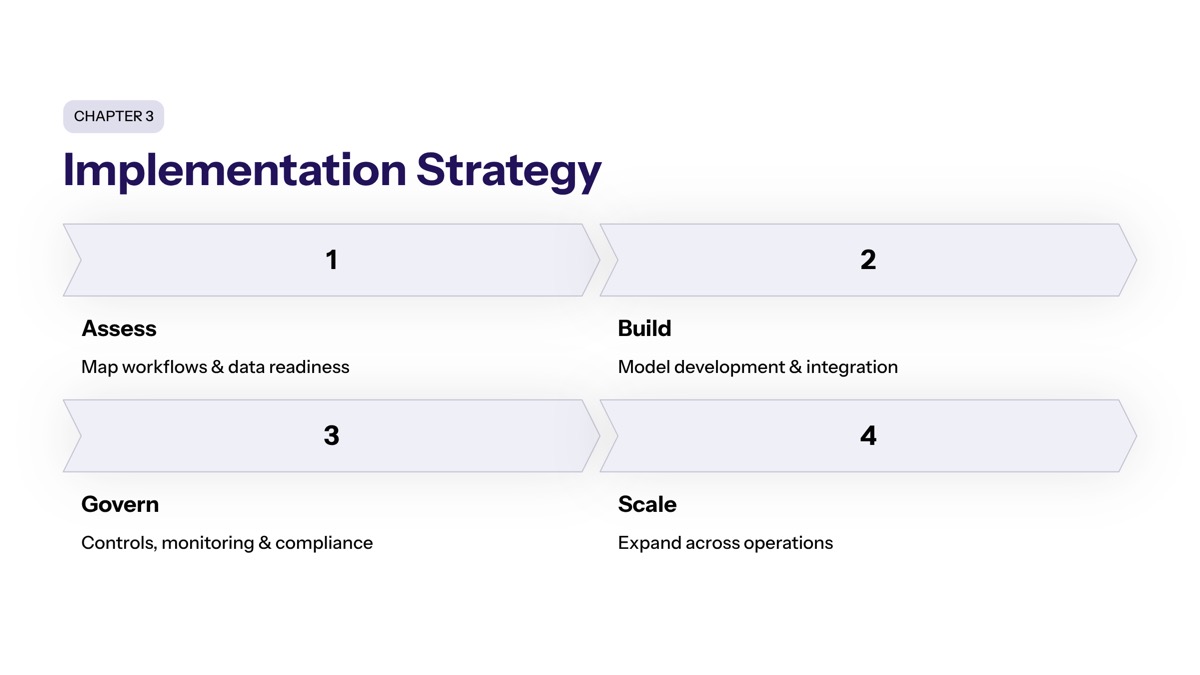
Financial institutions should follow a systematic approach when AI affects financial operations, customer decisions, sensitive data, or regulatory reporting. The process of custom software development typically involves several stages, including requirements analysis, design, development, testing, deployment, and ongoing maintenance.
Discovery and data assessment: Analyze existing financial data, operational workflows, customer journeys, compliance obligations, and AI opportunities. Custom financial software development can significantly improve data management by consolidating financial information, which enhances access, accuracy, and business insights for faster decision-making.
Architecture design: Create an AI-first architecture with security, scalability, compliance, auditability, and integration built in. Fintech AI solutions should accommodate seamless API integration with existing banking systems and legacy software. Custom software solutions in finance can be designed to integrate seamlessly with existing systems, allowing for better adaptability to evolving industry regulations and operational needs.
Model development and training: Build machine learning models using approved financial datasets while protecting data privacy. Models may support fraud detection, credit scoring, predictive analytics, algorithmic trading, customer segmentation, document processing, or regulatory monitoring.
Integration and testing: Deploy AI with existing systems such as a core banking system, payment platforms, customer service tools, CRM systems, and regulatory reporting workflows. Security testing should be embedded in each stage of financial software development to align with industry standards and protect sensitive data.
Monitoring and optimization: Track performance, drift, false positives, false negatives, latency, bias, audit findings, and compliance changes. Automating compliance checks within financial software can significantly reduce operational risks and manual workloads, enhancing overall security. Engaging in custom software development enables financial institutions to automate compliance checks, thereby reducing compliance risks and penalties associated with regulatory requirements.
Core Banking Software (CBS) is essential for enabling fundamental banking functions such as account management, deposits, loans, and withdrawals, providing a secure and efficient banking experience. Loan Management Software automates the entire loan cycle from origination to cash issuance, improving productivity and customer experience through faster processing and visibility. These systems are often central to AI implementation because they contain the workflows and data that AI must enhance.
Technology Stack Comparison for Fintech AI
Component | Traditional Approach | AI-First Approach |
|---|---|---|
Data Processing | Batch processing, manual analysis | Real-time streaming, automated insights |
Risk Assessment | Rule-based systems, periodic reviews | ML models, continuous learning |
Customer Service | Human agents, static FAQs | Conversational AI, personalized responses |
Fraud Detection | Signature-based rules | Behavioral analytics, anomaly detection |
Traditional banking software solutions may be easier to manage in the short term, but they often limit scalability, personalization, and responsiveness. AI-first financial software solutions require stronger data infrastructure, model governance, secure deployment practices, and ongoing support, but they can provide a competitive edge through faster decisions, better detection, and more adaptive financial processes.
Financial leaders should choose the approach based on business goals, regulatory requirements, technical capabilities, budget, and risk tolerance. A bank modernizing core banking platforms may prioritize integration and compliance first. A fintech company building digital banking software may prioritize real-time personalization, fraud detection, and customer acquisition. A lending organization may focus on risk management, creditworthiness analysis, and automated underwriting.
The next challenge is execution. Even strong AI strategies can fail if the organization underestimates data privacy requirements, legacy system constraints, explainability obligations, or talent gaps.
Common Challenges and Solutions
Fintech AI implementation projects are complex because they touch regulated data, financial transactions, customer trust, and mission-critical banking operations. The most common challenges are not only technical; they also involve governance, compliance, integration, staffing, and change management.
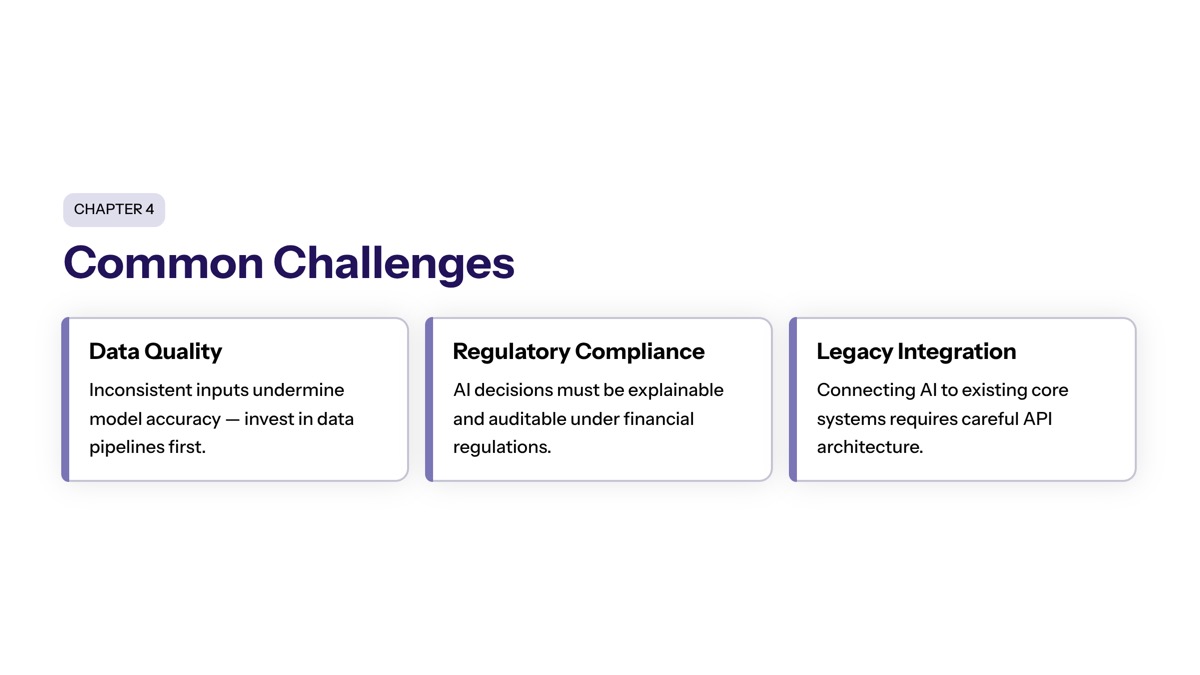
Data Privacy and Regulatory Compliance
The main challenge is protecting sensitive data while still enabling AI models to learn from financial data. Developers of fintech AI models must ensure compliance with global and local data protection standards, and financial software development must prioritize compliance with regulations such as GDPR, PCI DSS, and KYC to ensure data protection and legal adherence.
The solution is to use privacy-preserving AI techniques like federated learning and differential privacy where appropriate, combined with encryption, role-based access, data minimization, consent controls, and detailed audit logs. Robust frameworks for fintech AI must include encrypted data handling and detailed audit logs. Regulatory compliance in fintech also requires continuous monitoring as financial laws, reporting standards, and audit expectations evolve.
Legacy System Integration
Legacy systems in the financial sector often limit scalability and innovation, making modernization essential for growth and efficiency. Many banks still rely on monolithic core banking software, disconnected data stores, manual reconciliation tools, and aging payment infrastructure.
The solution is API-first architecture, microservices, integration layers, and event-driven workflows that connect AI capabilities to existing systems without forcing a full replacement at once. Modernizing legacy systems can significantly reduce operational complexity and enhance compliance with evolving regulatory requirements. Approximately 40% of banks in the US and UK are still not compliant with ISO 20022, highlighting the urgency for legacy system modernization to meet regulatory standards.
Model Explainability and Audit Requirements
AI systems must provide transparent reasoning to satisfy auditing requirements and avoid algorithmic biases. This is especially important when AI affects credit approvals, fraud decisions, account restrictions, pricing, investment risk, or customer eligibility.
The solution is to deploy explainable AI frameworks that show feature importance, decision rationale, confidence levels, and exception paths. Human-in-the-loop review should remain in place for high-risk decisions. Bias testing, model documentation, audit trails, and monitoring dashboards should be part of the software development lifecycle, not added after deployment.
Talent and Expertise Gaps
Fintech AI requires a deep understanding of machine learning, software engineering, banking operations, regulatory compliance, data security, and financial services industry workflows. Many organizations have strong internal teams but lack specialized experience in developing AI for regulated financial software systems.
The solution is to partner with specialized fintech AI development firms, financial software developers, or a banking software development company that combines technical expertise with financial domain knowledge. The right partner should support requirements analysis, architecture design, model development, secure deployment, project management, third party integrations, monitoring, and ongoing maintenance.
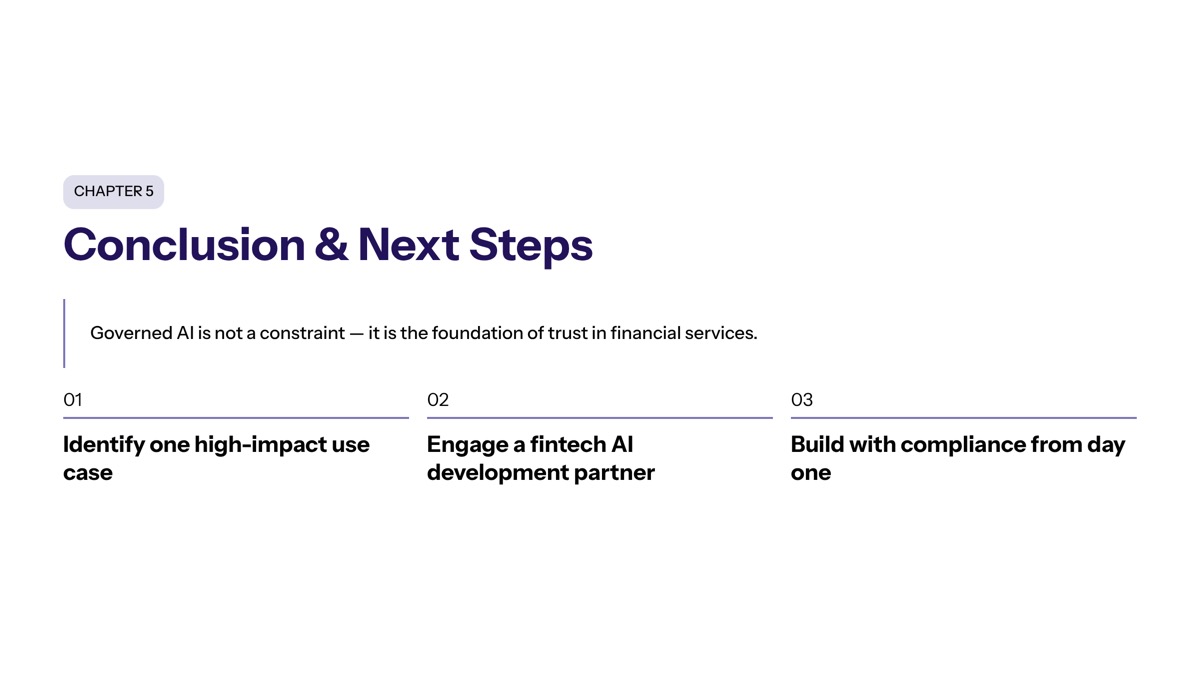
A strategic approach reduces risk: start with a high-impact use case, validate business value, prove compliance, then expand into broader custom banking software development or digital banking solutions.
Conclusion and Next Steps
Fintech AI development services help financial institutions automate operations, enhance security, improve customer experience, and maintain regulatory compliance. The strongest results come from combining AI-first architecture, compliance-aware implementation, custom software solutions, secure integrations, and continuous monitoring.
For banking and fintech leaders, the next steps are:
Conduct an AI readiness assessment across financial data, existing systems, compliance obligations, and operational workflows.
Identify high-impact use cases such as fraud detection, automated compliance checks, payment optimization, loan automation, or conversational AI.
Evaluate development partners based on fintech experience, security practices, explainability methods, integration capability, and ongoing support.
Create an implementation roadmap covering requirements analysis, design, development, testing, deployment, monitoring, and ongoing maintenance.
Measure business outcomes such as reduced manual work, lower fraud losses, faster onboarding, improved customer satisfaction, better regulatory reporting, and stronger operational efficiency.
Related areas to explore next include digital transformation in banking, regulatory technology, custom banking solutions, customer experience optimization, and secure financial software development for modern financial services.