First 10 Days of RAPID: Establishing a Baseline You Can Trust
RAPID doesn’t start with a roadmap. It starts with truth. Before you decide what to build, automate, or “transform,” you need a baseline you can trust—because transformation without a baseline is just motion. RAPID is built around a brutally honest assessment (“the audit”), then two flywheels that keep improving themselves through feedback, measurement, and re-deciding.
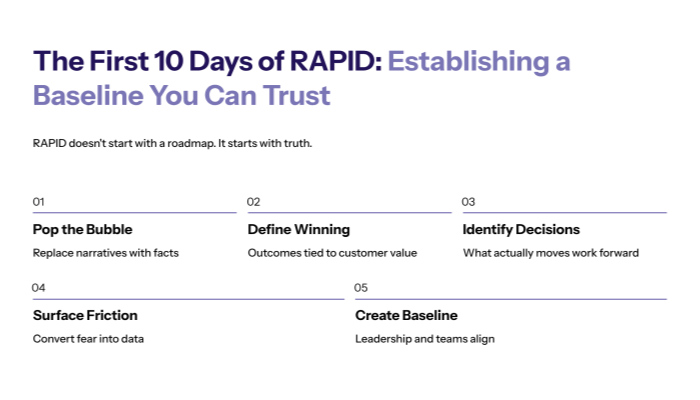
The first 10 days are where you:
- pop the bubble (replace narratives with facts)
- define what “winning” means (outcomes tied to customer value)
- identify the decisions that actually move work forward
- surface friction and fear (and convert them into data)
- create a baseline that leadership and teams can align around
Below is a practical 10-day RAPID baseline playbook—built to be fast, evidence-driven, and usable in real organizations.

Day 1–2 — Start With Truth (The Audit Baseline)
1.1 The audit mindset: truth is the motor
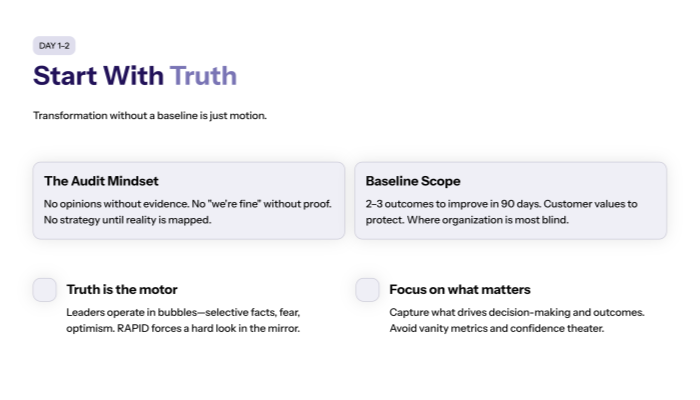
RAPID’s first move is explicit: everything begins with a brutally honest assessment of the situation—the audit. The reason is simple: leaders often operate inside a “bubble,” protecting themselves with selective facts, fear, or optimism. RAPID forces a hard look in the mirror—things as they are, not as they’d like them to be.
Your Day 1 baseline rule:
- No opinions without evidence.
- No “we’re fine” without measurable proof.
- No strategy talk until reality is mapped.
1.2 Define the baseline scope (tight, outcome-led)
RAPID works quickly because it’s focused. The goal isn’t to document everything—it’s to capture what matters for decision-making and outcomes. RAPID is designed to reduce friction, align actions to measurable outcomes, and avoid vanity metrics that create confidence theater.
Baseline scope questions for Day 2:
- What are the 2–3 outcomes the business must improve in the next 90 days?
- Which customer values must be protected while we change?
- Where is the organization most “blind” right now (data, process, ownership, customer truth)?
Day 3–4 — Build Customer Value + Outcomes (The “Why” and “What”)
2.1 Customer Value Inventory: why customers pay (and what they punish)
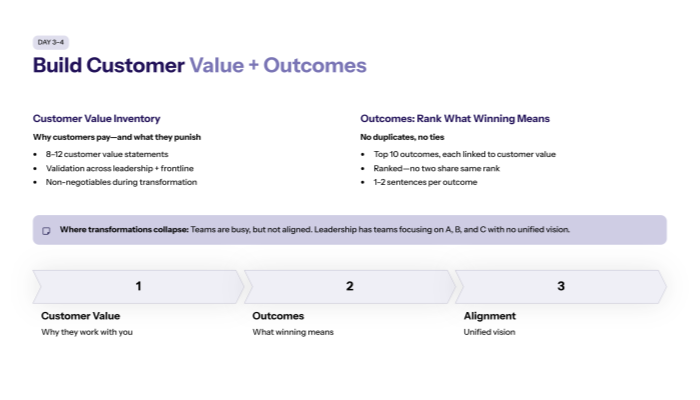
RAPID’s Research tools start with documenting and validating why customers work with you—Customer Value.
In practical terms, the baseline needs:
- 8–12 customer value statements
- agreement/disagreement validation across leadership + frontline
- the “non-negotiables” (what cannot break during transformation)
This becomes your transformation guardrail.
2.2 Outcomes: rank what “winning” means (no duplicates)
RAPID then forces alignment by documenting outcomes and linking them directly to customer value—then ranking them (no two outcomes share the same rank).
This is where many transformations collapse: teams are busy, but not aligned. RAPID calls out the pattern—leadership has teams focusing on A, B, and C with no unified vision—effort isn’t aligned to outcomes.
Baseline output (end of Day 4):
- top 10 outcomes, each linked to customer value + ranked
- 1–2 sentences per outcome describing what changes in the business
Day 5–6 — Map Decisions + Risks (What Actually Controls Execution)
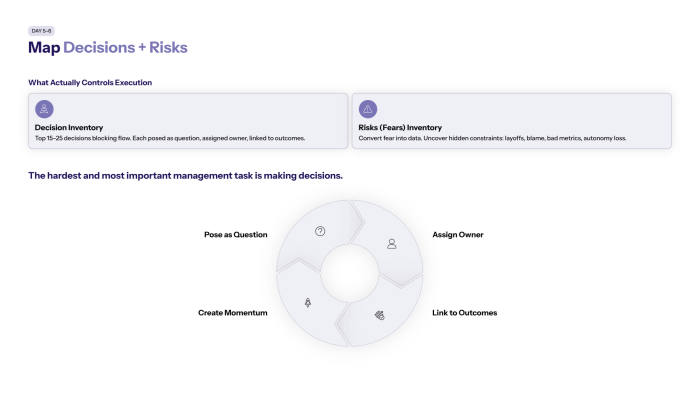
3.1 Decision Inventory: list the decisions that drive outcomes
RAPID is clear: the hardest and most important management task is making decisions. The Decision Inventory forces each decision to be posed as a question, assigned to an owner, and linked to outcomes and customer value.
This is how you avoid the “baseline trap” where you have a lot of information but no leverage.
What to capture by end of Day 6:
- top 15–25 decisions that block flow today
- “Who decides?” (actual owner, not org chart theory)
- priority + (if possible) a decision date column
RAPID also emphasizes that decisions create momentum—and they happen throughout all phases, not only at the end.
3.2 Risks (Fears) Inventory: convert fear into data
RAPID treats fear as a signal—not a weakness. The Risks (Fears) Inventory exists to convert fears into fuel by turning them into data points and removing emotion.
In the first 10 days, this is where you uncover the “hidden constraints”:
- fear of layoffs
- fear of blame
- fear of exposing bad metrics
- fear of losing autonomy
- fear of customer fallout
Your baseline becomes trustworthy when people stop hiding reality.
Day 7–8 — Baseline the Operating System (People, Process, Product)
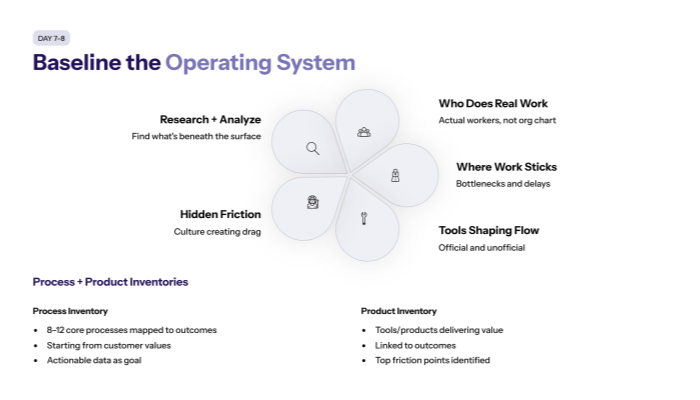
4.1 Research + Analyze flywheel: find what’s beneath the surface
RAPID frames Research and Analyze as a flywheel: analysis reveals holes in data collection, forcing you back to research—because most problems are “beneath the surface.”
For baseline purposes, your job is to capture enough truth to answer:
- Who’s doing the real work?
- Where does work get stuck?
- What tools/products are shaping workflows (officially or unofficially)?
- Where does culture create hidden friction?
4.2 Process + Product Inventories: document the real flow (not the org chart)
RAPID’s Process Inventory is designed to discover and describe processes starting from outcomes and customer values, focusing on what drives the majority of effort—with actionable data as the goal.
The Product Inventory complements it: what products/tools are used to deliver value, linked again to outcomes and customer value.
Baseline output (end of Day 8):
- 8–12 core processes mapped to outcomes
- the tools/products supporting each process
- top friction points (handoffs, delays, rework loops, compliance constraints)
Day 9–10 — Publish the Baseline and Lock the Operating Rules
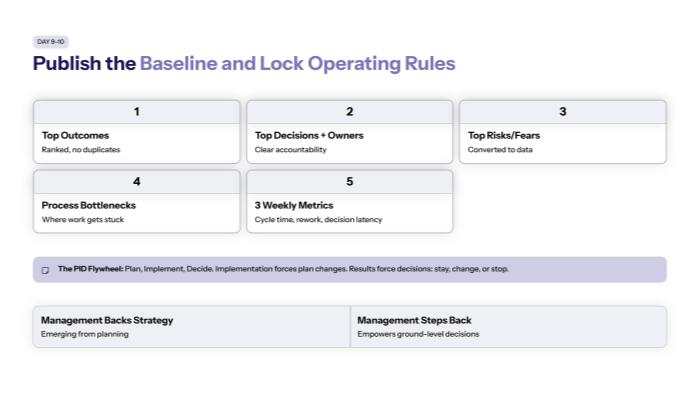
5.1 Establish “Minimum Viable Truth” + cadence (the PID flywheel)
RAPID isn’t static; it’s fluid. Plan, Implement, Decide form the PID flywheel where implementation forces plan changes, and results force decisions: stay, change, or stop.
So the baseline isn’t a report. It’s an operating reference you revisit weekly.
Publish a 1-page baseline (Day 9):
- top outcomes (ranked)
- top decisions + owners
- top risks/fears (as data)
- top process bottlenecks
- the 3 metrics you’ll track weekly (cycle time, rework, decision latency)
5.2 The two leadership decisions that make the baseline real
RAPID highlights two management decisions that drive success:
- management backs the strategy that emerges from planning
- management decides to “no longer decide”—empowering implementation decisions as close to the ground as possible
This matters because baseline trust collapses when:
- leaders override the system impulsively
- teams believe “nothing will change”
- decisions are delayed by micromanagement
If leadership won’t step back, the baseline becomes a document, not a change engine. RAPID is blunt about this risk: leadership interference can sabotage progress.
Day 10 output:
- baseline published
- weekly cadence scheduled (review → decide → adapt)
- first 3 “easy wins” identified to build confidence and show movement
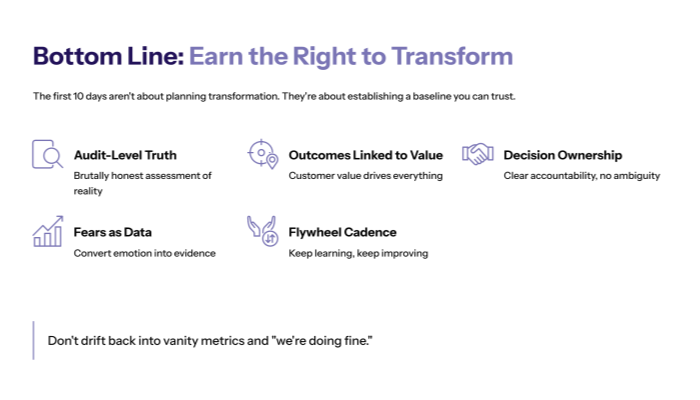
Bottom line
The first 10 days of RAPID are not about planning transformation. They’re about earning the right to transform by establishing a baseline you can trust.
That baseline comes from: audit-level truth, outcomes linked to customer value, decision ownership, fears converted into data, and a flywheel cadence that keeps learning and improving—so you don’t drift back into vanity metrics and “we’re doing fine.”