From Chaos to Clarity: Standardizing Work Without Killing Flexibility
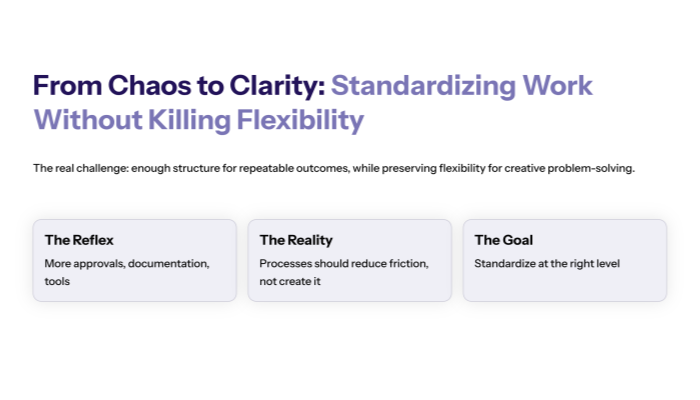
When teams feel stuck in chaos, the reflex is predictable: add process. More approvals. More documentation. More “best practices.” More tools.
But RAPID makes a critical distinction: processes should reduce friction, not create it—and if tech is involved, the goal is to keep it simple, not let the tool become the operating model.
The real challenge isn’t “standardize everything.” It’s standardizing work at the right level: enough structure to create repeatable outcomes and reliable coordination, while preserving the flexibility that high-performing teams need to solve problems creatively. RAPID explicitly notes problem-solving is a creative process, not a rigid ones-and-zeros method.
This guide shows how to move from chaos to clarity with a RAPID-aligned approach: define minimum standards, connect work to outcomes, empower implementation decisions close to the ground, and iterate fast.

Why Standardization Fails? (and Creates More Chaos)
1.1 The “bureaucracy trap”: processes outlive their value
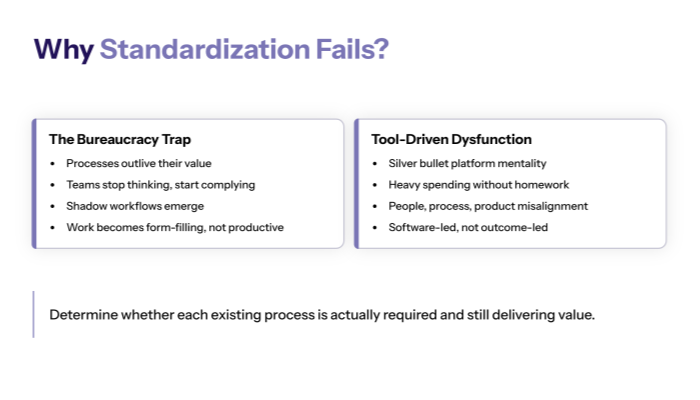
RAPID calls out a reality many organizations ignore: processes are meant to save time and generate consistent outcomes, but they often become outdated, overly complex, and difficult to dislodge once bureaucracy sets in. In the worst cases, work becomes more about “filling out forms than being productive.”
That’s how standardization kills flexibility:
- Teams stop thinking and start complying.
- Exceptions multiply, because the “standard” doesn’t match reality.
- People create shadow workflows (spreadsheets, side channels) to get work done.
RAPID’s first principle for process planning is blunt: determine whether each existing process is actually required and still delivering value.
1.2 Tool-driven standardization is the fastest way to scale dysfunction
RAPID warns against the “silver bullet platform” mentality—companies spend heavily on tools, promise that it will fix everything, and still fail because they never did the homework on the holy trinity: people, process, and product.
RAPID’s stated aim here is clear: align processes so they don’t conflict, reduce friction, and focus on quick testing, measurement, and adjustment.
Standardization should be outcome-led, not software-led.
The Right Kind of Standardization: “Minimum Viable Standards”
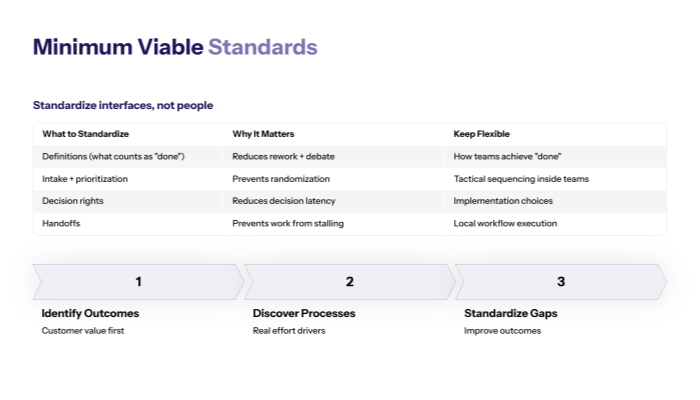
2.1 Standardize interfaces, not people
If you standardize how people think, you’ll crush adaptability. If you standardize the interfaces between work—handoffs, definitions, decision points, and “done” criteria—you create clarity without turning the org into a machine.
A practical model:
|
What to standardize |
Why it matters |
What to keep flexible |
|---|---|---|
|
Definitions (what counts as “done”) |
reduces rework + debate |
how teams achieve “done” |
|
Intake + prioritization |
prevents randomization |
tactical sequencing inside teams |
|
Decision rights |
reduces decision latency |
implementation choices |
|
Handoffs |
prevents work from stalling |
local workflow execution |
This aligns with RAPID’s mindset: reduce friction by aligning processes and keep improvements iterative and practical.
2.2 Anchor standards to outcomes (or they’ll become theater)
RAPID structures work around customer value and outcomes, then uses those to discover and describe the processes that drive the most effort.
That matters because “standards” without outcomes become compliance theater:
- lots of activity
- little measurable improvement
- endless arguments over whether the process is “followed”
RAPID’s tools force the correct order:
- identify outcomes and customer value
- discover the real processes that drive effort
- standardize only what improves those outcomes
RAPID Tools That Turn Chaos Into Clarity (Without Over-Engineering)
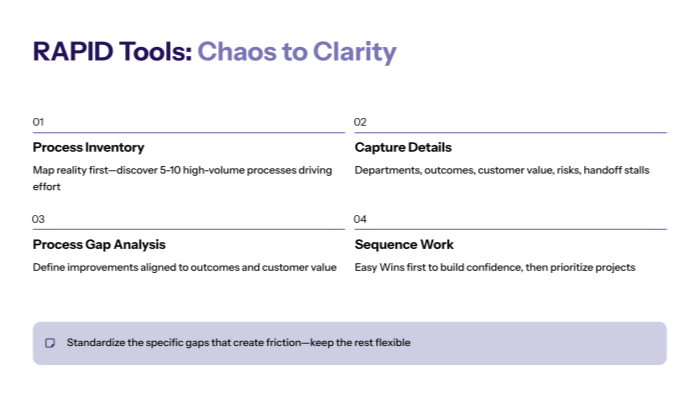
3.1 Process Inventory: map reality first
RAPID’s Process Inventory is designed to “discover and describe processes” starting from outcomes and customer values—focusing on the processes that drive the majority of effort. The key is actionable data, not documentation for its own sake.
How to use it to standardize work safely:
- Start with 5–10 high-volume processes (customer service and operations outward is a practical tip).
- For each process, capture departments involved, outcome linkage, customer value linkage, risk and compliance impact.
- Highlight where handoffs stall, where work loops back, and where “shadow processes” exist.
This step prevents the most common failure: standardizing the org chart fantasy instead of the workflow reality.
3.2 Process Gap Analysis: standardize only the gaps that matter
Once you’ve mapped reality, RAPID’s Process Gap Analysis helps you define improvements as specifically as possible—one department per line if needed—and forces each improvement to align to at least one customer value and one outcome.
This is how you avoid blanket standardization:
- You standardize the specific gaps that create friction.
- You tie those standards to outcomes (so you can measure value).
- You keep the rest flexible.
Then you sequence the work using RAPID’s Easy Wins and Project Inventory, which are explicitly designed to build confidence and deliver tangible improvements while keeping priorities clear.
Don’t Kill Flexibility: Empower Implementation Close to the Ground
4.1 Standardization requires trust (or it becomes resistance)
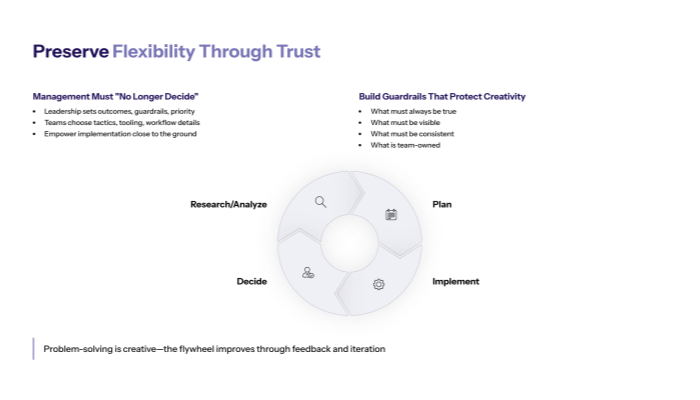
RAPID draws a hard line: for implementation to succeed, management must decide to “no longer decide”—meaning teams should be empowered to make implementation decisions as close to the ground as possible. Otherwise leadership can sabotage progress through micromanagement and wrong calls made from distance.
This is how you preserve flexibility:
- Leadership sets outcomes, guardrails, and priority.
- Teams choose tactics, tooling configurations, and workflow details inside those guardrails.
If leadership won’t let go, teams stop adapting and start waiting.
4.2 Build guardrails that protect creativity
RAPID emphasizes that problem-solving is creative and the process is fluid—Research/Analyze feeds Plan/Implement/Decide in a flywheel that improves itself through feedback and iteration.
So instead of rigid rules, define guardrails:
- “What must always be true” (compliance, security, customer commitments)
- “What must be visible” (the minimum data to coordinate)
- “What must be consistent” (definitions, decision rights)
- “What is team-owned” (local workflow, implementation details)
That creates repeatability without freezing the system.
A Practical “Chaos to Clarity” Standardization Sprint
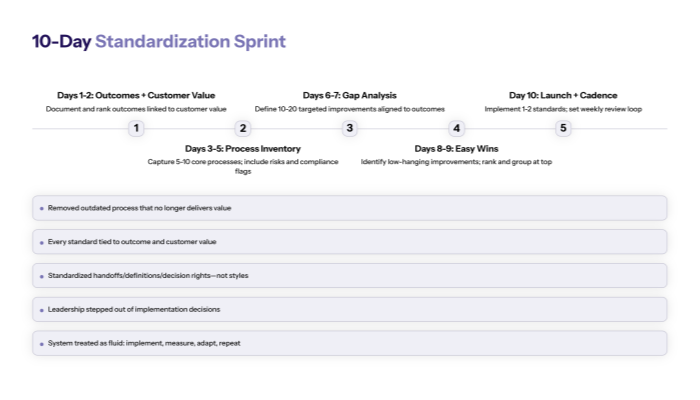
5.1 The 10-day blueprint (RAPID-aligned)
RAPID is designed to work quickly with urgency, but not artificial deadlines—the urgency comes from reaching goals and getting aligned behind them.
Days 1–2: Outcomes + customer value
- Document outcomes and link them to customer value (rank them).
Days 3–5: Process Inventory
- Capture 5–10 core processes driving most effort; include risks/compliance flags.
Days 6–7: Process Gap Analysis
- Define 10–20 targeted improvements; force alignment to outcomes and customer value.
Days 8–9: Easy Wins + sequencing
- Identify low-hanging improvements to build confidence; then rank projects and group easy wins at the top.
Day 10: Implement + decide cadence
- Launch 1–2 standards (interfaces), not “process overhaul.”
- Set a weekly review loop to measure impact and adjust (the PID flywheel mindset).
5.2 The “standardization checklist” that protects flexibility
Use this to validate you’re standardizing the right way:
- We removed or simplified at least one outdated process that no longer delivers value.
- Every new standard is tied to an outcome and customer value—not preference.
- We standardized handoffs/definitions/decision rights—not personal styles.
- Leadership committed to stepping out of implementation decisions (“no longer decide”).
- We treat the system as fluid: implement, measure, adapt, repeat.
Bottom line
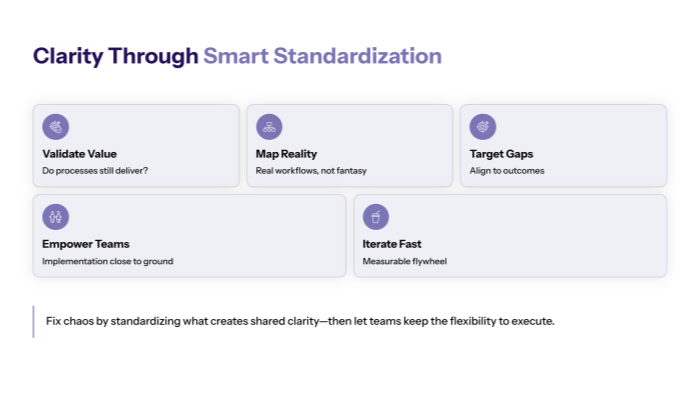
You don’t fix chaos by standardizing everything. You fix chaos by standardizing what creates shared clarity—then letting teams keep the flexibility required to execute.
RAPID’s approach is practical: validate whether processes still add value, map real workflows, target gap-driven improvements aligned to outcomes, empower implementation close to the ground, and iterate fast through a measurable flywheel.