From Vision to Execution: Defining Measurable Outcomes
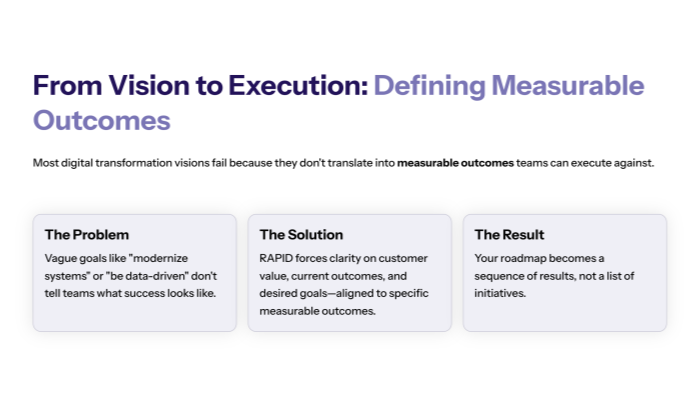
Most digital transformation “visions” fail for a simple reason: they don’t translate into measurable outcomes that teams can execute against.
You’ll hear goals like modernize our systems, be more data-driven, improve collaboration, or increase agility. Those statements might be directionally true, but they aren’t operational. They don’t tell teams what success looks like, what to change first, or how to decide when tradeoffs appear.
RAPID solves that by forcing one thing early: clarity on customer value, current outcomes, and desired goals, then aligning actions around specific measurable outcomes rather than vanity metrics.
This post shows how to move from vision to execution by defining measurable outcomes the RAPID way—so your roadmap becomes a sequence of results, not a list of initiatives.

Why “vision” doesn’t execute without measurable outcomes?
1.1 Vision creates direction; outcomes create traction
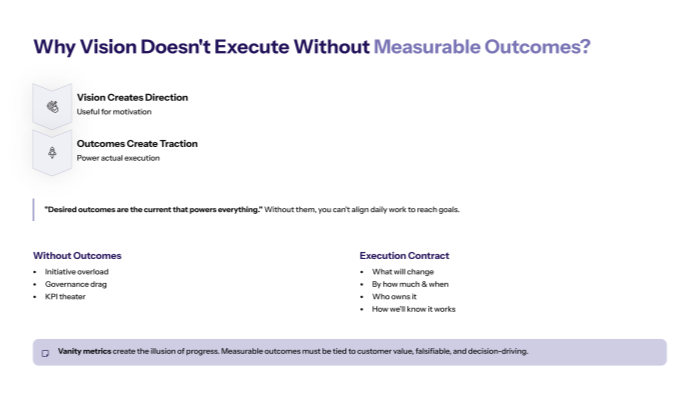
Vision is useful for motivation. Outcomes are what actually power execution.
RAPID says it bluntly: “desired outcomes are the current that powers everything.” If you don’t know the outcomes you’re after, you won’t align daily work to reach them.
When outcomes are missing, organizations default to:
- initiative overload (everything sounds strategic)
- governance drag (more approvals because nothing is clear)
- KPI theater (dashboards that look good, outcomes that don’t change)
Measurable outcomes act like an execution contract:
- what will change
- by how much
- by when
- who owns it
- how we’ll know it’s working
1.2 Vanity metrics create the illusion of progress
RAPID warns against vanity metrics—facts selected to make you feel good about a decision that may be wrong. When leadership relies on them, teams learn to optimize narratives rather than performance.
That’s why measurable outcomes must be:
- tied to customer value (not internal optics)
- falsifiable (you can be wrong)
- decision-driving (they tell you what to do next)
If your “outcome” can’t be proven wrong with data, it’s not an outcome—it’s branding.
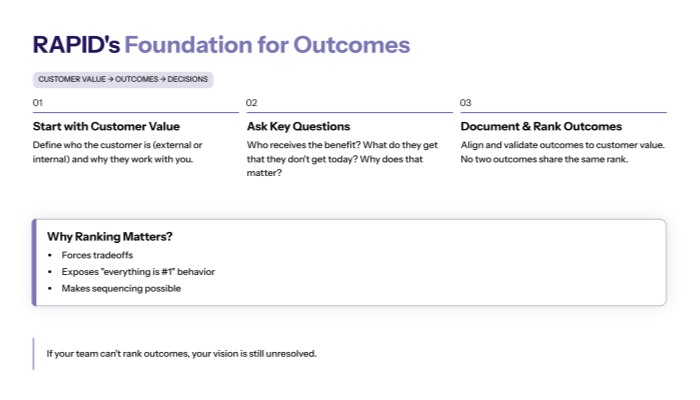
RAPID’s foundation for outcomes (Customer Value → Outcomes → Decisions)
2.1 Start with customer value (define who the customer is)
RAPID’s tools are intentionally ordered. It starts by forcing clarity on Customer Value: why customers work with you and what they pay for. RAPID also notes the “customer” can be external—or it can be internal (your team or organization) depending on the context.
This matters because “measurable outcomes” must drive value, not just operational neatness.
Practical prompt to define customer value:
- Who receives the benefit of this transformation outcome?
- What do they get that they don’t get today?
- Why does that matter economically, operationally, or competitively?
When customer value is explicit, outcomes stop being abstract.
2.2 Document outcomes and rank them (no duplicates)
RAPID’s Outcomes tool is designed to “document, align, and validate outcomes to customer value,” and it requires ranking—no two outcomes share the same rank.
That ranking rule is a hidden weapon:
- it forces tradeoffs
- it exposes political “everything is #1” behavior
- it makes sequencing possible
If your team can’t rank outcomes, it’s a signal that your “vision” is still unresolved.
What makes an outcome measurable (and actually executable)
3.1 A measurable outcome has five properties
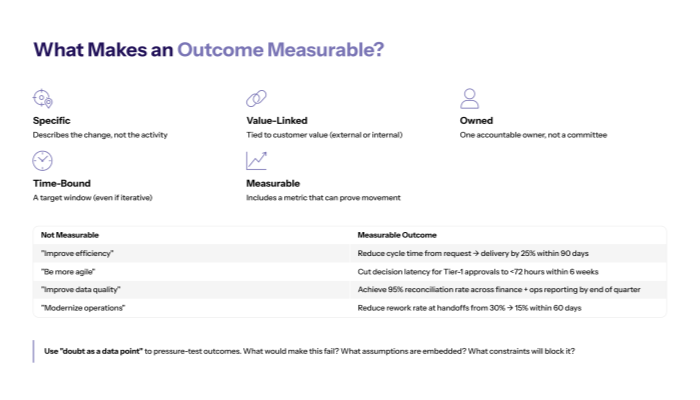
A measurable outcome should be:
- Specific — describes the change, not the activity
- Value-linked — tied to customer value (external or internal)
- Owned — one accountable owner, not a committee
- Time-bound — a target window (even if iterative)
- Measurable — includes a metric that can prove movement
Here’s the difference:
|
Not measurable (vision / intent) |
Measurable outcome |
|---|---|
|
“Improve efficiency” |
“Reduce cycle time from request → delivery by 25% within 90 days” |
|
“Be more agile” |
“Cut decision latency for Tier-1 approvals to <72 hours within 6 weeks” |
|
“Improve data quality” |
“Achieve 95% reconciliation rate across finance + ops reporting by end of quarter” |
|
“Modernize operations” |
“Reduce rework rate at handoffs from 30% → 15% within 60 days” |
Notice: none of these outcomes mention tools. Tools come later—only if they remove a proven constraint.
3.2 Use “doubt as a data point” to pressure-test outcomes
RAPID treats doubt as a useful input: “doubt is nothing but a data point.” It tells you what might go wrong so you can plan around it.
Use doubt to stress-test outcomes:
- What would make this outcome fail?
- What assumptions are embedded?
- What constraints will block it (people, process, product)?
- What evidence would prove the outcome isn’t moving?
Turn outcomes into execution via decisions and resource reality
4.1 Outcomes don’t happen without decisions (Decision Inventory)
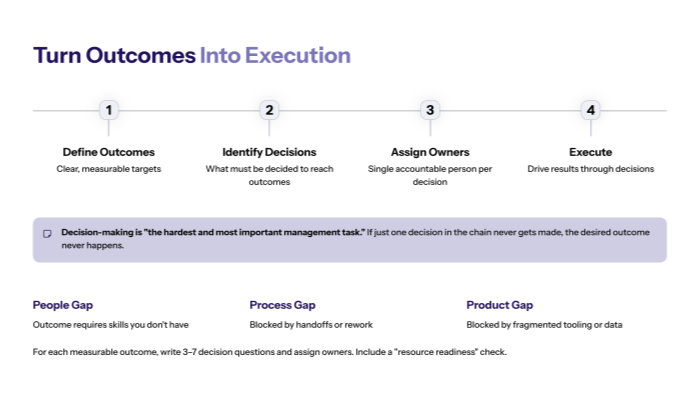
RAPID calls decision-making “the hardest and most important management task,” and its Decision Inventory is built to identify decisions that drive outcomes, assign owners, and prioritize them.
This is where most transformations break:
- the outcome is declared
- but the decisions required to reach it are not owned
- so the outcome becomes a wish
RAPID makes the point concrete: if just one decision in the chain never gets made, the desired outcome never happens (the “digital marketer” example).
Practical move: for each measurable outcome, write 3–7 “decision questions”:
- “Who owns the definition of done?”
- “What is the decision SLA for approvals?”
- “Which team is accountable for end-to-end flow?”
- “Which system is source-of-truth for reporting?”
Then assign owners.
4.2 Tie outcomes to people/process/product gaps (and resources)
RAPID emphasizes that after defining outcomes, you research and analyze the internal problems that must be solved—in terms of people, process, and products—to reach those outcomes. Then you plan to improve efficiency/workflow and obtain the resources needed.
This is where outcomes become realistic:
- If the outcome requires skills you don’t have → it’s a People gap.
- If the outcome is blocked by handoffs/rework → it’s a Process gap.
- If the outcome is blocked by fragmented tooling/data → it’s a Product gap.
And crucially: if resources aren’t provided in time, momentum stops—regardless of how good the plan is.
So your measurable outcomes should include a “resource readiness” check:
- What must be true (licenses, access, staffing) for this outcome to move next week?
Keep outcomes honest with the flywheel (measure → decide → adapt)
5.1 Treat outcomes as flywheel inputs, not “one-time goals”
RAPID is built as two flywheels: Research/Analyze, then Plan/Implement/Decide to create directives and outcomes.
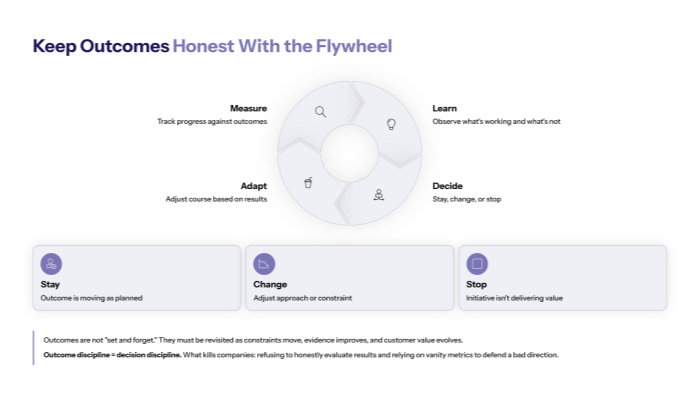
That means outcomes are not “set and forget.” They are revisited as reality changes:
- as constraints move
- as evidence improves
- as customer value evolves
RAPID describes this continuous philosophy as observing, learning, and correcting course—like driving a car to a destination.
If your outcomes aren’t being revisited and refined, they will drift into slogans.
5.2 Decide based on results: stay, change, stop
RAPID’s Decide phase forces a simple truth loop: after implementation, you must evaluate impact and then choose to stay, change, or stop.
This matters because even “perfect planning” can get hit by the X factor—so the work isn’t done until results are assessed and adjustments are made.
And RAPID is explicit about what kills companies: refusing to honestly evaluate results and continuing to rely on vanity metrics to defend a bad direction.
Outcome discipline = decision discipline.
If the outcome isn’t moving:
- change the approach
- change the constraint you’re targeting
- or stop the initiative
That’s how you keep vision tethered to execution.
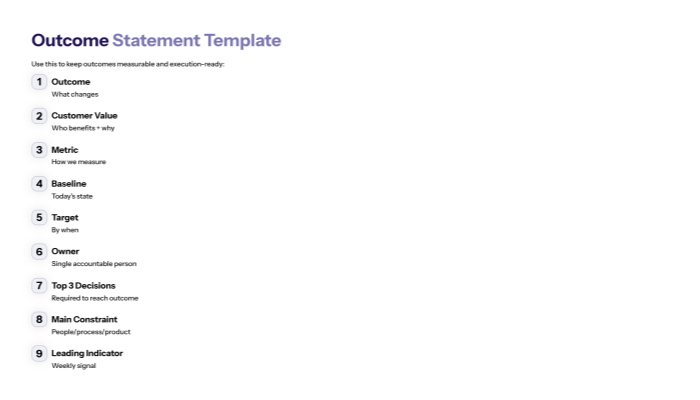
Quick template: outcome statement you can reuse
Use this to keep outcomes measurable and execution-ready:
- Outcome (what changes):
- Customer value it drives (who benefits + why):
- Metric (how we measure):
- Baseline (today):
- Target (by when):
- Owner (single accountable):
- Top 3 decisions required:
- Main constraint (people/process/product):
- Leading indicator (weekly signal):