Governance That Works: Decision-Making at Speed
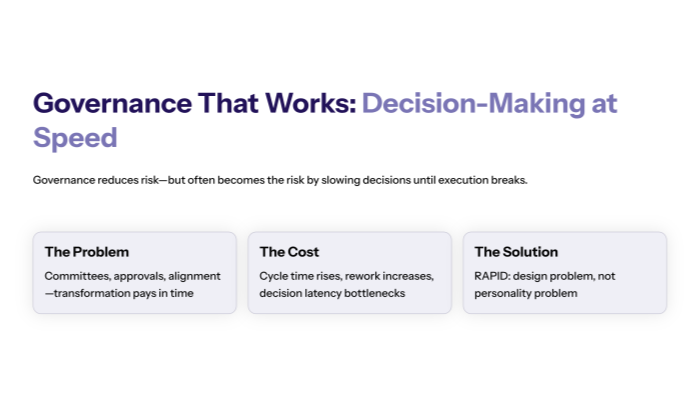
Governance is supposed to reduce risk. In practice, it often becomes the risk—because it slows decisions until execution breaks.
When transformation governance turns into committees, approvals, and “alignment,” the organization pays for it in the only currency that matters: time. Cycle time rises, rework increases, and decision latency becomes the bottleneck.
RAPID treats this as a design problem, not a leadership personality problem. Decisions drive outcomes, and if critical decisions never get made, the outcome never happens. RAPID also forces honesty through its Decide loop: evaluate results, then stay/change/stop based on measurable reality.
This post gives you a governance model that actually works: decision-making at speed.

Why most governance slows transformation instead of enabling it?
1.1 “More governance” is often a symptom of low trust
When leaders don’t trust:
the data,
the teams,
or the process,
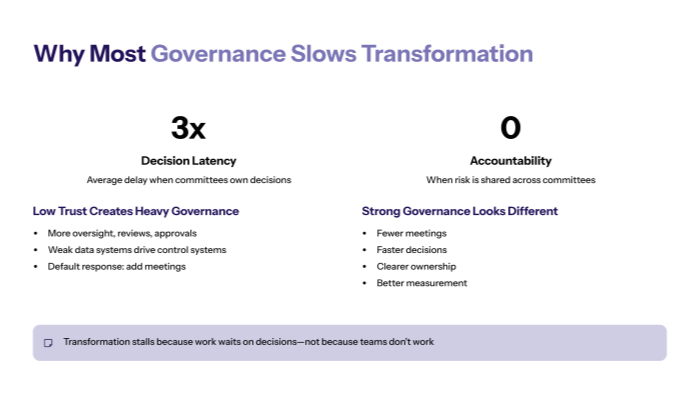
…the default response is more oversight. More reviews. More approvals. More check-ins.
RAPID warns that if you can’t get timely, accurate data to decision makers, major issues are inevitable. Weak information systems create heavy governance systems.
Strong governance is the opposite:
- fewer meetings
- faster decisions
- clearer ownership
- better measurement
1.2 Committees create decision latency (and decision latency becomes the bottleneck)
Transformation doesn’t stall because teams don’t work. It stalls because work waits on decisions.
RAPID is explicit: decision-making is central, decisions happen throughout, and if a decision doesn’t get made, the desired outcome never happens.
Committees are often where decisions go to die because:
- no one owns the call
- risk is shared (so accountability is diluted)
- choices get “socialized” instead of decided
So governance must be redesigned around owned decisions, not consensus.
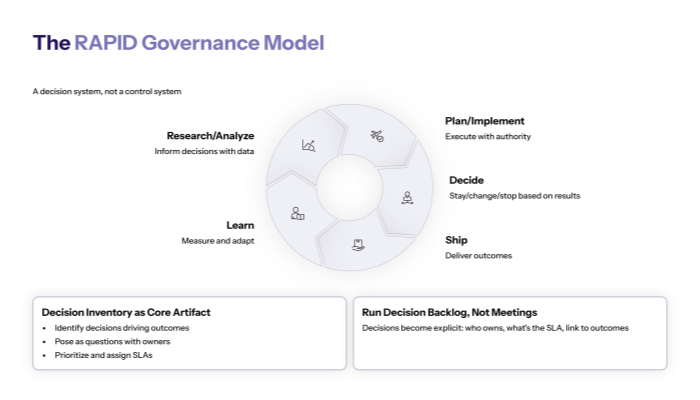
The RAPID governance model (a decision system, not a control system)
2.1 Use the Decision Inventory as the core governance artifact
RAPID’s Decision Inventory is designed to:
- identify decisions that drive outcomes and customer value
- pose decisions as questions
- assign owners
- prioritize decisions
This is the foundation of decision-making at speed.
Instead of “governance meetings,” you run:
- a decision backlog
- with owners, SLAs, and links to outcomes
- That immediately changes behavior:
- decisions stop being vague (“we need alignment”)
- decisions become explicit (“who owns X?” “what’s the SLA?”)
work starts flowing again.
2.2 Governance should run on the flywheel: measure → decide → ship → learn
RAPID is built as a cycle: Research/Analyze informs Plan/Implement, and Decide closes the loop with stay/change/stop based on results.
Governance that works simply protects that cycle:
- it forces decisions when blockers appear
- it ensures owners have authority
- it stops work that doesn’t move outcomes
- it reallocates resources based on what the metrics say
Governance is not oversight. It’s throughput management.
Decision-making at speed (design rules that work)
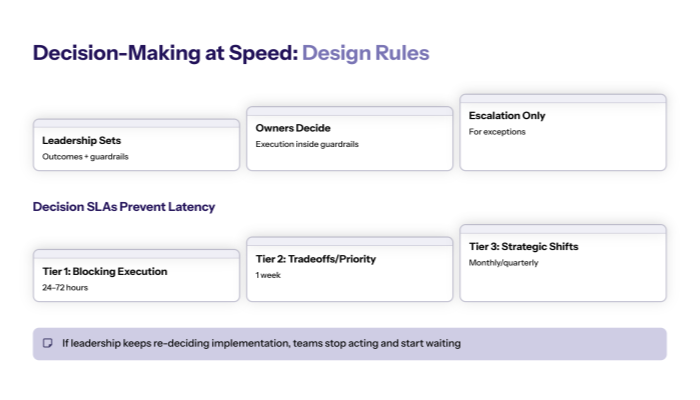
3.1 Define decision rights clearly (and keep leadership out of implementation details)
One of the most important RAPID leadership principles: once leadership backs the strategy, they must decide to “no longer decide” implementation details—otherwise progress stalls or reverses.
Decision-making at speed requires:
- leadership sets outcomes + guardrails
- owners decide execution inside guardrails
- escalation exists only for exceptions
If leadership keeps “helping” by re-deciding implementation every week, teams stop acting and start waiting.
3.2 Set decision SLAs (or you’ll measure decision latency forever)
If a decision blocks execution, it needs an SLA.
A simple SLA model:
- Tier 1 (blocking execution): 24–72 hours
- Tier 2 (tradeoffs/priority): 1 week
- Tier 3 (strategic shifts): monthly/quarterly
Then enforce:
- if SLA is missed twice → redesign decision rights
- if SLA is missed repeatedly → stop the initiative until governance is fixed
This supports RAPID’s philosophy: you can’t evaluate initiatives without measurable success criteria.
The governance operating rhythm (what happens weekly)
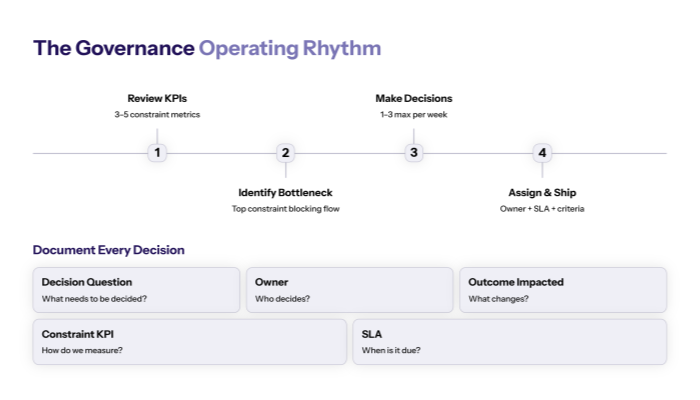
4.1 Run a weekly “Decision Review” (not a steering committee)
A governance rhythm that enables speed looks like this:
Weekly (30–45 min):
- Review 3–5 constraint KPIs (cycle time, rework, decision latency)
- Identify the top bottleneck
- Make 1–3 decisions (max)
- Assign owner + SLA + acceptance criteria
- Confirm what ships before next week
This aligns with RAPID’s emphasis that big problems are solved by many small steps—so governance must enable small, frequent shipping, not big quarterly approvals.
4.2 Document decisions as questions (so they don’t disappear)
Every decision must be captured in this format (RAPID style):
- Decision question:
- Owner:
- Outcome impacted:
- Constraint KPI:
- What ships:
- SLA:
- Escalation rule:
This is exactly what RAPID’s Decision Inventory is built to do.
If you don’t document decisions, you’ll relive the same debate next week.
The Decide loop that keeps governance honest
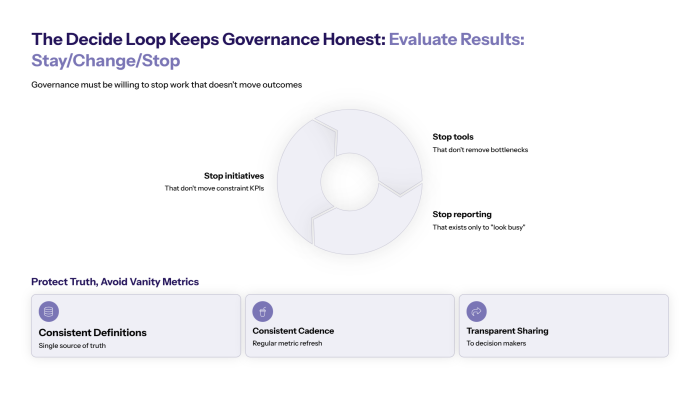
5.1 Measure impact and stay/change/stop (governance must cut work too)
RAPID’s Decide discipline is explicit: evaluate results, then decide to stay, change, or stop.
Governance that works must be willing to stop:
- initiatives that don’t move constraint KPIs
- tools that don’t remove a bottleneck
- reporting work that exists only to “look busy”
If governance never stops work, it becomes a backlog amplifier, not a transformation enabler.
5.2 Avoid vanity metrics and protect truth
RAPID warns that vanity metrics create false confidence and bad decisions. Decision-making at speed only works if governance runs on decision-grade truth.
So governance must enforce:
- consistent metric definitions (source of truth)
- consistent refresh cadence
- transparent sharing to decision makers
Truth reduces debate. Debate reduces speed.
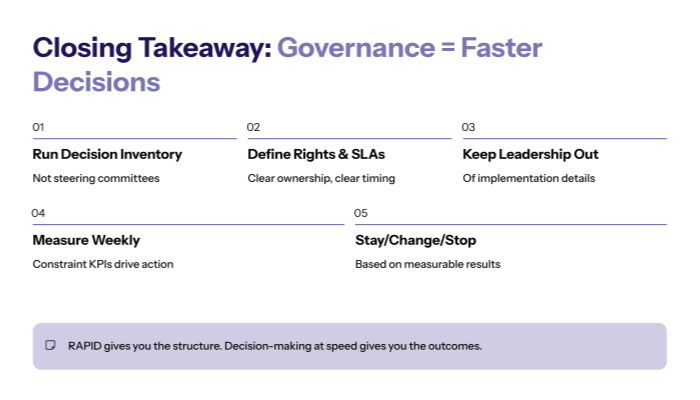
Closing takeaway
Governance that works is not “more control.” It’s faster decisions.
RAPID gives you the structure:
- run governance as a Decision Inventory
- define decision rights and SLAs
- keep leadership out of implementation details
- measure constraint KPIs weekly
- stay/change/stop based on results