How to Prioritize Transformation Initiatives Without Politics?
If you’ve ever watched a transformation portfolio get “prioritized,” you’ve probably seen the same pattern:
- the loudest leader wins
- the most urgent fire wins
- the most persuasive deck wins
- the newest tool wins
- the initiative with the biggest budget wins
That’s not prioritization. That’s politics plus momentum.
RAPID’s planning discipline is designed to replace that chaos with a system: you gather truth (Research), interpret what matters (Analyze), and then build a roadmap that sequences outcomes around constraints—measured with KPIs and owned by decision-makers.
This post gives you a practical approach to prioritizing transformation initiatives without politics—by anchoring decisions to outcomes, customer value, constraints, and measurable signals.

Why prioritization becomes political in the first place?
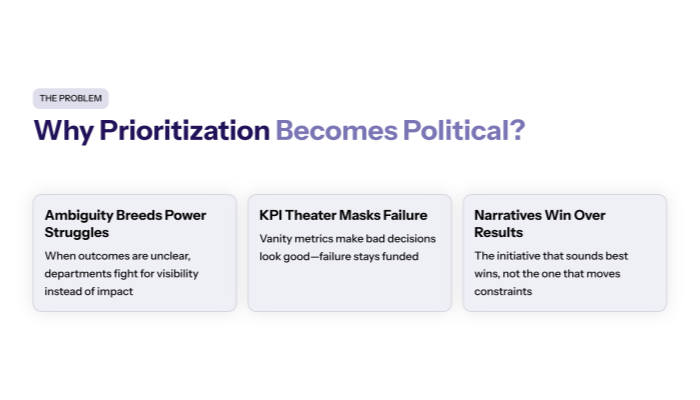
1.1 When outcomes are unclear, power fills the gap
If leadership can’t clearly define the outcomes that matter most, prioritization becomes a proxy fight:
- every department argues their work is essential
- every initiative claims to be strategic
- teams optimize for visibility instead of impact
RAPID calls out this misalignment directly: leaders often have teams focusing on multiple priorities without a unified vision, so effort is not aligned toward outcomes.
That’s the root cause of politics: ambiguity.
1.2 KPI theater makes politics look like performance
When metrics don’t reflect outcomes, prioritization becomes a contest of narratives.
RAPID explicitly warns against vanity metrics—selective measurement designed to make leaders feel good about decisions that are failing. And it emphasizes that if success can’t be measured in tangible ways, you can’t evaluate initiatives—so failure stays funded.
In that environment, the initiative that sounds best wins, not the one that moves constraints.
The RAPID method for prioritizing transformation initiatives
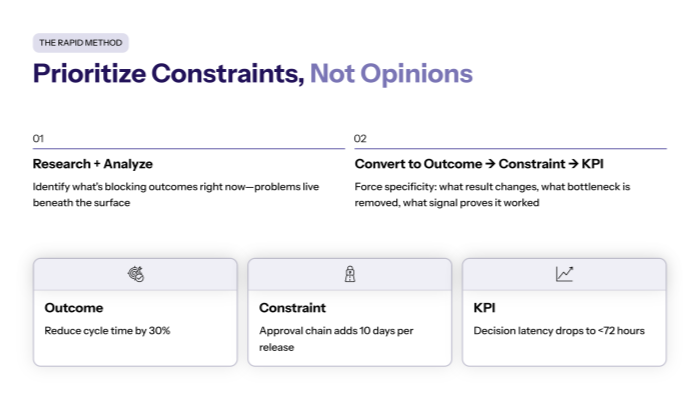
2.1 Start with Research + Analyze: prioritize constraints, not opinions
RAPID’s first flywheel (Research + Analyze) exists because most problems live beneath the surface, and analysis must filter relevant vs irrelevant information so you don’t waste time and resources.
That’s the key to prioritizing transformation initiatives without politics:
- stop starting from “what should we do?”
- start from “what’s blocking outcomes right now?”
Once you identify the constraint, prioritization becomes obvious: initiatives that don’t relieve the constraint are secondary.
2.2 Convert every initiative into an “Outcome → Constraint → KPI” statement
Politics thrives in vague initiatives:
- “modernize the stack”
- “improve collaboration”
- “optimize operations”
- “drive innovation”
RAPID forces specificity. Take any initiative and rewrite it in this format:
Outcome: what measurable result changes?
Constraint: what bottleneck does it remove?
KPI: what leading signal proves it worked?
Example:
- Outcome: reduce cycle time by 30%
- Constraint: approval chain adds 10 days per release
- KPI: decision latency for approvals drops to <72 hours
Now prioritization is no longer about who wants it. It’s about whether it moves the system.
A practical scoring model to eliminate politics
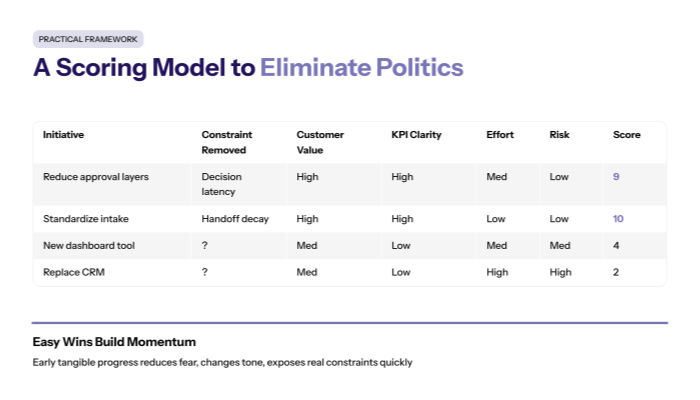
3.1 Score initiatives on customer value + constraint impact (not executive preference)
To prioritize transformation initiatives, use a scoring model that aligns with RAPID’s outcomes-first logic (and prevents “pet projects” from winning).
Here’s a simple table your team can apply in one workshop:
|
Initiative |
Outcome it claims |
Constraint it removes |
Customer value impact |
KPI clarity |
Effort |
Risk |
Score |
|---|---|---|---|---|---|---|---|
|
Reduce approval layers |
Faster delivery |
Decision latency |
High |
High |
Med |
Low |
9 |
|
New dashboard tool |
Better visibility |
? |
Med |
Low |
Med |
Med |
4 |
|
Standardize intake |
Less rework |
Handoff decay |
High |
High |
Low |
Low |
10 |
|
Replace CRM |
“Modernize” |
? |
Med |
Low |
High |
High |
2 |
Politics dies when initiatives must name:
- the constraint
- the KPI
- the outcome
- the customer value
This mirrors RAPID’s insistence that the system must be grounded in measurable outcomes rather than narratives.
3.2 Use Easy Wins to build momentum (and reduce political noise)
RAPID includes Easy Wins because early tangible progress builds confidence, reduces fear, and changes the tone of prioritization.
When teams deliver fast, measurable improvements, leaders become less attached to “my initiative” and more focused on “what works.”
Easy wins also expose the real constraint quickly:
- if an easy win doesn’t move a KPI, it wasn’t the bottleneck
- you learn and re-prioritize without drama
Lock prioritization through decision rights (so it stays stable)
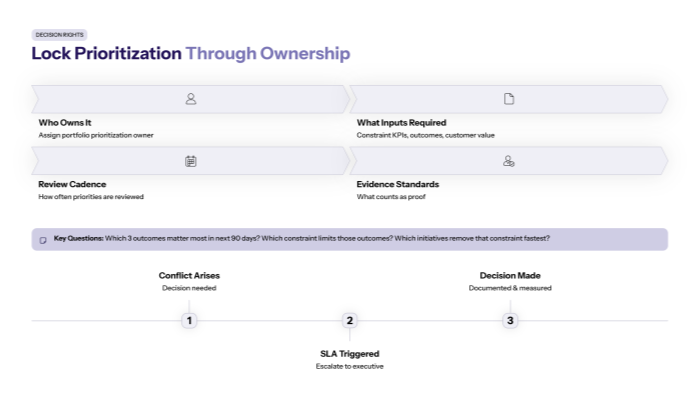
4.1 Use the Decision Inventory to make prioritization an owned decision
RAPID treats decision-making as the hardest and most important management task, and the Decision Inventory is designed to identify the decisions that drive outcomes, assign owners, link decisions to customer value, and prioritize them.
Prioritization is one of those decisions.
If you want to prioritize transformation initiatives without politics, define:
- who owns portfolio prioritization
- what inputs are required (constraint KPIs, outcomes, customer value)
- how often it’s reviewed (cadence)
- what counts as “evidence”
Then write the decision as a question (RAPID style):
- “Which 3 outcomes matter most in the next 90 days?”
- “Which constraint is currently limiting those outcomes?”
- “Which initiatives remove that constraint fastest?”
If no one owns that decision, politics fills the vacuum.
4.2 Build a simple escalation path (so conflicts don’t become delays)
Prioritization conflicts are inevitable. What matters is whether they turn into decision latency.
RAPID emphasizes that decisions create momentum and happen throughout; if a decision never gets made, the outcome never happens.
So define an escalation rule:
- if decision isn’t made within SLA → escalate to named executive owner
- executive must decide (not delegate to committee)
- decision is documented and measured
This turns conflict into forward motion instead of political gridlock.
Sustain non-political prioritization (measure → decide → adapt)
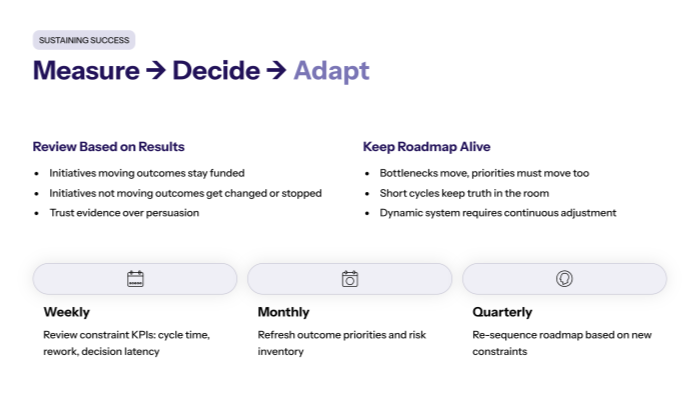
5.1 Review priorities based on results, not narratives
RAPID’s Decide discipline forces honesty: measure results and decide to stay, change, or stop.
That’s how you keep prioritization from drifting back into politics:
- initiatives that move outcomes stay funded
- initiatives that don’t move outcomes get changed or stopped
- leadership learns to trust evidence over persuasion
This also prevents KPI theater from reappearing, because you’re measuring constraint movement, not slide decks.
5.2 Keep the roadmap alive: bottlenecks move, so priorities must move too
A transformation system is dynamic. When you remove one constraint, another becomes the bottleneck.
RAPID is built as a flywheel process that keeps improving through better information, better analysis, better planning, and better decisions.
So your prioritization cadence should be short:
- weekly: review constraint KPIs (cycle time, rework, decision latency)
- monthly: refresh outcome priorities and risk inventory
- quarterly: re-sequence the roadmap based on new constraints
Politics thrives in long cycles because memory fades and narratives re-take control. Short cycles keep truth in the room.
Closing takeaway
You don’t eliminate politics by telling people to “be objective.”
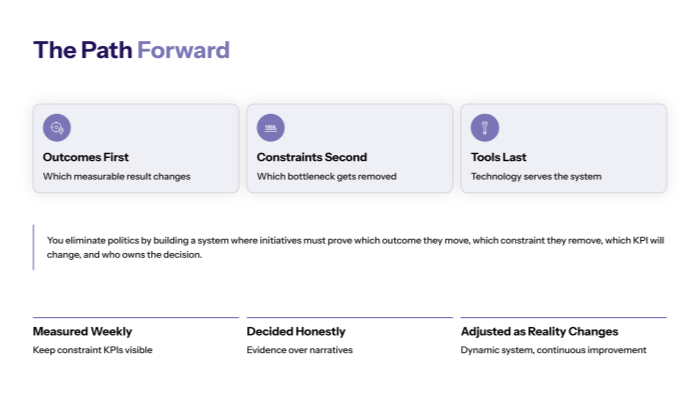
You eliminate politics by building a system where initiatives must prove:
- which outcome they move
- which constraint they remove
- which KPI will change
- who owns the decision
That’s the RAPID way to prioritize transformation initiatives: outcomes first, constraints second, tools last—measured weekly, decided honestly, and adjusted as reality changes.