Implementing Digital Transformation: Build the Execution Rhythm
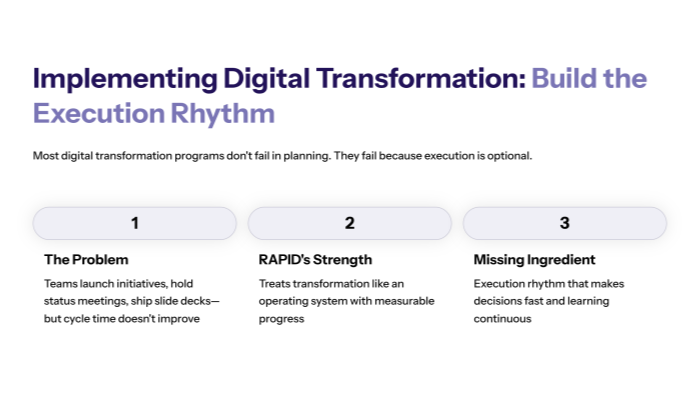
Most digital transformation programs don’t fail in planning. They fail because execution is optional.
Teams “launch initiatives,” hold status meetings, ship slide decks, and call it progress—while cycle time doesn’t improve, rework doesn’t drop, and decision latency stays high.
RAPID’s strength is that it treats transformation like an operating system: Research and Analyze create truth, Plan sequences outcomes around constraints, Implement builds the execution engine, and Decide turns results into learning—stay, change, or stop.
This post focuses on the missing ingredient: execution rhythm. Not more meetings—an operating cadence that makes progress measurable, decisions fast, and learning continuous.

Why execution rhythm is the real transformation differentiator?
1.1 Transformation without cadence becomes “initiative soup”
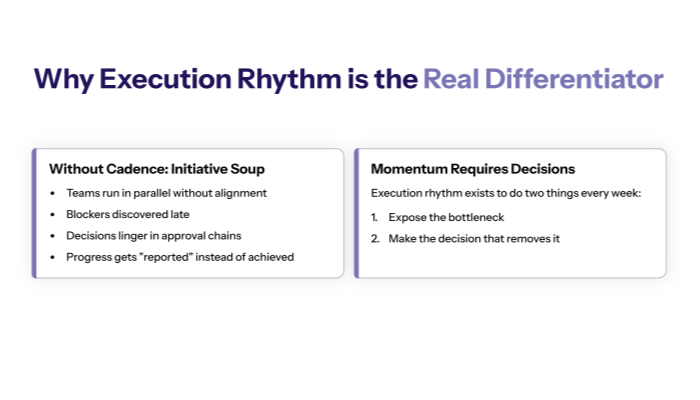
When there’s no execution rhythm, organizations fall into predictable patterns:
- teams run in parallel without alignment
- blockers are discovered late
- decisions linger in approval chains
- progress gets “reported” instead of achieved
RAPID warns that if you can’t get timely, accurate information to decision makers, major issues are inevitable. An execution rhythm is how you surface truth early enough to act.
It’s also how you prevent KPI theater: you stop measuring “activity” and start measuring constraint movement weekly.
1.2 Momentum requires decisions, not just work
RAPID emphasizes that decisions drive outcomes: decisions happen throughout transformation, and if critical decisions never get made, desired outcomes don’t happen.
An execution rhythm exists to do two things every week:
- expose the bottleneck
- make the decision that removes it
Without that loop, transformation becomes a set of tasks with no steering.
What “execution rhythm” means in RAPID terms?
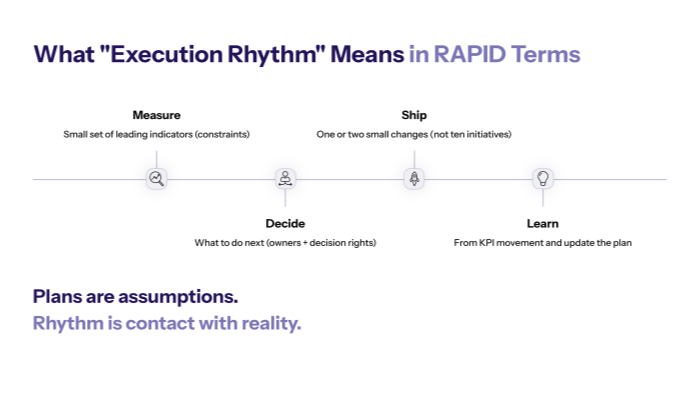
2.1 Rhythm is a repeatable cycle: measure → decide → ship → learn
RAPID’s Decide discipline is explicit: after implementation, evaluate results and decide to stay, change, or stop based on what happened.
An execution rhythm operationalizes that logic weekly:
- Measure a small set of leading indicators (constraints)
- Decide what to do next (owners + decision rights)
- Ship one or two small changes (not ten “initiatives”)
- Learn from KPI movement and update the plan
This is how you turn transformation into continuous improvement instead of quarterly surprises.
2.2 Rhythm is the bridge between Plan and reality
Plans are assumptions. Rhythm is contact with reality.
RAPID frames problems as iceberg issues—what’s visible is often not the real constraint. Execution rhythm is how you find the underwater friction quickly and correct course without drama.
If your plan doesn’t change after you start executing, you’re not learning—you’re defending.
The minimum viable execution rhythm (what to run every week)
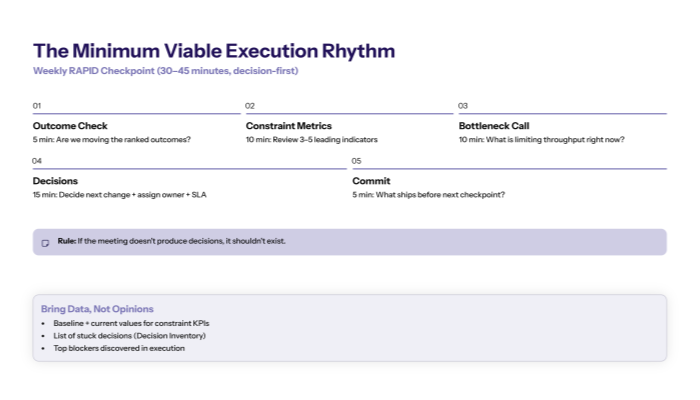
3.1 The “Weekly RAPID Checkpoint” (30–45 minutes, decision-first)
Here’s a practical rhythm that avoids wasted time:
Agenda (max 45 minutes):
- Outcome check (5 min): Are we moving the ranked outcomes?
- Constraint metrics (10 min): Review 3–5 leading indicators
- Bottleneck call (10 min): What is limiting throughput right now?
- Decisions (15 min): Decide the next change + assign owner + SLA
- Commit (5 min): What ships before the next checkpoint?
This aligns directly with RAPID’s emphasis on decision-making and measurable evaluation.
Rule: if the meeting doesn’t produce decisions, it shouldn’t exist.
3.2 What to bring into the checkpoint (data, not opinions)
To prevent politics and KPI theater, bring only:
- baseline + current values for constraint KPIs
- list of stuck decisions (Decision Inventory)
- top blockers discovered in execution
RAPID explicitly warns against vanity metrics—numbers selected to protect a narrative. The checkpoint must be built around decision-grade evidence.
What to ship each week? (small increments that move constraints)
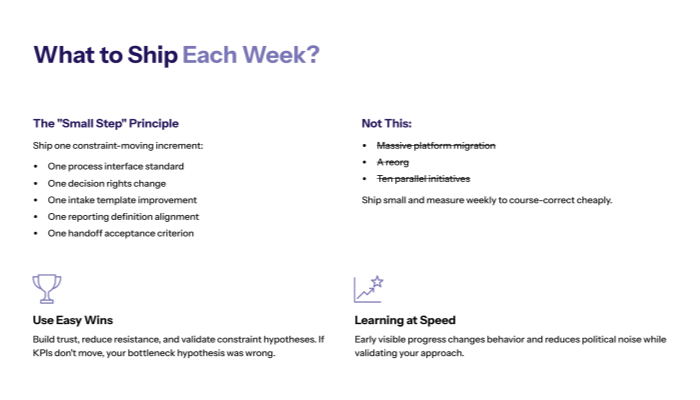
4.1 The “small step” principle (how execution rhythm stays sustainable)
RAPID is clear: big complex problems are solved by many small steps.
So the execution rhythm should ship:
- one process interface standard
- one decision rights change
- one intake template improvement
- one reporting definition alignment
- one handoff acceptance criterion
Not:
- a massive platform migration
- a reorg
- ten parallel initiatives
If you ship small and measure weekly, you can course-correct cheaply. If you ship big, you learn late and expensively.
4.2 Use Easy Wins to build trust and reduce resistance
RAPID’s Easy Wins concept exists because early visible progress changes behavior: it reduces fear, builds momentum, and lowers political noise.
In an execution rhythm, easy wins serve a second purpose:
- they validate whether you’ve identified the real constraint
- if the KPI doesn’t move, your bottleneck hypothesis was wrong → go back to Analyze
That’s learning at speed.
How the execution rhythm feeds the Decide loop? (learning without ego)
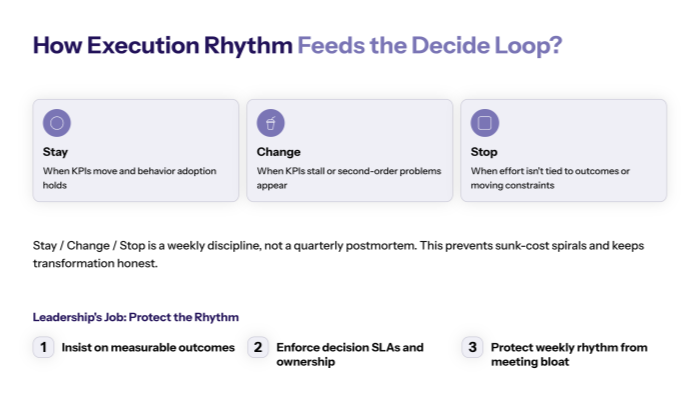
5.1 Stay / Change / Stop is the weekly discipline (not a quarterly postmortem)
RAPID’s Decide phase is often treated like a milestone. In practice, it’s the engine of continuous improvement: you evaluate results and decide whether to continue, adjust, or stop.
A strong execution rhythm makes Decide frequent and lightweight:
- Stay when KPIs move and behavior adoption holds
- Change when KPIs stall or second-order problems appear
- Stop when the effort isn’t tied to outcomes or isn’t moving constraints
This prevents sunk-cost spirals and keeps transformation honest.
5.2 Leadership’s job: protect the rhythm (and stay out of the way)
RAPID warns that leadership can stall or reverse progress if they won’t stay out of the way after endorsing the strategy. It also emphasizes the shift where leadership “decides to no longer decide” implementation details so teams can execute with autonomy.
So executives should do three things:
- insist on measurable outcomes
- enforce decision SLAs and ownership
- protect the weekly rhythm from meeting bloat and interference
That’s how execution becomes inevitable.
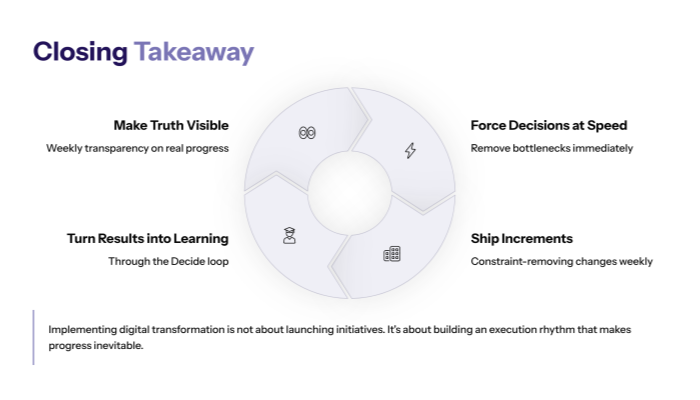
Closing takeaway
Implementing digital transformation is not about launching initiatives. It’s about building an execution rhythm that:
- makes truth visible weekly
- forces decisions at speed
- ships constraint-removing increments
- and turns results into learning through the Decide loop