Legacy System Modernization with AI: A CIO’s Guide to Phased Transformation and Risk Management
Legacy system modernization with AI is a strategic way to transform outdated systems into scalable, secure, cloud-ready platforms using artificial intelligence, machine learning, automation, and modern engineering practices. For CIOs and operations leaders planning AI-first modernization in 2026-2027, the priority is not simply replacing legacy software; it is modernizing critical systems without disrupting business operations.
This guide focuses on phased modernization, data readiness, integration architecture, workflow risk, and platform control. It is written for technology executives responsible for core systems, legacy applications, compliance-heavy workflows, and modernization programs where downtime, security vulnerabilities, or loss of business logic would create material business risk.
AI-powered legacy modernization can reduce transformation time by 40-50% while minimizing operational risk through phased delivery, intelligent automation, and stronger validation. Using generative AI for modernization can also lead to a 40% reduction in technical debt-related costs while improving output quality and significantly accelerating modernization timelines by 40 to 50%.
In this article, you will learn how to:
Build phased modernization roadmaps for legacy systems and critical services
Assess data readiness before connecting legacy data to AI models
Choose integration strategies such as APIs, microservices, and event-driven architectures
Reduce workflow risk through AI-powered monitoring and business continuity planning
Apply platform control mechanisms for security, compliance, auditability, and ongoing maintenance
Understanding AI-First Legacy Modernization
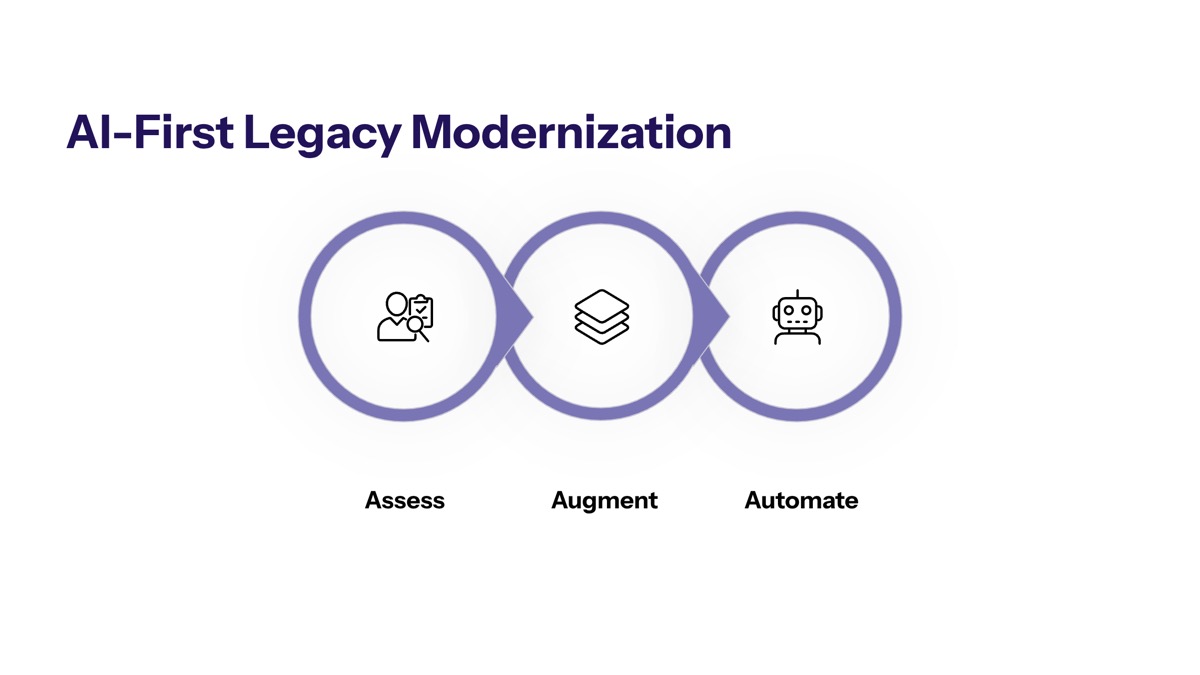
AI-first legacy modernization is the systematic transformation of legacy systems using generative AI, intelligent code analysis, automated discovery tools, and machine learning-assisted risk assessment. Instead of relying only on extensive manual effort from software developers and subject matter experts, AI-first modernization uses tools that analyze existing code, map dependencies, extract business rules, generate documentation, and support refactoring.
This differs from traditional methods such as lift-and-shift migrations or manual rewrites. Rehosting, also known as “lift and shift,” involves migrating legacy applications to a newer platform while keeping the existing code largely intact, which can provide immediate benefits like improved infrastructure and scalability. Refactoring involves restructuring existing code without changing its external behavior, which can improve maintainability and performance, making it a less risky approach than a complete rewrite.
Legacy modernization can take various forms, including rehosting, refactoring, replatforming, rearchitecting, and rebuilding, depending on the specific needs and circumstances of the organization. A hybrid approach to modernization combines multiple strategies, such as encapsulating some components while rehosting or refactoring others, to address specific needs and constraints of legacy systems.
Modernization strategies should be chosen based on factors like the age and complexity of the legacy system, budget constraints, risk tolerance, and the desired level of transformation. Choosing the right modernization strategy depends on various factors, including the age and complexity of the legacy system, budget constraints, risk tolerance, and the desired level of transformation.
Core AI Technologies in Modernization
Generative AI supports legacy application modernization by analyzing legacy code, identifying hidden dependencies, creating technical documentation, translating older programming patterns, and helping teams understand undocumented business logic. AI-driven legacy modernization services can automate code analysis, identify hidden dependencies, and translate legacy applications into modern cloud-ready architectures, helping industries like logistics and healthcare overcome modernization challenges.
Machine learning strengthens the modernization process through static and dynamic analysis, pattern recognition, anomaly detection, and technical debt assessment. It can detect code quality problems, security vulnerabilities, dependency risks, and areas where existing documentation does not match existing systems.
AI-augmented legacy modernization employs techniques such as agentic swarm coding and AI-assisted code refactoring to efficiently update and migrate older enterprise systems into modern environments while preserving critical business logic. Generative AI tools can handle 69-75% of code edits during large-scale migrations, effectively cutting project duration by around half and demonstrating AI’s potential to accelerate modernization efforts.
Business Value Framework
The business value of AI-first system modernization comes from cost savings, operational efficiency, enhanced security, compliance readiness, and stronger alignment between technology investments and business goals. Modernized systems streamline processes, automate manual tasks, and eliminate bottlenecks, resulting in faster response times and increased operational efficiency.
Investing in legacy modernization can yield benefits such as improved agility and responsiveness to market changes, enhanced security against cyber threats, and increased customer satisfaction through modernized user interfaces. Modernized systems can deliver a seamless, personalized, and omnichannel customer experience, increasing customer satisfaction and loyalty, ultimately leading to higher revenue.
Maintaining legacy systems can be a financial burden due to hardware obsolescence and expensive software licenses; modernized systems often leverage cloud infrastructure and standardized technologies, significantly reducing long-term costs. Modernization also ensures an organization’s IT infrastructure aligns with current and future technological advancements, avoiding obsolescence and providing a foundation for continuous innovation.
Cognativ’s RAPID framework provides a structured way to connect modernization projects to measurable outcomes. In practice, that means defining success criteria early, measuring technical debt reduction, tracking modernization timelines, validating code quality, and linking application modernization decisions to business growth.
Phased Modernization Strategy
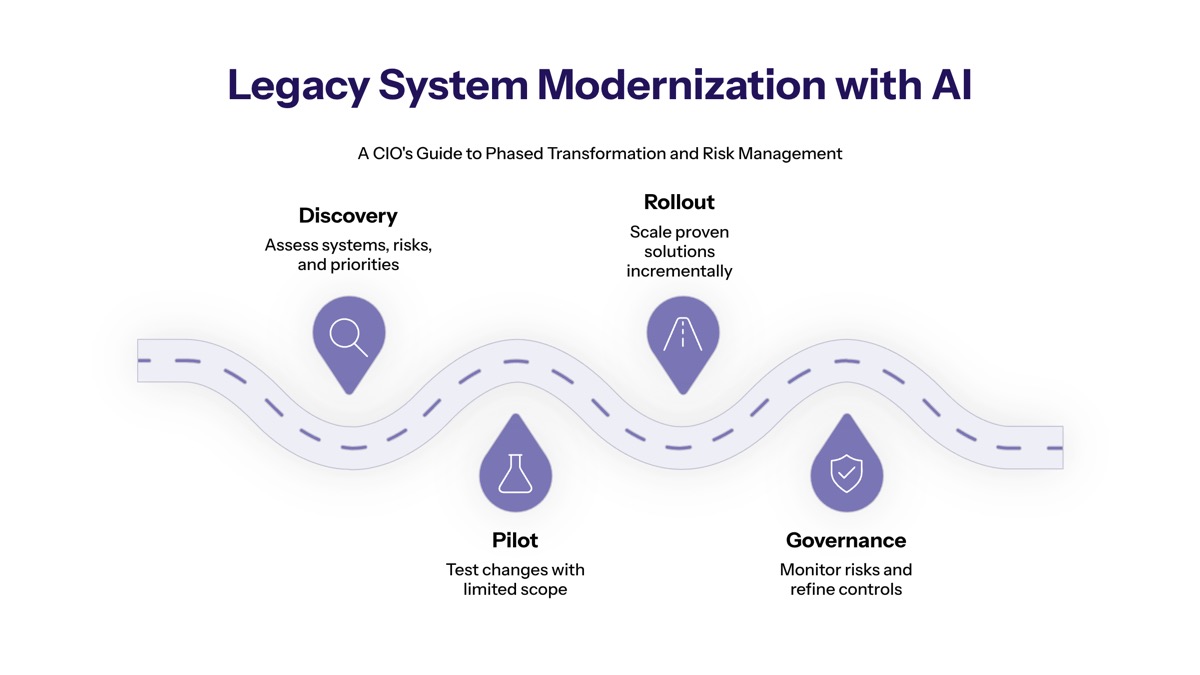
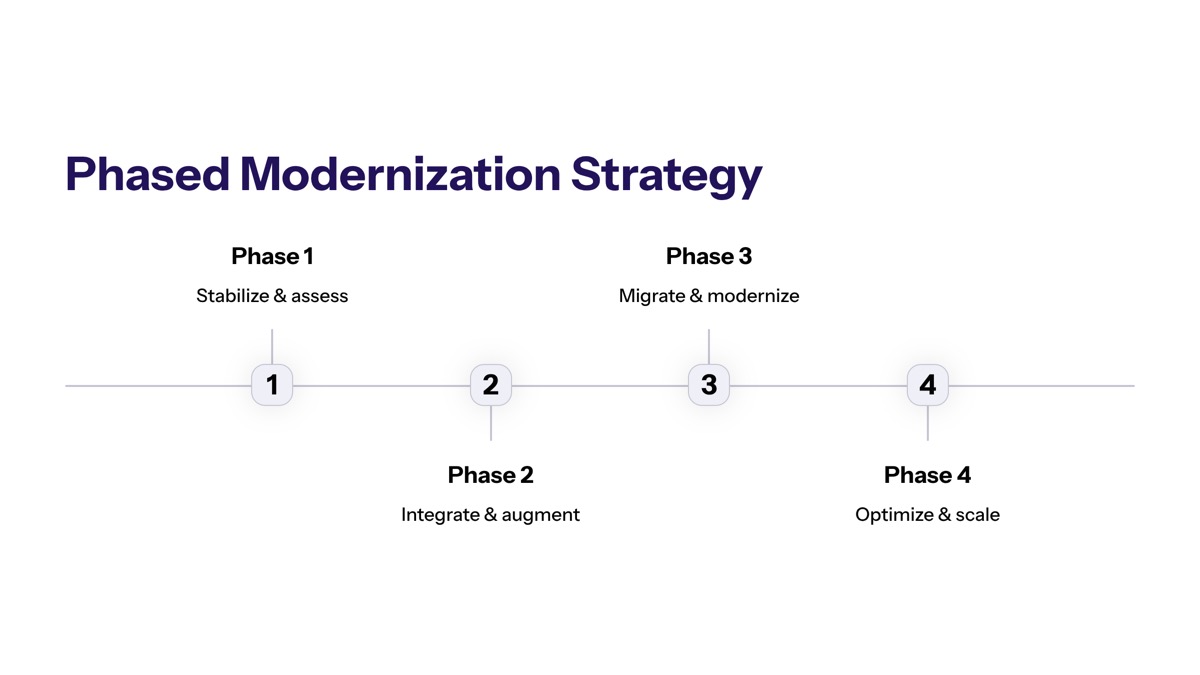
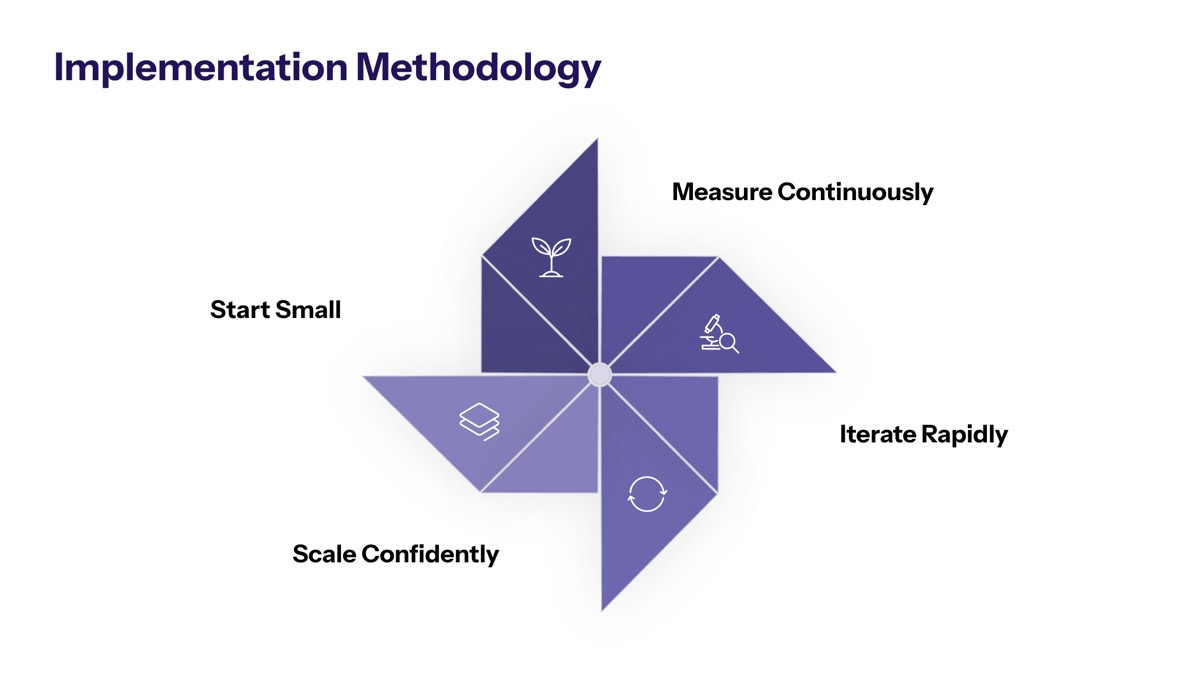
A phased modernization strategy is the safest path for large-scale enterprise transformation because it reduces operational disruption while creating measurable progress. Instead of attempting a full replacement of outdated legacy systems in one high-risk event, phased modernization separates the modernization journey into discovery, pilot implementation, and scaled rollout.
AI accelerates each phase by reducing manual analysis, improving roadmap planning, and helping teams validate business logic before changes reach production. This is especially important because legacy systems are often complex and poorly documented, which poses significant risks during modernization efforts, as organizations must carefully plan to avoid disruptions to critical business processes.
A well-crafted modernization strategy ensures that efforts are focused, cost-effective, and designed to yield the desired outcomes, aligning with the organization’s business goals and objectives.
Discovery and Assessment Phase
The discovery phase begins with a thorough assessment of the organization’s applications, data flows, business processes, integration points, and operational dependencies. A comprehensive assessment of an organization’s applications and systems is crucial to evaluate their current state, strengths, weaknesses, and potential areas for improvement before embarking on a modernization journey.
AI-powered discovery tools scan the legacy codebase, map dependencies, identify dead code, detect duplicated logic, and classify technical debt. Technical debt is a metaphor in software development that refers to the consequences of choosing a quick solution to a problem instead of a more comprehensive approach, often leading to increased long-term costs. Modernization of legacy systems can be hindered by technical debt, which refers to the consequences of taking shortcuts in software development that lead to increased long-term costs and maintenance challenges.
According to a 2023 article on tech debt, companies often pay an additional 10 to 20% to address tech debt on top of the costs of any project. Organizations spend roughly 20% of their IT budget servicing technical debt instead of investing in new capabilities, which can hinder modernization efforts. Organizations lose an average of $370 million per year due to outdated technology and technical debt, including costs associated with failed modernization projects and the ongoing expenses of maintaining legacy systems.
Discovery should also expose process debt. Legacy systems often create “process debt” that complicates modernization efforts, as critical business logic becomes tightly coupled with workflows, making it difficult to update or replace these systems without significant disruption.
Pilot Implementation Phase
The pilot phase tests the modernization strategy on a contained but meaningful system, service, workflow, or legacy application. Selection criteria should include business value, system risk, dependency complexity, data sensitivity, test coverage, and the ability to validate outputs against the current production environment.
AI-assisted refactoring, test generation, and automated code analysis help software developers optimize existing code without losing business rules. Refactoring is often appropriate where the organization wants better maintainability and performance while avoiding the risk of a complete rewrite.
Parallel runs are essential during pilot implementation. Running modernized applications alongside existing systems allows teams to compare outputs, validate workflow behavior, and detect regression issues before decommissioning old modules. Success metrics should include test coverage, performance, defect rates, deployment frequency, security findings, compliance readiness, and user experience improvements.
Phased rollout of AI agents in high-value legacy workflows can gradually deprecate outdated modules by replacing manual processes like data entry and claims processing. This approach lets modernization teams prove value while maintaining business continuity.
Scaled Rollout Phase
The scaled rollout phase extends validated modernization patterns across the enterprise. Common modernization strategies include rehosting, refactoring, rearchitecting, and rebuilding, each with varying degrees of complexity and invasiveness, tailored to the specific needs and circumstances of the organization.
At scale, modernization efforts require governance frameworks, change management, training, CI/CD pipelines, observability, cloud native architectures, and clear ownership models. Transitioning to cloud-based, microservices architectures provides greater scalability, flexibility, and easier integration of AI and machine learning tools.
Continuous optimization is also critical. Modernized systems should not become the next generation of outdated technology. MLOps frameworks are necessary for continuously monitoring, versioning, and retraining AI models to maintain accuracy in production. As technology evolves, modernization programs should keep improving system resilience, cost efficiency, user interface quality, and integration flexibility.
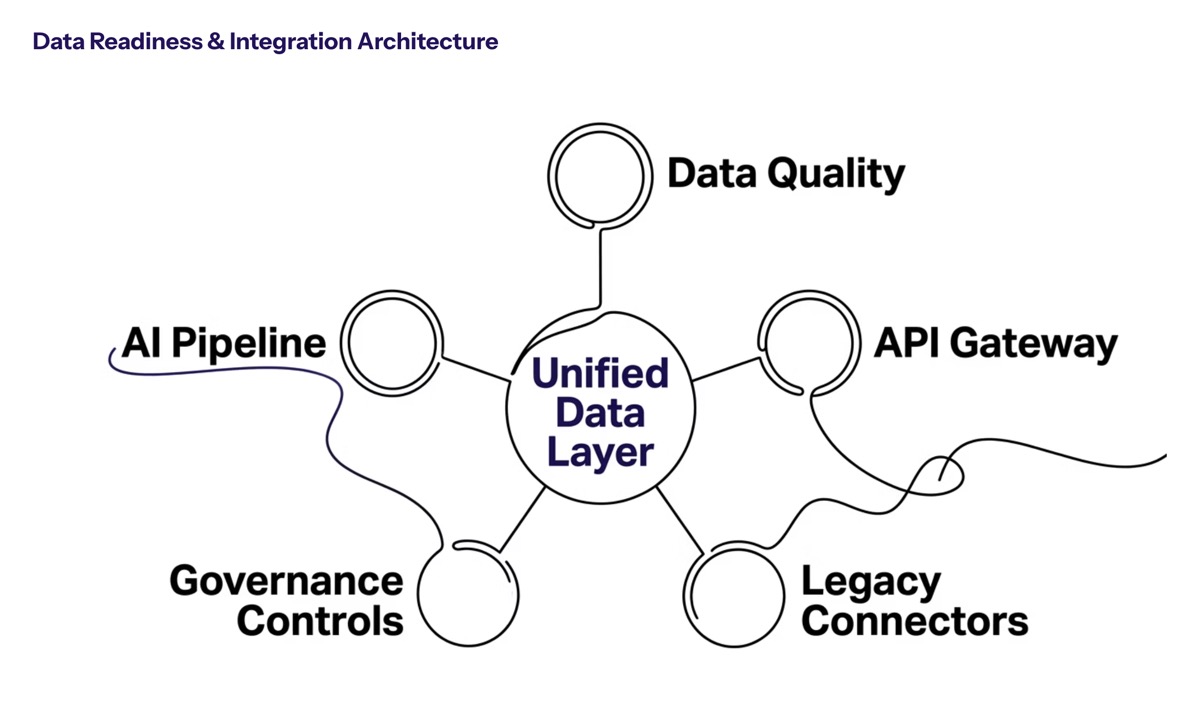
Data Readiness and Integration Architecture
Data readiness is the foundation of successful AI-powered legacy modernization. AI models, automation tools, and modern analytics depend on accurate, accessible, secure, and well-understood data. If legacy data is inconsistent, duplicated, poorly classified, or locked in outdated architecture, modernization projects can stall even when code migration appears successful.
To ensure reliable and compliant outputs, legacy data schemas should be standardized, deduplicated, and secured before connection to AI models. Data migration from legacy systems can be a complex process, requiring careful planning to ensure data accuracy, consistency, and security during the transition to modernized systems.
Data Discovery and Mapping
Data discovery identifies where data resides, how it moves, which business processes depend on it, and where sensitive data exists. AI-powered tools can map data lineage, infer schemas, flag quality problems, and identify migration priorities across legacy software, databases, files, APIs, and batch processes.
This is especially important when existing documentation is incomplete or outdated. AI can compare code paths, database queries, and runtime behavior to build a clearer picture of how business logic and data dependencies work in practice.
Data mapping should include:
Schema discovery across databases, files, and interfaces
Sensitive data classification for privacy, security, and compliance
Data quality assessment for duplication, inconsistency, missing values, and deprecated fields
Migration priority planning based on business risk and operational dependency
Integration Patterns and Architecture
Integration architecture determines whether legacy modernization becomes a stable strategic initiative or a series of disconnected technical fixes. API and microservices architecture allows modern AI tools to securely interact with legacy systems without breaking core functionalities.
API-first integration is often the first practical step. It encapsulates legacy functionality behind controlled interfaces so teams can modernize legacy systems gradually. Microservices decomposition then separates business capabilities into smaller services aligned to business needs and future architecture.
Specific modernization patterns include the strangler fig pattern, event-driven architectures, service mesh implementation, and hybrid integration. The strangler fig pattern lets teams build new services around the legacy application until outdated modules can be retired. Event-driven architecture improves responsiveness by allowing services to publish and consume business events asynchronously. Service mesh capabilities can add traffic control, observability, encryption, and policy enforcement across modern infrastructure.
Data Migration and Validation
AI-assisted data transformation can automate parts of schema conversion, field mapping, deduplication, and validation. However, data migration must still be governed through deterministic controls, test datasets, reconciliation reports, and rollback procedures.
Validation frameworks should confirm that modernized systems preserve business logic and produce outputs that match or improve on legacy behavior. Real-time synchronization strategies, dual writes, and parallel data pipelines allow teams to keep existing systems and modernized applications aligned during the transition.
Rollback procedures are not optional. If a migration creates performance, security, compliance, or data integrity issues, the organization must be able to return to a known stable state quickly. That requirement should be built into the modernization process from the start.
Workflow Risk Management and Platform Control
Workflow risk management ensures that business operations continue while underlying platforms change. In enterprise environments, legacy systems often support critical services such as claims processing, inventory management, billing, clinical reporting, logistics routing, or regulatory reporting. A modernization failure in these areas can affect revenue, compliance, customers, and safety.
The goal is to modernize legacy systems without breaking the business processes they support. That requires workflow mapping, operational monitoring, platform control, and business continuity planning.
Workflow Risk Assessment
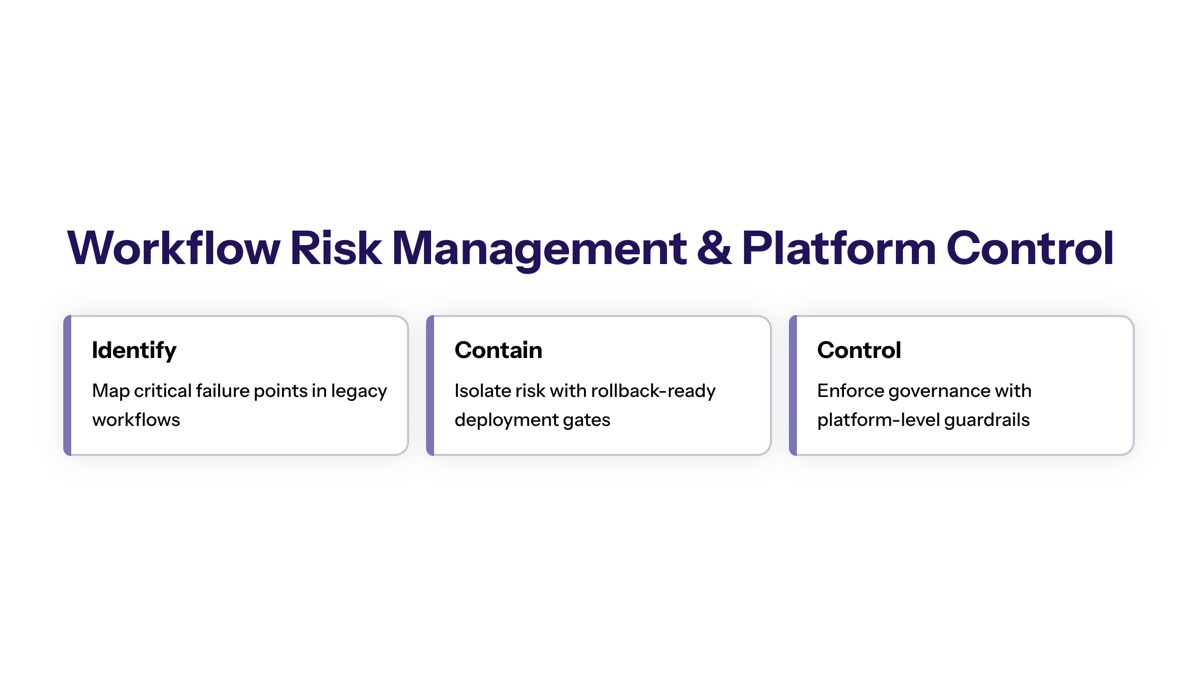
Workflow risk assessment starts by identifying critical business workflows, failure points, upstream and downstream dependencies, recovery procedures, and manual workarounds. AI-powered monitoring can then detect anomalies, predict failure patterns, and flag unusual behavior during modernization.
The biggest risk is often not syntax conversion; it is loss of implicit business logic. Older systems may contain undocumented conditions, exception handling, and domain-specific rules that only appear in the legacy code. Subject matter experts should validate AI-generated findings, especially where workflows affect regulated or customer-facing processes.
Risk assessment should cover:
Critical workflow dependency maps
Failure impact analysis by business process
Recovery time and recovery point requirements
Regression test coverage for high-value workflows
Monitoring rules for anomalies, latency, and data mismatches
Platform Control Mechanisms
Platform control mechanisms ensure that modernization efforts remain secure, auditable, and compliant. Continuous governance and monitoring of AI pipelines requires strict security controls such as automated vulnerability scanning and compliance management.
Controls should include role-based access, privileged access management, encrypted secrets, secure CI/CD pipelines, audit trails, data loss prevention, policy-as-code, and automated security testing. Enhanced security must be designed into the modernization process rather than added after deployment.
For AI-powered modernization, platform control also includes model governance. Teams need visibility into which AI tools were used, what code was generated, which business rules were extracted, who approved changes, and how outputs were validated. MLOps practices should track model versions, prompts where appropriate, evaluation results, retraining cycles, and production performance.
Business Continuity Planning
Business continuity planning protects core systems during modernization. It should define disaster recovery procedures, backup strategies, incident response plans, emergency rollback protocols, and communication paths for stakeholders.
Testing procedures should include functional testing, performance testing, security testing, compliance validation, and operational readiness reviews. For critical systems, business continuity should also include parallel runs, staged releases, canary deployments, and fallback to legacy workflows until modernized systems are proven stable.
Stakeholder communication matters because modernization affects more than IT. Operations teams, compliance leaders, finance, customer support, and business unit owners need clear checkpoints, escalation paths, and visibility into modernization timelines.
Implementation Methodology and Best Practices
Cognativ’s RAPID framework can be applied to AI-powered modernization projects as a structured methodology for reducing implementation risk and connecting technical work to measurable business outcomes. The framework emphasizes readiness, architecture validation, pilot execution, iterative scaling, and disciplined deployment.
The best modernization programs combine technical expertise with business ownership. They treat legacy system modernization as a strategic initiative, not a one-time software development project.
Readiness Assessment and Planning
Readiness assessment begins with stakeholder alignment. CIOs, operations leaders, security teams, compliance owners, product leaders, and subject matter experts should agree on business goals, risk tolerance, timeline expectations, and success metrics.
Planning should include:
Technical assessment of applications, data, integrations, and infrastructure
Resource planning for software developers, architects, data engineers, security teams, and SMEs
Timeline development with phased milestones and decision gates
Success criteria definition for cost savings, quality, performance, security, and operational efficiency
Vendor selection processes for AI driven modernization services, cloud platforms, integration tools, and governance solutions
AI-augmented modernization can accelerate timelines by 40 to 50%, significantly reducing the time and cost associated with addressing technical debt. Still, the organization must validate AI outputs and avoid assuming that automation eliminates the need for governance.
Architecture Design and Validation
Architecture design defines the target state for modern infrastructure, application modernization, data architecture, and platform control. It should address whether the organization will rehost, refactor, replatform, rearchitect, rebuild, or use a hybrid approach.
Architecture review boards should validate technology selection, development frameworks, integration patterns, security requirements, compliance controls, and operational support models. Proofs of concept should test AI-assisted code refactoring, automated documentation, data transformation, performance benchmarks, and user interface modernization.
Validation is especially important when business rules are embedded in legacy code. AI can help extract and explain logic, but SMEs must confirm that modernized applications preserve required behavior.
Pilot Execution and Scaling
Pilot execution turns the modernization strategy into a measurable delivery cycle. The pilot should include monitoring setup, feedback collection, automated testing, security review, release planning, and operational readiness checks.
Scaling requires repeatable patterns. Once a pilot proves successful, teams should standardize deployment pipelines, integration templates, testing frameworks, data migration playbooks, MLOps practices, and governance controls.
Training programs help internal teams adopt new technologies and reduce dependence on external vendors. Successful implementation depends on knowledge transfer, clear ownership, and a culture that treats modernization as an ongoing capability rather than a temporary project.
Common Challenges and Solutions
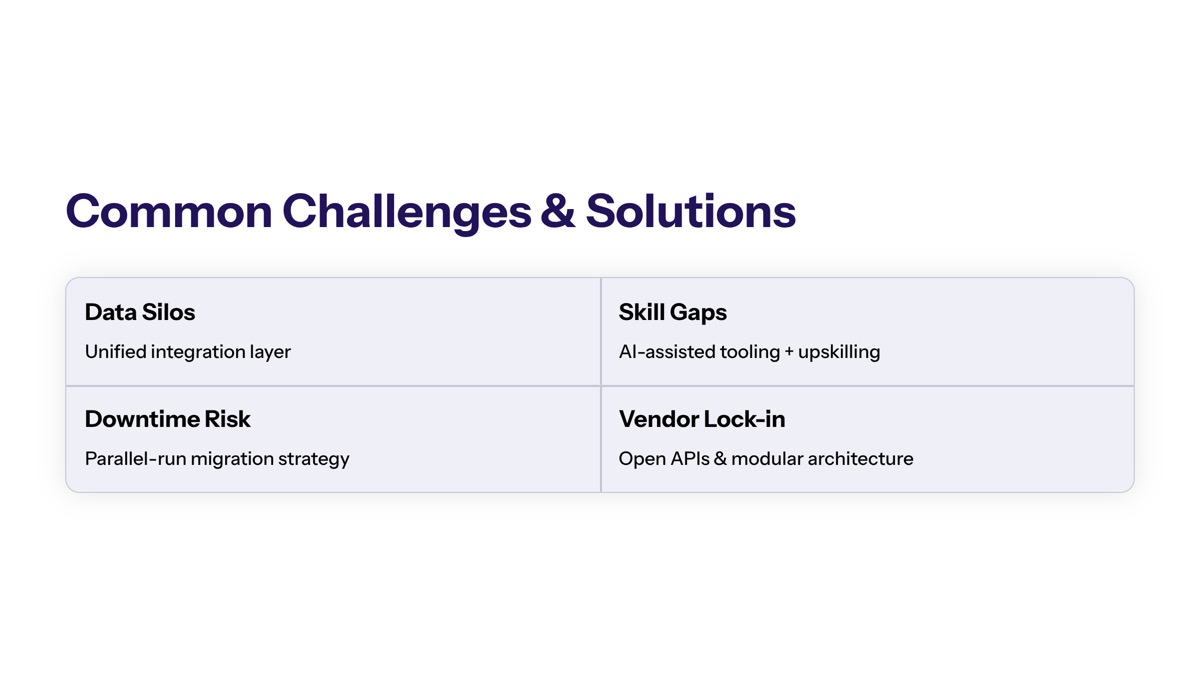
AI-powered modernization can significantly enhance the speed and quality of legacy modernization, but it introduces unique modernization challenges. The most common issues involve technical debt, stakeholder resistance, data quality, integration complexity, security, and operational continuity.
Technical Debt and System Complexity
Technical debt and outdated architecture make legacy modernization difficult because business logic is often buried in legacy code, undocumented workflows, and tightly coupled integrations. Legacy systems are often complex and poorly documented, so modernization teams must avoid changing behavior they do not fully understand.
The solution is AI-powered code analysis, dependency mapping, gradual refactoring, and automated testing. Static and dynamic analysis can reveal how existing code behaves, while generative AI can summarize business rules and identify hidden dependencies. Incremental modernization reduces risk compared with a full rewrite.
Stakeholder Resistance and Change Management
Stakeholder resistance occurs when users, operations teams, or compliance leaders fear disruption, job impact, or loss of control. This is common when critical services have depended on the same legacy application for years.
The solution is executive sponsorship, clear communication, training programs, and quick wins. Choose pilot workflows with visible value, involve subject matter experts early, and show how modernized systems improve operational efficiency, security, and customer experience. Feedback incorporation should be built into each phase of the modernization journey.
Data Quality and Integration Issues
Data quality and integration issues can undermine even well-planned modernization projects. Legacy data may be duplicated, inconsistent, incomplete, or difficult to classify. Existing systems may also depend on brittle point-to-point integrations that are hard to replace.
The solution is comprehensive data discovery, quality improvement programs, and gradual migration. Use AI-powered data lineage mapping, automated quality monitoring, validation tools, and real-time synchronization. API-first and microservices-based architecture can help modern technologies interact with legacy systems securely while teams modernize core components over time.
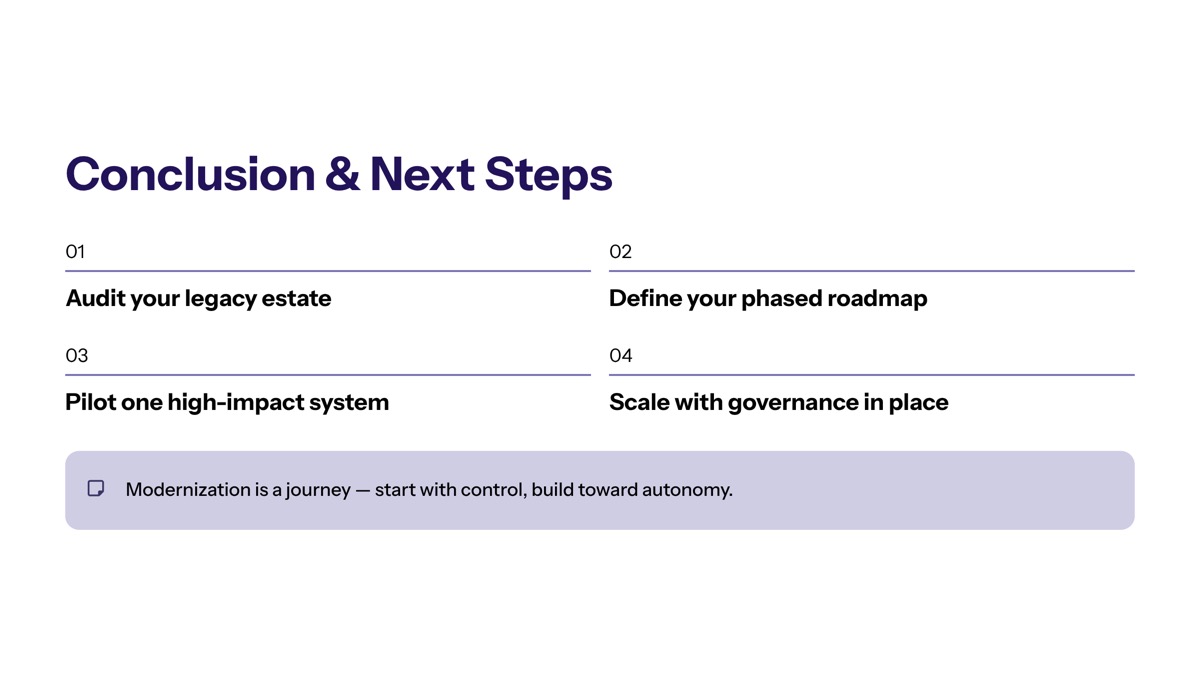
Conclusion and Next Steps
Legacy system modernization with AI is most effective when treated as a phased, governed, data-ready transformation program. AI can accelerate discovery, code analysis, refactoring, testing, documentation, and roadmap planning, but successful modernization still depends on platform control, business continuity, architecture discipline, and human validation.
For CIOs and operations leaders, the immediate next steps are:
Conduct a thorough assessment of legacy systems, data flows, technical debt, and critical workflows.
Align stakeholders around business goals, risk tolerance, compliance obligations, and modernization timelines.
Select a pilot system with meaningful business value and manageable operational risk.
Evaluate AI driven modernization services, integration platforms, cloud options, and governance tooling.
Define success metrics for cost savings, code quality, operational efficiency, security, and customer experience.
Build a phased roadmap that connects modernization projects to business growth and future architecture.
Related topics to explore next include cloud migration strategies, AI implementation frameworks, MLOps operating models, digital transformation roadmaps, and enterprise security architecture for modernized systems.
Additional Resources
Cognativ RAPID framework assessment tools and modernization readiness checklists for evaluating application portfolios, data readiness, workflow risk, and platform governance.
NIST Cybersecurity Framework for security controls and risk management during modernization.
OWASP Application Security Verification Standard for secure software development and application modernization.
HIPAA Security Rule guidance for healthcare modernization programs.
PCI Security Standards Council for payment and financial services compliance requirements.
Manufacturing modernization reference: legacy ERP modernization case study.
Financial and government modernization reference: MITRE legacy IT modernization with AI research.
Enterprise application modernization reference: AI-assisted legacy application modernization case study.