Logistics Software with AI Integration: A Complete Guide for Enterprise Decision-Makers
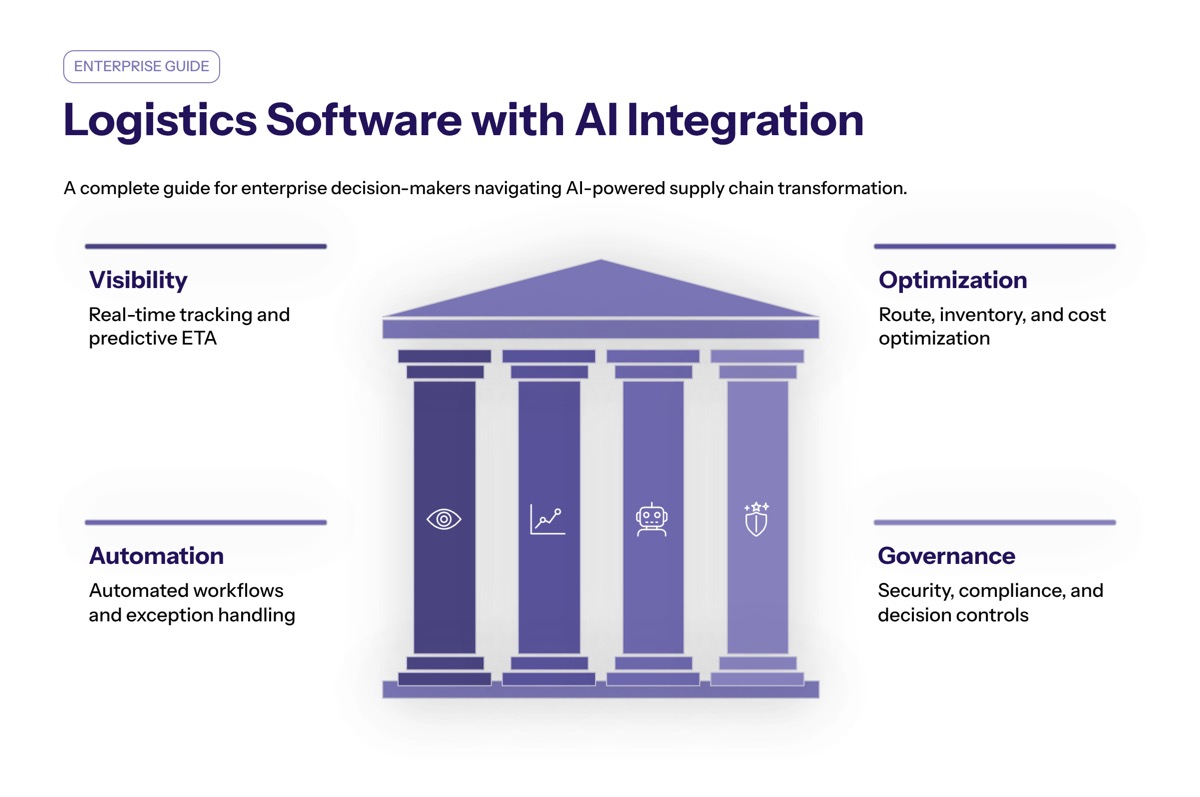
Logistics software with AI integration helps enterprises move from reactive supply chain management to predictive, automated, and continuously optimized logistics operations. These platforms combine traditional systems such as transportation management systems, warehouse management systems, inventory management tools, and supply chain visibility platforms with artificial intelligence capabilities that analyze data, detect anomalies, recommend actions, and automate decisions in real time.
This guide is for logistics executives, supply chain directors, technology leaders, and logistics managers evaluating AI-enabled platforms for complex supply chain operations. It covers warehouse operations, transportation management, demand forecasting, route optimization, predictive maintenance, supply chain visibility, compliance, and integration with existing systems. It is especially relevant for logistics firms and enterprise teams dealing with manual processes, limited visibility, fragmented operational data, rising service expectations, and complex supply chains that span multiple systems, carriers, suppliers, and distribution hubs.
The direct answer: AI-integrated logistics software transforms traditional supply chain management by using predictive analytics, automated workflows, ai agents, and intelligent optimization to reduce costs, improve service reliability, increase inventory accuracy, and support faster decision making.
In this article, you will learn:
What AI-integrated logistics software is and how it differs from traditional systems
Which AI powered tools matter most for logistics operations
How predictive analytics, route planning, warehouse automation, and real time visibility create measurable value
What integration challenges to expect when connecting AI systems to ERP, WMS, TMS, IoT, and partner data sources
How to plan next steps for secure, scalable implementation in the broader logistics industry
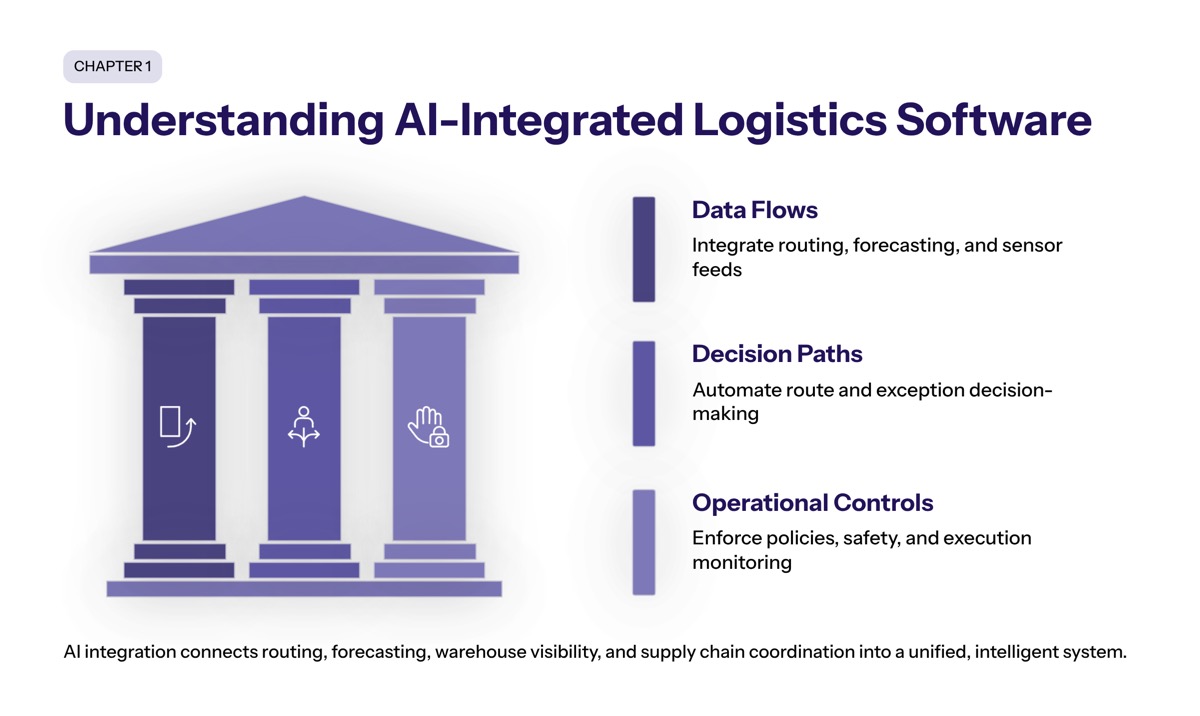
Understanding AI-Integrated Logistics Software
Traditional logistics software often depends on fixed rules, scheduled reports, manual exception handling, and historical data. These systems can function effectively for stable operations, but they struggle when transport disruptions, supply constraints, demand spikes, weather events, or supplier signals change conditions faster than planners can respond. In many organizations, logistics teams still move data between spreadsheets, carrier portals, warehouse platforms, and ERP systems, which increases human error and slows response time.
Integrating Artificial Intelligence (AI) into logistics software shifts supply chains from reactive operations to self-optimizing networks. Instead of waiting for a delayed shipment, late supplier update, or inventory imbalance to appear in a report, AI systems analyze live operational data, sensor data, historical data, and external feeds to generate actionable insights. AI agents in supply chain operations act as autonomous decision layers, analyzing inputs from multiple systems and executing responses in real time, which marks a shift from reactive logistics to proactive coordination.
Core AI Technologies in Logistics Platforms
Machine learning is the core technology behind many AI capabilities in logistics. Machine learning models use operational data to forecast demand, identify inefficiencies, predict asset failures, recommend efficient route planning, and improve inventory levels across warehouses, loading docks, fleets, and distribution hubs. AI algorithms in logistics can integrate real-time feeds with historical data to forecast demand more accurately, taking into account seasonal patterns, promotional impacts, and regional consumption behaviors.
Computer vision extends artificial intelligence into physical logistics environments. In warehouse operations, computer vision can verify inventory, monitor packing quality, inspect damage, detect mispicks, and support automated inventory tracking. Advanced computer vision applications in logistics can detect unauthorized access to facilities or tampering with consignments, thereby improving security measures and compliance with safety regulations.
Natural language processing supports document automation, supplier communication, customer service, customs paperwork, exception summaries, and intelligent responses for sales reps, logistics managers, and customer support teams. Natural language processing can turn unstructured emails, bills of lading, delivery notes, and supplier updates into structured data that AI models can use. Together, machine learning, computer vision, and natural language processing reduce manual processes, improve early detection of problems, and help logistics companies stay ahead of operational risk.
AI-Driven vs Traditional Logistics Systems
Traditional systems are usually rule-based. A traditional TMS may run route planning on a fixed schedule, a WMS may update inventory after batch processing, and a planning team may review forecasts weekly or monthly. These workflows can leave leaders with limited visibility because reports describe what already happened rather than what is changing now.
AI-integrated platforms are adaptive. AI agents continuously learn from data inputs, allowing them to make more accurate, context-aware decisions by interpreting signals from various sources such as IoT sensors and external feeds. AI agents enable continuous monitoring across warehouses, fleets, and suppliers, allowing leaders to act on live insights instead of historical data, which enhances operational efficiency.
This difference is critical for enterprise logistics. AI agents can dynamically adjust inventory allocation, reroute shipments, and respond to disruptions, turning logistics operations into a self-optimizing network that adapts in real time. For leaders, the value is not simply “more automation.” The value is a proactive approach to supply chain operations where AI powered systems can detect anomalies, trigger real time alerts, recommend the most efficient route, and support human oversight when decisions affect security, compliance, cost, or customer commitments.
Core AI Features in Modern Logistics Platforms
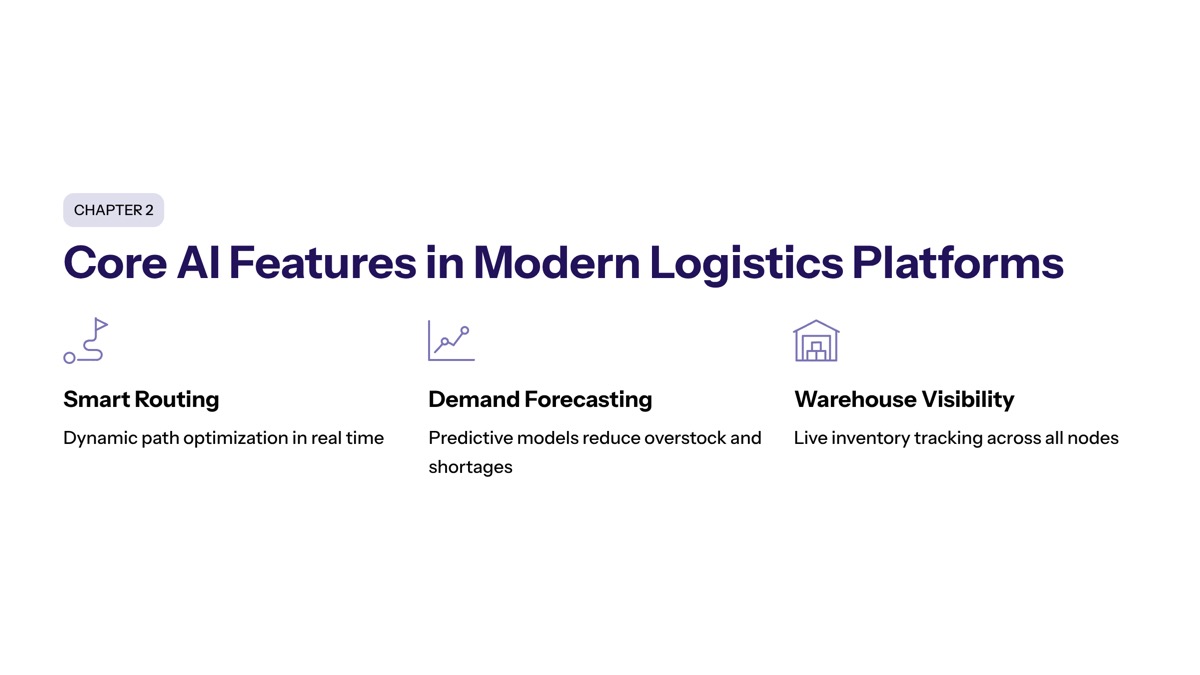
Once the foundation is clear, the next question is practical: which AI capabilities create measurable business value? The most important capabilities usually fall into three areas: predictive planning, intelligent transportation, and automated warehouse operations. Each area uses AI algorithms to analyze data from multiple systems and turn operational complexity into faster, more reliable decision making.
Predictive Analytics and Demand Forecasting
Predictive analytics helps logistics companies forecast demand by combining historical data with sales patterns, seasonality, regional behavior, promotions, market trends, supplier signals, and external data sources such as weather or economic indicators. Companies that integrated predictive AI into their planning processes reduced forecasting errors by an average of 18%, which directly improved order accuracy and inventory balance.
Demand forecasting becomes more powerful when forecasts update continuously instead of relying only on monthly planning cycles. Dynamic supply chain planning powered by AI allows logistics companies to adjust parameters such as reorder points and safety stock levels autonomously, leading to more precise and timely decision-making. The integration of AI in logistics allows for dynamic adjustments in supply parameters, such as reorder points and production schedules, leading to more precise and timely decision-making in response to variable demand scenarios.
For enterprise inventory management, this means fewer stockouts, less overstock, better safety stock levels, and stronger coordination between procurement, warehouse operations, transportation, and customer service. AI-powered logistics systems enhance supply chain visibility by correlating a wide range of data points, enabling organizations to quickly identify and mitigate disruptions related to transportation delays or supplier reliability issues.
Intelligent Route Optimization and Fleet Management
Route optimization is one of the clearest use cases for AI in logistics. AI models help businesses analyze existing routing and track route optimization, utilizing shortest-path algorithms to determine the most efficient route for logistics trucks, thereby reducing shipping costs and speeding up the shipping process. AI-driven route optimization can lead to a 15% reduction in logistics costs while maintaining higher service consistency, as it enables organizations to identify cost-saving opportunities faster than human planners.
Dynamic route optimization allows AI agents to read live traffic, weather, and terminal data to redirect shipments when conditions change, providing dispatchers with an always-on routing assistant that balances delivery time, fuel cost, and driver schedules without manual recalculation. This is especially valuable in complex supply chains where delays at loading docks, port congestion, road closures, or carrier capacity changes can affect service reliability across the network.
Predictive Maintenance monitors equipment and vehicle sensors to spot anomalies, preventing unexpected breakdowns and reducing downtime. By analyzing sensor data, maintenance history, route conditions, vehicle utilization, and environmental patterns, AI systems can predict failures before they interrupt logistics operations. Fleet managers can then schedule maintenance proactively, reduce emergency repairs, protect delivery time, and improve operational efficiency.
Warehouse Automation and Inventory Management
Warehouse automation uses AI powered tools to improve picking, packing, sorting, replenishment, and inventory accuracy. Automated Warehouse Operations coordinates AI-driven robotics and computer vision to streamline picking, packing, and sorting with extreme precision. In practice, AI can sequence picking tasks, assign work dynamically, reduce walking time, and balance labor or robotics across zones.
Inventory tracking is another high-value capability. AI-powered logistics systems can enhance monitoring and compliance by providing real-time tracking of cargo and inventory, ensuring precise dispatches and timely responses to deviations or obstructions. Computer vision, RFID, barcode scanning, IoT sensors, and live operational data can help teams track packages, monitor inventory levels, verify shipments, and detect anomalies before they become customer-facing issues.
Automation of complex calculations and parsing massive data sets in real time eliminates traditional bottlenecks across transportation, warehousing, and procurement. For logistics teams, that means less time reconciling reports and more time acting on real time alerts, exception handling, and actionable insights. For executives, it means warehouse operations can become more accurate, measurable, secure, and scalable without relying entirely on manual processes.
Implementation Strategies and Integration Approaches
Successful AI integration is not just a software purchase. It is a structured modernization effort that requires clean data, clear objectives, secure architecture, operational buy-in, and careful integration with existing systems. AI powered logistics platforms work best when leaders define where artificial intelligence should automate decisions, where human oversight is required, and how AI models will be monitored over time.
Assessment and Planning Framework
Use a phased framework before selecting or building AI-enabled logistics software:
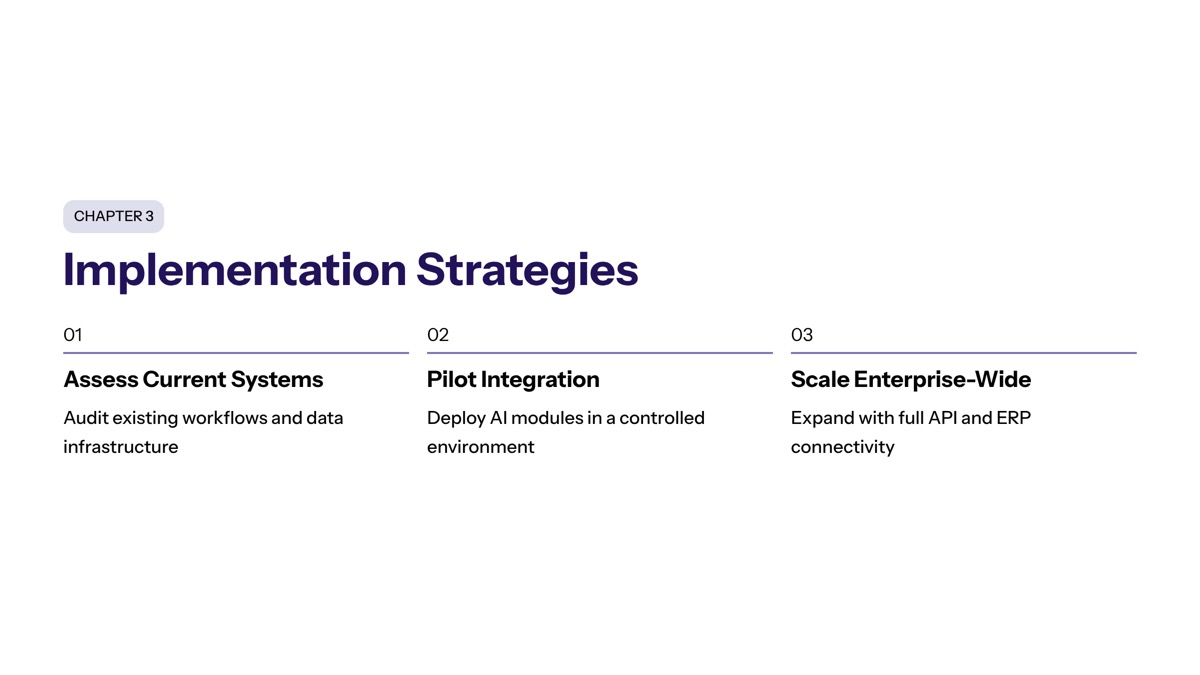
Audit current logistics systems and data quality. Map ERP, WMS, TMS, CRM, BI platforms, carrier portals, warehouse sensors, IoT devices, and third-party data sources. Identify where operational data is duplicated, delayed, incomplete, or trapped in multiple systems.
Define business objectives and ROI targets. Set measurable goals for cost per mile, on-time delivery, inventory accuracy, order accuracy, forecast demand accuracy, carrying cost, fleet utilization, downtime, and service reliability. These targets should connect AI capabilities to operational efficiency rather than vague innovation goals.
Assess AI readiness and integration complexity. Evaluate whether existing systems support APIs, streaming data, event-based updates, data synchronization, and real time coordination. AI systems need reliable data pipelines to function effectively, especially when models depend on live operational data.
Review regulatory, compliance, and logistics security requirements. Continuous monitoring of supply chain operations through AI can help organizations identify and mitigate risks, ensuring compliance with regulatory requirements and enhancing overall operational safety. Leaders should also assess potential security threats such as data poisoning, unauthorized access, model misuse, third-party data compromise, and reputational harm from incorrect automated decisions.
Prioritize pilots with visible operational value. Start with contained use cases such as demand forecasting for one product group, route optimization in one region, predictive maintenance for one fleet segment, or computer vision in one warehouse zone.
Build governance, training, and human oversight into the rollout. AI agents in logistics are transforming operations by enabling real-time visibility and faster decision-making, with organizations reporting 25% faster response times to disruptions and 30% fewer manual interventions when using AI for supply chain coordination. Even with these gains, logistics managers need explainable recommendations, escalation rules, and authority to override AI when safety, compliance, or customer commitments require it.
Technical Integration Considerations
The right architecture depends on security, scalability, latency, compliance, and the condition of existing systems. Many enterprises compare cloud-based platforms, on-premise deployment, and custom or hybrid architectures before implementing cutting edge technology.
Criterion | Cloud-Based AI Logistics Platform | On-Premise or Custom Deployment |
|---|---|---|
Scalability | Strong for logistics companies expanding across regions, carriers, and distribution hubs; cloud platforms can scale compute for demand forecasting, route planning, and analytics | More controlled but often slower and more expensive to scale; may be preferred for highly regulated logistics operations |
Data Control and Compliance | Easier access to AI services, but data residency, privacy, and vendor governance must be reviewed carefully | Greater control over sensitive data, security, audit trails, and compliance requirements |
Integration with Existing Systems | Often provides APIs, connectors, and prebuilt modules, but workflows may be vendor-defined | Can be tailored to ERP, WMS, TMS, IoT, partner systems, supplier portals, and unusual operational rules |
Real-Time Processing | Strong when cloud connectivity and streaming architecture are mature | Strong for low-latency local operations, edge devices, warehouse automation, and sensor-heavy environments |
Customization | Faster to deploy but may limit specialized workflows, compliance logic, or advanced exception handling | Better for custom logistics operations, complex pay rules, regulated environments, and unique supply chain constraints |
Maintenance and Upgrades | Vendor manages many updates, but forced changes and lock-in are possible | Organization controls roadmap but must manage maintenance, model monitoring, security, and MLOps discipline |
API capabilities are essential. AI systems need data synchronization between transportation, warehouse, order, supplier, and finance systems. If a legacy WMS updates only in batches, real time visibility will be limited unless middleware, event streaming, or data pipelines are added. In 2026, organizations using AI for supply chain coordination reported 25% faster response times to disruptions and 30% fewer manual interventions, showcasing the efficiency gains from AI agents.
Commercial platforms can accelerate implementation when workflows are standard. Custom development is often a better fit when logistics firms need specialized regulatory controls, unusual dispatch rules, multimodal orchestration, advanced logistics security, or deep integration with existing systems. Security teams should also distinguish legitimate AI powered automation from risky “ai weapon software” patterns, where poorly governed autonomous systems can manipulate operations, expose sensitive data, or trigger harmful actions without proper oversight.
Common Integration Challenges and Solutions
AI integration in logistics faces unique challenges because supply chain operations combine physical assets, partner dependencies, regulatory requirements, legacy software, and time-sensitive execution. The main risks are not limited to model performance. They include poor data quality, user resistance, scalability failures, security gaps, and unclear governance.
Data Quality and System Integration Issues
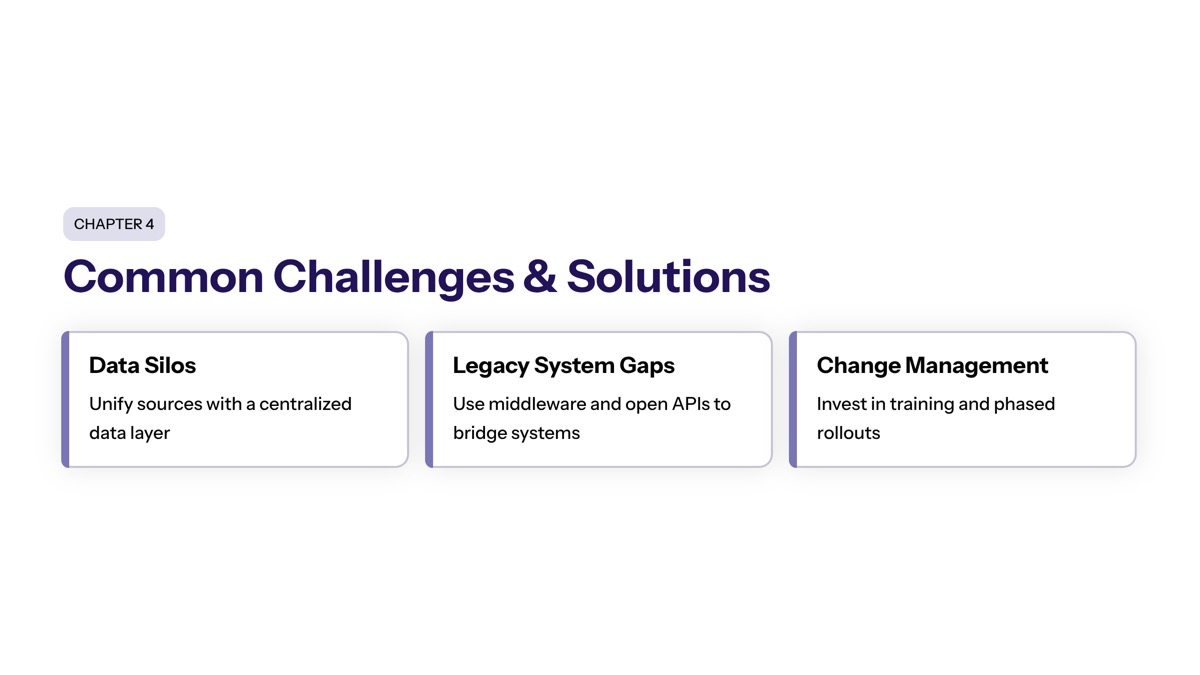
AI models are only as reliable as the data sources that feed them. Outdated SKU data, inconsistent units of measure, delayed sensor data, missing carrier updates, duplicated customer records, and disconnected warehouse systems can produce inaccurate forecasts, poor routing recommendations, and unreliable real time alerts.
The solution is to implement data cleansing, master data management, schema standardization, metadata catalogs, and validation pipelines before large-scale AI deployment. Establish real-time data synchronization between logistics systems so AI can analyze data across warehouse operations, fleet operations, supplier systems, and customer orders. This foundation helps AI powered platforms identify inefficiencies, detect anomalies, and maintain inventory accuracy across complex supply chains.
Change Management and User Adoption
Logistics teams may distrust AI recommendations, especially when traditional systems have required manual judgment for years. Users may worry that automating tasks will replace their roles, reduce control, or make exception handling harder. Adoption also suffers when AI recommendations are presented without explanations.
The solution is to start with augmentation rather than full autonomy. Provide dashboards that show why an AI model recommended a route, adjusted safety stock levels, escalated a supplier risk, or triggered predictive maintenance. Train dispatchers, planners, warehouse supervisors, and logistics managers to use AI as a decision-support layer. Human oversight should remain visible, especially where route optimization, compliance, customer commitments, and logistics security are involved.
Scalability and Performance Requirements
A pilot may work well in one warehouse, one route, or one product category but fail when expanded across multiple systems, distribution hubs, geographies, or business units. AI systems can also degrade when demand patterns change, new suppliers are added, transport disruptions become more frequent, or live operational data grows beyond original architecture assumptions.
The solution is modular design. Separate forecasting, routing, inventory management, visibility, document automation, and security services so each component can scale independently. Establish continuous monitoring, drift detection, model versioning, performance benchmarks, and real time threat detection for AI infrastructure. This keeps response time, accuracy, and service reliability stable as logistics operations expand.
Conclusion and Next Steps
AI-integrated logistics software turns supply chain operations into predictive, adaptive, and increasingly self-optimizing networks. The strongest platforms combine demand forecasting, route optimization, predictive maintenance, warehouse automation, real time visibility, logistics security, and human oversight into systems that help leaders reduce cost, improve service reliability, and respond faster to disruptions.
To move forward:
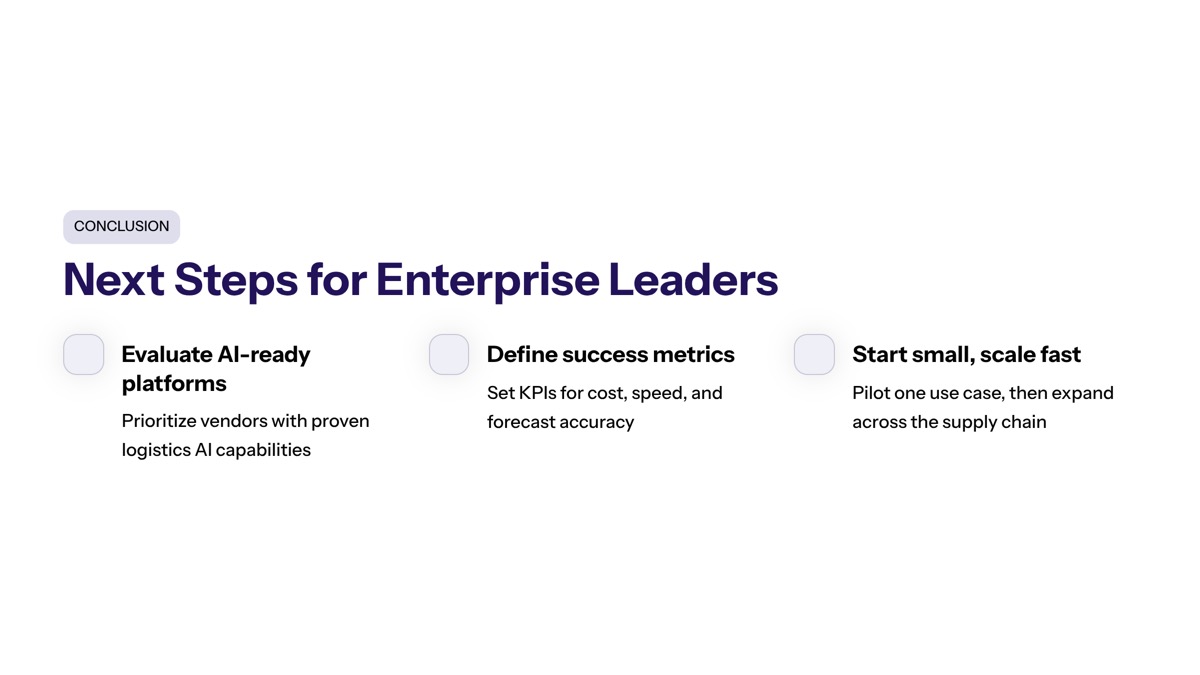
Assess your current logistics systems. Document ERP, WMS, TMS, carrier tools, warehouse systems, IoT devices, data sources, manual processes, and integration gaps.
Define specific business outcomes. Set targets for operational efficiency, cost reduction, delivery time, inventory accuracy, order accuracy, response time, and service improvement.
Prioritize high-value AI use cases. Common starting points include demand forecasting, efficient route planning, predictive maintenance, warehouse computer vision, and real time visibility.
Design for security and governance from the start. Include role-based access, audit trails, explainability, real time threat detection, model monitoring, and clear accountability for AI-assisted decisions.
Choose the right implementation path. Evaluate commercial platforms, custom development, and hybrid architectures based on existing systems, compliance needs, scalability goals, and operational complexity.
Build toward broader modernization. Related priorities include custom logistics platform development, legacy system modernization, AI-first architecture, and secure integration strategies for the logistics industry.
Additional Resources
Industry-specific AI implementation frameworks: Use structured frameworks to evaluate readiness, prioritize pilots, define governance, and scale AI capabilities across transportation, warehousing, procurement, and planning.
ROI calculation templates: Measure AI impact through transportation cost reduction, forecast accuracy, inventory balance, downtime reduction, empty-mile reduction, service reliability, and manual intervention reduction.
Compliance checklists for regulated logistics environments: Include data privacy, trade compliance, customs documentation, hazardous materials handling, driver regulations, auditability, and explainability requirements.
Technical specifications for logistics data integration: Define API standards, event streaming requirements, data synchronization rules, IoT and sensor data handling, model monitoring, and real-time processing requirements before integrating AI into production systems.