Managed AI Implementation Services: Support, Governance, and Production Readiness
Managed AI implementation services help organizations support AI systems after launch. They combine implementation support, monitoring, workflow optimization, governance, integration maintenance, user feedback, and production operations so AI does not remain a one-time pilot with no owner.
CTOs, AI program owners, operations leaders, security stakeholders, and enterprise teams evaluating managed AI implementation services providers need to focus on production responsibility. Managed AI support should be compared by operating responsibility, governance, support fit, and how well the provider maintains AI workflows after launch.
Managed AI implementation services are useful when AI becomes part of recurring operations. A production AI workflow needs support for access controls, workflow changes, source updates, monitoring, incidents, user adoption, and evidence. Without managed ownership, a useful pilot can slowly become an unreliable system.
The practical evaluation should focus on operating fit: whether the managed partner can support governance, integrations, monitoring, documentation, escalation, and continuous improvement after the initial AI implementation goes live.
What Managed AI Implementation Services Include
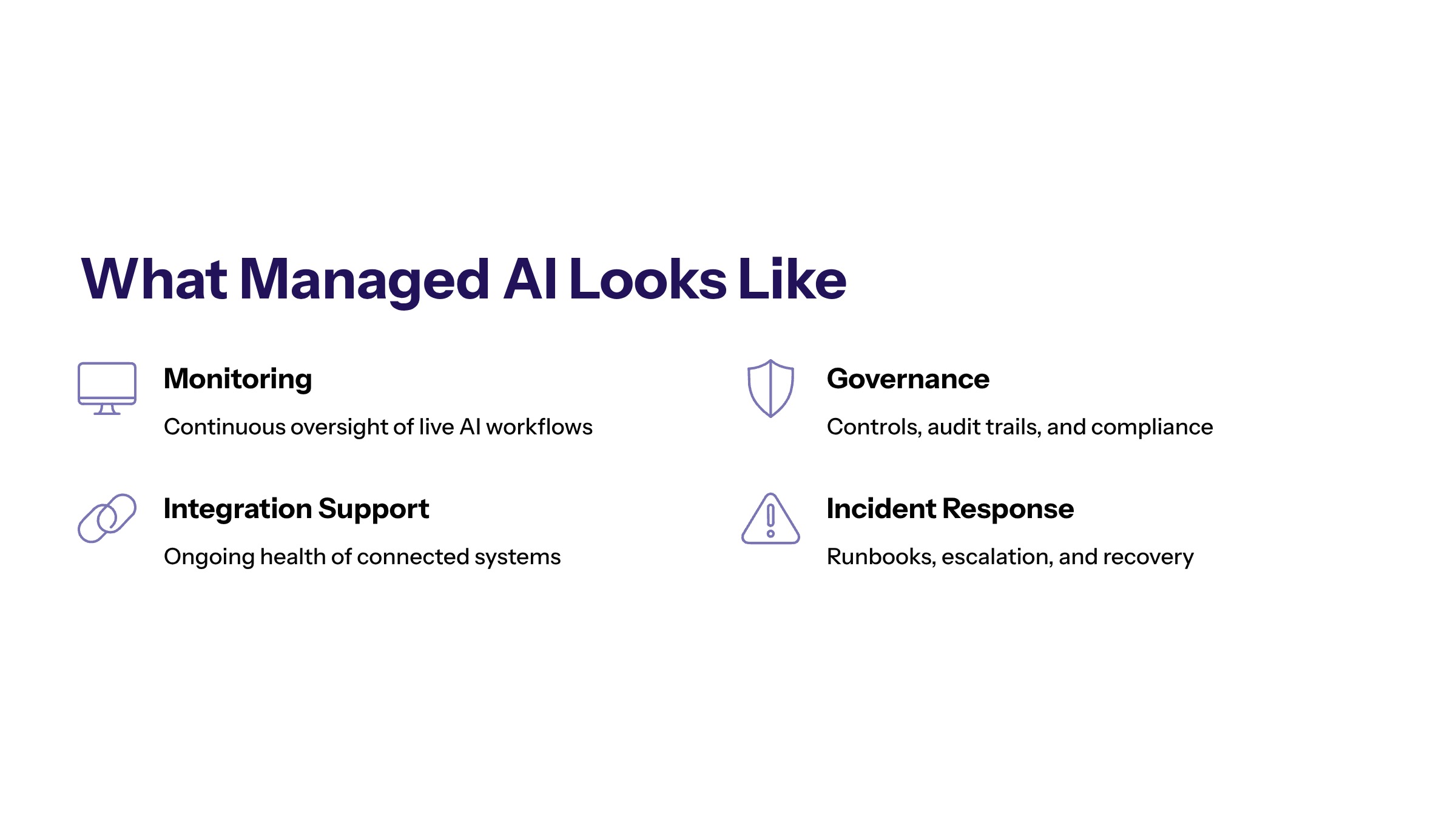
Managed AI implementation services usually begin where initial implementation ends. Once the AI workflow is live, the organization needs someone to monitor output quality, integration health, access rules, workflow performance, user feedback, and operational incidents. That work is different from simply building the first version.
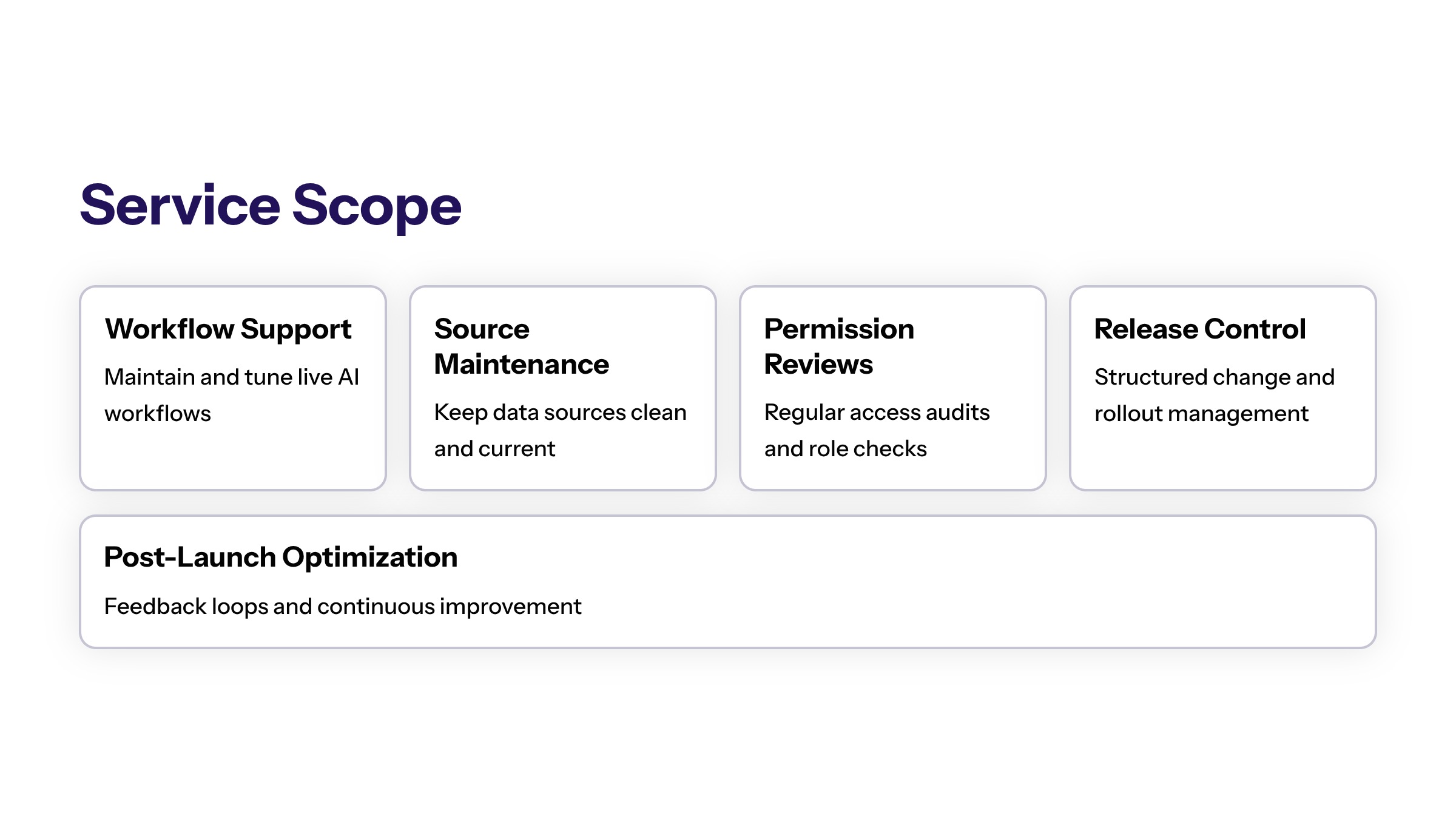
A managed service may include prompt and workflow updates, retrieval-source maintenance, permission reviews, release notes, user support, monitoring dashboards, model or configuration testing, and optimization cycles. It may also include ongoing advisory work when the business needs to decide whether to expand, pause, or redesign a workflow.
The most useful managed AI support is tied to the business process. A provider should understand what the AI system is supposed to improve, who uses it, which systems it touches, what evidence should be logged, and what risks require escalation. Support that only watches a model endpoint is too narrow for enterprise AI operations.
A practical service scope should also name what is outside the managed boundary. Some teams need model configuration support but keep integration ownership internally. Others need the provider to support workflow changes, source updates, user training, and release coordination. The managed model should make those lines explicit so no one assumes that "managed" means unlimited ownership of every AI-adjacent problem.
The best starting point is an operating inventory. List each live AI workflow, the business owner, the technical owner, the data sources, the user group, the review threshold, the systems touched, and the evidence retained. That inventory gives the managed provider a real support surface and gives the organization a baseline for evaluating service quality.
Managed AI Implementation vs One-Time AI Implementation
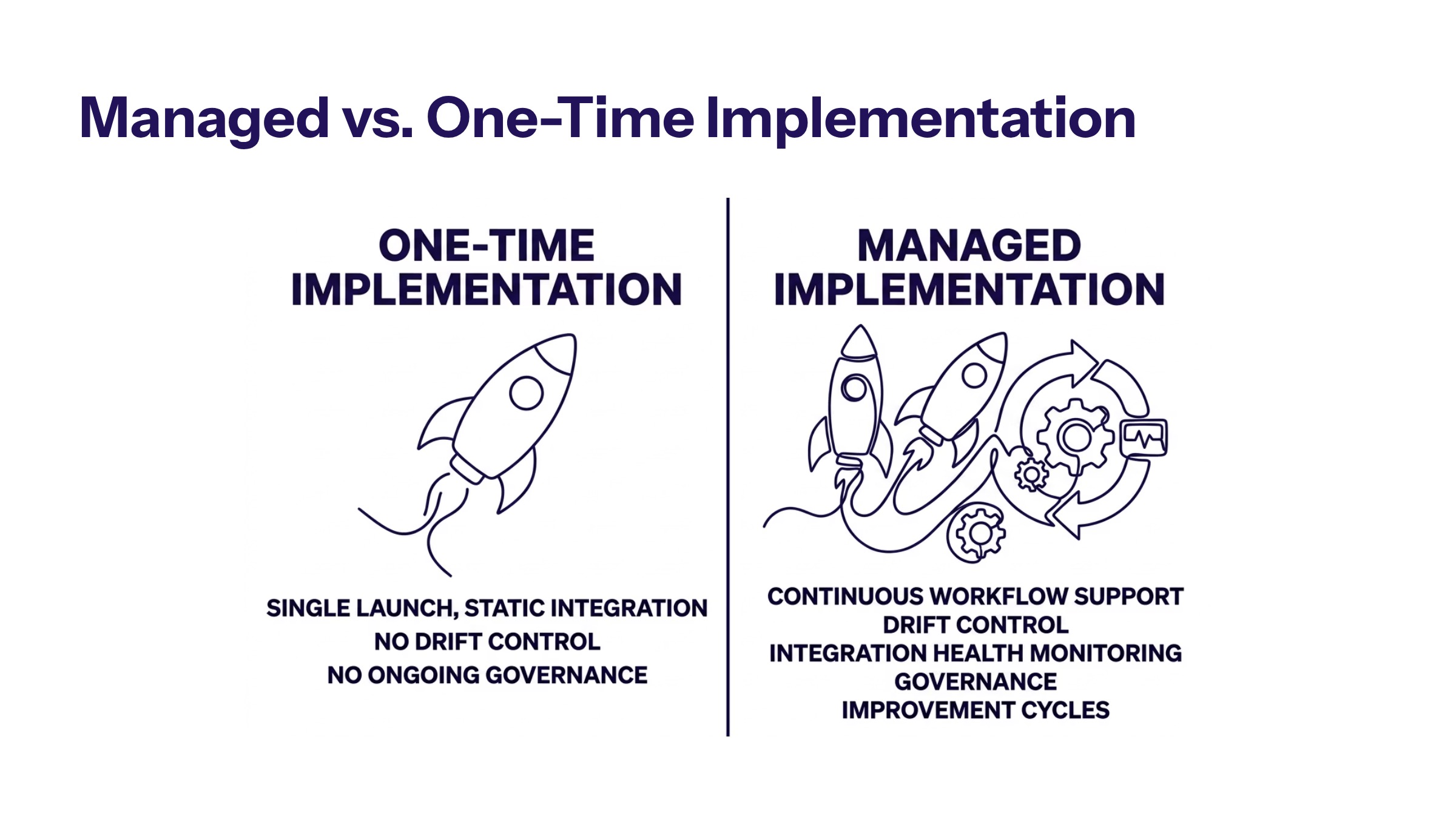
One-time AI implementation focuses on getting a defined system or workflow into production. It includes discovery, architecture, integration, testing, deployment, and initial adoption. Managed AI implementation services extend that work into the operating period after launch.
Service Area | One-Time Implementation | Managed AI Implementation | Risk if Missing |
|---|---|---|---|
Workflow setup | Design and launch the first controlled workflow. | Maintain workflow rules, owners, and exceptions. | The workflow drifts from the business process. |
Integration | Connect AI to approved systems and data. | Monitor connections and manage change requests. | Broken integrations create manual work and weak evidence. |
Governance | Define access, review, logging, and escalation. | Review permissions, logs, incidents, and ownership over time. | Controls become outdated or unowned. |
Optimization | Validate initial performance and user readiness. | Improve the workflow based on metrics and feedback. | The system remains technically live but operationally weak. |
The difference matters because production AI is not static. Source content changes, employees develop workarounds, integrations evolve, risk expectations shift, and users discover new failure modes. Managed support keeps those changes visible.
One-time implementation answers the question, "Can this workflow go live?" Managed implementation answers a different question: "Can this workflow keep producing controlled value after users, data, policies, systems, and operating priorities change?" That second question is where many AI pilots fail. The launch may be technically successful, but the operating model never matures.
For that reason, managed support should be planned before the first production release. Teams should decide how often the workflow will be reviewed, who approves updates, which incidents trigger escalation, what evidence is needed for leadership review, and how the provider will document changes. If those rules are deferred until after launch, the AI system can become difficult to govern just as people begin depending on it.
When Enterprise Teams Need Managed AI Support
Enterprise teams usually need managed AI support when the workflow affects recurring operations, customers, revenue, finance, compliance-sensitive work, employee data, or executive reporting. The more operational dependency the workflow creates, the more important post-launch support becomes.
A small internal assistant with low-risk outputs may only need periodic review. A workflow that routes approvals, summarizes sensitive records, updates systems, or supports customer-facing teams needs stronger operational support. Managed AI implementation services should match the risk and business value of the workflow.
Managed support is also useful when internal teams do not have enough capacity to maintain AI workflows. Engineering may be able to build the first version, but day-to-day support often falls between business, operations, security, and IT. A managed model can define ownership more clearly if responsibilities are explicit.
A second signal is workflow expansion pressure. If one pilot creates requests for new departments, new data sources, or new actions, the organization needs a repeatable support model before scaling. Otherwise each new AI workflow becomes a custom exception with its own permissions, documentation style, and review process.
A third signal is evidence demand. Leadership, security, finance, or risk stakeholders may ask whether the AI workflow is adopted, accurate enough for its role, controlled, measurable, and worth continued investment. Managed support should make those answers easier to produce through logs, reviews, change records, and operational summaries.
Production Monitoring, Optimization, and Incident Response
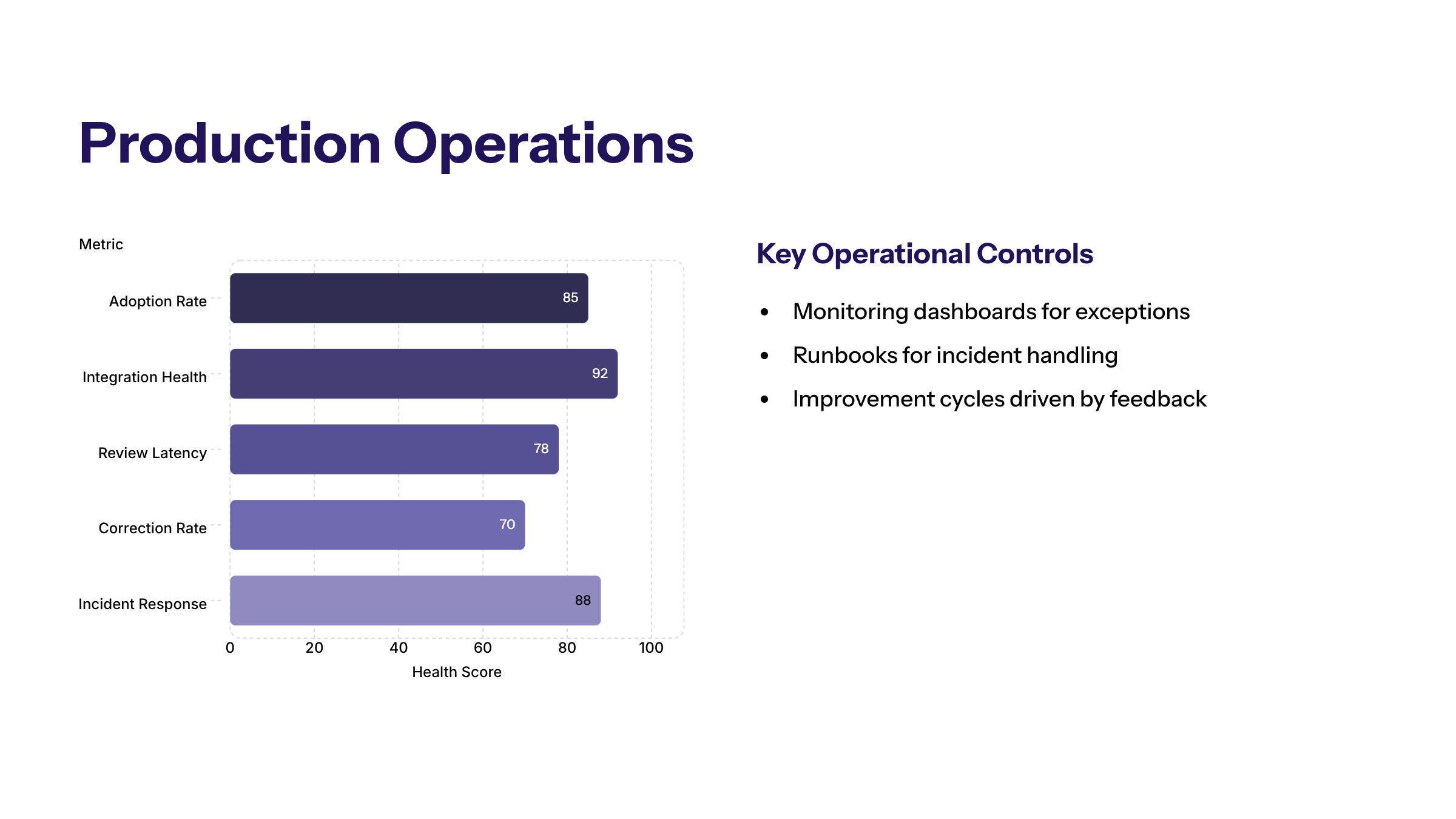
Production monitoring should track workflow health, not only model output. Useful signals include user adoption, correction rate, unresolved exceptions, integration errors, review latency, permission issues, source freshness, and audit completeness. These signals show whether the AI workflow is helping the business or creating hidden work.
Optimization should follow evidence. If users frequently override recommendations, the service team should investigate whether the workflow has poor context, unclear rules, missing data, weak interface design, or unrealistic automation boundaries. If exceptions rise, the team should review routing, thresholds, and escalation paths.
Incident response is part of managed support. The organization should know who is notified when the AI system produces unsafe output, exposes the wrong data, loses access to a source, fails an integration, or creates inaccurate operational records. A runbook should explain what to pause, who approves fixes, and how evidence is retained.
The monitoring plan should separate business signals from control signals. Business signals show whether the workflow is valuable: adoption, cycle time, review time, queue movement, reduced handoffs, or improved visibility. Control signals show whether the workflow remains safe enough to operate: override rate, unresolved exceptions, permission changes, missing sources, failed actions, and incidents.
Managed support should not optimize blindly for speed. If a workflow gets faster because reviewers stop checking outputs, the improvement may be fragile. If a workflow produces fewer escalations because thresholds are too loose, risk may be hidden. A mature service model improves throughput while preserving review quality and evidence.
Security, Access Control, and Data Governance Requirements
Managed AI support should include security and data governance because production workflows depend on access. If an AI system can retrieve data, draft recommendations, update a record, or trigger a workflow, the service model must define what access is allowed and how it is reviewed.
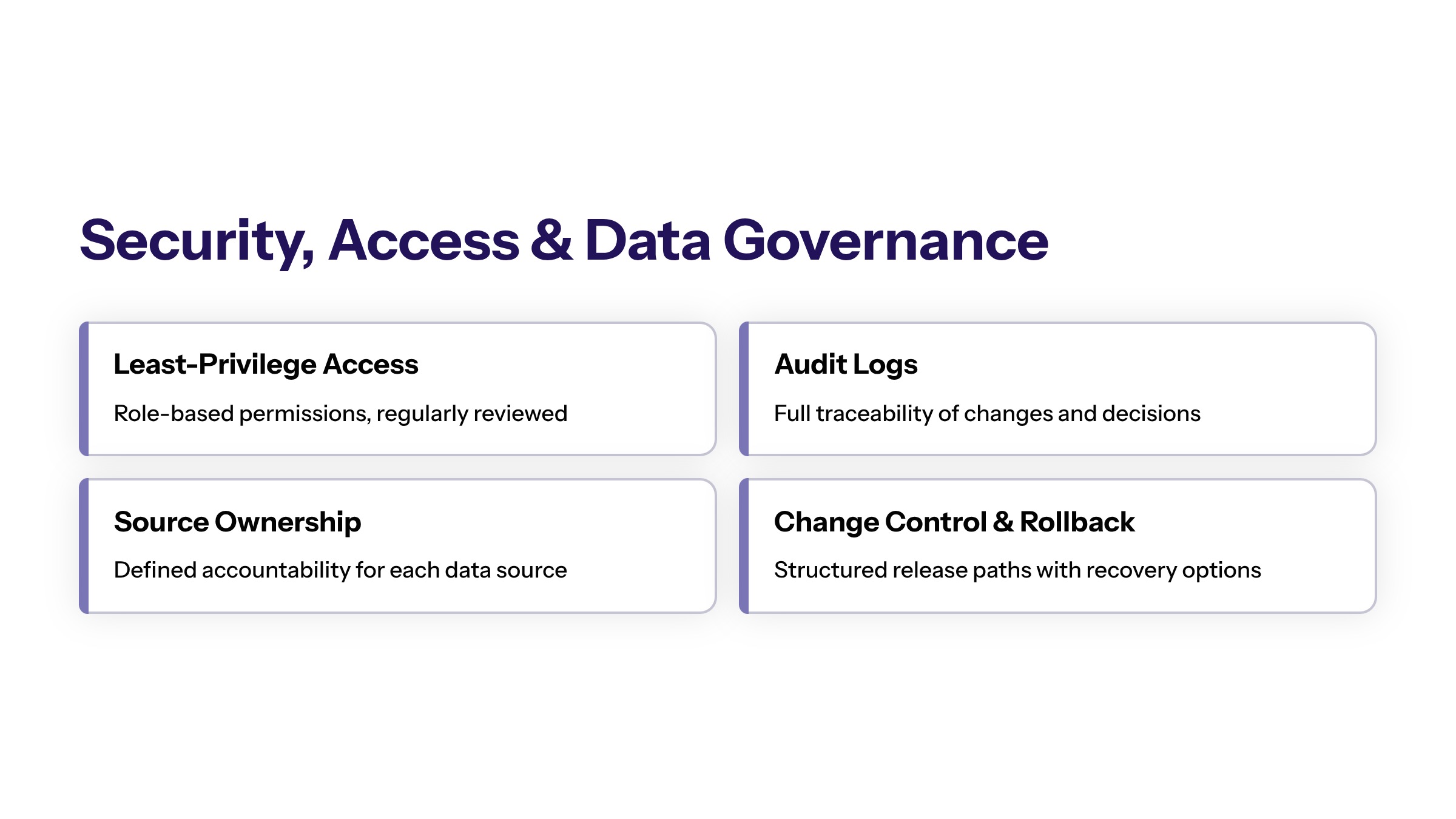
Secure development practices matter after launch as much as during the build. Least-privilege access, role-based permissions, audit logs, change control, redaction rules, and rollback paths should be part of the support model. A managed provider should not receive broad access simply because support is easier that way.
Data governance should also cover source ownership. Someone must own the documents, records, knowledge bases, and system fields the AI workflow relies on. If sources become outdated, the model may produce reasonable-looking but weak recommendations. Managed support should make source freshness visible.
Access reviews should be scheduled, not reactive. When employees change roles, vendors rotate, systems are replaced, or workflows expand, AI access can drift. Managed support should include periodic checks that confirm the system still has the minimum permissions required for the approved workflow and no more.
Change control is equally important. A new source, field, prompt, model setting, integration, or action rule can change workflow behavior. Managed AI implementation services should document those changes with the reason, approver, expected impact, test result, and rollback plan. That record helps teams understand why behavior changed instead of treating each issue as a mystery.
Managed AI Implementation Support for Finance and Regulated Workflows
Finance and regulated workflows require more caution. AI may support review, routing, summarization, reconciliation notes, exception queues, or reporting preparation, but final decisions and sensitive actions usually require accountable human review. Specific compliance requirements should be reviewed by qualified legal, risk, and business owners before production decisions are made.
Managed AI implementation support for finance should emphasize evidence. The service should maintain logs that show what the AI reviewed, which source records were used, who approved the output, which exceptions remained unresolved, and what changed after launch. This evidence helps finance, risk, and technology teams evaluate whether the workflow is controlled enough to expand.
The support model should also define escalation. If an AI workflow flags a high-risk exception, produces inconsistent output, or encounters missing data, the escalation owner should be clear. Managed support should not blur accountability between provider, finance team, compliance stakeholder, and technical owner.
For regulated workflows, conservative scoping is usually better than broad automation. AI can prepare summaries, organize evidence, compare records, or highlight exceptions, while accountable people approve final decisions. The managed provider should support that boundary instead of pushing toward autonomy before the operating evidence is strong enough.
How to Evaluate Managed AI Implementation Services Providers
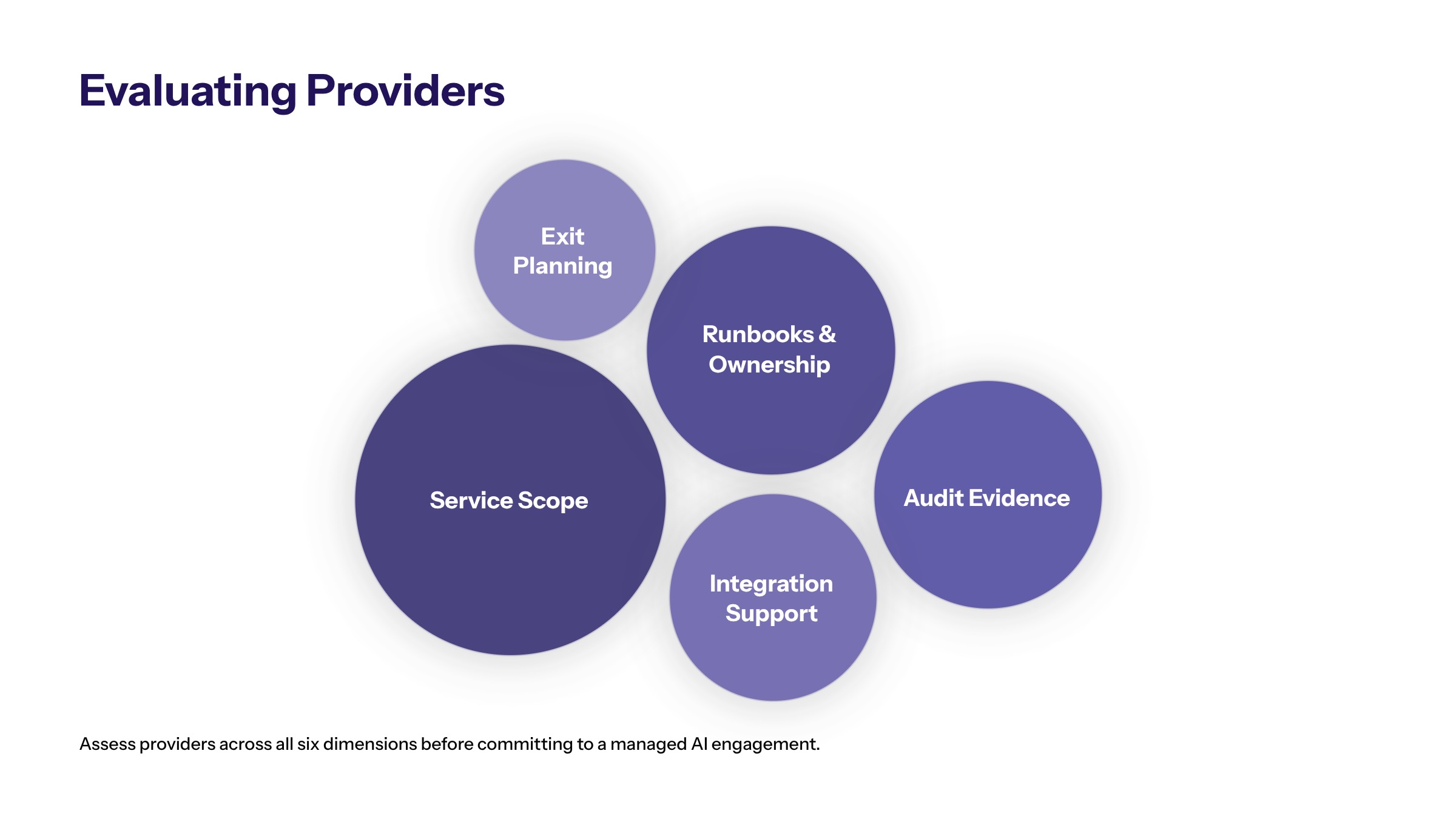
Teams evaluating managed AI implementation services providers should avoid beginning with price alone. Pricing matters, but a low-cost service that cannot explain ownership, access, runbooks, audit evidence, and integration support may become expensive operationally. Evaluation should begin with service scope and risk fit.
Useful questions include: what workflows are supported? Who owns incidents? How are changes requested and approved? What logs are retained? How is user feedback handled? What happens if the provider changes models, tools, or staffing? How does the organization exit the arrangement without losing operational knowledge?
Service agreements should clarify ownership of code, prompts, configuration, documentation, data mappings, integration logic, and support records. Managed support should increase platform control, not create a dependency that the organization cannot inspect or replace.
The evaluation should also test how the provider handles imperfect workflows. Ask how it responds when users ignore the AI output, when a source changes format, when a model response becomes inconsistent, when a business owner requests a risky shortcut, or when the workflow no longer supports the business goal. These answers reveal whether the provider understands operations or only implementation.
Teams should request sample runbooks, change records, review cadences, incident categories, and reporting examples. The format does not need to be complex, but it should prove that the provider can manage an AI workflow as an operating system rather than a one-time technical asset.
Service Model, Ownership, and Exit Planning
A managed AI service model should define roles before production. The business owner owns the workflow outcome. The data owner owns source quality and permissions. The technical owner owns architecture and integration health. The risk owner reviews control performance. The provider supports the agreed scope.
Exit planning is part of responsible ownership. The organization should know how to export documentation, logs, workflow configuration, integration details, and support history. If the managed service ends, the business should still understand how the AI workflow operates.
Custom enterprise software thinking is useful here because managed AI often depends on workflow-specific systems. The more critical the workflow, the more important portability, documentation, and long-term control become.
Ownership should also cover decision rights. A provider may recommend changes, but the business should decide whether the workflow expands, pauses, changes risk level, or receives new system permissions. The technical owner should confirm feasibility and security impact. The data owner should confirm source quality. That separation keeps managed support useful without handing away governance.
Managed AI Implementation Service Readiness Checklist
Before choosing a managed AI implementation partner, teams should confirm that the workflow is real, bounded, measurable, and owned. A provider cannot responsibly manage an AI workflow if the business has not defined what the workflow should accomplish.
The checklist should include access boundaries, data sources, review thresholds, incident response, user feedback, support hours, documentation, change approval, and metrics. It should also include the conditions for scale, pause, redesign, or retirement.
If a provider cannot explain how it will support governance, security, integration, monitoring, and improvement, the managed service may be too shallow. The right service should keep the AI workflow useful and controlled after launch.
Readiness also depends on internal discipline. If the business cannot name the workflow owner, success metric, data source, approval threshold, or escalation path, it may be too early to buy a managed service. In that case, the first managed engagement should be a readiness and operating-model buildout, not immediate production support.
How to Move From AI Launch to Managed Operations
Managed AI implementation services should help an organization move from launch to reliable operations. Start by defining the workflow owner, support scope, monitoring signals, security controls, incident runbook, and evidence requirements.
The strongest managed AI programs do not hide complexity. They make ownership, access, changes, incidents, and outcomes visible so the organization can keep improving the workflow with confidence.
Frequently Asked Questions About Managed AI Implementation Services: Support, Governance, and Production Readiness
No. Managed AI implementation services focus on AI workflows, data access, model behavior, integration support, monitoring, governance, and post-launch optimization. Managed IT may support infrastructure, but AI workflow support needs business-process context. For related reading, see custom enterprise software.
Pricing should be evaluated against scope, support model, implementation complexity, ownership expectations, and contract terms. The important question is whether the managed service can maintain useful AI workflows without weakening governance. For related reading, see custom software development.
Start with the workflow that creates recurring operational dependency and measurable business value. A managed service should support a real process, not a disconnected AI experiment. For related reading, see AI agent frameworks.
Managed AI support should include monitoring, issue triage, performance review, prompt or workflow updates, access reviews, documentation, and improvement planning. Support should preserve accountability. For related reading, see AI agent orchestration.
Managed workflows should be reviewed on a cadence based on business risk and after material system, data, or policy changes. Reviews should check both value and control. For related reading, see AI agent platforms.
Low confidence outputs, sensitive data, policy conflicts, failed actions, unusual exceptions, and high impact decisions should be escalated to a human owner. Escalation is part of safe operations. For related reading, see AI agent tools.