Nonprofit Software Development: A Complete Guide to Modernizing Your Organization’s Technology
Nonprofit software development creates custom digital solutions that streamline donor engagement, program management, compliance reporting, and operational workflows while maximizing impact per dollar spent. For nonprofit operators, the goal is not simply to add more software; it is to build or modernize systems that help teams save time, manage resources responsibly, and prove mission impact with reliable data.
This guide covers the core technology areas most nonprofits need to modernize: donor management, program tracking, reporting systems, event management, and workflow optimization. It is written for nonprofit executives, operations managers, program directors, and development teams evaluating whether to improve existing systems, customize platforms, or invest in custom software development.
The short answer: nonprofit software development helps mission-driven organizations replace manual processes and disconnected tools with tailored solutions for fundraising, service delivery, financial transparency, compliance, and operational efficiency.
By the end, you will understand how nonprofit software can help your organization:
Reduce administrative overhead through automation and better data flow
Improve donor retention through stronger donor engagement and donation tracking
Increase program visibility with dashboards that connect activities to outcomes
Simplify reporting for funders, boards, auditors, and regulators
Measure ROI from software development, cloud engineering, integrations, and operational improvements
For a deeper view of sector-specific services and completed projects, see our nonprofit industry page.
Understanding Nonprofit Software Development
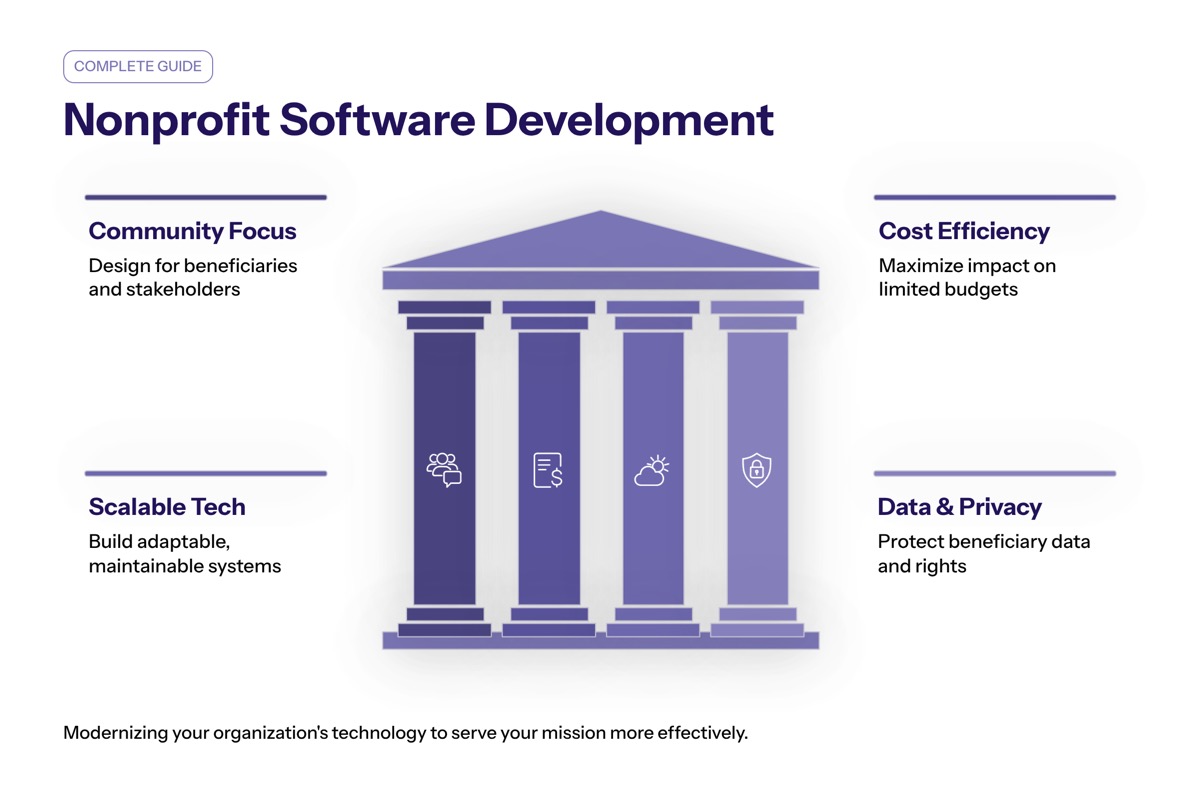
Nonprofit software development is the process of designing, building, integrating, and improving software solutions for mission-driven organizations. Unlike generic business software, nonprofit software must support fundraising, restricted funds, program outcomes, compliance documentation, volunteer coordination, and stakeholder accountability.
Many nonprofits begin with spreadsheets, standalone donor platforms, accounting tools, and manual reporting workflows. Over time, those tools often create duplicate data, reporting delays, inconsistent communication, and a weak view of impact. Custom software solutions can centralize data, automate work, and help teams make data driven decisions across fundraising, programs, finance, and operations.
Nonprofit organizations operate under tight budget constraints, heavily relying on non-technical staff and needing to demonstrate clear mission impact. That is why successful software engineering in this space requires a deep understanding of the organization’s mission, budget, business needs, staff skills, and community expectations.
Mission-Specific Requirements
Nonprofit-specific functionality includes donor stewardship, grant tracking, donation tracking, volunteer management, program outcome measurement, event management, and compliance reporting. A donor management system, for example, should track giving history, automate acknowledgments, personalize communication, and support recurring giving instead of acting as a basic contact database.
These requirements connect directly to mission impact and accountability. Effective compliance and reporting systems help nonprofits track their financial performance and program outcomes, ensuring they meet regulatory requirements and demonstrate accountability to their communities. Data-driven dashboards that connect program outcomes with financial performance help nonprofits visualize and communicate their mission impact, which is crucial for donor management.
Nonprofits must also maintain compliance with 501(c)(3) regulations, which requires transparency in financial reporting and operational activities to build trust with donors and stakeholders. Audit-ready transparency solutions are essential for nonprofits to maintain compliance, as they provide clear documentation of finances, activities, and outcomes, which is crucial for regulatory reviews and donor confidence.
Security is part of the mission-specific requirement set. Strong encryption should be implemented to protect financial and personal donor data in nonprofits. Nonprofits are required to comply with data privacy laws like GDPR and CCPA, especially when handling sensitive donor information, and robust user permission systems should be implemented to ensure staff can only access relevant data based on their roles.
Budget-Conscious Development Approach
A budget-conscious development approach focuses software development on the highest-impact work first. For many nonprofit teams, that means donor management, reporting automation, program tracking, or integrations that remove duplicate entry. Nonprofits should ensure every technical feature directly supports operational goals such as fundraising and program delivery.
It is beneficial to build a Minimum Viable Product (MVP) first when developing software for nonprofits due to their limited funds. An MVP may include core donor profiles, gift tracking, basic reports, user permissions, and accounting integration before adding predictive analytics, mobile applications, advanced marketing automation, or a donor-facing web app.
Agile methodologies can enhance software development processes in the nonprofit sector by promoting incremental development and flexibility. Nonprofits should avoid lengthy waterfall projects and instead adopt iterative development approaches to adapt to quickly changing needs. This creates a better trade off between cost control, functionality, user experiences, and long-term scalability.
Nonprofits are advised to leverage technology subsidies and discounts to mitigate the costs associated with software development. Engaging skilled volunteers and tech donations can help nonprofits access necessary resources without incurring high costs, although volunteer contributions should still be supported by clear documentation, quality standards, and experienced technical oversight.
Integration with Existing Systems
Nonprofit modernization rarely starts from zero. Most organizations already use existing systems such as Salesforce, QuickBooks, Sage Intacct, payment processors, email marketing platforms, spreadsheets, legacy databases, event tools, or grant portals. Effective software integration can connect existing systems with new solutions, enhancing functionality and enabling organizations to operate more efficiently.
Using open APIs allows for easier integration of custom software with existing nonprofit tools like CRMs and payment processors. Seamless custom integrations help unify data, streamline workflows, and improve overall productivity, allowing organizations to focus more on their mission and less on managing technology.
Integrating various software systems can enhance data accuracy by eliminating duplicate entries and improving reporting accuracy across all initiatives. This matters because reliable data is the foundation for fundraising strategy, compliance, program evaluation, donor engagement, and leadership decisions.
The next step is understanding which software solutions nonprofits most often need to modernize.
Core Nonprofit Software Solutions
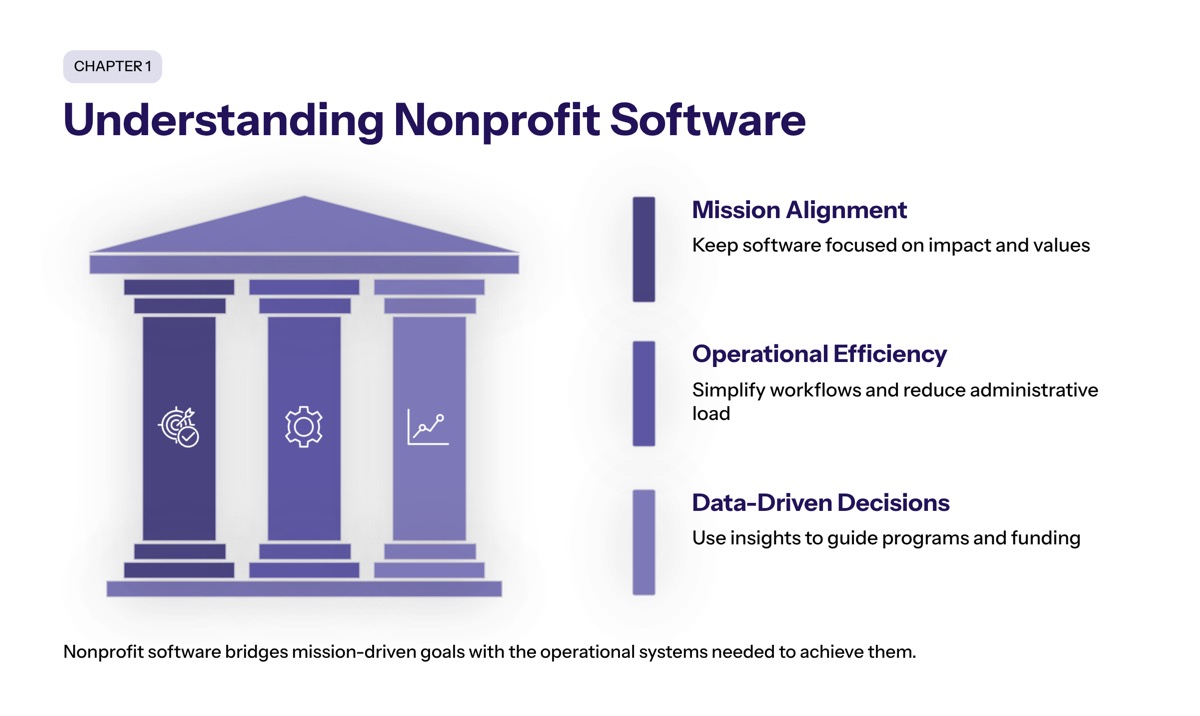
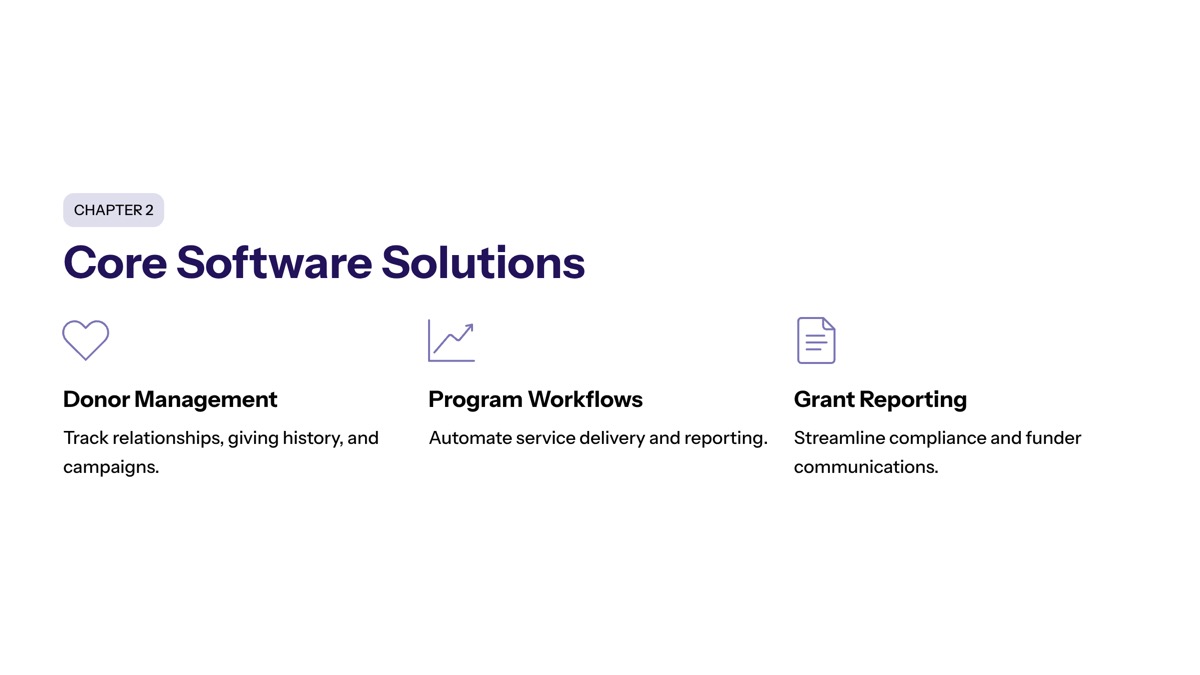
The four primary areas nonprofit operators usually need to modernize are donor systems, program management, reporting infrastructure, and workflow automation. These systems should not operate as disconnected tools; they should support one shared view of constituents, funds, activities, outcomes, and operational performance.
Custom software, platform customization, and hybrid development services can all work depending on budget, complexity, and internal capacity. The right approach depends on whether the organization needs a lightweight web app, mobile applications for field teams, full stack custom software development, cloud engineering, or tailored solutions that extend current platforms.
Donor Management and Fundraising Systems
Donor management and fundraising systems help nonprofits manage relationships from first interaction to recurring giving, major gifts, event participation, and long-term stewardship. Building donor management systems that track giving, automate acknowledgments, and personalize engagement can boost donor retention and drive fundraising success.
Effective donor management involves creating unified fundraising and payment solutions that enable seamless online donations and recurring giving. A strong system should support donation tracking, gift receipts, segmentation, campaign attribution, donor notes, pledge reminders, and marketing automation. It should also integrate with payment processors, accounting software, and communication tools so fundraising data does not remain isolated.
AI tools can assist nonprofits in personalizing donor communications and optimizing outreach strategies, which can lead to increased donor engagement and retention. Implementing AI-driven marketing automation can help nonprofits better target their audience, increase engagement, and drive donations more effectively.
ROI can be measured through improved donor retention, higher recurring gift adoption, reduced manual acknowledgment time, and stronger campaign performance. Since many nonprofits lose over half of their donors each year, even modest improvements in donor engagement can create meaningful financial and social impact.
Program Management and Impact Tracking
Program management software helps teams monitor services, beneficiaries, attendance, case activity, volunteer hours, outcomes, and program costs. Instead of relying on scattered spreadsheets, teams can use centralized tools to track what happened, who was served, what resources were used, and what results were achieved.
Real-time dashboards connect program activities to financial performance. This helps leadership, boards, funders, and community partners understand not only how much money was spent, but what impact was created. Data driven decisions become easier when program outcomes, operational data, and financial inputs are visible in one system.
Predictive analytics powered by AI can help nonprofits forecast donations, volunteer needs, and program demands, enabling smarter planning and maximizing impact. AI-driven solutions can enhance nonprofit operations by automating administrative tasks, allowing teams to focus on mission-critical activities and improving overall efficiency.
A strong focus on accessible software development is vital for nonprofits that serve diverse populations with varying technological literacy. User experiences should be kept intuitive in nonprofit software, given that staff and volunteers often lack advanced technical training. The best nonprofit software reduces friction for staff, volunteers, and clients instead of adding new complexity.
Financial Reporting and Grant Management
Financial reporting and grant management systems help nonprofits manage restricted and unrestricted funds, funder requirements, grant applications, disbursements, budgets, approvals, and reporting cycles. These systems are especially important for organizations that must document how money was received, allocated, spent, and connected to program outcomes.
Automated compliance reporting supports 501(c)(3) requirements, funder obligations, board oversight, and audit preparation. Effective compliance and reporting systems help nonprofits track their financial performance and program outcomes, ensuring they meet regulatory requirements and demonstrate accountability to their communities.
Grant lifecycle management should cover the full process from application through reporting. This includes deadlines, funder communication, required documentation, budget tracking, outcome metrics, and final reports. When integrated with accounting platforms, grant systems provide transparent financial oversight and reduce the risk of misreporting.
Audit-ready transparency solutions are essential for nonprofits to maintain compliance, as they provide clear documentation of finances, activities, and outcomes, which is crucial for regulatory reviews and donor confidence. Strong encryption, role-based access, and privacy controls should be part of the reporting architecture because financial and donor data are sensitive assets.
Workflow Automation and Operational Efficiency
Workflow automation reduces manual work in volunteer coordination, event management, approvals, document routing, reminders, outreach, reporting, and administrative tasks. Automating administrative tasks can save time and reduce costs for nonprofit organizations, allowing them to focus more on mission-critical operations.
Custom software solutions for nonprofits can streamline processes, increase transparency, and enhance operational efficiency by eliminating manual tasks and centralizing data. Implementing operational automation in nonprofits can lead to measurable gains such as increased donor retention, reduced administrative hours, and improved data accuracy.
Event management software is essential for nonprofits to organize various types of events effectively, improving overall management practices. Custom nonprofit management solutions can enhance event planning by streamlining processes, improving communication, and facilitating participant engagement. Effective event management tools help nonprofits track attendance, manage registrations, and analyze event outcomes to improve future initiatives.
Cloud services can reduce upfront hardware costs for nonprofits while allowing scalability to handle fluctuating demands. During seasonal campaigns, emergency response periods, large events, or year-end giving, cloud engineering helps systems scale without forcing the organization to pay for unnecessary infrastructure year-round.
Together, donor systems, program tools, grant reporting, and workflow automation form the operational foundation for modern nonprofit management.
Implementation Process and Strategic Considerations
Technology modernization works best when the process balances operational needs, budget limits, staff capacity, compliance, and measurable mission outcomes. The goal is not to build every possible feature; the goal is creating software solutions that solve real problems, improve management practices, and support long-term success.
Engaging stakeholders in early research is crucial to ensure the software addresses real problems rather than creating technical bloat. High staff turnover in nonprofits highlights the need for robust documentation and easy onboarding strategies. Documentation should be exhaustive and user-friendly to facilitate onboarding for new hires and volunteers.
Assessment and Planning Framework
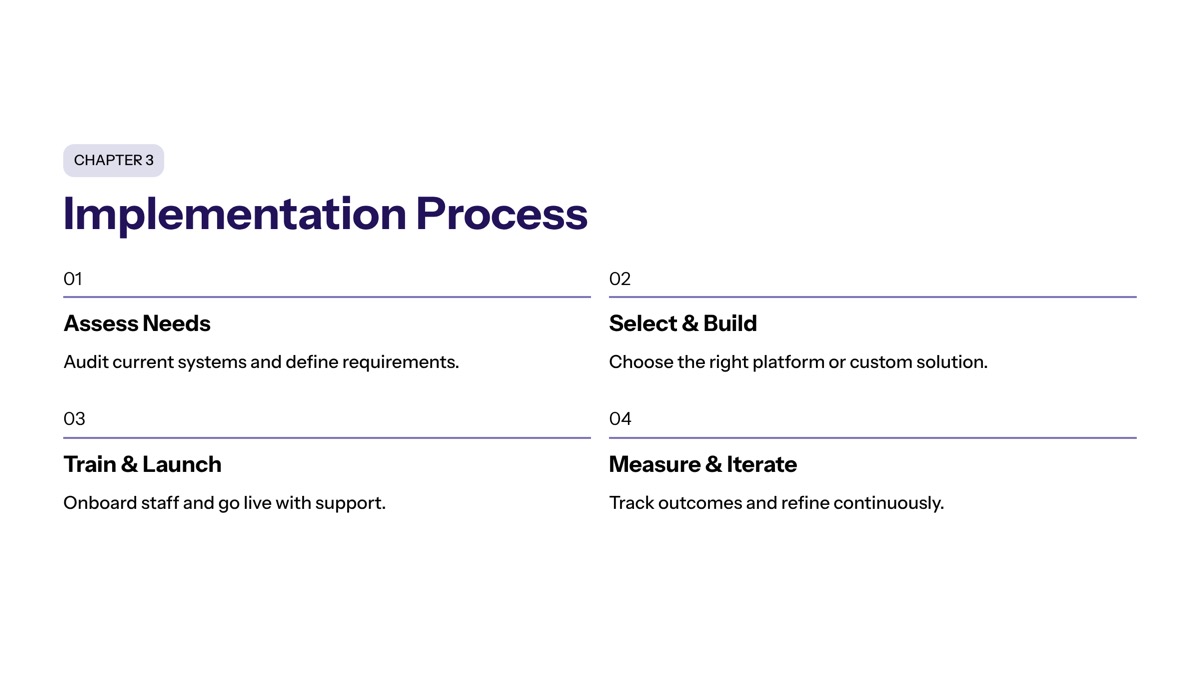
Nonprofits should evaluate their technology infrastructure when manual work is slowing teams down, reports are unreliable, donor data is fragmented, staff are duplicating entries, or leadership cannot easily connect resources to outcomes.
Current system audit to identify inefficiencies and data silos
Review existing systems, spreadsheets, site forms, donor databases, accounting platforms, and legacy tools. Identify duplicate data, manual handoffs, reporting gaps, security risks, and workflows that consume unnecessary staff time.Stakeholder needs assessment across programs, development, and finance teams
Interview staff, volunteers, leadership, partners, and users who rely on the software daily. A collaborative research process helps the development team understand pain points, communication needs, compliance obligations, and must-have functionality.Budget analysis including total cost of ownership and expected ROI
Include app development, licensing, integrations, data migration, training, support, maintenance, security reviews, and future enhancements. The right strategy should show how the project will save time, reduce costs, improve donor retention, increase reporting quality, or strengthen program delivery.Implementation timeline planning that minimizes operational disruption
Use phased releases, pilot groups, training sessions, and migration safeguards. Agile development makes it easier to test features, gather feedback, and adjust priorities before the full organization depends on the new system.
Development Approach Comparison
Nonprofit leaders should compare development approaches before committing to a project. The best option depends on mission complexity, budget, existing platforms, internal technical skills, data requirements, and growth plans.
Approach | Custom Development | Platform Customization | Hybrid Solution |
|---|---|---|---|
Budget Range | $50K-$200K+ | $15K-$75K | $25K-$100K |
Timeline | 6-18 months | 2-6 months | 4-12 months |
Customization Level | Complete flexibility | Platform limitations | Selective custom features |
Maintenance Requirements | Ongoing development support | Platform updates | Mixed approach |
Custom development is the best fit when an organization has highly specific workflows, complex data needs, unusual reporting requirements, or a long-term strategy to reduce platform constraints. Platform customization works well when the nonprofit can adapt to a proven tool and wants faster deployment. A hybrid solution combines both: core platforms for standard needs and custom software for mission-specific features.
The key trade off is control versus speed and cost. A company with hands on experience in nonprofit software, full stack development, integrations, cloud engineering, and security can help the client choose a realistic path without overbuilding.
Common Challenges and Solutions
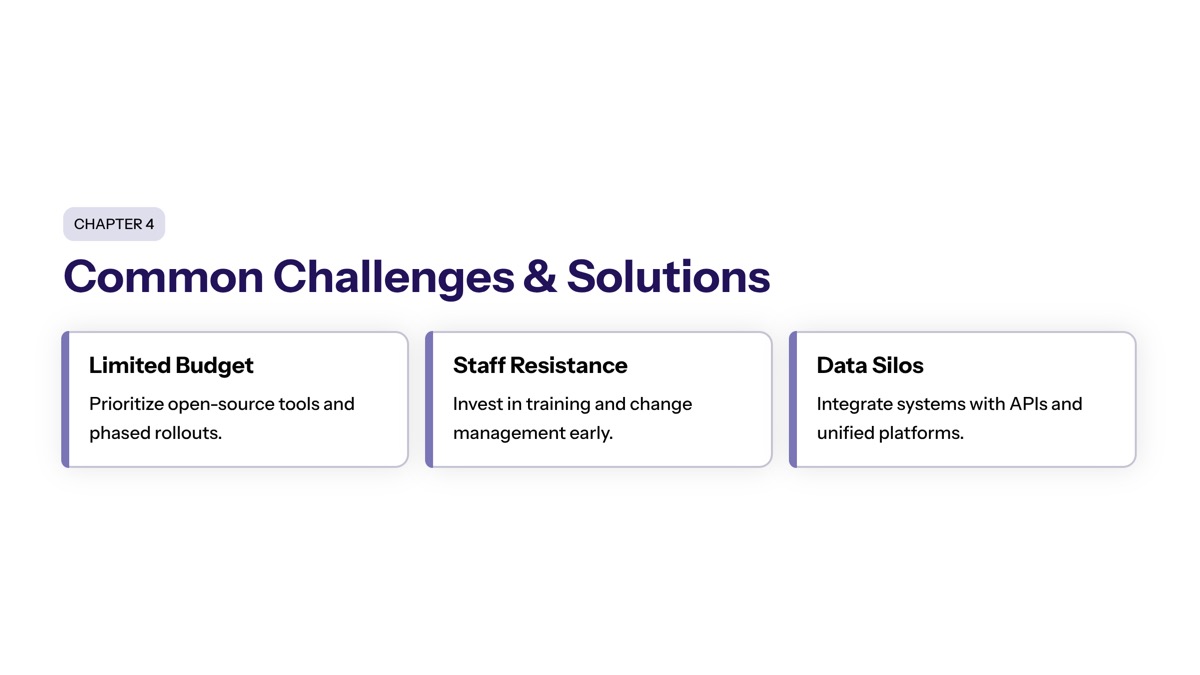
Nonprofit software development comes with predictable challenges: limited budgets, small technical teams, staff turnover, data quality issues, compliance pressure, and competing priorities. These challenges can be managed with clear planning, incremental development, accessible design, and strong governance.
Limited Technology Budget and Resource Constraints
Start with the highest-impact areas, such as donor management, compliance reporting, program dashboards, or automation that removes repetitive administrative work. A phased MVP helps the organization pay for the most valuable functionality first and delay lower-priority features.
Nonprofits should leverage nonprofit discounts, technology subsidies, grants, skilled volunteers, and tech donations where appropriate. These resources can reduce costs, but they should be managed with clear ownership, documentation, and quality controls so the organization is not left with unsupported software.
Staff Adoption and Change Management
Staff adoption improves when users are involved early, trained gradually, and shown how the software will reduce manual work. Communication should focus on practical gains: fewer duplicate entries, faster reports, clearer donor history, simpler event management, and easier onboarding.
Because many teams include non-technical staff and volunteers, intuitive user experiences are essential. Accessible interfaces, role-specific workflows, training materials, and searchable documentation help staff use the system confidently even when turnover occurs.
Data Migration and System Integration
Data migration should include cleanup, deduplication, field mapping, backup safeguards, testing, and validation before launch. Poor migration can damage donor records, create inaccurate reports, and weaken trust in the new software.
API-based integrations should connect essential tools such as CRMs, accounting systems, payment processors, marketing platforms, and program databases. Effective integration improves data accuracy by eliminating duplicate entries and improving reporting accuracy across all initiatives.
Compliance and Security Requirements
Compliance and security must be built into the software from the beginning. Strong encryption should protect financial and personal donor data, and role-based user permissions should limit access to only the data each person needs.
Nonprofits must comply with data privacy laws like GDPR and CCPA when handling sensitive donor information. They must also maintain compliance with 501(c)(3) regulations through transparent financial reporting and operational documentation. Audit-ready reporting, secure development practices, consent management, and regular reviews help protect the organization, its donors, and the communities it serves.
Conclusion and Next Steps
Nonprofit software development helps organizations amplify impact by improving operational efficiency, centralizing data, strengthening donor engagement, simplifying reporting, and connecting resources to measurable outcomes. The most successful projects stay focused on mission-critical operations instead of adding unnecessary tech complexity.
To move forward:
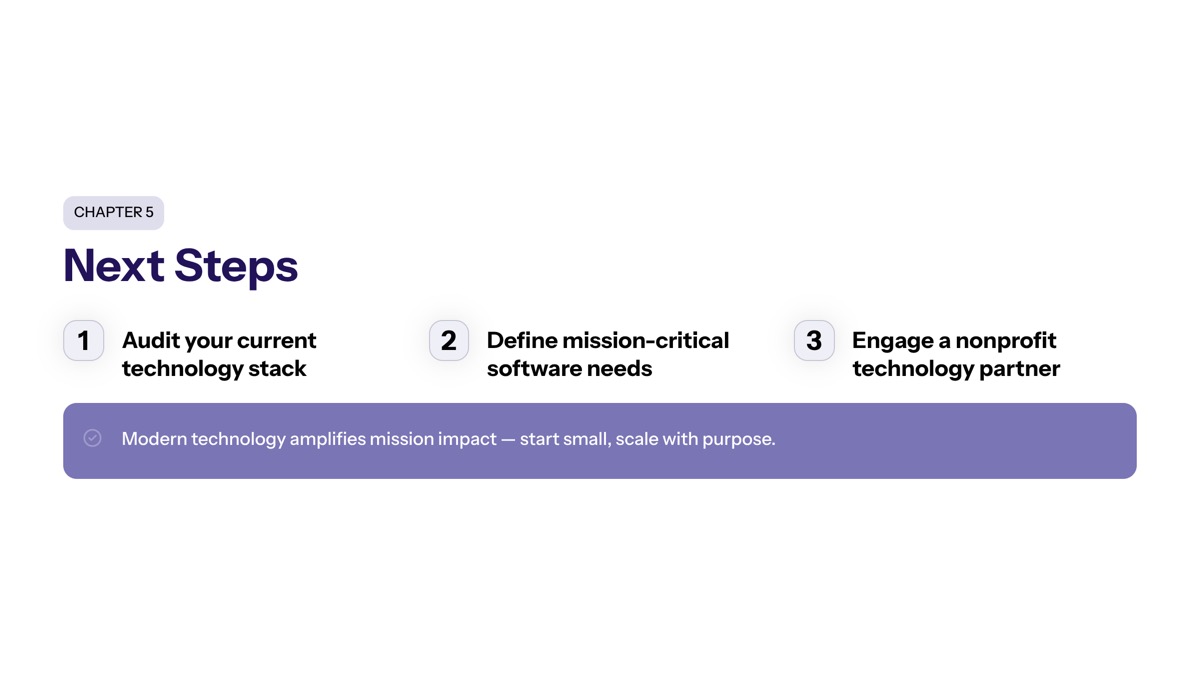
Assess current systems to identify manual work, reporting gaps, duplicate data, security risks, and disconnected platforms.
Prioritize high-impact workflows such as donor management, grant reporting, program tracking, event management, or workflow automation.
Define budget and ROI expectations including development, migration, training, support, maintenance, and long-term scalability.
Choose the right development approach: custom software development, platform customization, or a hybrid solution.
Plan for adoption and sustainability with training, documentation, user permissions, support, and future enhancements.
Ongoing support, staff training, cloud scalability, security reviews, and future integrations should be part of the strategy from the beginning. For organizations ready to modernize donor, program, reporting, and workflow systems, the next step is to align technology investment with measurable mission outcomes and a practical implementation roadmap.