Operating Model Anti-Patterns: Symptoms and Fixes
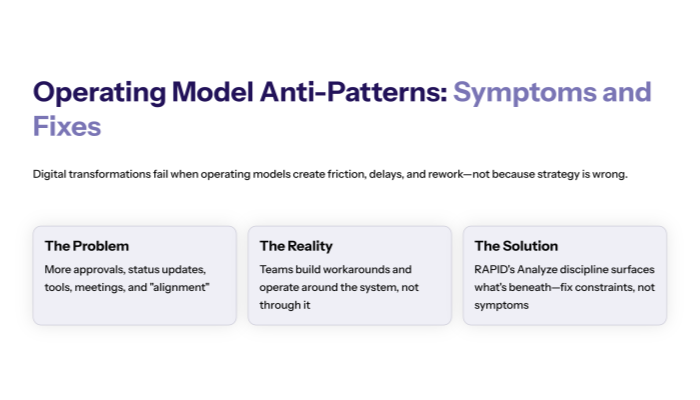
Most digital transformations don’t fail because the strategy is wrong. They fail because the operating model can’t execute the strategy without creating friction, delays, and rework.
That friction rarely shows up as a single “big problem.” It shows up as normal work:
- more approvals
- more status updates
- more tools
- more meetings
- more “alignment”
Over time, these patterns become invisible because everyone adapts. Teams build workarounds, create shadow workflows, and learn to operate around the system instead of through it.
RAPID’s Analyze discipline is designed to break that loop: interpret what you found, sort what’s relevant vs irrelevant, and surface what sits beneath the surface—so you can fix constraints, not symptoms.
This post lays out the most common operating model anti-patterns, the real symptoms they create, and how to fix them using a RAPID-aligned approach.

What operating model anti-patterns really are?
1.1 Anti-patterns are “default behaviors” produced by a broken system
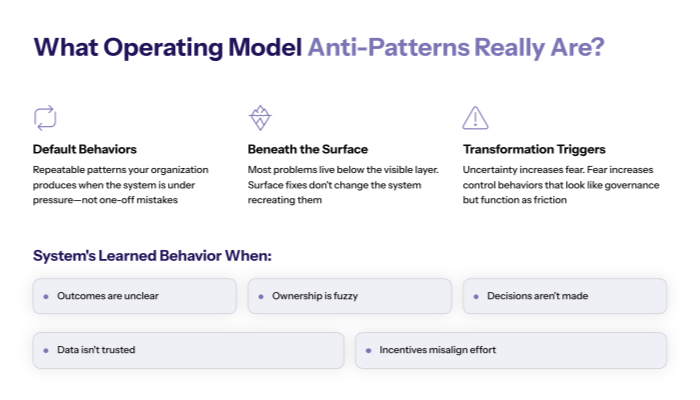
An operating model anti-pattern isn’t a one-off mistake. It’s a repeatable way your organization behaves when the system is under pressure.
If you see the same friction in multiple teams, quarters, or initiatives, you’re not dealing with a “project issue.” You’re dealing with the operating model producing predictable outcomes.
This is why RAPID emphasizes the iceberg reality: most company problems live beneath the surface, and surface fixes don’t change the system that keeps recreating them.
Anti-patterns are simply the system’s learned behavior when:
- outcomes are unclear
- ownership is fuzzy
- decisions aren’t made
- data isn’t trusted
- incentives misalign effort
1.2 Why anti-patterns appear during transformation? (Even in good companies)
Transformation increases uncertainty. Uncertainty increases fear. Fear increases control behaviors:
- more approvals
- more reporting
- more committees
- slower decisions
RAPID addresses this directly through its approach to risk and its insistence on aligning actions around measurable outcomes to reduce doubt and fear.
When organizations don’t have a disciplined operating system, transformation triggers defensive behaviors that look like “governance” but function like friction.
The RAPID way to spot anti-patterns fast (without politics)
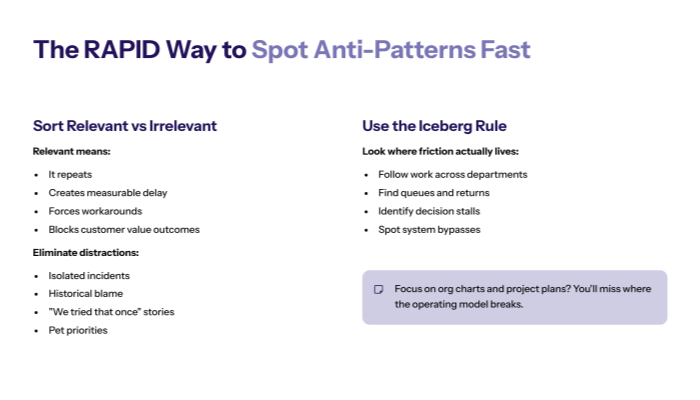
2.1 Sort relevant vs irrelevant (the fastest anti-pattern filter)
RAPID’s Analyze phase starts with a brutal rule: irrelevant information wastes time and resources.
For anti-patterns, “relevant” means:
- it repeats
- it creates measurable delay
- it forces workarounds
- it blocks outcomes tied to customer value
That eliminates distractions like:
- isolated incidents
- historical blame
- “we tried that once” stories
- pet priorities
This is how you stop debating and start diagnosing.
2.2 Use the iceberg rule: anti-patterns hide in flow, not on slides
RAPID frames many problems as iceberg problems: what leadership sees is the visible layer, while most friction sits below.
So to spot anti-patterns:
- follow the work across departments
- look for queues and returns
- find where decisions stall
- identify where teams bypass systems
If you focus only on the org chart and project plans, you’ll miss where the operating model is actually breaking.
Operating model anti-pattern catalog (symptoms → root causes)
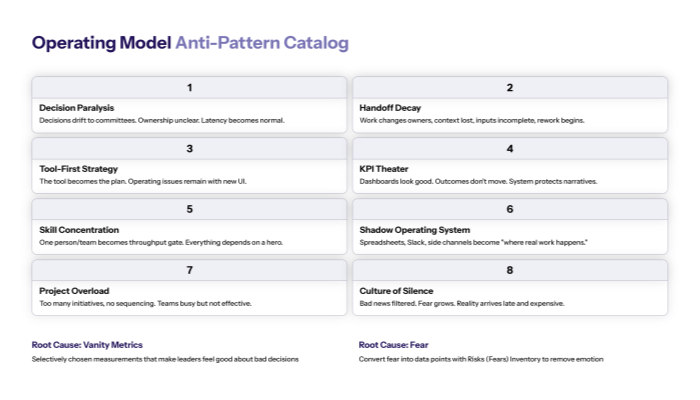
3.1 The 8 anti-patterns that show up most often
Below are the patterns that repeatedly break transformation execution:
- Decision paralysis
Decisions drift to committees. Ownership is unclear. Decision latency becomes normal.
- Handoff decay
Work changes owners, context is lost, inputs are incomplete, rework begins.
- Tool-first strategy (“silver bullet platform”)
The tool becomes the plan. Operating issues remain, just with new UI.
- KPI theater
Dashboards look good. Outcomes don’t move. The system protects narratives.
- Skill concentration
One person/team becomes the throughput gate. Everything depends on a hero.
- Shadow operating system
Spreadsheets, Slack, and side channels become “where real work happens.”
- Project overload
Too many initiatives, no sequencing. Teams are busy but not effective.
- Culture of silence (“the bubble”)
Bad news gets filtered. Fear grows. Reality arrives late and expensive.
RAPID explicitly warns against the “silver bullet platform” mentality—spending on tools expecting them to fix systemic problems without addressing people, process, and product.
3.2 Root causes: vanity metrics + fear-based governance
Two forces keep anti-patterns alive:
- Vanity metrics: RAPID calls out vanity metrics as selectively chosen measurements that make leaders feel good about bad decisions.
- Fear: RAPID formalizes fear with a Risks (Fears) Inventory to convert fear into data points and remove emotion.
When fear + vanity metrics combine, the operating model defaults to control behaviors that slow execution.
Fixes mapped to RAPID tools (turn symptoms into executable change)
4.1 Use RAPID to convert anti-patterns into gaps and decisions
Anti-patterns aren’t solved with slogans. They’re solved by turning them into:
- Owned decisions (Decision Inventory)
- Actionable gaps (People / Process / Product gap analysis)
- Prioritized quick wins (Easy Wins)
RAPID’s Decision Inventory is designed to identify decisions that drive outcomes, assign owners, and link each decision to outcomes and customer value.
Then gap analyses translate findings into specific improvements:
- People Gap Analysis
- Process Gap Analysis
- Product Gap Analysis
And Easy Wins build momentum quickly.
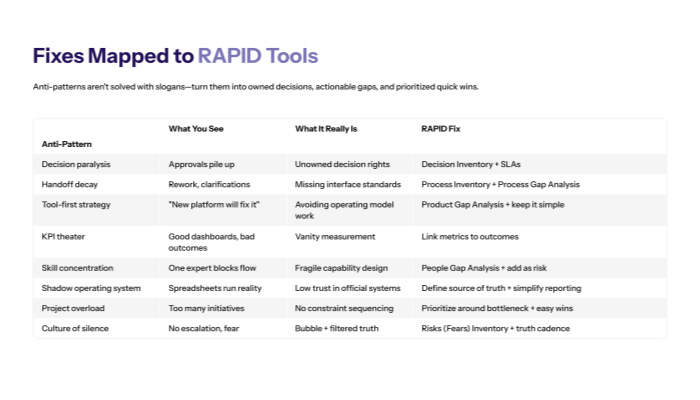
4.2 Anti-pattern → symptom → RAPID fix
Here’s the “diagnose to execute” map:
|
Anti-pattern |
What you see |
What it really is |
RAPID fix |
|---|---|---|---|
|
Decision paralysis |
approvals pile up |
unowned decision rights |
Decision Inventory + SLAs |
|
Handoff decay |
rework, clarifications |
missing interface standards |
Process Inventory + Process Gap Analysis |
|
Tool-first strategy |
“new platform will fix it” |
avoiding operating model work |
Product Gap Analysis + keep it simple |
|
KPI theater |
good dashboards, bad outcomes |
vanity measurement |
link metrics to outcomes |
|
Skill concentration |
one expert blocks flow |
fragile capability design |
People Gap Analysis + add as risk |
|
Shadow operating system |
spreadsheets run reality |
low trust in official systems |
define source of truth + simplify reporting |
|
Project overload |
too many initiatives |
no constraint sequencing |
prioritize around bottleneck + easy wins |
|
Culture of silence |
no escalation, fear |
bubble + filtered truth |
Risks (Fears) Inventory + truth cadence |
How to make the fixes durable? (or anti-patterns return)
5.1 Leadership’s key operating decision: decide outcomes, not implementation
RAPID calls out a critical leadership shift: once leadership backs the strategy, management must decide to “no longer decide” implementation details—so decisions happen close to the ground where knowledge exists.
This is how you prevent relapse:
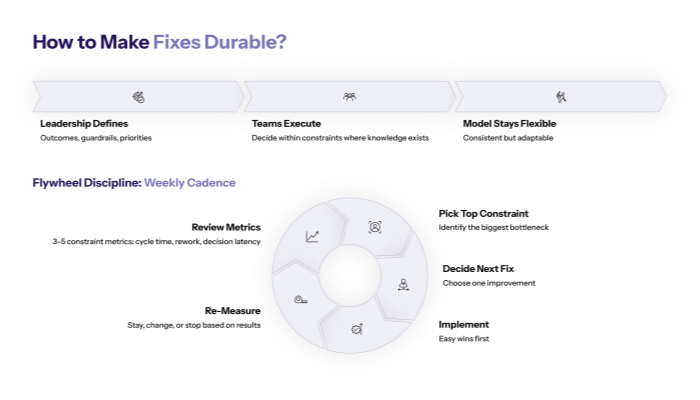
- leadership defines outcomes, guardrails, priorities
- teams execute and decide within those constraints
- the operating model stays flexible but consistent
Without this shift, everything escalates again and anti-patterns become permanent.
5.2 Flywheel discipline: measure → decide → adapt
RAPID is built as iterative flywheels: Research/Analyze feeds Plan/Implement/Decide, and results feed back into better analysis and better decisions.
To keep anti-patterns from returning, run a simple weekly cadence:
- review 3–5 constraint metrics (cycle time, rework, decision latency)
- pick the top constraint
- decide the next fix
- implement one improvement (easy wins first)
- re-measure
RAPID’s Decide logic makes this honest: stay, change, or stop based on results.
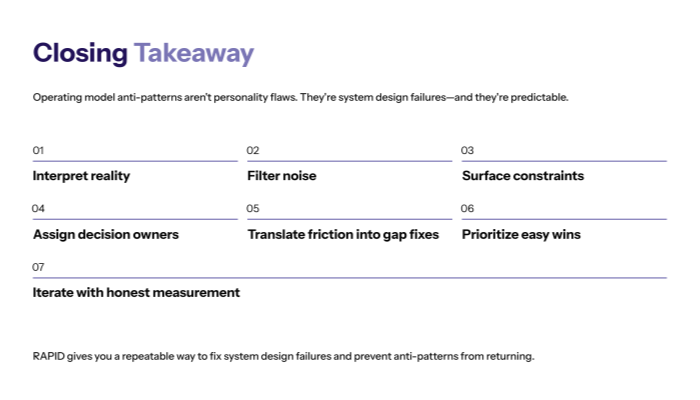
Closing takeaway
Operating model anti-patterns aren’t personality flaws. They’re system design failures—and they’re predictable.
RAPID gives you a repeatable way to fix them: interpret reality, filter noise, surface constraints, assign decision owners, translate friction into gap fixes, prioritize easy wins, and iterate with honest measurement.