Private AI Systems: Complete Guide to Secure Enterprise AI Implementation
Private AI systems are enterprise-grade artificial intelligence deployments that run inside an organization’s controlled environment, such as on-premises servers, a private cloud, or a carefully governed hybrid architecture. They are designed so sensitive data, prompts, ai models, and business logic remain protected instead of being exposed to public ai services or shared third party cloud services.
This guide explains private ai systems architecture, implementation requirements, deployment models, data governance, security controls, and compliance considerations. It focuses on enterprise ai adoption for CTOs, IT directors, security teams, compliance leaders, and decision-makers evaluating secure AI deployment options. It does not treat public ai models as the default solution; instead, it explains where public ai is useful, where private ai differ, and when private ai solutions are the safer strategic choice.
Private AI refers to artificial intelligence systems that operate within an organization’s secure infrastructure, ensuring that sensitive data remains private and compliant with industry regulations. In practical terms, private ai enables enterprises to leverage ai capabilities while maintaining control over internal data, customer data, proprietary data, intellectual property, and regulated workloads.
By reading this guide, you will understand:
How private ai infrastructure is structured across on-premises, private cloud, and hybrid models.
Why private ai offers enhanced data security, data privacy, and regulatory compliance.
How private ai models support industries that handle sensitive patient data, financial transactions, sensor data, and personal information.
What is required when implementing private ai, including governance, infrastructure, talent, and cost planning.
How to choose a deployment path that supports operational efficiency without compromising data security.
Understanding Private AI Systems Architecture
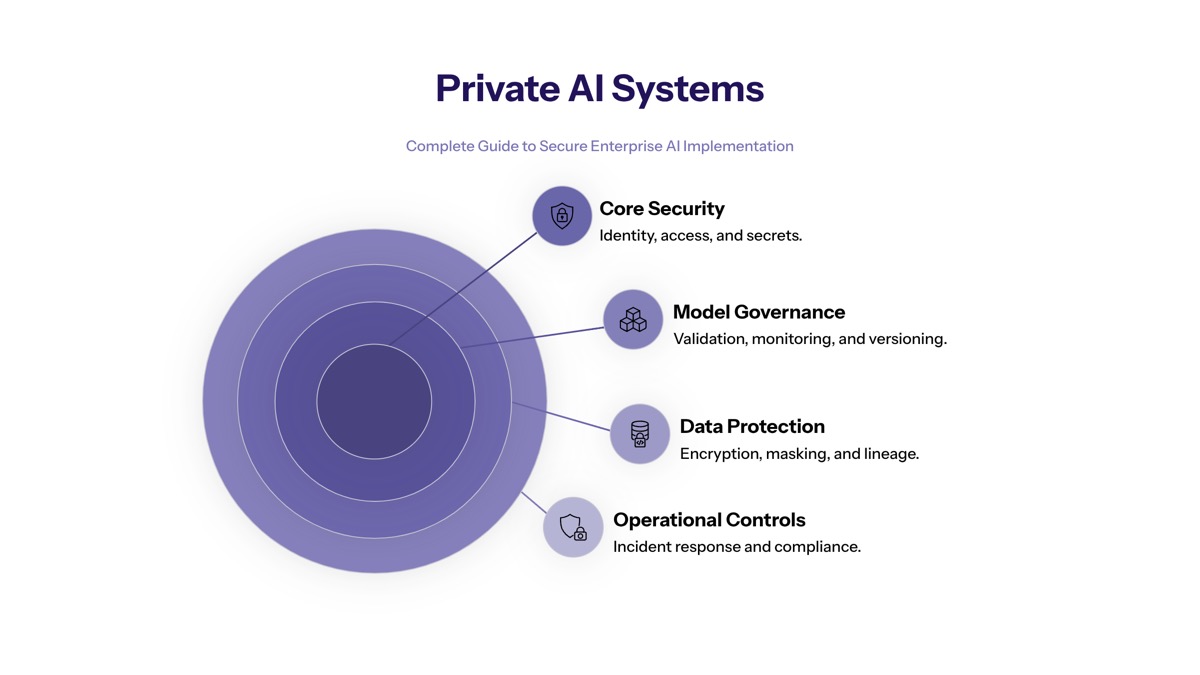
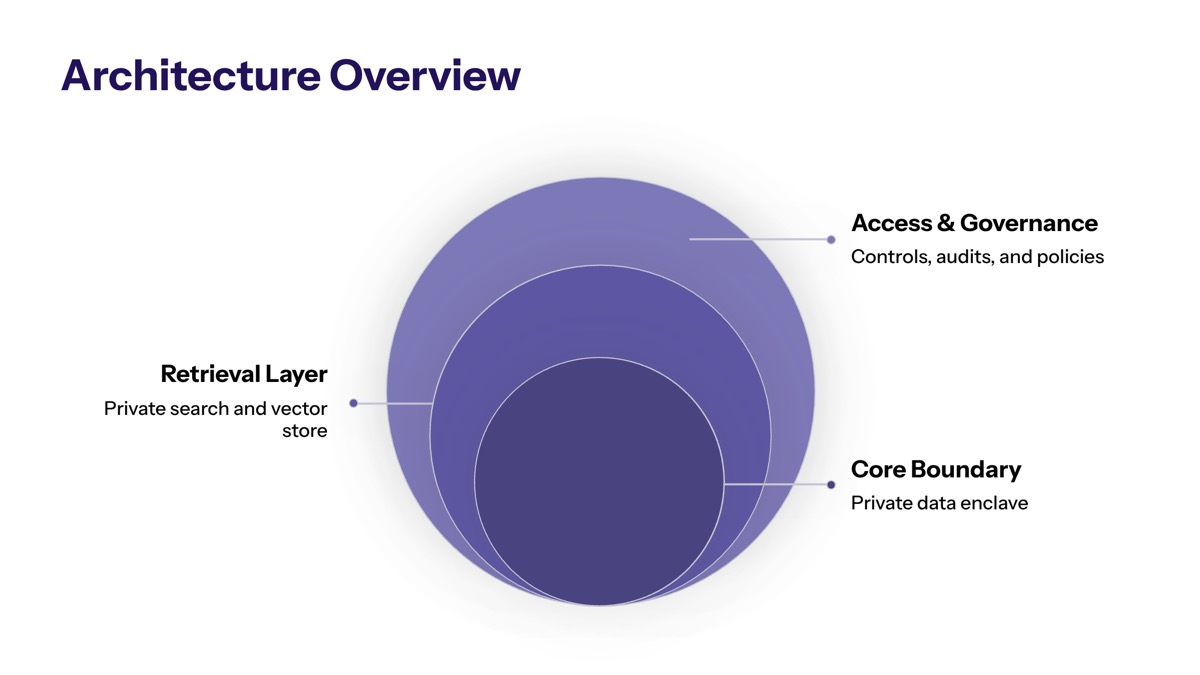
Private AI systems combine secure infrastructure, data governance, ai processing controls, model lifecycle management, and compliance oversight into one controlled environment. Unlike public ai models, which are typically hosted by third-party providers and operate in shared environments, private ai operates inside an organization’s infrastructure or a dedicated private cloud where access, storage, processing, and monitoring are governed by enterprise policy.
Private AI systems keep an organization’s data, prompts, and models completely isolated from external entities and the public. This isolation is especially important for organizations handling private data, personal data, trade secrets, sensitive information, or regulated records. Private AI enhances data privacy and security by ensuring that sensitive data remains within the organization’s controlled environment, significantly reducing the risk of data breaches and unauthorized access.
Private AI is ideal for highly regulated industries where the protection of trade secrets and personal data is mandated. Healthcare providers are using private AI to analyze sensitive patient data for diagnostics and treatment planning while ensuring compliance with regulations like HIPAA. Banks and financial institutions deploy private AI to detect fraudulent activities in real time, analyzing vast amounts of transactional data while keeping sensitive information secure and compliant with regulations such as GDPR and PCI DSS. Manufacturers are leveraging private AI to optimize supply chains and predict maintenance needs by analyzing sensor data from IoT-enabled equipment, ensuring that proprietary data remains protected. Retailers utilize private AI to create personalized shopping experiences based on customer data, ensuring that sensitive information is kept secure and private.
Core Infrastructure Components
The foundation of private ai infrastructure is the environment where ai workloads run. On-premises deployment involves housing models on physical, company-owned hardware to ensure data security. This model gives organizations maximum control because the ai infrastructure, encrypted storage, network segmentation, internal servers, and access controls remain under the organization’s direct management.
Private cloud environments provide another secure infrastructure option. A private cloud may be hosted by an enterprise or by third party providers under strict isolation, residency, and access controls. This approach gives organizations high scalability while still supporting data sovereignty, data protection, and compliance with data protection regulations.
Hybrid deployment models combine private ai with selected public ai or cloud capabilities. Many enterprises use a hybrid approach known as Retrieval-Augmented Generation (RAG) to enhance responses while maintaining data security. In this pattern, proprietary documents, internal data, and sensitive information remain in the organization’s controlled environment, while limited non-sensitive tasks may use external ai solutions under strict governance.
Data Processing and Model Training Elements
Private AI enables organizations to develop and deploy ai models while keeping raw data local, encrypted, or anonymized, ensuring that personal or proprietary information is minimally exposed or centralized. Processing data locally is central to private ai because it allows organizations to train ai models, run inference, and process data without exposing sensitive information to public ai models.
Federated learning can support private ai when data is spread across hospitals, branches, manufacturing sites, or regional business units. Instead of centralizing raw data, federated learning shares model updates while local data remains protected. Encrypted storage, confidential computing, anonymization, and access-based segmentation strengthen the secure environment for ai training and inference.
These elements work together to support regulatory compliance. By deploying private AI, enterprises can ensure compliance with regulations such as HIPAA, GDPR, and GLBA, as it allows organizations to control where data is stored, processed, and transferred, which is critical for navigating multi-jurisdictional requirements. The implementation of private AI allows organizations to maintain control over their data and AI models, which is critical for compliance with regulations such as GDPR, HIPAA, and GLBA.
Once the architecture is understood, the next question is how private ai systems compare with public alternatives in control, security, customization, cost, and deployment speed.
Private AI Systems vs. Public AI Solutions
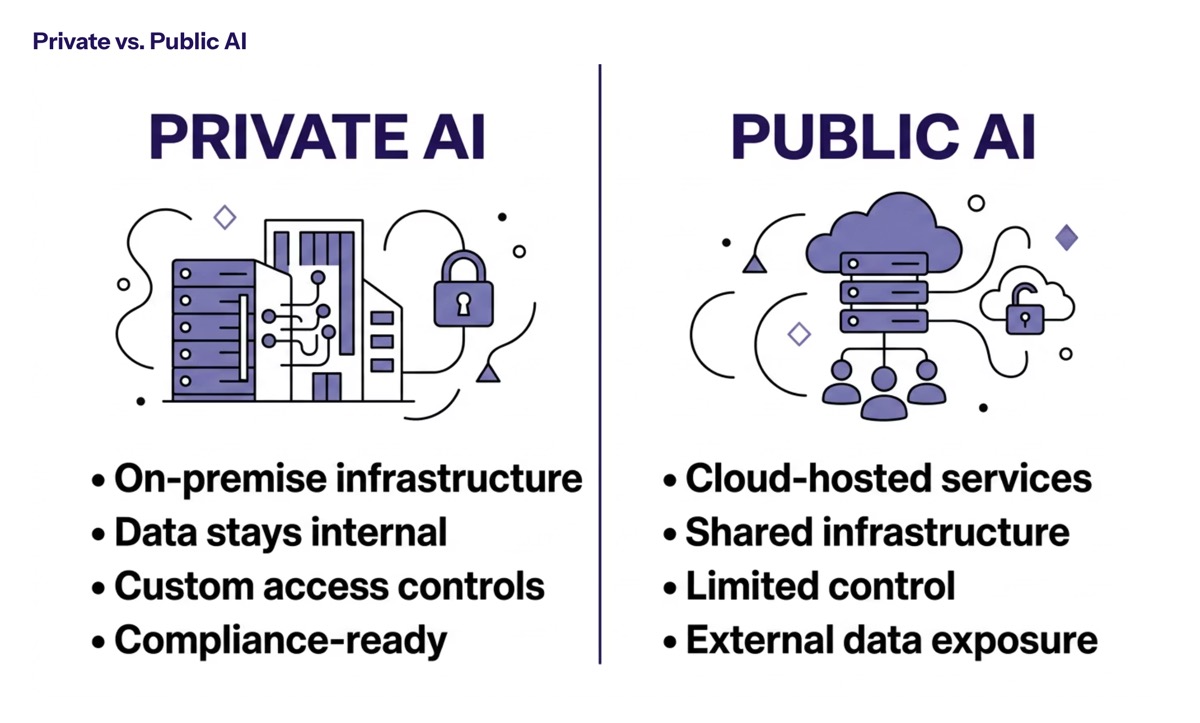
The architecture of private ai systems directly shapes how they differ from public ai solutions. Public ai offers speed, accessibility, and broad scalability, but it often requires organizations to rely on shared environments, vendor-managed infrastructure, and external data processing. Private ai offers stronger control, better governance, and a clearer path to compliance for sensitive enterprise data.
Public AI models are typically hosted by third-party providers and operate in shared environments, which raises concerns about data privacy and control. While public AI offers scalability and ease of access, it often requires organizations to share data externally, increasing the risk of data breaches and loss of control over sensitive information. Private AI systems provide maximum control over data and compliance, reducing the risk of data exposure.
Control and Data Sovereignty
Private ai ensures that data, prompts, model outputs, machine learning models, and ai applications remain within enterprise-approved boundaries. This is important when organizations must protect data across jurisdictions or maintain strict ownership of proprietary logic. Private AI keeps sensitive information within an organization’s controlled environment, allowing for better governance and compliance with regulations like GDPR and HIPAA.
Data sovereignty is not only a technical requirement; it is also a legal and operational requirement. Ensuring data sovereignty means controlling where enterprise data is stored, how ai processing occurs, and who can access the results. For organizations with sensitive patient data, financial records, customer data, or intellectual property, maintaining control is often the deciding factor in adopting private ai.
Private AI creates strategic differentiation by allowing organizations to securely tap into exclusive datasets, leading to automation tailored to internal processes and faster, data-driven innovation without sacrificing privacy. Private AI creates strategic differentiation for enterprises by allowing them to securely tap into exclusive datasets, unlocking insights that public models cannot match.
Security and Compliance Capabilities
Private ai solutions support regulatory compliance because security controls can be built directly into the organization’s infrastructure. These controls may include identity-based access, encrypted storage, audit trails, network isolation, policy-based retention, and monitoring mechanisms for accountability. Private AI allows organizations to safeguard their proprietary data and intellectual property by keeping data and AI models within a secure environment, preventing potential leaks or misuse of sensitive information.
Private ai is especially useful for HIPAA, GDPR, GLBA, PCI DSS, SOC 2, and the california consumer privacy act because these frameworks require organizations to prove control over data usage, storage, transfer, and access. Healthcare, banking, insurance, retail, and manufacturing organizations often need private ai because compromising data security can trigger regulatory penalties, litigation, operational disruption, and reputational damage.
Enhanced data security does not happen automatically just because ai systems are private. Organizations still need security teams, governance workflows, vulnerability management, encryption policies, and compliance audits. However, private ai provides the environment in which those controls can be enforced consistently.
Customization and Integration Options
Private ai models can be tailored to internal processes, domain-specific terminology, legacy systems, and proprietary workflows. This matters when generic public ai models cannot understand internal policy documents, industry-specific risk signals, custom ERP data, or specialized operational patterns. Custom ai solutions allow organizations to integrate ai into existing workflows without sending private data outside approved systems.
Private ai enables enterprises to improve operational efficiency by automating routine tasks, summarizing internal documents, supporting fraud detection, accelerating compliance review, optimizing resource allocation, and improving decision quality. Implementing private AI can streamline operations by automating routine tasks and enabling faster decision-making processes, which improves productivity and allows employees to focus on more strategic initiatives. Organizations adopting private AI can enhance operational efficiency by automating routine tasks and enabling faster decision-making processes while ensuring data privacy and security.
Private ai systems are preferred over public ai alternatives when:
Workloads include sensitive data, private data, patient data, trade secrets, financial data, or regulated customer data.
Data protection regulations require strict control over data location, transfer, retention, and processing.
The organization needs domain-specific ai capabilities built on internal data and proprietary data.
Exposing sensitive information to third party providers would create unacceptable legal, security, or reputational risk.
Long-term ai adoption depends on reusable private ai infrastructure rather than ongoing public ai usage fees.
These differences lead directly into implementation planning, where enterprises must decide which infrastructure model, governance approach, and rollout strategy best fit their risk profile.
Implementing Private AI Systems in Enterprise Environments
Implementing private ai requires more than choosing ai models or buying GPUs. It requires a strategic approach that includes assessing data sensitivity, investing in secure infrastructure, developing clear governance policies, and training staff on data privacy and AI ethics. The goal is to create ai systems that deliver measurable business value while ensuring data remains protected.
Private AI requires a higher investment in hardware, specialized talent, and maintenance compared to public AI. Entering into a private AI arrangement involves significant upfront infrastructure investments and longer development timelines than using public models. For that reason, enterprises should treat private ai as a modernization program, not a single software deployment.
Infrastructure Assessment and Planning Process
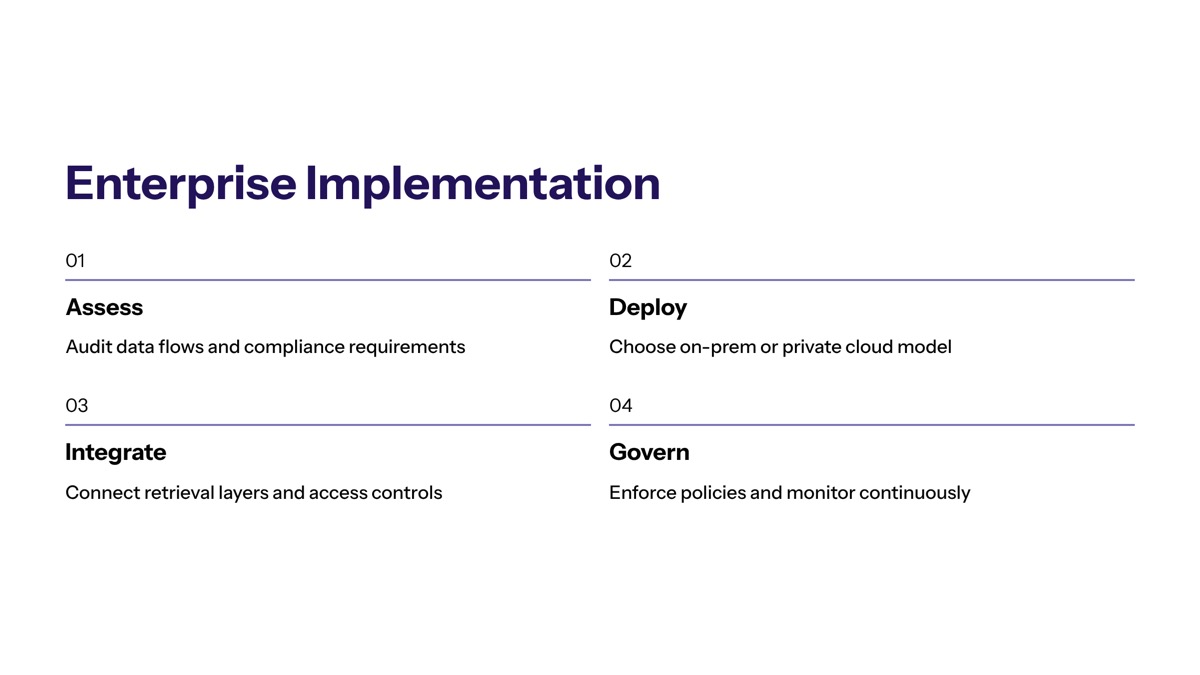
Organizations should evaluate current infrastructure before deploying private ai applications, especially when workloads include regulated data, legacy integrations, high-volume inference, or specialized ai training. This assessment helps determine whether the organization can support ai workloads on own hardware, private cloud environments, or a hybrid model.
Assess current data infrastructure and security requirements
Organizations should conduct a comprehensive data inventory and classification to identify sensitive data, which helps in choosing the right privacy-preserving techniques for AI training and inference. This includes identifying customer data, patient data, financial records, employee data, sensor data, intellectual property, and proprietary data.Evaluate compliance and governance needs
Establishing strong governance policies is critical for private AI, defining who can access data and AI models, how data can be used, and what monitoring mechanisms are in place to ensure compliance and accountability. Governance should cover model ownership, audit trails, risk classification, retention policies, human oversight, and approval workflows.Determine processing and storage capacity requirements
Investing in secure infrastructure, such as on-premises servers and private cloud environments, is essential for safeguarding AI workloads and ensuring compliance with data protection regulations. Planning should account for GPUs, accelerators, encrypted storage, backup systems, availability requirements, ai processing demand, and resource allocation.Plan integration with existing enterprise systems
Private ai should connect with internal servers, identity systems, document repositories, data warehouses, security tools, and business applications. Training staff on data privacy principles and AI ethics is crucial, as private AI systems often involve multiple teams, including data engineers, AI developers, and compliance officers, to maintain a secure AI environment.
Deployment Models Comparison
Deployment Model | Control Level | Compliance | Scalability |
|---|---|---|---|
On-Premises | Maximum | Full | Limited |
Private Cloud | High | High | High |
Hybrid | Variable | Configurable | Maximum |
On-premises deployment is best when organizations need maximum control, strict isolation, and physical ownership of ai infrastructure. It is common in defense, healthcare, government, and financial environments where sensitive information cannot leave the organization’s infrastructure. The tradeoff is limited elasticity because scaling depends on hardware procurement, power, cooling, and specialized maintenance.
Private cloud deployment is useful when enterprises need strong governance and compliance without managing every layer of physical infrastructure. A private cloud can support high scalability, centralized monitoring, and secure ai workloads while keeping data access and processing rules under enterprise control. This is often a practical middle ground for organizations that need to leverage ai capabilities quickly while maintaining data security.
Hybrid deployment works when some ai applications can use public ai safely while sensitive workloads remain private. For example, an enterprise may use RAG to let employees query internal documents while keeping those documents in encrypted storage and only exposing approved context to a controlled model endpoint. Hybrid models require careful data governance so teams do not accidentally route sensitive data into public ai systems.
The right model depends on regulatory exposure, workload sensitivity, performance requirements, budget, internal talent, and long-term ai adoption goals. After choosing the deployment model, enterprises must prepare for the operational challenges that typically determine whether private ai succeeds.
Common Implementation Challenges and Solutions
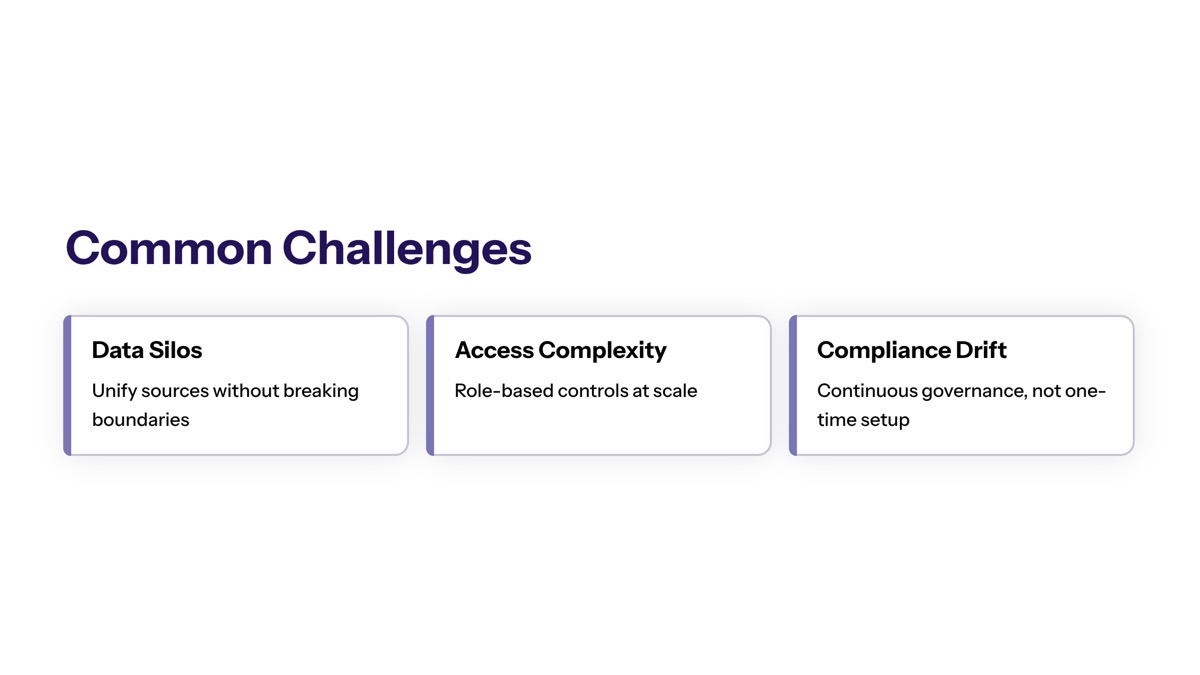
Private ai systems can deliver strong security, compliance, and operational efficiency, but implementation introduces infrastructure, talent, governance, and cost challenges. These challenges are manageable when organizations plan phased rollouts, define ownership early, and measure both business value and risk reduction from the start.
Infrastructure Complexity and Integration
Private ai infrastructure can be difficult to build because it must support secure compute, encrypted storage, network isolation, identity controls, monitoring, backup, and integration with existing enterprise systems. Legacy applications, fragmented data stores, and unclear data ownership can slow deployment.
The solution is a phased implementation approach with proof-of-concept deployments and gradual scaling. Start with one high-value, low-risk use case, such as internal document search, compliance summarization, customer service knowledge retrieval, or fraud detection analytics. Use RAG where appropriate so internal data remains protected while teams validate model quality, access controls, and governance workflows before expanding.
Skills Gap and Resource Requirements
Private ai requires specialized expertise across machine learning, cybersecurity, infrastructure operations, data engineering, compliance, legal review, and ai ethics. Many organizations do not have enough internal capacity to design private ai models, maintain secure environments, monitor ai systems, and manage evolving regulatory requirements.
The solution is to partner with experienced AI implementation consultants and invest in team training programs. Security teams, data engineers, AI developers, compliance officers, and business owners should be trained on data privacy, data governance, acceptable use, incident response, and model evaluation. This helps prevent misuse, reduces shadow ai, and keeps ai applications aligned with enterprise policy.
Cost Management and ROI Measurement
Private ai requires meaningful upfront investment in own hardware, private cloud resources, specialized talent, compliance processes, and ongoing maintenance. Without cost governance, enterprises may overbuild infrastructure, underuse expensive compute, or fail to prove the benefits of private ai to executive stakeholders.
The solution is to establish a clear metrics framework and implement cost monitoring tools from the deployment start. Useful metrics include cost per inference, infrastructure utilization, hours saved, process cycle time, fraud detection accuracy, compliance review duration, avoided data exposure risk, audit readiness, and employee productivity. Private ai can also optimize resource allocation by matching ai workloads to the right compute environment and scaling only after validated demand.
Strategic planning matters because the best private ai programs are not only secure; they are measurable, governed, and connected to business outcomes.
Conclusion and Next Steps
Private AI systems enable secure, compliant enterprise ai adoption by keeping sensitive data, ai models, prompts, and proprietary workflows inside a controlled environment. For organizations in regulated sectors, private ai offers stronger data security, better data governance, clearer regulatory compliance, and deeper customization than public ai models.
The strongest use cases appear where data privacy, operational efficiency, and strategic differentiation intersect: healthcare diagnostics using sensitive patient data, banking fraud detection using regulated transaction data, manufacturing optimization using proprietary sensor data, and retail personalization using protected customer data.
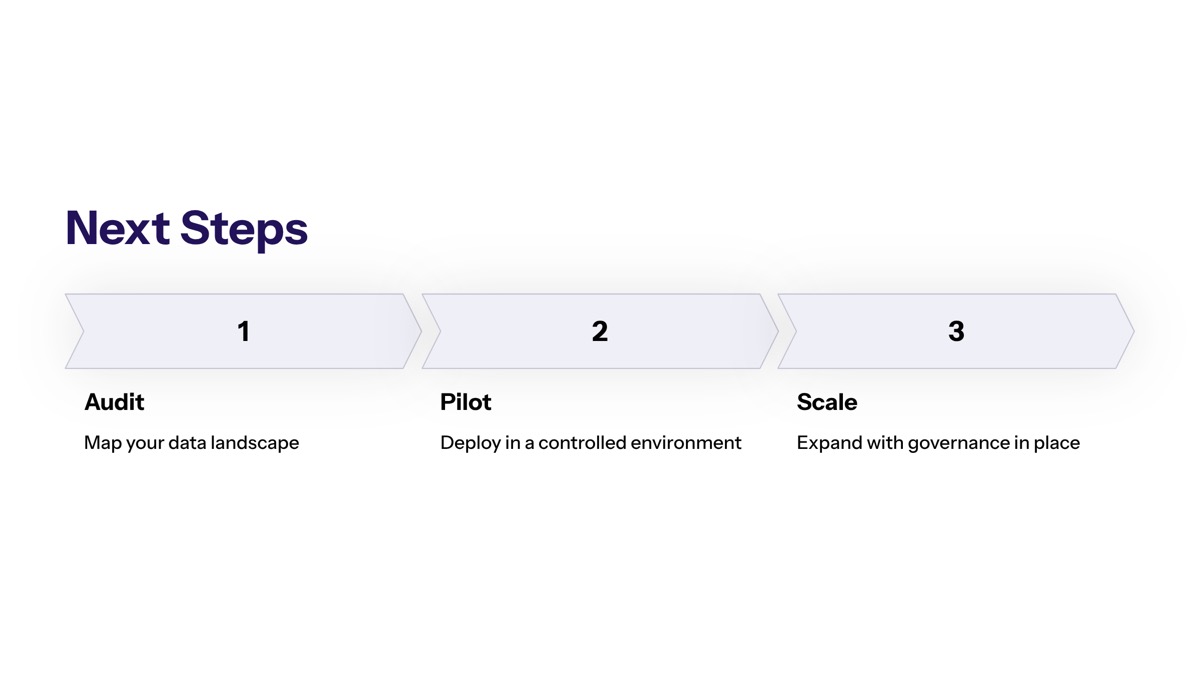
Next steps for implementing private ai:
Complete an infrastructure and data readiness assessment
Inventory internal data, classify sensitive data, review current security controls, and identify which ai workloads require private processing.Define governance and compliance requirements
Establish access rules, model ownership, audit trails, monitoring mechanisms, and policy controls for HIPAA, GDPR, GLBA, PCI DSS, SOC 2, the california consumer privacy act, and other applicable industry regulations.Evaluate deployment options and vendors
Compare on-premises, private cloud, and hybrid models based on control, compliance, scalability, cost, and integration needs.Launch a focused pilot program
Start with a contained use case that proves value without exposing sensitive information. Measure quality, security, productivity, compliance readiness, and cost.Scale with operational controls
Expand only after validating data protection, user adoption, resource allocation, monitoring, and governance workflows.
Related topics worth exploring include AI governance frameworks, compliance automation, privacy-preserving machine learning, confidential computing, RAG architecture, and enterprise modernization strategies.
Additional Resources
Useful reference materials for private ai planning include:
Enterprise AI governance frameworks for model ownership, access control, risk classification, auditability, and accountability.
Compliance checklists for HIPAA, GDPR, GLBA, PCI DSS, SOC 2, and the california consumer privacy act in AI deployments.
Technical specifications for private ai infrastructure, including encrypted storage, private cloud architecture, internal servers, GPU planning, network segmentation, and monitoring.
Data privacy and AI ethics training materials for data engineers, AI developers, compliance officers, business users, and security teams.
Deployment planning templates for on-premises, private cloud, and hybrid private ai solutions.