Process Mapping for Executives: Find Waste Fast (Without a 6-Month Project)
Most executive teams don’t need another “process transformation program.” They need a fast, credible way to see how work really flows, where it stalls, and what to fix first—without triggering chaos. That’s exactly what process mapping for executives is for: a short, outcomes-driven mapping sprint that surfaces waste, handoffs, hidden queues, and decision bottlenecks you can address immediately.
RAPID’s foundation is a brutally honest audit—bringing facts to the forefront, asking the hard questions, and refusing to optimize based on the rosiest internal narrative. From there, RAPID uses two flywheels (Research/Analyze and Plan/Implement/Decide) to iterate quickly toward measurable outcomes.
Below is a practical, executive-friendly approach to process mapping for executives that aligns with RAPID and helps you find waste fast—without a 6-month project.

What Executives Get Wrong About Process Mapping?
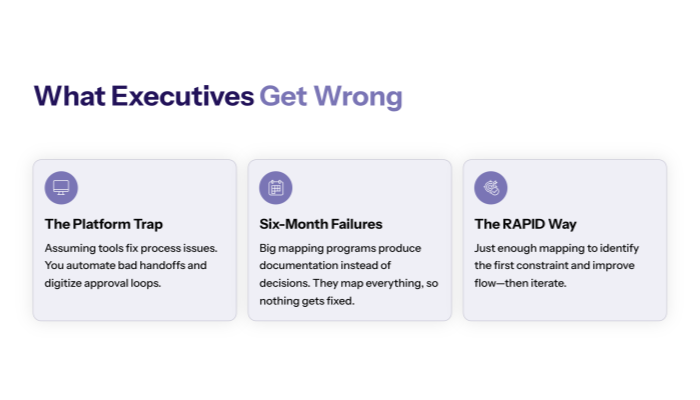
1.1 The “silver bullet platform” trap
Executives often assume process issues are tooling issues. RAPID calls this out directly: companies spend millions on a new platform expecting it to fix everything, but the root problem is usually a failure to understand the “holy trinity” of people, process, and product.
That’s why process mapping for executives must come before tool decisions. Otherwise, you simply encode dysfunction into a new system:
- You automate bad handoffs.
- You digitize approval loops.
- You scale rework.
RAPID’s guidance is blunt: if tech is involved, keep it simple—technology should support the business strategy, not dictate it.
1.2 Why six-month mapping projects fail (and what to do instead)
Big mapping programs collapse for predictable reasons:
- They map everything, so nothing gets fixed.
- They produce documentation instead of decisions.
- They ignore interdependencies and trigger downstream breakage.
RAPID emphasizes the flywheel principle: everything is connected, so changing one department’s process impacts others. Executives need just enough mapping to identify the first constraint and improve flow—then iterate.
The goal of process mapping for executives is not “perfect maps.” It’s a trusted baseline that enables fast prioritization and measurable improvement.
The RAPID Way to Map a Process (Fast and Truthful)
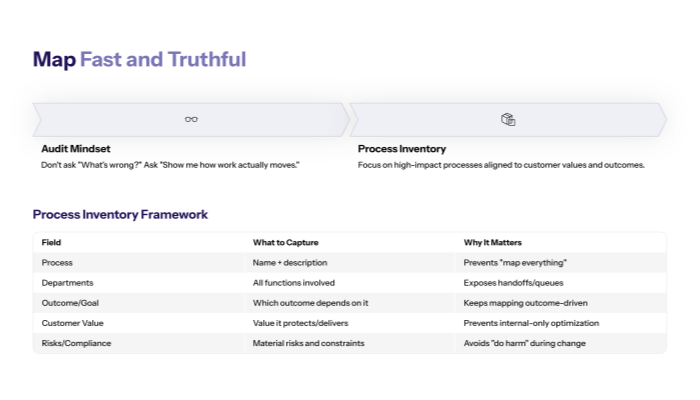
2.1 Start with an audit mindset, not a workshop mindset
RAPID frames the early stage as “prework” (Research + Analyze) and compares it to an IRS audit: you pull records, test explanations, and keep pressing until reality is clear.
For process mapping for executives, that means:
- You don’t start by asking “What’s wrong?”
- You start by asking “Show me how work actually moves.”
Your job is to surface:
- Where work waits
- Where work bounces back (rework)
- Where decisions stall (latency)
- Where teams bypass systems to “get it done”
This is not about blame. It’s about surfacing the system, because the truth is often hidden beneath the surface—like an iceberg.
2.2 Use the Process Inventory to keep mapping focused
RAPID includes a Process Inventory tool designed to discover and describe the processes that drive the majority of effort, aligned to customer values and outcomes. This is perfect for executive mapping because it forces focus.
Use this simplified version as your intake table:
|
Field |
What to capture |
Why it matters |
|---|---|---|
|
Process |
Name + short description |
Prevents “we map everything” |
|
Departments |
All functions involved |
Exposes handoffs/queues |
|
Outcome/Goal |
Which outcome depends on it |
Keeps mapping outcome-driven |
|
Customer Value |
What value it protects/delivers |
Prevents internal-only optimization |
|
Risks / Compliance |
Material risks and constraints |
Avoids “do harm” during change |
This is the backbone of process mapping for executives: you select one high-impact process from the inventory and map it end-to-end.
How to Find Waste Fast? (Without Getting Lost in Detail)
3.1 The executive waste lens: queues, handoffs, rework, decisions
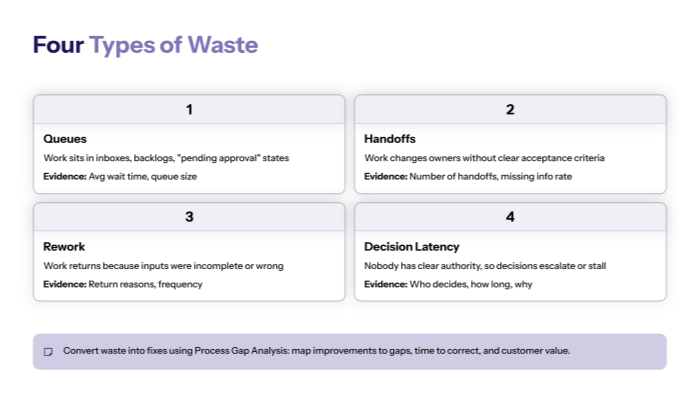
Executives don’t need every micro-step. They need the few failure patterns that drive most delay and cost. In process mapping for executives, waste almost always clusters into four buckets:
- Queues (waiting): work sits in inboxes, backlogs, “pending approval” states
- Handoffs: work changes owners without clear acceptance criteria
- Rework: work returns because inputs were incomplete, unclear, or wrong
- Decision latency: nobody has clear authority, so decisions escalate or stall
RAPID’s approach is to remove friction by aligning processes so they don’t conflict, and to focus on quick, incremental measurement and adjustment.
Here’s a “waste capture” mini-table you can use live while mapping:
|
Waste type |
What it looks like |
Evidence to capture |
|---|---|---|
|
Queue |
“Waiting for review/approval” |
Avg wait time, queue size |
|
Handoff |
“Sent to X team” |
# handoffs, missing info rate |
|
Rework |
“Returned / reopened” |
Return reasons, frequency |
|
Decision latency |
“Need sign-off” |
Who decides, how long, why |
This is the fastest route to process mapping for executives that produces action, not artifacts.
3.2 Use Process Gap Analysis to convert waste into fixes
RAPID also provides a Process Gap Analysis tool that forces specificity: one process improvement per line, mapped to gaps found in Research, with time to correct, skills required, customer value linkage, and outcomes linkage.
Use this executive-friendly version:
|
Process improvement |
Department |
Gap |
Time to correct |
Customer value |
Outcome |
|---|---|---|---|---|---|
|
“Standardize intake fields” |
Ops |
Missing data causes rework |
1–2 weeks |
Faster response |
Reduced cycle time |
|
“Remove redundant approval” |
Finance |
Decision latency |
2–4 weeks |
Faster delivery |
Reduced decision latency |
|
“Define ‘done’ criteria” |
Engineering |
Reopens + churn |
1–2 weeks |
Higher quality |
Reduced rework |
This is where process mapping for executives becomes a roadmap you can execute immediately—without waiting for a massive replatform.
The 90-Minute Executive Mapping Sprint (Step-by-Step)
4.1 Run the session: map one value stream end-to-end
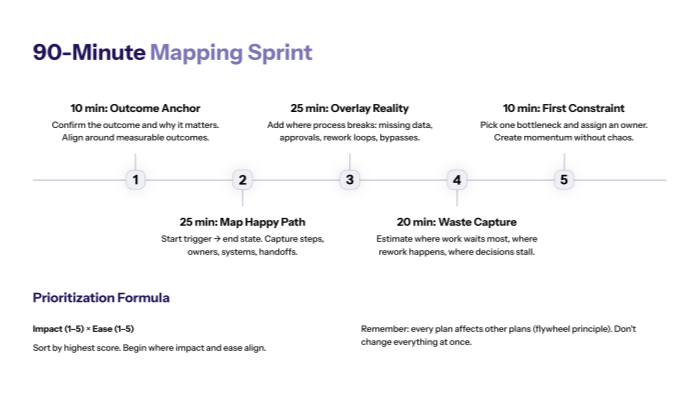
A high-value process mapping for executives session can be run in 90 minutes if you keep scope tight and force evidence.
Agenda (90 minutes)
- 10 min — Outcome anchor
Confirm the outcome and why it matters (don’t debate it for an hour). RAPID stresses aligning around measurable outcomes instead of vanity metrics.
- 25 min — Map the “happy path”
Start trigger → end state. Capture only:
-
- Steps
- Owners
- Systems used
- Handoffs
- 25 min — Overlay reality (“exceptions”)
Add where the process breaks:
-
- Missing data
- Approvals
- Rework loops
- Bypasses (spreadsheets, email)
- 20 min — Waste capture + metric estimates
Use the waste mini-table and estimate:
-
- Where work waits the most
- Where rework happens most
- Where decisions stall
- 10 min — Commit to the first constraint
Pick one bottleneck and assign an owner.
RAPID’s flywheel logic matters here: mapping is not static—it’s an iterative loop where you refine based on feedback and reality.
4.2 After the session: prioritize fixes without causing chaos
RAPID explicitly warns that you can’t change everything at once—chaos becomes the outcome. So for process mapping for executives, the output should be a ranked list of changes, starting with easy wins.
RAPID prioritization approach:
- First choose what creates the most positive impact on business + customer.
- Then consider ease of execution (“low-hanging fruit”).
- Begin where impact and ease align.
- Remember every plan affects other plans (flywheel principle).
If you want to formalize this, add two columns to your gap analysis:
- Impact (1–5)
- Ease (1–5)
Then sort by (Impact × Ease).
This is the executive version of process mapping for executives: pick the first change that creates momentum without destabilizing the system.
Turning the Map Into an Operating Rhythm (So It Sticks)
5.1 Embed mapping into the RAPID flywheel (Research → Decide)
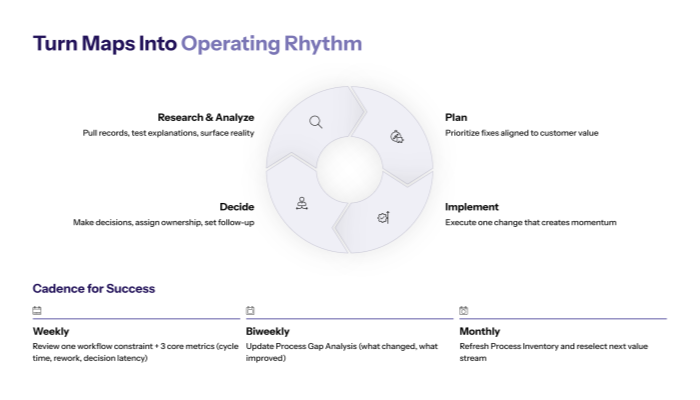
A map is useless unless it changes decisions. RAPID’s core strength is the flywheel: Research and Analyze feed Plan, Implement, Decide—and the loop keeps improving itself through focused information and iteration.
To operationalize process mapping for executives, set a simple cadence:
- Weekly: review one workflow constraint + the 3 core metrics (cycle time, rework, decision latency)
- Biweekly: update the Process Gap Analysis (what changed, what improved)
- Monthly: refresh the Process Inventory and reselect the next value stream
This makes process mapping a management system, not a one-time exercise.
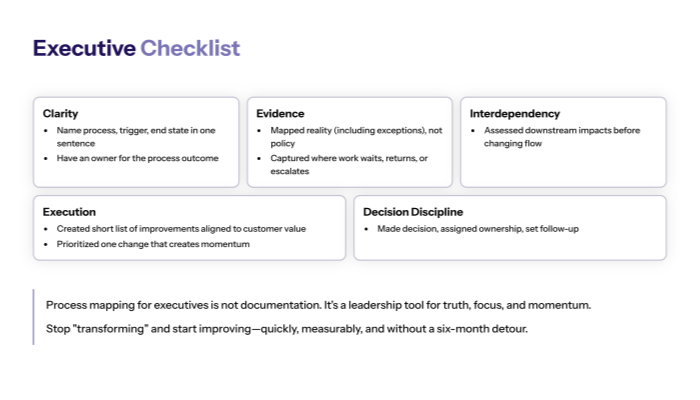
5.2 The executive checklist: “Are we mapping the right way?”
Use this checklist to ensure your process mapping for executives stays outcome-driven and fast:
Clarity
- We can name the process, trigger, and end state in one sentence.
- We have an owner for the process outcome.
Evidence
- We mapped reality (including exceptions), not policy.
- We captured where work waits, returns, or escalates.
Interdependency
- We assessed downstream impacts before changing a single department’s flow.
Execution
- We created a short list of process improvements aligned to customer value and outcomes.
- We prioritized one change that creates momentum without chaos.
Decision discipline
- We made a decision, assigned ownership, and set follow-up (RAPID emphasizes follow-up after decisions).
Closing thought
Process mapping for executives is not documentation. It’s a leadership tool for truth, focus, and momentum. When you map one value stream end-to-end, expose the waste patterns, and convert them into prioritized process improvements aligned to outcomes, you stop “transforming” and start improving—quickly, measurably, and without a six-month detour.