RAPID Analyze: Turning Observations Into Prioritized Constraints
Most transformation teams aren’t short on observations. They’re short on priorities.
They have data, workshops, interviews, dashboards, and long lists of issues. But without a disciplined way to interpret what matters—and convert it into owned constraints—execution turns into noise.
That’s exactly why RAPID Analyze exists. In the book, Analyze is the stage where you interpret what you found, separate relevant from irrelevant, identify what’s beneath the surface, and use expertise to shape what happens next. It is explicitly not just “more research.” It’s the conversion step that turns information into action.
This post shows how to run RAPID Analyze so your organization stops collecting observations and starts moving constraints.

Section 1: What RAPID Analyze is (and what it isn’t)
1.1 Analyze is interpretation, not data collection
RAPID draws a clean boundary:
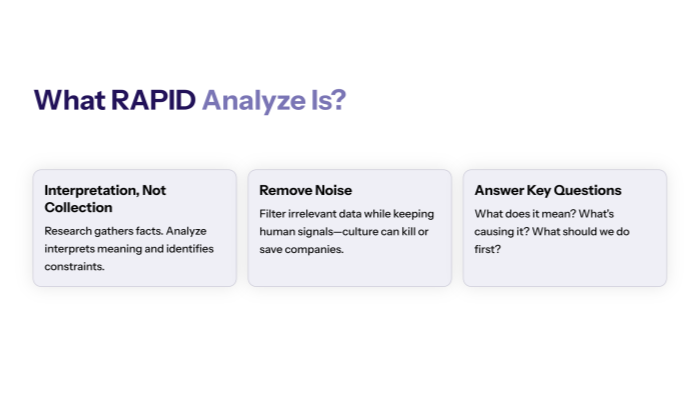
- Research gathers facts and metrics
- Analyze interprets those facts and decides what matters
If Research answers “What is happening?”, Analyze answers:
- “What does it mean?”
- “What’s causing it?”
- “What is the constraint that limits outcomes right now?”
- “What should we do first?”
This is the step many transformations skip. They gather endlessly, then jump to solutions.
RAPID prevents that because analysis must identify gaps, prioritize, and set up the next phase (Plan) with clarity.
1.2 Analyze is where you remove noise (but keep human reality)
The first move in Analyze is sorting information into relevant and irrelevant. The book is explicit: irrelevant information wastes time and resources and should be removed.
But RAPID also makes one exception: the “human aspect” is not irrelevant. You must understand who does what, how they do it, and what commitment and culture look like in practice—because culture can kill companies or save them.
That’s the balancing act:
- remove noise metrics, one-off incidents, old issues
- keep recurring friction and the human signals that explain why it persists
The Analyze engine: from observations to constraints (the flywheel logic)
2.1 The Research ↔ Analyze flywheel (iceberg rule)
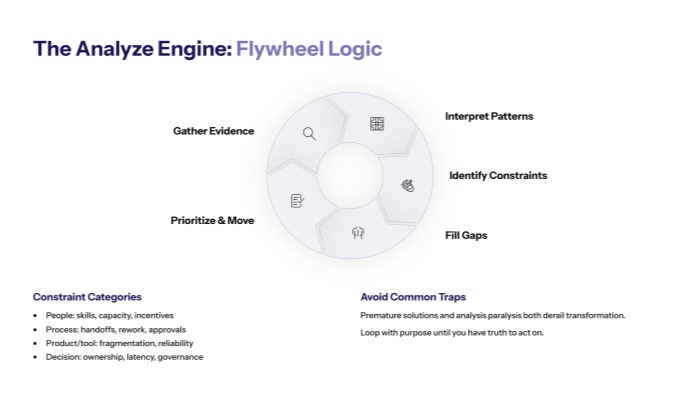
RAPID frames Research + Analyze as a flywheel because problems often sit beneath the surface. Analyze will reveal holes in your data collection, forcing you back to Research until you have enough truth to act.
This is how RAPID avoids two common traps:
- premature solutions (“buy a tool,” “reorg,” “train people”)
- analysis paralysis (endless research with no prioritization)
Instead, you loop with purpose:
- gather evidence
- interpret patterns
- identify gaps/constraints
- go back for missing proof if needed
- prioritize and move
2.2 Analyze categories: where constraints tend to live
RAPID notes that analysis can focus on multiple dimensions—people, finance, product, technology—and should always consider culture.
A practical way to run RAPID Analyze is to classify every observation into one bucket:
- People constraint (skills, capacity, incentives, skill concentration)
- Process constraint (handoffs, rework, approvals, unclear interfaces)
- Product/tool constraint (fragmentation, missing capabilities, reliability, reporting)
- Decision constraint (unowned decisions, decision latency, governance overload)
This classification makes your analysis executable—because each bucket maps directly to RAPID artifacts and actions.
Turning observations into prioritized constraints (the method)
3.1 Step 1 — Convert observations into “constraint candidates”
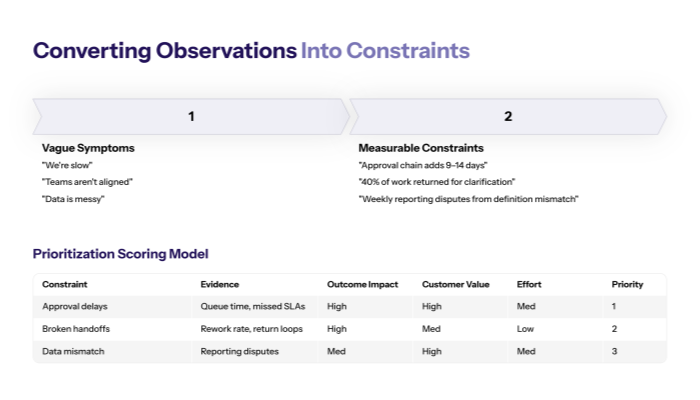
Most observations are phrased like symptoms:
- “We’re slow.”
- “Teams aren’t aligned.”
- “Data is messy.”
- “Approvals take forever.”
RAPID Analyze converts them into constraint candidates you can act on:
- “Approval chain adds 9–14 days before execution begins.”
- “Intake fields are inconsistent; 40% of work is returned for clarification.”
- “Two departments use different definitions, causing weekly reporting disputes.”
This is exactly what the relevant/irrelevant filter enables: you strip vague statements until you have a constraint you can measure.
3.2 Step 2 — Score constraints for impact and urgency
RAPID’s strength is not just identifying constraints—it’s prioritizing them.
Use a lightweight scoring model:
|
Constraint candidate |
Evidence |
Outcome impact |
Customer value impact |
Effort to fix |
Priority |
|---|---|---|---|---|---|
|
Approval chain delays |
queue time, missed SLAs |
High |
High |
Med |
1 |
|
Broken handoffs |
rework rate, return loops |
High |
Med |
Low |
2 |
|
Data mismatch |
reporting disputes |
Med |
High |
Med |
3 |
RAPID also supports this prioritization with its “Easy Wins” concept: select low-hanging fruit to build confidence and tangible progress quickly.
So you should always ask:
- What constraint is most limiting outcomes now?
- What constraint can we relieve quickly to build momentum?
Make constraints executable (gaps + owners + decisions)
4.1 Convert the top constraints into gap analyses (people/process/product)
Once constraints are ranked, RAPID gives you the translation mechanism: gap analyses.
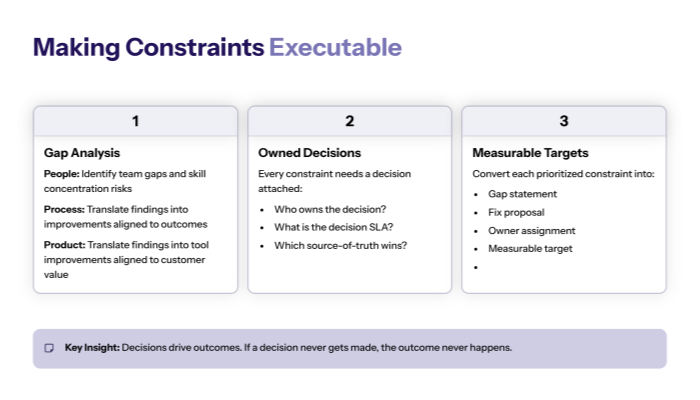
- People Gap Analysis identifies team gaps and risks like skill concentration
- Process Gap Analysis translates findings into specific process improvements aligned to outcomes/customer value
- Product Gap Analysis translates findings into specific product/tool improvements aligned to outcomes/customer value
This is where RAPID Analyze becomes actionable. Every prioritized constraint becomes:
- a gap statement
- a fix proposal
- an owner
- a measurable target
4.2 Turn constraints into owned decisions (or they stay as “insights”)
RAPID treats decision-making as the hardest and most important management task and emphasizes that decisions drive outcomes—if a decision never gets made, the outcome never happens.
So every top constraint needs a decision attached:
- “Who owns the decision to change this process interface?”
- “What is the new decision SLA?”
- “Which source-of-truth wins?”
This is where the Decision Inventory becomes the bridge between analysis and execution: decisions posed as questions, owned, prioritized, linked to outcomes/customer value.
Hand off to Plan/Implement/Decide (and iterate as constraints move)
5.1 Plan should sequence around constraints, not projects
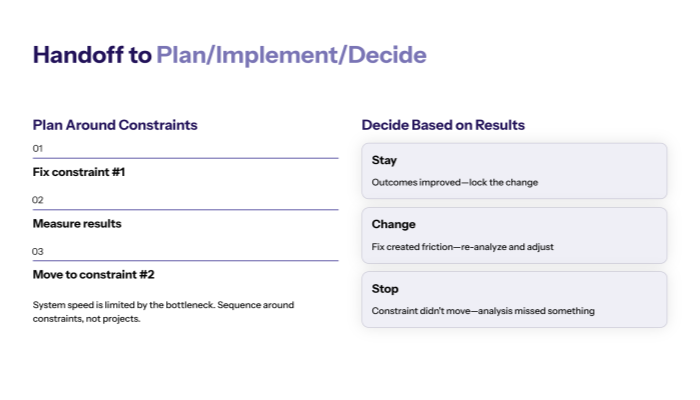
One reason transformations stall is that roadmaps become project lists. RAPID pushes you to plan based on outcomes and constraints—because your system speed is limited by the bottleneck.
Once Analyze produces prioritized constraints, planning becomes straightforward:
- fix constraint #1
- measure results
- move to constraint #2
RAPID reinforces that big problems are often solved by many small steps, executed sequentially.
5.2 Decide based on results: stay, change, stop
RAPID’s Decide principle is disciplined: measure results and decide to stay, change, or stop.
This is how RAPID Analyze stays honest:
- if the constraint didn’t move, your analysis missed something
- if a fix created new friction, you re-analyze and adjust
- if outcomes improved, you lock the change and move forward
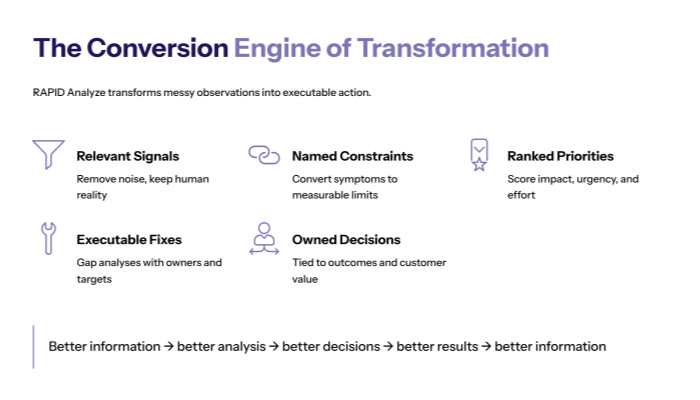
That’s the flywheel: better information → better analysis → better decisions → better results → better information.
Closing takeaway
RAPID Analyze is the conversion engine of transformation.
It takes messy observations and turns them into:
- relevant signals
- named constraints
- ranked priorities
- executable gap fixes
- owned decisions tied to outcomes and customer value