RAPID Decide: Turning Results Into Better Decisions (and Better Plans)
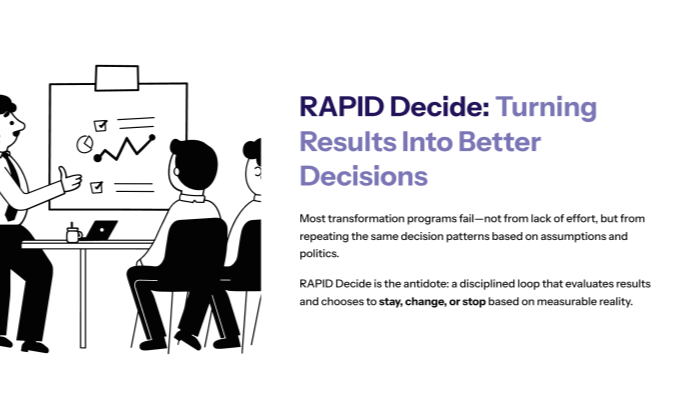
Most transformation programs don’t fail because teams don’t work hard.
They fail because organizations keep making the same kinds of decisions—based on assumptions, politics, and late signals—then they lock those decisions into roadmaps that don’t evolve.
RAPID Decide is the antidote. It turns execution results into better decisions, and those decisions into better plans—through a disciplined loop: evaluate what happened, then choose to stay, change, or stop based on measurable reality.

Why “Decide” is the most important part of transformation?
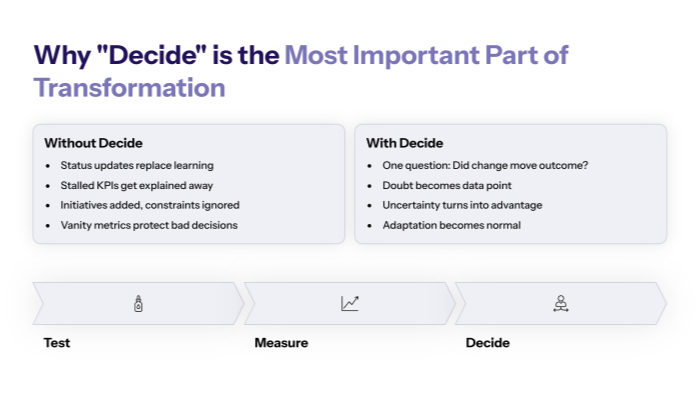
1.1 Without Decide, transformation becomes narrative management
When Decide is missing (or weak), organizations drift into:
- “status updates” instead of learning
- explaining away stalled KPIs
- adding initiatives instead of removing constraints
- funding work because it’s politically protected
RAPID explicitly warns about vanity metrics—numbers selected to make leaders feel good about decisions that may be wrong. Without a Decide discipline, vanity metrics become the glue holding bad plans together.
Decide prevents that by forcing one question:
Did the change move the outcome?
1.2 Decide is how you turn uncertainty into an advantage
Plans are guesses. Good organizations learn faster than their environment changes.
RAPID frames doubt as useful: doubt is a data point, not a weakness. The Decide loop converts doubt into:
- a test
- a measurement
- a new decision
This is why RAPID works across complex transformations: it makes adaptation normal, not embarrassing.
What RAPID Decide is? (the operating definition)
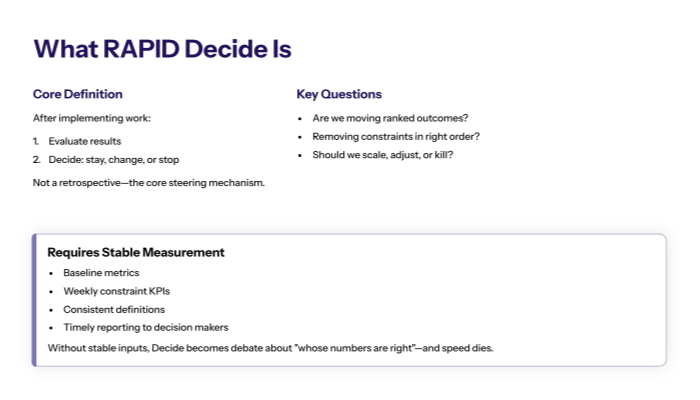
2.1 Decide = evaluate results, then stay / change / stop
RAPID’s definition is clean:
- after implementing work, evaluate results
- then decide whether to stay, change, or stop
This is not a retrospective. It’s the core steering mechanism.
It answers:
- Are we moving ranked outcomes?
- Are we removing constraints in the right order?
- Should we scale, adjust, or kill this effort?
2.2 Decide needs a stable measurement system (or it becomes debate)
RAPID stresses measurable success: if you can’t measure success tangibly, you can’t evaluate initiatives.
So Decide requires:
- baseline metrics
- weekly constraint KPIs
- consistent definitions (source of truth)
- timely reporting to decision makers
If inputs are unstable, Decide becomes “whose numbers are right?”—and speed dies.
How to run Decide weekly? (fast, evidence-based)
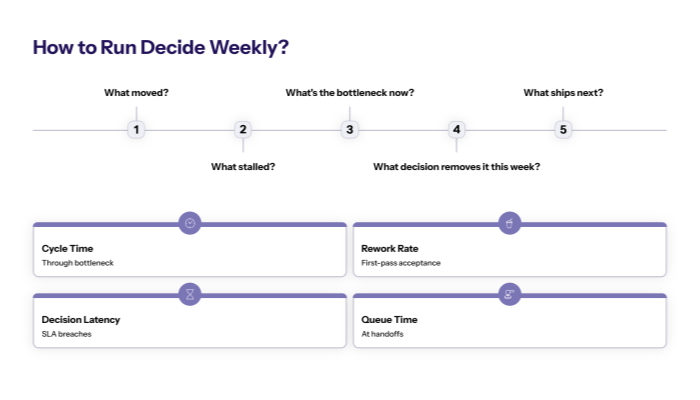
3.1 Use constraint KPIs as your weekly steering wheel
Weekly Decide is about leading indicators—the ones that move first:
- cycle time through the bottleneck
- rework rate / first-pass acceptance
- decision latency and SLA breaches
- queue time at handoffs
- data trust/reconciliation (if relevant)
This aligns with RAPID’s Analyze discipline: identify what’s beneath the surface (iceberg problem), prioritize what matters, then act.
Weekly Decide format:
- What moved?
- What stalled?
- What’s the bottleneck now?
- What decision removes it this week?
- What ships next?
3.2 Tie Decide to Decision Inventory (so learning becomes execution)
RAPID’s Decision Inventory exists to list decisions as questions, assign owners, and prioritize them linked to outcomes and customer value.
Decide works best when every weekly decision is captured as:
- Decision question
- Owner
- Outcome impacted
- Constraint KPI
- What ships (small increment)
- SLA
- Escalation rule
This makes learning operational. Not philosophical.
How Decide improves plans? (and kills bad work early)
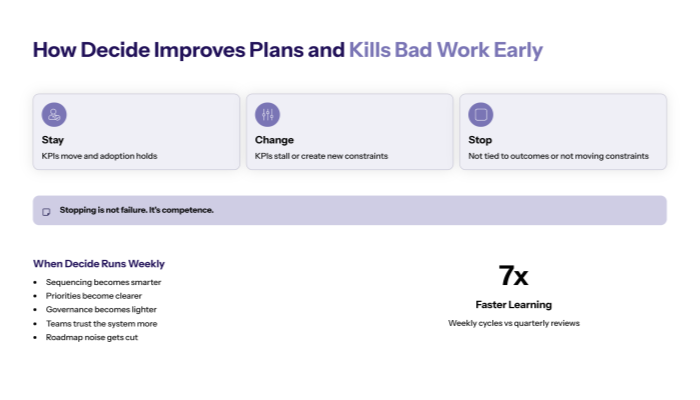
4.1 Decide is how you prevent sunk-cost spirals
Most roadmaps become prisons:
- teams keep executing because it’s “the plan”
- even when KPIs show it’s not working
RAPID’s stay/change/stop discipline exists to break this.
Practical rules:
- Stay if KPIs move and adoption holds
- Change if KPIs stall or create new constraints
- Stop if the initiative isn’t tied to outcomes or isn’t moving constraints
Stopping is not failure. It’s competence.
4.2 Decide turns planning into a living system (not a document)
RAPID emphasizes that complex problems are solved by many small steps. That means your plan should evolve as you learn—which only happens if Decide is real.
When Decide is running weekly:
- sequencing becomes smarter
- priorities become clearer
- governance becomes lighter
- teams trust the system more
- roadmap “noise” gets cut
The plan becomes a reflection of reality, not aspirations.
The executive discipline: protect truth, speed, and ownership
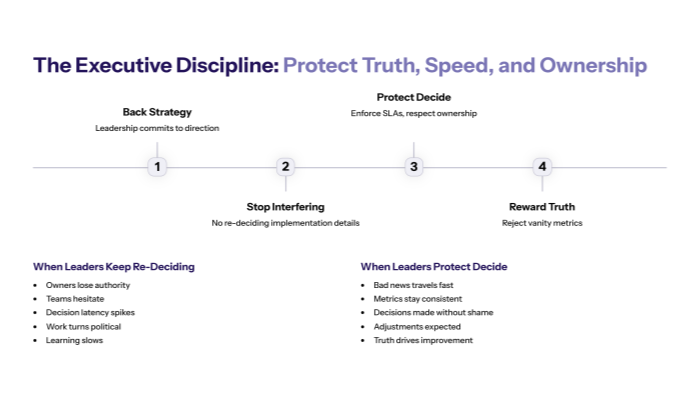
5.1 Decide requires leadership to back strategy and then stop interfering
RAPID highlights the leadership shift: once strategy is backed, leadership must decide to “no longer decide” implementation details.
If leaders keep re-deciding execution:
- owners lose authority
- teams hesitate
- decision latency spikes
- work turns political
- learning slows
Executives should protect Decide by:
- enforcing decision SLAs
- respecting ownership
- insisting on measurement (not narratives)
5.2 Decide stays honest when vanity metrics are rejected
RAPID warns vanity metrics create false confidence. Decide only works when leadership rewards truth:
- bad news travels fast
- metrics are consistent
- decisions are made without shame
- adjustments are expected
That’s how you get better decisions—and better plans—every cycle.
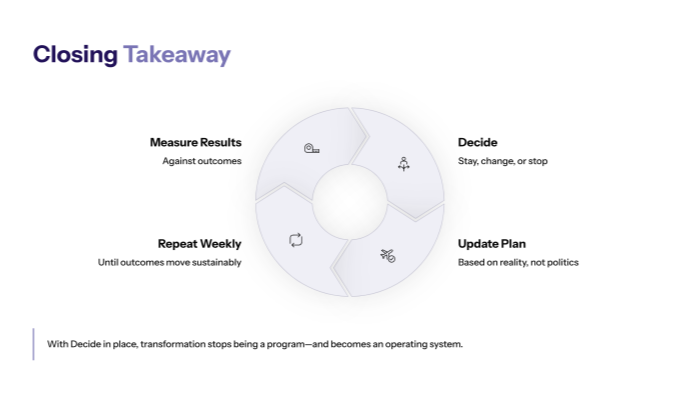
Closing takeaway
RAPID Decide is the transformation learning loop:
- Measure results against outcomes
- Decide to stay, change, or stop
- Update the plan based on reality (not politics)
- Repeat weekly until outcomes move sustainably
With Decide in place, transformation stops being a program—and becomes an operating system.