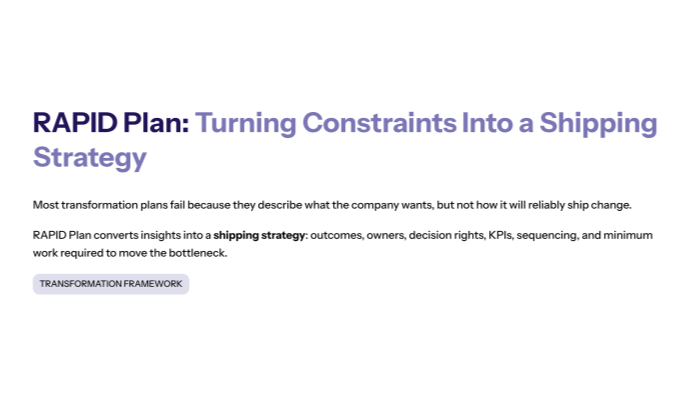
RAPID Plan: Turning Constraints Into a Shipping Strategy
Most transformation plans fail for a simple reason: they describe what the company wants, but not how the company will reliably ship change.
They become documents—roadmaps, slides, “initiatives”—instead of an operating system that turns real constraints into measurable outcomes.
RAPID Plan exists to prevent that. After Research and Analyze identify what’s real (and what’s limiting performance), Plan converts those insights into a shipping strategy: outcomes, owners, decision rights, KPIs, sequencing, and the minimum set of work required to move the bottleneck.
This post shows how to do RAPID Plan the practical way—so “transformation” becomes something you can ship every week.

Why most “plans” don’t ship?
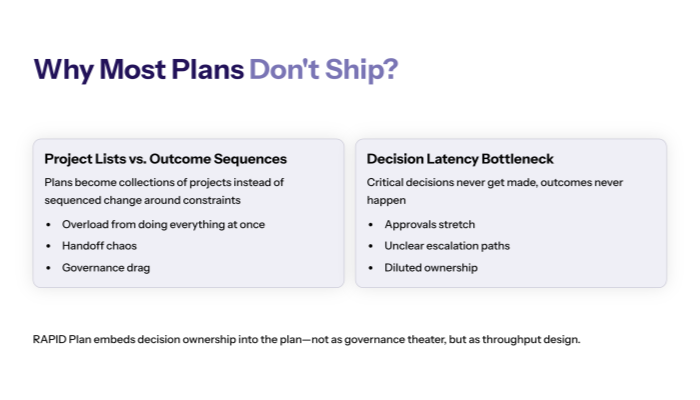
1.1 Planning fails when it’s project lists, not outcome sequences
A lot of plans are just collections of projects:
- “implement X tool”
- “migrate Y system”
- “launch Z initiative”
But RAPID is explicit that complex problems are solved through many small steps, executed in the right sequence. A plan that tries to do everything at once creates overload, handoff chaos, and governance drag.
A shipping strategy is different:
- it sequences change around constraints
- it defines how decisions get made fast
- it measures whether outcomes moved (not whether tasks completed)
1.2 Planning fails when decisions aren’t designed (decision latency becomes the bottleneck)
RAPID treats decision-making as central: decisions happen throughout transformation, and if critical decisions never get made, outcomes never happen.
That’s why many plans “stall” in the real world:
- approvals stretch
- escalation paths are unclear
- ownership is diluted
- teams wait instead of shipping
RAPID Plan fixes this by embedding decision ownership into the plan—not as governance theater, but as throughput design.
What RAPID Plan actually produces?
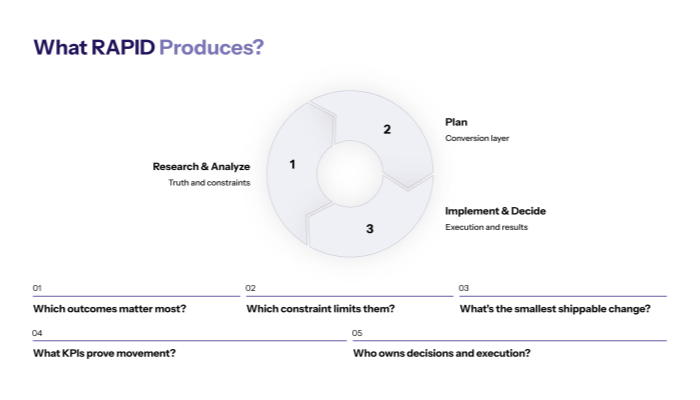
2.1 RAPID Plan is the conversion step: constraints → outcomes → shipping increments
RAPID is built as a flywheel: Research/Analyze produces truth and constraints; Plan/Implement/Decide turns that into execution and measurable results.
So RAPID Plan is not “planning mode.” It’s the conversion layer that answers:
- Which outcomes matter most?
- Which constraint limits them right now?
- What is the smallest shippable change that moves the constraint?
- What KPIs will prove movement?
- Who owns decisions and execution?
This is how planning becomes a shipping system.
2.2 The RAPID planning artifacts that keep execution honest
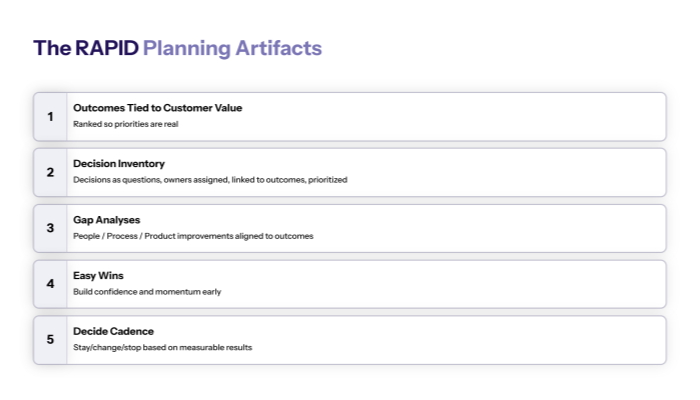
A RAPID Plan becomes robust when it’s built on these artifacts (lightweight, but explicit):
- Outcomes tied to customer value + ranked (so priorities are real)
- Decision Inventory (decisions as questions, owners assigned, linked to outcomes/customer value, prioritized)
- Gap Analyses (People / Process / Product) that translate findings into improvements aligned to outcomes
- Easy Wins identified early to build confidence and momentum
- Decide cadence (stay/change/stop based on measurable results)
If your plan doesn’t include these, it’s likely a roadmap narrative—easy to approve, hard to ship.
Turning constraints into a shipping strategy (the RAPID method)
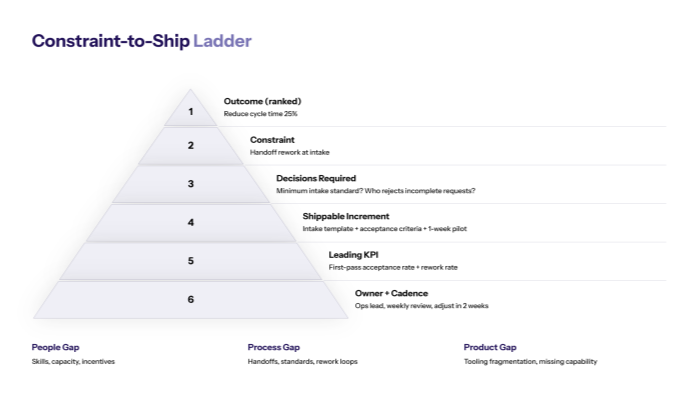
3.1 Step-by-step: build the “constraint-to-ship” ladder
Start with the constraint you found in Analyze. RAPID’s Analyze discipline begins by sorting relevant vs irrelevant information and surfacing what’s beneath the surface—so you don’t plan around noise.
Then build this ladder:
- Outcome (ranked)
- Constraint limiting the outcome
- Decision(s) required to remove the constraint
- Smallest shippable increment (change you can deliver fast)
- Leading KPI (constraint metric that moves early)
- Owner (single accountable)
- Cadence (weekly check + re-decision)
Example:
- Outcome: Reduce cycle time 25%
- Constraint: Handoff rework at intake (incomplete inputs)
- Decisions: “What is minimum intake standard?” “Who can reject incomplete requests?”
- Shippable increment: Intake template + acceptance criteria + 1-week enforcement pilot
- Leading KPI: First-pass acceptance rate + rework rate
- Owner: Ops lead
- Cadence: weekly review, adjust in 2 weeks
This is what “turning constraints into shipping” looks like: practical, measurable, owned.
3.2 Use gap analyses to choose what kind of work to ship
Once constraints are clear, RAPID makes the next move straightforward: translate constraints into gap analyses so you know whether the fix is people, process, or product.
- People Gap Analysis: skills/capacity/incentives that block outcomes
- Process Gap Analysis: handoffs, standards, rework loops, interfaces
- Product Gap Analysis: tooling fragmentation, missing capability, reliability issues
This prevents a classic transformation failure: defaulting to “buy a tool” when the constraint is actually a process interface or a decision right.
RAPID also warns against “silver bullet platform” thinking—tools won’t fix broken systems by themselves.
Sequencing + KPIs (how to know you’re shipping the right thing)
4.1 Sequence around the bottleneck, and keep the plan small
RAPID’s “many small steps” principle is not just a philosophy—it’s a sequencing rule.
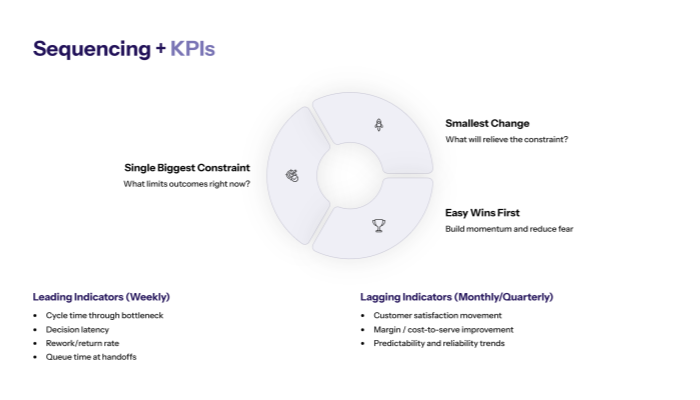
A RAPID Plan should answer:
- What is the single biggest constraint right now?
- What is the smallest change that will relieve it?
- What do we ship first to build momentum?
This is also why Easy Wins matter: they create visible progress quickly and reduce fear/politics—so the organization starts trusting the system.
4.2 KPIs: kill vanity metrics, measure constraint movement
RAPID explicitly warns against vanity metrics—selectively chosen numbers that make leaders feel good about decisions that are failing. It also emphasizes that if you can’t measure success in tangible ways, you can’t evaluate initiatives—and you’ll keep funding failure.
So a RAPID shipping strategy uses two KPI layers:
Leading indicators (weekly, constraint metrics):
- cycle time through the bottleneck
- decision latency
- rework/return rate
- queue time at handoffs
- data trust/reconciliation rate (where relevant)
Lagging indicators (monthly/quarterly, business confirmation):
- customer satisfaction / retention movement
- margin / cost-to-serve improvement
- predictability and reliability trends
If the leading KPI doesn’t move after shipping an increment, you didn’t hit the constraint—go back to Analyze and adjust.
Keep shipping: governance, resources, and re-decision
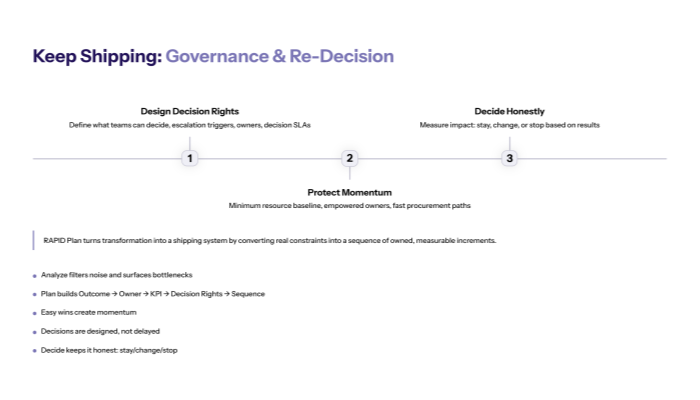
5.1 Design decision rights so shipping doesn’t stall
RAPID’s Decision Inventory exists because governance must be a decision system, not a committee schedule. Decisions should be posed as questions, owned, prioritized, and tied back to outcomes and customer value.
For RAPID Plan, define:
- which decisions teams can make within guardrails
- what triggers escalation
- who owns escalations
- decision SLAs (so decision latency doesn’t become the bottleneck)
And remember RAPID’s leadership warning: once leadership backs the strategy, they must “no longer decide” implementation details—otherwise progress stalls or reverses.
5.2 Protect momentum with resources, then Decide honestly (stay/change/stop)
RAPID makes an underrated point: momentum dies when essential resources aren’t provided in time—like missing licenses or budgeted hires that never happen.
So a shipping strategy must include:
- a minimum resource baseline (licenses/access/coverage)
- owners empowered to act
- fast procurement paths for constraint removals
Then you close the loop with Decide:
- measure impact
- stay, change, or stop based on results
That’s how RAPID Plan avoids sunk-cost spirals and keeps the organization learning faster than the constraints move.
Closing takeaway
RAPID Plan turns transformation into a shipping system by doing one thing exceptionally well: converting real constraints into a sequence of owned, measurable increments.
- Analyze filters noise and surfaces bottlenecks
- Plan builds Outcome → Owner → KPI → Decision Rights → Sequence
- Easy wins create momentum
- Decisions are designed, not delayed
- Decide keeps it honest: stay/change/stop