Retail Software Development Services: Building Scalable Omnichannel Platforms for Modern Commerce
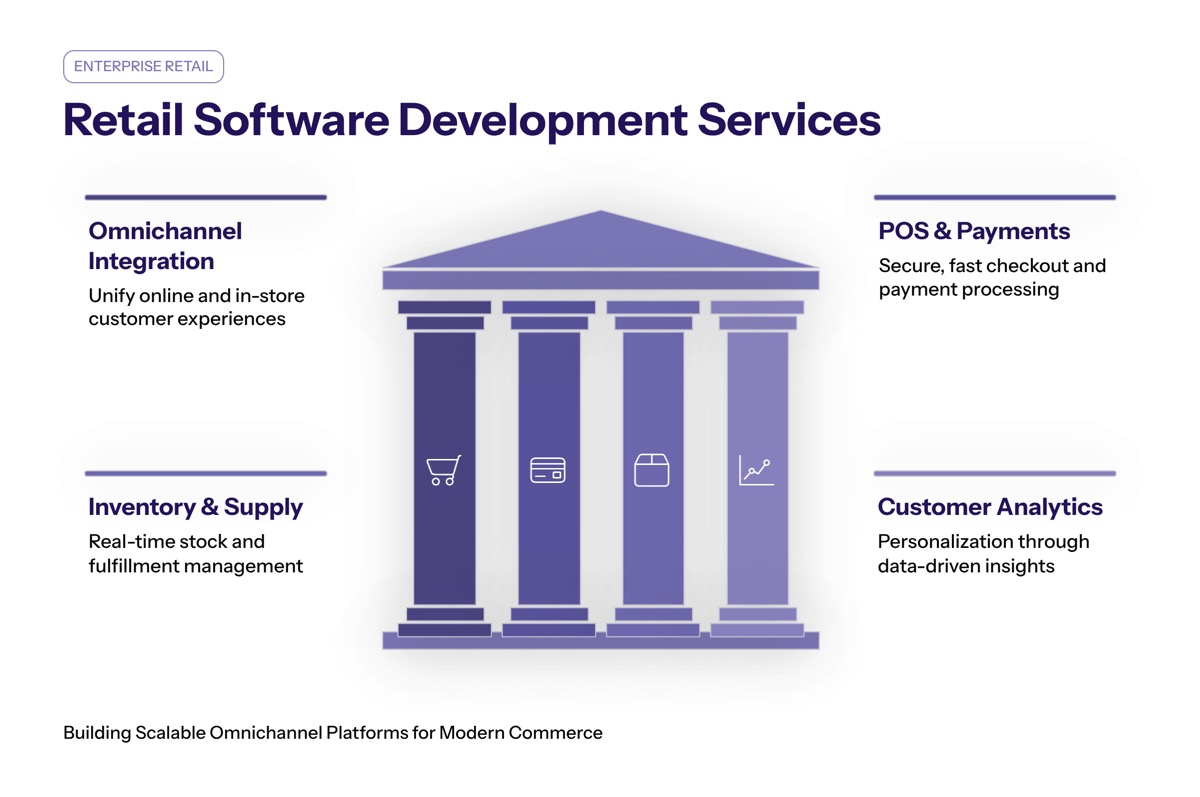
Retail software development services help retailers build connected platforms that unify ecommerce, POS systems, inventory management, customer data, and retail operations across physical stores, mobile apps, marketplaces, and other sales channels. For a retail business operating across multiple sales channels, the goal is not simply to add another tool; it is to create modern retail software that aligns data, decisions, and execution across the business.
This article covers enterprise retail platforms, omnichannel integration, POS systems, inventory management systems, customer management, supply chain software, and customer experience modernization for mid-market to enterprise retailers. It is written for retail executives, IT leaders, operations managers, and digital transformation teams evaluating custom software development, ecommerce scalability, and long-term retail technology investments.
Retail software development services create integrated platforms that connect POS systems, ecommerce, inventory management, and customer data to eliminate operational silos and improve customer experience consistency. Many retail environments grow through disconnected tools added over time, leading to fragmented systems that hurt margins and customer experience; successful retailers think in systems rather than tools, approaching retail software development as a connected platform effort to reduce rework and support growth.
In this guide, you will learn how to evaluate:
Unified commerce architecture for online, mobile, and physical stores
Real-time inventory visibility and efficient inventory management
Streamlined retail operations across stores, warehouses, and fulfillment centers
Customer engagement, customer loyalty, and personalization capabilities
Measurable ROI from retail software investments, including operational efficiency and total cost of ownership
Understanding Modern Retail Software Architecture
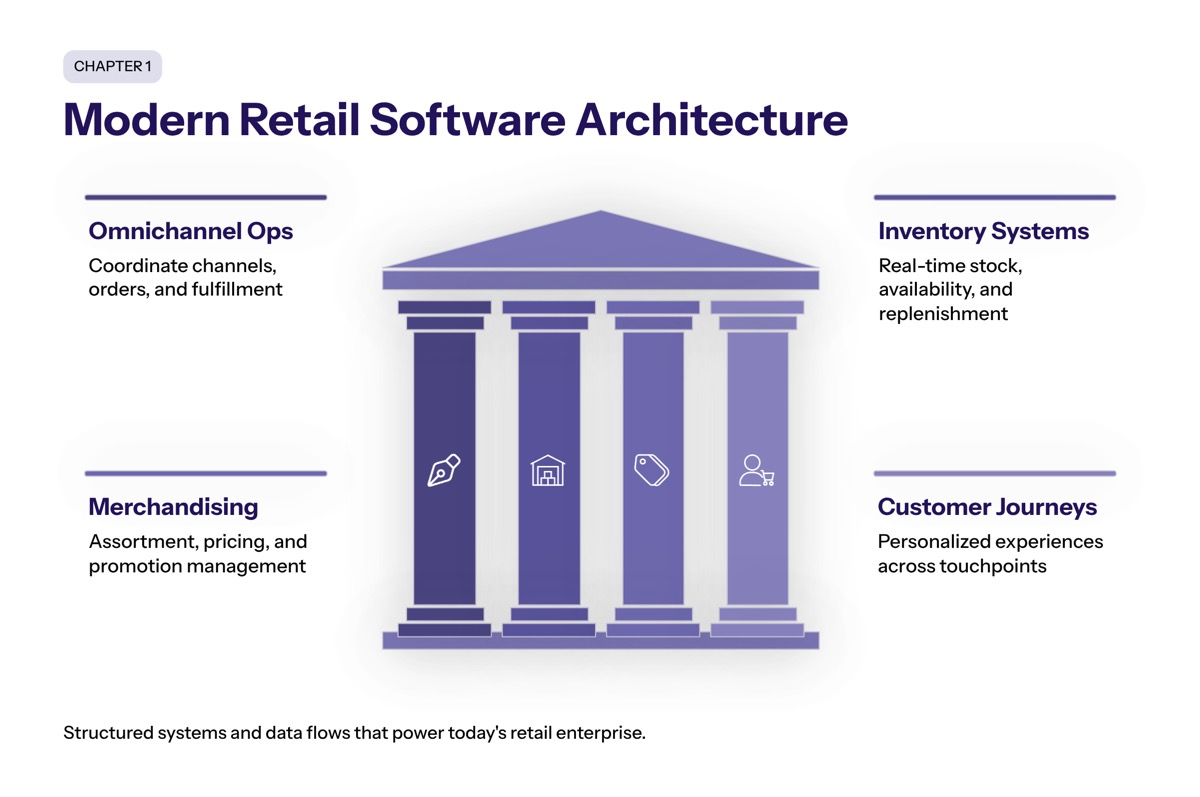
Modern retail software is best understood as a connected system of capabilities that supports the entire retail value chain, ensuring data, decisions, and execution are aligned across the business. Retail software development goes beyond standalone point solutions such as isolated accounting software, simple inventory systems, or single-channel ecommerce platforms. It creates an integrated architecture where inventory, orders, payments, customer and sales data, supply chain activity, and retail analytics solutions work together.
Retail software must effectively sync across online, mobile, and physical stores to support omnichannel operations. Omnichannel Selling connects physical stores and online shops into one unified sales system, allowing customers to browse, buy, return, exchange, and redeem loyalty benefits consistently across channels. This matters because customer expectations now include real-time availability, flexible fulfillment, personalized offers, and frictionless checkout experiences.
Many enterprises adopt MACH principles - Microservices, API-first, Cloud-native, and Headless - to stay vendor-agnostic and reduce long-term lock-in, making it easier to replace individual components without rewriting the entire retail platform. This approach gives retail systems flexibility while supporting scalability, integration capability, and long-term modernization.
Core Platform Components
Core retail software solutions typically include transaction systems, payment processing, ecommerce platforms, inventory management software, CRM tools, supply chain and logistics software, customer engagement systems, and retail management software. Retail software encompasses various types, including e-commerce platforms, inventory management systems, customer relationship management (CRM) tools, and point-of-sale (POS) systems.
Transaction and payment processing systems must support secure payment processing across retail stores, mobile devices, web checkout, marketplaces, and emerging payment methods. Data security in retail software must ensure strict adherence to PCI-DSS data protection standards. Retail software development must also comply with data protection regulations such as GDPR, CCPA, and PCI-DSS, especially when customer data capture, loyalty programs, and payment processing operate across regions.
Inventory management integration is equally critical. Inventory management software is crucial for optimizing stock levels across multiple locations, helping retailers avoid stockouts and overstock situations. For enterprise retail operations, inventory control must include warehouses, distribution centers, in-transit goods, store inventory, returns, reserved stock, and supplier pipelines. Supply Chain and Logistics software optimizes product shipping, warehousing, and fulfillment, while demand forecasting supports better replenishment and supply chain efficiency.
These components support unified commerce goals by improving operational efficiency, reducing manual work, and giving teams a more reliable view of stock, sales, orders, and customers. Retail software services improve efficiency by automating manual tasks such as stock counting and sales reporting, which allows teams to spend more time managing exceptions that require judgment.
Data Integration and Visibility
Data integration is the foundation of modern retail software. System Integration allows for smooth data exchange with existing ERP, CRM, and POS systems. Without proper integration, fragmented retail systems can lead to delayed data, manual workarounds, and inconsistent reporting, which negatively impact pricing decisions and stock availability.
Customer data platforms connect online behavior with in-store interactions, ecommerce purchases, service tickets, loyalty redemptions, and marketing automation tools. Retail software development can enhance customer engagement by providing seamless omnichannel experiences, allowing customers to interact with brands consistently across various platforms. Personalization in retail software solutions is crucial for improving customer engagement, as it allows businesses to tailor experiences based on individual customer preferences and behaviors.
Real-time reporting and data analytics turn operational data into actionable insights. Retail software generates accurate reports on buying trends, profit margins, and peak shopping hours, enabling data-driven decisions. Data analytics in retail helps organizations transform operational data into actionable insights, which can improve financial control, operational stability, and customer continuity across channels. Effective data management and analytics can prevent issues like “ghost inventory,” where stock appears available but is not, by establishing a Single Source of Truth using Master Data Management (MDM).
This architecture foundation leads directly to the practical question retail leaders face next: which software development services are required to modernize customer experience, inventory management, store operations, and supply chain execution without disrupting the business?
Enterprise Retail Software Development Services
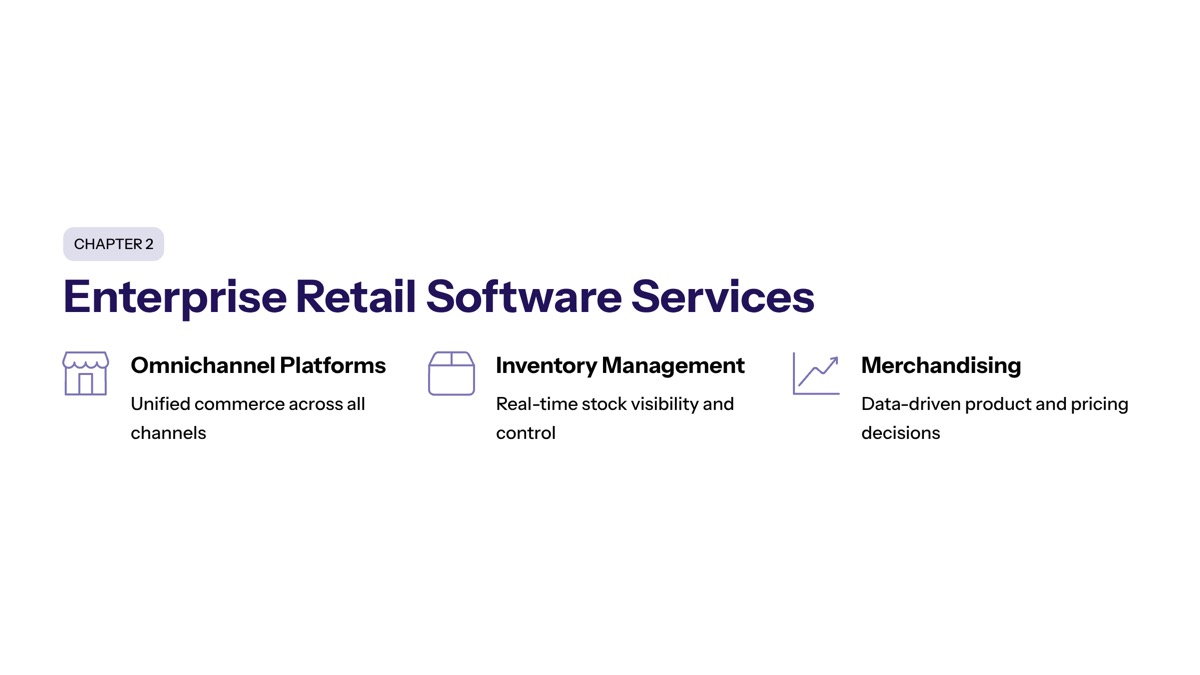
Enterprise retail software development services translate architecture into working systems. A retail software development company may support custom retail software development, mobile app development, ecommerce modernization, POS integration, supply chain automation, retail analytics solutions, and ongoing support. The right service mix depends on business needs, existing systems, retail locations, transaction volume, compliance requirements, and digital transformation priorities.
Many enterprises are moving towards custom retail software development to ensure that their systems work together seamlessly, reducing operational risks and improving data flow. A well-structured integration of retail systems can lead to improved revenue consistency across channels by ensuring that pricing and availability are aligned.
Custom Ecommerce and Omnichannel Platforms
Custom ecommerce and omnichannel platforms create a unified customer experience across web, mobile, and physical store touchpoints. Ecommerce platforms like Shopify and BigCommerce are designed to help businesses create online stores quickly and efficiently, often without requiring coding skills. However, mid-market and enterprise retailers often need custom retail software when standard e commerce platforms cannot support complex pricing, promotions, fulfillment models, integrations, or regional compliance requirements.
A custom omnichannel platform connects ecommerce, POS systems, CRM, inventory systems, marketing automation tools, and warehouse management systems. This allows a customer to see accurate availability online, buy through a mobile app, pick up in a store, receive personalized offers, and return through another retail location without data gaps. Effective customer engagement strategies in retail often rely on data-driven insights, enabling businesses to understand customer behavior and preferences, which can lead to improved service and satisfaction.
Performance is a major design requirement. Mobile-first design, fast checkout, resilient cloud infrastructure, and conversion-focused UI/UX all affect revenue. Retail traffic is highly volatile, necessitating software that scales infrastructure dynamically during peak seasons without downtime. Retail technology also requires continuous updates, bug fixes, and UI/UX refinements as market trends shift, which makes ongoing support part of the platform strategy rather than an afterthought.
Point-of-Sale and Store Management Systems
Modern POS systems should not operate as disconnected cash registers. They should integrate with inventory management, customer data, customer loyalty, promotions, returns, and accounting processes. When POS data syncs with ecommerce and inventory management systems, store associates can access accurate product availability, customer profiles, purchase history, and loyalty status.
Store management software also supports staff productivity tools and real-time operational dashboards. Retail management software integrates various functions such as financial, operational, and accounting processes, providing a comprehensive solution for brick-and-mortar and online stores alike. Dashboards can show sales trends, stock movement, store performance, fulfillment tasks, and customer satisfaction signals.
Reliability matters in retail environments where connectivity may be inconsistent. Offline capability and cloud synchronization allow retail stores to continue processing transactions even when networks are unstable. Once connectivity returns, the platform should reconcile sales data, inventory updates, and customer records without duplication or data loss.
Supply Chain and Inventory Optimization
Supply chain and inventory optimization services focus on multi-location inventory tracking, automated reordering, supplier integration, and demand forecasting. Advanced analytics and machine learning applications in retail can optimize inventory management and enhance merchandising strategies, leading to more effective decision-making. Predictive analytics in retail can enhance inventory management, optimize merchandising strategies, and improve offerings personalization, leading to better decision-making and customer satisfaction.
Supplier integration and procurement workflow automation reduce delays between demand signals and replenishment actions. This can include purchase order automation, vendor catalogs, receipt matching, supplier performance analytics, and integrations with logistics providers. Supply chain transparency also becomes more important as customers, regulators, and finance teams demand better visibility into product movement and fulfillment performance.
AI is becoming central to inventory and fulfillment modernization. 90% of retailers are now deploying artificial intelligence in at least one operational area, indicating a significant shift towards AI-driven solutions in the retail sector. AI-driven automation in retail helps reduce manual work in high-volume processes, improving reliability and allowing teams to focus on exceptions instead of routine tasks. AI technologies are increasingly being integrated into retail systems to provide real-time inventory visibility and frictionless checkout experiences, meeting rising customer expectations.
These service categories create the business case, but successful delivery depends on the implementation method.
Retail Software Implementation Using the RAPID Framework
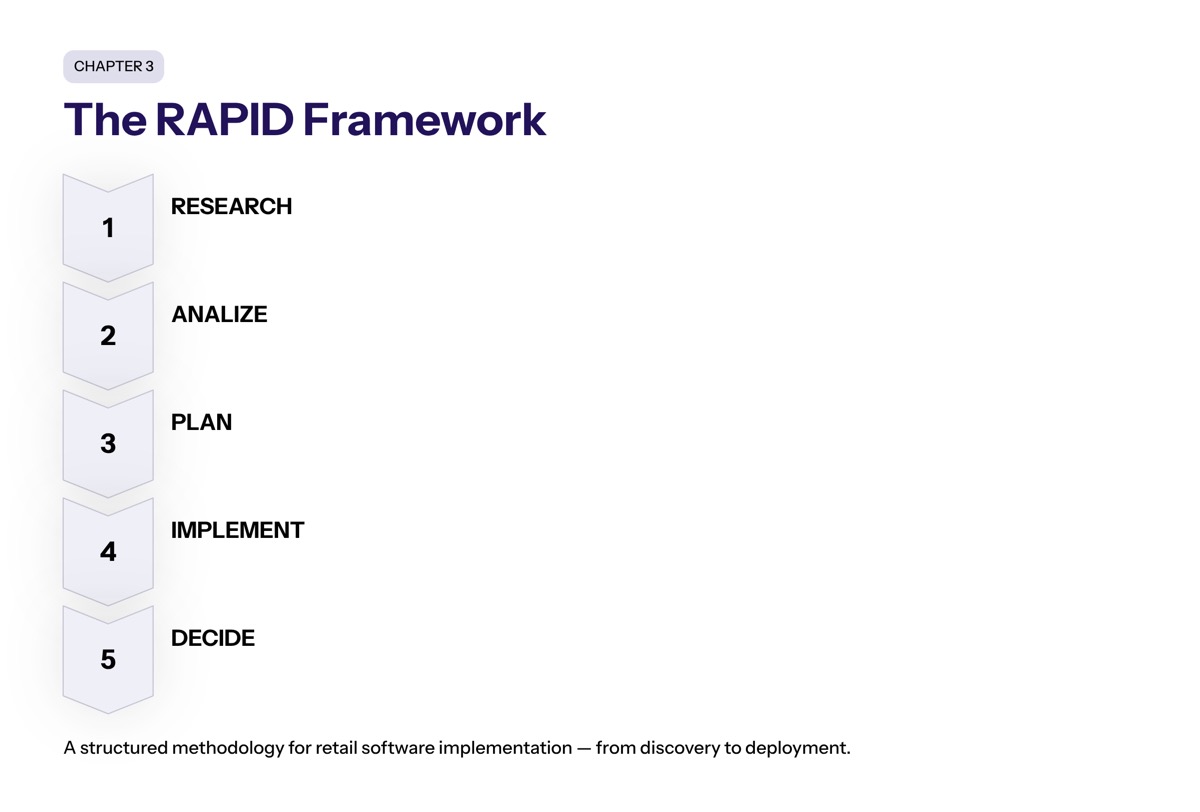
Cognativ’s RAPID Framework gives retail leaders a structured way to move from strategic intent to operational execution. For custom retail software development, RAPID helps define requirements, shape architecture, plan migration, implement software solutions, and deploy with measurable business outcomes. This is especially important when existing systems include legacy systems, fragmented tools, manual workflows, and high-risk integrations.
Retail software investments are evaluated on outcomes, with decision-makers measuring improvements in financial control, operational stability, and customer continuity across channels over time. The implementation approach should therefore connect technical work to measurable retail operations goals.
Requirements Analysis and Discovery
Comprehensive discovery reduces implementation risk by clarifying what the retail platform must do, where current systems fail, and how the new architecture should support future growth. Industry-specific knowledge in retail software development ensures compliance and standard workflows, especially around payments, returns, promotions, tax handling, inventory control, and customer data protection.
Current system audit and integration complexity assessment
Review existing systems, including ERP, CRM, POS systems, ecommerce platforms, accounting software, inventory systems, marketing automation tools, and warehouse tools. Isolated systems create blind spots in retail operations, making it difficult to maintain accurate inventory levels and timely decision-making.Business workflow mapping and bottleneck identification
Map business processes across online orders, store fulfillment, returns, replenishment, promotions, customer management, and reporting. Effective system integration in retail helps to reduce manual reconciliation between systems, thereby increasing operational efficiency and allowing teams to focus on managing exceptions that require judgment.Compliance requirements analysis for payment processing and data security
Analyze PCI-DSS, GDPR, CCPA, encryption, access controls, audit logs, fraud detection, and data retention requirements. Evaluating software development partners should involve a review of their encryption protocols, security testing frameworks, and compliance track record.Scalability planning for seasonal demand and business growth
Plan cloud infrastructure, performance testing, data architecture, and failover for Black Friday, holiday campaigns, flash sales, and new retail locations. Retailers should prioritize scalability, integration capability, and industry expertise when selecting software development services.
Implementation Approach Comparison
Approach | Timeline | Risk Level | Business Disruption |
|---|---|---|---|
Phased Rollout | 6-12 months | Low | Minimal |
Big Bang Launch | 3-6 months | High | Significant |
Hybrid Migration | 8-15 months | Medium | Controlled |
A phased rollout works well when retail operations cannot tolerate disruption and teams need time for training. A big bang launch may be appropriate when fragmented systems are too costly to maintain, but it requires extensive testing and strong executive alignment. A hybrid migration often fits enterprise retail environments because it allows core capabilities, such as inventory management or order orchestration, to be modernized first while customer-facing experiences transition gradually.
The best implementation strategy depends on operational constraints, seasonality, budget, integration complexity, and business priorities. Many organizations focus on initial build costs but overlook long-term ownership costs, which can lead to higher total expenses if systems require frequent workarounds and maintenance.
Common Retail Software Development Challenges and Solutions
Retail software development is complex because retail environments combine high transaction volume, volatile demand, regulatory requirements, legacy systems, physical operations, and customer-facing digital experiences. The most successful projects address technical risk, operational risk, and staff adoption together.
Legacy System Integration and Data Migration
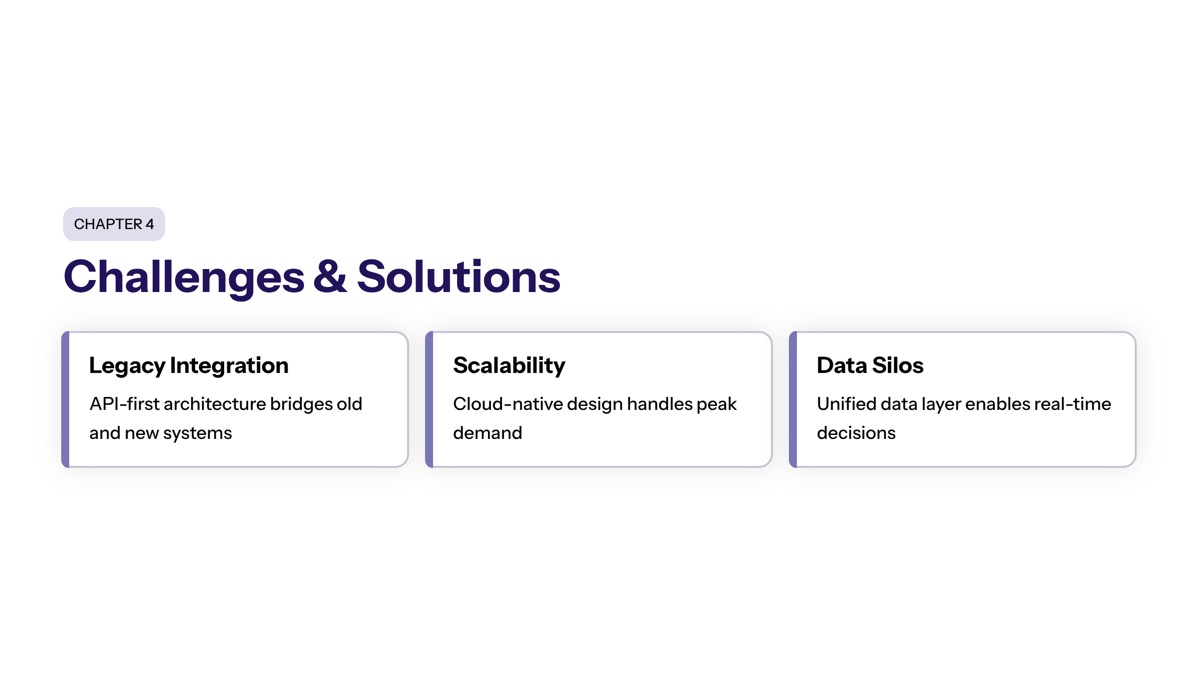
Legacy system integration is often the hardest part of retail software development. Older ERP, POS, warehouse, and accounting platforms may lack modern APIs or use inconsistent product, customer, and inventory data. API development, middleware, and integration layers can connect existing systems without immediate full replacement.
Data migration should include cleanup, deduplication, validation, and standardization across multiple sources and formats. Fragmented data can distort inventory availability, customer segmentation, pricing decisions, and sales reporting. A strong Master Data Management approach creates a Single Source of Truth for products, customers, prices, orders, and inventory.
Peak Season Performance and Scalability
Peak season performance failures can directly reduce revenue and damage customer satisfaction. Cloud architecture design should support Black Friday, holiday traffic spikes, promotional campaigns, and sudden demand changes across ecommerce platforms, mobile apps, and retail stores.
Load testing, stress testing, caching, autoscaling, and observability are essential for mission-critical retail operations. Cloud-native architecture, MACH principles, and microservices help teams scale individual components, such as checkout, product search, inventory availability, or payment processing, without scaling the entire platform unnecessarily.
Security and Compliance in Retail Environments
Security and compliance must be built into retail software from the beginning. PCI DSS compliance protects payment processing, while GDPR and CCPA govern customer data, consent, retention, and privacy rights. Fraud detection and prevention systems should integrate with transaction processing to detect unusual behavior without creating unnecessary friction for legitimate customers.
Secure software development should include encryption at rest and in transit, role-based access control, penetration testing, vulnerability scanning, code review, audit logging, and incident response planning. Retailers evaluating a retail software development company should verify industry expertise, compliance experience, security testing frameworks, and post-launch monitoring capabilities.
Change Management and Staff Adoption
Even technically strong retail software solutions can fail if store associates, managers, and back-office teams do not adopt them. Training programs should be role-specific and tied to real workflows such as returns, stock transfers, customer lookup, order fulfillment, and promotional adjustments.
User experience design matters for store operations because staff often work under time pressure with customers waiting. Pilot stores, feedback loops, and phased training reduce adoption risk. The goal is to enhance operational efficiency without overwhelming teams during daily retail operations.
Conclusion and Next Steps for Retail Leaders
Retail software development services are a strategic platform investment, not a one-time software purchase. The strongest retail platforms connect ecommerce, POS systems, inventory management, customer data, supply chain operations, and analytics into one operating model that improves customer experience, operational efficiency, and financial control.
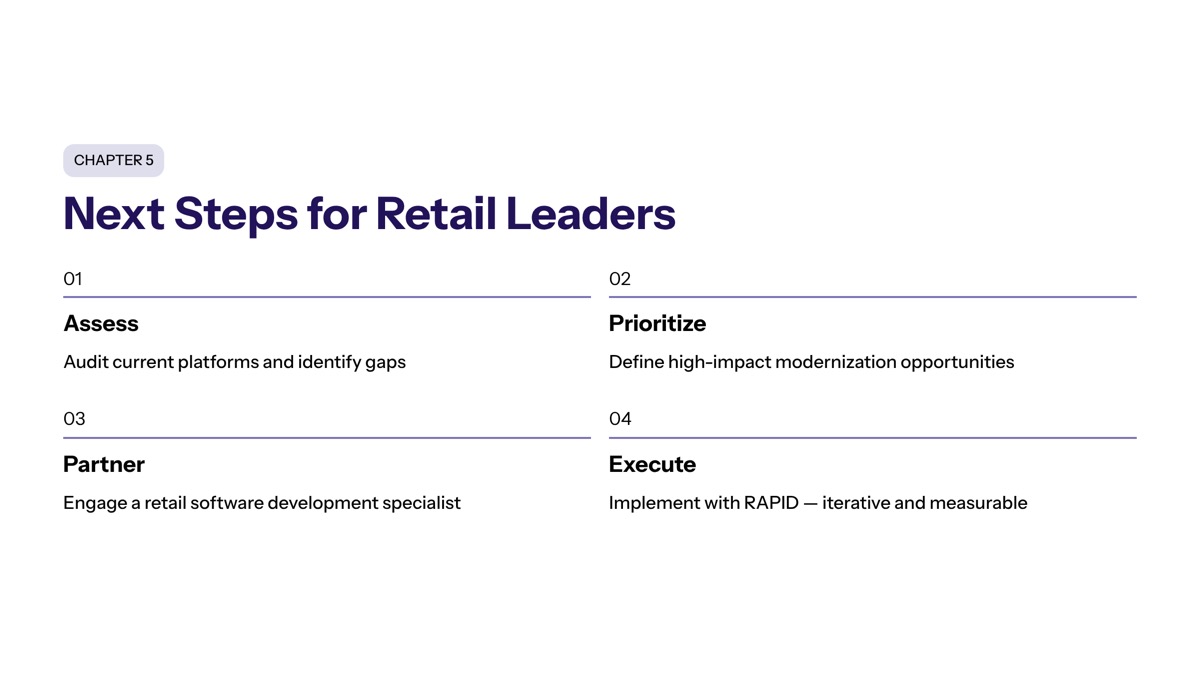
For retail leaders evaluating custom retail software, the next steps are:
Conduct current system assessment and identify integration requirements
Map existing systems, data flows, manual workarounds, and operational gaps across retail locations and digital channels.Define measurable business outcomes and ROI expectations
Set targets for inventory accuracy, checkout speed, customer satisfaction, revenue consistency, supply chain efficiency, and total cost of ownership.Evaluate implementation approaches based on operational constraints
Choose phased rollout, big bang launch, or hybrid migration based on seasonality, risk tolerance, staffing, and business continuity needs.Partner with experienced retail technology consultants for strategic planning
Work with a team that understands retail systems, secure payment processing, data migration, omnichannel operations, and scalable cloud infrastructure.
Related modernization priorities include AI integration for personalization, mobile commerce optimization, supply chain automation, frictionless checkout, and advanced retail analytics solutions. To explore how Cognativ supports connected retail platforms, visit our retail industry expertise page.
Frequently Asked Questions
What are retail software development services?
Retail software development services include the design, development, integration, modernization, and support of retail platforms. These services may cover ecommerce platforms, POS systems, inventory management software, CRM, customer loyalty tools, supply chain systems, retail analytics solutions, mobile apps, and custom management software.
How much does retail software development cost?
Retail software development costs typically range from $30,000 to $200,000 for mid-scale platforms, while enterprise-grade systems can range from $100,000 to $400,000 or more, depending on scope and complexity. The retail software development cost is influenced by several factors, including the scope of functionality, integration complexity, customization level, data migration needs, and security and compliance requirements.
How long does enterprise retail software implementation take?
A phased rollout often takes 6-12 months, a big bang launch may take 3-6 months, and a hybrid migration often takes 8-15 months. Timelines depend on integrations, data quality, number of retail stores, ecommerce complexity, compliance requirements, and staff training needs.
Why do retailers choose custom retail software instead of off-the-shelf tools?
Off-the-shelf tools can work well for simple operations, but custom retail software is often needed when a retailer has complex pricing, multiple sales channels, custom fulfillment workflows, legacy systems, or specialized compliance needs. Custom retail software development helps align software solutions with actual business processes rather than forcing teams into generic workflows.
What business outcomes should retail leaders measure?
Retailers evaluate software development services based on omnichannel integration, scalability, data security, industry experience, post-launch support, and total cost of ownership. Key outcome metrics include inventory accuracy, revenue consistency, checkout speed, customer satisfaction, repeat purchase rate, fulfillment cost, reporting accuracy, and operational stability.
How does retail software improve customer engagement?
Retail software improves customer engagement by connecting customer data across ecommerce, mobile apps, retail stores, loyalty systems, support channels, and marketing automation tools. The adoption of AI in retail has been linked to improved customer experiences, with organizations reporting conversion rate uplifts of 15–30% due to better personalization and operational efficiency.
What are the biggest risks in retail software modernization?
Common risks include poor integration with existing systems, inaccurate data migration, weak security controls, peak-season downtime, staff resistance, and underestimated long-term maintenance needs. These risks can be reduced through discovery, architecture planning, load testing, compliance reviews, training, and ongoing support.
How should retailers select a retail software development company?
Retailers should prioritize scalability, integration capability, and industry expertise when selecting software development services. They should also evaluate omnichannel experience, cloud infrastructure knowledge, security practices, encryption protocols, compliance track record, retail industry references, and ability to provide post-launch support. For strategic guidance, connect with Cognativ through our retail industry expertise page and discuss your modernization roadmap.