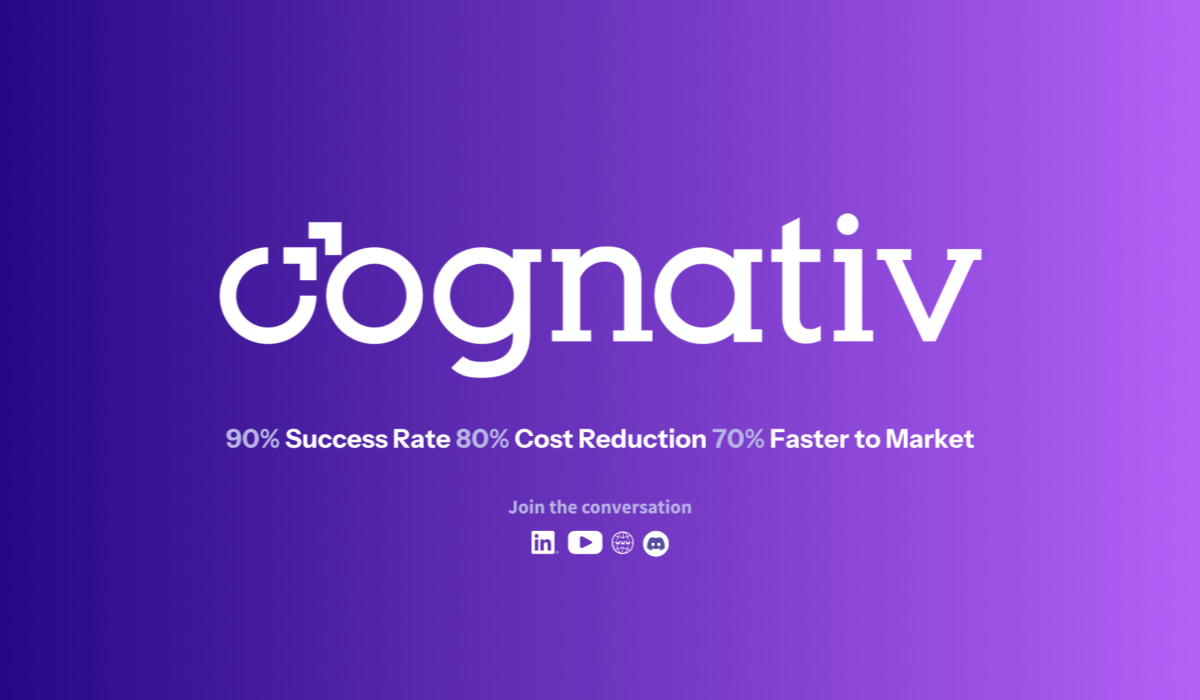
Root-Cause Analysis for Transformation: Beyond “People Problems”
When transformation stalls, the easiest explanation is also the most dangerous one: “It’s a people problem.”
That statement feels actionable. It gives leadership something to blame. It creates a simple story.
But most “people problems” are system problems in disguise: unclear outcomes, broken handoffs, unowned decisions, misaligned incentives, outdated processes, tool fragmentation, or fear-based governance that makes the safest action “do nothing.”
RAPID’s Analyze phase is designed to prevent exactly this failure mode. Analyze isn’t about collecting more opinions—it’s about interpreting facts, filtering what’s relevant, and revealing what sits beneath the surface. It’s also explicit that human factors are not irrelevant—culture can kill or save companies—so you need to understand who does the work, how they do it, and how committed they are.
This post shows how to run root cause analysis for digital transformation in a RAPID-aligned way—so you stop blaming people and start fixing constraints that actually control outcomes.
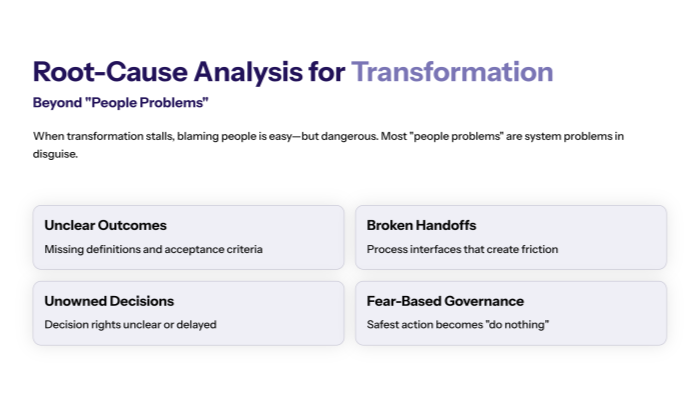

Why “people problems” are usually system failures?
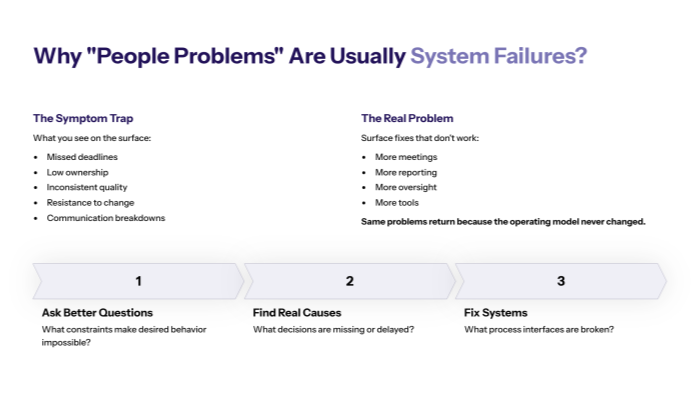
1.1 The symptom trap: blaming the visible layer
“People problems” tend to be what you see on the surface:
- missed deadlines
- low ownership
- inconsistent quality
- resistance to change
- “lack of urgency”
- communication breakdowns
But RAPID’s core insight is that most problems live beneath the surface. That’s why Research and Analyze behave like a flywheel: analysis reveals gaps in what you collected, forcing deeper research until the true issue becomes clear.
When leaders stop at the surface layer, they fix symptoms:
- more meetings
- more reporting
- more oversight
- more tools
…and the same problems return, because the operating model never changed.
1.2 The operating model creates behavior
A practical rule for root cause analysis for digital transformation: If the same “people problems” happen repeatedly, the system is producing them.
RAPID’s Analyze framing is helpful here because it forces you to interpret what you observed through key organizational lenses (people, finance, product, technology) and to treat culture as a first-class variable.
So instead of asking “Why aren’t they performing?”, you ask:
- What constraints make the desired behavior impossible?
- What decisions are missing or delayed?
- What process interfaces are broken?
- What tools force workarounds?
That’s where root cause lives.
RAPID Analyze: interpret evidence, don’t summarize opinions
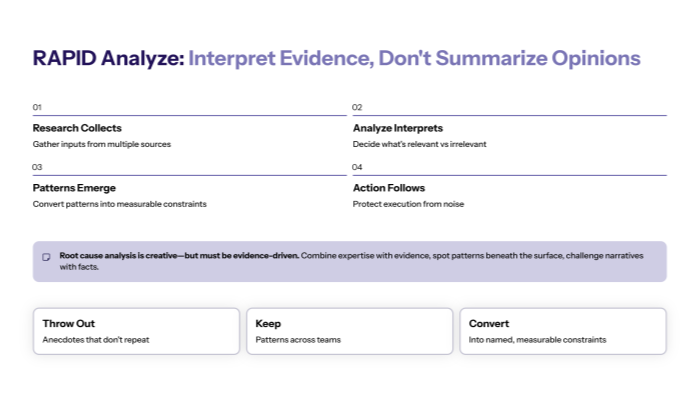
2.1 Analyze is where data becomes meaning
RAPID draws a direct line: Research collects inputs; Analyze interprets them and decides what is relevant vs irrelevant.
For root cause analysis for digital transformation, that means:
- throw out anecdotes that don’t repeat
- keep patterns that show up across teams
- convert patterns into constraints you can name and measure
RAPID explicitly warns that irrelevant data wastes time and resources. The job of analysis is to protect execution from noise.
2.2 Root cause is creative—but must be evidence-driven
RAPID also acknowledges that analysis is not a mechanical checkbox. Problem-solving is creative and requires contextual understanding.
But “creative” doesn’t mean “subjective.” It means:
- you combine expertise with evidence
- you spot patterns beneath the surface
- you challenge narratives with facts
- you translate complexity into actionable priorities
A strong root cause analysis never ends with “communication.” It ends with:
- a constraint you can map
- a decision you can assign
- a gap you can fix
A practical root-cause framework (People / Process / Product / Decision)
3.1 The four root-cause categories that matter most
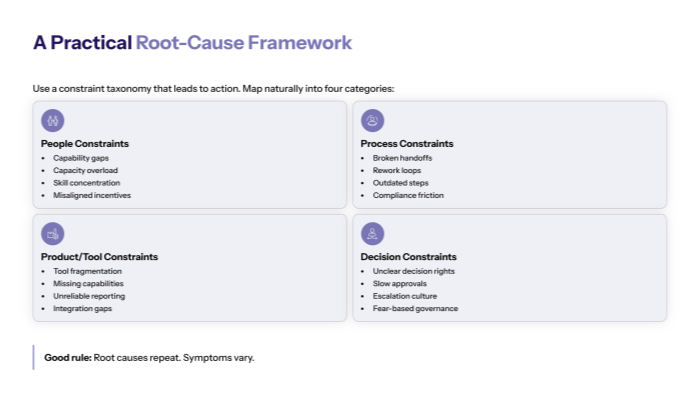
To run root cause analysis for digital transformation, use a constraint taxonomy that leads to action. RAPID’s toolset maps naturally into four categories:
- People constraints (capability, capacity, skill concentration, incentives)
- Process constraints (handoffs, rework loops, outdated steps, compliance friction)
- Product/tool constraints (fragmentation, missing capabilities, unreliable reporting)
- Decision constraints (unclear decision rights, slow approvals, escalation culture)
This is consistent with RAPID’s recurring emphasis on aligning solutions across people, process, and product, and turning insights into decisions that drive outcomes.
3.2 Use “repeating friction” as your root-cause signal
A good rule: root causes repeat. Symptoms vary.
Examples:
- Symptom: “Teams miss deadlines.”
Root cause candidates: unowned decisions, input quality at handoffs, rework loops, skill concentration.
- Symptom: “People don’t take ownership.”
Root cause candidates: unclear outcomes, unclear decision rights, fear-based culture, misaligned incentives.
- Symptom: “We need a new tool.”
Root cause candidates: process debt, inconsistent definitions, broken reporting trust.
RAPID encourages eliminating irrelevant noise and going deeper when your analysis reveals incomplete understanding. That’s how you avoid premature conclusions.
Turn root causes into RAPID artifacts (so it becomes executable)
4.1 People Gap Analysis: uncover capability bottlenecks (not blame)
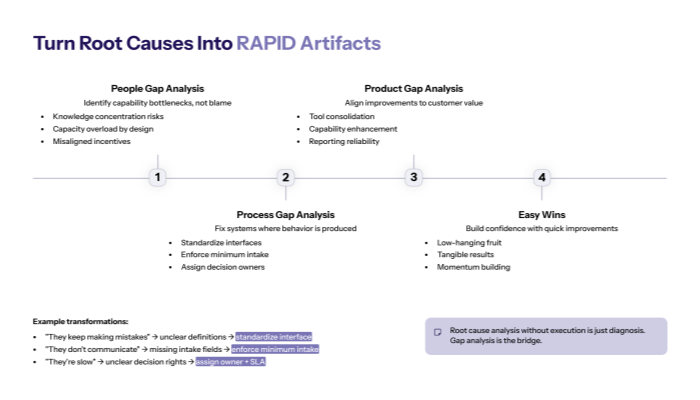
RAPID’s People Gap Analysis exists to identify gaps in people and teams, and it explicitly calls out skill concentration as a risk—because it creates fragility and bottlenecks.
For root cause analysis, use it to answer:
- Where is knowledge concentrated in one person/team?
- Where is capacity overloaded by design?
- Where are incentives misaligned with outcomes?
This lets you propose fixes like:
- redundancy planning
- training
- role clarity
- rebalancing work
…instead of “try harder.”
4.2 Process + Product Gap Analysis: fix the system where behavior is produced
RAPID’s Process Gap Analysis and Product Gap Analysis exist to translate findings into specific improvements aligned to customer value and outcomes.
This is where “people problems” usually resolve:
- “they keep making mistakes” → unclear definitions and acceptance criteria → standardize interface
- “they don’t communicate” → missing intake fields → enforce minimum viable intake
- “they’re slow” → approval chain + decision rights unclear → assign owner + SLA
And to keep momentum, RAPID includes Easy Wins: low-hanging fruit selected to build confidence and deliver tangible improvements quickly.
Root cause analysis without execution is just diagnosis. Gap analysis is the bridge.
Validate root causes and keep iterating (or you’ll relapse)
5.1 Confirm root cause with measurement, not consensus
The fastest way to keep a bad root cause alive is to make it a “team agreement.” Consensus is not proof.
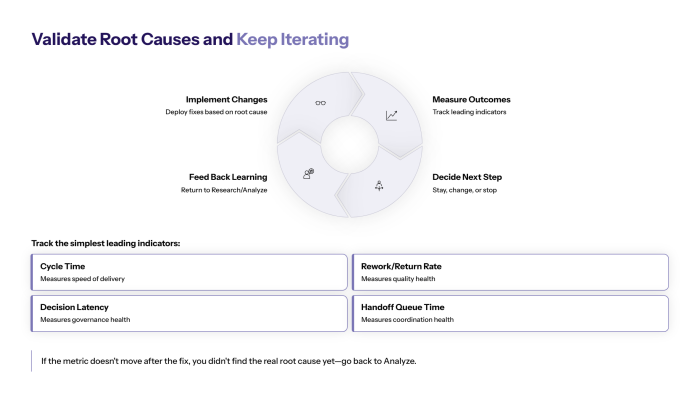
RAPID’s method is iterative: implement changes, measure outcomes, decide whether to stay, change, or stop, and feed learning back into Research/Analyze.
For root cause analysis for digital transformation, track the simplest leading indicators:
- cycle time (speed)
- rework/return rate (quality)
- decision latency (governance health)
- handoff queue time (coordination health)
If the metric doesn’t move after the fix, you didn’t find the real root cause yet—go back to Analyze.
5.2 Remember: transformation is a flywheel, not a project plan
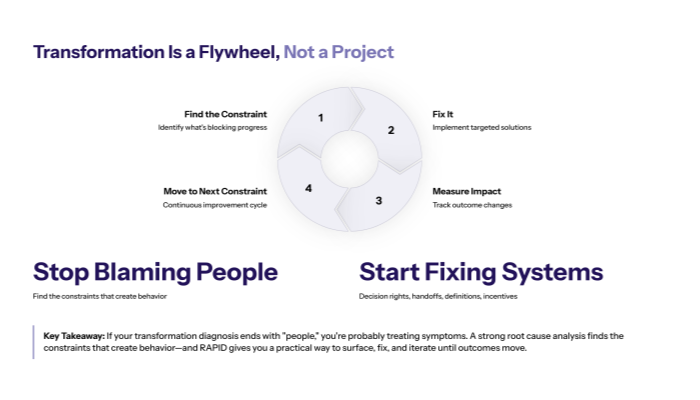
RAPID repeatedly frames itself as a flywheel process that keeps improving through feedback, better information, and better decisions.
That’s why root cause analysis is never “done.” It becomes your operating habit:
- find the constraint
- fix it
- measure the impact
- move to the next constraint
This is also how you avoid KPI theater and vanity narratives—because your analysis stays tied to outcomes and reality rather than stories.
Closing takeaway
If your transformation diagnosis ends with “people,” you’re probably treating symptoms.
A strong root cause analysis for digital transformation finds the constraints that create behavior: decision rights, handoffs, definitions, incentives, tools, and fear-based governance. RAPID gives you a practical way to surface those constraints, translate them into gap fixes, prioritize easy wins, and iterate with measurement until outcomes move.