
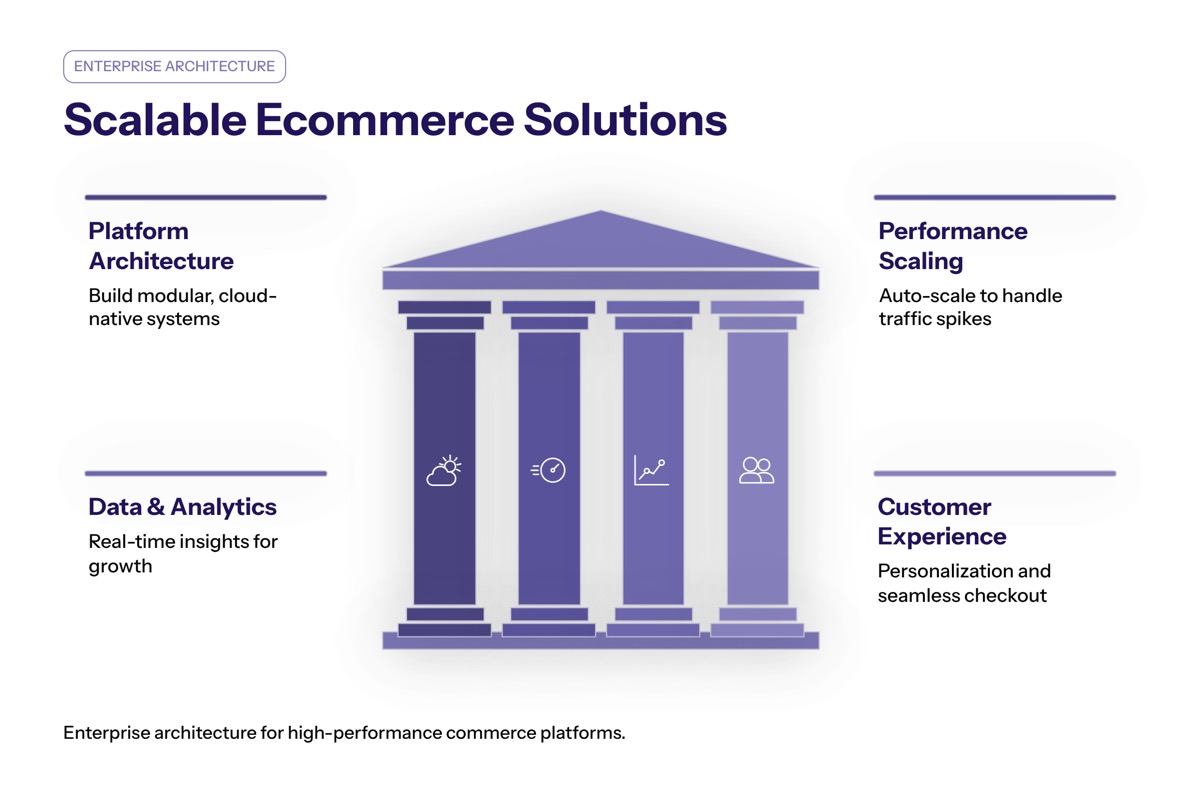
Scalable Ecommerce Solutions: Enterprise Architecture for High-Performance Commerce Platforms
Scalable ecommerce solutions are commerce systems that can handle growing traffic, higher transaction volumes, sudden traffic spikes, larger catalogs, and operational complexity without compromising performance or customer experience. For teams building ecommerce-at-scale, scalability is not only about adding more servers; it is about designing a scalable ecommerce platform that can support peak demand, new markets, mobile users, payment processing, inventory management, and faster feature delivery as the ecommerce business grows.
This article covers enterprise-grade scalable ecommerce architecture, custom platform development, AI integration, cloud native infrastructure, and post-launch optimization for mid-market and enterprise organizations. It is written for CTOs, engineering leaders, enterprise architects, and ecommerce teams managing legacy constraints, scaling limits, platform performance issues, operational complexity, or post-launch support demands.
The short answer: scalable ecommerce solutions combine modular architecture, cloud infrastructure, AI-driven automation, secure custom development, strong observability, and disciplined implementation methods to support sustainable business growth. A scalable solution should maintain reliable performance during high traffic events, adapt to market demands, and give teams room for future growth without forcing repeated replatforming.
Key outcomes from this guide:
Understand ecommerce scalability across infrastructure, operations, and development velocity.
Compare microservices, AI-first architecture, and cloud native solutions for scalable commerce systems.
Apply implementation methods such as RAPID to reduce modernization risk.
Identify common scaling challenges in legacy integration, performance under load, and compliance.
Define practical next steps for platform evaluation, roadmap planning, and ecommerce-at-scale execution.
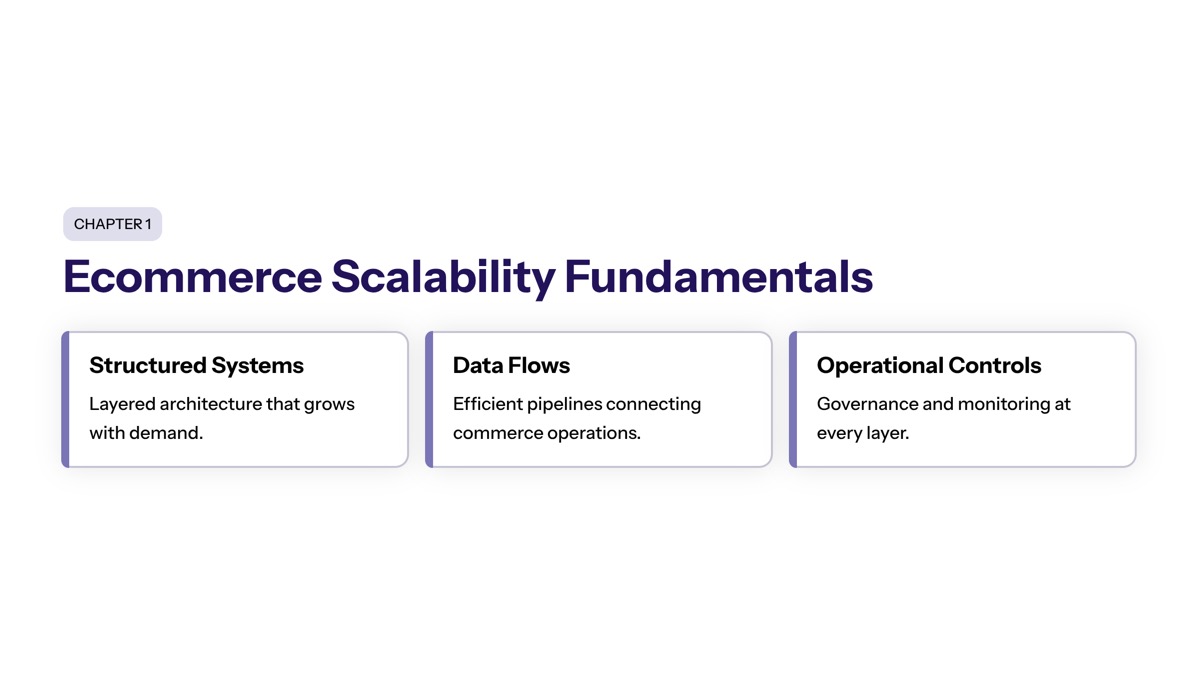
Understanding Ecommerce Scalability Fundamentals
Scalability in eCommerce refers to a platform’s ability to handle increased traffic, higher transaction volumes, and changing traffic patterns without performance degradation. Scalability in eCommerce also refers to a platform’s ability to handle increasing demands, such as more website traffic, higher order volumes, and larger product catalogs, without compromising performance or customer experience.
A scalable ecommerce platform must grow across three dimensions at the same time: infrastructure scalability, operational scalability, and development scalability. If one dimension is neglected, the whole ecommerce platform becomes fragile. A site may survive peak traffic but fail at real-time inventory management; a platform may support multiple channels but take months to release a new checkout feature; a team may introduce new functionality quickly but create security gaps and maintenance burden.
Poorly scalable eCommerce platforms can lead to diminished customer experience, as they struggle to maintain a user-friendly website over time, resulting in downtime and security breaches. If an eCommerce platform cannot scale, it hampers the ability to grow catalogs, expand to new markets, and acquire new customers, leading to missed business opportunities.
Infrastructure Scalability
Infrastructure scalability is the ability of ecommerce infrastructure to handle incoming traffic, concurrent sessions, traffic fluctuations, and transaction volume without slow load times, failed transactions, or downtime. During peak shopping periods, such as Black Friday, eCommerce platforms often experience traffic surges that can overwhelm unprepared systems, leading to slow load times or crashes.
A scalable eCommerce platform must manage data effectively, utilizing techniques such as caching frequently accessed data and distributing content through a content delivery network to handle high traffic. Performance optimization techniques such as load balancing and caching are critical for maintaining fast, seamless experiences for users during high-traffic periods, as they help distribute incoming traffic and reduce server load.
Infrastructure scalability directly affects revenue during flash sales, holiday campaigns, product launches, and other high traffic periods. Scalability is crucial for maintaining user experience; if a platform cannot handle increased traffic, it risks slow load times, failed transactions, and ultimately, lost sales. A lack of scalability can lead to slow load times, failed transactions, and ultimately lost sales, especially during high traffic events like Black Friday or holiday sales, which are critical for revenue generation.
Operational Scalability
Operational scalability is the ability to manage expanding business requirements as an ecommerce business moves into new channels, geographies, customer segments, currencies, and fulfillment models. This includes inventory management, localized checkout, tax rules, returns, pricing logic, promotions, loyalty programs, marketplace feeds, and customer service workflows.
Omnichannel selling integrates inventory and customer data across web, mobile, and physical stores. Global Infrastructure should include multi-currency, multi-language, and localized checkout options. Without this operational foundation, scaling ecommerce into new markets can create fragmented customer records, inaccurate stock positions, duplicated content work, and inconsistent experiences across mobile devices, storefronts, marketplaces, and stores.
Unscalable systems may struggle with real-time inventory management during peak demand, leading to overselling or stockouts, which frustrates customers and complicates fulfillment processes. Automated workflows in scalable ecommerce platforms reduce manual overhead by syncing orders in real-time with accounting, HR, and ERP software.
Development Scalability
Development scalability is the ability of engineering and product teams to release features, fix defects, improve performance, and maintain the ecommerce solution without excessive coordination costs. A scalable platform should let teams introduce new functionality, optimize customer journeys, update integrations, and respond to market trends without destabilizing the entire application.
A scalable eCommerce architecture should support modular design, allowing businesses to add or modify features without disrupting the entire application, which is particularly useful for frequently introducing new functionalities. Increased maintenance burdens arise from poorly scalable systems, as they grow in complexity and require more resources to patch performance issues instead of focusing on innovation.
Legacy systems that are not built for scalability can limit agility and responsiveness, causing businesses to react to issues rather than proactively prepare for growth, resulting in lost revenue and broken customer trust. Once the three dimensions of ecommerce scalability are clear, the next step is selecting the architecture that can support scalable systems in production.
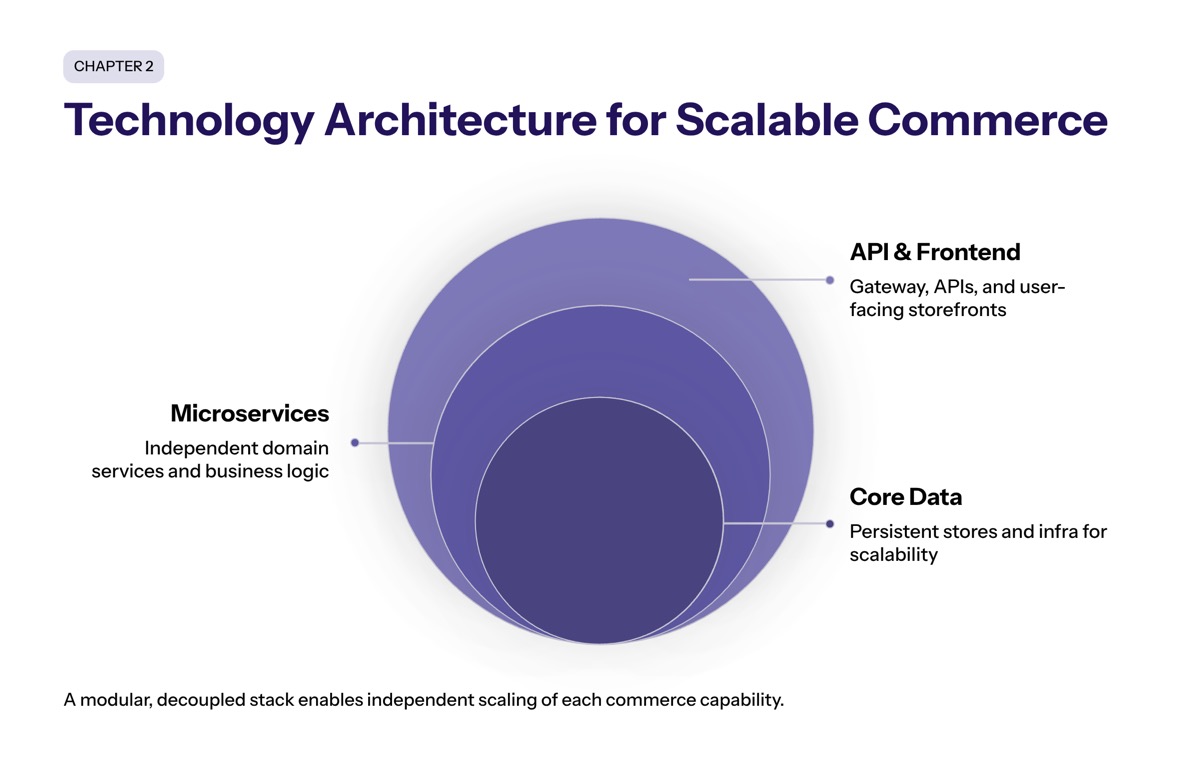
Technology Architecture for Scalable Commerce
Scalable ecommerce architecture turns the three dimensions of scalability into an executable technology model. The architecture must support high traffic events, payment processing, user authentication, inventory synchronization, frontend speed, compliance, and post-launch support. For enterprise e commerce businesses, the most common patterns are microservices architecture, AI-first architecture, and cloud-native infrastructure.
Microservices Architecture
Microservices architecture allows eCommerce platforms to break down applications into smaller, independent components that can operate and scale independently, reducing pressure on any single system component during traffic surges. Implementing a microservices architecture can enhance scalability by allowing individual services to scale independently based on demand, reducing the risk of platform-wide slowdowns during traffic surges.
In practice, a scalable ecommerce platform may separate catalog, search, cart, checkout, payment, promotions, inventory, customer profile, user authentication, and order management into distinct services. This lets the catalog service scale for browsing traffic, the checkout service scale for peak conversion windows, and the inventory service scale for real-time stock updates without forcing the whole ecommerce platform to scale as one unit.
Microservices are especially useful for enterprise teams managing complex product catalogs, multiple servers, regional storefronts, and multiple sales channels. More than 85% of enterprise ecommerce businesses are using microservices architectures according to BigCommerce industry content, which reflects the pressure many commerce platforms face as customer demand grows and monolithic systems become bottlenecks.
AI-First Architecture
AI-first architecture embeds automation and intelligence into the ecommerce solution rather than treating AI as a later add-on. AI-driven automation can support personalization, inventory forecasting, fraud detection, product recommendations, search relevance, customer segmentation, customer service workflows, and anomaly detection.
For a scalable ecommerce business, AI must reflect enterprise-specific business rules, compliance requirements, margin logic, catalog structure, and regional policies. A generic recommendation engine may improve discovery, but a custom AI implementation can account for regulated product categories, shipping constraints, loyalty programs, inventory positions, and customer expectations across markets.
AI can also support operational scalability. Forecasting models can help predict peak demand, automation can improve feed quality for marketplaces, and customer service assistants can reduce support load during traffic spikes. The key is to pair AI with governed data pipelines, auditability, monitoring for model drift, and human oversight where compliance or customer trust is at stake.
Cloud-Native Infrastructure
Cloud-native infrastructure uses cloud computing, container orchestration, managed databases, content delivery networks, automated deployments, and elastic capacity to support commerce scalability. Adopting a cloud-native infrastructure allows eCommerce platforms to dynamically allocate resources based on current traffic demands, ensuring consistent performance during traffic spikes.
Cloud-native development enables eCommerce platforms to dynamically adjust resources based on demand, ensuring consistent performance even during traffic spikes, and eliminating the need for businesses to invest in expensive on-premises hardware. Flexible infrastructure allows eCommerce platforms to respond to traffic fluctuations without manual intervention, ensuring stable performance during peak demand periods.
Cloud-based platforms manage all hosting, security, and infrastructure updates automatically. However, cloud based solutions still need careful design: load balancing, distributed caching, database replication, API governance, cost monitoring, and region-aware deployment all affect system performance. A cloud native solution can scale effectively only when architecture, operations, and development practices are aligned.
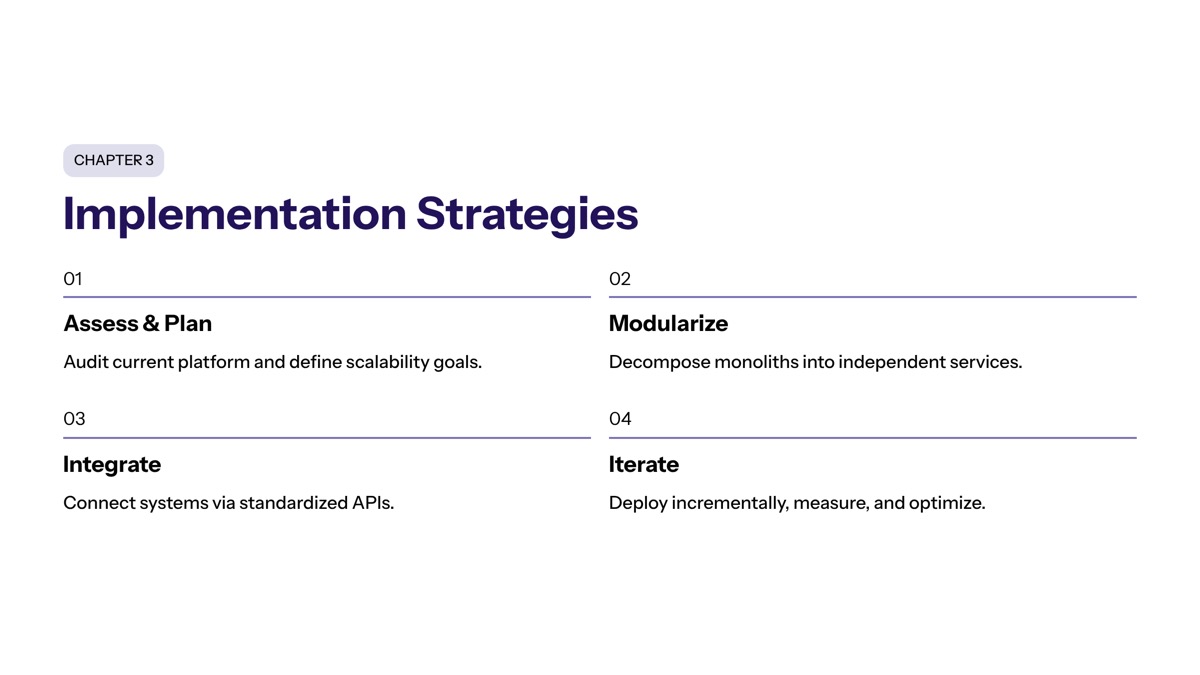
Implementation Strategies and Development Methods
A scalable e commerce platform is rarely created by a single replatforming project. Enterprise teams usually need a staged modernization approach that reduces risk while improving ecommerce scalability, performance, integrations, and operating model maturity. The RAPID framework is a practical structure for moving from current constraints to a scalable ecommerce architecture.
RAPID Framework Application
RAPID stands for Requirements, Architecture, Phases, Integration, and Deployment. It works well for ecommerce-at-scale because it forces teams to connect business growth goals with technical constraints, implementation sequencing, and post-launch support.
Requirements assessment and constraint identification
Audit current system performance, traffic patterns, checkout failures, page latency, database bottlenecks, API dependencies, SKU growth, release frequency, and infrastructure cost. Identify whether scaling limits come from frontend code, database contention, legacy integrations, server load, payment processing, search latency, or operational workflows.Architecture planning and technology stack selection
Choose whether the future ecommerce platform should use custom development, platform modification, or a hybrid model. Define the role of microservices, headless commerce, cloud platforms, PIM, ERP, CRM, analytics, AI tooling, content delivery networks, and compliance controls.Phased implementation with measurable milestones
Avoid rewriting the entire commerce platform at once. Sequence the work around measurable outcomes such as faster page load times, improved checkout completion, lower error rates, more reliable inventory sync, reduced manual work, improved release frequency, and readiness for peak traffic.Integration testing and performance optimization
Test ERP, CRM, payment gateways, tax engines, inventory systems, marketplace feeds, and customer data flows under realistic load. API Limits ensure the platform handles high-volume data syncs with your ERP. To ensure a smooth user experience during high traffic, eCommerce platforms should focus on frontend optimization, including reducing asset sizes, minimizing blocking requests, and serving static assets through a content delivery network.Deployment with monitoring and continuous improvement
Use blue-green releases, canary deployments, rollback plans, observability dashboards, synthetic monitoring, and post-launch reviews. Implementing real-time monitoring tools is essential for tracking response times, error rates, and traffic spikes, allowing businesses to react to performance issues while traffic is still active.
Custom vs. Platform Comparison
Approach | Scalability Control | Development Timeline | Long-term TCO |
|---|---|---|---|
Custom Development | Full control over architecture and performance optimization | 6-18 months for enterprise implementation | Higher upfront, lower maintenance with proper architecture |
Platform Modification | Limited by platform constraints and vendor roadmap | 3-9 months with customization limitations | Lower upfront, higher long-term due to licensing and limitations |
Hybrid Approach | Balanced control with strategic custom components | 4-12 months with focused custom development | Optimized for specific enterprise requirements |
Custom development is best when business models, compliance rules, inventory workflows, or customer experiences are too specialized for a standard e commerce platform. It gives maximum architectural control, but it requires strong engineering, DevOps, security, and product governance.
Platform modification is often faster when business requirements fit within established commerce platforms such as BigCommerce, Magento, Shopify Plus, or similar systems. BigCommerce has stated that enterprise clients maintain 99.99% annual uptime and 100% uptime during Cyber Week since 2016, which shows why many teams consider cloud based solutions during platform evaluation.
A hybrid approach is often the most pragmatic scalable ecommerce strategy. Teams can use proven SaaS or open-source components for commodity capabilities while building custom services for differentiation, such as checkout, pricing, inventory allocation, B2B workflows, or AI-driven personalization. Investing in scalable infrastructure not only prepares businesses for future growth but also allows them to seize new opportunities, deliver exceptional customer experiences, and achieve cost savings through optimized resource usage.
Common Challenges and Solutions
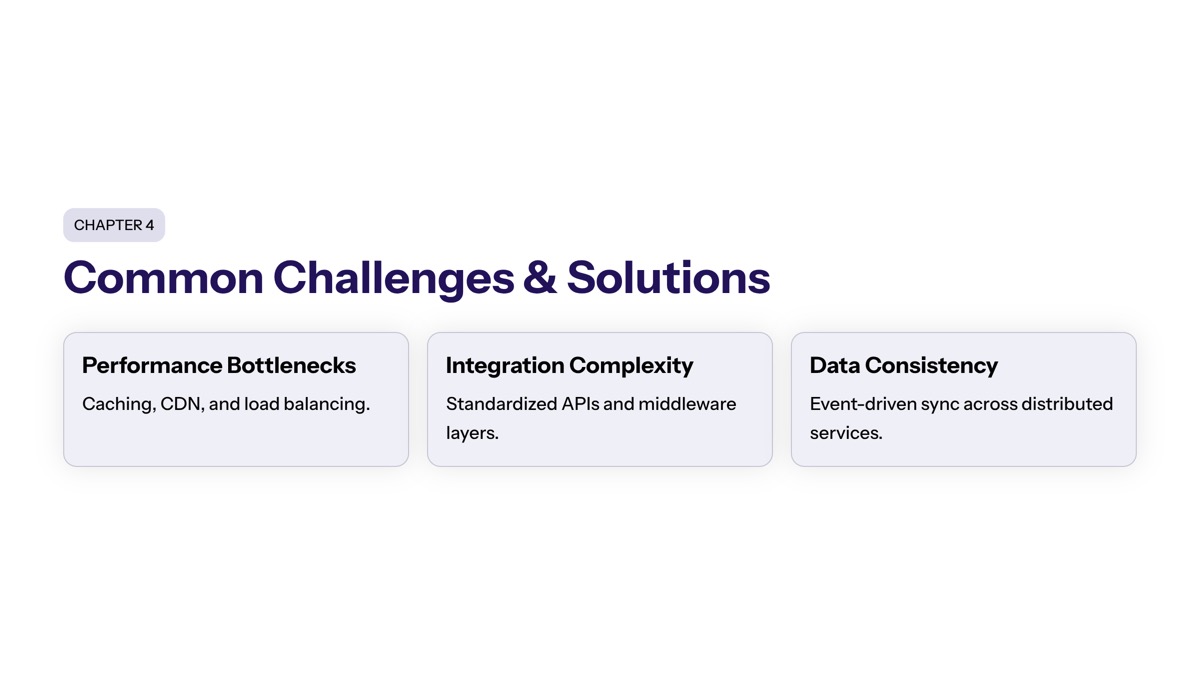
Enterprise ecommerce teams usually hit scaling limits in three places: legacy system integration, performance under load, and security or compliance. These problems are connected. A legacy ERP can slow inventory updates; slow inventory updates can damage customer loyalty; rushed workarounds can create security gaps; and weak observability can hide the root cause until peak traffic is already active.
Legacy System Integration
Many ecommerce systems depend on ERP, CRM, accounting, warehouse, HR, inventory, and fulfillment tools that were not designed for API-first commerce. The solution is to use middleware, message queues, event-driven integration, and API-first architecture to decouple legacy systems from customer-facing storefronts.
Secure data synchronization is essential. Orders, inventory, customer records, pricing, tax, returns, and fulfillment status should move through controlled integration layers rather than brittle point-to-point scripts. Gradual migration reduces risk: wrap legacy functions behind APIs, replace the highest-friction modules first, and maintain backward compatibility while the new scalable platform matures.
For enterprises, API governance matters as much as API creation. API Limits ensure the platform handles high-volume data syncs with your ERP, and the integration strategy should account for retries, rate limits, reconciliation, audit logs, and failure handling.
Performance Under Load
Performance under load depends on frontend optimization, backend architecture, database design, caching, content delivery networks, and real-time monitoring. During high traffic periods, every slow asset, blocking request, inefficient database query, or overloaded third-party service can reduce conversion and damage customer trust.
The solution starts with load balancing, caching frequently accessed data, optimizing media, reducing JavaScript payloads, minimizing blocking requests, and serving static assets through content delivery networks. Using asynchronous requests and lightweight UI updates during peak traffic can help maintain fast checkout flows and cart updates, reducing the likelihood of user drop-off.
Teams should test for peak traffic before peak traffic arrives. Load tests, stress tests, synthetic monitoring, real user monitoring, and chaos testing expose weaknesses before Black Friday, flash sales, product launches, or holiday sales. Real-time dashboards should track response times, error rates, throughput, checkout latency, payment failures, API failures, cache hit rates, and database contention.
Security and Compliance
Security and compliance must be built into scalable ecommerce solutions from the beginning. Payment processing requires PCI compliance; customer data may fall under GDPR, CCPA, HIPAA, SOX, SOC 2, or industry-specific regulation; international growth may require data residency, cross-border tax controls, and localized privacy handling.
The solution is secure-by-design architecture: encryption in transit and at rest, tokenized payments, role-based access control, least privilege, audit logging, vulnerability scanning, secure CI/CD, web application firewalls, API gateways, and regular penetration testing. For regulated sectors such as healthcare, financial services, and other high-trust industries, custom controls may be necessary to support business requirements and audit obligations.
Security also affects customer loyalty. Customers expect a seamless user experience, but customers also expect their data, payment details, and account access to be protected. A scalable ecommerce platform should improve both performance and trust as customer demand grows.
Conclusion and Next Steps
Scalable ecommerce solutions require strategic architecture decisions that combine technology, process, and team capability. A scalable e commerce platform is not only faster during traffic surges; it is more adaptable to new markets, more reliable under peak demand, more efficient for operations, and easier for teams to evolve after launch.
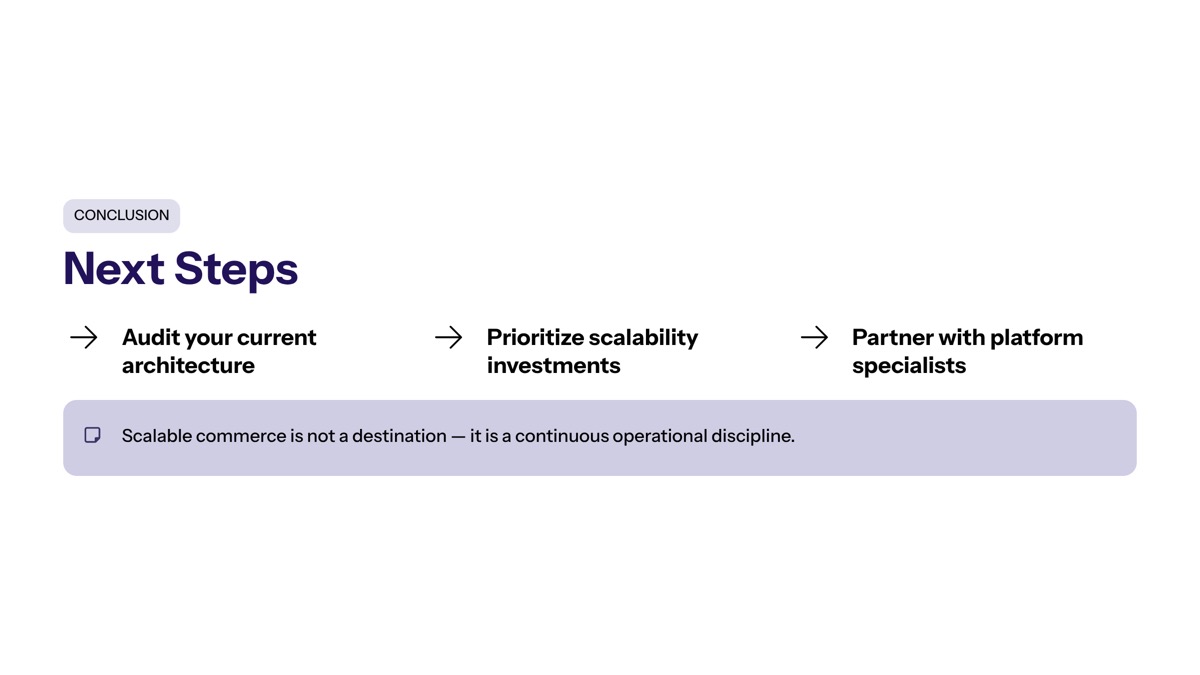
Immediate next steps:
Assess the current ecommerce platform. Measure page speed, checkout latency, error rates, failed transactions, infrastructure cost, release frequency, integration failures, SKU growth, and customer experience gaps.
Identify scalability constraints. Determine whether limits are caused by monolithic architecture, database design, frontend performance, inventory management, legacy systems, API bottlenecks, cloud infrastructure, or team workflow.
Plan the scalable ecommerce roadmap. Decide whether custom development, platform modification, or a hybrid approach best matches business growth, compliance needs, market demands, and future growth projections.
Prioritize performance and observability. Implement monitoring, load testing, caching, load balancing, content delivery networks, and alerting before the next high traffic event.
Design for operational scale. Support omnichannel selling, localized checkout, multi-currency operations, multi-language content, automated workflows, and real-time inventory visibility.
Build post-launch optimization into the operating model. Treat scalable ecommerce as an ongoing capability, not a one-time project.
Related topics worth exploring next include AI-driven automation implementation, cloud migration strategies, enterprise software modernization, composable commerce, MACH architecture, and ecommerce-at-scale operating models.
Additional Resources
Enterprise ecommerce architecture assessment frameworks: Use these to evaluate infrastructure scalability, operational complexity, development velocity, security posture, and platform fit.
Performance benchmarking tools for traffic and transaction testing: Use load testing, stress testing, synthetic monitoring, real user monitoring, and checkout-specific performance tests to validate readiness for peak demand.
Compliance checklists for regulated industries implementing scalable commerce platforms: Include PCI, GDPR, CCPA, HIPAA, SOC 2, audit logging, data residency, vendor risk, and secure development controls.