Secure AI Implementation: A Complete Guide for Regulated Enterprises
Secure AI implementation requires layered security controls, compliance-first architecture, and continuous monitoring across the full AI lifecycle. For regulated enterprises, the goal is not simply to deploy artificial intelligence faster; it is to deploy secure AI systems that protect sensitive data, preserve data integrity, meet regulatory requirements, and keep model behavior accountable.
This guide covers the core areas regulated teams need to evaluate before deploying AI systems: data governance, access controls, model behavior monitoring, vendor risk assessment, auditability requirements, and human oversight mechanisms. It is written for healthcare, financial services, logistics, education, critical infrastructure, and other compliance-heavy organizations where AI adoption must align with HIPAA, the general data protection regulation, SOX, PCI DSS, the EU AI Act, and internal risk management expectations.
In practical terms, secure AI implementation means using a structured framework that protects data, algorithms, and infrastructure while balancing innovation with rigorous risk management. It combines traditional cybersecurity focus areas with techniques designed for machine learning vulnerabilities, because ai specific threats such as prompt injection, data poisoning, model inversion, and adversarial inputs are not fully addressed by traditional security measures alone.
Readers will gain a working view of how to:
Select a relevant risk management framework, such as the NIST AI Risk Management Framework or other AI governance frameworks
Build an implementation roadmap for secure AI across planning, development, deployment, and monitoring
Design security controls for sensitive information, model endpoints, AI agents, and enterprise systems
Evaluate ai vendors, cloud AI services, on-premises AI, and hybrid deployment models
Establish continuous monitoring, audit trails, human oversight, and incident response plans for AI-specific threats
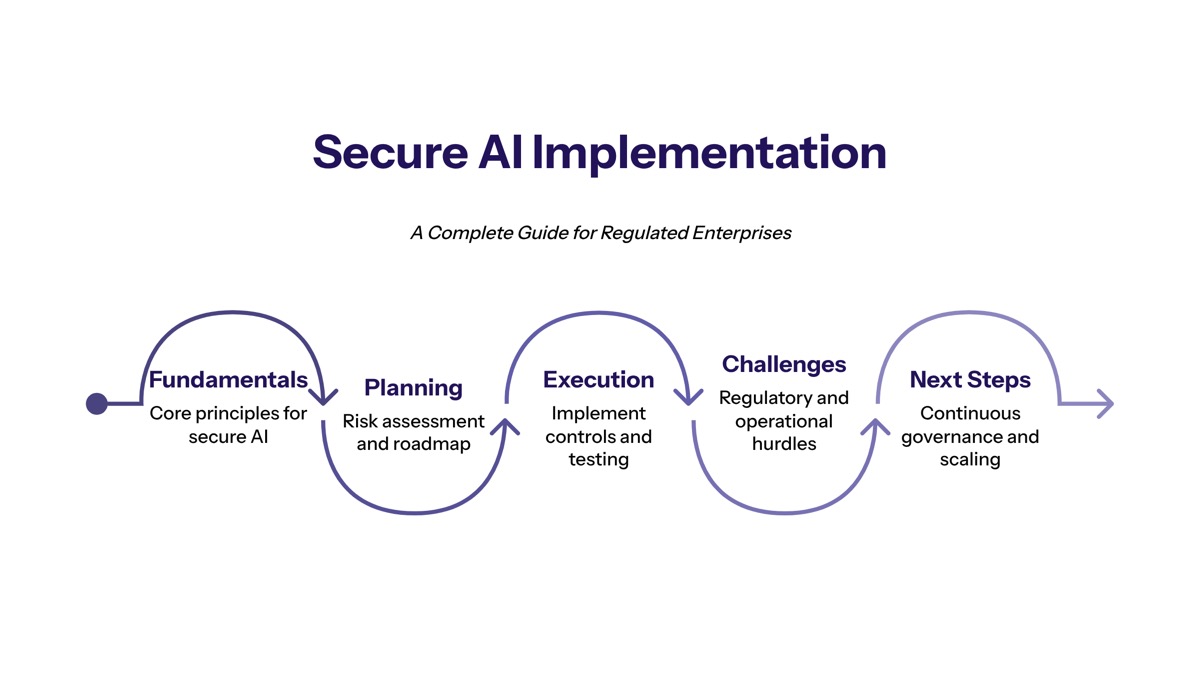
Understanding Secure AI Implementation Fundamentals
Secure AI implementation is the systematic deployment of ai systems with built-in data security, access governance, model oversight, compliance management, and security monitoring. In regulated environments, this means every stage of the AI lifecycle-from data ingestion and model development to inference, vendor integration, audit logging, and retirement-must be governed by policies, technical controls, and evidence that regulators, customers, and internal security teams can trust.
This matters because regulated enterprises are under pressure to modernize with ai technologies while still protecting sensitive data and meeting compliance requirements. Healthcare organizations must protect PHI under HIPAA. Financial institutions must preserve control integrity under SOX and protect payment data under PCI DSS. Organizations operating in Europe must consider the general data protection regulation and the EU AI Act, which officially came into force in August 2024 and is considered the world’s first comprehensive regulatory framework for AI, implementing strict governance, risk management, and transparency requirements for AI systems.
AI governance is essential for achieving compliance, trust, and efficiency in the development and application of AI technologies, as it addresses challenges related to explainability, ethics, and bias that hinder AI adoption. High-profile incidents, such as Microsoft’s Tay Chatbot and flaws in the AI COMPAS software, highlight the potential social and ethical harm caused by ungoverned AI systems, underscoring the importance of governance in building public trust.
Core Security Principles
Secure AI begins with data residency, data sovereignty, and data sensitivity decisions. Regulated teams must know where training data, inference inputs, outputs, logs, and model artifacts are stored and processed. For some ai workloads, “data stays in the EU” or “data stays in the United States” is not a preference; it is a regulatory, contractual, or sovereign AI requirement.
Zero-trust architecture is also central to ai security. Organizations should adopt zero trust principles for AI agents, treating every request as potentially hostile and implementing dynamic policy evaluation to ensure that only authorized actions are permitted. This applies to users, service accounts, model endpoints, data pipelines, internal systems, and ai software components that interact with proprietary ai models or third-party ai solutions.
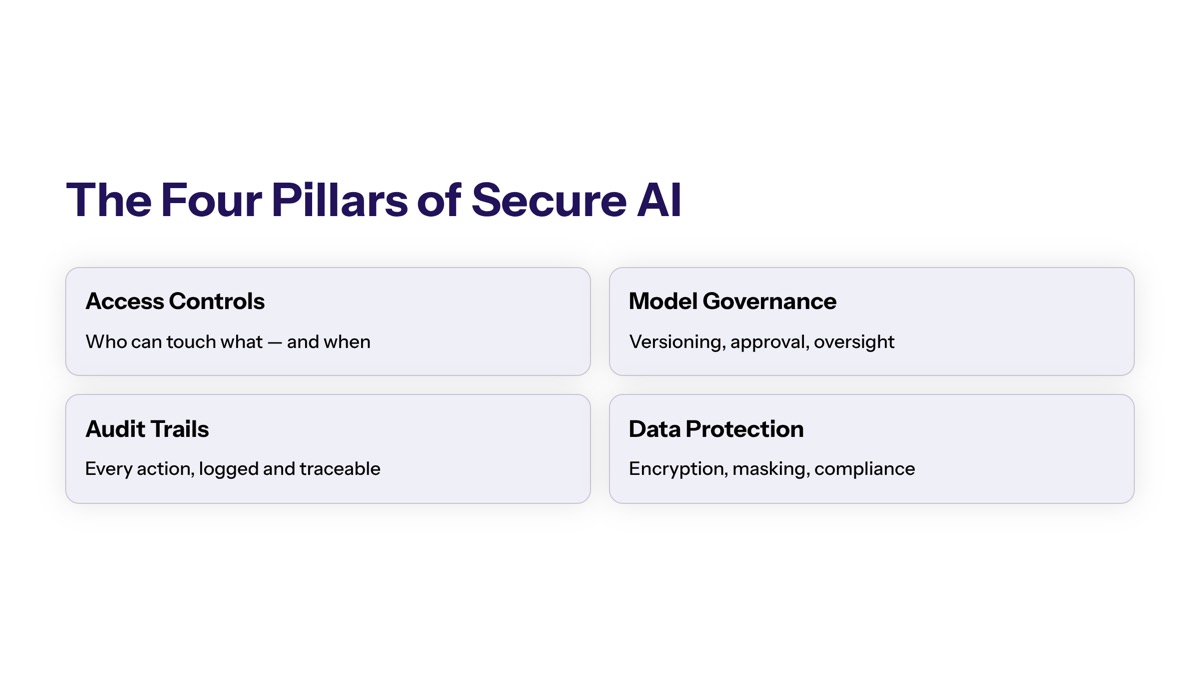
The principle of least privilege should guide every identity, workflow, and application connection. Access control should be enforced using the principle of least privilege in AI systems, and access control through identity and access management (IAM) is vital for AI security. Strict access controls and restricted access should determine who can view sensitive data, retrain ai models, deploy new model versions, approve high-impact outputs, or access logs.
These principles must be connected to regulatory frameworks and governance structures. The NIST AI Risk Management Framework (AI RMF), released on January 26, 2023, aims to improve the ability to incorporate trustworthiness considerations into the design, development, use, and evaluation of AI products, services, and systems. AI governance frameworks, such as the NIST AI RMF and the OECD Principles on Artificial Intelligence, provide guidance on transparency, accountability, fairness, privacy, security, and safety in AI systems.
Implementation Lifecycle Security
Securing ai systems requires protecting data, models, and software infrastructure throughout the lifecycle. Security controls should be embedded from planning through model development, testing, deployment, monitoring, incident response, and decommissioning. This lifecycle view is especially important because ai system risks can emerge from training data, runtime prompts, data pipelines, APIs, dependencies, model outputs, and vendor policy changes.
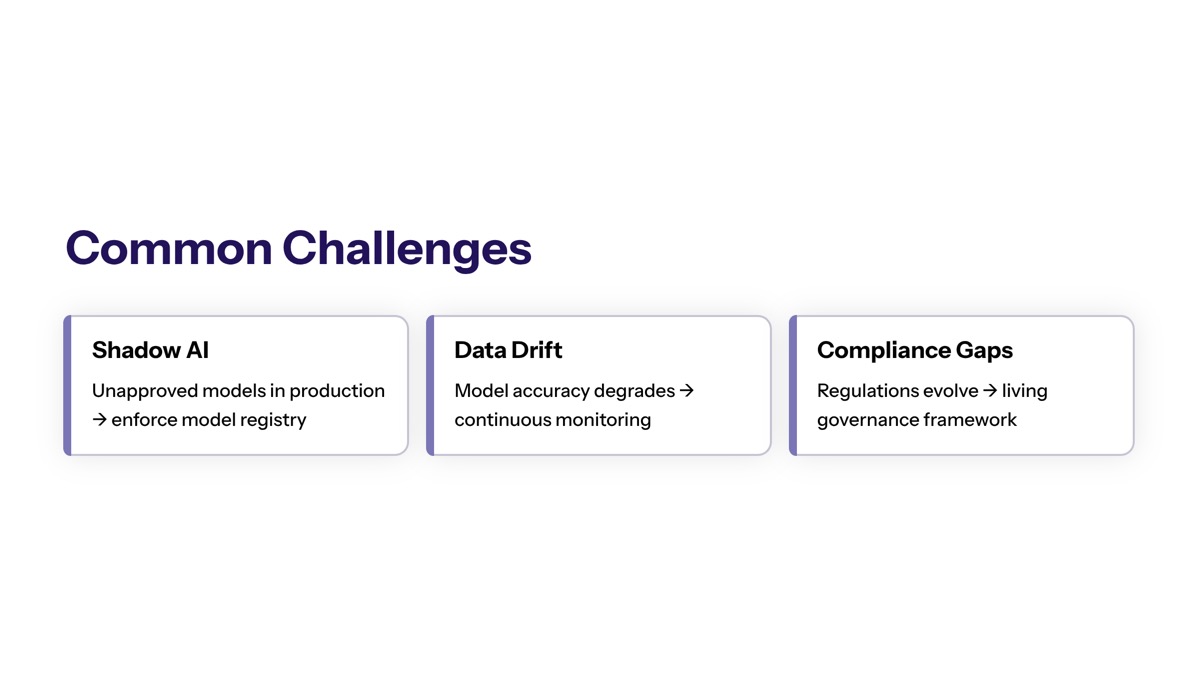
MLSecOps extends DevSecOps practices into artificial intelligence systems. Security professionals and data teams should validate sources of training data to help prevent poisoning attacks in AI models. Data cleaning is necessary to prevent malicious inputs in training data for AI systems. Implementing strict version control for datasets helps maintain traceability and data integrity, while maintaining documentation of AI models and their versions is critical for accountability and security.
Continuous compliance validation is equally important. Continuous independent security reviews of AI models should be conducted for auditing purposes. Establishing clear channels for reporting AI-specific security flaws is important design, and clear rules for acceptable AI use should be defined through established policies. According to a report from the IBM Institute for Business Value, 80% of organizations have a separate part of their risk function dedicated to risks associated with the use of AI or generative AI, which reflects how quickly AI risk is becoming a formal enterprise discipline.
These fundamentals create the basis for implementation planning: regulated organizations need architecture that controls data access, protects model behavior, documents decisions, and produces audit-ready evidence.
Implementation Planning and Architecture
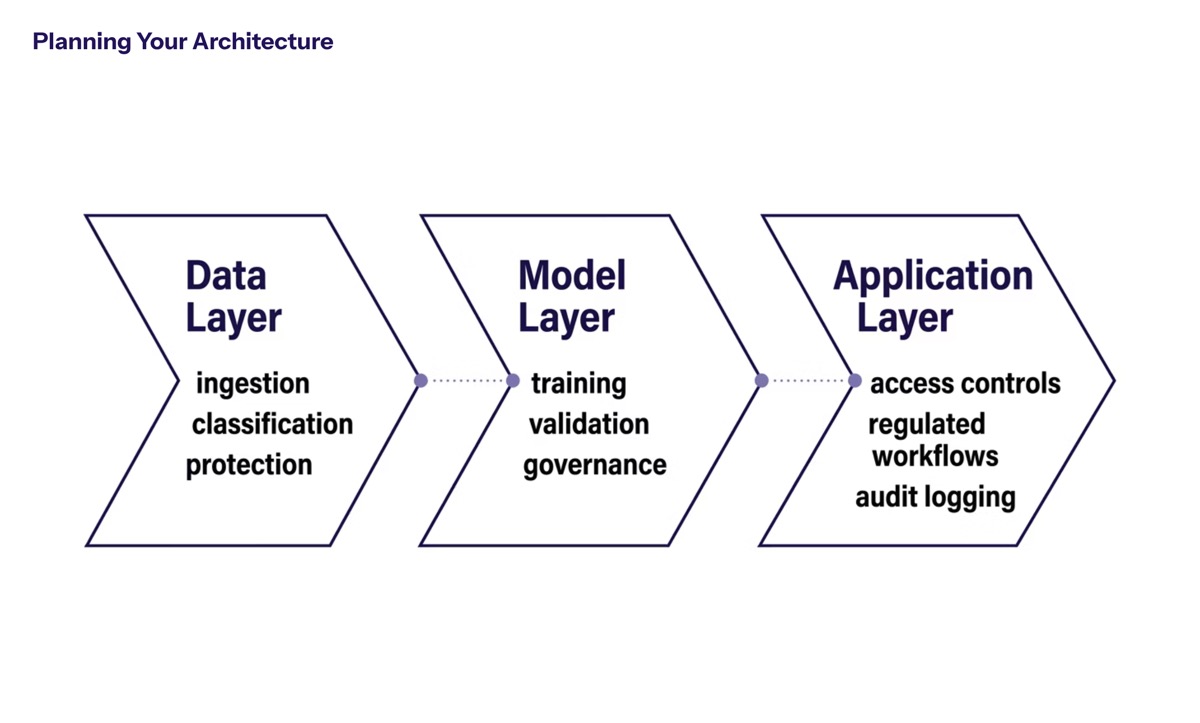
Once the security fundamentals are clear, implementation planning turns them into operating design. A secure ai architecture should show what data can feed into ai systems, how data moves through data pipelines, who can access ai infrastructure, how ai models are validated, which ai vendors are involved, and how the organization will respond to security incidents.
The planning phase should also define governance structures. AI governance involves establishing robust control structures, including policies, guidelines, and frameworks, to continuously monitor and evaluate AI systems, ensuring compliance with ethical norms and legal regulations. Organizations can adopt various frameworks for AI governance, such as the NIST AI Risk Management Framework and the OECD Principles on Artificial Intelligence, which provide guidance on transparency, accountability, and fairness in AI systems.
Data Control Architecture
Data classification is the starting point. Data classification involves determining what data can feed into AI systems, including highly regulated data, regulated personal data, internal business data, proprietary records, and public information. A practical framework may classify data as highly regulated, regulated PII, internal use only, or public, with stricter handling rules as data sensitivity increases.
Encryption is mandatory for regulated AI workloads. Encrypting data both at rest and in transit is crucial for data security in AI. Sensitive data should use strong encryption at rest, protected storage, and encrypted backups, while data in transit should use modern TLS configurations. For high-risk model training or private analytics, privacy techniques like differential privacy ensure compliance with regulatory standards during AI training, and anonymizing inputs by stripping personally identifiable information is important before processing.
Data lineage and provenance documentation are also audit requirements. Teams should record where training data originated, how it was transformed, which datasets were used for model development, and which model versions consumed which data. To prevent data poisoning, organizations must prioritize data quality and oversight, employing rigorous validation protocols and real-time monitoring of data pipelines to identify and neutralize threats before they compromise model integrity.
Access Control Design
Access control design defines who can use, change, monitor, or approve AI capabilities. Role based access controls should separate model developers, data stewards, security teams, auditors, inference users, and business approvers. The person who can query an ai model should not automatically be able to access raw training data, modify deployment settings, or approve production releases.
Multi factor authentication should be required for AI system administration, privileged data access, model deployment, and access to sensitive governance consoles. Implementing strong authentication mechanisms, such as multi-factor authentication (MFA) and automated API key lifecycle management, is essential for securing AI systems against unauthorized access and potential breaches.
APIs connecting applications to AI models need to be secured to prevent unauthorized access. API security involves using strong authentication and encryption to protect APIs used by AI systems. Teams should also add rate limiting, logging, input validation, authorization checks, and monitoring for abnormal usage. Sanitizing prompts is necessary to block input attacks like prompt injection, especially for generative ai tools and ai agents that can call tools, retrieve documents, or trigger internal workflows.
Model Behavior Governance
Model behavior governance focuses on whether ai models perform safely, fairly, and predictably after deployment. Model validation frameworks should test for accuracy, bias, robustness, fairness, and security risks before release. Strengthening AI systems against adversarial attacks can be achieved through adversarial training, which simulates attack scenarios during the development phase, allowing AI models to learn to identify and counteract malicious inputs.
Monitoring AI systems for runtime anomalies helps detect unexpected behaviors and security threats. Real-time monitoring and threat detection are critical for AI systems, requiring the deployment of machine learning-based security analytics to establish baseline behaviors and detect anomalies that exceed established thresholds. Automated monitoring should include drift detection, prediction changes, prompt abuse, abnormal API calls, data leakage patterns, and unexpected access to sensitive information.
Explainability and documentation are necessary for regulatory compliance and human oversight. Documenting AI model decision-making processes promotes transparency. Data extraction prevention measures guard against model inversion and theft attempts. Testing new AI models in contained environments prevents risks associated with untested systems, while model versioning and rollback procedures allow teams to recover from security incidents, compliance failures, or degraded performance.
This architecture becomes actionable when translated into a structured execution framework.
Implementation Execution Framework
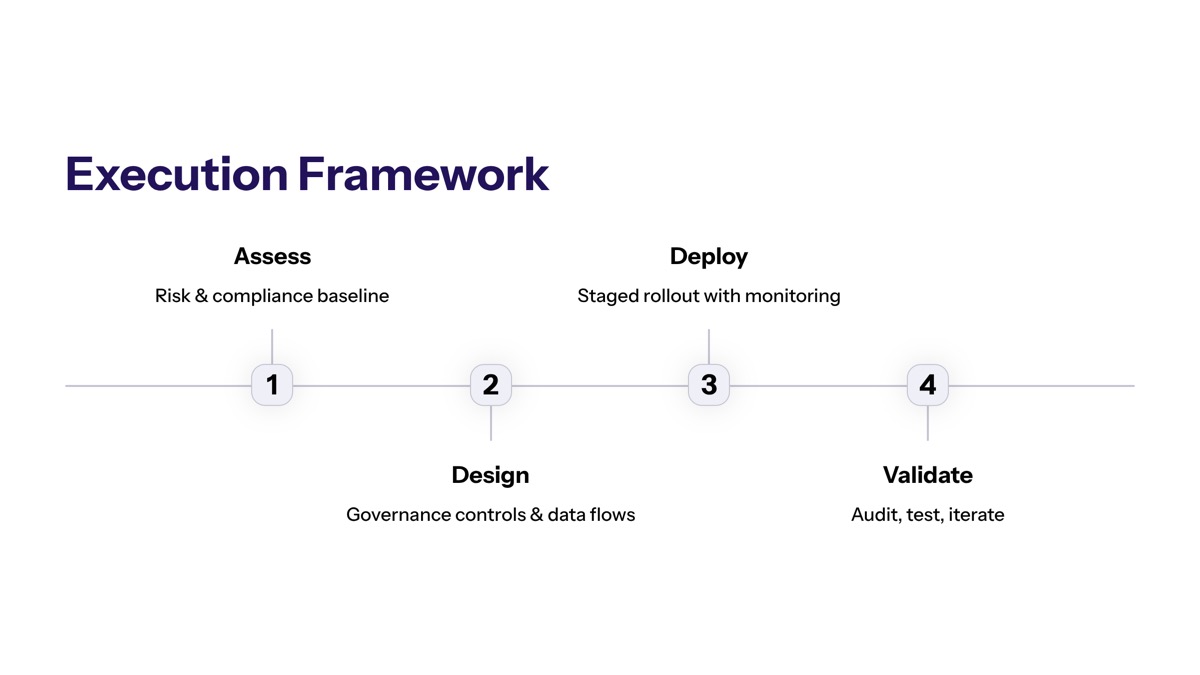
Secure AI implementation works best as a staged program rather than a one-time technical project. A useful approach is similar to RAPID: recognize constraints, allocate accountable teams, plan controls, implement incrementally, and deliver production systems with governance. The same logic applies across ai infrastructure, enterprise systems, cloud platforms, on-premises environments, hybrid models, and third-party ai vendors.
Designating a responsible team for AI risk is essential for secure AI implementation. That team should include security professionals, legal and compliance leaders, data governance owners, model development specialists, business process owners, and audit stakeholders. The group should define risk tolerance, approve high-risk use cases, review vendor evidence, monitor shadow AI tools, and ensure that ai innovation does not bypass regulatory compliance.
Pre-Implementation Security Assessment
A comprehensive security review should happen before deploying ai systems into production, especially when the use case involves sensitive information, customer rights, financial decisions, healthcare workflows, critical infrastructure, or proprietary ai models. The assessment should combine traditional security controls with AI-specific evaluations of model behavior, training data, prompt handling, data access, and runtime monitoring.
Conduct regulatory compliance gap analysis against current infrastructure. Map each AI use case to HIPAA, GDPR, SOX, PCI DSS, the EU AI Act, CCPA, and internal compliance requirements where relevant. Identify gaps around automated decision-making, explainability, data retention, audit trails, human oversight, and data subject rights.
Perform vendor security assessment including SOC 2, penetration testing, and compliance certifications. Review whether SOC 2 Type II, ISO 27001, ISO 42001, penetration testing, data processing agreements, subprocessor lists, and security documentation actually cover the vendor’s AI features. Vendors that cannot explain data handling, model training, prompt retention, or output evaluation introduce residual ai risk that must be accepted or rejected.
Design network segmentation and data flow architecture for AI workloads. Separate development, training, testing, staging, and production environments. Use network segmentation, secure enclaves, private endpoints, or isolated processing for high-sensitivity workloads. Shadow AI tools should be monitored to track unauthorized usage within organizations.
Establish monitoring and alerting infrastructure for security events. Use SIEM integration, model monitoring dashboards, audit trails, threat detection, and alert thresholds for runtime anomalies. Developing incident response plans for AI-specific threats ensures readiness against attacks, including prompt injection, data leakage, data poisoning, adversarial attacks, model theft, malicious code in dependencies, and unauthorized model access.
Vendor Risk Evaluation Framework
AI vendor evaluation is especially important in regulated environments because cloud AI services, SaaS products, and embedded generative ai features may process sensitive data or influence regulated decisions. Security teams should evaluate not only a vendor’s general security posture but also ai specific vulnerabilities, training data practices, model documentation, data retention, opt-out controls, and incident handling.
Risk Category | On-Premises AI | Cloud AI Services | Hybrid Deployment |
|---|---|---|---|
Data Residency Control | Full control | Limited control | Selective control |
Compliance Certification | Self-managed | Vendor-dependent | Shared responsibility |
Audit Trail Access | Complete access | Vendor-provided logs | Mixed sources |
Cost Predictability | High upfront, stable | Usage-based variability | Blended model |
On-premises AI provides the strongest direct control over data residency, audit trail access, and internal security controls, but it requires higher investment in ai infrastructure, security professionals, monitoring tools, and operational support. Cloud AI services can improve operational efficiency and accelerate ai adoption, but they introduce vendor risk, subprocessor exposure, policy dependency, and possible gaps in audit evidence. Hybrid deployment often gives the best balance for regulated enterprises: sensitive data and high-risk ai workloads can remain under internal control, while lower-risk workloads can use scalable cloud services.
Vendor evaluation should also include acceptable AI use policies, staff training, and data leakage controls. Educating staff on risks related to data leakage is crucial for organizational security. Scanning dependencies for vulnerabilities is a part of maintaining secure AI libraries, especially when ai development uses open-source models, packages, plugins, connectors, or orchestration tools.
Common Implementation Challenges and Solutions
Regulated enterprises often understand the need for secure ai, but implementation becomes difficult when AI capabilities spread across departments, vendors, data environments, and business processes. The most common challenges involve audit readiness, human oversight, and explaining model behavior in a regulatory environment that increasingly expects trustworthy AI.
Compliance Documentation and Audit Readiness
Regulators and auditors need evidence: who accessed sensitive data, which model version was used, what training data supported the model, how the decision was made, which controls were active, and whether exceptions were approved. Manual documentation is fragile, especially when ai adoption accelerates across multiple teams.
The solution is automated audit trail collection with tamper-proof logging and centralized SIEM integration for regulatory examinations. Maintain model cards, dataset records, data lineage, access logs, change approvals, and incident records. Continuous independent security reviews of AI models should be conducted for auditing purposes, and maintaining documentation of AI models and their versions is critical for accountability and security.
Human Oversight Integration
Human oversight is required when ai systems influence rights, safety, money, healthcare, employment, education, credit, insurance, or other high-impact decisions. Fully automated workflows can create legal, ethical, and operational risks if model behavior is wrong, biased, or manipulated.
Design human-in-the-loop workflows with clear escalation paths, approval thresholds, and override capabilities for critical decisions. For example, a financial model may recommend a fraud action, but a qualified human may approve the final decision above a defined value threshold. A healthcare ai system may highlight a clinical concern, but a clinician remains responsible for diagnosis or treatment decisions. These workflows should clearly record whether a decision was made by a human, an ai model, or a combined process.
Model Transparency and Explainability
Many machine learning models, deep learning systems, and generative ai applications are difficult for business users, auditors, and customers to interpret. This creates problems under governance frameworks that expect transparency, accountability, fairness, privacy, security, and safety in AI systems.
Deploy explainable AI frameworks like LIME or SHAP with business-friendly dashboards for regulatory compliance and stakeholder communication. Use counterfactual explanations where useful, such as showing what factors would need to change for a different outcome. For generative ai, document prompt design, retrieval sources, guardrails, evaluation methods, known limitations, and hallucination controls. Documenting AI model decision-making processes promotes transparency and helps connect technical model behavior to compliance management.
Conclusion and Next Steps
Secure AI implementation is a lifecycle discipline that combines data governance, access management, vendor evaluation, model behavior controls, auditability, human oversight, and continuous monitoring. Regulated organizations cannot rely on traditional security measures alone; they need ai governance, AI-specific risk assessment, secure data pipelines, strong authentication, explainability, and incident response plans built around how artificial intelligence systems actually operate.
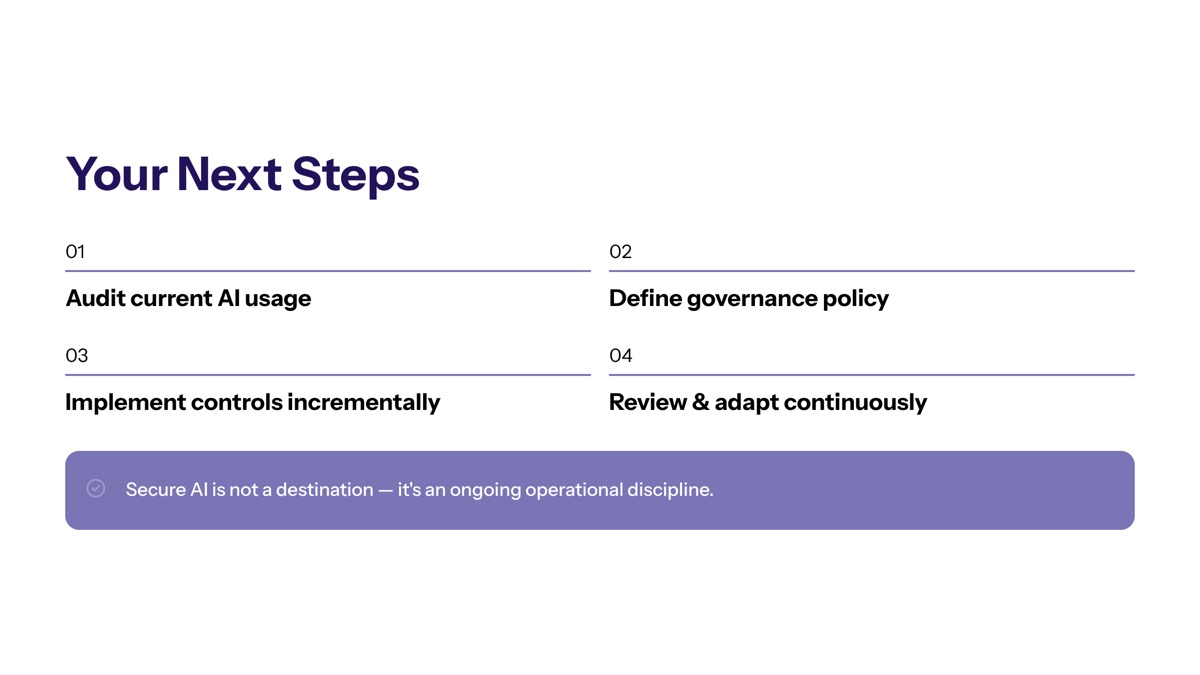
Immediate next steps:
Conduct a security and compliance gap assessment for current and planned AI use cases.
Designate a responsible team for AI risk across security, legal, compliance, data, engineering, and business leadership.
Define acceptable AI use policies, data classification rules, and strict access controls before scaling adoption.
Evaluate ai vendors for AI-specific evidence, including model documentation, data handling, prompt security, certifications, and audit access.
Establish continuous monitoring, real time monitoring, threat detection, model drift alerts, and incident response workflows.
Related topics worth addressing next include AI governance policies, incident response planning for AI-specific threats, vendor risk management, model monitoring, data leakage prevention, and ongoing compliance management as the regulatory environment continues to evolve.
Additional Resources
NIST AI Risk Management Framework implementation guide, including the AI RMF released on January 26, 2023
OECD Principles on Artificial Intelligence for transparency, accountability, fairness, privacy, security, and safety
Industry-specific compliance checklists for healthcare under HIPAA, financial services under SOX, payment environments under PCI DSS, and data protection under GDPR
EU AI Act readiness materials for governance, transparency, and risk management obligations after the law came into force in August 2024
Vendor security assessment templates covering SOC 2 Type II, ISO 27001, ISO 42001, penetration testing, subprocessor lists, data retention, and AI model documentation
AI model monitoring and alerting examples for drift detection, runtime anomalies, prompt injection attempts, data poisoning indicators, and unauthorized access