Sequencing Change: Why “Big Bang” Rollouts Fail?
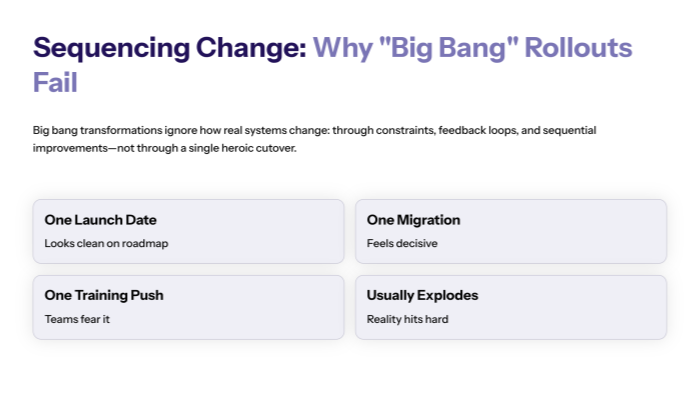
A “big bang” rollout is tempting because it feels decisive:
- one launch date
- one migration
- one training push
- one platform to rule them all
Leaders like it because it looks clean on a roadmap. Teams fear it because it usually explodes in execution.
In RAPID terms, big bang transformations fail because they ignore how real systems change: through constraints, feedback loops, and sequential improvements—not through a single heroic cutover. RAPID is explicit that big, complex problems are solved by many small steps and that progress requires discipline, measurement, and iteration.
This post explains why big bang rollouts fail, how to sequence change effectively, and how RAPID turns transformation into a shipping system instead of a gamble.

Why “big bang” rollouts are attractive and dangerous?
1.1 The big bang promise is simplicity (but reality is intertwined systems)
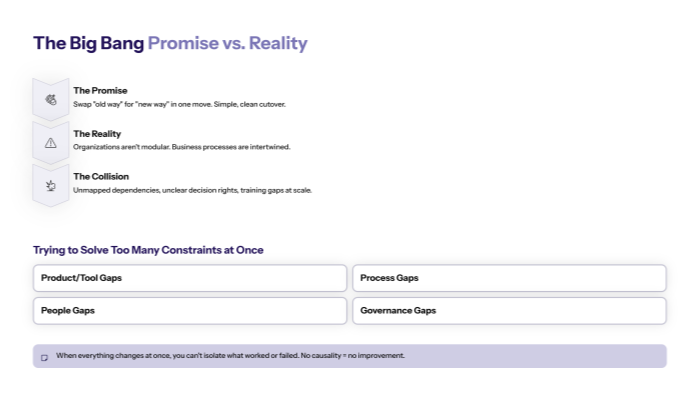
Big bang plans assume you can swap “the old way” for “the new way” in one move.
But organizations aren’t modular. RAPID is clear that business processes are intertwined, and if you improve one process without accounting for others, you often create new problems—because everything connects.
So a big bang rollout usually collides with reality:
- dependencies you didn’t map
- teams with different definitions of “done”
- reporting systems that don’t reconcile
- decision rights that are unclear
- training gaps that surface only at scale
What looked like a clean cutover becomes a system-wide fragility event.
1.2 Big bang fails because it tries to solve too many constraints at once
RAPID’s logic is constraint-first: identify what’s limiting outcomes now, remove it, measure, and move to the next bottleneck.
Big bang rollouts violate that logic. They attempt to fix:
- product/tool gaps
- process gaps
- people gaps
- governance gaps
…all at the same time.
When everything changes at once, you can’t isolate what worked or failed. And if you can’t isolate causality, you can’t improve—only react.
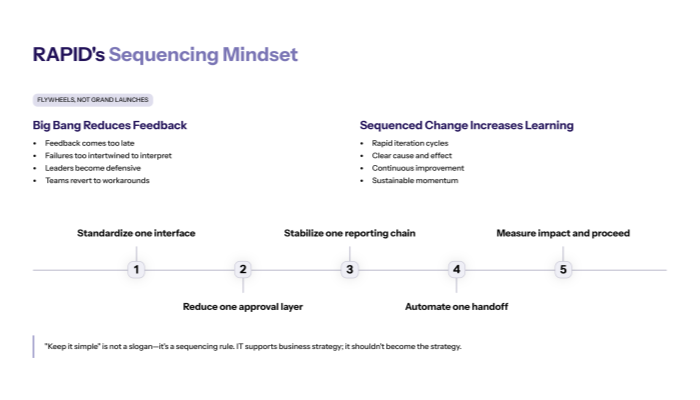
RAPID’s sequencing mindset (flywheels, not grand launches)
2.1 The transformation flywheel requires feedback, not heroics
RAPID is built as an iterative system: Research and Analyze surface truth and constraints, then Plan/Implement/Decide turns that into execution and re-decision based on results.
That structure is fundamentally incompatible with big bang rollouts because big bang reduces feedback:
- feedback comes too late
- failures are too intertwined to interpret
- leaders become defensive (too much sunk cost)
- teams revert to workarounds to survive
Sequenced change does the opposite: it increases learning velocity.
2.2 “Keep it simple” is not a slogan—it’s a sequencing rule
RAPID explicitly advises: if technology is involved, keep it simple—IT supports business strategy; it shouldn’t become the strategy.
Sequencing change is how you keep it simple:
- standardize one interface
- reduce one approval layer
- stabilize one reporting chain
- automate one repetitive handoff
Then measure impact and proceed.
Big bang rollouts are complexity compounding. Sequencing is complexity containment.
The failure modes of big bang rollouts (what breaks first)
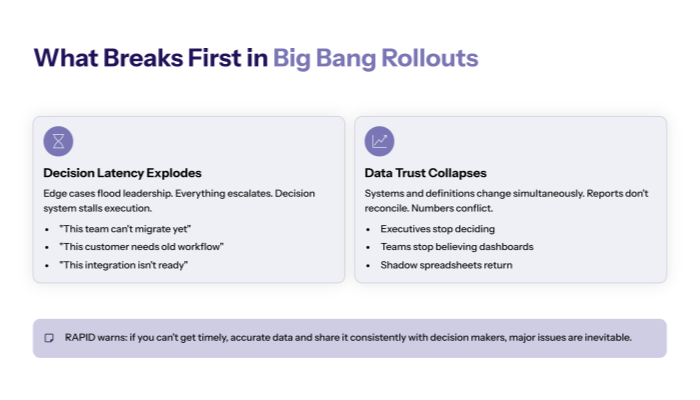
3.1 Decision latency explodes (because exceptions flood leadership)
Big bang creates edge cases at scale:
- “this team can’t migrate yet”
- “this customer needs the old workflow”
- “this compliance step doesn’t fit”
- “this integration isn’t ready”
If decision rights aren’t designed, everything escalates. That creates decision latency and stalls execution.
RAPID treats decision-making as central: decisions drive outcomes, and if critical decisions never get made, outcomes never happen.
So the first thing that breaks in a big bang is often the decision system—because it was never designed.
3.2 Data trust collapses (because reporting changes without agreement)
Big bang rollouts often change systems and definitions simultaneously:
- “pipeline” in the new CRM doesn’t match old definitions
- finance reports don’t reconcile with ops data
- leadership sees conflicting numbers
RAPID warns that if you can’t get timely, accurate data and share it consistently with decision makers, major issues are inevitable.
When data trust collapses:
- executives stop deciding
- teams stop believing dashboards
- shadow spreadsheets return
- rollout momentum dies
Big bang turns “data mismatch” from an annoyance into a systemic shutdown.
How to sequence change the RAPID way? (constraint-first shipping)
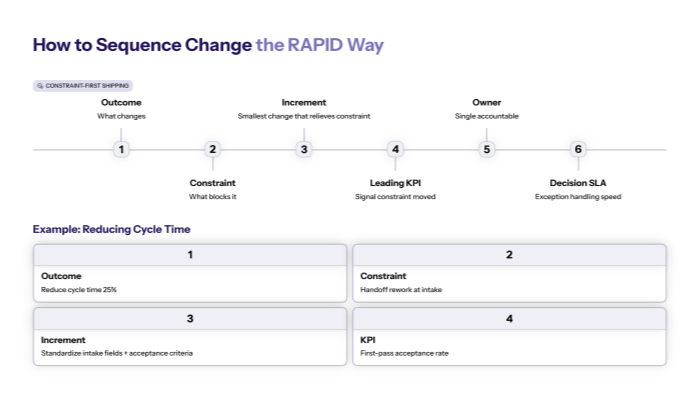
4.1 Build a minimum viable roadmap: outcomes → constraints → increments
Sequencing starts by defining measurable outcomes tied to customer value, then identifying constraints and choosing the smallest increments that remove them. RAPID emphasizes aligning around measurable outcomes (not vanity metrics) to reduce doubt and keep execution grounded.
A practical sequencing framework:
- Outcome (what changes)
- Constraint (what blocks it)
- Increment (smallest change that relieves the constraint)
- Leading KPI (signal the constraint moved)
- Owner (single accountable)
- Decision SLA (how fast exceptions are handled)
Example:
- Outcome: reduce cycle time 25%
- Constraint: handoff rework at intake
- Increment: standardize intake fields + acceptance criteria
- KPI: first-pass acceptance rate
- Owner: Ops lead
That is a shippable slice. Big bang is not.
4.2 Use Easy Wins to create momentum and buy organizational trust
RAPID includes “Easy Wins” because early tangible improvements build confidence and make deeper change possible.
This is sequencing psychology:
- People follow what works.
- Momentum reduces fear.
- Visible wins reduce political resistance.
- Leaders become less tempted by big bang heroics.
Easy wins also help you validate your assumptions:
- If the KPI moved, you targeted a real constraint.
- If it didn’t, you go back to Analyze and adjust.
That’s RAPID’s flywheel logic in action.
Making sequencing durable (governance + measurement + re-decision)
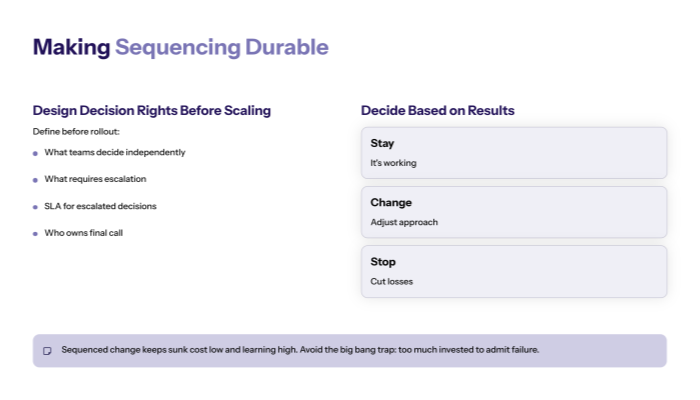
5.1 Design decision rights before you scale change
Sequencing fails when escalation overwhelms leadership.
RAPID’s Decision Inventory is designed to identify decisions that drive outcomes, assign owners, link decisions to customer value, and prioritize them.
Before scaling a rollout, define:
- what decisions teams can make independently
- what requires escalation
- the SLA for escalated decisions
- who owns the final call
This prevents “governance collapse,” where big bang turns into a permission queue.
5.2 Decide based on results: stay, change, stop
Sequencing is only effective if you treat every increment as an experiment with measurable outcomes.
RAPID’s Decide discipline is explicit: evaluate results and decide to stay, change, or stop.
This is how you avoid the classic big bang trap:
- too much sunk cost to admit it failed
- leadership protects the narrative
- teams work around the system indefinitely
Sequenced change keeps sunk cost low and learning high.
Closing takeaway
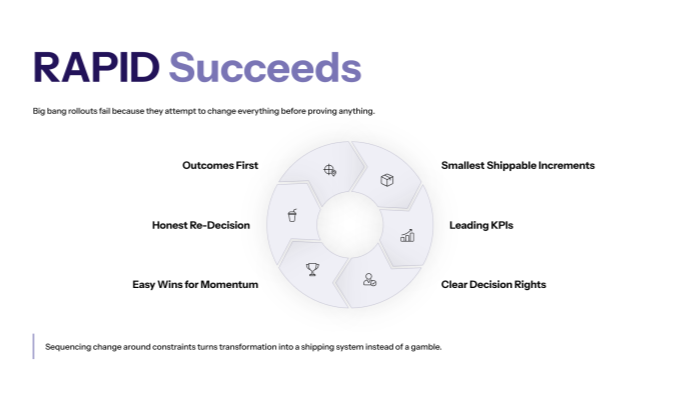
Big bang rollouts fail because they attempt to change everything before you’ve proven anything.
RAPID succeeds because it sequences change around constraints:
- outcomes first
- smallest shippable increments
- leading KPIs that reveal the bottleneck
- clear decision rights
- easy wins for momentum
- honest re-decision based on results