Software Development Consulting Services: Strategic Technology Execution for Enterprise Growth
Software development consulting services help organizations plan, design, and execute software initiatives with less risk, clearer governance, and measurable business value. For enterprise buyers, software development consulting is not just about adding software engineers to a project; it is a strategic partnership that connects business goals, software architecture, secure implementation, and long-term digital transformation.
This article is for executives, IT leaders, business leaders, and decision-makers evaluating software consulting services for roadmap planning, software modernization, digital transformation support, AI-driven automation, or execution governance. The focus is mid-market and enterprise organizations, especially companies in regulated industries such as healthcare, financial services, logistics, ecommerce, media, and public sector environments where security, compliance, scalability, and operational continuity matter.
Software development consulting services combine strategic planning, technical expertise, and execution governance to modernize existing systems while reducing operational risk. A qualified software consulting company assesses current software systems, identifies areas for improvement, develops tailored software solutions, and guides the development process so software development projects are executed efficiently, on time, and within budget.
Key outcomes buyers should expect include:
Improved workflow efficiency across business processes and employee experiences
Reduced technical debt through software modernization and architecture improvement
Enhanced security posture through secure coding practices and compliance controls
Measurable results tied to ROI, cost efficiency, customer satisfaction, and business outcomes
Faster time-to-market by accelerating development speed using proven frameworks and best practices
Only about 30% of companies navigate a digital transformation successfully, highlighting the challenges organizations face in adapting to new technologies and market demands. Successful digital transformations are incremental, cost-effective, and sustainable, with clear focus on outcomes such as new products, new features, improved processes, and greater efficiency. Digital transformation strategies should be closely tied to business outcomes and goals so technology investments deliver measurable business value rather than isolated software activity.
Understanding Software Development Consulting Services
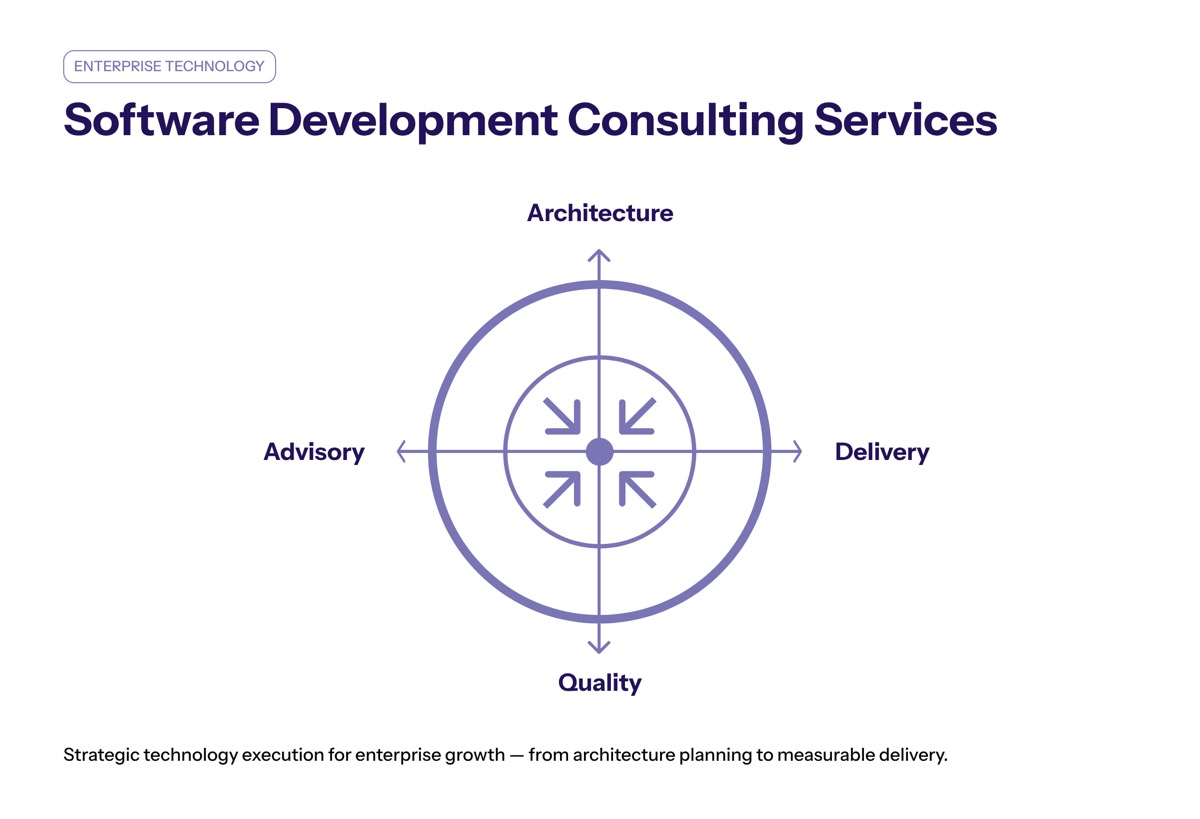
Software development consulting involves providing expert advice and support to organizations looking to develop or improve their software systems, ensuring that projects are executed efficiently, on time, and within budget. The best software development consultants bridge the gap between business goals and technical execution by translating business requirements into the right technologies, software architecture, governance model, and implementation plan.
Traditional outsourcing usually focuses on delivering predefined tasks. Strategic software consulting goes further: software consultants assess existing systems, validate the business case, identify technical risks, recommend the right solution, and guide project management throughout the software development life cycle. This distinction matters because approximately 70% of software projects fail, often due to outdated systems and lack of modernization efforts.
Organizations undergoing digital transformation must assess their current state, including people, technology, data, culture, leadership, and governance, to identify areas for improvement. That assessment gives business stakeholders, technical experts, and digital transformation consultants a shared view of constraints, dependencies, and success factors before major investment begins.
Strategic Planning and Roadmap Development
Strategic planning aligns software choices with long-term business goals. In a consulting engagement, roadmap planning begins with a structured review of business needs, software needs, business processes, existing systems, operational bottlenecks, data quality, security exposure, and the current tech stack.
A software stack assessment helps determine whether the organization’s programming languages, frameworks, infrastructure, integrations, and cloud computing environment can support the business model as the business grows. Technology audits include reviewing existing code to find bugs and performance bottlenecks, while unbiased feedback provides objective, third-party perspectives on internal tech problems that internal teams may be too close to see clearly.
A practical roadmap should define implementation priorities, expected business value, modernization phases, compliance requirements, and ROI targets. For example, enterprises often evaluate whether to refactor a monolith, wrap legacy functions with APIs, replace a specific software product, or build new software for emerging digital capabilities. The roadmap should also clarify whether the business wants to cut costs, improve customer experience, increase market share, launch new business models, or create a competitive edge through new technologies.
Technical Architecture and Design
Architecture design involves building the structural blueprint for secure, scalable systems. Strong software architecture defines how applications, services, APIs, data platforms, cloud infrastructure, security layers, and user-facing interfaces work together to support the business.
Software architecture assessments help identify flaws in existing systems that affect performance and security, enabling organizations to redesign their architecture for improved scalability and resilience. A thorough software architecture assessment provides documentation that allows businesses to scale and adapt their software solutions long after initial development is complete. Conducting a software architecture assessment can reveal opportunities for improvement in software systems, leading to enhanced workflows, higher-quality data, and better return on investment.
AI-first architecture is increasingly important for companies preparing for the next wave of digital technologies. AI-ready systems need reliable data pipelines, machine learning integration, data science workflows, model monitoring, governance, and privacy controls. For regulated environments, consultants should implement secure coding practices and build scalable architectures with encryption, audit trails, access control, data residency planning, and standards that comply with regulations like GDPR, HIPAA, or ISO.
Scalability also applies to delivery capacity. Scalability ensures that teams can quickly add or remove developers as project needs change, which helps control cost efficiency without forcing companies to hire full-time employees before demand is proven.
Execution Governance and Implementation
Execution governance turns strategy into controlled delivery. Software consultants play a crucial role in project management by overseeing the development process, coordinating with teams, managing timelines, and ensuring that the project meets its objectives and quality standards.
Structured frameworks such as RAPID help business stakeholders and technical teams make faster decisions, reduce delivery ambiguity, and manage risk. RAPID-style governance defines who recommends, approves, performs, provides input, and decides so the development team can move quickly without losing accountability.
Quality assurance, secure coding, compliance validation, and stakeholder communication should run throughout the software development life cycle, not only at the end. Communication transparency is vital for successful consulting engagements because clear communication helps bridge gaps between business leadership and technical teams. Transparent collaboration supports faster issue resolution, more accurate expectations, and better adoption after deployment.
Utilizing software development consulting services allows businesses to focus on their core operations while leveraging expert support for technological needs, ultimately leading to improved operational efficiency and competitive advantage.
Core Service Areas and Applications
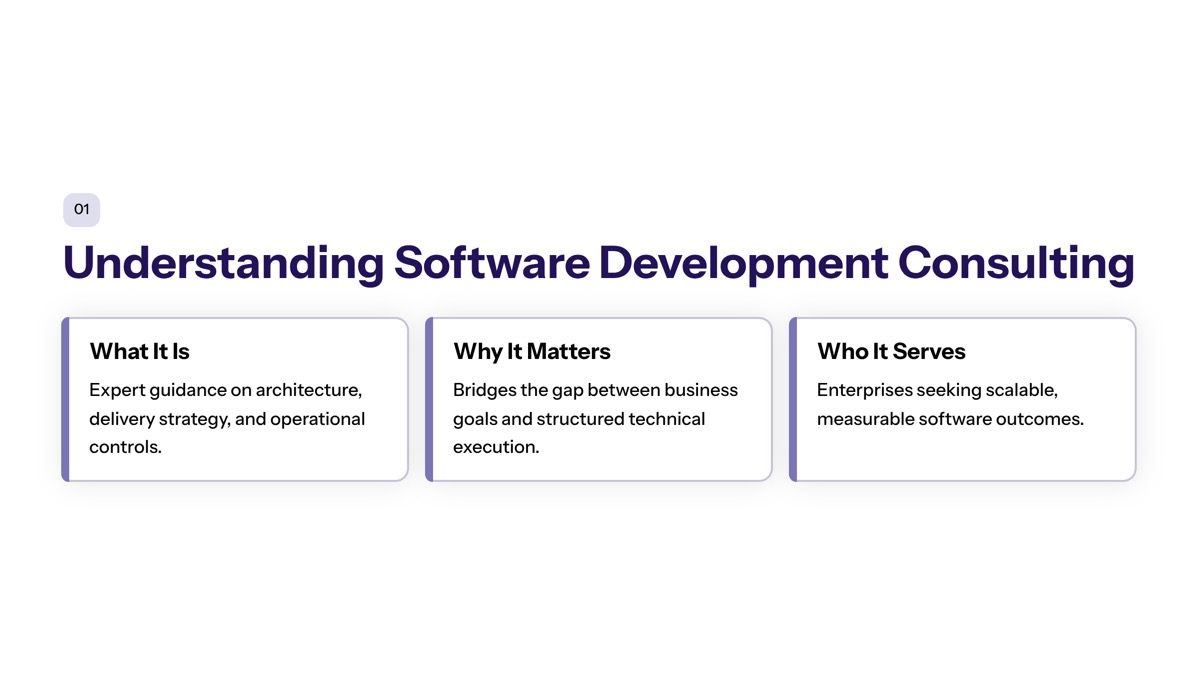
Software consulting services usually fall into several specialized service areas: legacy system modernization, AI-driven automation, and industry-specific platform development. Each domain requires deep expertise, domain knowledge, technical experts, and a tailored approach because the right solution depends on the organization’s business requirements, technology constraints, data environment, and regulatory exposure.
Domain knowledge is important for consultants to understand industry regulations, user workflows, security standards, and operational realities. Evaluating a provider’s industry-specific expertise is critical when choosing a consulting service because software companies without relevant domain experience may underestimate compliance, integration, or adoption requirements.
Legacy System Modernization
Legacy systems are often outdated, poorly documented, expensive to maintain, difficult to integrate, or unsupported by vendors. Software modernization involves updating legacy applications with newer programming languages, frameworks, and infrastructure to ensure long-term viability and efficiency.
Modernizing legacy software can significantly enhance performance, improve security, and increase scalability, allowing businesses to adapt to changing market demands. Modernization may include cloud migration, API integration, data migration, database redesign, user experience improvement, DevOps automation, or selective refactoring of high-risk modules.
The business case is strong when legacy platforms limit digital capabilities. Pegasystems and Savanta research cited in industry reporting found that enterprises lose about $370 million each year due to outdated technology, including about $134 million from legacy transformation projects, about $56 million per year for system maintenance, and about $58 million lost due to failed projects. In another example, a U.S. Department of Defense modernization of a COBOL mainframe system processed about 500,000 transactions per day and achieved estimated savings of about $25 million per year, including about $7.5 million per year in hosting savings.
Not every modernization requires a full rewrite. A consulting company may recommend wrapping stable legacy functions with APIs, using a strangler pattern to migrate incrementally, or replacing only the components that create security, performance, or scalability risk. This is where unbiased software consultants can prevent expensive technical mistakes in security, compliance, and scalability.
AI-Driven Automation Implementation
AI-driven automation begins with workflow analysis. Consultants identify repetitive manual tasks, approval bottlenecks, data entry work, compliance checks, customer support patterns, and operational processes where machine learning, rules engines, robotic process automation, or LLM-enabled tools can improve speed and accuracy.
Custom AI solution development should be grounded in existing systems and data quality. If contact data, transaction records, patient information, inventory data, or operational logs are fragmented across tools, AI initiatives may fail to produce reliable results. Digital transformation consulting should therefore include data architecture, data governance, model monitoring, access control, and seamless integration with core systems.
AI ambition is often ahead of infrastructure readiness. Industry research has reported that more than 85% of senior executives believe existing infrastructure will limit AI adoption, and 79% say their organizations will not retire even half of their technical debt over the next five years. This is why AI implementation strategy, software modernization, and architecture planning must be handled together rather than treated as separate consultancy services.
Industry-Specific Platform Development
Industry-specific platform development applies software development consulting to the operating realities of a particular market. A healthcare platform may require HIPAA compliance, secure patient data handling, PHI encryption, consent management, audit logs, FHIR or HL7 integrations, and privacy-first design. A financial services platform may require PCI-DSS, SOX, AML/KYC workflows, data residency, transaction security, and real-time risk controls.
Ecommerce and logistics systems often focus on supply chain optimization, inventory visibility, order tracking, shipping integrations, demand forecasting, secure payments, and scalability during peak demand. Media and streaming platforms require content delivery networks, performance engineering, rights management, DRM, low-latency streaming, user engagement features, and reliability under heavy traffic.
Across industries, the goal is not merely to design software or ship a software product. The goal is to create software solutions that support business processes, improve customer satisfaction, enable new business models, and strengthen the organization’s competitive edge.
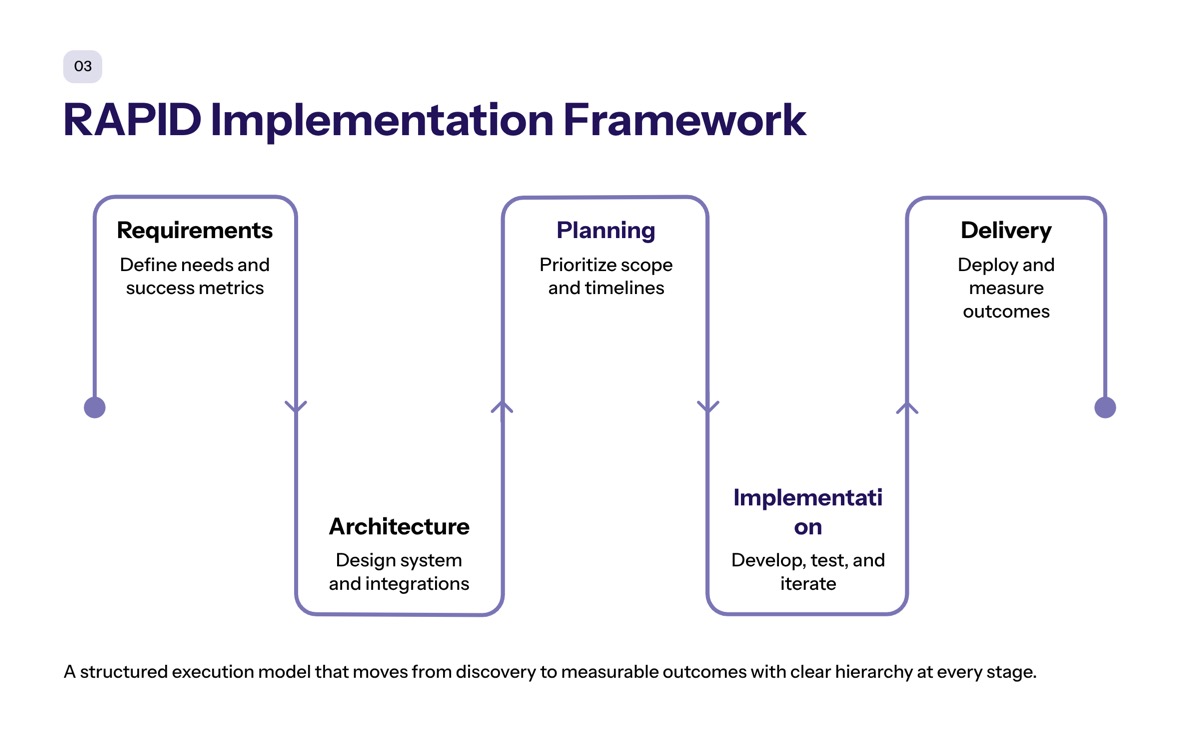
RAPID Implementation Framework and Process
RAPID is a structured approach for moving from business pressure to controlled implementation. In software development consulting, a RAPID-style framework helps companies avoid vague decision-making, ungoverned scope changes, weak accountability, and disconnected technical execution.
For buyers evaluating digital transformation services, RAPID is useful because it connects strategy, architecture, delivery, measurement, and optimization. Effective software development consulting can significantly enhance the quality and efficiency of software projects, helping businesses avoid common pitfalls and save time and money through expert guidance and strategic planning.
Assessment and Requirements Gathering
Assessment begins with current system analysis and business constraint identification. Consultants review existing systems, infrastructure, integrations, source code, data flows, workflows, user pain points, security requirements, and operational dependencies.
Stakeholder interviews and workflow documentation are critical. The interview process should include executives, business stakeholders, IT leaders, software engineers, end users, compliance teams, and operational managers. This creates a shared understanding of business requirements, user needs, constraints, and decision priorities.
Security, compliance, and governance requirements should be defined early. Security standards should comply with regulations like GDPR, HIPAA, or ISO when those standards apply. Risk mitigation helps avoid expensive technical mistakes in security, compliance, and scalability, especially when sensitive data, customer records, financial transactions, or regulated workflows are involved.
ROI baseline establishment should include current costs, maintenance burden, downtime, release frequency, defect rates, infrastructure spend, support effort, customer experience issues, and cycle time. Faster time-to-market is attained by accelerating development speed using proven frameworks and best practices, but the baseline is what allows the organization to prove measurable results later.
Strategic Planning and Architecture Design
Strategic planning turns assessment findings into a technology roadmap. The roadmap should define implementation priorities, modernization sequence, dependencies, resource needs, integration requirements, and expected outcomes.
System architecture design should support scalability and security. Consultants should implement secure coding practices and build scalable architectures so the solution remains viable as users, data, integrations, and transaction volume grow. Architecture planning should also consider cloud computing, DevOps practices, observability, infrastructure as code, API design, data pipelines, and future AI or automation needs.
Integration planning with existing tools and workflows is essential for seamless integration. Many enterprises operate ERP, CRM, home-grown tools, data warehouses, reporting systems, and manual processes that cannot be disrupted all at once. A phased roadmap can reduce downtime, protect embedded business logic, and allow the business to keep operating during modernization.
Pricing structure should also be clarified during planning. Evaluating fixed-price contracts versus time-and-materials models is a key consideration in pricing structure. Contract clarity regarding Time and Materials (T&M) and Fixed-Price models is essential for project planning. The pricing models used by software consulting companies can significantly impact the success of custom software projects.
Pricing consideration | Time and Materials | Fixed Price |
|---|---|---|
Budget control | Time and Materials pricing models are based on hourly rates, which can lead to budget overruns if clients do not monitor hours worked closely. | Fixed Price contracts require detailed scope definitions upfront, which can limit flexibility and adaptability during the project, potentially leading to disputes over what is included in the price. |
Flexibility | Strong fit when requirements may evolve during discovery, modernization, or AI implementation. | Strong fit when scope is stable, requirements are detailed, and delivery risk is low. |
Governance need | Requires frequent reporting, burn-rate visibility, and milestone reviews. | Requires precise documentation, change-control rules, and acceptance criteria. |
Implementation and Deployment
Implementation should use a phased development approach with regular milestone reviews. Phased delivery reduces risk, supports stakeholder feedback, and allows teams to release value incrementally instead of waiting for one large launch.
Quality assurance and security testing should run throughout development. Consultants should validate performance, reliability, accessibility, integration behavior, regression risk, data protection, and compliance controls before deployment. Process optimization improves team workflows using Agile or DevOps methodologies, which can improve release frequency, defect management, and collaboration.
User training and change management support are necessary because successful digital transformation depends on adoption. Employees need to understand why workflows are changing, how new tools affect daily work, and how the new software supports business outcomes. Clear communication, shared dashboards, and executive sponsorship help reduce resistance.
Go-live support and post-deployment monitoring should include rollback plans, observability, incident response, performance tracking, and user support. UST reported a modernization case in which two monolithic applications were refactored into microservices in 16 weeks, release cycles became 65% faster, and savings reached $1.2 million over three years. A public sector modernization case reported 85% faster response time, annual savings of about $72,000, 40% infrastructure cost reduction, deployment time reduced from weeks to minutes, and vulnerability reduction of about 97%.
Measurement and Optimization
Measurement confirms whether the software project produced the intended business outcomes. Performance monitoring should compare results against established KPIs and ROI metrics such as uptime, latency, cost reduction, release frequency, defect rate, cycle time, user adoption, customer satisfaction, and operational efficiency.
User feedback collection helps consultants optimize workflows, refine new features, and address usability issues that were not visible during design. Optimization is not a final cleanup step; it is how consulting services convert software delivery into sustained business value.
Ongoing support and maintenance planning should address security updates, dependency management, compliance changes, incident handling, cloud cost optimization, and future capacity needs. ACI Infotech reported a global packaging company modernization that reduced order-to-invoice cycle time by 67%, improved system availability to about 99.97%, and generated $1.8 million in annual operational cost savings. MSCI finance modernization reported 65% faster month-end close, 30% better data accuracy, and $2.3 million in annual savings.
A future enhancement roadmap should identify the next wave of software capabilities: additional automation, AI features, analytics, customer-facing digital capabilities, new products, or platform extensions. This keeps modernization tied to business growth rather than one-time technical cleanup.
Common Challenges and Solutions
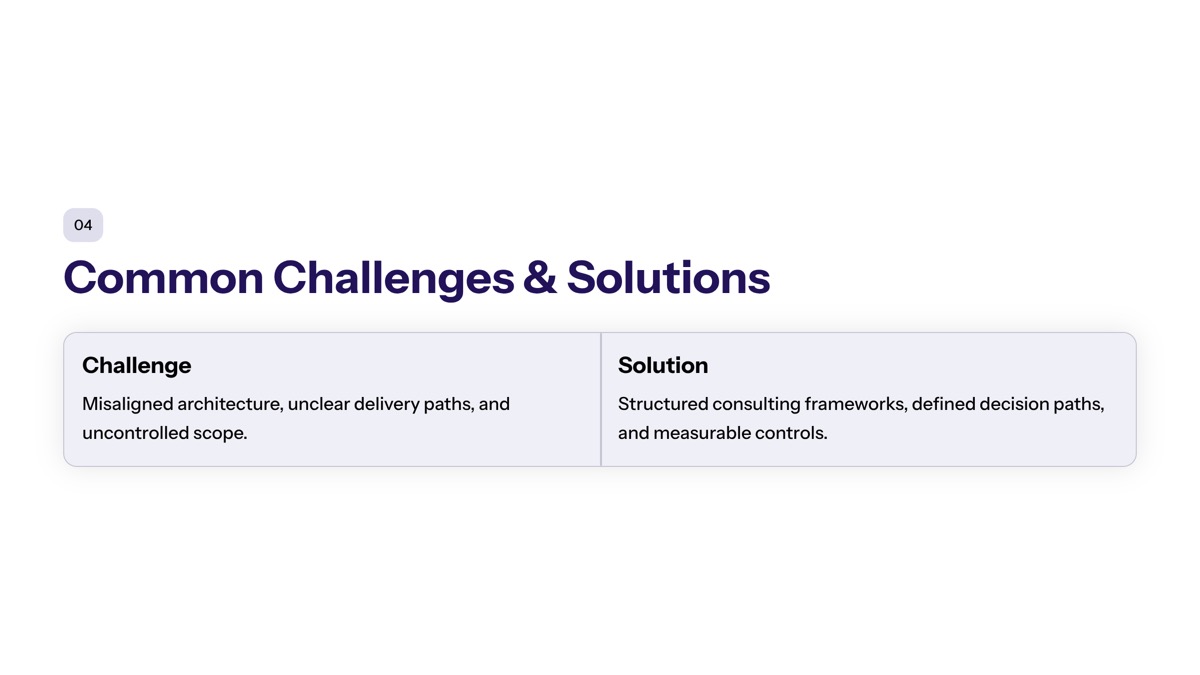
Enterprise software development projects face recurring risks: changing requirements, hidden legacy dependencies, compliance pressure, stakeholder misalignment, weak project management, and unclear pricing. The right software development consulting partner helps companies anticipate these risks before they become expensive failures.
Choosing the right software development consulting partner requires balancing technical capability and cultural alignment. Technical expertise includes verifying experience in the specific tech stack, while technology stack proficiency is necessary for effective project execution. Consultants should have proven case studies to demonstrate their ability to deliver results timely, and IP ownership verification ensures that clients retain all software source code rights.
Scope Creep and Requirements Changes
Scope creep happens when new requirements, undocumented workflows, or additional stakeholder demands expand the software project beyond the original plan. This risk is common in modernization because old systems often contain business logic that no one has fully documented.
The solution is structured change management with clear approval workflows, defined project boundaries, and communication protocols from the project start. Iterative development with regular stakeholder reviews and feedback loops allows teams to adapt without losing control over budget, timeline, or quality.
Clear pricing governance also matters. Fixed Price contracts need detailed scope definitions upfront, while T&M contracts need transparent hour tracking, milestone reporting, and active budget monitoring. Both models can work when the contract structure matches the uncertainty level of the work.
Legacy System Integration Complexity
Legacy integration is difficult because existing systems may contain brittle connections, inconsistent data formats, undocumented dependencies, unsupported programming languages, and security gaps. Business-critical rules may be embedded in code written decades ago.
The solution is a thorough system assessment and detailed integration mapping before implementation. Consultants should use technology audits, dependency analysis, architecture reviews, API planning, test harnesses, and phased migration strategies to minimize operational disruption.
Robust testing and rollback procedures are essential for safe deployment. Modernization success often comes from incremental change rather than full replacement. For example, a financial services modernization by Tech Mahindra reported a 40% reduction in Total Cost of Ownership after workflows were modernized and customer service improved.
Security and Compliance Requirements
Security and compliance cannot be added after the development process without cost and risk. Regulated industries need encryption, access control, audit trails, secure coding, privacy controls, data residency planning, and governance.
The solution is to engage compliance and legal teams early in the planning process. Security-first architecture should include appropriate governance controls, threat modeling, identity and access management, logging, vulnerability management, and secure deployment practices.
Regular security audits and compliance validation should continue throughout development. Consultants with domain knowledge can help organizations meet GDPR, HIPAA, ISO, PCI-DSS, SOC2, FedRAMP, or other applicable frameworks while still delivering useful software solutions.
Stakeholder Alignment and Communication
Stakeholder misalignment occurs when executives, business units, IT teams, compliance leaders, and users have different definitions of success. Misalignment can delay approvals, create rework, and reduce adoption.
The solution is to establish clear communication channels and regular status reporting. Shared project dashboards improve transparency and accountability by showing milestones, risks, decisions, budget status, and KPI progress.
Structured decision-making processes with defined roles and responsibilities help consulting engagements move faster. Transparent collaboration helps bridge gaps between business leadership and technical teams, while communication transparency is vital for successful consulting engagements.
Conclusion and Next Steps
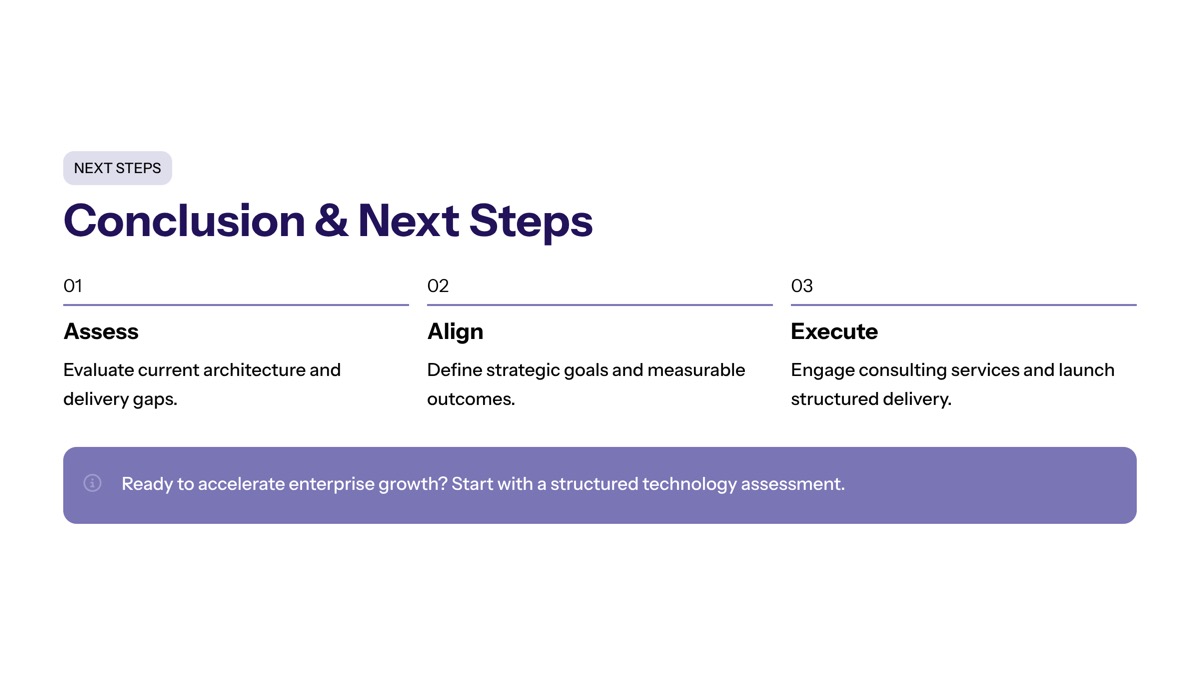
Software development consulting services help enterprises convert technology pressure into controlled execution. The strategic value comes from combining roadmap planning, software architecture, secure implementation, software modernization, project management, and measurable ROI into one governed development process.
Immediate next steps:
Assess current systems, including people, technology, data, culture, leadership, and governance.
Identify modernization priorities based on risk, cost, business value, customer experience, and time-to-market.
Conduct stakeholder alignment sessions with executives, IT, users, compliance, and operational leaders.
Establish success metrics before delivery begins, including cost, quality, speed, security, adoption, and business outcomes.
Evaluate software development consultants based on industry expertise, technical capability, cultural fit, case studies, communication transparency, pricing model clarity, and IP ownership terms.
For buyers evaluating digital transformation services, the strongest consulting partners are not just software companies that write code. The strongest partners provide digital expertise, strategic planning, architecture discipline, secure development, execution governance, and measurable results that support long-term business goals.
Related topics worth exploring include AI implementation strategy, digital transformation planning, technology ROI measurement, software architecture assessment, cloud modernization, and enterprise change management.
Additional Resources
Use these resources and evaluation areas when comparing software consulting services:
Industry-specific compliance requirements and security frameworks: GDPR, HIPAA, ISO, PCI-DSS, SOC2, FedRAMP, NIST, data residency rules, audit logging, and secure access management.
Technology assessment tools and modernization checklists: software stack assessment, code review, dependency mapping, cloud readiness assessment, architecture review, security audit, and data quality review.
ROI calculation templates for software development projects: current maintenance cost, infrastructure spend, defect cost, downtime cost, release cycle time, customer satisfaction impact, productivity gains, and payback period.
Change management best practices for enterprise technology implementations: stakeholder mapping, communication planning, user training, adoption tracking, executive sponsorship, and feedback loops.
Consulting partner selection criteria: verified domain knowledge, proven case studies, technical expertise in the specific tech stack, scalable delivery capacity, clear project management model, transparent pricing, secure coding practices, and source code ownership terms.