Stakeholder Interviews That Reveal the Real Work (Not the Org Chart)
Most digital transformations don’t fail because the strategy was “wrong.” They fail because leadership is operating off an org chart narrative—while the real work happens through invisible handoffs, informal decision paths, shadow processes, and fear-based workarounds.
RAPID’s starting point is the opposite: a brutally honest assessment (“the audit”) that pops the internal bubble and forces everyone to see things as they are, not as they’d like them to be. And RAPID is explicit that research isn’t just paperwork—it requires discussing the situation with the parties involved.
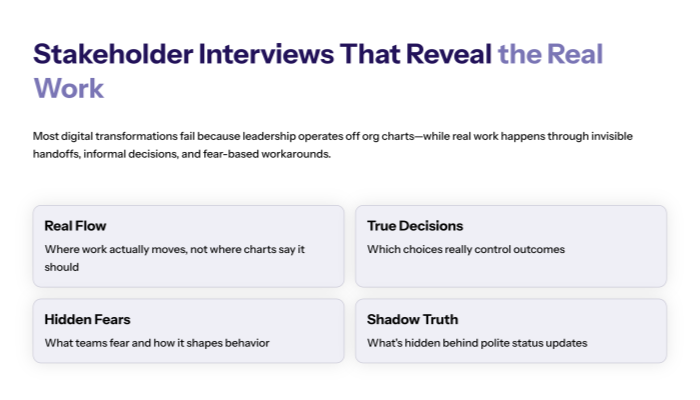
That’s why stakeholder interviews matter. Done well, they surface:
- where work actually flows (not where the org chart says it should)
- which decisions really control outcomes
- what teams fear (and how fear shapes behavior)
- what’s being hidden behind polite status updates
Below is a practical RAPID-aligned guide to stakeholder interviews that expose the real operating system—fast, respectfully, and with decision-grade outputs.

Why the Org Chart Lies? (and Interviews Tell the Truth)
1.1 “Paper reality” vs. “execution reality”
In most organizations, there are two systems running at the same time:
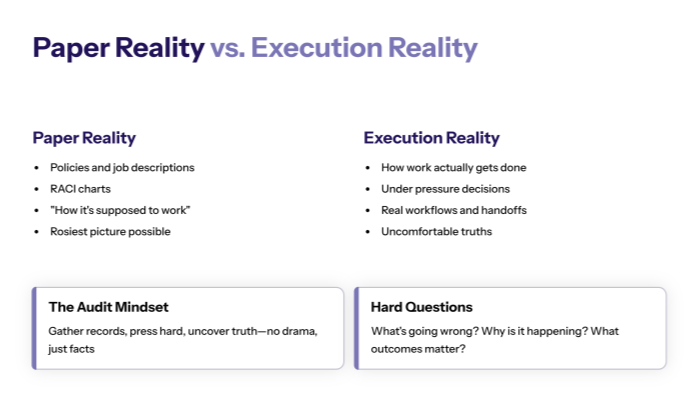
- Paper reality: policies, job descriptions, RACI charts, and “how it’s supposed to work.”
- Execution reality: how people actually get work done under pressure.
RAPID frames this as the need to “pop the bubble” by using an objective process grounded in facts. That bubble is built from partial truths: people avoid hard questions because those questions force uncomfortable realities.
Stakeholder interviews are how you get from paper reality to execution reality—without waiting for a six-month discovery effort.
1.2 The audit mindset: hard questions, no drama
RAPID compares early-stage discovery to an IRS audit: you gather records, review them, and then press hard to get past misrepresentation—because leadership often paints the rosiest picture possible.
The goal isn’t to “catch people.” The goal is to uncover truth:
- What’s actually going wrong?
- Why is it happening?
- What outcomes are we really trying to achieve?
This is where stakeholder interviews become a transformation lever—not a “change management” ritual.
The RAPID Interview Approach (Respectful, Fast, Evidence-Driven)
2.1 One-on-ones first: trust beats politics
RAPID’s research approach includes one-on-one interviews and is explicit about how to run them: be present, avoid distractions, listen more than you talk, and pay attention to how things are said—not just what’s said.
RAPID also explains why: most people unintentionally reveal more than they mean through tone, language, and posture—and the interviewer’s job is to read what’s happening beneath the surface.
Practical rules for RAPID-style stakeholder interviews:
- No phone checking. Presence is the trust signal.
- You don’t dominate airtime. Your job is to listen, process, observe.
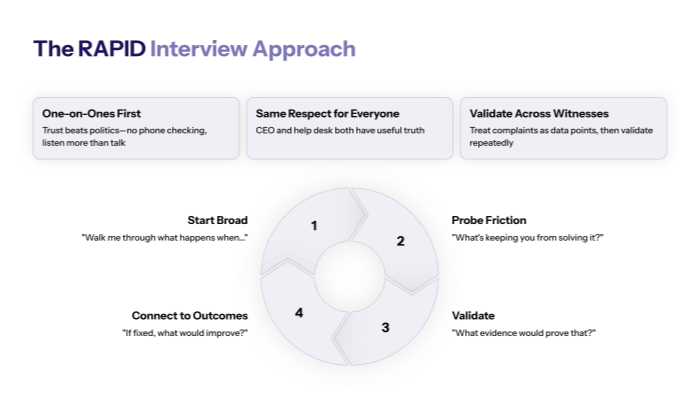
- Same respect for everyone. CEO and help desk both have useful truth.
- Validate across witnesses. Treat complaints as data points, then validate repeatedly.
That last point matters: people will blame “that team over there.” RAPID treats those statements with a grain of salt and redirects toward concrete factors: resources, tools, processes, constraints.
2.2 Use open-ended questions to unlock reality
RAPID emphasizes pushing past knee-jerk excuses toward reality. One of the simplest mechanics is question design: open-ended questions reduce defensiveness and uncover information.
Use this structure:
- Start broad: “Walk me through what happens when…”
- Then probe friction: “What’s keeping you from solving it?”
- Then validate: “What evidence would prove that?”
- Then connect to outcomes: “If this were fixed, what would improve?”
This keeps stakeholder interviews grounded in operational truth instead of opinions.
Interview What Matters (Outcomes, Decisions, Friction, Fear)
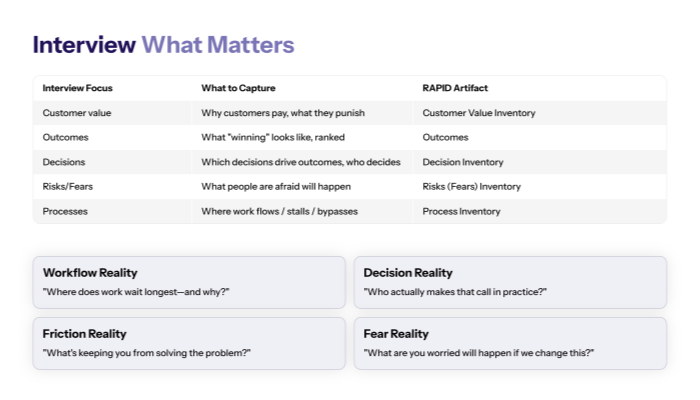
3.1 Map interviews to RAPID’s inventories (so it doesn’t become “notes”)
RAPID’s tools are designed to make research actionable: Customer Value, Outcomes, Decision Inventory, Risks (Fears), Process Inventory, and more. Stakeholder interviews should feed these inventories directly—so your output isn’t a transcript, it’s a transformation dataset.
Here’s a clean interview capture table you can use:
|
Interview focus |
What to capture |
RAPID artifact it feeds |
|---|---|---|
|
Customer value |
Why customers pay, what they punish |
Customer Value Inventory |
|
Outcomes |
What “winning” looks like, ranked |
Outcomes |
|
Decisions |
Which decisions drive outcomes, who decides |
Decision Inventory |
|
Risks/Fears |
What people are afraid will happen |
Risks (Fears) Inventory |
|
Processes |
Where work flows / stalls / bypasses |
Process Inventory |
RAPID’s Decision Inventory is especially useful because it forces specificity: decisions are posed as questions, mapped to outcomes and customer value, and assigned to an owner.
3.2 The “real work” question bank (executive-ready)
Use these questions to reveal the operating system behind the org chart:
A) Workflow reality
- “Walk me through the last time this went well. What happened end-to-end?”
- “Where does work wait the longest—and why?”
- “Which steps exist only because someone doesn’t trust the previous step?”
B) Decision reality
- “What decision has to happen for work to move?”
- “Who actually makes that call in practice?” (not “who should”)
- “When decisions stall, what’s the most common reason?”
- “What decisions get escalated that shouldn’t?”
C) Friction reality
- “What’s keeping you from solving the problem?”
- “If I fixed one thing for you next week, what would unblock the most?”
D) Fear reality (this is the hidden layer)
RAPID notes that after one-on-ones, people often ask what they fear might happen (office closure, layoffs, budgets). Being as honest and forthright as possible builds trust.
Ask:
- “What are you worried will happen if we change this?”
- “What are you worried will happen if we don’t change this?”
- “What would make this effort feel unsafe for your team?”
Fear is not a soft topic in RAPID—it’s fuel you turn into data so you can move forward.
Synthesize Without Politics (Validate, Pattern-Match, Decide)
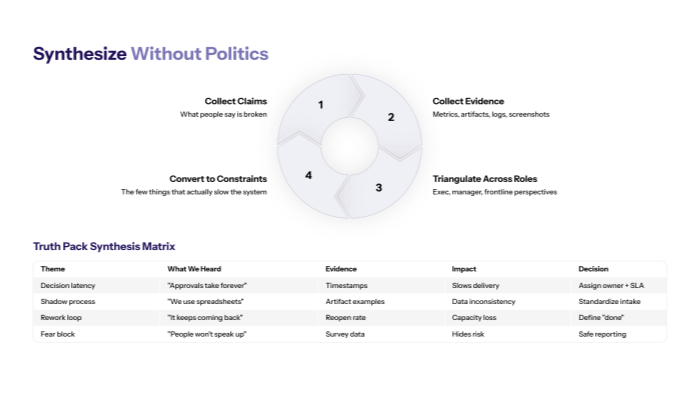
4.1 Validate like a detective, not a diplomat
RAPID explicitly describes the validation mindset: like a cop interviewing witnesses, gather testimony, then validate repeatedly.
A practical approach:
- Collect claims (what people say is broken)
- Collect evidence (metrics, artifacts, emails, queue screenshots, handoff logs)
- Triangulate across roles (exec, manager, frontline)
- Convert into constraints (the few things that actually slow the system)
This protects you from the two classic failure modes of stakeholder interviews:
- political narratives (“that team is incompetent”)
- executive optimism (“we’re doing fine”)
RAPID’s audit chapter highlights that most people want to talk about symptoms, not disease—your job is to cut to the chase and get to what’s really going on.
4.2 Turn interview insights into a decision-grade “Truth Pack”
Your stakeholder interviews should end with outputs that leadership can act on immediately.
Use this synthesis matrix:
|
Theme |
What we heard |
Evidence to confirm |
Impact on outcomes |
Decision needed |
|---|---|---|---|---|
|
Decision latency |
“Approvals take forever” |
approval timestamps |
slows delivery |
assign owner + SLA |
|
Shadow process |
“We do it in spreadsheets” |
artifact examples |
data inconsistency |
standardize intake |
|
Rework loop |
“It keeps coming back” |
reopen rate |
capacity loss |
define “done” criteria |
|
Fear block |
“People won’t speak up” |
survey + language |
hides risk |
create safe reporting |
Then load the “Decision needed” column into RAPID’s Decision Inventory format (decision as a question + owner + linked outcome + customer value).
This is how stakeholder interviews stop being “qualitative feedback” and become operating model governance.
The 10-Day Stakeholder Interview Sprint (RAPID-Style)
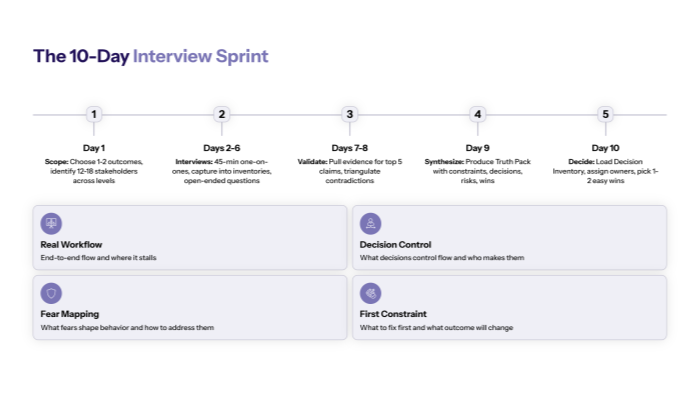
5.1 A simple plan you can run without disrupting the business
RAPID’s flywheel logic (Research ↔ Analyze) is designed to work quickly with urgency and iteration. Your interview sprint should match that spirit.
Day 1 — Scope
- Choose 1–2 outcomes you care about (speed, quality, retention, margin).
- Identify 12–18 stakeholders across levels (exec, middle management, frontline, customer-facing).
Days 2–6 — Interviews (45 minutes each)
- Run one-on-ones.
- Capture into inventories (value, outcomes, decisions, fears, process).
- Keep questions open-ended to reduce defensiveness.
Days 7–8 — Validate
- Pull evidence for the top 5 claims.
- Triangulate contradictions (don’t average them—explain them).
Day 9 — Synthesize
- Produce the “Truth Pack”: top constraints, top decisions, top risks/fears, top easy wins.
Day 10 — Decide
- Load decisions into the Decision Inventory and assign owners.
- Pick 1–2 easy wins and one structural fix (decision rights, intake standards, removal of a redundant approval).
5.2 The quality bar: How to know interviews worked?
Your stakeholder interviews worked if you can answer these questions in plain language:
- What is the real workflow (end-to-end) and where does it stall?
- What decisions control flow—and who actually makes them today?
- What fears are shaping behavior (and how will we remove emotion by turning fear into data)?
- What is the first constraint we will fix—and what measurable outcome will change?
If you can answer those, you’ve revealed the real work—not the org chart.
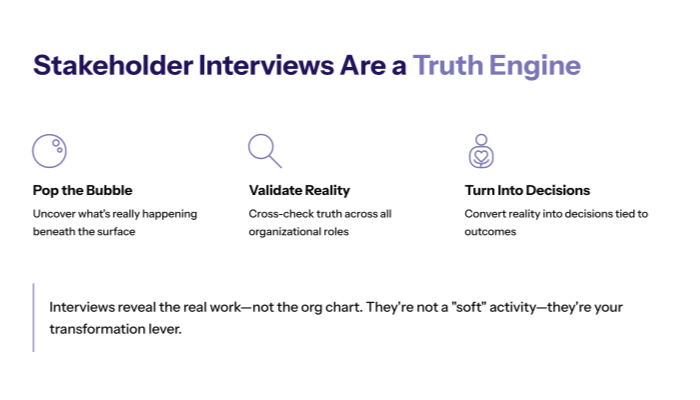
Bottom line
Stakeholder interviews are not a “soft” activity. In RAPID, they’re a truth engine.