
Tech Debt vs. Process Debt: Which One Is Slowing You Down?
When a transformation program starts slipping, the default diagnosis is predictable:
“We have too much tech debt.”
Sometimes that’s true. But just as often, the real constraint is process debt—broken handoffs, unclear definitions, approval chains, rework loops, and “work about work” that quietly destroys throughput.
The hard part isn’t choosing a side. The hard part is identifying which debt is actually setting the pace of the system—because that’s the only one that matters right now.
This is where RAPID’s Analyze phase is useful: it filters what’s relevant, surfaces what’s beneath the surface, and turns observations into prioritized constraints that you can execute against.
In this guide, we’ll break down tech debt vs process debt, how to tell the difference, and how to fix the true bottleneck without falling into “silver bullet platform” thinking.

Why teams confuse tech debt vs process debt?
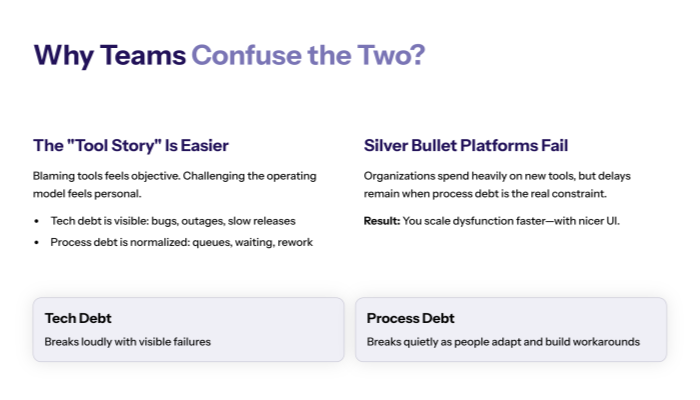
1.1 The “tool story” is easier than the “system story”
It’s emotionally and politically easier to blame tools than to challenge the operating model. “The platform is outdated” feels objective. “Our approval chain is broken” feels personal.
RAPID’s approach is built to break the bubble and replace narratives with facts: irrelevant noise gets removed, and the issues that consistently block outcomes become visible.
That’s why the tech debt vs process debt debate is often misframed:
- Tech debt is visible (bugs, outages, slow releases).
- Process debt is normalized (queues, waiting, rework, escalation).
If you don’t measure both, you’ll default to the most visible story—not the most constraining truth.
1.2 “Silver bullet platforms” don’t pay off when the real debt is process
RAPID warns directly against the “silver bullet platform” mentality: organizations spend heavily on new tools believing the tool will fix everything, but fail because they didn’t do the people/process/product work first.
This is the classic trap:
- You upgrade software.
- The same delays remain.
- The same bottlenecks move around.
- People adopt workarounds again.
If process debt is the constraint, you’ll scale dysfunction faster—with nicer UI.
Define tech debt vs process debt (the decision-grade definitions)
2.1 What “tech debt” really means (in transformation terms)
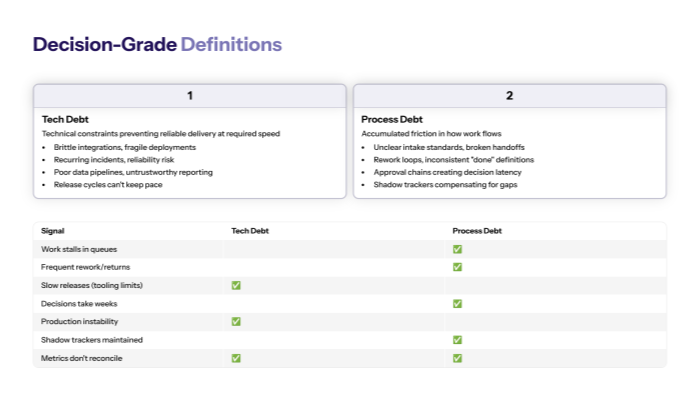
Tech debt isn’t “old code.” Tech debt is any technical constraint that prevents the organization from delivering outcomes reliably at the speed required.
Common tech-debt signals:
- brittle integrations or fragile deployments
- recurring incidents and reliability risk
- poor data pipelines that make reporting untrustworthy
- release cycles that can’t keep up with demand
In RAPID terms, these issues matter when they block outcomes and customer value—because the method anchors execution to measurable outcomes, not opinions.
2.2 What “process debt” really means (and why it’s usually the hidden bottleneck)
Process debt is accumulated friction in how work flows:
- unclear intake standards
- broken handoffs
- rework loops and inconsistent definitions of “done”
- approval chains that create decision latency
- compliance steps that are not right-sized to risk
RAPID’s “beneath the surface” framing is important here: process debt becomes invisible because people adapt. They build shadow work. They “just know” who to message. They maintain spreadsheets to compensate for system gaps.
So when you’re deciding tech debt vs process debt, remember: tech debt breaks loudly; process debt breaks quietly.
Tech debt vs process debt signals
|
Signal |
More likely tech debt |
More likely process debt |
|---|---|---|
|
Work stalls in queues |
|
✅ |
|
Frequent rework / returns |
|
✅ |
|
Releases are slow due to tooling limits |
✅ |
|
|
Decisions take weeks (approval chain) |
|
✅ |
|
Production instability / outages |
✅ |
|
|
Teams maintain shadow trackers |
|
✅ |
|
Metrics don’t reconcile / data distrust |
✅ (pipeline) |
✅ (definitions/ownership) |
How RAPID identifies whether tech debt vs process debt is the constraint?
3.1 Use the Analyze lens: relevant vs irrelevant (with human factors intact)
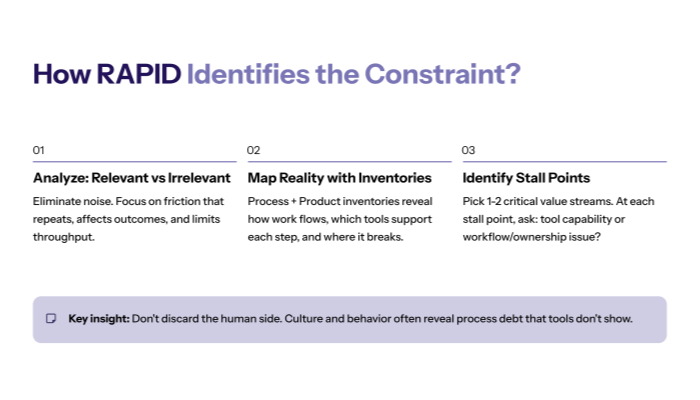
RAPID is explicit that Analyze starts by sorting information into relevant and irrelevant—eliminating noise that wastes time and resources.
For tech debt vs process debt, “relevant” means:
- the friction repeats
- it affects outcomes
- it limits throughput or quality
- it shows up across multiple stakeholders
But RAPID also warns: you can’t discard the human side. You must understand who does what, how they do it, and the cultural commitment behind it—because culture and behavior often reveal process debt that tools don’t show.
3.2 Map reality using Process + Product inventories (don’t guess)
To decide tech debt vs process debt, you need a shared view of:
- how work actually flows
- which tools/products support each step
- where it breaks, loops, or waits
RAPID’s Process Inventory is designed to discover and describe processes starting from outcomes and customer value—focusing on what drives the majority of effort.
Pair that with the Product/Tool view (what tools support delivery) and you get a decision-grade map instead of anecdotes.
A practical move:
- Pick 1–2 critical value streams (the ones tied to near-term outcomes).
- Map end-to-end flow and identify “stall points.”
- At each stall point, ask: is the constraint caused by tool capability (tech debt) or workflow/ownership/standards (process debt)?
Fix the true debt (gap analysis + decision ownership)
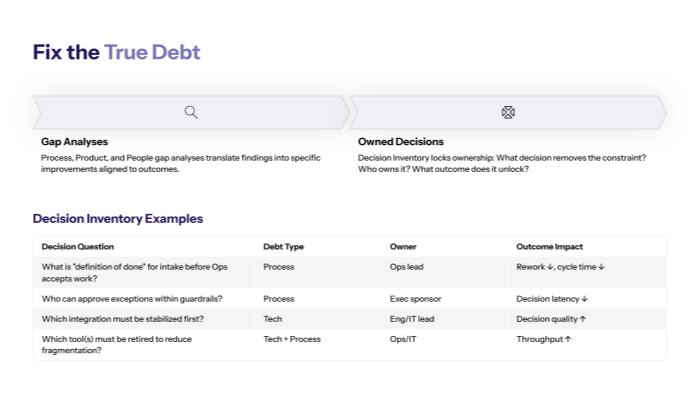
4.1 Use gap analyses to make the fix specific
Once you’ve identified whether tech debt vs process debt is setting the pace, RAPID gives you the conversion mechanism: gap analyses.
- Process Gap Analysis translates findings into specific process improvements aligned to outcomes and customer value.
- Product Gap Analysis translates findings into specific product/tool improvements aligned to outcomes and customer value.
- People Gap Analysis identifies capability constraints and risk factors like skill concentration.
This is where transformation gets real:
- If process debt is the constraint, standardize interfaces (intake, definitions, handoffs, acceptance criteria).
- If tech debt is the constraint, simplify and stabilize the minimal technical capabilities needed for flow and trust.
4.2 Turn constraints into owned decisions (or nothing moves)
Even perfect analysis stalls without decisions. RAPID emphasizes that decision-making is central, and that decisions create momentum—if a decision never gets made, the outcome never happens.
Use the Decision Inventory to lock ownership:
- What decision removes the constraint?
- Who owns it?
- What outcome does it unlock?
- What minimum data is required to decide?
RAPID’s Decision Inventory structure (decisions posed as questions, assigned owners, linked to outcomes and customer value, prioritized) is built for this exact moment.
Decision inventory examples for tech debt vs process debt
|
Decision question |
Debt type |
Owner |
Outcome impact |
|---|---|---|---|
|
What is the “definition of done” for intake before Ops accepts work? |
process debt |
Ops lead |
rework ↓, cycle time ↓ |
|
Who can approve exceptions within guardrails (and within what SLA)? |
process debt |
Exec sponsor |
decision latency ↓ |
|
Which integration must be stabilized first to restore reporting trust? |
tech debt |
Eng/IT lead |
decision quality ↑ |
|
Which tool(s) must be retired to reduce fragmentation and duplication? |
tech + process |
Ops/IT |
throughput ↑ |
Prevent recurrence (keep it simple, iterate, and measure honestly)
5.1 “If tech is involved, keep it simple”
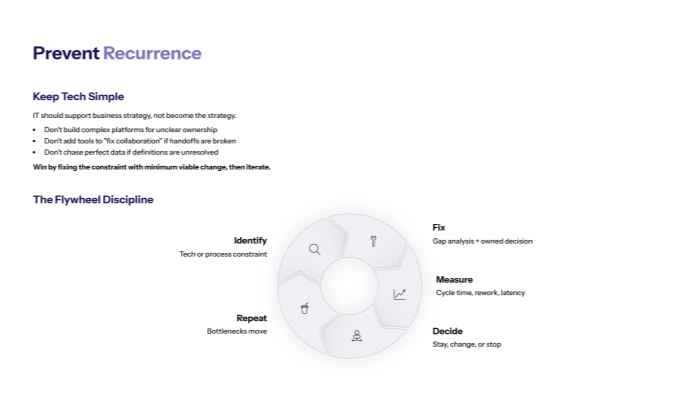
RAPID’s guidance is direct: if technology is involved, keep it simple—IT should support business strategy, not become the strategy.
This is critical in tech debt vs process debt decisions:
- Don’t build a complex platform to compensate for unclear ownership.
- Don’t introduce more tools to “fix collaboration” if handoffs are broken.
- Don’t chase perfect data warehouses if definitions and decision rights are unresolved.
Most teams win by fixing the constraint with the minimum viable change, then iterating.
5.2 Use the flywheel discipline: fix → measure → decide → repeat
RAPID is structured as iterative flywheels: Research/Analyze feeds Plan/Implement/Decide, and results feed back into analysis.
That’s how you keep tech debt vs process debt from becoming a permanent argument. You treat it as a repeatable diagnostic loop:
- Identify the constraint (tech or process)
- Fix the constraint (gap analysis + owned decision)
- Measure impact (cycle time, rework, decision latency)
- Decide: stay, change, stop (based on reality)
- Repeat (because bottlenecks move)
And you avoid KPI theater by tying measurement to outcomes—not vanity narratives.
Closing takeaway
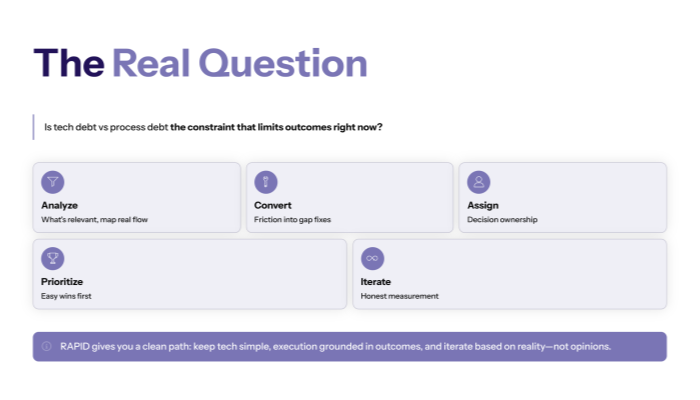
The real question isn’t whether you have tech debt or process debt.
The real question is whether tech debt vs process debt is the constraint that limits outcomes right now.
RAPID gives you a clean path: Analyze what’s relevant, map the real flow, convert friction into gap fixes, assign decision ownership, prioritize easy wins, and iterate with honest measurement—keeping tech simple and execution grounded in outcomes.